Tag: Netflix

  • Netflix to acquire virtual production studio Scanline VFX

    Netflix to acquire virtual production studio Scanline VFX

    Mumbai: Netflix has announced its plans to acquire virtual production studio Scanline VFX. The company is responsible for the visual effects in Netflix series like “Cowboy Bebop,” “Stranger Things,” and “Blood Red Sky.”

    The company expects to complete the acquisition by the end of first quarter 2022 subject to regulatory approvals. 

    Founded in 1989, Scanline is led by Stephan Trojansky, a VFX supervisor whose proprietary fluid rendering system ‘Flowline’ won an Academy Award for Technical Achievement in 2008. The company has offices in Vancouver, Montreal, Los Angeles, London, Munich, Stuttgart, and Seoul.

    The company is working on VFX effects for upcoming Netflix content including “Don’t Look Up,” “The Gray Man,” “Slumberland,” “The Adam Project,” and “Stranger Things 4.”

    “Netflix will invest in Scanline’s pipeline, infrastructure and workforce and continue to support the pioneering work that Scanline’s Eyeline Studios is doing in virtual production to push the boundaries of what is visibly possible,” said Netflix vice president of studio operations Amy Reinhard.

    Apart from Netflix content, Scanline has done ground-breaking work on series like “Game of Thrones” to films like “Godzilla vs Kong” and “Zack Snyder’s Justice League.” “Going forward, the company will continue to operate as a standalone business and work with their variety of clients,” said Reinhard.

    Netflix will continue to rely on other VFX studios around the world “to ensure that our creators have access to the world’s most innovative tech,” said Reinhard.

  • In a first, major OTT platforms to participate in IFFI

    In a first, major OTT platforms to participate in IFFI

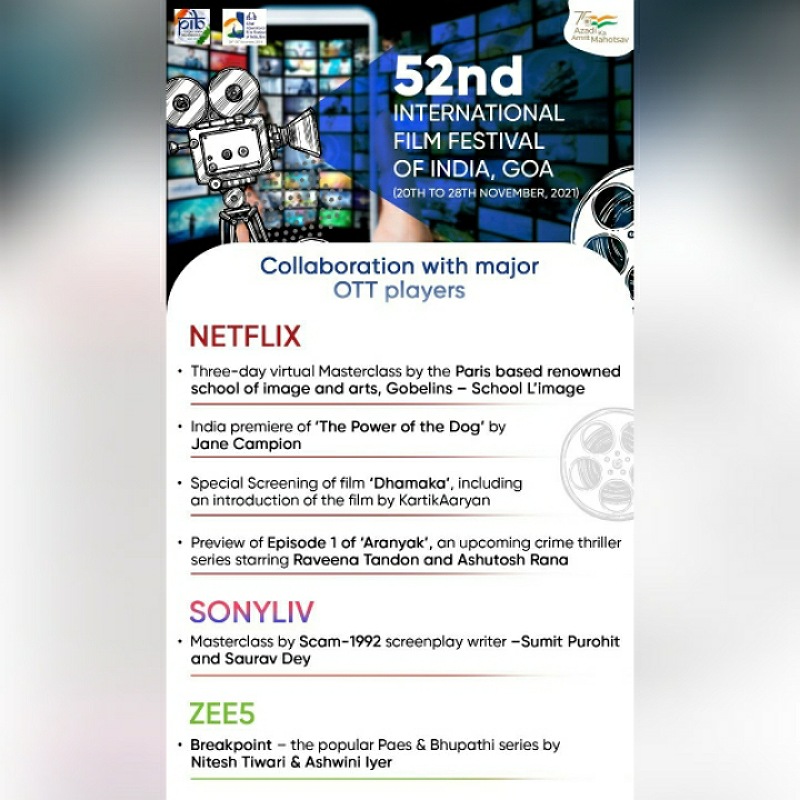
    Mumbai: The International Film Festival of India (IFFI) will see participation from major OTT platforms, for the first time in its history. Netflix, Amazon Prime Video, Zee5, SonyLIV, and Voot will participate at IFFI that is being held in Goa starting 20 November.

    The festival will offer exclusive masterclasses, content launches, previews, and much more. The 52nd edition of IFFI will be held in hybrid format considering the present Covid-19 situation.

    Netflix has organised a three-day virtual masterclass by the Paris-based renowned school of image and arts, Gobelins – School L’image. It facilitated the India premiere of the film “The Power Of The Dog” by Jane Campion, a special screening of the film “Dhamaka” including an introduction of the film by Karthik Aryan and a preview of the first episode of its upcoming crime thriller series “Aranyak” starring Raveena Tandon and Ashutosh Rana. SonyLIV is organising a masterclass by “Scam 1992” screenplay writers Sumit Purohit and Saurav Dey.

    The union minister of information and broadcasting Anurag Thakur announced that actor and member of parliament from Mathura Uttar Pradesh Hema Malini and lyricist and chairperson of Central Board of Film Certification (CBFC) Prasoon Joshi will be conferred the Indian film personality of the year award 2021 at the festival.

    IFFI will feature 148 films from about 73 countries in the international section. The festival will have about 12 world premieres, about 7 international premieres, 26 Asia premieres, and about 64 India premieres. IFFI received 624 films from 95 countries this time, up from 69 countries in the previous edition.

    Global cinematic giants Martin Scorsese and Istevan Szabo are being honoured with the first Satyajit Ray lifetime achievement award. They will not be attending the festival physically but their video messages conveying acceptance of the award will be played.

    The opening feature film of Indian Panorama 2021 is the film “Semkhor,” directed by Aimee Baruah. This is the first-ever film made in Dimasa (dialect from Assam) to be featured at IFFI. “The Visionary” (English) directed by Shri Rajiv Parkash is the opening non-feature film in the Indian Panorama section. “The King of all the World” (El Rey de Todo El Mundo) directed by Carlos Saura will be the opening film and this will also be the film’s international premiere. IFFI 52 will come to a close with the screening of Asghar Farhadi’s “A Hero,” which won the Grand Prix at the Cannes Film Festival.

    There will be about 18 specially curated films presented as part of the ongoing celebration of Azadi Ka Amrit Mahotsav. The festival director informed that the international jury chaired by the Iranian filmmaker Rakhshān Banietemad is coming to attend the festival. The BRICS Film Festival is being held on the sidelines of IFFI for the first time. There will be a special package presenting films from the five countries.

    The 52nd edition of IFFI is paying homage to the prominent Kannada film actor Puneet Rajkumar and iconic James Bond actor Sir Sean Connery.

    IFFI will open with a star-studded inaugural ceremony, featuring Salman Khan, Ranveer Singh, Riteish Deshmukh, Genelia Deshmukh, Shraddha Kapoor, amongst others. Karan Johar and Manish Paul will host the event.

  • Netflix to make mobile game titles available on App Store for iOS users: Reports

    Netflix to make mobile game titles available on App Store for iOS users: Reports

    Mumbai: Earlier this month, Netflix announced that it is making four mobile gaming titles available to Android OS subscribers worldwide. The company is working on an iOS version however Apple’s App Store policies may prevent it from making these games available via its app.

    App Store policies bar third-party apps from functioning as a centre for games. Netflix’s mobile games are currently available on Android via a dedicated tab on the Netflix app and users are only able to launch the games from within the app. These games have to be downloaded individually from the Google Play Store.

    According to a report by ANI, Netflix plans to skirt Apple’s policies by making its games available via the App Store. This means that the games won’t be downloadable or playable via the Netflix app. Users will only be able to launch them from there.  

    Other platforms such as Facebook have got around these policies by developing a web app for their games. Cloud gaming services such as Xbox Cloud Gaming, Nvidia Geforce Now, and Google Stadia have been unable to offer their games from within their apps.

  • Netflix is testing TikTok-inspired short clip feature for kids

    Netflix is testing TikTok-inspired short clip feature for kids

    Mumbai: Netflix Inc is testing out a TikTok-inspired ‘Kids Clips’ feature to attract younger viewers to its platform and help them discover programming.

    It will feature new short videos or ‘clips’ from the existing library of kids’ programs and movies on a daily basis on its current as well as future offerings. An added feature limiting access to only 10-20 clips at a time will also be introduced subsequently.

    The kids’ feed will resemble ‘Fast Laughs’ – the feature showing funny clips from different series, films and stand-up specials on Netflix that was introduced earlier this year. However, unlike vertically aligned videos on Fast Laughs, here they will be available for viewing horizontally.

    The Kids Clips feature will be piloted in markets like the US, Latin America, Canada, Australia, and Ireland this week.

  • Netflix launches its mobile games worldwide

    Netflix launches its mobile games worldwide

    Mumbai: Netflix has announced that it will launch its games on mobile across the world. Every Netflix subscriber can play up to five mobile games including “Stranger Things: 1984” (BonusXP), “Stranger Things 3: The Game” (BonusXP), “Shooting Hoops” (Frosty Pop), “Card Blast” (Amuzo & Rogue Games), and “Teeter Up” (Frosty Pop).

    Netflix members can play these mobile games without paying any additional fees, ad-free and without any in-app purchases. These games are currently only available on Android devices. Members on an Android tablet will see a dedicated games row or be able to select games from the categories drop down menu to download and play. The games are available in multiple languages but will default to English if the language is not available in a particular country, said the streaming giant in a statement.

    Users can play games across multiple mobile devices via the same account. If you hit your device limit, you can sign out of devices not in use or deactivate them remotely on Netflix website to free up a slot. Keeping in mind child safety controls, Netflix has made these games unavailable on kids’ profiles. While some mobile games will require an internet connection, others will be playable offline, it added.

    “We are in the early days of creating a great gaming experience, and we’re excited to take you on this journey with us,” said Netflix vice president for game development Mike Verdu.

    In July, Netflix hired former Facebook vice president Mike Verdu to head its video games unit as vice president, game development. Verdu has been associated with EA Mobile, Kabam, TapZen and served as chief executive officer at Zynga from 2009 to 2012. 

    The company officially revealed its plans to enter the video game market in its second quarter earnings call. Netflix views gaming as a segment that will help it attract and retain customers. Co-CEO Reed Hastings emphasised that Netflix is not looking to generate revenues from video games per se, it is about “enhancing the big service that we have.”

    The company announced its first big move in the gaming space on 28 September with the acquisition of indie video game creator Night School Studio.

  • Nippon TV inks licensing deal with Netflix

    Nippon TV inks licensing deal with Netflix

    Mumbai: Nippon TV, Japan’s multiplatform entertainment company, has partnered with Netflix for the first time to make 30 of its biggest drama series and entertainment shows available outside Japan, all across Asia.

    The first 15 titles have just started to stream in October. Titles include its mega-hit 2011 drama series “I’m Mita,” “Your Housekeeper,” whose last episode broke records with a 40 per cent viewer rating in Japan and has also been successful as a scripted format and licensed to Korea; “Death Note,” which is a live-action drama based on its widely popular comic series, and “Tokyo Tarareba Girls,” which is also remade from the hit comic series that saw over 1.8 million copies printed throughout Japan.

    From December, another 15 titles will be added, including the 2019 award-winning drama series “Mr Hiiragi’s Homeroom,” “Your Turn to Kill,” and “Life’s Punchline,” which was broadcast this year with almost 14 million total views to date on TVer, a VOD streaming service in Japan. 

    Entertainment shows as part of this deal include the highly popular adventure variety show “The Quest,” and the contest show “Masquerade,” which is one of Nippon TV’s longest-running programs with its over 40 years history.

    “We are very pleased to announce that Netflix will be offering our content to its audience across Asia,” stated Nippon TV head of finished program sales, international business development Keisuke Miyata. “This region is a key part of our continued growth, and now coupled with Netflix’s strength as one of the world’s leading streaming platforms, we are confident that Nippon TV’s titles will be well received by viewers in this prominent new territory for us.”

  • Viewing of Korean dramas in India up by 3.7x in 2020 over 2019: Netflix

    Viewing of Korean dramas in India up by 3.7x in 2020 over 2019: Netflix

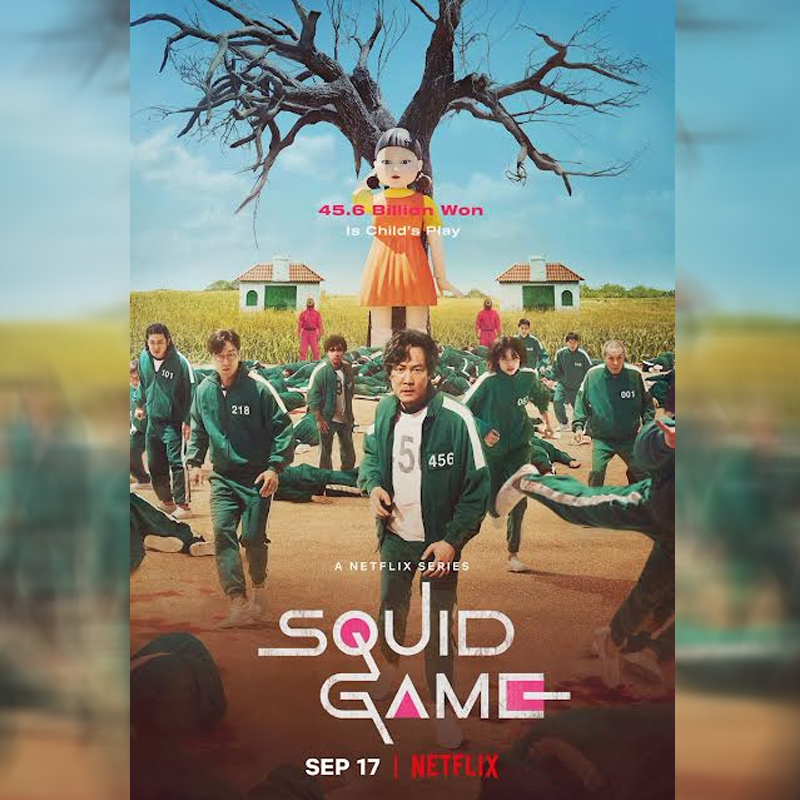
    Mumbai: The recent success of the Korean hit show ‘The Squid Game’ on Netflix has once again put the spotlight on the K-wave –or ‘Hallyu’ which has swept over the online audiences globally, including India. Not only was the Netflix original viewed by 142-million-member households globally in the first four weeks, according to CNBC, 89 per cent of people who started watching ‘Squid Game’ saw at least one entire episode. That is about 126 million hours of consumption.

    In India, the show not only holds the top position among Netflix top ten shows in India, but it is also accompanied by other K-dramas including ‘The King: Eternal Monarch’, ‘Kingdom’, ‘It’s Okay to Not Be Okay’, ‘Sweet Home’, ‘Crash Landing on You’, and ‘Space Sweepers’ in the category.

    According to the streaming platform, the viewing for Korean dramas on Netflix in India has gone up by 3.7X in 2020 over 2019, while it went up by four times in Asia overall in the pandemic year. Dubbing and subtitling have gone a long way in making these shows accessible to a wider audience. Currently, Netflix subs and dubs are in over 30 languages.

    “A story that is well told has the ability to make us laugh, or get excited or feel angry the same way, whether it is told in Korean or in Hindi, Tamil, and Telugu,” said a Netflix India spokesperson. “The emotions that these stories evoke transcend the boundaries of geography and language. Dubbing and subtitles play a major role in making these stories accessible to a much wider audience, in the language they are truly able to enjoy them.”

    In South Korea, the streaming platform’s local content push brought over 3.8 million subscribers.

    Netflix began working with South Korean filmmakers and talent in 2016 and has since launched over 80 Korean shows and films. It’s planning to invest another $500 million in Korean content in 2021 alone.

    In India and other countries like Argentina, Australia, Brazil, France, Mexico, Thailand, and the Philippines, audiences are discovering K-content perhaps for the first time on Netflix. A typical K-drama may have 10-16 episodes where each episode maybe 50-60 minutes in duration. Outside of their local market (South Korea), these shows should account for long-tail consumption on the OTT platform but are actually emerging as driver content in some countries.

    For instance, in India, Netflix is one of the few OTT platforms where audiences can access high-quality K-dramas from leading producers in Korea including CJ ENM/Studio Dragon and JTBC.

    Netflix’s co-CEO and chief content officer Ted Sarandos admitted that it was their Korea team that saw the potential in the show. “(Squid Game) was picked up a couple of years ago from the Korea team who did recognise it to be one of what they thought would be their biggest title this year. But I can’t tell you that we had the same eyeball on it to tell you that it was going to be the biggest title in our history around the world,” he said in the Q3 earnings call. “The growth – the viewing outside of Korea has been phenomenal everywhere we operate. If you look at the numbers – the internal viewing looks like a local language show in any country.”

    He further pointed out that Netflix shows like ‘La Casa de Papel’ from Spain, ‘Lupin’ from France, the film ‘Blood Red Sky’ from Germany, and ‘Sex Education’ from the UK show that great stories can come from anywhere in the world. “Non-English content viewing has gone up by three times since we started in 2008 making content,” he observed.

    Netflix also partnered with Deloitte to study the impact it had on the Korean creative ecosystem since its launch in 2016. According to the report, the platform’s investment in content production in Korea has contributed almost KRW 5.6 trillion won (~$4.7 billion) to the country’s GDP and helped create more than 16,000 jobs. The report studied the impact the company had on production and distribution as well as related fields including publishing, webtoons, music, consumer goods, and tourism. It highlighted that since the investment of OTT services, the average revenue of Korean VFX studios has increased almost fourfold from KRW four billion in 2010 to KRW 16 billion in 2020. It also observed that K-content has found success with audiences in over 80 countries.

    South Korean culture has left an indelible mark on people across the world and India is no exception. The successful globalisation of South Korean content by Netflix has incentivised other OTT platforms to bring Korean content to wider audiences. While Netflix has benefitted by riding the K-wave popularly known as ‘Hallyu’, it is now a key driver of the cultural zeitgeist that has gripped audiences globally.

  • GUEST COLUMN: Mobile marketing in the OTT landscape: Big opportunity for digital marketers

    GUEST COLUMN: Mobile marketing in the OTT landscape: Big opportunity for digital marketers

    Mumbai: The rise in both viewership and engagement of over-the-top (OTT) has opened up a world of possibilities for marketers looking for new and better ways to reach their consumers sitting in the comfort of their homes. Recent reports estimate that the OTT segment will grow to approximately $ four billion by 2025. 

    Confirming this trend, India saw a huge upsurge in media consumption between March and June 2020. By the end of 2020, OTT video subscribers almost tripled to nearly 62 million, up from 32 million at the end of 2019. This accelerated growth of the Indian SVOD industry is assumed to be caused by the Covid-19 pandemic. 

    Despite the fact that the OTT streaming business is dominated by large corporations such as Netflix, Hulu, YouTube, and Amazon Prime, smaller OTT streaming services continue to emerge. In order to have an edge over these budding competitors, it’s essential to utilise the power and proven results of mobile marketing.

    Before we dive into the strategies, below are some major trends that mobile marketers must be cognisant of, to make the best use of this ripe opportunity:

    Mobile is becoming the first choice for content: Mobile has surpassed traditional TV as the main growth route for video distribution. In fact, mobile collaborations now account for more than half of all recent OTT video bundle deals, indicating that customers are increasingly using mobile devices. As more MNOs subsidise at no additional cost to encourage upsell and retention, this trend is anticipated to continue.

    The rise of 5G: Because 5G internet is projected to become the standard, especially in metropolitan areas, it will permanently transform streaming patterns.

    Shared viewing due to lockdown: The entire population has been forced to stay at home owing to worldwide lockdowns, which has resulted in a fast rise in the consumption of content. Many OTT platforms, such as Netflix and Disney+, quickly acted on this and launched technology that allows individuals to view films together on a video chat, allowing platform users to stream in sync, to assist customers to isolate themselves and social distance. GroupWatch on Disney+ and Teleparty on Netflix have been huge hits, and it’s a trend that is likely to remain.

    Shift in OTT Model: Live and linear OTT services, which are projected to be an essential element of the future generation of OTT video, have a large growth opportunity based on existing watching trends and untapped video segments. Pay-TV providers are ideally positioned to offer live streaming services that make use of content that is best enjoyed in real-time, such as news, weather, talk programs, and sports. In the future, the content will be re-bundled under an OTT structure, whereas the previous cable model concentrated on content unbundling.

    Now, in OTT, when it comes to developing a short- or long-term marketing strategy, mobile marketing is a critical component. There’s a mobile marketing channel for every segment of your audience where they are most comfortable, from email to pay-per-click (PPC), search engine optimisation (SEO), content marketing, and social media marketing. 

    To be effective with mobile marketing, marketers must provide a consistent experience that customers expect—which may be difficult to do when you’re trying to attract, engage, and retain people across several platforms.

    Following are some of the key things that marketers must keep in mind while crafting strategies for the OTT landscape-

    Push notifications are key: User-behavior-driven push notifications should remain a crucial component of the entire engagement plan, which are proven to boost engagement rates by as much as 80 per cent. 

    Value recommendations of customers: It’s extremely important for marketers to understand the preference of their customers and value their suggestions. Viewing history, in-app behavior, and daily time of app launch are some of the data points that when accumulated continuously will give a wealth of information on customer behavior, significantly helping personalisation. This personalisation will further help in increasing in-app time spent by generating the most appropriate content recommendations over time.

    Timing is crucial: Focusing on personalisation and context is very important to make mobile marketing work for OTT platforms. However, what’s also important is delivering the content, suggestions, and notifications at the correct time, the results of which are proven to be phenomenal.

    Conversion of freemium subscribers to paying customers is imperative: Acquiring users is definitely important when it comes to implementing a growth strategy, but the end goal should be to turn the subscribers who are consuming content for free into paying customers. Hence, marketers need to focus on pitching the platform’s subscription options, with appropriate personalisation, to the customer.

    Make the customers feel important: Finally, building brand loyalty is the key at every stage, and this can be done by making customers feel valued by addressing their feedback. Hence, through personalised and crafted push notifications and in-app messages, repeat users can be encouraged to rate and review the OTT platform.

    Connecting the links between online and offline media is the future of mobile marketing. When used with other, more traditional media, mobile is a strong tool that should be viewed as the glue that holds everything together. The competitive environment for OTT apps, both native and browser-based, is continuously shifting. Benchmarking one’s performance and development versus industry norms is essential for marketers. 

    OTT marketers need to note that distinctions between the provision of and accessibility to high-quality content across OTT platforms will continue to merge. How they can achieve a substantial competitive edge is by using data-driven AI-powered customised, relevant, and time-bound multi-channel dialogues with consumers. For successful user engagement for your media, marketers must take advantage of every single mobile moment!

    (Dave Dabbah is former chief marketing officer of CleverTap. The views expressed in the column are personal and Indiantelevision.com may not subscribe to them.)

  • AR Rahman returns as BAFTA Breakthrough India ambassador

    AR Rahman returns as BAFTA Breakthrough India ambassador

    Mumbai: The British Academy of Film and Television Arts (BAFTA) has announced AR Rahman as the Breakthrough India ambassador for another year as they invite a new round of applications in India for the programme. Supported by Netflix, this programme will be open for prospective talent across the film, games, and television industries. 

    The BAFTA Breakthrough India programme will once again identify, promote and support Indian talent within these industries on a global scale, said the organisation in a statement on Wednesday. 

    “BAFTA Breakthrough India is an awe-inspiring initiative that offers the unique opportunity to promising artists to connect with influential experts in their field, serving as a life-changing experience,” remarked AR Rahman. “India has the supreme talent to offer which was evidenced by the overwhelming response received during the first round of Breakthrough India that compelled the jury to select ten deserving participants instead of five as originally planned.”

    Akin to the debut initiative, BAFTA Breakthrough aims to celebrate Indian talent by offering a bespoke programme of support – helping participants develop knowledge about the industry, develop their craft, address barriers to progression, and network globally with people who can influence their careers. 

    The programme provides a bursary to support international networking opportunities, further to this, recipients will also receive: One-to-one industry meetings and group roundtable sessions; Global networking opportunities with BAFTA membership, industry and peer to pee Breakthrough cohorts; Access to Career Coaching sessions and support with professional skills development; Access to BAFTA’s virtual programme of events and screenings for 12 months, and PR support and showcasing as part of Breakthrough.

    “India has a wealth of talent waiting to be discovered and showcased. For the second year, we are delighted to open applications for BAFTA Breakthrough supported by Netflix,” stated BAFTA chief executive Amanda Berry OBE. “The high quality of applicants in our first year prompted the jury to select ten individuals rather than five, and we look forward to receiving applications from the very best emerging talent in film, games, and television again.”

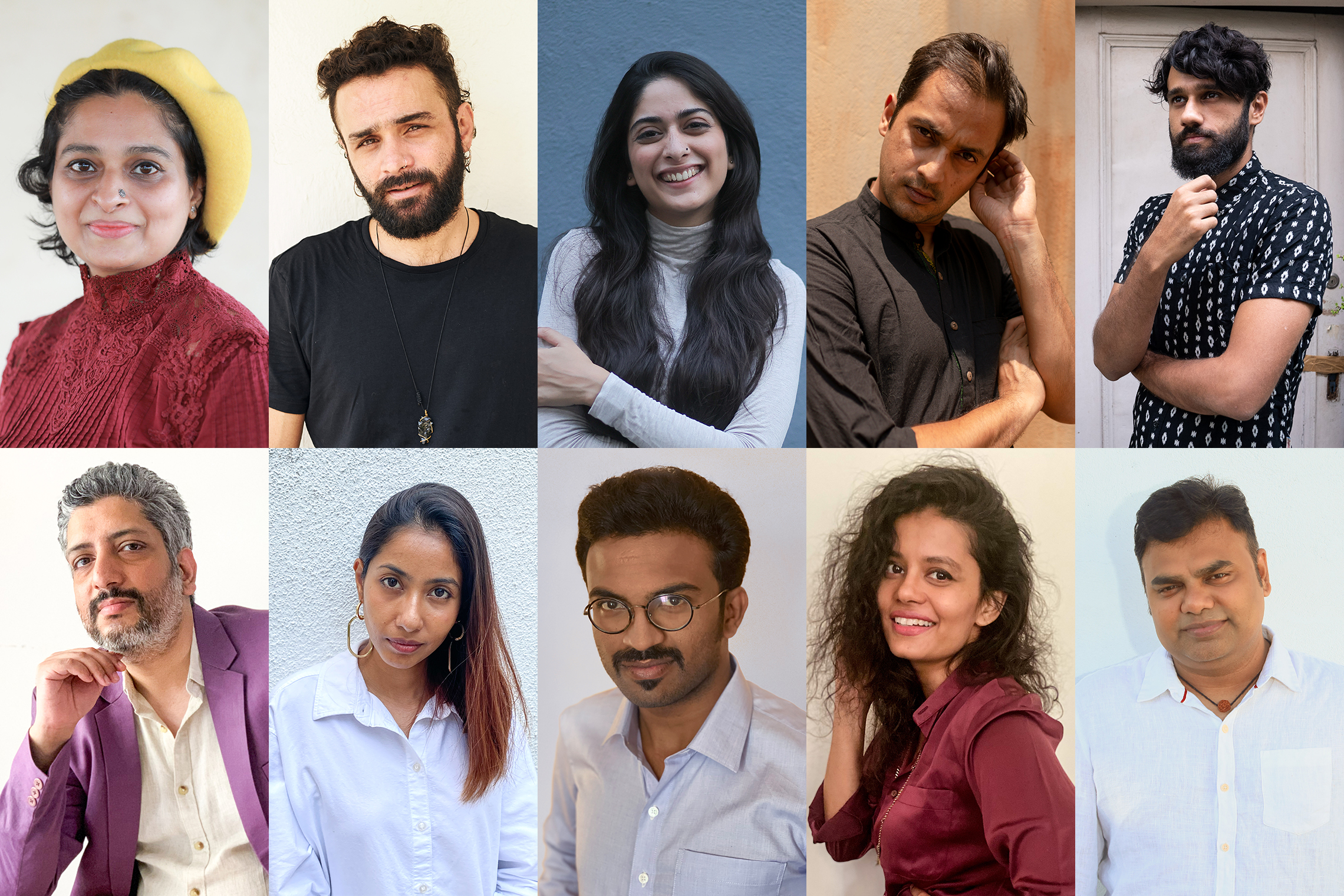
    The incredibly talented list of BAFTA Breakthrough’s first cohort comprised of the future stars of the film, games, and television industries: Akshay Singh (writer), Arun Karthick (director/writer), Jay Pinak Oza (cinematographer), Karthikeya Murthy (composer), Palomi Ghosh (actor), Renu Savant (director/writer), Shruti Ghosh (game developer & art director), Sumit Purohit (director/writer), Tanya Maniktala (actor) and Vikramaditya Singh (director).

    “Coming together to create opportunities for fresh talent and offering them a global platform is vital to the growth of the entertainment industry,” said Netflix India VP – content Monika Shergill. “Through the BAFTA Breakthrough India initiative, we want to drive progress in creating a more inclusive industry where many tales are told, and many voices tell those stories. We look forward to an equally enthusiastic and quality response as in the first year.”

  • Netflix adds 2.2 million subs from APAC in Q3 2021

    Netflix adds 2.2 million subs from APAC in Q3 2021

    Mumbai: OTT Giant Netflix announced its results for Q3 2021. The company grew its revenues by 16 per cent to $7.5 billion year-on-year and added as many as 4.4 million paid subscribers globally bringing its total subscriber base to 214 million subscribers.

    For the second consecutive quarter, the Asia-Pacific (APAC) region was the largest contributor to Netflix’s subscriber growth with 2.2 million subscribers coming from this region alone. The streaming giant added 1.8 million subscribers from the Europe, Middle East, and Africa (EMEA) market.

    The company forecasted 8.5 million subscriber additions for Q4 2021.

    Netflix also reported that ‘Money Heist- Season five’ and ‘Sex Education- season three’ were two of its biggest returning shows of the quarter reaching 69 million and 55 million households, respectively. Korean drama ‘Squid Game’ became its “biggest TV show ever” by reaching 142-million-member households in its first four weeks of launch. The show has ranked #1 in Netflix’s top ten shows across 94 countries including the US.

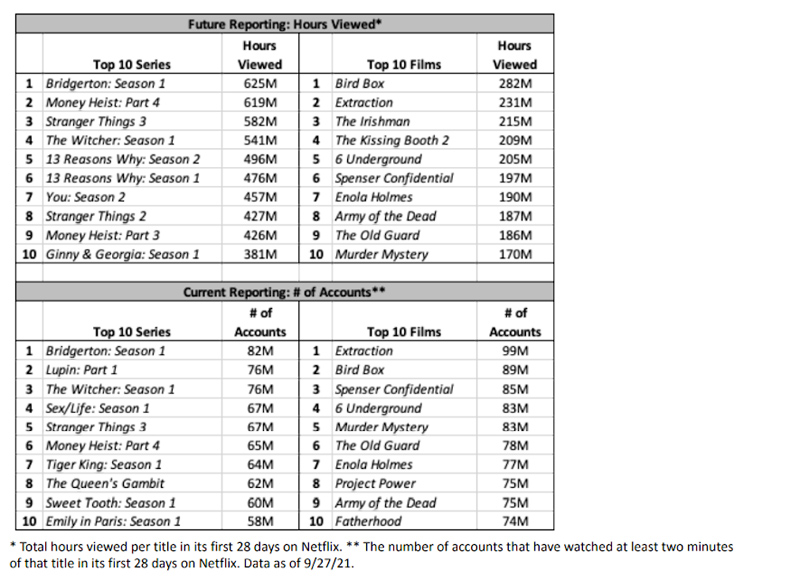
    The streaming giant said it will shift its metrics to ‘hours viewed’ for its titles rather than the ‘number of accounts that choose to watch them’ later this year.

    “There is some difference in rankings but we think engagement, as measured by hours viewed, is a slightly better indicator of the overall success of our titles and member satisfaction,” it said on Wednesday. “We will start to release title metrics more regularly outside of our earnings report so our members and the industry can better measure success in the streaming world.”

    Barring unforeseen events that result in large-scale production shutdowns the company anticipates a more normalised production slate for 2022 with even more originals releasing than 2021.

    During Q3, Netflix announced its agreement to acquire the Roald Dahl Story Company pending regulatory approval and acquired video game developer Night School Studio.

    Netflix also reported that when Facebook experienced a global outage for several hours on 4 October, the streaming platform saw a 14 per cent increase in engagement during that time period.