NEW DELHI: Nestlè India's coffee brand NESCAFÉ has come up with a new campaign called, ‘Karne se hee hona hai,’ for the coffee lovers across the country. The existing environment, with its uncertainties, has shown that life is full of opportunities and surprises for those who wish to find them. NESCAFÉ with its latest campaign aims to encourage people to seize these opportunities and surpass the challenges of the current times with optimism, action and resilience.
The brand has always encouraged the youth to dream, act and achieve. With this outlook, during these trying times, NESCAFÉ aims to motivate millennials, broaden the skyline of their imagination and to mentally stimulate them to re-start their lives with renewed focus and energy.
Nestlé India director of coffee & beverages Sunayan Mitra said, “The spirit of determination and tenacity forms the essence of this campaign, wherein a mug of NESCAFÉ is an ally, in the journey towards purposeful living, irrespective of the circumstances. The challenges, as a result of the current crisis, are significant. However, it is also a chance for everyone to take a moment and look at the bigger picture, adapt to the new world, and restart lives through conscious action. NESCAFÉ, the purposeful ally, motivates and supports consumers in this endeavour, while they go about restarting their lives in the evolving reality with hope, optimism and positive actions.”
McCann India CEO and chief creative officer Prasoon Joshi said, “At a time when India is restarting after a prolonged crisis, NESCAFÉ through this campaign speaks of the spirit of purposiveness and resilience. ‘Karne se hee hona hai’ – a phrase that captures the positivity, hope and the optimism of the youth and those who take it upon themselves to be at the forefront to restart, infuse life and purpose into their passion.”
Created with an upbeat background score, the latest TVC highlights that even though life had seemingly come to a halt with more than 100 days of being inside, we must now get ready to restart it and find newer ways to drive ourselves to achieve our dreams and ambitions.
The link to the TVC can be accessed here: https://www.youtube.com/watch?v=hz01uvZK_tY
MUMBAI: Cooking is an integral part of every mother’s life. It is her way of showing her love and devotion towards her family. But who would have thought that it could also be a simple tool to impart impactful life lessons to her young teens? MAGGI, through its new campaign for ‘Masala-ae-Magic’ showcases exactly this.
The campaign features the well-known Bollywood superstar Juhi Chawla. Known for her stellar performances on the silver screen, Juhi will be donning the cap of a mother who teaches her son an empowering lesson through every day cooking- ‘It is in your hands how you transform the ordinary to extra-ordinary’.
Talking about the campaign, Mr. Nikhil Chand, Director, Foods and Confectionery, Nestlé India said, “At MAGGI we realize that parenting is an immensely fulfilling but also challenging and demanding experience. Mothers are always looking to guide their teenagers and impart important life lessons that will prepare them for the future. One of these important life lessons is about a young teen’s attitude to everyday life- the ability to transform the ordinary to extra ordinary through one’s actions. Our new MAGGI Masala-ae-Magic campaign captures this insight beautifully and we are very excited to have Juhi Chawla as brand ambassador and as our newest MAGGI mom. MAGGI Masala-ae-Magic is a great cooking aid to mothers everywhere as it enhances the taste of every day vegetables and makes them extra-ordinarily tasty with its special blend of 10 roasted, aromatic spices.
On her association with the brand, Juhi Chawla said, “Associating with a brand that has such a legacy is always delightful. I believe Masala-Ae-Magic is the magical, secret ingredient for those who cook daily. As a mother of young teenagers, I totally understand how tough it is to keep children happy with everyday food, made at home. Adding Masala-Ae-Magic really goes a long way in making ordinary, everyday food extraordinarily tasty.”
The new campaign will have a high impact multimedia release encompassing television, digital, print and on-ground activations.
BENGALURU: Food and Beverages major Nestle India Ltd (Nestle India) spent Rs 729.44 crore or 6.46 percent of its operating revenue towards advertisement and sales promotion expenses for the year ended 31 December 2018. This was the highest spends towards ad and sales promotion (promo) by the company in absolute terms – in terms of percentage of operating revenue, this was the highest percentage that Nestle India has spent towards ad and sales promotion since 2013. Nestle’s India’s ad and sales promotion spends in 2018 were 44.16 percent higher than the Rs 506 crore (4.96 percent of operating revenue).
The figures below indicate Nestle India’s operating revenue and ad and sales promotion expenses growth. The number for 2014 in the first chart is with respect to the number for 2013.
In 2017, the company claimed in an annual report, that it was the first purely food and beverages company in India to cross the milestone of operating revenue of Rs 10,000 crore (Rs 100 billion). The company had reported operating revenue of Rs 10,192.18 crore for 2017.
Nestle India has been a profitable company with average profit after taxes (PAT) of 10.33 percent of operating revenue over the past 6 years (from 2013 to 2018) despite a downturn in 2015. In 2015, the company had a huge setback due to one of its biggest products – noodles sold under the Maggi brand. Operating revenue, profit after tax plummeted. The company had to spend more towards ad and sales promotion for damage control. If one were to neglect the numbers for 2015, the company’s average operating profit was 12.22 percent of operating revenue during five years from 2014 to 2018 excluding 2015. Its PAT of Rs 1,606.9 crore in 2018 has been the highest in terms of rupees as per well as in terms of percentage of operating revenue at 14.23 percent during the period under consideration.
When comparing Nestle India’s ad and sales promotion expenses with PAT, the average ad and sales promotion spends during the six year period between 2014 and 2018 was 50.48 percent of PAT. If one were to neglect the numbers for 2015 during which the company spent an equivalent of 93.27 percent of its PAT towards ad and sales promotion, the five year average works out to 41.92 percent.
Company speak
Nestle India chairman and managing director Suresh Narayanan said in the company’s annual report, “2018 has been memorable and a year of many ‘firsts’. We started the year on a bright note, as by the end of 2017 we became the first listed pure play food and beverage Company in India to reach a milestone crossing Rs 10,000 crore in revenue. This historic milestone signifies the strength of our 106-year old business in India and will serve as a moment of inspiration as we continue to build for a healthier future. It is clear that a healthier future requires a healthier business and a healthier society, and my team and I are fully committed to this. We continued to build trust with consumers and communities by being responsible, transparent and maintained our focus on building long term relationships.”
“Consumers have always been at the heart of our initiatives. We continued to offer exciting new product categories by introducing NESPLUS Breakfast Cereals, MAGGI Nutri-licious Baked Noodles, MAGGI Dip & Spread, NESCAFÉ Ready-to-Drink Cans, NESCAFÉ É Smart Coffee Machine and EVERYDAY Chai Life,” added Narayanan.
MUMBAI: Boiling fresh trouble for Nestle, the Supreme Court has revived the four-year-old Consumer Affairs Ministry’s case against its instant noodles Maggi on charges of unfair trade practices, false labeling, and misleading advertisements.
A Bench headed by Justice DY Chandrachud said the report from CFTRI (Central Food Technological Research Institute, Mysuru), where the testing of the Maggi noodle samples was conducted, will form the basis for the proceedings.
The government had filed a complaint in National Consumer Disputes Redressal Commission (NCDRC) in 2015, using a provision for the first time in the nearly three-decade-old Consumer Protection Act, stating that Nestle was causing harm to Indian consumers by allegedly indulging in unfair trade practices and false labeling of its noodles product—Maggi. The ministry had charged that Maggi noodle’s claim of being ‘Tasty Bhi Healthy Bhi’ was misleading as the product contained high amounts of lead and MSG (monosodium glutamate), which are unhealthy for human consumption. It had sought damages of Rs 640 crore from the company. The top court had earlier stayed the proceedings before the NCDRC after Nestle had challenged it.
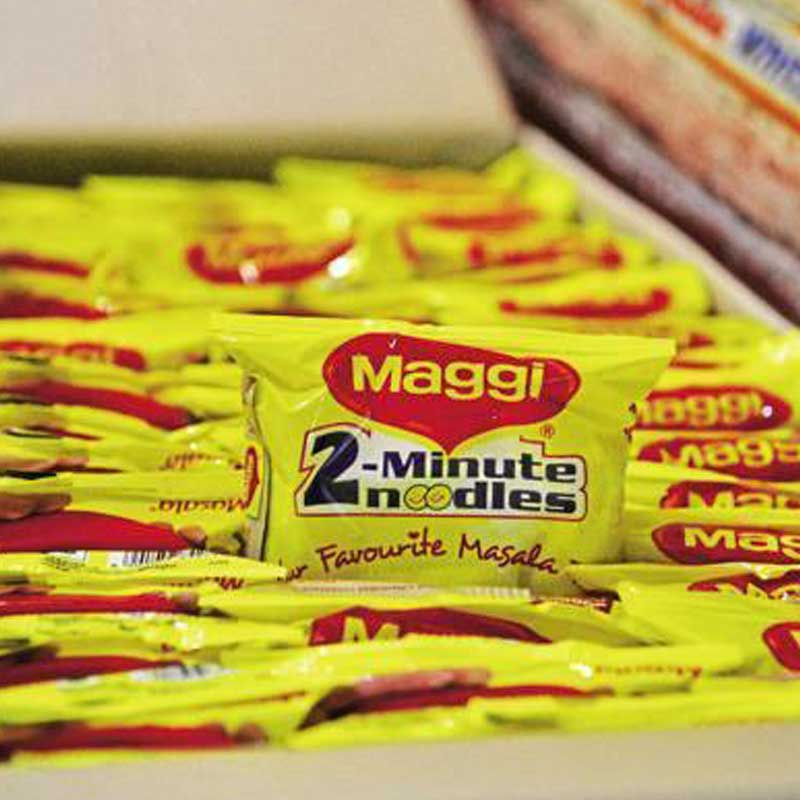
MUMBAI: If you are a loyal Maggi patron who has been pining for the product’s return to the market, it’s time for a fist pump. ‘The two minute noodles’ have been declared safe for consumption by the testing labs, announced Nestle India on Wednesday. The newly manufactured stocks have cleared all the three lab tests authorised by the Bombay High Court, and Maggi is expected to hit the shelves by this November.
This isn’t good news for just Maggi lovers, but for the company’s investors as well. Since the news was out, Nestle’s share prices saw a surge. As compared to its previous day’s close of Rs 6234.35, the company’s stock was up 12.80 per cent at end of day’s trade on 4 November to close at Rs 6247.15. The stock opened at Rs 6256.85 and touched an intra-day high of Rs 6479 and a low of Rs 6220.80.
The popular FMCG product came under scrutiny after more than permissible amount of lead was found in it, which eventually led to the product being taken off the shelf.
To read more on Maggi’s ban from the market, click here.
But Maggi’s fight to win back its lost reputation, and make up for its absence from the brand space doesn’t stop at government clearance.
The industry’s eyes are trained to see what the brand pulls off on its marketing and advertising front, given that Maggi’s return could be the biggest brand come back of the year.
A precursor to which we saw in a slew of short videos that Nestle recently launched on its official YouTube channel. These managed to evoke nostalgia for the brand, even when the product was off the shelf.
Responding to the many love letters from loyal fans on social media, Maggi released six videos each ending with a ‘Miss You’ message. Conceptualised by McCann Worldwide, which handles Nestle’s corporate campaigns, the campaign instantly grabbed eyeballs with #WeMissYouToo spreading across social media.
In a later interview to a leading business daily, McCann Worldwide India CEO Prasoon Joshi had said that the campaign was an instinctual response to what was being said on Twitter and Facebook.
While Publicis Worldwide remain the creative agency for Maggi, Joshi is heralding the re-launch campaign for the brand.
The campaign may have tugged at the heartstrings of a few, but according RK Swamy Hansa Group chairman and International Advertising Association (IAA) India chapter president Srinivasan Swamy the campaign hit the market “a little late in the day.” Swamy also feels that the campaign was mostly targeted towards opinion makers, and not at the core consumer base of the product, which is a larger number than Twitter and Facebook’s audience.
“I feel that for a FMCG product, social campaign through Facebook may not be adequate. They must employ mass media to engage with their consumers. The audience that they can reach through Twitter and Facebook, is small compared to its huge consumer base,” he says.
Digitally Maggi may have made an effort to remain alive in our memories, but the volume the product lost from the shelves is not going to be regained by a campaign. It is going to be a long drawn out process, where the brand will have to make use of the mass media more aggressively, keeping digital as one of the peripherals, feels Swamy.
And that is precisely what the brand has done with their recent full page ad in a national daily. Meanwhile, the company has been playing up Maggi’s safety.
“Your Maggi is safe, has always been.” – is what the ad reads before it goes on to explain that 3,500 tests conducted in India and abroad by food standards authorities in the US, Canada, the UK, Australia, New Zealand and Singapore have pronounced the noodles as “safe for consumption.”
During the ban, Nestle India lost advertising inventory of about Rs 10 crore due to Maggi recall although they aired commercials of Nescafe or KitKat in all advertisement slots booked for the instant noodles brand. Nestle notified broadcasters and other media houses in India to stop publishing Maggi ads till the next directive is issued.
Nestle India is known for their conservative spends on marketing and advertising. Between 2010 and 2014, Nestlé India’s spending on advertising and sales promotions was between 4.2 per cent and 4.8 per cent of total income. With a powerful and impactful campaign in the queue, market analysts predicts a sea change in their spending in the sector, which may even go up to seven per cent.
While not revealing any figures, Nestlé India’s new managing director Suresh Narayanan, had earlier stated that the company would “spend more on advertising, marketing and promotions across categories to counter impact on sales caused by the Maggi ban.”
“They have to spend more on marketing and advertising if they even attempt to relaunch the product,” says BBH India CEO Subhash Kamath. “The brand has been off air for a while now. They need to come back with a bang and to be more credible and visible to their consumers,” he adds, saying that the company should spend a portion of their marketing spends in the initial phase of the re-launch campaign.
This isn’t the first time that a popular household product needed a comeback campaign after they went off shelf for a period of time. Remember Cadbury Dairy Milk’s come back campaign with Amitabh Bachchan, conceptualised by the maverick ad man Piyush Pandey?
Kamath recollects how Cadbury had re-packaged the product with an extra layer and brought it back to the market to convince its consumers, and how a similar approach may work for Maggi as well. “Credibility is something the brands need to earn, and campaigns can just assist it. Cadbury did a very good job at that time. Maggi will probably have to do the same thing.”
Having said that, going the celebrity way to earn this credibility may not work for Maggi.
“Bachchan Ji had a certain credibility in the eyes of the people at that time. It was possible for him to convince the consumers of the products lost credibility. Consumers today are more skeptical. They wouldn’t buy any product just because their favourite star is selling it. Chances are, Maggi wouldn’t go the celebrity way. They may prefer the testimonials of consumers and facts for their campaign,” opines Kamath.
Incidentally, Bachchan was also one of the endorses of Maggi some years back.
Going ‘bold and confident’ is the only way Maggi can pull this off, opines Grey South and southeast Asia chief strategy officer Dheeraj Sinha, who has also penned the book India Reloaded. “The biggest thing that the consumers will be looking out for in Maggi’s first relaunch campaign is the air of confidence. Their message to the consumers should be emphatic about the fact that they are back. And that should be sufficient,” he says, adding that evoking any more nostalgia and emotions may undo the campaign.
Commenting on the pressure on the products marketing team, Swamy adds, “It is an interesting challenge for the brand marketers and their creative agencies. They must obviously take multiple approaches to strategise this relaunch. I don’t believe that the marketers are sweating under the pressure. I believe they will be closely monitoring the first communique that the brand will put out in the public, and evaluate the same. This is an important re-launch for them and they have to get it right. Irrespective of what the campaigns may say, consumers take a while to respond to these changes.”
It is interesting to note that as per a survey conducted by Airloyal’s GeInsights, 73 per cent of the respondents said that can’t wait to get their hands on a packet of Maggi, while 27 per cent are still a little unsure of its safety.”
However, sample base for the responders form a small section of the product’s total consumer base, therefore whether this survey reflects the true guideline for the campaign is still something to wait and watch for.
NEW DELHI: Just a day after the Government announced it was moving a Consumer Court, the Bombay High Court lifted the nationwide ban on Maggi Noodles but asked Nestle India to test five variants of noodles at three accredited labs.
The Court said in a sharp indictment that principles of natural justice were not followed by Food Safety and Standards Authority of India (FSSAI) in passing the impugned order of ban.
Holding that tests must be completed within six weeks, the Court told Nestle India that if test reports suggest that lead is within permissible limit then it can start the sale of products.
In June, the FSSAI said the popular snack was found “hazardous and unsafe for human consumption.”
More than 2,700 samples of Maggi noodles have been tested by laboratories in India and abroad in recent months, and each test confirmed the level of lead to be “far below permissible limits,” Nestle had said in a recent statement.
The Department of Consumer Affairs’ claim for Rs 639.95 crore in damages from Nestle is to be heard by the National Consumer Disputes Redressal Commission (NCDRC) in probably the class-action suit against a multinational. The ruling of the quasi-judicial body will be legally binding.
In June, the country’s food safety regulator banned Maggi after excessive amounts of lead and monosodium glutamate (MSG) were reported in samples tested in Uttar Pradesh.
BENGALURU: In what is probably a first, Nestle India Limited (Nestle) has reported a loss. A loss to the extent of Rs 64.4 crore in the quarter ended 30 June, 2015 (Q2-2015, Nestle’s financial year ends on 31 December). Hit by the Maggi Noodles controversy, exceptional items worth Rs 451.66 crore have wiped off the Rs 333.1 crore profit before exceptional items and tax that the company had earned.
The resulting loss of Rs 118.56 crore was mitigated by a tax credit of Rs 54.16 crore and the result was the above mentioned net loss of Rs 64.4 crore.
Last quarter, the company had reported a profit after tax (PAT) of Rs 320.28 crore and a PAT of Rs 287.86 crore in Q2-2014. For now the company has suspended manufacture of Maggi Noodles pending a decision of the Bombay High Court pertaining to a case it has filed regarding interpretation of the Foods Safety and Standards Act, 2011. The loss of the brand value, goodwill is difficult to calculate.
The company says that net sales worth Rs 288.38 crore has been reversed in the current quarter in relation to Maggi Noodles stock being withdrawn from trade partners and the market. The exceptional items amount of Rs 451.66 crore relates to estimates of loss on account of stocks withdrawn including incidental costs thereto and other costs incurred exclusively in the ordinary course of business, dealt with in with the Accounting Standard AS2 on valuation of inventories and Accounting Standard AS5 on net profit or loss for the period, prior period items and changes in accounting policies.
Let us look at the other numbers in Q2-2015 that have changed:
The company says that its net sales have been impacted by 20.1 per cent on account of Maggi Noodles. Nestle’s net domestic sales have decreased by 20.6 per cent , export sales decreased by 12.7 per cent impacted by lower coffee exports Russia, partly offset by export of milk and nutrition products to Bangla Desh. Nestle reported net Total Income from Operations (TIO) of Rs 1957.01 crore in the current quarter as compared to the Rs 2516.48 crore in the immediate trailing quarter and the Rs 2431.97 crore in the corresponding year ago quarter.
Total Expenditure (TE) in Q2-2015 declined to Rs 1634.38 crore as compared to the Rs 2000.75 crore in Q1-2015 and the Rs 2008.91 crore in Q2-2014. Nestle’s cost of materials consumed declined to Rs 718.80 crore in Q2-2015 as compared to the Rs 1110.50 crore in Q1-2015 and Rs 1123.47 crore in Q2-2014.
For the six month period ended 30 June, 2015 (6M-2015, YTD), Nestle reported a 5.9 per cent drop in TIO to Rs 4473.49 crore as compared to the Rs 4753.48 crore in 6M-2014. PAT in 6M-2015 declined to less than half (fell by 53.2 per cent) at Rs 255.88 crore as compared to the Rs 547.02 crore in the corresponding period of the previous year.
During 6M-2015, TE was lower at Rs 3635.13 crore as compared to the Rs 3913.13 crore in 6M-2014. The company’s cost of raw materials declined to Rs 1829.30 crore as compared to the Rs 2275.39 crore in 6M-2014.
Nestle’s board of directors at its meeting held on 29 July, 2015 based on the recommendation of the Nomination and Remuneration Committee, appointed Suresh Narayanan as managing director of the company effective from 1 August, 2015, subject to approvals. The company will seek consent of members by means of postal ballot on the proposal of the appointment of Narayanan as managing director. The board of directors has also appointed Abhinav Khosla, a chartered accountant, to act as the scrutinizer for conducting the postal ballot process in a fair and transparent manner.
MUMBAI: Nestle India has pegged the stock of its embroiled-in-controversy Maggi brand to be in the region of approximately Rs 320 crore.
The company has said that Maggi noodles stock worth Rs 210 crore was being withdrawn from the Indian market and destroyed. Additionally, Rs 110 crore worth of finished and related material stocks of Maggi remained at Nestle India’s factories and distribution centres.
In a statement, the company said, “These are broad estimates because it is impossible to calculate the final figure while the withdrawal is taking place. There will be additional costs to take into account, for example bringing stock from the market, transporting the stock to the destruction points, destruction costs etc.”
Nestle India will come up with the final figure at a later date.
As was reported earlier by Indiantelevision.com, the Food Safety and Standards Authority of India (FSSAI) had ordered Nestle to withdraw Maggi noodles after some of its samples were found to contain more than permissible levels of lead.
However, even as the company withdraws the brand from the market, it moved the Bombay High Court, challenging FSSAI’s order. The court will hear the matter on 30 June.
The company added that above mentioned cost and other unforeseen costs associated with the withdrawal of Maggi noodles from across India, will be dealt with the applicable accounting standards when Nestle India will announce its financial results on the due date.
Nestle India’s stock has been nose-diving ever since the Maggi imbroglio broke out in the country. Over the last 15 days, Nestle India’s market cap has been down roughly 13.25 per cent. On 29 May, the company’s market cap stood at roughly Rs 66,113 crore as compared to approximately Rs 57354 crore today (15 June).
At the close of the day’s trade, the company stock price at Rs 5948.65 was down 2.14 per cent from its previous close of Rs 6078.80 on the Bombay Stock Exchange (BSE).
MUMBAI: It comes as no surprise that Nestle Global CEO Paul Bulcke is in India for damage control and takes stock of the situation here. Having reduced production by a third, sales halved for the brand with a 75 per cent market share and market price plunging by nine per cent in a day, Nestle India’s Maggi is indeed seeing a slow boil.
In a statement, the MNC said that it had decided to withdraw the product from shelves across India.
Addressing the media in a press conference held in Delhi today, Bulcke said that the company applied the same quality standards everywhere in the world. “We do not add MSG in Maggi noodles and it is safe for consumption in India,” he said.
Speaking about recalling the product from the market, Bulcke said, “What we do here is only with the consumer in mind. I don’t feel this is the right environment to have the product on shelves.”
Additionally, India’s central food safety regulator Food Safety and Standards Authority of India (FSSAI) has now ordered Nestle India to recall nine Maggi variants from the market.
Justifying its stance Nestle has said in an earlier statement that the batch in which the UP government found lead was an expired batch. The company’s reasoning remains restricted to testing the product in their labs and some external labs as well. However, as many as six Indian state governments have not accepted their testing and have called for a ban for the noodles brand.
“We are aware of media reports that say a case has been filed against us by the authorities in Uttar Pradesh. On receipt of the official notice we will take appropriate action under the guidance of our legal advisors. We cannot comment any further at this stage,” the company had said.
The company, like its CEO Bulcke, has maintained that there was no added flavour to its product. “We do not add the flavour enhancer MSG (E621) to Maggi Noodles in India. However, the product contains glutamate from hydrolysed groundnut protein, onion powder and wheat flour. Glutamate produces a positive result in a test for MSG,” said Nestle India.
In light of the trust of its consumers and the safety of its products being Nestle’s first priority, recent developments and unfounded concerns about the product has led to an environment of confusion for the consumer, to such an extent that the product has been withdraw from the shelves, despite the company claiming it to be safe.
While it is unlikely that this controversy will die down in “2 Minutes,” Maggi Noodles nonetheless promises to come back in the market as soon as Nestle India takes corrective measures in order to get out of this imbroglio.
After all the hullabaloo about Nestle withdrawing nine variants of its noodle brand from the shelves, the latest development in the Maggi controversy is that the government has asked the company to stop further production, processing, import, distribution and sale of the product.
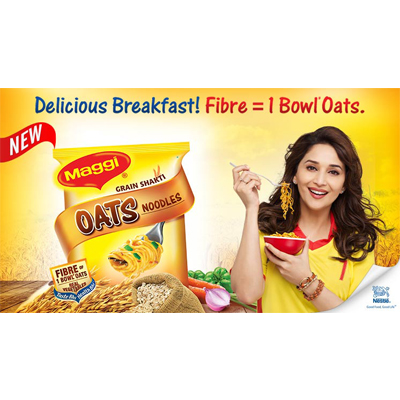
The FMCG major was also asked to withdraw and recall the food product “Maggi Oats Masala Noodles with Tastemaker” and any other product for which risk assessment has not been undertaken and product approval granted.
The FSSAI did not find a satisfactory response from Nestle India’s representatives, who were given a hearing on 4 June by FSSAI chairman and CEO to seek their response in the matter and hence this decision was taken.
MUMBAI: Nestled in controversy over the presence of lead beyond permissible limits in its popular noodle brand Maggi, Nestle India has found itself in a soup. As Barkha Dutt tweeted, it could well be “The Two Minute death of a brand #Maggi.”
What’s more, a domino effect followed immediately with the recent detection of creepy-crawlies in Nestle’s other food product Nan Pro-3.
A brand being embroiled in controversy is not something new with the likes of Cadburys and cola companies having faced similar problems in the not so distant past. About a decade ago, there was uproar over worms being found in Cadbury chocolates. On that note, the company said that most stores in India at that time didn’t have refrigerators and that had affected the product. Similarly cola brands were hit with the pesticide crisis in early 2000, which wiped off their growth for over two years.
In testing times like these for brand Maggi, the big question on everyone’s lips is… could this hullabaloo well sound the death knell for the brand, which has been around in India for decades?
Speaking to Indiantelevision.com about the controversy, Kwan Entertainment & Marketing Solutions COO Indranil Das Blah strongly believed that if Maggi is being held accountable, so should the government, for the simple reason that it has been approved by the Food Safety and Standards Authority of India (FSSAI), which is a government body.
“I don’t think it’s the death of the brand in India. They’ve been around for about two decades now. A lot of brands have faced similar controversies, be it the cola brands or various food companies. Having said that, it has been approved by the FSSAI, which is why it is available in the market in the first place. Maybe a certain batch had certain excess content of lead and that is something that the judiciary should decide,” Blah said.
Harish Bijoor Consultants CEO Harish Bijoor opined, “It’s a big shock for Maggi. The trauma is for the consumers as well because they love the brand so much.”
According to Blah, while the controversy will definitely cause immediate damage to the brand, in the long run the brand is strong enough to survive if the allegations are proven false. “Unless there is firm evidence and a court order is passed, which is not in favour of Maggi, I don’t think it’s the death of the brand,” he added.
Pertinent to note here is that all FMCG products especially food items go through stringent manufacturing processes as well as government approvals. Blah is of the opinion that it never hurts to be extra careful and hence the Maggi fiasco should serve as a wakeup call for other FMCG giants.
While there have been discussions about the nutrition value of Maggi for years now, it hasn’t really hurt the brand and Nestle India has gone about producing it without a hitch riding on its taste quotient.
What’s more, with the involvement of big celebrities like Amitabh Bachchan and Madhuri Dixit as brand endorsers, the matter has been highlighted even more. It is a well-known fact that celebrities are soft targets whenever there is a controversy brewing.
When queried about whether it was fair to drag celebrities into the controversy, renowned photographer and founder of celebrity management firm Bling! Entertainment Solutions, Atul Kasbekar said, “I believe it’s an irrational act to go after the endorsers. While stars and their managers question the brand fits and ask relevant questions at the beginning of any relationship, it’s unreasonable to hold an endorser responsible for episodes like this. Already contracts have strong two way indemnity clauses in place; I guess they’d be stronger now and spend more billable legal hours in the process. I cannot imagine that there’s a single celeb out there who would’ve declined a Nestle brand to be honest. I don’t imagine that’s going to change very much.”
Concurring with Kasbekar, Blah said, “When a celebrity is endorsing a product, he is lending his name and his image to it. He is not involved in any other activity of the product. All he is doing is attracting eyeballs for the brand. If he were involved in the making of the product, then it would have been justified. But after they endorse a finished product, one can’t hold them responsible. If one batch goes wrong then it is not the celebrity’s responsibility, it is the company’s and the government’s responsibility as they have approved the product. It’s not fair to drag celebrities in this,” he said.
Bijoor is of the opinion that the first thing that Nestle India will do is sort out the issue with the regulators and various states. “After that they will start addressing the consumer and that is when a lot of credibility building advertising will come from Maggi. Maggi is a highly evolved brand in India. They need to communicate with a different degree of tenacity with the consumers and they will do that,” he voiced.
While celebs have been a part of the controversy, Bijoor thinks that the first thing celebs will do and have done in the past is to indemnify themselves from any collateral damage that the brand faces. “Without doubt they will be more careful and diligent henceforth,” he added.
Will this one controversy also open doors to other and put other brands under the scanner? To this, Bijoor said, “This is just one category. If you look at the other categories like tea, frozen food, fresh vegetables, fish, poultry and meat that we eat; you will be shocked to find that the content of chemicals and metals is much higher than permissible limits across the world. So this is a major reaction on Maggi. This paints the entire industry with the same brush.”
Sharing her thoughts on the controversy, PromaxBDA Africa and Asia Pacific country head Rajika Mitra said, “For the brand Maggi, it has created a huge setback and for Nestle, the brand integrity has been hugely impacted. The brand image of Maggi has witnessed a major dent in its popularity.”
Mitra further added that Nestle would have an uphill task to build customer confidence and re-launch the brand in a completely new avatar, which might take years.
“Celebs have been drawn into this controversy in a big way. Big brands and celebrity associations have always been a popular feature and they do feel responsible for the brands that they accept and endorse. Henceforth, they will be more cautious when accepting such brands in future,” she said.
It may be recalled that as part of its damage control exercise after the worm controversy, Cadburys India came up with new packaging, which would keep the product fresh and intact without refrigeration. However, it is a known fact that chocolates need to be refrigerated, the question is: Why did Cadbury wait for the worm controversy to change its packaging?
While Kasbekar believes that this controversy will be a blip in the progress of this superbrand, the fact remains that the communication path that Nestle India will have to take for brand Maggi following this unprecedented controversial blaze will no doubt have to be powerful enough to dowse the flames.