Tag: NDTV

  • World TV Day: Industry barons go down the memory lane

    World TV Day: Industry barons go down the memory lane

    It was on 15 September 1959 when India officially experimented her tryst with the box that has been loved, loathed and equally criticized over the years.  But today, in its current avatar, the television set has seen a paramount shift, right from colour television being introduced in 1982 as India geared up for the Asian games to today’s 4K technology.

    Production values of various shows as well as the viewership experience have changed phenomenally.  As the world today celebrates World Television Day which was declared by the U.N in December 1996, indiantelevision.com speaks to some of India’s most notable names from the TV industry recalling some of their fondest memories of viewing television programmes.


    Prasar Bharati CEO Jawhar Sircar

    Television needs to look beyond its traditional ecosystem to embrace the opportunities offered by digital technology. The medium will die if it continues to grow in a linear fashion. TV began over electro-magnetic waves in 1959 and has grown through satellite to cover the entire country.

    While terrestrial TV has its own relevance, it will be quickly overtaken by new technologies including satellite and digital addressable systems.


    India Today Group consulting editor Rajdeep Sardesai

    For me my fondest memory was the coverage of the live elections in the years of 1995-1996. At that time, everyone would watch the national broadcaster Doordarshan as there were no private news channels. Covering the elections as a reporter along with journalist like Vinod Dua and Dr Pranoy Roy is a big part of those memories for me.


    NDTV executive vice chairperson KVL Narayan Rao

    Television today is more contemporary. Society has changed a little and what you have on air is reflective of that. The world has become a smaller place. There is more access now as compared to 25 years ago when the only window to international news was The Week That Was, produced by NDTV as one of the earliest private players. I remember serials like Buniyad, Humlog, Mahabharat and Ramayan. Some of the old ones were core of the heart serials and dealt with issues that were the reality of so many people of the country at that time such as post partition. The serials now have different production values.


    Sony Six business head Prasana Krishnan  

    Sports on television is growing rapidly and the Indian sports fan today has more access to viewing multiple properties than any other fan in the world and that too at an affordable cost. My fondest memory has to be this year’s FIFA World Cup Brazil as not only was it personally satisfying for me as a football fan but  a matter of pride to be carried on the channel. Every minute of the game on TV was engaging.


    Ten Sports CEO Rajesh Sethi

    Viewing television programmes is an enriching experience and is all about entertainment, entertainment and entertainment! Watching television especially sports is a great stress buster and allows me to relax. In fact watching sports on TV for me is all about celebration.


    Gasoline, founder and chief creative officer Anil Kakar

    From just two Doordarshan channels to over 800 channels today, television has come a long way. The good thing is, content continues to get more defined to suit niche audiences.  With the recent changes announced by the Star Network, viewers now have the choice of subscribing to specific channels on an a la carte basis. It will be interesting to see how this will go on to alter viewing patterns. In the long run, this might even lead to a shift of focus, largely from GECs to more diversified, niche content, as television gets more fragmented. Ultimately, as audiences, we will have even greater choice than we have today. Even with so many channels today, I would say the finest moments in television belong to the 90s. MTV and Channel V brought in a cultural change and attitudinal shift of sorts. Programmes such as Different Strokes, The Wonder Years, Mind Your Language and Star Trek were had to miss and are still hard to forget.

  • Carriage fee on a rise again?

    Carriage fee on a rise again?

    MUMBAI: Delayed digitisation of phase III and phase IV areas have marred the hopes of broadcasters, multi-system operators (MSOs) and the local cable operators (LCOs) alike. With implementation of digitisation in phase I and II, while broadcasters were enjoying the reduced carriage fees, MSOs were hoping for better on-ground collections with increasing transparency. But all this has taken a U-turn with the Ministry of Information and Broadcasting announcing 2016 as the year when India will be fully digitised.

    The MSOs who have invested heavily for digitising phase I and II markets are still waiting for reaping the benefits of it. And now even the broadcasters who saw some reduction in carriage fees (industry sources peg it between 10 per cent to 30 per cent) during the first two phases have gone back to basics.

    If one has to go by the Media Partners Asia (MPA) report, the cable TV industry has seen a 14 per cent jump in carriage fees. The reason for the jump in carriage fee could be many. Here are a few reasons which we understand could be playing a role in the changed carriage fee pattern:

    1)    Delayed digitisation: The MSOs have already invested heavily in phase I and II and have also borrowed money for phase III and IV markets. Now with the government announcing the final dates for digitisation as 2015 for phase III and 2016 for phase IV, MSOs fear that the LCOs will not increase their collections from the ground.

    2)    Low ARPUs: Even in phase I and II areas, the ARPU hasn’t gone up as expected by the MSOs. And so they haven’t been able to recover the money they had invested.

    3)     New channel launches: Broadcasters launching new channels need greater reach and visibility and so pay more in order to get carried by the platform and also to ensure that it is available to all the subscribers of the platform. This in turn sets a benchmark for the other players also.

    4)    Lack of transparency: Even though one of the aims of digitisation was bringing in transparency and addressability, both haven’t happened as yet. The cable operators have not been able to get the consumer application forms filled and thus, are still unaware of the choice of consumer. Also, there is still under declaration of consumers. 

    “This is true especially for news channels, niche channels and the new channels that have been recently launched. While the existing channels have not seen any hike in carriage fees, broadcasters that launched new channels in the different genres, right from GECs to regional to music and movies have seen a jump in carriage fees, which ranges from 15-25 per cent,” says a distribution head on condition of anonymity.

    Another source close to the development agrees and says, “Yes! The carriage fee for broadcasters launching new channels have gone up. This can be anywhere between 20-25 per cent, depending on the distribution strategy of the broadcaster and the visibility it is looking for.”

    Many in the industry blame the new channel launches for the increase in the carriage fee. “While for the news channels the carriage fee had seen a drop by 10-15 per cent, the new channels that are being launched every now and then, sets a different benchmark. Since broadcasters want better reach for their new channels, they pay huge sums as carriage fee to MSOs and this affects the news channels as well,” says a news broadcaster.

    Even at the recently concluded MIPCOM 2014, Colors CEO Raj Nayak during a panel discussion had stressed that there needs to be complete implementation of digitisation. “While in the phase I of digitisation, the carriage fees had come down by 20 per cent, it has now gone back to square one and this is a dangerous trend,” he had then said.

    Viacom18 group CEO Sudhanshu Vats feels no different. In his recent interaction with Indiantelevision.com he had said, “Carriage, rather than continually coming down, has begun to rise again in recent months.”

    According to India TV chairman and editor-in-chief Rajat Sharma, when digitisation kickstarted, news broadcasters expected consumers to get better quality channels and carriage fees to disappear. “For the MSOs, it is the carriage fee from the news channels that helps them sustain, since they pay the GECs huge sums for getting their programming on their platform,” opines Sharma.

    Unlike the expectations by many, carriage fees haven’t yet been abolished.  “When phase I of digitisation was implemented, carriage fees did come down in terms of what was being paid in the four metros. The national level MSOs saw the benefits of digitisation and passed on some of that benefit to broadcasters. However, with phase II, it hasn’t happened. On the contrary they are going up and extortionist demands are being made again. Perhaps because in other parts of the country the MSOs are in partnership with local or regional players who do not want to let go of carriage fees even though that was meant to be a natural outcome of digitisation,” informs NDTV executive vice chairperson KVL Narayan Rao.

    Rao further adds, “It is impossible for news broadcasters to withstand payment of high carriage fees. Other components of digitisation like buoyant and fair subscription revenues, have not kicked in either. Something needs to be done about these aspects immediately. Carriage fees in particular have to be rationalised.” Rao also pegs the carriage fee increase between 10-30 per cent.

    As for Focus Network group CEO Neeraj Sanan, carriage fee revenues for MSOs are likely to reduce. “However the carriage paid by a broadcaster to an MSO, will increase post first year of DAS due to aggregation at MSO level and the ever increasing number of channels,” he adds.

    Even the MSOs agree that the carriage fee has seen an upward trend. “This is true mostly for the new channel launches. Broadcasters want better reach for their new channels and are ready to pay more carriage fee for those channels. The new channels are seeing a hike in carriage fee by about 20-25 per cent,” concludes the MSO.

  • Election broadcast must be seen in context of electoral constituencies: NBSA

    Election broadcast must be seen in context of electoral constituencies: NBSA

    MUMBAI: A case had been filed against English news channels CNN-IBN, NDTV, Times Now and Headlines Today regarding a piece of news that was broadcast on 7 April 2014.

    The complaint filed by Vishal  Kudchadkar and  Syed Ali Hussaini claimed that on the particular day, some constituencies in Assam and Tripura went to polls but the above mentioned channels chose to broadcast the BJP manifesto release on the same day. According to the complainants, they have violated the Section 126 (1) of the Representation of People Act, 1951, which prohibits any public display of  election  matter  by means  of cinematography,  television and other  similar apparatus  during  the  period  of 48 hours  prior  to  the end  of  polling.  

    This apart they allege that it also violates the direction of the Election Commission of India and Guideline 12 of the NBA guidelines for election broadcasts.

    The NBSA sought a reply from the ECI in this regard to which it said, “The legal opinion (obtained by EC) on the issue relating to Section 126 of  RP Act was that the said section,  being a penal provision,   had  to be strictly construed; and that the telecasting of an election related event such as release of election manifesto or an election address or a press conference outside the limits of a constituency  going  to   the  poll  would  not  attract  the  penal  provisions  of Section 126; and that the prohibition  regarding the release of  a manifesto or election address or press conference will have to be restricted  to any election matters relating to that constituency and the candidates in that constituency.”

    Guideline 12 of the NBA says, ‘The  broadcasters shall not broadcast any ‘election matter’ that is, any matter intended  or calculated to influence or affect  the result of  an election during the 48 hours ending with the hours fixed for the conclusion of  poll, in violation of  Section 126 (1) (b) of  the Representation of People Act. 1951.’ The EC was proposing to consider the broadcast of the BJP manifesto as a violation of section 126 of RP Act.


    Therefore, the NBSA feels that this falls in the jurisdiction of the criminal courts. It says that it could have considered that the broadcasters had violated the provision of section 126 (1)(b) of the RP Act, had the words ‘in violation of section 126(1)(b) of the Representation of People Act, 1951’.


    The election matter also involves the fact that whether anything was done to disturb or tilt the voting scenario in the area where it is being held rather than throughout the country. Therefore, the NBSA says that the complaints have no merit and can be closed.


  • Television Media Segment leads NDTV’s loss in Q2-2015

    Television Media Segment leads NDTV’s loss in Q2-2015

    MUMBAI:  Announcing the current quarter results (Q2-2014), news broadcaster NDTV reported a net loss of Rs 26.89 crore. The loss for the company for the quarter had widened from Rs 1.49 crore in the preceding quarter (Q1-2014) and Rs 15.26 crore in the corresponding quarter last year (Q2-2013).

    But the loss before tax for the HY-2014 has decreased to Rs 26.05 crore from Rs 33.56 crore in HY-2013.

    The loss for the company for this current quarter is led by its television media and related operations segment. The segment reported a loss of Rs 15.22 crore in Q2-2014 as compared to a profit of Rs 7.95 crore in Q1-2014 and loss of Rs 1.98 crore in Q2-2013. Half yearly, the segment also reported a decline in loss. In HY-2014 (first half of 2014), the loss for the segment was reported as Rs 7.27 crore as compared to Rs 19.38 crore in the first half last year (HY-2013).

    In the current quarter, the company also reported a fall in its Total Income from Operations (TIO) on a q-o-q basis contributing to its widening loss in the current quarter. TIO in Q2-2014 was Rs 110.38 crore, 25.12 per cent less than Rs 147.42 crore in the last quarter while the company reported a 3.9 per cent rise in its TIO at Rs 106.19 crore on a y-o-y basis.
    In H1-2014, NDTV’s TIO at Rs 257.80 crore was 23.5 per cent more than Rs 208.59 crore in HY-2013, explaining the contraction in the HY-2014 loss.

    The revenue on television media and related operations segment decreased 24.4 per cent q-o-q, from Rs 143.96 crore in Q1-2014 to Rs 108.83 crore in Q2-2014, another factor in the widening loss in Q2-2014. The revenue for the segment was almost flat (1.3 percent rise) at Rs 1.7.42 crore in Q2-2013.

    In HY-2014 the revenue for the segment at Rs 252.79 crore was 20.37 per cent more than Rs 210.01 crore in HY-2013, another element in the reduction in the HY-2014 loss while the Q2-2014 loss had expanded.

    Total expenses for the company in Q2-2014 was reported at Rs 132.43 crore, 10.6 per cent less than the Rs 148.18 crore in Q1-2014 and 2.3 per cent lower than Rs 135.58 crore in Q2-2013.

    NDTV’s production expenses decreased 40.9 per cent from Rs 36.67 crore in Q1-2014 to Rs 21.64 crore in Q2-2014 and 5.2 percent from Rs 22.84 crore in Q2-2013.
    According to the company statement, NDTV Convergence showed revenue growth of 22% in this quarter and a growth of 34% for H1-2014 on a y-o-y basis.

    Also, NDTV Profit / Prime achieved a major turnaround by turning EBITDA positive in Q2 FY15, within six months of its re-launch, added the statement.

    The company also announced on BSE that the board had ‘mandated the management to focus’ on the following: accelerate growth in core business; fix, restructure or sell non-core businesses; further invest in online assets to accelerate the Company’s leadership position to benefit from the digital revolution and explore all options to unlock and maximise shareholders’ value.

    “NDTV’s losses are lower in the first half of this year than in the previous year and are narrowing down over time. A major step forward is that NDTV Profit / Prime was EBITDA positive this quarter (this is after making losses of Rs 40+ crore last year and losses in earlier years too). This will help the company to move towards profitability. Further, profitability can also be achieved by restructuring of businesses or selling of loss-making units while ensuring a hard focus on the core business,” said the company in a statement.


  • NDTV to focus on Convergence to increase profit

    NDTV to focus on Convergence to increase profit

    MUMBAI: NDTV has been trying various measures to keep its spending under control and to increase its profits for the group. In a shareholder meeting held recently, the company has laid out its past and future plans for profit.


    A special focus is being given to special events as well as the introduction of pre-sponsored bands beginning with NDTV Prime.


    What the network has also been doing is cost optimisation according to a study by E&Y. Thus, it restructured NDTV Profit by bringing down personnel and overhead cost as well as extensive cost cutting measures in NDTV Goodtimes.


    Now it is looking at focusing on its core businesses for growth while cutting down on non-core businesses. One of its core businesses is NDTV Convergence, the digital side, which it says has been giving it revenue growth at 46 per cent CAGR in last six years while it turned EBIDTA positive in FY 2012. On the other hand NDTV 24X7, its flagship property has been giving it average annual profit of Rs 40 crore per year over the last three years.


    To tap into the digital sector, the network is continuing to invest in its online assets namely NDTV News, NDTV Sports, NDTV Movies, NDTV Gadgets, NDTV Cooks and the newly launched NDTV Auto. It is also contemplating restructuring so that shareholders can squeeze out maximum value from NDTV Convergence.


    NDTV Convergence clocks more than 40 million unique visitors per month, more than 2.4 billion minutes of premium videos streamed per annum. The statement says that ‘the sum of the parts of NDTV group assets is not reflected in the market cap of NDTV. This is particularly true for the value of its digital assets.’


    On the other hand, NDTV India, its loss making Hindi channel got its EBIDTA breakeven in FY 2014, which it hands out to the new content strategy of offering relevant content to the Hindi speaking market.  NDTV Prime that launched with pre-sponsored bands for technology, auto and property with channel sponsor Micromax for a period of three years, was draining out Rs 40 crore on an annual basis. With the dual channel model, it hopes to achieve financial stability by next year.

  • NDTV files fresh application against Quantum Securities

    NDTV files fresh application against Quantum Securities

    MUMBAI:  Prannoy Roy-promoted media company New Delhi Television (NDTV) has filed a fresh application against a minority shareholder, Quantum Securities Limited (QSL) in the Bombay High Court, after QSL ran a newspaper advertisement accusing NDTV of not disclosing vital facts during a presentation to fund managers, equity brokers and investors by the company.


    Quantum owns 0.22 per cent in the group. According to the advertisement published in the Economic Times, QSL said the company, in its presentation, did not reveal certain facts that included the income tax departments’ demand of Rs 492 crore tax dues for the annual year 2009-10.


    “Sum of parts of NDTV group assets is not reflected in the market cap of NDTV. This is particularly true for the value of its digital assets.” It further said, the network had made no mention of the notice served to NDTV and its promoters by the department and a pending adjudication with the Income Tax Appellate Tribunal (ITAT).


    The ad further highlighted that the issues relating to the Company Petition for Reduction of Capital filed by NDTV in Delhi High Court was also not mentioned. It quotes from an affidavit filed by the department “there are serious allegations of round-tripping for evasion of taxes in the case of the petitioner company for the annual years 2010-11 and 2011-12, being investigated.”


    The income tax department also objected to the decision of NDTV Board relating to NDTV Convergence and stated that the petitioner company (NDTV) has not disclosed material facts while seeking approval of capital reduction. This establishes that the applicant company (NDTV) has not approached with clean hands. This capital reduction has been proposed with malafide intention of defrauding revenue of its legitimate tax dues.


    Additionally, the ad said the presentation did not mention that NDTV Convergence had filed a charge to the Registrar of Companies, New Delhi that hypothecated all movable and immovable assets to YES Bank.


    In response to QSL’s ad, NDTV clarified to the National Stock Exchange (NSE) that the allegations were baseless as it had made all announcements on the proceedings (in the ITAT and the Delhi High Court) to the exchanges as required by law and also included those in the annual report of the company.


    “The allegations and insinuations and statements made by QSL in the said announcement are completely false, vexatious and have no basis in law or in fact. The announcement places selective material before the public at large and makes false and baseless allegations against the Company,” NDTV said in the notice.


    “The Company submits  that  the  allegations made  by  the  QSL in  the Announcement are  completely baseless as the  Company has in fact made all necessary  announcements in relation to the proceedings to the stock exchanges as required by law. Further, the necessary disclosures in relation to the same have also been made in the Annual Report of the Company,” the statement added.


    The notice by NDTV further highlighted the fact that QSL director Sanjay Dutt and his related companies have been investigated for market manipulation by capital markets regulator Securities and Exchange Board of India.


    Further it said, “At  the  outset  we   state  that   the Announcement is in flagrant violation of the injunction passed  by  the Hon’ble Bombay High  Court  against   inter-alia QSL and  its  directors including one Sanjay Dutt.”


    On 27 June 2013, the company sent a legal notice to Quantum Securities, Dutt and directors of the company, through its law firm Amarchand Mangaldas accusing him of making defamatory statements, writing to various regulators and ‘launching a tirade’ against NDTV because he bears a ‘grudge’ against the broadcaster. Dutt was a consultant to NDTV from 2006-08.


    The court had granted relief to NDTV by its orders dated 6 and 13 August and 13 and 17 October 2013, in terms of which QSL and its directors were restrained from issuing any defamatory letters, notices, emails, etc.


    Click here to read the full statement by NDTV

  • The 7th Indian News Television Summit a roaring success

    The 7th Indian News Television Summit a roaring success

    NOIDA: The 7th Indian News Television Summit that was held at The Radisson in Noida, was a huge success with some of the big names in the industry attending the conference.


    The day began with a keynote by India TV chairman and editor in chief and the News Broadcasters Association president Rajat Sharma wherein he spoke about the changing face of news and how content as well as ad sales is under pressure and for things to improve, the industry has to get together and find solutions.


    He lamented on the horror of having to pay huge carriage fees along with the burden of the ad cap which the NBA is vociferously fighting. According to him, the TV news industry has changed in the last three years with more responsibility having crept into the veins of channels.


    This was followed by a one on one with ITV Network MD Kartikeya Sharma wherein he discussed about why he got into the news business, the aim of his news network and its future roadmap to being the biggest news company in the country.


    The first session saw NDTV Group CEO Vikram Chandra, TV Today CEO Ashish Bagga, IBN18 CEO Avinash Kaul, Focus News Network group CEO Neeraj Sanan and Doordarshan ADG news Mayank Agrawal speak on the various modes of revenue generation through traditional and digital mediums. Executives highlighted that it was too soon to depend heavily on the digital medium for revenue which will work as a compliment to television but not replace it.


    This was followed by a keynote from GroupM south Asia CEO CVL Srinivas who highlighted what brands were looking for in news networks and how the genre is growing year on year. According to Srinivas, news broadcasters need to keep in mind a few things for the future-co creating socially responsible agendas with brands, invest more in digital, new metrics such as consumer sentiment, social buzz, social impact, viewers’ profile and getting into big data.


    Following this was a discussion on finding innovative ways for revenue generation that saw Zee Sangam national sales head Harsha Vardhan Dwivedi, India TV senior VP and country head ad sales Sudipto Chowdhuri, CNN-IBN and IBN7 national revenue head Vishal Bhatnagar, IPG Mediabrands CEO initiatives Anamika Mehta and Times Television Network senior VP and business head for branded content Hemant Arora.


    An informative presentation by Amagi co-founder KA Srinivasan enlightened the audience about utilising geo-targetting to increase revenue for various channels of a network and also more focused reach for a brand.


    The day concluded with an editorial session that discussed how much editors are willing to allow ad sales to interfere with content for higher revenue. ITV Network editor in chief Deepak Chaurasia, senior columnist QW Naqvi and Mi Marathi consultant Nikhil Wagle discussed on how much an editor can mix with the ad sales team and how much of interference by them is acceptable.


    With the belief that the discussions between the various stakeholders of the industry will propel better returns for the community as a whole, we look forward to the Indian News Television Summit 2015.

  • 7th Indian News Television Summit: Innovation for higher ad revenue

    7th Indian News Television Summit: Innovation for higher ad revenue

    MUMBAI: ‘When the going gets tough, the tough get going’ is an age old adage. Operating in a cash crunch environment, this seems to be just what Indian news broadcasters will have to do  if they want to continue to beam into homes. 


    The Indian TV news business has been grappling with several issues. Close to 400 channels account for a small per cent of ad spends. High carriage fees and cutthroat competition for the ad rupee have made the going really tough for those in the news business. 


    With this as the backdrop, comes leading Indian media service Indiantelevision.com’s Seventh News Television Summit entitled ‘Monetisation in Transformational Times” on 28 October at the Radisson Blu Hotel in Noida, Uttar Pradesh.  It seeks to address how those in the news TV ecosystem can develop more robust or new business models, including new revenue streams such as digital online video, syndication, off the air ground activities, advertiser driven programming solutions, among many others. 


    The highlights of the half day premier news television industry confab  are a keynote by News Broadcasters Association president and India TV chairman and editor in chief Rajat Sharma followed by a discussion on ‘Meeting the challenge for today’s TV news networks, a one-on-one with ITV Network MD Kartikeya Sharma and then a keynote from leading media agency Group M south Asia CEO CVL Srinivas.  .


    The session ‘Content monetisation through conventional and digital platforms of news channel’ will see a reveling discussion on how business heads are meeting the challenge of low ad rates and near zero subscription revenue with rising cost through alternative options such as syndication of news, events, digital etc. Included in this session are NDTV group CEO Vikram Chandra, TV Today Network CEO Ashish Bagga, IBN18 Network CEO Avinash Kaul, Doordarshan ADG News Mayank Agarwal and Focus News Network group CEO Neeraj Sanan.


    ‘Innovation in news selling’ will explore novel ideas for media agencies and brands to increase their ROI from their investments on news networks and what innovative methods can be drawn for both to achieve a win-win business model. Opening the session is Srinivas’ keynote followed by a discussion with IPG Mediabrands India CEO Shashi Sinha, CNN-IBN and IBN7 national revenue head Vishal Bhatnagar, India TV senior VP and country head – ad sales Sudipto Chowdhuri and Zee Sangam national sales head Harsha Vardhan Dwivedi. The sessions will be moderated by Provocateur Advisory principal Paritosh Joshi.


    Editors of networks will discuss how far they will go to allow money to drive content in the session titled  ‘Monetisation for editorial independence’. ITV Network editor in chief Deepak Chaurasia, former India TV editorial director and veteran journalist QW Naqvi, Mi Marathi consultant Nikhil Wagle and moderator Aaj Tak and Headlines Today editor at large Rahul Kanwal will take the stage. In a separate discussion,  Amagi co-founder KA Srinivasan will discuss how it can offer solutions to advertisers and news networks to further ad revenue.


    Says Indiantelevision.com founder, CEO and editor in chief Anil Wanvari:So far the news television industry has not been able to harness substantial subscription revenues, even as carriage fees look set to rise with digitisation being delayed. Hence, it needs to look for solutions to hike revenues from the advertising inventory – the threat of the reduction of this has been staved off at least for now – they have, apart from working closely with advertisers and agencies to offer solutions that opens up the revenue pipeline for them further. The challenge is to increase their yields while increasing the ROI for advertisers. I believe the seventh news television summit will help give both advertisers and news channels some pointers as to how they could achieve this jointly.”


    The presented by sponsor for the event is Jia News, silver partners are Akamai, India News, NewsX, Sakshi TV, TV9, growth partner is SureWaves, Amagi is lanyard partner, support partners are CNBC Awaaz and CNBC TV18, online media partners are radioandmusic.com and tellychakkar.com. The event is executed by ITV 2.0 Productions.


  • Amazon’s cloud service, the preferred choice by media industry, says Amit Sharma

    Amazon’s cloud service, the preferred choice by media industry, says Amit Sharma

    MUMBAI: Striving to be Earth’s most consumer-centric company, Amazon.com is a place where customers can virtually discover anything they want to buy online. To prove their consumer-centeredness, the online retail giant in 2006 launched Amazon Web Services (AWS) exposing key infrastructure services to businesses in the form of web services, more commonly known as cloud computing.

    Even as a web service, Amazon is as well received and popular as its e-tailer form with clients ranging from MNCs to online agencies and news broadcasters.

    Talking about the base strategy of the company at Broadcast India conference, Amazon Internet Services’ solution architect Amit Sharma said “Focus on content development, leave the infrastructure management to us.”

    The company’s global clientele includes; Netflix, IMDB, Discovery Communications, Samsung, NASA while Hungama, NDTV, DigiCable, India Today Group, Sony among others joined them from India.

    According to Sharma, the company has around 8000 customers in India. “AWS Cloud is a preferred choice by the media industry,” he adds.

    With the rise of the online medium, everything from music to movies and TV shows have shifted online. The old hardware storage has been replaced almost completely by internet, tapes have been replaced by servers and the companies have gone digital. With these paradigm changes happening in the online world, AWS provides a platform for better web services to the company, Sharma opines.

    The company mainly handles issues getting all the content online to provide easy access.

    “Netflix runs almost 100 per cent of its online videos on AWS. In order to transfer the entire library of Netflix to AWS, we used around 1200 servers,” Sharma reveals.

    Similarly AWS provides solutions to problems including; reducing IT cost for new applications, for user profiling, websites and website hosting, business applications, backup and recovery, disaster recovery, data archive, high performance computing, mobile services, digital marketing, game development and digital media.

    Book My Show, uses AWS to analyse users that visit the site while Hungama was looking to reduced 33 per cent monthly costs using AWS.

    The company provides a highly reliable, scalable, low-cost infrastructure platform in the cloud that has helped a number of enterprises, government and startup customers businesses in 190 countries around the world. AWS offers over 30 different services, including Amazon Elastic Compute Cloud (Amazon EC2), Amazon Simple Storage Service (Amazon S3) and Amazon Relational Database Service (Amazon RDS).

    Available to customers from data center locations in the US, Brazil, Europe, Japan, Singapore and Australia, the company is planning to expand further and open a data centre in India.

    Recently, software giant Microsoft had said it will set up three data centres in India, offering commercial cloud services, to tap what it estimates is a $2 trillion opportunity. These data centres are expected to be set up by the end of 2015.


  • Diageo and NDTV partner to launch ‘Road to Safety’

    Diageo and NDTV partner to launch ‘Road to Safety’

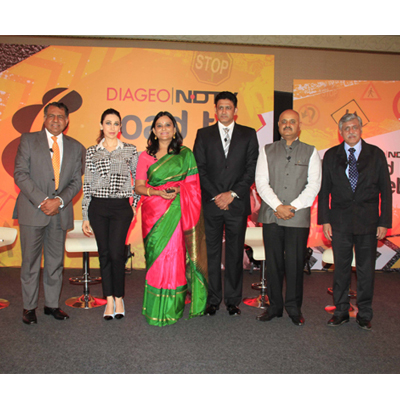
    MUMBAI: Diageo and NDTV have joined hands to launch ‘Diageo-NDTV Road to Safety’ – a campaign aimed at addressing one of the biggest concerns for the Indian government and society today -the appalling state of road safety in our country. The campaign aims to make our roads safer and reduce the number of preventable accidents by encouraging citizens, specially the youth of India, to be more responsible behind the wheel.


    Bollywood actor Karisma Kapoor,, veteran cricketer Anil Kumble and Karnataka Transport Minister Shri Ramalinga Reddy all came together to lend their support to the ‘Diageo-NDTV Road to Safety’ campaign and inspire people to take a pledge to Never Drink and Drive. Also present were Dr. Rohit Baluja, President, Institute of Road Traffic Education and Praveen Sood, IPS, Additional Director General of Police and Principal Secretary, Home, Karnataka.


    Karisma Kapoor expressed her concerns on the state of road safety in the country and said, “I am proud to support the Road to Safety cause. So many lives are lost every year in India due to a casual approach and lack of knowledge about road safety. Initiatives like this will go a long way in educating people about road safety measures and in turn will help save lives.”


    Anand Kripalu, Managing Director of United Spirits (a Diageo group company) said “Diageo and USL are taking the lead to persuade consumers to take responsibility for their actions and put safety first.  Diageo’s Road to Safety initiative is a yearlong program of partnership with government, NGOs and educational institutes to cause a paradigm shift in people’s approach to Road Safety in India.”


    Union Minster for Road Transport & Highways, Nitin Gadkari, said that the Central government committed to improving national and state highways along with changing the law and bringing these in line with international standards. A new Motor Vehicle Act will be introduced in the next session of Parliament. He added that drivers and pedestrians have to take more responsibility for their actions and be aware of the rules of the road; and that suggestions from the public and the use of hi-tech equipment will also help in implementing a safer and healthier driving environment.


    Last year, over 1,37,000 people lost their lives on Indian roads, a number that is shockingly more than the fatalities reported in all our wars put together. Averaging an accident every minute, and a fatality once every 4, Indian roads are some of the most dangerous in the world.


    Launching the initiative Vikram Chandra, CEO, NDTV Group said, “The number of fatalities due to road mishaps is shocking and is a huge issue that we urgently need to address. NDTV has always been concerned about such issues and has tried to find practical solutions for these. We hope that with this campaign we are able to sensitize and educate citizens and create awareness about road safety.”


    The campaign aims to educate and inspire citizens to action by drawing attention to critical issues including lack of safety awareness, public apathy towards accident victims and a widening gap between legislation and enforcement. This campaign will be launched across the country and will address city specific road safety issues.