Tag: NDA government

  • CNBC-TV18 steals the show on the television and digital arena with the most comprehensive coverage of the 2019 Interim Budget

    CNBC-TV18 steals the show on the television and digital arena with the most comprehensive coverage of the 2019 Interim Budget

    MUMBAI: The last budget presented by the NDA government marked the first budget of CNBC-TV18 as an integrated newsroom with comprehensive coverage across TV and the digital space. Over the course of an eventful Friday, CNBC-TV18’s digital avatar was successfully able to elevate and expand the platform’s reach amongst India's growing business audience.

    Shereen Bhan, Managing Editor, CNBC-TV18, said, “CNBC-TV18 continued its dominance on budget day, with the biggest voices from corporate India and the markets analysing the fine print of the budget in real time. Our comprehensive coverage was complemented this year by our digital operations, which provided our audience with more options to access our content. CNBC-TV18’s effort to make the budget accessible to all was bolstered by CNBCTV18.com, which helped our readers get more from the budget."

    In the build-up to the big day, in-depth and extensive pre-budget expectations were covered through an in-depth budget microsite. Subscribers, who keep themselves abreast of the latest happenings, were sent regular newsletter updates of the expectations, verdict and highlights. To help break down the budget that covered a host of diverse sectors, for the uninitiated, budget highlights were made easy to consume via video, text and infographic formats along with WhatsApp alerts through the day. These tools, on the back of effective ideation and execution, coupled with real-time analyses by industry experts, were able to effectively bridge the knowledge gap that existed between the target audience and the budget presented. 

    Binoy Prabhakar, Editor, CNBCTV18.com, commented “CNBTV18.com helps readers stay on top of news and see the corners. Budget 2019, though our first since launch, was no different as we provided our audience with the news and views that matter to them. They benefited from the full power of an integrated newsroom as TV and Digital worked in tandem to provide them breaking news and in-depth analyses to connect the dots about the budget.”

    Ensuring that the audiences don't miss out on a single minute of the budget, delivering updates in real-time was of paramount importance. Live coverage of the budget was achieved via real-time Twitter updates from industry experts in addition to cutting-edge analysis of the Budget in the form of videos and live blogs. Visitors were also able to stream the live television feed of CNBC-TV18 on the website to catch up with the budget on the go. 

    They could access budget highlights and read about reactions from corporates, industry experts and anchors, which offered them an authentic perspective from those involved in their respective sectors. Some of the leading financial experts present as columnists on the platform included Baba Kalyani, chairman and managing director of Bharat Forge, S Naren, ED & CIO, ICICI Prudential AMC, Nilesh Shah, MD & CEO, Kotak Mutual Fund, Niranjan Hiranandani is co-Founder and MD, Hiranandani Group, Ashish Fafadia – Partner – Blume Ventures, Sunil Rohokale – Managing Director and CEO, ASK Group, Sudhakar Sethuraman – Partner, Deloitte India, Rajiv Chugh – Partner & National Leader, Policy Advisory & Speciality Services, EY India and Shishir Baijal – Chairman and Managing Director of Knight Frank India. 

    Also sharing their valuable inputs as guest speakers were Anand Mahindra – Chairman of the Mahindra Group, Deepak Parekh – Chairman of HDFC, Ashok Wadhwa – Group CEO of Ambit Capital and Mark Mobius – Founding Partner of Mobius Capital Partners.

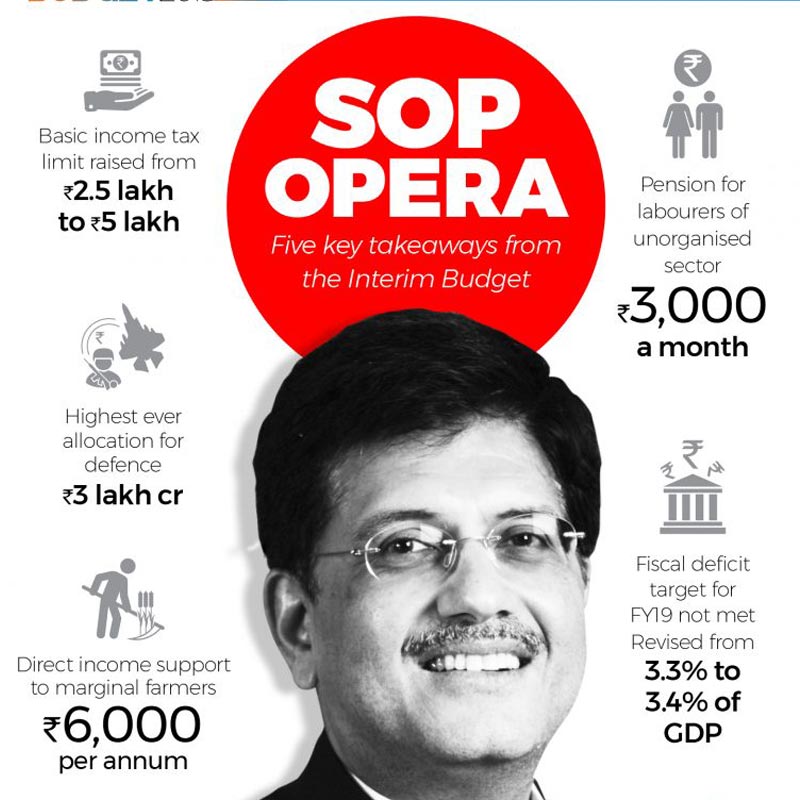
    While Finance minister Piyush Goyal took centre stage as he presented the interim budget on an eventful February 1, CNBC-TV18 too came at the forefront in delivering real-time coverage of the budget via authentic offerings from experts. Having positioned itself as one of the leaders of disseminating reliable information when it comes to business, the platform gave its audiences a truly extensive coverage on a day that played a crucial role in the shaping of the country's future. 

    Ranjita Sehgal, Business Head, CNBCTV18.com added “For years, CNBC-TV18 has held the reputation of the Budget Headquarters of the country. This year, for the Interim Budget 2019, we went a step further and leveraged the strength of a unified newsroom powered by television and digital providing real-time analysis and insights; making CNBC-TV18 the coveted destination for both consumers and advertisers.”

  • BTVi unveils programming series — ‘1100 Days of Modi’

    MUMBAI: The NDA government led by the prime minister Narendra Modi has been in power since May 2016, and nearly 1100 days since then have seen the government take a several significant steps including on the economic front to enhance growth in one of the fastest growing countries in the world.

    In order to take stock of the economic performance of the Modi government, the hits and the misses, Business Television India (BTVi) has begun (at 12 noon-1pm and 9pm-10pm every day) a new series “1100 Days Of Modi” – that includes several shows that highlight multiple aspects of the Indian economy, business and the stock markets. The programming began with a hard-hitting show on why global ratings agencies are not re-rating India despite multiple improvements in the macro-economic framework of the country and put the agencies on the mat for this inexplicable stance.

    Commenting on the special series, BTVi executive editor Siddharth Zarabi said, “The period since May 2014 has been one of significant all round change, with the central government taking numerous steps to fix many vital parts of the economy. The reforms scorecard is pretty impressive and has the potential to propel India to a path of high and sustainable GDP growth.”

    “At BTVI, we are taking stock of the performance so far and are presenting an economic reforms scorecard for our viewers to grasp not just the most recent, but the overall trajectory of economic changes since Modi assumed power. Our coverage is based on the recognition that business TV viewers in India are extremely sophisticated and need more insightful information and intelligent analysis,” Zarabi added.

    Viewers will have the chance to watch engaging discussions between eminent experts around the real and key metrics of India’s economic performance and be able to ascertain the possibilities of new investment opportunities that the recent policy changes offer for both Indian as well as overseas investors. The series remains on air during the coming fortnight.

  • Modi effect: India’s economic confidence upbeat, reports Ipsos

    Modi effect: India’s economic confidence upbeat, reports Ipsos

    MUMBAI: The Lok Sabha elections of 2014 were won on the promise of ‘achhe din aane wale hai’ (good days are going to come).


    And riding on that hope, Indians are very confident that Narendra Modi-led NDA government will carry on making progress on its domestic reforms agenda and encourage investments that will trigger economic growth and create more jobs.
     
    With more than seven in 10 (71 per cent) people expecting that the economy in their local area will be stronger in next six months, makes India the most optimistic country in the world.


    Indians have emerged as the second most confident people about their economy globally by end of 2014. This is on account of falling inflation due to lower oil prices, government’s commitment to contain fiscal deficit, promote investment and economic development, according to a report by global research firm Ipsos.

     
    According to the ‘Ipsos Economic Pulse of the World’ study, India’s economic confidence level has shot up to 81 per cent in December 2014, a very significant rise of 29 points over the past 12 months.

    More than half, 53 per cent Indians believe that the local economy, which impacts their personal finance is good. “The repo interest rate cut by RBI on Thursday from 8 per cent to 7.75 per cent is expected to boost economic confidence and add further momentum to economic growth,” said Ipsos India managing director Amit Adarkar.


    “The decision was primarily guided by dip in inflation, a sharp fall in global crude prices and expectations that the government would be doing enough to keep the fiscal deficit in check,” he added.


    The online Ipsos Economic Pulse of the World survey was conducted in November 2014 among 19,152 people in 24 countries.

     
    The clear winners in economic confidence recovery over the past 12 months in 2014 include India (+29), Great Britain (+19), China (+17), Russia (+12, but with a precipitous slide over the past four months (-18)), Poland (+11), United States (+11), Spain (+10) and Saudi Arabia (+5). The clear losers include Brazil (-11), South Korea (-11), and Argentina (-7).

     
    Those countries with marginal positive movement include Belgium (+2), Italy (+2), Egypt (+1), France (+1), Germany (+1), Hungary (+1) and Mexico (+1). Countries on positive watch include China (although it may have peaked), Great Britain, Poland, Spain and the United States.

     
    Those countries with marginal negative movement include Canada (-1), South Africa (-1), and Turkey (-2). Countries on negative watch include Argentina, Belgium, Brazil and Sweden.


    After showing slight improvement in November 2014, the average global economic assessment of national economies surveyed in 24 countries is down one point as 40 per cent of global citizen’s rate their national economies to be ‘good’.


    Despite two point decline, Saudi Arabia (85 per cent) remains at the top of the national economic assessment in December 2014, followed by India (81 per cent), China (78 per cent), Germany (74 per cent), Canada (67 per cent) and Sweden (67 per cent). At the other end of the assessment, only a small minority rate their national economy as good in France (6 per cent), followed by Italy (8 per cent), Spain (10 per cent), South Korea (11 per cent), Hungary (13 per cent) and Romania (16 per cent).


    Gaining momentum since last sounding, China (63 per cent) takes the lead in the local economy assessment ratings, which impacts people’s personal finance, followed by Saudi Arabia (61 per cent), India (53 per cent), Germany (52 per cent), Canada (47 per cent), Sweden (47 per cent) and Australia (40 per cent). Only one in ten (9 per cent) in Spain agree that the state of the current economy in their local area is ‘good’, followed by Italy (10 per cent), Japan (10 per cent), Romania (10 per cent), France (12 per cent), South Korea (13 per cent) and Hungary (14 per cent).


    Once again, India (71 per cent) holds the lead in the future outlook assessment rating. The rest of the highest-ranking countries are: Brazil (58 per cent), China (53 per cent), Saudi Arabia (50 per cent), Egypt (46 per cent), Argentina (34 per cent) and Mexico (31 per cent). The lowest-ranking country this month is France (4 per cent), followed by Italy (9 per cent), Japan (10 per cent), Belgium (11 per cent), Hungary (11 per cent), South Korea (11 per cent) and Germany (15 per cent).


  • Govt identifies broadband and mobile networks as key growth pillars

    Govt identifies broadband and mobile networks as key growth pillars

    NEW DELHI: The government has identified broadband and mobile networks as the key growth pillars to achieve its targets under the digital India programmme.


    It identified two areas of growth: broadband and mobile in untapped areas where the Telecom Ministry wants to spend more funds. It started allocating more finance for the initiative and the government is trying to achieve its targets in advance.


    The government has enhanced expenditure on broadband network to connect all 2,50,000 village panchayats to Rs 32,000 crore against Rs 20,000 crore approved by the previous government, according to a PTI report.


    The BJP government is also trying to advance deadline to finish roll out of national optical fibre network (NOFN) to December 2016 from the earlier announced date of March 2017.


    Recently, TRAI chairman Rahul Khullar criticised the delay in executing NOFN project, saying private sector companies should be part of such large projects.


    The Indian government has earmarked Rs 16,000 crore to provide mobile connectivity to approximately 42,300 villages that still don’t have any network coverage. The deadline to offer mobile connectivity in these unconnected villages is 2018.


    The BJP government has decided to create national information infrastructure at a cost of Rs 15,686 crore. The project will include integration of existing programmes like the National Knowledge Network (NKN) and NOFN.


    Under the National Rural Internet Mission, government has earmarked fund of Rs 4750 crore to roll out common service centres (CSCs) across 2.5 lakh villages.


    Through CSCs, people in rural area get access to government services like birth certificate, train tickets, pay various fees etc without actually having to visit the concerned office. The CSCs are present at about 1.3 lakh locations.


    Besides this, the union government has earmarked Rs 200 crore to train one crore students in small towns and villages for IT sector jobs over period of next five years.


    UPA government had started NKN to connect 1,500 universities with high speed broadband network.


    The NDA government has decided to provide wi-fi at all universities in the country with an estimated cost of Rs 790 crore by the end of next year.


    Under digital India programme, government has decided to spend Rs 98 crore on secure email, which will now be the primary mode of communications, for official communications.


    At present 10 lakh government employees have been moved to secure email communication and by March 2015 around 50 lakh employees will be moved on to the new system.


    The union cabinet on Wednesday approved the digital India programme that deals with all projects involving IT and communication technology like e-governance and broadband connectivity. The initial cost of the project, to be implemented over the next five years, is estimated at Rs 1,13,000 crore.


    The Digital India programme has various other provisions which include wi-fi hotspots at public places, e-books for schools, national portal for lost and found children, biometric attendance at government offices for which funds are yet to be finalised.

  • Most comprehensive budget analysis on Zee News

    Most comprehensive budget analysis on Zee News

    MUMBAI: With hopes soaring ahead of the Union budget FY 15, Zee News has lined up a series of programmes under the brand of ‘Ab Ki Baar Khush Kar Do Sarkar’ that reflects the aspiration of the common man. The programming will dejargonise the technicalities of the budget. With the focus centered on the aam admi, Zee News seeks to articulate and analyse the Budget for the lowest common denominator and how it’s going to impact their daily lives. Zee News will telecast the pre Budget discussions and analysis from 7AM onwards and will bring in live and uninterrupted coverage of the Finance Minister Budget Speech from 11 AM onwards.   

    With best editorial minds to decipher and analyze the maiden Union Budget of the NDA government, Zee News will bring together leading experts across different fields in India along with policy makers. Through detailed shows, the news channel aims to reach out to every Indian from industrialists to the common man by providing a detailed coverage.

    In its effort to reach the common man, the channel has planned a special live event from Connaught Place from 7pm to 9pm in order to engage the public in a meaningful debate with our anchors and experts. The channel will also beam a live show from the Noida campus of Indian Institute of Management (IIM) Lucknow so as to capture the views of young MBA students on the Budget.

    Mr. Sudhir Chaudhary, Editor, Zee News said, “With all eyes on the much-anticipated Budget, an extensive programming on the budget day has been lined up, which will give our viewers a holistic view on the economy and the impact on their pocket. It will be an opportunity for us to share all the analysis and aspects of the Union Budget.”


    Zee News will also showcase special shows analyzing key policies and schemes of the government and measure their impact on the economy as well as on the pocket of common men. Moreover, the series will capture the expectations of key decision makers following the budget. The special shows will present a comprehensive analysis of the Budgets from a variety of perspectives, and its impact.
    Stay tuned to Zee News for the most credible and accurate analysis of Budget 2014.


  • Interview of Narendra Modi at Zee News

    Interview of Narendra Modi at Zee News

    MUMBAI: Claiming to know the pulse of the nation, BJP Prime Ministerial candidate Narendra Modi took the fight to the enemy camp saying that the foundation for a new government had already been laid.


    He said recent statements by Congress leadership in regard to support likely to a Third Front meant that the party had accepted defeat. “When elections were announced there was talk of a hung Parliament. Now there is talk of support to non NDA government. I am not myself saying anything. Congress statements themselves show that the mother-son government is on the way out and the foundation for a new government has been laid.”


    Commenting on the idea behind the popular BJP’s slogan “Acche din aane wale hain”, Modi said, “While inaugurating Pravasi Bharatiya Sammelan PM Manmohan Singh assured good days will come despite gloomy economic scenario. Next day I had a meeting there where I narrated PM’s slogan and the entire hall burst into laughter. The message was clear.”


    Maintaining his attack on Congress, he said, “Look at all bad things in this country and they all add up to define Congress today. That is why all miss-governance gets identified with Congress. There is negativity all round.”


    Modi, however, sounded optimistic for May 16. “The moment results come out on May 16 we will move out of negativity. The country will take 125 core steps forward. 2014 is an election of hope. Aspiration yields positive energy which leads to growth of the country.”


    Refusing to be drawn further on the issue of ever growing personal attacks, BJP Prime Ministerial candidate said, “We are committed to the slogan of good governance and development. People have liked our pitch.”  To substantiate his view, he cited an earlier instance of good governance. “In 2001 the massive earthquake had devastated Gujarat and within a short span of time the state got back on the development track.”


    However, in response to another question, on heightened attacks on him and BJP by Mamata Banerjee and other regional leaders, he sounded aggressive in his response. “Six phases of polling have already taken place. The mood of the nation is known to everyone. That is why the heightened attack. They have nothing to offer of their own. Their objective is to aim to dislodge him.”


    On how he faced up to the Gandhi troika, he said, “It is not just the Gandhi family. All UPA allies are up against me. It is Modi versus the rest. The irony is that instead of evaluating the performance of their government, they are all auditing Gujarat model.”


    Modi reiterated that his brand of politics revolved purely on development. “I am not in favour of vote bank politics. I am not for communal and caste politics. I oppose them.”


    Citing his own humble background to buttress the point, he said, “Is it a sin to be poor in this country? I come from a poor background but I have never used poverty as a political ploy. I am here today having sold tea in train compartments.” He categorically denied he was in race for power but reiterated his commitment to work towards building a modern India.


    In response to another question on whether he had raised far too many expectations, he said he was no dream seller but had a sense of the pulse of the people of this country. “There has to be a commitment to governance and that is my promise. I have not made any tall claims.” Citing what these steps would be, he quoted the example of sanitation.  “Small steps will make a difference to shed all round negativity. There are no toilets for women in most part of India. This has to change.”     


    Modi said he was like any other citizen and lived life like a commoner. “I am not a robot. I am a common man. I think and act like a common man. I have a commitment to the common man. But I have my own limitations like any other human being.”    


    Evading question on Baba Ramdev’s measures to improve the economy, Modi said, “My expert team will decide about the economic decision. Don’t bring Baba Ramdev in such things”. Was he readying his team ahead of his party’s claim of NDA coming to power, Modi said, “My current KRA is to fight and win the election. I am not thinking of anything else.”


    On stock market rally ahead of elections, he said there had been a needless controversy. Without getting into directly attacking the finance minister, he said, “It is for investing community to respond to as to why it mentions my name and not that of the Prime Minister and finance minister.”