Tag: Narendra Modi

  • MIB directs private TV channels to spread Covid awareness

    MIB directs private TV channels to spread Covid awareness

    NEW DELHI: After showing strong signs of flattening the curve, India is again struggling to bring Covid2019 to heel. On 6 April, the country recorded more than 1,15,000 positive cases; a strong indication that the pandemic has returned with a vengeance. 

    Amid the second wave of Covid cases, the ministry of information and broadcasting (MIB) has written a letter to all private channels, the News Broadcasters Association (NBA), and the Indian Broadcasting Foundation (IBF) urging them to disseminate messages for Covid-appropriate behaviour and vaccination of the eligible age groups to generate greater awareness among people. 

    The ministry's advisory sent to private channels cited a meeting under the leadership of prime minister Narendra Modi on 4 April taking stock of the current pandemic situation in India. During the meeting, it was also decided to focus on a five-fold strategy of testing, tracing, treatment, Covid-appropriate behaviour and vaccine roll-out to curb the spread of coronavirus. 

    "It is, therefore, imperative that all stakeholders take forward the communication strategy with a renewed emphasis on Dawai Bhi, Kadai Bhi (medicines and preventive measures)," said the MIB in its letter. 

    The ministry also lauded the leadership role played by private media houses in spreading messages in the public interesinterest.

    ​​​​"Private TV channels have always been at the forefront of spreading important messages in the larger public interest. It is, therefore, requested that private channels may appropriately disseminate messages for Covid-appropriate behaviour and vaccination of the eligible age group so as to create greater awareness among the citizens of the country," stated the advisory. 

  • ABP News to buzz in 2021 with diverse year-ender shows

    ABP News to buzz in 2021 with diverse year-ender shows

    NEW DELHI: Aiming to dial up the excitement for 2021 after a tumultuous year, ABP News has curated a special programming line-up on new year's eve. After its recent rebranding, the channel is taking another step forward to keep viewers engaged with a host of interesting programmes marking the end of 2020. 

    The channel will be reflecting on the best and memorable moments of 2020 and will also give a sneak peek into how 2021 is going to be. ABP News, which has otherwise tried to remain away from astrology-based shows on it for the past few years, will host a special show called 2021 ka Rashiphal. It will be hosted by renowned astrologer Pawan Sinha. Another special show called Bade logon ke liye kaisa rahega saal 2021 will have different astrologers and numerologists predicting how the year 2021 will turn out to be for 10 big personalities of the country.

    Bringing cheer to viewers whilst bidding adieu, the diverse line-up will include a Comedy Special show which will have the ‘Best of Comedy by Kapil Sharma’ and a discussion with other renowned guests; Kavi Sammelan – another unique show, will mark the presence of Kumar Vishwas and other renowned poets.

    Other interesting shows like Corona Ki Zubaani 2020 Ki Kahani will talk about the Covid2019 pandemic and its impact; 100 Khabrein 100 Reporters will feature 100 reporters of ABP Network narrating different stories of the year 2020; Jai Jawaan Jai Kisaan will be a new year special show on the soldiers and farmers of the country, highlighting their contribution and service to the nation. 

    2020 aur Modi will dissect the journey of PM Narendra Modi and how he navigated the past year; 10 Badi Tasveerien  – a show which will talk about the different aspects of 2020 through 10 big stories; Top Viral – a special programme featuring viral stories of 2020; and Vyakti Vishes will nominate the personality of the year through a five-day viewer engagement poll on social media.

  • Cabinet approves merger of four film units with NFDC

    Cabinet approves merger of four film units with NFDC

    NEW DELHI: The government has given its nod to the merger of four of its film media units with the national film development corporation (NFDC).

    The decision was taken in the Cabinet meeting chaired by PM Narendra Modi on Wednesday. As part of the plan, the four units namely films division, directorate of film festivals, national film archives of India, and children’s film society, India will now operate under the NFDC, which will then carry out all the activities hitherto performed by them.

    While this will lead to rationalisation of infrastructure and manpower, the government highlighted that interests of employees of all the concerned media units will be fully taken care of and no employees will be retrenched. A transaction advisor and legal advisor will be appointed to advise on the transfer of assets and employees, and to oversee all aspects of operationalisation of the merger.

    “There was a lot of duplication in activities and there was a need to bring synergy. However, all the work which is currently underway at each of the units will remain in progress. Our aim is to ensure good films reach masses,” said Union information and broadcasting minister Prakash Javadekar post the meeting.

    India is one of the largest film producers in the world with an industry led by the private sector. Over 3,000 films are produced every year. After the merger, all promotion, production and preservation of film content will come under one management.

    The films division, a subordinate office of the ministry of information and broadcasting, is among the oldest of the four media units. It was formed in 1948 to produce documentaries and news magazines for publicity of government programmes and cinematic record of Indian history.

    Formed in 1964, the national film archives is mainly responsible for acquiring and preserving Indian cinematic heritage, and the directorate of film festivals, set up in 1973, focuses on promoting Indian films and cultural exchange. The children’s film society, India is however, an autonomous organisation formed under the Societies Act in 1955 to specifically provide children and young people value-based entertainment through the medium of films.

    All the four media units will now operate as one unit under the NFDC – the central public sector undertaking  which was formed in 1975 for planning and promoting an organised, efficient and integrated development of the Indian film industry. “The vision of the new entity will be to ensure balanced and focused development of Indian cinema in all its genres – feature films, including films/content for the OTT platforms, children's content, animation, short films and documentaries,” stated the government.

  • Brands pay tribute to ‘The God’ Diego Maradona on Twitter

    Brands pay tribute to ‘The God’ Diego Maradona on Twitter

    NEW DELHI: The sad demise of legendary Argentina football player and manager Diego Maradona has left his fans heartbroken. Popularly known as 'El Dios' or 'The God', Maradona in his international career with Argentina earned 91 caps and scored 34 goals. He is best known for the ‘Hand of God’ goal, and leading his country to victory in the 1986 FIFA World Cup.

    At the peak of his career in the late ‘80s, Maradona also endorsed some of the top brands like Puma and Coca Cola. He breathed his last on Wednesday evening following a cardiac arrest. A number of brands, clubs, and celebs took to social media to pay their condolences on the passing of the maestro.

    Puma


    Greenply Plywood


    Mobile Premier League


    ATK Mohun Bagan FC


    Chennai Super Kings


    Chennaiyin FC

    Embed:


    Delhi Capitals


    Fox Football


    Sony Sports


    Sourav Ganguly


    Narendra Modi


    Robbie Fowler


    Virat Kohli


  • Meet Tooter, the ‘swadeshi’ alternative to Twitter

    Meet Tooter, the ‘swadeshi’ alternative to Twitter

    NEW DELHI: As the ‘Vocal for Local’ initiative putters on and gathers steam, some enterprising individuals have seized the chance to create a swadeshi alternative to Twitter, one of the most popular microblogging platforms in India. Named Tooter (sound familiar?), the social network calls itself the “Swadeshi Andolan 2.0.” In look and feel, it appears to be modelled after Twitter and follows the same mechanics as its source of inspiration.

    Just like one shoots off tweets on Twitter, users of Tooter can post ‘toots’. Users have a profile, can make lists, scroll down a news feed, follow people, and be followed back. Even the colour palette and app icon – a blue conch shell – bear a striking resemblance to Jack Dorsey’s brainchild.

    In its Terms of Service, Tooter stresses that it has been created for 'free speech'. The platform declared it will make the best efforts to ensure that all content moderation decisions and enforcement of terms of service "does not punish users for exercising their god-given right to speak freely."

    Tooter can be used on web browsers, and it has an Android app on the Google Play store, but is missing from the App Store for iOS devices as of now.

    What's more, Tooter is already home to a number of high-profile faces. Prime minister Narendra Modi is already there with a verified account; home minister Amit Shah, Amitabh Bachchan, Virat Kohli, Sadhguru, and the Bharatiya Janata Party are also on the platform. It seems the site has been live since July 2020, but it’s only recently that Tooter went viral on Twitter, the social network it’s hoping to give a run for its money.

    So it should come as no surprise that Tooter’s sudden popularity has catalysed Twitterati to do what they’re the best at – making memes. Some pointed out, tongue-in-cheek, the uncanny similarities between Twitter and Tooter…


    …Others wondered if certain noisy elements will leave the US-based platform in favour of the Swadeshi alternative:


    Though it’s perhaps this person who summed it up best:


    While it will be interesting to see whether Tooter makes it in the long run, or fizzles out like Kimboh, the desi counterpart to WhatsApp, for the moment it has succeeded in creating a buzz.

  • Prime minister Narendra Modi assures all villages to be connected with optical fibre in 1000 days

    Prime minister Narendra Modi assures all villages to be connected with optical fibre in 1000 days

    NEW DELHI: Marking the beginning of the 74th year of independence from the ramparts of the Red Fort on Saturday, prime minister Narendra Modi announced his plans to connect all villages in India with optical fibre cables in the next 1000 days. Lakshadweep too would be connected with submarine optical fibre cable.

    Modi had recently inaugurated the first undersea optical fibre cable project for Andaman and Nicobar Islands.

    He noted that only five dozen panchayats in the country were connected with optical fibre cable before 2014 and in the last five years, 1.5 lakh villages have been provided the facility.

    He took the opportunity to announce a new policy on cyber security, which will soon be unveiled.

  • Galwan Valley skirmish boosts news channels’ viewership in week 24

    Galwan Valley skirmish boosts news channels’ viewership in week 24

    BENGALURU: The Indo-Chinese skirmish at the Galwan Valley in Ladakh on 15 June has grown Hindi news television consumption in Week 24 of 2020 (Saturday, 13 June 2020 to Friday, 19 June 2020, week or period under review) according to Broadcast Audience Research Council of India (BARC) data for top 5 Hindi and English News channels. The combined consumption of the Top 5 Hindi Hews channels in urban and rural Hindi speaking markets or HSM (U+R) and English News in India viewership increased 32.7 percent and 43.3 percent respectively in Week 24 of 2020 as compared to the previous week. Consumption of News on Bangla, Marathi, Oriya, Tamil and Telugu News channels also increased week-on-week in Week 24 of 2020 by varying percentages, while Assamese, Kannada and Malayalam News channels experienced viewership dips.

    And from the dip in viewership of Top 5 Hindi GEC channels during prime time, it seems that news channels have eaten into the viewership of Hindi GEC and movie channels. The combined weekly impressions of the Top 5 Hindi GEC programmes in HSM (U+R) during primetime (1800 to 2330 hours) declined 35.1 percent in Week 24 of 2020 as compared to Week 23. The combined weekly impressions of the Top 5 Hindi movies programmes in HSM (U+R) also declined 12.6 percent during the week under review as compared to the previous week.

    Hindi news in HSM (U+R)

    Hindi news in HSM (U+R) saw combined viewership increase by 32.7 percent week-on-week during the period under review as mentioned above. There were two new channels in BARC’s weekly list of Top 5 Hindi news channels in HSM (U+R) in Week 24 of 2020 as compared to Week 23.  Two channels – ABP News and News18 India exited the list. The India Today Group's Aaj Tak retained its unassailable first rank in Week 24 of 2020 with a 44.2 percent growth in weekly impressions to 295.275 million from 204.732 million. India TV also retained second rank with 31.1 percent growth to 222.917 million weekly impressions from 170.011 million weekly impressions.

    Zee News entered the Top 5 Hindi news channels in HSM (U+R) list with 191.303 million weekly impressions. Republic Bharat dropped a place to fourth rank despite a 24.3 percent growth with 189.378 million weekly impressions in Week 24 of 2020 from 152.387 million weekly impressions in Week 23. TV9 Bharatvarsh also entered the list with 188.800 million weekly impressions.

    Hindi news in HSM (U)

    The Top 5 Hindi news channels in HSM (U) saw consumption increase 30.2 percent week-on-week to 674.607 million weekly impressions from 518.345 million weekly impressions in the previous week. Four of the channels in BARC’s weekly list of Top 5 Hindi news channels in HSM (U) in Week 24 were the same as in the previous week – one channel that exited it was ABP News, which was replaced by Zee News.

    Aaj Tak led the list with 41.1 percent growth to 181.668 million weekly impressions in Week 24 of 2020 from 128.777 million weekly impressions in the previous week. India TV also retained its second place in Week 24 of 2020 with 25.9 percent growth to 143.173 million weekly impressions as compared to 113.737 million weekly impressions. News18 India climbed a place to third rank in BARC’s weekly list of Top 5 Hindi news channels in HSM (U) with 28.7 percent growth to 118.688 million weekly impressions in Week 24 of 2020 from 92.195 million weekly impressions in the previous week. Zee News entered the list in Week 24 of 2020 with 117.349 million weekly impressions. Republic Bharat dropped two places to fifth rank with 21.9 percent growth to 113.729 million weekly impressions from 93.275 million weekly impressions.

    Hindi news in HSM (R)

    The Top 5 Hindi news channels in HSM (R) saw consumption increase 38.8 percent week-on-week to 426.774 million weekly impressions from 307.400 million weekly impressions. Four of the channels in BARC’s Top 5 Hindi news channels in HSM (U) in Week 24 were the same as in the previous week – as in the case of Hindi news channels in HSM (U+R) one channel that exited it was ABP News and was replaced by Zee News.

    Aaj Tak at first rank, saw a growth of 49.6 percent to 113.607 million weekly impressions in Week 24 of 2020 from 75.995 million weekly impressions. TV9 Bharatvarsh climbed up a place to second rank with a 44 percent growth to 83.820 million weekly impressions from 58.214 million weekly impressions. India TV climbed two places to third rank in Week 24 of 2020 with 41.7 percent growth to 79.744 million weekly impressions from 58.214 million weekly impressions.  Republic Bharat dropped two places to fourth rank with 28 percent growth in Week 24 of 2020 to 75.649 million weekly impressions from 59.112 million weekly impressions. Zee News entered the list at fifth rank with 93.594 million weekly impressions.

    English news

    As mentioned above, the Top 5 English news channels saw a 43.3 percent increase to 15.310 million weekly impressions in Week 24 of 2020 from 10.687 million weekly impressions in the previous week. All the five channels in the list in Week 24 of 2020 was the same with shuffling of ranks as in Week 23. Retaining first rank with a 56.5 percent growth to 5.582 million weekly impressions in Week 24 of 2020 from 3.567 million weekly impression was the Arnab Goswami led Republic TV. Also retaining its previous week’s second week with 31.9 percent growth to 3.565 million weekly impressions in Week 24 of 2020 from 2.703 million weekly impressions in Week 23 was Times Now. India Today Television climbed up a place to third rank with a growth of 61.6 percent to 2.389 million weekly impressions in Week 24 of 2020 from 1.478 million weekly impressions in the previous week. CNN News18 dropped a place to fourth rank with a growth of 39.9 percent to 2.272 million weekly impressions in Week 24 of 2020 from 1.624 million weekly impressions in Week 23. DD India also retained its previous week’s fifth rank with a growth of 14.2 percent to 1.502 million weekly impressions in the week under review from 1.315 million weekly impressions in Week 23 of 2020.

  • Modi 2.0: The year gone by for I&B ministry

    Modi 2.0: The year gone by for I&B ministry

    MUMBAI: The ruling Bharatiya Janta Party (BJP) recently completed one year in its second term in office at a time when the world reels under the novel SarsCoV2 crises. Through this year, the government has taken several key decisions and measures which have kept the ministry of information and broadcasting (MIB) busy.   

    Under the leadership of Prakash Javadekar, MIB doled out various significant measures and guidelines that will have a lasting impact on the media and entertainment industry. Here are some key announcements and proposals by the MIB in the past year.  

    OTT industry in self-regulatory mode

    Javadekar stressed on the importance of self-regulation rather than setting up a statutory body for the OTT industry and also assured stakeholders such as Netflix, Amazon Prime, Zee5, MX Player, ALTBalaji, Hotstar, Voot and Jio regarding the same. MIB had asked OTT content players in March this year to set up an adjudicatory body and decide on a code of conduct within 100 days. Most OTT players are in favour of mutually agreeable terms and not an imposing statutory body.

    Fake or fact?

    In 2019, the Press Information Bureau (PIB) decided to fight fake news by setting up a fact-checking unit. Aiming for better communication around the pandemic between citizens and the government, PIB also launched a Covid2019 fact check unit. In addition to that, it launched a Twitter handle, @CovidnewsbyMIB, and started #IndiaFightsCorona to share all pandemic-related updates.

    A year of guidelines, advisories and new policies

    From issuing several guidelines and regulations to implementations of advisories and policies, MIB under Javadekar, had a lot to offer in the past year.

    In June 2019, the ministry issued an advisory to all private television channels to carry end credits of the programmes in the language that they are being telecasted in. The step was an initiative towards promoting Indian languages.

    Following this, MIB announced the implementation of accessibility standard for TV programmes for those with hearing disability. It became mandatory for all news channels to carry at least one programme a day with sign language broadcast and subtitles, while other channels were asked to have at least one show a week with similar features.

    MIB also recently issued draft policy guidelines stipulating that social media platforms with 25 million monthly unique users will be eligible for government ads. Under the new policy, the bureau of outreach will also partake in the bidding process, including buying inventory or space for government messaging. To bring community radios at par with TV channels, Javadekar proposed to raise advertisement air time to 12 minutes from seven minutes.

    The ministry has also been issuing advisories to private satellite TV channels to adhere to the Programme and Advertising Codes as prescribed in the Cable Television Networks (Regulation) Act 1995.

    Staying informed

    In an effort to keep spirits uplifted during the pandemic, the MIB directed broadcasters and distribution platform operators (DPOs) to ensure uninterrupted supply of services to subscribers and to cooperate with other players. It also requested all states and union territories to provide a constant flow of authentic information for the public by ensuring operational continuity of the print and electronic media.

  • News ratings on the decline as lockdown eases

    News ratings on the decline as lockdown eases

    BENGALURU: News is event-driven. Events drive up viewership of news channels. Elections, disasters, pandemics send news channels into a frenzy.  Coverage, debates, breaking news …., the rapid staccato oratory, hyperbole, events dissected from different angles often leaving messy dregs of the matter, all these antics drive viewership up. Now to the cliché. No other event in television history has affected humanity as the advent of Covid2019 or COVID-19 as most call it. 

    The pandemic that this virus has caused has resulted in the largest lockdown in human memory. People stayed at home, worked from there, for there and at there. Commutes to anywhere were suddenly recent memory. Movie halls closed, business, sporting and other entertainment events were canceled as humanity sought shelter in the precincts of home. World economy, economy of countries and states and cities and places took a nosedive as manufacturing, all business, all economic activitiesalmost completely halted. The stock markets, of course, did function and they too went into steep falls, and then recovered with each bit of ‘positive’ news, but they are nowhere near the highs’ of just a few months ago.

    The time saved from commuting and the spare time culminated into television, media and entertainment consumption binges like never before. And the shortage of surrealism that soaps created, because fresh content was not being produced, led to viewership increases of channels and genres that had never ever experienced the kinds of viewership peaks that they did during the COVID2019 weeks. News, movies, mythology, classics were tried and tested as the media and entertainment industry tried to offer apprehensive audiences some solace, some time away from reality. Television viewership, reach, average time spent (ATS) rose probably like never before. GECs’ lost viewership share to News and Movies channels, but quickly regained some of the lost eyeballs by airing movies, mythology and classics. Pubcaster network Doordarshan or DD made a viewership coup, a killing of sorts, by airing the original Ramanand Sagar made Ramayanand the B R Chopra made Mahabharat as well as classics from the late eighties and nineties of the previous century. 

    Many celebrities including heads and leaders of a few nations contracted the virus. A few succumbed to it. People wanted to know what was happening. Am I safe? Are my family, my parents, my elders, my siblings, my siblings, my pals safe? Could humanity survive the pandemic? Was there a cure, was there a vaccine? News consumption on the ‘idiot box’, on the smart phone, on the laptop or a digital computing device exploded. News on newspapers was often a no-no as some people feared contracting the virus by touching the surface of the newspaper that has to go through so many hands before it is delivered for the reading over a breakfast or a ‘cuppa’. 

    Overall news consumption on television trebled to 21 per cent of total television consumption in Week 13 of 2020 as compared to the average consumption between weeks 2 and 4 of 2020 according to Broadcast Audience Research Council of India and Nielsen (BARC-Nielsen) Reports. This was the first full week of the All India Lockdown, or Lockdown 1.0 as it is now called, that commenced on 25 March 2020, which by the way, was just after midway into Week 12 of 2020. BARC-Nielsen have standardized the average data for weeks 2 and 4 of 2020 as the Pre-COVID-19 reference point in their reports.

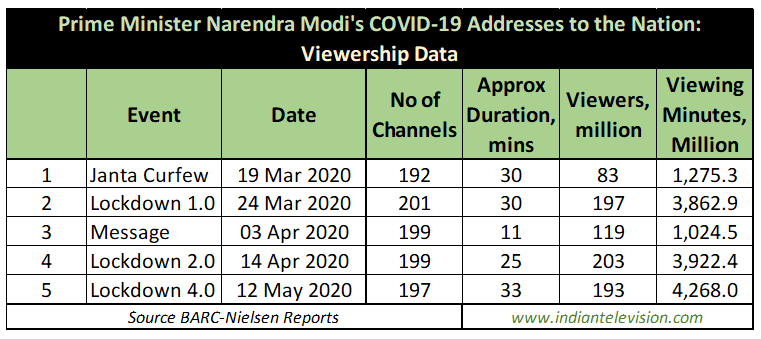
    Week 12 by itself saw Television News viewership surge past the normal – this was the week in which India had the Janata Curfew first and then the announcement of the first All India lockdown by prime minister Narendra Modi. Now a digression – Modi has been one of the biggest viewership draws for News Television, and every time he appeared on television during the lockdown weeks, television consumption lineswent completely off even the new charts!

    Please refer to the chart below for Viewership data of the 5 Addresses that Prime Minister Modi has made to the Nation pertaining to COVID-19 (COVID2019) until the time of writing of this paper.
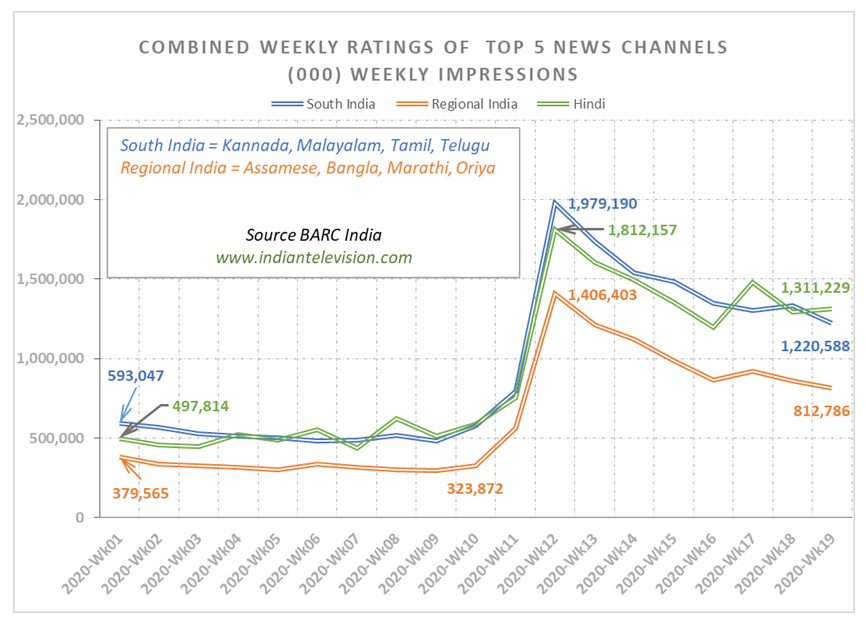
    News Television ratings rose phenomenally in the week leading to and during the lockdown period. Overtime, as Indians got used to the idea that staying at home was the one option that would keep them safe from the disease, television viewership started petering down. Events that were out of normal resulted in small spikes in the already ballooned viewership. The chart below shows viewership data of Top 5 News channels for nine of the ten languages for which BARC provides on a weekly basis for Week 1 to 19 of 2020. To make things easier, the author has combined viewership of top 5 News channels in Kannada, Malayalam, Tamil and Telugu News channels into South India, and the combined viewership of Top 5 News channels in Assamese, Bangla, Marathi and Oriya into Regional India. 

    Per capita news consumption in South India and other regional markets is higher than in the overall Hindi Speaking Market or HSM. BARC defines HRM as All India excluding the South Indian states of Karnataka (Kannada); Kerala (Malayalam); Tamil Nadu and Puducherry (Tamil); and Andhra Pradesh and Telangana (Telugu). TV penetration in South India is also higher than the rest of the country. 

    As is obvious from the viewership trends of the Top 5 Channels from the chart below, News consumption in the country in the weeks after Week 13 of 2020 is lower. 

    Using the BARC-Nielsen base of average data for Week 2 to 4 of 2020, the All India average for the combined weekly impressions of Top 5 channels for 10 languages (nine mentioned above and English) works out to 1,338.614 billion weekly impressions. As is obvious from the viewership trends of the Top 5 Channels from the chart below, News consumption in the country in the weeks after Week 13 of 2020 is lower. 

    Week 12 of 2020 saw the highest consumption of television news across India until the writing of this paper at 5,203.690 million weekly impressions or 388 per cent of the pre-COVID-19 weeks average. This was followed by Week 13 of 2020 with 4,558.658 combined weekly impressions of the top five channels in 10 languages, or about 341 per cent of the pre-COVID-19 week’s average.

    Week 18 saw All India News viewership of top 5 channels of the 10 languages drop to 3,499.652 million weekly impressions or 261 per cent of the pre-COVID-19 weeks average. Week 19 of 2020 has seen a further drop to 3,357.073 million weekly impressions or 251 per cent of the pre-COVID-19 weeks average.
    Economic stagnations and declines have forced governments across the world to slowly recommence trade, businesses, at least within their own boundaries in a limited way with a number of restrictions. As humans slowly restart work and start and learn to adapt, there will be less and less time for television consumption. At present, a lot of people across the globe, including Indians, are still continuing to work from home. And as a matter of fact, the so called ‘new normal’ which has yet to take a definite shape, may enclose work at home for many businesses and services. The world is likely to work quite differently at least until the pandemic dies out, or there is a cure for it or there is a vaccine or maybe all the three or some other combination of these options and or new ones. Media and Entertainment consumption, which includes news is likely to be quite high, higher anyway that during the pre-COVID-19 period.
     

  • Are we ready for vocal for local?

    Are we ready for vocal for local?

    NEW DELHI: As the country transitioned into the fourth phase of Covid2019 lockdown, prime minister Narendra Modi in his effervescently charming manner stood on the national podium asking citizens to go “Vocal for Local” for building an “Aatmnirbhar Bharat” (self-reliant India), on 12 May. He also announced a stimulus package of Rs 20 lakh crores for the economy to realise this aspiration.

    Following his address, union minister of finance Nirmala Sitharaman spelt out a list of reforms and reliefs, utilising the huge stimulus package, including a change in the definition of MSMEs, the introduction of collateral-free loans for the sector, injection of liquidity in DISCOMs, and liquidity support for farmers.

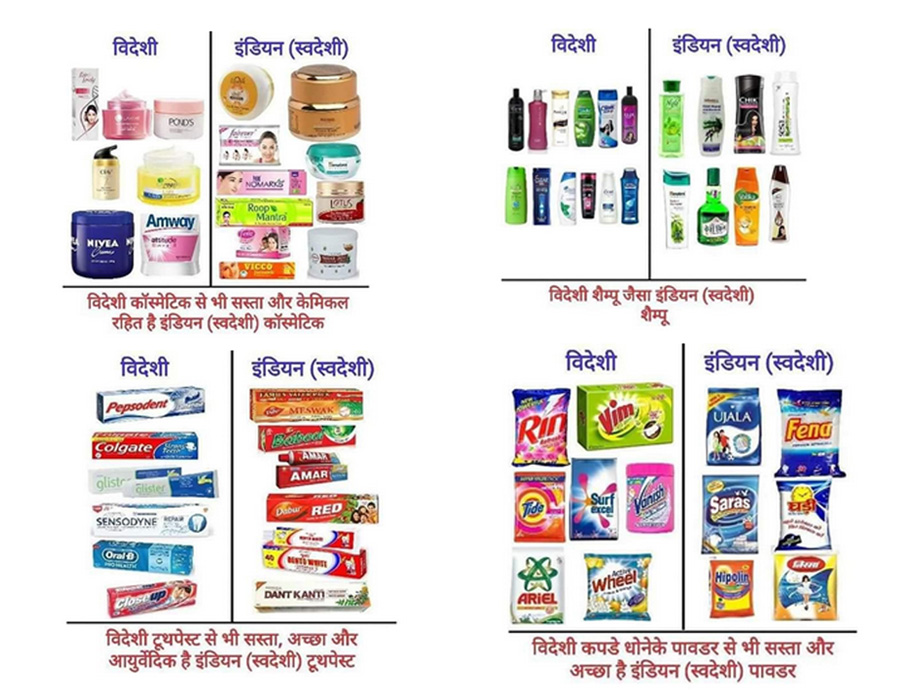
    As expected, social media was abuzz with posts supporting the call for using local products, some also sharing a detailed list of global vs ‘swadeshi’ FMCG products.

    Praising this move of the government, chartered accountant and AnBac Advisors founder Anuj Bali told Indiantelevision.com, “This is a great initiative taken by the Indian government as it is going to help us in building a stronger economy and also positively balance our imports with exports.”

    He added that the way the prime minister has approached the public with the idea is also a great stimulator. “He has presented it like he had come up with the Swacch Bharat Abhiyan, motivating people to start living the movement.”

    However, while the idea of going local and creating a self-reliant India has appealed greatly to the masses and industrialists, there are some structural issues, which the governments will have to address.

    DigitalKites SVP Amil Lall says, “Going local helps any economy to grow but first we need to check if we are ready for it. For example, if we talk of mobile manufacturers or automobile manufacturers in India, we will still have to import the spare parts, as such facilities are far from realisation here. Brands like Lava, while being Indian, have their research and development departments based in China.”

    Bali shared similar views as he said, “Yes, the government needs to intervene at core levels, apart from introducing financial stimulus. There are a lot of bureaucratic issues as well when it comes to acquiring land for businesses and setting up factories, which needs to be addressed.

    He added, “We also need some intervention in the education sector to develop research appetite in our students.”

    Economic experts noted that it is not very feasible to achieve this target of going completely local, given the current status of India.

    Retired professor Satish K Jain, who has served institutions like JNU, shared, “It is a good idea but I think we are not really prepared it (using only local brands). You need to have proper infrastructure, rules and regulations should be easy, bureaucracy should be efficient, and there should be enough local expertise in place, all of which is lacking right now. Our infrastructure also is not developed to achieve this.”

    TERI School of Advanced Studies vice-chancellor (Actg) Manipadma Datta said, “India is facing a demand-side crisis right now, but with this, we are making it look like a supply-side challenge. Even before the lockdown, we saw how automobile manufacturers were struggling as there was no demand. In addition to this, our manufacturing index and agricultural index has been falling rapidly.”

    He added that another problem facing the Indian business sector right now is the unorganised labour class, which comprises 24 per cent of the workforce. “They have had a very traumatic experience because of Covid2019 and it will take time for them to get over it.”

    Both Datta and Bali noted that the economy will grow only when all people have money in their hands and the government needs to address the liquidity issues for the consumers as well.

    All of them agreed that a rework on labour laws, already in process, simplification of bureaucratic processes, and investment in research & development facilities are needed to achieve this goal, and that seems like an extension of ‘Make In India’ mission.

    However, Datta left us with a question around how feasible and sensible is it to make a local economy in a highly globalised world. “Look at Singapore. That is a very small nation, doesn’t have enough land to put factories and relies on international facilities. Yet, it is one of the most advanced regions, not just in Asia, but globally. So, why do we really need a local approach to be self-reliant?”