Tag: Narendra Modi

  • Narendra Modi speaks to Fareed Zakaria on India’s world relations

    Narendra Modi speaks to Fareed Zakaria on India’s world relations

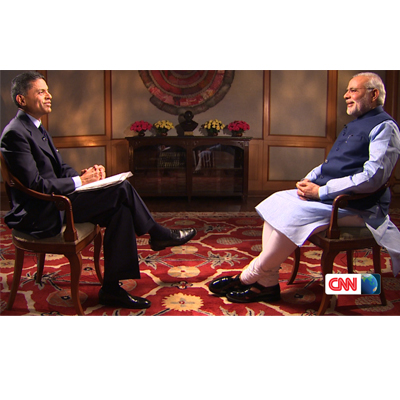
    MUMBAI: Narendra Modi’s much awaited interview with CNN International took place on 21 September 2014. Here is the transcript of the interview with CNN’s Fareed Zakaria.


    Fareed Zakaria, Host, CNN GPS: Prime Minister thank you so much for doing this.


    Narendra Modi, Prime Minister, India:  Thank you.


    Zakaria: After your election people have begun asking again a question that has been asked many times for the last two decades, which is, will India be the next China. Will India be able to grow at 8-9% a year consistently and transform itself and thus transform the world?


    Modi: See, India does not need to become anything else. India must become only India. This is a country that once upon a time was called ‘the golden bird’. We have fallen from where we were before. But now we have the chance to rise again. If you see the details of the last five or ten centuries, you will see that India and China have grown at similar paces. Their contributions to global GDP have risen in parallel, and fallen in parallel. Today’s era once again belongs to Asia. India and China are both growing rapidly, together.


    Zakaria: But people would still I think wonder can India achieve the kind of 8 & 9% growth rates that China has done consistently for 30 years and India has only done for a short period.


    Modi: It is my absolute belief that Indians have unlimited talent. I have no doubt about our capabilities. I have a lot of faith in the entrepreneurial nature of our 1.25 billion people. There is a lot of capability. And I have a clear road-map to channel it.


    Zakaria: China’s behavior in the East China Sea and the South China Sea over the last two years has worried many of its neighbors. The head of the governments in Philippines and Vietnam have made very sharp statements worrying about it. Do you worry about it?


    Modi: India is different. It is a country of 1.25 billion people. We can’t run our country if we get worried about every small thing. At the same time, we can’t close our eyes to problems. We are not living in the eighteenth century. This is an era of partnership. Everyone will have to seek and extend help mutually.  China is also a country with an ancient cultural heritage. Look at how it has focused on economic development. It’s hardly the sign of a country that wants to be isolated.  We should have trust in China’s understanding and have faith that it would accept global laws and will play its role in cooperating and moving forward.


    Zakaria: Do you look at China and feel that it has been able to develop as fast as it has, really the fastest development in human history, because it is an authoritarian government, because the government has the power to build great infrastructure, to create incentives for investment. Do you look at that and think to yourself that that would be — that there is a price to democracy that you have to do things a little bit more slowly.


    Modi: If China is one example, then democratic countries provide another example. They have also grown fast. You can’t say that growth is not possible because of democracy.  Democracy is our commitment. It is our great legacy, a legacy we simply cannot compromise. Democracy is in our DNA.


    Zakaria: So you don’t look at the power of the Chinese government and wish you had some of that authority.


    Modi: See, I have seen the strength of democracy. If there were no democracy then someone like me, Modi, a child born in a poor family, how would he sit here? This is the strength of democracy.


    Zakaria: From the strength of democracy to the strength or weakness of the crucial relationship between the US and India. Mr. Modi goes to the White House next week.  This after he was actually banned from even stepping on U.S. soil for many years. How does he see relations between the two nations?  Also, I ask about India’s recent record of terrible crimes against women. The Prime Minister will tell me what his government intends to do about it.


    ..BREAK..


    Zakaria: And we are back with more of my exclusive interview with India’s Prime Minister, Narendra Modi. Next week, he will make his first trip to the White House, warmly welcomed by the Obama administration. That’s quite a turnaround for a man who was placed on a blacklist by the George W. Bush administration in 2005 and, for many years, denied a visa to enter the United States. The ban stemmed from an incident in 2002, when he was chief minister of India’s state of Gujarat. Modi was criticized for failing to quell riots there, riots that, according to a U.S. government report, killed more than twelve-hundred people, the majority of the dead were Muslim.  Modi is Hindu.  Modi has been exonerated three times by India’s Supreme Court, notes the New York Times.  The Obama administration reversed the ban and has been courting Modi actively. Has Modi any qualms about warmer ties with India? I asked him.


    Zakaria: There are many people in the United States and some in India who wish that the United States and India were much closer allies. The world’s oldest democracy, the world’s biggest democracy, but somehow that has never happened and there have always been these frictions and difficulties. Do you think it is possible for the United States and India to develop a genuinely strategic alliance?


    Modi: I have a one word answer: Yes. And with great confidence I say “yes”. Let me explain. There are many similarities between India and America. If you look at the last few centuries, two things come to light. America has absorbed people from around the world and there is an Indian in every part of the world. This characterizes both the societies. Indians and Americans have coexistence in their natural temperament. Now, yes, for sure, there have been ups and downs in our relationship in the last century. But from the end of the 20th century to the first decade of the 21st century, we have witnessed a big change. Our ties have deepened. India and the United States of America are bound together, by history and by culture. These ties will deepen further.


    Zakaria: So far in your contacts with the Obama administration, you have had several cabinet members come here. Do you feel that there is a genuine desire from Washington to try to upgrade the relationship with India substantially?


    Modi: Relations between India and America should not be seen within the limits of just Delhi and Washington. It’s a much larger sphere. The good thing is that the mood of both Delhi and Washington is in harmony with this understanding. Both sides have played a role in this.


    Zakaria: With regard to Russia’s action in Ukraine. India has not been particularly active.  Do you, how do you view Russia’s annexation of the Crimea.


    Modi: Firstly, whatever happened there, innocent people died in a plane accident. That’s very saddening. These are not good things for humanity in this age. There is a saying in India that the person who should throw a stone first is the person who has not committed any sins. In the world right now, a lot of people want to give advice. But look within them, and they too have sinned in some way. Ultimately, India’s view point is that efforts need to be made to sit together and talk, and to resolve problems in an ongoing process.


    Zakaria: One of the areas that India has come on to the world scene or people have read about and heard about it, which has been unfortunate has been violence against women. This issue of rape. Why is it do you think that there is this problem of, it seems persistent discrimination and violence against women in India and what do you think can be done about it?


    Modi: Look, us political pundits shouldn’t tangle ourselves up in knots by searching for the root cause of this problem. More damage is done by statements from political pundits. Dignity of women is our collective responsibility. There should be no compromise in this matter. There should be no erosion in the law and order situation. We have to revive the family culture in which a woman is respected and considered equal, her dignity encouraged. The main thing here is girl child education. By doing so the possibility of empowerment will increase. On August 15, my government pushed ahead a movement called: educate the girl, save the girl.


    Zakaria: Next on GPS, the head of al Qaeda says he’s opening a franchise in India. What does Prime Minister Modi have to say about that? I’ll ask him.  Also, when you lead 1.25 billion people, the pressures mount.  How does Mr. Modi relax? You’ll find out, when we come back.


    ..BREAK..


    Zakaria: Earlier this month, Osama bin Laden’s successor as head of Al Qaeda – Ayman Al-Zawahiri – announced in an almost-hour long video that the terror organization was going to open a new branch in India. India’s Muslims are a minority – just over 13 percent of the population, versus more than 80 percent of the population that is Hindu. And, thus far, the cause of “jihad” amongst that Muslim minority in India hasn’t taken off at all, certainly not as it has across the border in Pakistan. At a time when terror is atop the headlines, I wanted to get Mr. Modi’s thoughts on al Qaeda’s plans for his country.


    Zakaria: Ayman al-Zawahiri the head of al Qaeda has issued a video and an appeal trying to create an al Qaeda really in India. In South Asia he says but the message was really directed towards India and he says he wants to free Muslims from the oppression they face in Gujarat, in Kashmir. Do you think, do you worry that something like this could succeed?


    Modi: My understanding is that they are doing injustice towards the Muslims of our country. If anyone thinks Indian Muslims will dance to their tune, they are delusional. Indian Muslims will live for India. They will die for India. They will not want anything bad for India.


    Zakaria: Why do you think it is that there is this remarkable phenomenon that you have a 170 million Muslims and there seem to be almost no or very few members of al-Qaeda. Even though al-Qaeda is in Afghanistan and of course there are many in Pakistan. What is it that has made this community not as susceptible?


    Modi: Firstly, I am not the authority for doing a psychological and religious analysis on this.  But the question is, whether or not humanity should be defended in the world? Whether or not believers in humanity should unite? This is a crisis against humanity, not a crisis against one country or one race.  So we have to frame this as a fight between humanity and inhumanity. Nothing else. 


    Zakaria: A year or two from now, what would you like people to say, that these are the things Narendra Modi has managed to accomplish in terms of actions in office.


    Modi: See the biggest thing is that the people of the country have faith. That trust should never break. If I can win the confidence of the people of India, not from my speeches, but by actions, then the power of 1.25 billion Indians will come together to take the country forward.


    Zakaria:  One final question. How do you relax? What do you enjoy doing when you are not working?


    Modi: Look, I’m not the “not-working” type. I derive pleasure from my work. Work gives me relaxation too. Every moment I am thinking of something new: making a new plan, new ways to work. In the same way that a scientist draws pleasure from long hours in the laboratory, I draw pleasure in governance, in doing new things and bringing people together. That pleasure is sufficient for me.


    Zakaria: Do you meditate? Do you do Yoga?


    Modi: I’m fortunate that I was introduced to the world of yoga. That has been very useful to me. I always advise everyone to make this a part of their lives


    Zakaria: You gave a long speech about the benefits of Yoga. Explain what you see them as.


    Modi: See, sometimes we notice our mind works on one thing, the body on another, and time brings us in conflict. Yoga synchronizes the heart, the mind, and the body. That is Yoga.


    Zakaria: And that was Narendra Modi, the new prime minister of India in his first interview in office.
  • Narendra Modi speaks to CNN’s Fareed Zakaria

    Narendra Modi speaks to CNN’s Fareed Zakaria

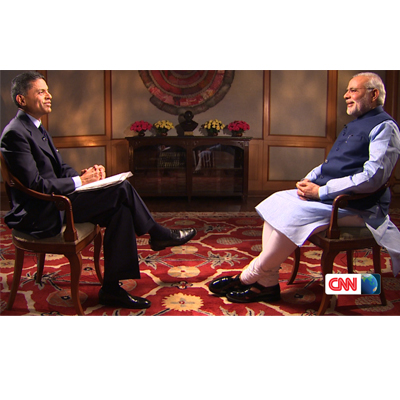
    MUMBAI: India’s Prime Minister Narendra Modi has been touring Asia over the last few weeks. In a first interview that will introduce him to the world audience, Modi has given an interview to CNN International’s show Fareed Zakaria GPS.


    The interview was taped on Saturday 13 September at the Prime Minister’s official residence at 7 Race Course Road in New Delhi and will go on air on 21 September. It will mark Modi’s first global interview after being elected as the Prime Minister of India.    


    During the interview, Modi will be discussing a wide range of topics such as India’s economic growth, relations with China and the United States, terrorism and much more.


    In India the interview will be first telecast at 4:30 pm on 21 September.  This will be further followed by a repeat on 22 September at 7:30am.


    Before being elected as the PM, Modi had created a lot of hype among the media fraternity with his choice of channels to speak to. This included ETV Gujarati, Times Now, India TV, Aaj Tak, CNBC Awaaz, NewsX, News 24 etc.


    This will be Modi’s first interview after assuming charge. He has kept the media at arm’s length since May 2014.

  • I&B Ministry explains to PMO its reasons for postponing digitisation dates

    I&B Ministry explains to PMO its reasons for postponing digitisation dates

    NEW DELHI: The Information and Broadcasting Ministry feels that digitisation is a tool to empower the people and not create difficulties, and therefore does not agree that it will create any setback to the Digital India Plan.


    Ministry sources told indiantelevision.com that this had been conveyed by the Ministry to the Prime Minister’s Office (PMO) in response to the communication to PMO by Telecom Regulatory Authority of India chairman Rahul Khullar.


    The sources also pointed out that the pace of digitisation had slowed down over the past year due to lack of adequate publicity and paucity of fund allocation. 


    The Ministry said cable TV digitisation was only a small though major part of Digital India.


    The main purpose was not to delay digitisation of cable television networks but to encourage greater indigenisation of both set top boxes and other equipment, the sources informed.


    The dates proposed by the Ministry were only the outer limit and every effort would be made to ensure digitisation of cable TV is achieved before that. It was also pointed out that the consumer’s capacity to pay was of great importance in the last two phases which were reaching out to semi-urban or rural areas.


    It was also emphasised that TRAI was being consulted on the proposal about the new dates and the views of the regulator would be taken into account.


    Khullar in his note to the PMO has said staggering implementation of the cable TV digitisation plan will be a major setback to the Digital India plan.


    He said, “For the last six months, we have been working on phase-III and phase-IV. If implementation is now staggered, it will be a body blow to the project, primarily because momentum will be lost and it is truly very difficult to enforce compliance countrywide.”


    Under the current plan, the third phase of the cable TV digitisation plan is expected to end on 30 September, and phase IV by 31 December this year, while the Ministry feels the new dates should be December 2015 and December 2016 respectively.


    “Should this happen, it will be a major setback to digitisation in the country. Further, a huge effort was made by TRAI to enforce compliance. We encountered significant difficulties in ensuring that phase I and phase II were effectively completed,” the TRAI chief wrote.


    There are 100 million homes with cable TV connection of which 20 million are digital. In addition, there are 56 million DTH homes. This is more than the fixed line telephony subscriber base. Digitisation would enable cable TV networks to be used for two-way communications, a pre-requisite for internet services.


    TRAI said that digitisation offers much cheaper means of providing broadband to consumers compared to the National Optical Fibre Network project, which aims to roll out fibre cables across the country as broadband is the main supplier of TV signals in all developed countries. 

  • 100 days of the I&B Ministry

    100 days of the I&B Ministry

    NEW DELHI: The Narendra Modi led NDA government has completed 100 successful days in power. And in these days, the Information & Broadcasting (I&B) Ministry has done its bit to woo the Media and Entertainment industry.


    Listing the achievements was I&B Minister Prakash Javadekar, through a press meet in Delhi.


    The government is launching a new 24×7 channel for the northeast called Arun Prabha in order to provide a strong platform for expression of cultural identities and for creating greater awareness regarding the region.


    Even as a Task Force has been constituted to steer the remaining two phases i.e. phase III and phase IV of digitisation in India, the government has made efforts towards fulfilling the long pending demand of domestic manufacturers of Set Top Boxes to get tax concession (C Form benefit) in order to compete with imported STBs.


    He said this will pave the way for implementation of digitisation initiative in India and see digitisation of about 80 million Cable TV homes in India. It is also a step towards the Prime Minister’s dream of a Digital India as digitisation will enable quick penetration of broadband connectivity in India.


    The Minister talked of initiatives taken in different sectors aimed at enhancing the outreach of policies and programmes across platforms. Some of the initiatives undertaken have been innovative involving people’s participation, enhancing government’s presence on the social media platforms and strengthening communication at the grassroots.


    He said Rs 100 crore had been allocated to Kisan Channel, which will disseminate real time information to the farmers regarding new farming techniques, water conservation, organic farming etc.


    In order to facilitate Ministries/Departments in registering their presence on social media the Ministry had organised a half day training workshop on 11 July.


    The Telecom Regulatory Authority of India (TRAI) has on the request of the Ministry given recommendations on migration of FM Radio Broadcasters from phase-II to phase-III which is under examination.


    Goa has been declared the permanent destination for the International Films Festival of India to develop the “Brand IFFI” on the lines of other International Film Festivals. Although the decision to move IFFI to Goa was taken in 2004 when the National Democratic Alliance was in power, a fresh Memorandum of Understanding was being signed year-to-year for the Festival.


    The three-day North East Film Festival held in Delhi recently will henceforth be an annual feature organised by the Directorate of Film Festivals.


    The Film and Television Institute of India and the Satyajit Ray Film and TV Institute are to be institutes of National Importance and an Act of Parliament will be passed for this. The proposed Bill would enable both the Institutes to award its own degrees and diplomas and start new activities on the lines of IITs and IIMs.


    The office of the Registrar of Newspapers for India (RNI) has streamlined its Single Window Public dealing mechanism at its office. RNI has achieved 100 per cent success in online e-filing of annual statements by publishers for 2013-14.


    Under the Rs 100 crore set aside for “Supporting Community Radio Movement in India,” 600 community radio stations will be set up across the country in the 12th Five Year Plan. This major initiative of the new government will strengthen the link with the population living in rural and marginalized areas.


    The Home Ministry has agreed to the proposal of the Ministry for not seeking security clearance for such channels whose security clearance have already been sought earlier along with the Board of Directors. This decision has paved the way for speedy clearance of additional television channel permissions, which will benefit the broadcast industry in a big way.  After the decision was taken, 23 TV channels have already been permitted by the Ministry.


    The proposal has been cleared for Rs.600 crore National Film Heritage Mission (NFHM) to preserve India’s film legacy by the Expenditure Finance Committee in the Finance Ministry. The draft Cabinet Note has been circulated to the concerned Ministries and the Note will shortly be submitted for approval of the Cabinet.


    To ensure people’s participation in Government Advertising through Crowd-Sourcing of Advertisements, the advertisement for important events are to be designed by the people. The Independence Day advertisement designed on these lines and DAVP has invited suggestions for the proposed advertisement to be brought out on 5 September to observe “Teachers Day”.


    For Independence Day, the advertisements were crowd sourced for the first time and Independence Day coverage was extended to all media platforms. Similarly, a series of press conferences being organised to highlight the initiatives of the Government and the same approach is being adopted to ensure information dissemination across all platforms.

  • CNN-IBN & IBN’s offerings to review 100 Days of Modi

    CNN-IBN & IBN’s offerings to review 100 Days of Modi

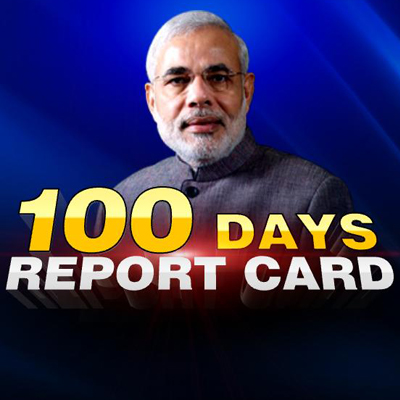
    MUMBAI: As Prime Minister Narendra Modi’s Government completes 100 days in office on 3rd September 2014, CNN-IBN & IBN7 line up an extensive array of special programming, ‘100 Days – Report Card’ and ‘Saikada Paar Modi Sarkar’ respectively. The channels are airing a slew of special shows analyzing the performance of the Government & PM Modi’s leadership in all its hues. Through these studio based discussions, interviews and shows the channels are highlighting the various facets of the new Government from the perspective of a common man, Ministers and MPs.

    This gamut of special programming will culminate in special shows based on a nationwide 16 city poll, conducted by Today’s Chanakya which will analyze and assess the performance of PM Modi and his Government. With an expert panel comprising of top analysts such as N. Ram, Swapan Dasgupta, Vinod Mehta & Shankkar Aiyar on CNN-IBN and G Parthasarthy, Nilanjan M and Prof. Pushpesh Pant on IBN7, the channels will discuss if the Government has delivered on a plethora of issues like corruption, inflation, economy, communal harmony & foreign policy.

    Don’t miss the special shows on the findings of this survey on September 2 & 3 at 8pm on CNN-IBN and at 9pm on IBN7.

  • Govt identifies broadband and mobile networks as key growth pillars

    Govt identifies broadband and mobile networks as key growth pillars

    NEW DELHI: The government has identified broadband and mobile networks as the key growth pillars to achieve its targets under the digital India programmme.


    It identified two areas of growth: broadband and mobile in untapped areas where the Telecom Ministry wants to spend more funds. It started allocating more finance for the initiative and the government is trying to achieve its targets in advance.


    The government has enhanced expenditure on broadband network to connect all 2,50,000 village panchayats to Rs 32,000 crore against Rs 20,000 crore approved by the previous government, according to a PTI report.


    The BJP government is also trying to advance deadline to finish roll out of national optical fibre network (NOFN) to December 2016 from the earlier announced date of March 2017.


    Recently, TRAI chairman Rahul Khullar criticised the delay in executing NOFN project, saying private sector companies should be part of such large projects.


    The Indian government has earmarked Rs 16,000 crore to provide mobile connectivity to approximately 42,300 villages that still don’t have any network coverage. The deadline to offer mobile connectivity in these unconnected villages is 2018.


    The BJP government has decided to create national information infrastructure at a cost of Rs 15,686 crore. The project will include integration of existing programmes like the National Knowledge Network (NKN) and NOFN.


    Under the National Rural Internet Mission, government has earmarked fund of Rs 4750 crore to roll out common service centres (CSCs) across 2.5 lakh villages.


    Through CSCs, people in rural area get access to government services like birth certificate, train tickets, pay various fees etc without actually having to visit the concerned office. The CSCs are present at about 1.3 lakh locations.


    Besides this, the union government has earmarked Rs 200 crore to train one crore students in small towns and villages for IT sector jobs over period of next five years.


    UPA government had started NKN to connect 1,500 universities with high speed broadband network.


    The NDA government has decided to provide wi-fi at all universities in the country with an estimated cost of Rs 790 crore by the end of next year.


    Under digital India programme, government has decided to spend Rs 98 crore on secure email, which will now be the primary mode of communications, for official communications.


    At present 10 lakh government employees have been moved to secure email communication and by March 2015 around 50 lakh employees will be moved on to the new system.


    The union cabinet on Wednesday approved the digital India programme that deals with all projects involving IT and communication technology like e-governance and broadband connectivity. The initial cost of the project, to be implemented over the next five years, is estimated at Rs 1,13,000 crore.


    The Digital India programme has various other provisions which include wi-fi hotspots at public places, e-books for schools, national portal for lost and found children, biometric attendance at government offices for which funds are yet to be finalised.

  • “We hope Brandz study will propel other brands to become like the top 50”: Prasun Basu

    “We hope Brandz study will propel other brands to become like the top 50”: Prasun Basu

    WPP CEO Sir Martin Sorrell calls him the data analyst expert.  Prasun Basu’s relationship with WPP’s brand, media and communications research company Millward Brown, goes back a couple of years.


    In 2013, two years after he joined Millward Brown as managing director of East Africa operations, he was elevated as managing director south Asia region. A frequent presenter and writer for many journals, publications and seminars, he co-authored the article ‘The New Indian Consumer’ published in the Harvard Business Review in 2006, and ‘The Curve-fitting Problem’ in the leading journal Philosophy of Science.


    On the debut launch of BrandZ top 50 most valued brands in India, indiantelevision.com’s Meghna Sharma caught up with the man for a quick conversation on how he sees the report helping the Indian market, the future scenario and any favourite brand which he would like to see on the list.


    Excerpts…


    You launched the BrandZ top 100 in China four years ago and two years ago came the top 50 in the Latin American market. Why made you opt for India now and not before?


    You need to ask this question to Martin. In the relative order of things, China is a much bigger economy today. There was a time when India and China were almost at par. India had a great story but China had a massive one in the last decade or so. The country has really pulled itself out of the crowd especially amongst the BRIC markets. And after seeing the success in China, it gave us enough confidence that we should go with India. It’s also important to remember that we don’t cover the UK or US. It’s just China, LatAm and India.


    In the coming years what changes do you see in the top 50 compilation? Currently, the top five have three from the financial sector.


    If you see our global reports, this year Google dislodged Apple and it did so with a huge margin. While last year, Apple had a large gap. So, I’m sure changes will come because India is a dynamic market than any other. India is also a very stable economy. If we look at the past, India was one of the less touched markets during recessions. I expect some changes by next year for sure.


    What expectations do you have from the new government and how do you see it impacting the market?


    The way the Prime Minister Narendra Modi is implementing his policies, there is a very clear sense that this will start having results, but the size of the economy at the current stage will take a little time to show results. So you might see results in six months, I don’t know. Two years down the line, probably yes. In his term we will see results.


    We are talking about FDI in railways, defence; nobody ever thought about FDI in defence. He has already taken up the limits in insurance. It is very clear in which direction he is heading. With ‘Make in India’, the country which has been driven by the service sector is not talking about manufacturing as well. So, while the service sector continues to do well and we manage to build the manufacturing industry then think about the quantum shift we will create.


    How do you see the report helping the Indian clients/brands?


    Actually it can help in a big way. For some of them, especially the big brands on the list, it can give them a very sound evaluation of the work they are doing, it will give them more confidence and more boldness to do what they are doing better. It will reinforce their talent in either building skill or building brand equity and consumer connect.


    The other thing it can do is that it will propel other brands to try to become like the top 50.


    Apart from this, the third community that will gain is the financial community within the companies like the CFOs, evaluation people etc.


    Globally, technology companies rule the list. Why is that not the case in India?


    Look at what is happening in the e-commerce sector in the country. So, who knows maybe we will see them in the list soon if they go public. Some of the best minds in technology are sitting somewhere else and with India being a very clear economy, global technology companies trade freely here. So as a result, building local outfits has not been much while it is quite opposite in China.


    How important is advertising when it comes to building of a brand?


    ICICI Bank was the first one in the financial sector to advertise years ago with Amitabh Bachchan. The campaign helped it reach the level it is today and since then, many have followed suit. Different brands have different strategies to succeed. Today, one doesn’t have to do just television advertising, social media route can be taken as well since it has become very important today. Some do CSR activities which help them connect with the consumers. Word-of-mouth is an excellent way as well, used by many high-end brands.


    Is there any particular brand which you would like to see on the list?


    We have followed a very transparent method in India and are very proud of the list we have come out with.


    I would like to see Indigo on the list because it has done an amazing work. It doesn’t believe much in TV advertising and concentrates more on outdoor, print etc. But they have built themselves very well and the service experience has been built through word of mouth. Their position is also very clear – arrive on time – and has struck to it over the years.

  • DD offers free signals of sign language interpretation for I-Day celebrations

    DD offers free signals of sign language interpretation for I-Day celebrations

    NEW DELHI: To enable the hearing impaired so that they can savour the spirit of Independence Day, Doordarshan will make available free of cost the signals of the coverage of the Prime Minister Narendra Modi’s address to the nation after the flag hoisting of the tricolour along with the sign language interpretation.


    The Information and Broadcasting ministry said all news television channels interested in carrying the live telecast of the ceremony commentary are advised to carry the signals of DD News with sign language interpretation.


     The Ministry said that this was being done in view of requests received from members of the civil society.


     Prasar Bharati has informed the ministry that DD news channel would be carrying the sign language interpretation and private satellite TV channels can avail the same from them.

  • News channels to focus on Modi this Independence Day

    News channels to focus on Modi this Independence Day

    MUMBAI: News channels, during the general elections had gone all out to cover the mega event. With the new BJP government coming to power, it hardly comes as a surprise that during India’s 68th Independence Day, the focus of news channels will be on the newly elected Prime Minister of India Narendra Modi who will be addressing the nation for the first time after assuming power. News channels have also come up with special programmes and bulletins to celebrate the day.

    CNN-IBN

    In the run up to the Independence day, CNN-IBN had initiated a month long campaign Clean up India’, where the channel appealed to the viewers to identify areas in their cities that are eyesores and unhygienic due to filth and garbage. People from cities like Delhi, Varanasi, Kolkata, Mumbai, Bengaluru, Chennai, Trivandrum, Hyderabad, Jaipur, Puri, Srinagar and Ahmedabad reached out to the channel and shared their experiences about the lack of civic sense amongst common people and their thoughts on the inadequacies of the waste management system in the country.  At 12 pm the show will have its final telecast which will take a close look at what it would take to bring sanitation, waste management and hygiene to rural and urban areas.

    NDTV India

    The channel will begin its line up at 6 am. Panelists on the channel will be seen discussing what they could expect the focus of Modi’s maiden speech to be. It has also prepared two special shows; one called Lal Kila which will include the important highlights of former Prime Minister’s of India like Morarji Desai, Indira Gandhi and Jawaharlal Nehru.  The other show titled Colours Of India will unravel the colourful diversity and unity of India’s people. In the evening, the channel will focus on the highlights of the PM’s speech and the importance given to the different cabinet ministries.

    IBN-7

    The programming will commence early morning with the live coverage of Modi’s address to the nation from the Red Fort. The long 7 hours of programming will highlight the plight of the holy river Ganga. IBN7’s OB vans will be stationed at various banks of Haridwar, Kanpur, Varanasi and Ganga Sagar in West Bengal. The channel’s reporters will do on-ground reporting from there and will be joined by local activists, environmentalists, priests along with a panel of guests. At 7:30 pm, the last episode of Saving the Ganga series will culminate with a half hour special. From 9 pm onwards, the channel will discuss the PM’s speech and its significance in detail.

    News Express

    News Express will be launching a new show Kamal Prajapati Ke Saath Aankhein Kholo India. Kamal Prajapati is a 21 year old visually challenged journalist who through the show will try instilling civic sense among India’s citizens. In five minute specials, he will be visiting the streets of Delhi and questioning citizens who are seen breaking traffic rules while at the same time explaining the importance of maintaining traffic discipline. “For the channel, Independence Day was the best opportunity to come with a show that will help contribute towards the nations,” says News Express executive editor Jacob Mathew. The daily show will see the boy travelling to other cities later on. Besides this, the channel will also be covering the Prime Minister’s Independence Day speech.

    NewsX

    The channel will be focusing on the PM’s speech and have defense and foreign policy experts along with politicians. Special shows include Patriotic Songs –Flash back Special at 2:30 pm, Campus Connect Independence day Special at 6:30 pm followed by Young MPs Dream for India  at 7:30pm

    Zee News

    Zee News launched a media campaign called ‘My Earth My Duty’, under which a symbolic plantation will be done at office and also at locations like Wagah Border, Lucknow, Udhampur and Delhi. While it will be focusing on the PM’s speech, it will also showcase various programs under the theme ‘Jashn-e-Azadi’ during Independence Day.

  • The strange case of NDTV and the taxman

    The strange case of NDTV and the taxman

    MUMBAI: The share price rise, a comment about it always being open to potential partnership, has got the income tax department running to news network NDTV’s doors again. And a war of letters has broken out between the two with the taxman once again reiterating his demand for alleged unpaid taxes from the broadcaster, promoters Prannoy and his wife Radhika Roy, which they have disputed for a long time.


    What got the IT department’s attention was the sharp 20 per cent rise in the NDTV share price last month. Speculative reports appeared in the media which hinted that the broadcaster was a takeover target and the stalker was allegedly the Adani group. The company issued a clarification to the Bombay stock exchange stating that it is regularly in discussions with various potential partners to further its business interests. And that it would make the appropriate disclosure when the talks reach a concrete stage or a transaction is happening.


    The circle 13 deputy commissioner of income tax (D-CIT) in New Delhi responded to this announcement a few days later by writing to the company,  Prannoy and Radhika Roy, forbidding them from selling or taking a charge against their shareholding in NDTV without taking permission from the assessing IT officer during the pendency of assessment/reassessment of tax demands  proceedings.  He said that section 281 of The Income Tax Act (which prescribes this) is applicable in the broadcaster’s case as it had not met the department’s tax demands against it for the assessment years 2003-2004 (Rs 9.16 crore), 2006-2007 (Rs 4.21 crore), 2007-2008 (Rs 6.80 crore), 2008-2009 (Rs 22.99 crore) and 2009-2010 (Rs 449.24 crore). 


    The D-CIT also wrote to Prannoy and Radhika Roy claiming unpaid taxes of Rs 69 lakh (2009-2010) and Rs 22.81 crore (2010-2011) and Rs 68 lakh (2009-2010)and Rs 22.61 crore (2010-2011), respectively.  


    NDTV responded to the D-CIT’s order through a notice to the Bombay stock exchange yesterday by stating that section 281 does not have a bearing on NDTV shares held by individual shareholders and could only apply on assets of the company.  The company also stated that the claims by the Tax department prima facie don’t exist or are unsustainable or are stayed by Income Tax Appellate Tribunal. In fact, it has argued in the stock exchange notice that the department owes it Rs 40.84 crore in tax refunds. Hence, there is no case of section 281 being applied in NDTV’s case.


    It has “further  prayed that  the records of the department  may kindly be rectified to reflect the correct position of the  amount  of  refunds  due  to  the  company.”


    The chartered accountancy firm of RKACA & Associate which is advising both Prannoy and Radhika Roy later informed the tax authorities and the stock exchange that both are aware of the provision of the law referred in D-CIT’s letter and that both will comply with the same in both “letter and spirit.” 


    Ever since the media reports about the NDTV takeover broke last month, the company’s shares have been climbing northwards. NDTV got listed on May 2004 at an issue price of Rs 70, and hit an all time high of Rs 511.75 in 2008 and all time low of Rs 24.75 in 2011.  The share closed today at Rs 91.55. It was trading at Rs 66.25 a share on 16 May, the day Narendra Modi was elected prime minister but then recovered to hit Rs 82.95 on 26 May and Rs 89.05 on 6 June 2014.