Tag: Narendra Modi

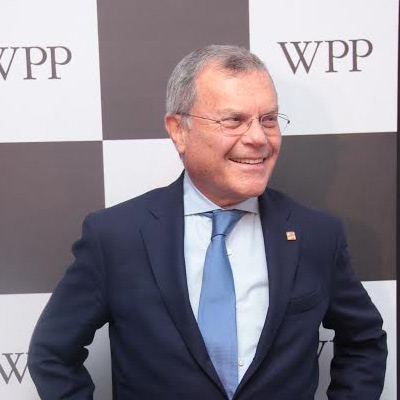
  • Martin Sorrell pegs WPP’s India biz at $600 mn; thrust on organic growth

    Martin Sorrell pegs WPP’s India biz at $600 mn; thrust on organic growth

    MUMBAI: Just a few days after meeting Prime Minister Narendra Modi in New York, WPP CEO Martin Sorrell, in his visit to India was bullish about the market and pegs the company’s business here at $600 million with a strong thrust on organic growth.


    “We are very aggressive in terms of growth here in India and this year we are expecting to grow by 10 per cent, which is double of the global growth rate (4.8 per cent). Net sales growth in India is roughly same as the revenue growth, which is 10 per cent while globally it’s three per cent. So overall, we are doing very good across the board and have no complaints,” he said.


    “Our business in India is just under $600 million in revenue. We are proud of our business here and we have a very large market share,” asserted Sorrell.


    He further added, “Though we will have acquisitions, organic growth will be key in India. If your business is $600 million and you are growing at 10 per cent per annum, you can’t find acquisitions in India in $60 million. So organic growth will continue to be the principle way that we grow in the Indian market.”


    Events to watch out for in 2016:


    Sorrell is of the opinion that the 2016 Rio Olympics will be a major event. “The backdrop in Rio de Janeiro will be one of the best backdrops to be in,” Sorrell says.


    Apart from the Olympics, the US presidential elections as well as the UEFA European Championship will also be key events to watch out for in 2016 according to Sorrell.


    Key for advertising industry:


    Sorrell predicts that the key for the company would be to grow at the rate of GDP growth with little or no inflation.


    “The thing that worries me the most is not the geo-political issues, be it Greece or US deficit, or the Middle East, but the failure of companies to invest long term,” he emphasised.


    Importance of People:


    Sorrell believes that people are the most important part of a company and clients choose agencies on the basis of that.


    He said, “Our revenues are at $19 billion around the world and at $23 billion including associates. Of the $19 billion, $12 billion is invested in people because I believe that the key differentiator between agencies is people. That’s how clients choose one agency over the other.”


    BARC and TAM JV


    The biggest outcome of the team up between two Indian television measurement agencies, as per Sorrell is both companies accepting each other’s business models. He was also of the opinion that TAM should have been more flexible in terms of number of meters. He said, “I think we will get to one equilibrium that gives some consistency and validation, which is really important.”

  • Narendra Modi to felicitate Clean Champions at India Today Awards

    Narendra Modi to felicitate Clean Champions at India Today Awards

    MUMBAI: It’s been one year since Prime Minister Narendra Modi nominated India Today Group chairman and editor in chief Aroon Purie to be a Clean India advocate. The India Today Group will be commemorating the honour with the India Today Safaigiri Singathon and Awards 2015.

    The event will be held on 2 October, the first anniversary of the Swachh Bharat Abhiyan and the birth anniversary of Mahatma Gandhi. Prime Minister Narendra Modi will be the keynote speaker and give away awards to the Clean India Champions.

    Purie said, “I was delighted when the PM nominated me and The India Today group as an ambassador of the Swachh Bharat Abhiyan. A clean India is such a simple idea but a revolutionary one.  It will only succeed if all of us work to make it a movement. So many of our ills will be solved if we fix our sanitation. By one estimate it could increase our average per capita income by seven per cent. As a media group, we can play a role to raise awareness of this campaign and get people involved. Our first step is Safaigiri Singathon & Awards. Our aim is to work on an attitude change and bring viewers face to face with uncomfortable facts in an entertaining manner. I am glad that we are not just reporting   but   making a difference.”

    India Today Safaigiri Singathon & Awards is a key initiative of the group’s efforts in realising the vision of Swachh Bharat and in recognising Clean Champions across the country. The Clean Champions are selected in 13 categories through a process of online entries, field work, and selection by a jury of eminent citizens.

    The event will be highlighted by the Safai Singathon with singers and musicians performing through the day. The singers and musicians attending the daylong event include, Asha Bhosle, Kailash Kher, Daler Mehndi, Sonu Nigam, Hans Raj Hans, Papon and Udit Narayan. 

    The Safai Singathon will be telecast on all four channels of the network namely India Today Television, Aaj Tak, Tez and Business Today for over eight hours non-stop Live on 2 October.

  • Prasoon Joshi pens new anthem song for Swachh Bharat mission

    Prasoon Joshi pens new anthem song for Swachh Bharat mission

    NEW DELHI: An anthem has been written for the ‘Swachh Bharat Mission’ by ad man and lyricist Prasoon Joshi.


    The song was written in response to Prime Minister Narendra Modi’s call for a ‘jan andolan’ to make the mission successful.


    The celebrities have come together to enthuse and inspire citizens to join hands in realising the collective dream of a ‘clean India.’


    The anthem penned by Joshi is set to tune by musical trio Shankar-Ehsaan-Loy. It is sung by Shankar Mahadevan and other playback singers, who will also feature a video being produced by Mukesh Bhatt for the same.


    Cricket icon Sachin Tendulkar has contributed to this endeavour by reciting a few lines that will specially feature in the anthem, as well as providing various musical suggestions for the recording.  


    The audio of the song is expected to be released on the eve of Mahatma Gandhi’s birth anniversary on 2 October.

  • Mark Zuckerberg on Internet.org and Net Neutrality in India

    Mark Zuckerberg on Internet.org and Net Neutrality in India

    Over the past week in India, there has been a lot written about Internet.org and net neutrality. I’d like to share my position on these topics here for everyone to see.

    First, I’ll share a quick story. Last year I visited Chandauli, a small village in northern India that had just been connected to the internet.

    In a classroom in the village, I had the chance to talk to a group of students who were learning to use the internet. It was an incredible experience to think that right there in that room might be a student with a big idea that could change the world — and now they could actually make that happen through the internet.

    The internet is one of the most powerful tools for economic and social progress. It gives people access to jobs, knowledge and opportunities. It gives voice to the voiceless in our society, and it connects people with vital resources for health and education.

    I believe everyone in the world deserves access to these opportunities.

    In many countries, however, there are big social and economic obstacles to connectivity. The internet isn’t affordable to everyone, and in many places awareness of its value remains low. Women and the poor are most likely to be excluded and further disempowered by lack of connectivity.

    This is why we created Internet.org, our effort to connect the whole world. By partnering with mobile operators and governments in different countries, Internet.org offers free access in local languages to basic internet services in areas like jobs, health, education and messaging.Internet.org lowers the cost of accessing the internet and raises the awareness of the internet’s value. It helps include everyone in the world’s opportunities.

    We’ve made some great progress, and already more than 800 million people in 9 countries can now access free basic services throughInternet.org. In India, we’ve already rolled out free basic services on the Reliance network to millions of people in Tamil Nadu, Maharashtra, Andhra Pradesh, Gujarat, Kerala and Telangana. And we just launched in Indonesia on the Indosat network today.

    We’re proud of this progress. But some people have criticized the concept of zero-rating that allows Internet.org to deliver free basic internet services, saying that offering some services for free goes against the spirit of net neutrality. I strongly disagree with this.

    We fully support net neutrality. We want to keep the internet open. Net neutrality ensures network operators don’t discriminate by limiting access to services you want to use. It’s an essential part of the open internet, and we are fully committed to it.

    But net neutrality is not in conflict with working to get more people connected. These two principles — universal connectivity and net neutrality — can and must coexist.

    To give more people access to the internet, it is useful to offer some service for free. If someone can’t afford to pay for connectivity, it is always better to have some access than none at all.

    Internet.org doesn’t block or throttle any other services or create fast lanes — and it never will. We’re open for all mobile operators and we’re not stopping anyone from joining. We want as many internet providers to join so as many people as possible can be connected.

    Arguments about net neutrality shouldn’t be used to prevent the most disadvantaged people in society from gaining access or to deprive people of opportunity. Eliminating programs that bring more people online won’t increase social inclusion or close the digital divide. It will only deprive all of us of the ideas and contributions of the two thirds of the world who are not connected.

    Every person in the world deserves access to the opportunities the internet provides. And we can all benefit from the perspectives, creativity and talent of the people not yet connected.

    We have a historic opportunity to connect billions of more people worldwide for the first time. We should work together to make that happen now.


    DISCLAIMER: The author of this article is Facebook Chairman and CEO. The article has been sourced from Mark Zuckerberg’s Facebook page. The views expressed here are purely personal views of the author and Indiantelevision.com does not necessarily subscribe to them.

  • IT experts & professionals to endorse Digital India

    IT experts & professionals to endorse Digital India

    NEW DELHI: In a break with tradition, four non-celebrities have been appointed as brand ambassadors to promote the Digital India programme.


    The brand ambassadors appointed by the Government for a period of one year include author and ethical hacker Ankit Fadia and computer scientist and author of ‘Sixth Sense’ Pranav Mistry of Samsung in the United States.


    In addition, there are two student brand ambassadors: Satwat Jagwani and Krati Tiwari who are both All India IIT-JEE – Advanced student Toppers for 2015. 

    The Communications and Information Technology Ministry said no other person has been appointed as brand ambassador for Digital India and reports indicating that a Digital India brand ambassador has been appointed other than these four are wrong. 

    As part of the Digital India week (1 – 7 July) these four brand ambassadors were nominated for a period of one year to propagate the product and applications being launched by the Department under Digital India programme. 


    The services of these brand ambassadors will be used, as and when required for generating mass awareness for the programme.

  • Modi convinces Silicon Valley about Digital India, lauds Facebook & Google

    Modi convinces Silicon Valley about Digital India, lauds Facebook & Google

    NEW DELHI: As he entered the extensive office of Facebook in California, he was greeted with the song ‘Chak de India’ and when he left, Prime Narendra Modi left a huge impression about India’s seriousness ongoing digital.


    The euphoria was the same when he visited Google, or addressed a meeting of persons from LinkedIn or start-ups.


    In various speeches during his visit, Modi said Facebook, Twitter and Instagram were the new neighbourhood.


    “If Facebook were a country, it would be the third most populous one and the most connected,” he said. 


    Similarly, he said Google “has made teachers less awe-inspiring and grandparents more idle. Twitter has turned everyone into a reporter. The traffic lights that need to work the best are on CISCO routers.” 


    The status that now matters, he said, “is not whether you are awake or asleep but whether you are online or offline. The most fundamental debate for our youth is the choice between Android, iOS or Windows.”


    From computing to communication, entertainment to education, from printing documents to printing products, and, now to Internet of Things, it’s been a long journey in a short time. 


    Referring to digital networks, he said, “We have attacked poverty by using the power of networks and mobile phones to launch a new era of empowerment and inclusion: 180 million new bank accounts in a few months; direct transfer of benefits to the poor; funds for the unbanked; insurance within the reach of the poorest; and, pension for the sunset years for all.”


    By using Space technology and internet, the country had been able to identify in the last few months 170 applications that will make governance better and development faster. 


    “The pace at which people are taking to digital technology defies our stereotypes of age, education, language and income,” he added.


    “Customers, more than creators, are defining the use of a product. The world may be driven by the same ancient impulses. We will continue to see human struggles and successes. We will witness human glory and tragedies,” Modi said. 


    He added that in this digital age, there was an opportunity to transform lives of people in ways that was hard to imagine just a couple of decades ago. 


    “Today, technology is advancing citizen empowerment and democracy that once drew their strength from Constitutions. Technology is forcing governments to deal with massive volume of data and generate responses, not in 24 hours but in 24 minutes. When you think of the exponential speed and scale of expansion of social media or a service, you have to believe that it is equally possible to rapidly transform the lives of those who have long stood on the margins of hope. So out of this conviction was born the vision of Digital India,” he said. 


    “It is an enterprise for India’s transformation on a scale that is, perhaps, unmatched in human history. Not just to touch the lives of the weakest, farthest and the poorest citizen of India, but change the way our nation will live and work,” he said. “We will transform governance, making it more transparent, accountable, accessible and participative. I spoke of E-Governance as a foundation of better governance – efficient, economical and effective.” 


    After MyGov.in, Modi said he had just launched the Narendra Modi Mobile App.


    Information, education, skills, healthcare, livelihood, financial inclusion, small and village enterprises, opportunities for women, conservation of natural resources, distributed clean energy – entirely new possibilities have emerged to change the development model. 


    “We want our 1.25 billion citizens to be digitally connected. We already have broadband usage across India go up by 63 per cent last year. We need to accelerate this further,” he further said. 


    An aggressive expansion of the National Optical Fibre Network had been launched that will take broadband to our 600,000 villages. “We are expanding our public Wi-Fi hotspots. For example, we want to ensure that free Wi-Fi is not only there in airport lounges, but also on our railway platforms. Teaming up with Google, we will cover 500 railway stations in a short time. We are also setting up Common Service Centres in villages and towns. We will also use information technology to build smart cities,” Modi informed. 


    “We are also setting up an Electronics Development Fund to support design, development and launch of new products,” he added. 


    Indians account for 15 per cent of startups in the United States. “Hundreds of thousands of Indian professionals here and in India are contributing to the global success of US enterprises. Many are leading them today. This is the possibility of the digital bridge – to connect distant lives and change fortunes and future,” he said.


    Modi said he was delighted that Qualcomm announced a fund of $150 million for startups in India.

  • Modi effect: Qualcomm to invest $150 million in Indian mobile startups

    Modi effect: Qualcomm to invest $150 million in Indian mobile startups

    MUMBAI: Indian Prime Minister Narendra Modi is making waves in the United States. And the effects of his power packed visit have already started trickling in.


    US based Qualcomm Incorporated, which operates in 3G, 4G and next-generation wireless technologies, plans to invest up to $150 million in Indian startup companies across all stages. This is a part of its commitment to India during a meeting with Modi at the Digital Economy event in San Jose.


    Qualcomm Ventures will advise and direct Qualcomm’s activities with respect to these strategic investments.


    Qualcomm has been investing in promising Indian startups since 2007 and there are more than 20 Indian companies as part of its global portfolio. Sectors of investment vary across the mobile ecosystem and include hardware, software platforms, e-commerce, healthcare, location based services and retail technology. Initiatives such as the QPrize competition, a global seed investment competition, as well as an early stage fund, are part of the team’s efforts in encouraging early stage entrepreneurs.


    Qualcomm directly invests in Indian mobile and internet start-up companies to keenly foster the local ecosystem. Portfolio companies include Yourstory, a media tech platform for entrepreneurs; Portea Medical, an in-home healthcare provider; and MapMyIndia, a provider of digital map, navigation, and tracking products and services. Indian companies receiving funding can benefit from Qualcomm’s insights on mobile technologies and utilize Qualcomm’s relationships throughout the industry.


    Qualcomm Ventures’ India team also provides unique support through its comprehensive knowledge and understanding of the region.


    “We share Prime Minister Narendra Modi’s vision to transform India into a digitally empowered society and knowledge economy. India is at the cusp of a technology revolution and mobile technologies will lay the foundation for Digital India. We are committed to providing local innovative start-ups with the support needed to help India’s IOE ecosystem grow, increasing consumer choice and availability,” said Qualcomm Incorporated executive chairman Dr. Paul E. Jacobs.


    “Since Qualcomm’s first India investment in 2007 and with full-fledged presence starting in early 2008, we continue to invest broadly to strengthen India’s overall economy. We are committed to providing these companies with the support needed to help propel them forward in the competitive Indian region. We’re excited about the new prospects in India and look forward to growing our portfolio,” said Qualcomm Incorporated senior vice president Nagraj Kashyap.


    Qualcomm also plays a key role driving India’s wireless revolution by making mobile communications increasingly accessible and affordable. For over two decades, Qualcomm has been helping the country’s mobile ecosystem achieve ongoing success and growth through its work with operators, OEM/ODMs, software developers, sales/distribution partners, governmental entities, academic institutions and standards organizations, among others. Qualcomm believes that its initiatives in India will help support the Indian government’s Digital India vision.

  • Rupert Murdoch lauds Modi; US CEOs call for speedy TV digitisation

    Rupert Murdoch lauds Modi; US CEOs call for speedy TV digitisation

    MUMBAI: There are some leaders who leave a good impression and then there are those who leave a lasting impression on others’ mind, and Indian Prime Minister Narendra Modi definitely belongs to the latter type. 

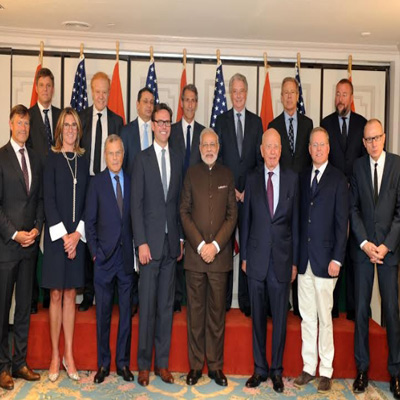
    In his recent meeting with the Fortune 500 CEOs at the iconic Waldorf Astoria Hotel in New York, Modi not only successfully brought up the burning issues of Indian media and digitisation to the world platform, but also instilled a sense of camaraderie amongst the executives, whose net worth, as per the media buzz, was $4.5 trillion!

    The proof of the pudding lay in the superlative address that 21st Century Fox chairman Rupert Murdoch gave Modi through his tweet after the event.

    “Great hour with Indian PM Modi. Best leader with best policies since independence, but massive task to achieve in most complex nation,” said Murdoch.

    Apart from the senior Murdoch, the CEOs present at the roundtable meeting chaired by Modi included 21st Century Fox CEO James Murdoch, News Corp  CEO Robert Thompson, Star India CEO Uday Shankar, WPP CEO Martin Sorrell, Discovery Communications president and CEO David Zaslav, Sony Entertainment CEO Michael Lynton, Interpublic Group of Companies CEO Michael Roth, Vice Media CEO Shane Smith, Time Warner CEO Jeff Bewkes, A&E Networks CEO Nancy Dubuc, Visy Industries chairman Anthony Pratt, Route One Investment Company’s William Duhamel and ValueAct Capital CEO Jeff Ubben.

    While the CEOs were enthusiastic about the digital transformation that is taking place in India through the Digital India initiative, they called for speeding up of television digitisation, and strengthening of the cellular (mobile) infrastructure.

    According to the head honchos, the current strong trajectory of the Indian economy made it at a unique moment to accelerate growth in this sector.

    Post the meeting, Modi tweeted his pleasure in seeing the executives enthusiastic about being part of Digital India and the role of media in it. “Met top American CEOs from media & entertainment sector. They were enthusiastic about the change @_DigitalIndia initiative in driving,” he said before craftily leading in the major issues that were discussed among the executives in the congregation earlier.

    “My interaction with Fortune 500 CEOs was on investment opportunities in India & why they must come & @makeinindia! Digital technology has a vital role in making democracy stronger & in overall human resource development,” he tweeted.

    Modi painted the government's vision to connect the 600,000-odd villages in India with broadband and emphasised that digital technology will increasingly play a major role in further strengthening democracy and India's development narrative. He also highlighted how Digital India posed as a great opportunity for the international media companies.

    As evident from the PM’s tweets, foreign direct investment (FDI) formed a large chunk of the round table and the 90 minute soiree. “Foreign direct investment all over the world has fallen. But in India, it increased by 40 per cent. This reflects confidence in the Indian economy,” Modi was heard pointing out the executives right before they sat down for dinner. “Reform in governance is my number one priority. We are for simplified procedures, speedy decision-making, transparency and accountability,” he assured the prospective investors.

    The topic that dominated most of the evening was the role that the media and entertainment industry can play in development and generation of employment opportunities in India.

    Modi also touched upon the importance of a smoother Intellectual Property Rights (IPR) regime in the digital era.

    Pegging his argument on India’s value for intellectual property he said, “We are committed to protecting IPR, that's essential to fostering creativity.”

    He also upheld the importance of regional languages in India and suggested to the CEOs that India represents both the biggest opportunity and the biggest challenge for them. He also urged them to keep regional languages in mind, as they firm up investment plans for India. “Explained to media CEOs why India is a great opportunity for them & how many regional languages makes India even more special to invest in,” Modi tweeted.

    “The government has already undertaken a massive amount of reforms. Key message from the US companies was keep doing what you are doing. I had a great meeting, there was a constructive dialogue in the spirit of collaboration. We are looking at India trying to get foreign direct investment,” said J P Morgan CEO James Dimon.

    As per  India's foreign office spokesperson Vikas Swarup, Modi took keen interest to personally interact with every CEO, and understand the executives’ areas of concern that his government could address and resolve.

    The Prime Minister emphasised that he saw a key role for digital technology in further strengthening democracy, and in India’s development narrative.

  • Oxigen appoints Sachin Tendulkar as brand ambassador

    Oxigen appoints Sachin Tendulkar as brand ambassador

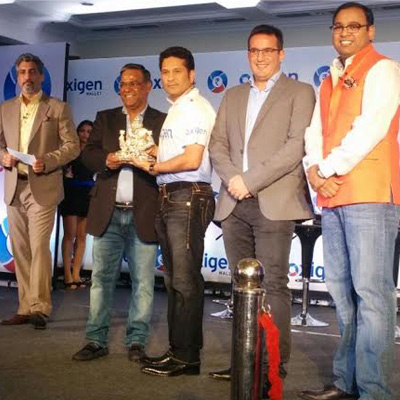
    MUMBAI: India’s payments solutions provider Oxigen Services has signed cricketer Sachin Tendulkar as its brand ambassador.


    The brand zeroed in on Tendulkar as he reflects the core values of the company in his virtues of unshakable commitment and humility.


    Oxigen has aligned its vision to aggressively push for Digital India and financial inclusion, a key agenda on the radar of Indian Prime Minister Narendra Modi.


    Oxigen Services India founder & CMD Pramod Saxena said, “We are absolutely proud and honoured to be associated with the god of cricket himself, who is renowned not only in India, but across the globe. It is not just his values that inspired us to get him on board, but also his strong commitment towards larger national issues such as education and  upliftment of rural India that resonate with our own programs. Together we are set to take our initiatives towards Financial Inclusion, Digital India and Swachh Bharat Abhiyan to the next level.”


    Tendulkar added, “I am excited to be associated with Oxigen Services, which is at the threshold of exponential growth. Oxigen’s effort to align with the needs of the common Indian and focus on offering convenience, flexibility and ease in payment solutions is admirable. With the Oxigen wallet providing so many features, I am sure it will be the preferred mode for payment emphatically replacing the present day need to carry physical forms of cash and plastic money.”


    Oxigen recently came on board as the official sponsor of the Proteas – South African T20 Cricket Team, which will be visiting India for The Mahatma Gandhi – Nelson Mandela Series this week.


    The company has also launched the #Playthehost campaign for the series.


    “The adoration for Tendulkar, as a person, cuts across demographics, states and cultures. He is a much loved and trusted sport personality, with an unblemished track record. We, at Oxigen as well, reach out to a large mass of people across the country, we have something for everyone, A mobile wallet for the youth and money transfer and payments services, through our retail network for all fellow Indians.  The city dwellers and rural Indians alike, see us as a dependable service provider. By associating with Sachin we are sure we reinforce the trust and reliability factor with our customers, taking it to the zenith with his endorsement to the Oxigen Brand,” said Oxigen corporate affairs brand and marketing services president Meher Sarid.

  • Amitabh Bachchan joins campaign to give up LPG subsidy

    Amitabh Bachchan joins campaign to give up LPG subsidy

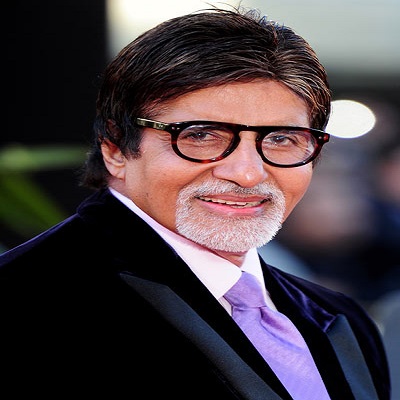
    NEW DELHI: Megastar Amitabh Bachchan has joined the GiveItUp movement where he will encourage people to give up the subsidy on LPG to benefit those who cannot afford it.

    Acknowledging the gesture, Petroleum and Natural Gas Minister Dharmendra Pradhan said that such a noble gesture by Bachchan would surely inspire many others to join GiveItUp, a movement committed to bring smiles to millions of poor households by providing them access to clean fuel (LPG).

    As on date, he said more than three million people have surrendered their LPG subsidy in response to the appeal made by Prime Minister Narendra Modi on 27 March.

    Modi had also promised that the money saved from this effort will be utilised to provide LPG connection to poor households.

    Modi had also talked about the GiveItUp movement during his recent MannKiBaat. He had mentioned, “Lakhs of families have given up their gas subsidies. These are not rich people. This is a silent revolution.”