Tag: Narendra Ambwani

  • Rebuilding consumer trust, meeting altered expectations: Brands on the 2021 challenge

    Rebuilding consumer trust, meeting altered expectations: Brands on the 2021 challenge

    MUMBAI: Our world, as we know it, changed irrevocably last year in the wake of Covid2019. As people everywhere struggled to make sense of an evolving reality, organisations too were forced to reassess and recalibrate their businesses in a bid to survive and grow. Consumer behaviour having gone through a paradigm shift during the pandemic, has posed additional challenges for brands. There is understandably uncertainty on all fronts.

    In order to understand the strategies devised by top brands to tackle the challenges of this global crisis and to look beyond it, the Indian Society of Advertisers (ISA), in association with the Free Press Journal and ABP Network, organised a two-part webinar – Brands and Consumers: 2021 and Beyond.

    While the first part of this series on the manufacturing sector was held last week, the second part on the service sector was held on Wednesday with some of the best marketing minds from across the service sector. The panel discussion that followed aimed to share the best practices during the pandemic and the way to look forward with hope.  

    The session was moderated by ISA executive council member and former Johnson & Johnson MD Narendra Ambwani. Panelists included Thomas Cook (India) president & group head-marketing, service quality, financial services & innovation Abraham Alapatt, Aditya Birla Capital CMO Ajay Kakar, Jio Platforms group vice president- advertising & innovations Mohit Kapoor, and Amazon India’s director, mass & brand marketing international Ravi Desai.

    Opening the session, Ambwani spoke about how post-Covid, brands face many challenges with consumers‘ expectations as well as behaviours changing. He shared the main question confronting the industry today: “what are the lessons learnt in overcoming the disruptions posed by lockdown, WFH and fears caused by Covid.” Alapatt voiced his opinion on how the travel sector was the most affected in the crisis with the entire industry’s demand going down to “zero”, in part due to the physical restrictions in place. “The past twelve months have given a learning equivalent to twelve years,” he stated.

    From a marketer’s perspective, he encapsulated the year gone by into six Cs of 60 days each, with the first 60 days being a state of “confusion”, turning to “concern” in next 60, then going on to “careful” where the initial paranoia had subdued, proceeding to a mix of “cautious + careless” when the lockdowns eased and finally learning to “coexist” with the pandemic and the restrictions.

    Sharing Thomas Cook’s marketing strategy during the crisis, he highlighted the importance of staying connected to the consumer via newsletters and surveys, while reassuring them on the safety protocols being adopted by the company. The travel company also guaranteed the customer’s financial security by giving them the freedom to reschedule or cancel flights without monetary loss. 

    Aditya Birla’s Ajay Kakar agreed with Alapatt on the importance of remaining connected with the customer, while also stressing on brand visibility and relevance. Being primarily from the health and life insurance sector, he said it was equally crucial to be there for existing customers and listen to their concerns, rather than only focus on new customers. He agreed that the sector benefited from people having time to spare to finally explore investing in the capital market.

    Jio’s Mohit Kapoor was more upbeat regarding the past year, although he admitted that the April 2020 quarter was the worst in many years for the company. He shared the forecast of Jio’s smartphones reaching a market of 800 million from existing 500 million, paving the way for a ‘2G-Mukt Bharat’. He predicted that social is the way forward for commerce with social networking sites like Facebook and Instagram seeing a huge spike in users. He also touched on the upcoming relevance of social gaming and e-sports genres with India becoming one of the biggest gamers markets.

    Amazon’s Ravi Desai was also quite optimistic about the e-commerce giant’s prospects in the past, as well as the coming year. As he put it, “consumers’ needs for a wide selection of products, delivered quickly and safely is not going to change,” even with local retailers opening up and customers stepping out to buy. His advice to brands: To look for the ‘permanent’ factor in their business module which will remain relevant to customers, and to focus on that core part.

    Summing up the main takeaways for brands from the discussion –

    u  Stay connected and relevant to customers

    u  Reach out and reassure existing customers

    u  With changed consumer-expectations, brands that step up will remain in the game

    u  Trust is the keyword – rebuilding and reassuring customer’s trust in a crisis

    After the bloodbath of last year, the travel industry is on the road to recovery, with a huge spate of bookings for the months of November and December, shared Alapatt. He added that Maldives, which had never figured in the top destinations for Indians now, had single largest visitors from India. Even enquiries post-lockdown were record-breaking, indicating that people were frustrated after remaining indoors for so long. With prices lower than ever and great travel deals, he concluded that things can only look up from hereon for travel and tourism. At the same time, he emphasised there was no compromise on the safety factor of customers, and that adding safety value to a brand where required will pay dividends with customers willing to pay for the extra. He cited the example of Thomas Cook’s partnership with Apollo, to enable the customer to avail the ‘doctor-on-call’ facility while travelling.

    In conclusion, this optimism was shared by all other service sectors when it came to looking forward at 2021 and beyond. They surmised that this was a powerful opportunity for the hospitality and service sector, with the worst over and behind them. And that in this pursuit, the relevance and value of customer engagement has grown even more significant for all brands.

  • ASCI appoints Benoy Roychowdhury as new chairman

    ASCI appoints Benoy Roychowdhury as new chairman

    MUMBAI: The Advertising Standards Council of India (ASCI) has appointed HT Media executive director Benoy Roychowdhury as its new chairman. As a member of the Board of Governors for four years, he has represented print media and provided active support to self-regulation.


    R.K. Swamy BBDO chairman and MD Srinivasan K. Swamy was elected as vice chairman and Media Brands CEO Shashidhar Sinha, was re-appointed the honorary treasurer.


    ASCI outgoing chairman Narendra Ambwani said, “It has been quite an eventful year for ASCI. We had set four key priorities for the year i.e. Collaboration with the regulators, easier consumer access to ASCI services, inculcate self-discipline among creators of advertising and be seen as fair adjudicator by all stakeholders. Not only were we able to deliver on all four priorities; but we also received recognition for all the good work ASCI has been doing. The Department of Consumer Affair (DCA) engaged ASCI as their “Executive Arm” to curb misleading advertisements and has entrusted ASCI to process complaints received on DCA’s portal “Grievances Against Misleading Advertisements (gama.gov.in).”


    Roychowdhury added, “There has been a remarkable transition in the last couple of years of how newer sectors like e-commerce and media such as digital advertising have changed the game. Over 90 per cent of consumers send in their complaints to ASCI online or via e: mail versus letters or phone calls. ASCI has also evolved to match the pace by significantly improving the efficiency and speed in ASCI’s consumer redressal process. These continuous efforts are now being backed by regulatory agencies such as the Ministry of Information and Broadcasting as well as the DCA, and more and more Government organizations are approaching ASCI to seek help in adjudicating on various complaints related to advertisements. Responsibility for the success of self-regulation rests with every player – Advertisers should advertise with a conscience, media which carry the ads should be more responsible and regulators should back self-regulation by lending their support.”


    Speaking exclusively to Indiantelevision.com the new chairman said, “I would like to strengthen the four pillars that we stand tall on. Educate through our E-Learning initiative, enhance consumer interaction and our app will play a pivotal role in it. I am also looking at more collaborations.  We had great success as Ministry of Consumer Affairs recognised us last year and lastly we need to advertise our presence so that more people are aware about ASCI.”


    ASCI promotes self regulation philosophy and Roychowdhury thinks it’s healthy for the fraternity as the alternatives can be difficult. “The alternative to self regulation is government regulation which I think is not what the industry is looking towards. Responsible advertising is much better than courts and judicial processes,” he added. 


    Other members of the Board of Governors are CIABC vice president Abanti Sankanarayan, Procter & Gamble Hygiene and Healthcare managing director and chief executive Al Rajwani, Bennett Coleman and Co Ltd president Arunab Das Sharma, Pepsico India chairman & CEO D. Shivakumar, Eanadu director I Venkat, Agrotech Foods Ltd director Narendra Ambwani, Provacateur director Paritosh Joshi, Genesis Burson-Marsteller Asia Pacific & principal/founder, Burson-Marsteller vice chair Prema Sagar, Google India managing director Rajan Anandan, Hindustan Unilever executive director personal care Sameer Singh, S.P. Jain Institute management educationist SK Palekar, BBH Comms India managing partner Subhash Kamath and Grey Group chairman and managing director Sunil Lulla.

  • ASCIonline gets 15% complaints registrations via new mobile app

    ASCIonline gets 15% complaints registrations via new mobile app

    MUMBAI: The ASCIonline mobile app, in just two months of launch, has seen a boost in the number of complaints received. Complaints through the mobile app, now contribute to almost 15 per cent of the total number of complaints received by the Advertising Standards Council of India (ASCI).


    The app has surpassed 1000 downloads within just two months since its launch on 17 June, 2015. 


    ASCIonline mobile app facilitates convenient filing of complaints against misleading advertisements. The app has received a 4.0 /5 star rating by users and some positive feedback.


    ASCI chairman Narendra Ambwani said, “ASCI’s priority for the year was improving its reach to    provide a super-fast and convenient access for consumers to lodge complaints and to increase ASCI’s reach across India trickling down to smaller towns.”   


    While the web-based online complaint registration system has been functional for over three years, the mobile app has broken the “reach” barrier. With the dramatic and ever growing increase in smartphone penetration and its use for various transactions, the mobile app has been a great enabler for end consumers. Analysis of complaints received via mobile app is the real “proof of the pudding.”


    “We have received complaints from more than 15 different states and cities like Darjeeling, Thiruwallur, Almora, Bikaner, Jalandhar, Hingoli etc. Not only that, consumers have complained against advertisements from a wide range of sectors such as education, FMCG, healthcare, telecom, e-commerce, durables, automotive, food and beverages, and across media beyond  print and TV, such as website, radio, SMS, emailers, promotional materials, product packaging and app ads,” informed Ambwani.


    For promoting the mobile app, ASCI coined the “SnapItandAppIt” tagline as the app allows one to take a picture of the objectionable ad and send it through the app to ASCI. Social media is being leveraged to create awareness. Prasar Bharati also took note of this mobile app and actively supported this by tweeting about the app. Even industry stalwarts and twitteratis like Google MD Rajan Anandan, RK Swamy BBDO MD SK Swamy, Intradia head catalyst Sanjeev Kotnala, Provacateur director Paritosh Joshi created a buzz, causing a ripple effect.


    With ASCIonline app, the body has engaged thousands of ASCI ambassadors who are ASCI’s eyes and ears and would put a check on erring advertisers and push for “Responsible Advertising.”

  • UP Transport Department asks ASCI to enforce responsible advertising in auto sector

    UP Transport Department asks ASCI to enforce responsible advertising in auto sector

    MUMBAI: The Uttar Pradesh Department of Transport has approached The Advertising Standard Council of India (ASCI) for taking action against automotive advertisements that depict violation of traffic rules.


    Through a letter, Transport & Road Safety commissioner K. Ravindra Naik has strongly backed ASCI for its efforts in promoting responsible advertising and has requested the industry body to instruct advertising agencies to adhere to the self-regulatory code.


    Early in July, highlighting the recent incident of a road accident in Delhi, Prime Minister Narendra Modi in the 10th edition of ‘Mann Ki Baat’ programme also focused on the importance of road safety in the country. He said, “It is the duty of every family to inform youngsters about the importance of road safety rules.”


    “According to the statistics of road accidents in the country, every four minutes a person dies in a road accident and around one – third of those dying in road accidents are between 15 and 25 years of age. It is the need of hour on creating awareness of road safety across the country as also through the manner in which advertisements depict responsible driving,” he added.


    ASCI chairman Narendra Ambwani said, “ASCI has been very proactive on the subject of advertisements for Automotive Vehicles and came up with a specific guideline in April 2008. Chapter III.3 of the ASCI’s Self-Regulatory code prescribes that ‘Advertisements shall not, without justifiable reason, show or refer to dangerous practices or manifest a disregard for safety or encourage negligence.’ We welcome this move by the Department of Transport, Uttar Pradesh for discouraging depiction of rash and unsafe driving. We hope each state in the country will also take effective measure to encourage responsible advertising and promote road safety.”


    The Department of Transport, Uttar Pradesh has also requested ASCI to ask advertising agencies to take effective measures to follow the said guidelines and to blacklist the agencies that do not comply with ASCI’s recommendations. The State Transport Authorities of UP has also written to all District Magistrates in the state to take action in this matter.


    According to self–regulation guidelines on advertisements for automotive vehicles, advertisers are encouraged to depict advertisements in a manner, which promotes safe practices, e.g. wearing helmets and fastening of seatbelts, not using mobile phones when driving etc. The advertisements should not portray violations of any traffic rules, should not show speeding or manoeuvrability in a manner which encourages unsafe or reckless driving, which could harm the driver, passengers and / or the general public, or show stunts or actions which require professional driving skills, in normal traffic conditions which, in any case, should carry a readable cautionary message drawing viewers’ attention to the depiction of stunts.

  • ASCI launches mobile app to curb misleading ads

    ASCI launches mobile app to curb misleading ads

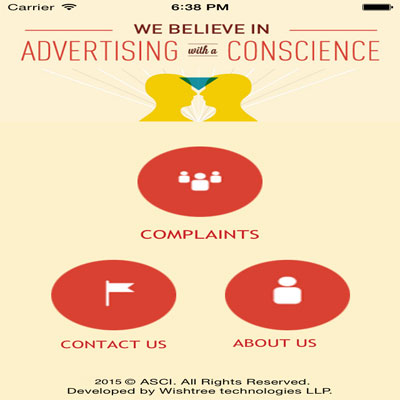
    MUMBAI: Continuing with its mission to address misleading advertisements, Advertising Standard Council of India (ASCI) has launched India’s first consumer complaint mobile App – ASCIonline, to provide consumer complaint services on a mobile phone besides providing the facility online. The mobile app is currently available on Android and iOS.

     
    ASCI chairman Narendra Ambwani said, “One of the goals of ASCI is to provide convenient access for lodging complaint and hence this launch of mobile app. Today mobiles devices are more widely used compared to desktops. With growing use of smart phones consumers want apps to put power of doing transactions in their pocket. ASCIonline mobile app is consumer friendly and can be freely downloaded. It will be very useful as one can track the status of the complaints which he or she registered on our portal with the help of the app.”

    Some of the key features of the app are as follows: 


    1)    Lodge complaint: Lodge complaints by simply providing advertisement details and objection. Users can also attach the files like image or video or YouTube link of that advertisement.


    2)    History: Check the history of all previously registered complaints with the latest status and all other details.


    3)    Complaint Tracking: Simply track the status of the complaints by providing the tracking code of the complaint.


    4)    Manage profile: Manage profile and contact details.


    5)    Push Notifications: Receive the automatic push notifications when status of your complaint gets changed.


    6)    Accessibility: It’s always on and connected.

  • “ASCI’s goal is to promote self regulation and keep regulatory body away”: Narendra Ambwani

    “ASCI’s goal is to promote self regulation and keep regulatory body away”: Narendra Ambwani

    We are in an era where advertising is redefining itself every second day, where regulations are questioned on the basis of its relevance in current scenario every hour and a new advertisement is released across various platforms every second in some part of the country. In a scenario like this, a nonprofit organization- Advertisement Standards Council of India (ASCI), which builds on the philosophy of self-regulation, examines thousands of complaints from various sources and at the same time makes efforts to empower advertising aspirants with various initiatives.


    An organization in existence since 1985, ASCI got recognition from the government of India Consumer’s Affairs Department in 2015, which ASCI chairman Narendra Ambwani terms as one of the biggest feat achieved so far.


    In conversation with Indiantelevision.com’s Anirban Roy Choudhury, Ambwani points out the importance of keeping a regulatory body away from the advertising fraternity. He feels that the only way one could do so is by promoting self regulation, which is the major reason why ASCI is endeavoring more in spreading awareness and empowering the fraternity by educating them.     


    Excerpts:


    What are the steps being taken by ASCI to educate ad makers in order to ensure that no derogatory work is done?


    We came up with the e-learning prospect, where people can enroll at a very low rate (Rs 500 for students, Rs 1000 for individuals). We didn’t keep it free because we need some money to upgrade the website and maintain a good workflow and that’s why we kept the minimal fees, and it’s not at all a profit making initiative. This consists of 13 modules on advertising, which has various chapters based on the advertising course. Each and every chapter is introduced by prominent figures of Indian advertising history, which includes Sam Balsara, Piyush Pandey and others and then we have examples defining the code and conduct.


    Suppose the chapter is about making unsubstantiated claims, with examples we will show that the claims made weren’t substantiated enough and hence it was challenged. At the end of the chapter there will be a quick test, which one has to undergo in order to prove that he or she has understood the chapter. The entire course is executed with the help of enhanced online technology and though it is not physically interactive, it is very much technically interactive. On a successful completion, one will get marks and a certificate from ASCI.


    What is the duration of the course and who all can enroll for it?


    The course can be pursued by anyone interested and can be undertaken at his or her own pace. The one time registration is valid for six months and one can do it any time till the registration is valid. It requires about four hours of work and if someone is focused, they can finish it in the given timeframe. The main idea behind the entire course is to educate people so that every ad is made by following the code and conducts so that we don’t have to challenge any. Every ad is made after putting a lot of efforts and money, and after a complain comes, if the ad has to be removed or modified, it upsets the entire schedule and hence why not create something that is right the first time round.


    Will there be any marketing activity to promote the e- learning innovation?


    We are promoting the initiative; in fact we have already started to do it through our members. We have around 350 members from the entire advertising fraternity, which includes agencies as well as consultancies. Our members are being mailed and at the same time we are asking them to inform people about the initiative in their respective organisations. Apart from that, we are also undertaking some activity at the school level where advertising is taught. We are requesting the authorities to enroll their students so that they understand the ASCI codes before they pass out. We are also very much active in the social media space.


    Will lessons on new age advertising also feature in the modules?


    The lessons will make people aware about code and conduct of advertising across all mediums whether it is digital, print or outdoor. The principles on the basis of which the ASCI codes are structured are uniform across all the platforms and hence the lessons are equally relevant throughout different parabolas.


    Apart from the e-learning initiatives, what are the other attempts ASCI has made so far or is planning to execute in the near future?


    In March, we had organised a conference where we invited marketing folks to participate. We took the opportunity to promote self-regulation and people of high repute from the advertising industry came in and spoke about it. That was one of our ways to promote ASCI and its code of conducts.


    How does the ASCI mechanism work?


    ASCI is not a regulatory body. We don’t decide if an ad should be made or not or if it is right or wrong. If any individual or company finds an ad offensive or derogatory, they can register a complaint. We have an independent panel, which is called the Consumer Complaints Council (CCC), which has two divisions. One has 14 members while the other has 21. The majority is from civil society, which includes professors of IIT, people from the medical field and journalists. So overall, it’s a wide mix of people from various fields. Once the complaint comes, we verify it. It has to be credible and not anonymous and the complainer’s details should be available with the secretariat. The complaint has to be for a current advertisement and not for an ad that was aired a year ago. Once the complaint is verified and the objections are examined, we give a week’s time to the advertiser to respond. Once the response comes, we send the ad to the technical expert. For example, if an ad says that a product will make hair 10 times stronger, the technical expert examines if the claims are substantiated. After the technical committee analysis is received, the complaint is brought to the weekly CCC meeting. The CCC then decides if the complaint should be upheld or not.


    What happens after the complaint is upheld?


    After the complaint is upheld, we write to the advertiser that the complaint is substantiated and that the board found issues in their ad. We tell them that they need to modify their ad rectifying the concerned issue. After that we give them two weeks’ time to implement the changes. In almost 90 per cent of the cases, advertisers comply with the guidelines and remove the concerned parts.


    The mechanism takes three weeks minimum to come to a conclusion, if not more. For that period does the ad stay on air?


    Yes, the ad stays on air for that span of time. Three weeks is the minimum time required to complete the due process and we need to undergo the process. In case an ad is extremely derogatory and we feel it is truly offensive, we have a system called Suspended Pending Investigation (SPI), which we impose. However, that happens very rarely. ASCI chairman heads SPI. The chairman shares the said offensive ad with CCC members and asks for an immediate suggestion. After the suggestion is received, if the members feel that the ad needs to be brought down immediately, we write to the advertisers to hold the ad till the investigation process is concluded.


    What have been the major challenges in front of ASCI?


    The major challenge was to make people aware about ASCI. Social media played a vital role and the website also helped us. Earlier people had to fill a form and send it to us through post but with the website in place, we have now started receiving a lot of complaints. Last year, we got around 6000 complaints. So the more people connect with us, the better it is for us. That’s the major challenge at hand.


    Apart from that, there are a few rouge advertisers, who do not comply with any code of conduct and often they fail to respond to ASCI too. They put their ads late night making unsubstantiated claims promising Dhan Laxmi or Sukh Shanti and people going through stress often fall into their trap. Getting them off is the other major challenge that we have at hand.


    Recently ASCI signed an MoU with the Indiam Government’s Department of Consumer Affairs. Can you throw some light on the development?


    The MoU with the Department of Consumer Affairs states that any complaint received by the government will be dealt by ASCI. Additionally, we will also endeavour into joint promotional activities, which is a major boost for us. Getting recognition from the government and being asked to deal with complaints is a huge step forward. It signifies that the philosophy of self-regulation is making strong statements across all levels. It has been great working with the new government as it has been very cooperative so far.


    ASCI’s procedures, which also involve scientific research, may turn out to be very expensive at times. How is the organisation funded?


    The funding of ASCI is through its members. We have approximately 350 members from the industry who contribute. That’s where the major funding comes from. Apart from that, we raise funds from various initiatives like conferences, training etc. Overall, it’s a tight budget and as we all know ASCI is a non-profit organization. We are like any other NGO. It’s just that we are an industry NGO.


    As you said the major portion of the funds are raised through members who apparently are also involved in the advertising industry. If an ad from their company comes up for adjudication, will ASCI take it to CCC?


    Of course we will. In fact most of the complaints are against our members’ company because the members represent 90 per cent of the advertising fraternity. ASCI looks into each and every case without a bias. In fact, there is a rule that if either complainant or advertiser against whom the complaint is from the CCC, he or she will not take part in the adjudication process of that particular case. So there are no possibilities of partiality or vested interest when it comes to the adjudication of any case.


    Going forward, what are ASCI’s strategies and goals?


    We have many strategies to ASCI’s credit. We achieved the government’s recognition on the aspect of self-regulation and the possibilities of a regulatory body to regulate advertisement, which none of us wanted, is dimming gradually. We are launching an app to ensure more and more reach, getting more and more people enrolled in our e-learning initiative is a major task at hand currently and we are building strategies around it.


    While I speak about goals, we only have one goal and that is to prevail our philosophy, which is fairness, responsibility, decency, honesty and truthfulness and conscience in advertising. The day ASCI will empower every advertiser with the code and conduct awareness to a level that the CCC fails to find one guilty party will be the best day for ASCI and that’s the only goal.

  • ASCI launches e-learning programme on responsible advertising

    ASCI launches e-learning programme on responsible advertising

    MUMBAI: In keeping with ASCI chairman Narendra Ambwani’s 2015 vision of ‘Self-discipline by creators of advertising’, the Advertising Standard Council of India (ASCI) has launched an e-learning training programme for advertisers and communication professionals, at a nominal price.


    “We at ASCI are happy to launch this e-learning programme, which has culminated as a result of hard work put in by our team over several months. It is a proactive approach that would enable the creators of advertising to get their advertisements “Right the first time.” There is a direct and tangible business benefit associated with it, as a trained individual would be able to avoid costly reworks of modifying or pulling down of advertisement by adhering to simple dos and don’ts set out in the code,” said Ambwani.


    ASCI’s e-learning will offer its modules to all members; non-members, students and other interested individuals. This e-learning programme would be especially useful for students aspiring to make a career in advertising and marketing communication, legal and regulatory professionals by adding a feather in their CV with this additional qualification. ASCI is also offering special discounts to educational institutes. Prominent personalities from the field of advertising like Piyush Pandey, R. Balki and Sam Balsara have participated and lent their support to the e-learning modules.


    The e-learning course is designed in several modules, which the users can complete at their own pace within a six month window. Each of these modules consists of engaging multimedia content followed by a quiz.


    · Introduction to ASCI (one module)- Advertising Self-regulation and ASCI


    · ASCI advertising Codes (four modules)- Truthful and honest representation, non-offensive to public, against harmful products/situations and fair in competition


    · ASCI category guidelines (four modules)- Brand Extension, Food and Beverages, Educational Institutions and Automotive vehicles


    · ASCI processes (four modules)- Supers, Complaints Registrations and Monitoring, Complaint processing and ASCI Membership


    On successful completion, the user is awarded with a certificate.


    Being an online platform, the programme will be accessible to everyone from anywhere at any time.


    Yahoo India Advertising Operations director Vishwas Govindarajan became the first industry professional to enroll for the e-learning programme and bagged the ASCI e-learning certificate.


    “This is the era of digital technology where advertising bombards every available space. In such an extremely versatile and dynamic medium, self-regulation plays a vital role. If the ad content falls below the regulatory standard set for advertising, it may result in irreparable damage, both to the brand and the company. ASCI e-learning programme is a “Must have” tool for every advertising professional,” said Govindarajan.

  • Portal launched to help consumers complain against misleading ads

    Portal launched to help consumers complain against misleading ads

    NEW DELHI: A three-tier system has been constituted by the the Department of Consumer Affairs (DoCA) to tackle the menace of misleading advertisements as part of its mission to address misleading advertisements and avoid unfair trade practices.


    DoCA has partnered with the Advertising Standard Council of India (ASCI) as an executive arm to process the incoming consumer complaints.


    Consumer Affairs, Food and Public Distribution Minister Ram Vilas Paswan today launched the web portal GAMA (“Grievances against Misleading Advertisements”) at the National Conference on Consumer Rights in New Delhi to help this mission.


    The collaboration will see joint efforts to evaluate and pass strictures against the violators. The six priority sectors that would be covered are agriculture and food, health, education, housing, financial services and e-commerce.


    The complaints will be evaluated across media including print, packaging, internet, outdoor, wall paintings, posters and billboards amongst others.


    The complaints of misleading advertisements received on GAMA portal (gama.gov.in), will be handled in a three level-system: first by ASCI, in case of non-compliance by a sub-committee headed by the Joint Secretary DoCA under Inter Ministerial Monitoring Committee (IMMC) and finally the concerned regulator will take action in case of persistent offenders.


    DoCA is also leveraging the network of Grahak Suvidha Kendra to make it easier for consumers in remote areas to complain.


    DoCA additional secretary G Gurucharan said, “The problem of misleading advertisements and the consequent unfair trade practices that arise is widespread – across sectors, mediums and geographies. DoCA’s partnering with ASCI is an important step in empowering self-regulatory bodies and demonstrating “More Governance – Less Government.”


    ASCI chairman Narendra Ambwani added“We are very happy to have been entrusted with this responsibility by DoCA. GAMA portal will be very consumer friendly as one can track the status of the complaints which he or she registered on this portal.”

  • ASCI to hold debate on relevance of self-regulation in advertising

    ASCI to hold debate on relevance of self-regulation in advertising

    MUMBAI: In line with its commitment to self-regulation in advertising on different platforms, the Advertising Standard Council of India (ASCI) is presenting a platform for industry stalwarts and key stakeholders to deliberate, discuss and challenge the fraternity on the importance and the relevance of self-regulation in today’s world. ASCI has organized a festival of debate on “Creativity, For Goodness’ Sake” on 20 March 2015 from 3 pm onwards. It will be held at The Taj Land’s End in Mumbai.


    The objective of this event is to create and present an engagement platform to uphold creativity, which is not only exciting and memorable but with a conscience; based on the premise that there is a critical need to create awareness, belief and advocacy for the very concept of self-regulation in advertising. 


    The festival will have global speakers namely BBH creative founder John Hegarty, Unilever SVP marketing Marc Matheiu, P&G managing director Shantanu Khosla, and filmmaker Rajkumar Hirani.


    At the centre of the festival will be a debate on the parameters of creative expression in advertising with speakers drawn from the top echelons of the creative industry, advertisers and consumer activists. Industry Stalwarts like Ogilvy & Mather India and South Asia executive chairman and creative director Piyush Pandey, Future Brands CEO and MD Santosh Desai, Standard Chartered Bank global head of brand and CMO Sanjeeb Chaudhuri, and Provocateur Advisory director Paritosh Joshi, will be part of the panel discussion which will be moderated by Anish Trivedi. The debate will rake up issues on creative freedom and much more.


    ASCI chairman Narendra Ambwani said, “Encouraging self-discipline by the creators of advertising, has been one of the key priorities chalked out for the year 2014 – 2015. As the chairman of ASCI, I believe that by promoting ASCI’s guidelines more vigorously among advertisers and creative agencies the new advertisements released will meet ASCI’s standards at the creative stage itself. This would help eradicate false and misleading claims in ads and very importantly serve the need of the hour – safeguarding consumer interest and reinforcing public’s confidence in the advertising industry. Working towards this cause of promoting the spirit of self – regulation, we here at ASCI have all come together to create a one-of-a kind festival of debate – Creativity for Goodness’ Sake! Through this unique engagement platform we aim at a fairly high powered and intellectually stimulating event for all stakeholders involved in the process of communication with consumers.”

  • ASCI launches ‘Swachh Ads Abhiyan’

    ASCI launches ‘Swachh Ads Abhiyan’

    MUMBAI: Observing the National Consumers Day on 24 December, Advertising Standards Council of India (ASCI) has launched the initiative ‘Swachh Ads Abhiyan’.

    With the purpose of combating misleading advertisements, the Department of Consumers Affairs proposed ASCI to come up with an initiative to create awareness amongst consumers to take action against misleading content. The campaign was initiated across various social platforms like Facebook, Twitter, LinkedIn and YouTube.  Engaging with the consumers and making them aware of what advertisements lead to misleading content and consumer’s right to complain against any such advertisements.

    ASCI chairman Narendra Ambwani said, “‘Swachh Ads Abhiyan’ is yet another initiative by ASCI to combat the issue of misleading advertisements and create awareness for the consumers on National Consumers Day. It’s really important that the consumers don’t blindly believe in advertisements and understand unethical and misleading claims. ASCI engaged with consumers through social media, which have massively driven consumer attention towards the campaign. We hope this initiative from ASCI will empower and are encouraging consumers to make the right decisions.”

    ASCI’s Consumer Complaints Council member Sucheta Dalal stated, “As a member of the consumer complaints committee (CCC) I have seen the big leap in ASCI’s effort to track misleading advertisements across different media and languages on a nationwide basis. ASCI has also made it easy to file and track complaints online or engage with it through social media. All we need now is better consumer awareness and action by concerned citizens to keep ASCI on its toes by filing complaints and making themselves heard on the evolving issue of misleading advertisements.”