Tag: NaMo

  • Modi convinces Silicon Valley about Digital India, lauds Facebook & Google

    Modi convinces Silicon Valley about Digital India, lauds Facebook & Google

    NEW DELHI: As he entered the extensive office of Facebook in California, he was greeted with the song ‘Chak de India’ and when he left, Prime Narendra Modi left a huge impression about India’s seriousness ongoing digital.


    The euphoria was the same when he visited Google, or addressed a meeting of persons from LinkedIn or start-ups.


    In various speeches during his visit, Modi said Facebook, Twitter and Instagram were the new neighbourhood.


    “If Facebook were a country, it would be the third most populous one and the most connected,” he said. 


    Similarly, he said Google “has made teachers less awe-inspiring and grandparents more idle. Twitter has turned everyone into a reporter. The traffic lights that need to work the best are on CISCO routers.” 


    The status that now matters, he said, “is not whether you are awake or asleep but whether you are online or offline. The most fundamental debate for our youth is the choice between Android, iOS or Windows.”


    From computing to communication, entertainment to education, from printing documents to printing products, and, now to Internet of Things, it’s been a long journey in a short time. 


    Referring to digital networks, he said, “We have attacked poverty by using the power of networks and mobile phones to launch a new era of empowerment and inclusion: 180 million new bank accounts in a few months; direct transfer of benefits to the poor; funds for the unbanked; insurance within the reach of the poorest; and, pension for the sunset years for all.”


    By using Space technology and internet, the country had been able to identify in the last few months 170 applications that will make governance better and development faster. 


    “The pace at which people are taking to digital technology defies our stereotypes of age, education, language and income,” he added.


    “Customers, more than creators, are defining the use of a product. The world may be driven by the same ancient impulses. We will continue to see human struggles and successes. We will witness human glory and tragedies,” Modi said. 


    He added that in this digital age, there was an opportunity to transform lives of people in ways that was hard to imagine just a couple of decades ago. 


    “Today, technology is advancing citizen empowerment and democracy that once drew their strength from Constitutions. Technology is forcing governments to deal with massive volume of data and generate responses, not in 24 hours but in 24 minutes. When you think of the exponential speed and scale of expansion of social media or a service, you have to believe that it is equally possible to rapidly transform the lives of those who have long stood on the margins of hope. So out of this conviction was born the vision of Digital India,” he said. 


    “It is an enterprise for India’s transformation on a scale that is, perhaps, unmatched in human history. Not just to touch the lives of the weakest, farthest and the poorest citizen of India, but change the way our nation will live and work,” he said. “We will transform governance, making it more transparent, accountable, accessible and participative. I spoke of E-Governance as a foundation of better governance – efficient, economical and effective.” 


    After MyGov.in, Modi said he had just launched the Narendra Modi Mobile App.


    Information, education, skills, healthcare, livelihood, financial inclusion, small and village enterprises, opportunities for women, conservation of natural resources, distributed clean energy – entirely new possibilities have emerged to change the development model. 


    “We want our 1.25 billion citizens to be digitally connected. We already have broadband usage across India go up by 63 per cent last year. We need to accelerate this further,” he further said. 


    An aggressive expansion of the National Optical Fibre Network had been launched that will take broadband to our 600,000 villages. “We are expanding our public Wi-Fi hotspots. For example, we want to ensure that free Wi-Fi is not only there in airport lounges, but also on our railway platforms. Teaming up with Google, we will cover 500 railway stations in a short time. We are also setting up Common Service Centres in villages and towns. We will also use information technology to build smart cities,” Modi informed. 


    “We are also setting up an Electronics Development Fund to support design, development and launch of new products,” he added. 


    Indians account for 15 per cent of startups in the United States. “Hundreds of thousands of Indian professionals here and in India are contributing to the global success of US enterprises. Many are leading them today. This is the possibility of the digital bridge – to connect distant lives and change fortunes and future,” he said.


    Modi said he was delighted that Qualcomm announced a fund of $150 million for startups in India.

  • Rupert Murdoch lauds Modi; US CEOs call for speedy TV digitisation

    Rupert Murdoch lauds Modi; US CEOs call for speedy TV digitisation

    MUMBAI: There are some leaders who leave a good impression and then there are those who leave a lasting impression on others’ mind, and Indian Prime Minister Narendra Modi definitely belongs to the latter type. 

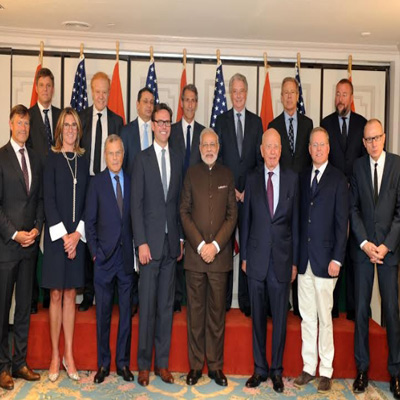
    In his recent meeting with the Fortune 500 CEOs at the iconic Waldorf Astoria Hotel in New York, Modi not only successfully brought up the burning issues of Indian media and digitisation to the world platform, but also instilled a sense of camaraderie amongst the executives, whose net worth, as per the media buzz, was $4.5 trillion!

    The proof of the pudding lay in the superlative address that 21st Century Fox chairman Rupert Murdoch gave Modi through his tweet after the event.

    “Great hour with Indian PM Modi. Best leader with best policies since independence, but massive task to achieve in most complex nation,” said Murdoch.

    Apart from the senior Murdoch, the CEOs present at the roundtable meeting chaired by Modi included 21st Century Fox CEO James Murdoch, News Corp  CEO Robert Thompson, Star India CEO Uday Shankar, WPP CEO Martin Sorrell, Discovery Communications president and CEO David Zaslav, Sony Entertainment CEO Michael Lynton, Interpublic Group of Companies CEO Michael Roth, Vice Media CEO Shane Smith, Time Warner CEO Jeff Bewkes, A&E Networks CEO Nancy Dubuc, Visy Industries chairman Anthony Pratt, Route One Investment Company’s William Duhamel and ValueAct Capital CEO Jeff Ubben.

    While the CEOs were enthusiastic about the digital transformation that is taking place in India through the Digital India initiative, they called for speeding up of television digitisation, and strengthening of the cellular (mobile) infrastructure.

    According to the head honchos, the current strong trajectory of the Indian economy made it at a unique moment to accelerate growth in this sector.

    Post the meeting, Modi tweeted his pleasure in seeing the executives enthusiastic about being part of Digital India and the role of media in it. “Met top American CEOs from media & entertainment sector. They were enthusiastic about the change @_DigitalIndia initiative in driving,” he said before craftily leading in the major issues that were discussed among the executives in the congregation earlier.

    “My interaction with Fortune 500 CEOs was on investment opportunities in India & why they must come & @makeinindia! Digital technology has a vital role in making democracy stronger & in overall human resource development,” he tweeted.

    Modi painted the government's vision to connect the 600,000-odd villages in India with broadband and emphasised that digital technology will increasingly play a major role in further strengthening democracy and India's development narrative. He also highlighted how Digital India posed as a great opportunity for the international media companies.

    As evident from the PM’s tweets, foreign direct investment (FDI) formed a large chunk of the round table and the 90 minute soiree. “Foreign direct investment all over the world has fallen. But in India, it increased by 40 per cent. This reflects confidence in the Indian economy,” Modi was heard pointing out the executives right before they sat down for dinner. “Reform in governance is my number one priority. We are for simplified procedures, speedy decision-making, transparency and accountability,” he assured the prospective investors.

    The topic that dominated most of the evening was the role that the media and entertainment industry can play in development and generation of employment opportunities in India.

    Modi also touched upon the importance of a smoother Intellectual Property Rights (IPR) regime in the digital era.

    Pegging his argument on India’s value for intellectual property he said, “We are committed to protecting IPR, that's essential to fostering creativity.”

    He also upheld the importance of regional languages in India and suggested to the CEOs that India represents both the biggest opportunity and the biggest challenge for them. He also urged them to keep regional languages in mind, as they firm up investment plans for India. “Explained to media CEOs why India is a great opportunity for them & how many regional languages makes India even more special to invest in,” Modi tweeted.

    “The government has already undertaken a massive amount of reforms. Key message from the US companies was keep doing what you are doing. I had a great meeting, there was a constructive dialogue in the spirit of collaboration. We are looking at India trying to get foreign direct investment,” said J P Morgan CEO James Dimon.

    As per  India's foreign office spokesperson Vikas Swarup, Modi took keen interest to personally interact with every CEO, and understand the executives’ areas of concern that his government could address and resolve.

    The Prime Minister emphasised that he saw a key role for digital technology in further strengthening democracy, and in India’s development narrative.

  • NewsX, India News line up special coverage on PM Narendra Modi’s US visit

    NewsX, India News line up special coverage on PM Narendra Modi’s US visit

    MUMBAI: All eyes are trained on Indian Prime Minister Narendra Modi’s second visit to the US, which is also the first time in three decades that an Indian PM visits the west coast.


    Understanding the geopolitical and economic gravity that this event brings for India and the world at large, news channels NewsX and India News have lined up expansive coverage for viewers throughout Modi’s visit.


    The programming line-up on NewsX and India News includes special shows, exclusive interviews, roundtable discussions and prime time debates. Viewers can also tune into the live reports of the events unfolding from ground zero including live coverage from San Jose where Modi will address the Indian-American community.


    While NewsX will present roundtable discussions in collaboration with the US-India Political Action Committee (USINPAC), an American, Bipartisan Political Action Committee representing Indian-Americans, India News will report special stories from New York.


    This special line-up of programming on NewsX and India News will be driven by the channel’s team of editorial experts led by NewsX editor-in-chief Rahul Shivshankar and India News editor-in-chief Deepak Chaurasia along with veteran journalists like Kartikeya Sharma, Geeta Mohan and Sheetal Rajput, who will travel to the US to cover the visit and provide the viewers with in-depth live reportage.


    “Not only Indian viewers, but the whole world is keeping a close eye on this much anticipated visit. Through our extensive coverage, we look forward to continue our leadership and deliver on the expectations of our viewers of being the most trusted network,” said Chaurasia.

  • Times Now takes on NaMo govt’s one-year anniversary with special shows

    Times Now takes on NaMo govt’s one-year anniversary with special shows

    MUMBAI: Prime Minister Narendra Modi’s government has completed one year of governance after it swept to power with a thumping win of 282 seats in the Lok Sabha elections in 2014.


    Under the Modi wave, the country saw some key decision-making and initiatives. A year on, it is now time to review the BJP’s performance. So has the past one year seen the PM’s most promised reforms move the big way and speedily? Have the NaMo policies for the masses been effective and beneficial? From banking to labour to general schemes to social security, how good or bad has it been? Times Now will bring to its viewers an exhaustive and in depth overview with details on the minutest of moves from 22 – 16 May, 2015 with Modi 365.


    Modi 365 on Times Now, shall look at the hits and misses, the politics behind the big moves, the real issues that have been looked at, India’s foreign policies and how or if it has worked. The channel aims at giving the nation a voice to raise important issues, ask the right questions and take action that brings about a positive change in the society. The special programming and broadcast will have a wide participation from those who matter and have been in the know of things – from ministers and politicians to bureaucrats besides the master observers.


    Starting with a special Super Prime Time debate on 22 May, the series shall cover The Home Stretch (Politics First) on 23 May at 6.30 pm, followed by Real Politik Special at 7.30 pm, debates with expert on 23 and 24 May at 9 pm. Modi 365 will also have the C Voter Opinion Poll on the Modi government’s first year in power on 25 May at 7 pm.

  • After Congress and BJP, AAP enters ‘outdoor’ fray

    After Congress and BJP, AAP enters ‘outdoor’ fray

    MUMBAI: Barely days for the city to go to polls, and a party which had hitherto relied on unconventional methods such as word-of-mouth, foot soldiers and dharnas to gain popularity, has finally taken refuge in mainstream advertising, albeit out-of-home (OOH).


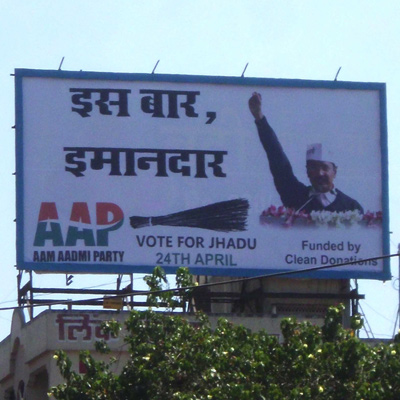
    Indeed, the Aam Aadmi Party (AAP) and its most public face, Arvind Kejriwal, are the latest to find their way to a string of hoardings plastered across Mumbai in the lead-up to voting day on 24 April.


    In the hoardings, Kejriwal is seen asking Mumbaikars for votes, alongside slogans in Hindi which read: “Jitne Sitam Karna Hai Kar Lo, Lekin Desh ko Badal kar Rahenge”, “Is baar Imaandaar” et al.


     According to Global Advertisers, which has the mandate for the main political parties, while BJP and Congress are utilizing 17 to 20 per cent and 25 to 27 per cent of the total outdoor hoardings, respectively, AAP is utilizing only 7 to 8 per cent.


    In terms of monies spent, “If Congress is spending around Rs 50 crore and BJP about Rs 20 crore on outdoor, AAP, which does not have as much money as BJP and Congress, should be spending much less than Rs 3 to 5 crore. However, it is important to note here that unlike Congress and BJP that are creating a very strong presence through TV and print advertising, AAP’s advertising backbone comprises just outdoor and word-of-mouth,” informs Global Advertisers managing director Sanjeev Gupta.


     For AAP, the outdoor agency is currently focusing on Mumbai’s high-visibility regions such as Worli, Andheri, Dadar and Thane. Despite having been approached at the nth hour, the agency’s media planning and buying teams have selected some of the best sites for the party.


    In this election year, Indian advertising is expected to witness an overall boost of around Rs 1,000 crore from political advertising, with outdoor advertising expected to see a 10 per cent rise within that. “We at Global expect to witness as much as a 30 per cent rise in our revenues just from political advertising,” says Gupta.


    While TV and print exude national presence, outdoor is very important for parties to reach out to masses who stay in the country’s hinterland. “And since the 2014 elections are being considered to be one of the toughest elections of all time, parties are more than willing to dig deep into their pockets and spend on advertising, especially outdoor, since their vote bank lies within these tier 2, 3, 4 markets,” Gupta points out.