Tag: Namit Das

  • Gas-O-Fast brings ‘India ki Acidity ka Indian Ayurvedic Solution’

    Gas-O-Fast brings ‘India ki Acidity ka Indian Ayurvedic Solution’

    Mumbai: Mankind Pharma’s Ayurvedic Gas-O-Fast has rolled out an extension of its ‘India ki Acidity ka Indian Ayurvedic Solution’ campaign. The brand came up with a digital campaign featuring Namit Das to effectively communicate the message that Ayurvedic Gas-O-Fast can address the common acidity problem in India. For creating a presence in the regional market, the brand also launched a multilingual TVC campaign, with Kanneganti Brahmanandam and Biswanath Basu, for better brand awareness in the South and East, respectively.

    Aiming to reach a wider audience base, this year the brand initiated a well-planned 360-degree campaign aiming to amplify the brand’s reach and seek deeper penetration into the market. As part of the campaign, the brand executed multiple activities. In the first instance, Ayurvedic Gas-O-Fast activated an OOH campaign to strike a chord with the audience.

    The brand has launched the activity across Pune, Kashmir, Uttar Pradesh, Gujarat, Rajasthan, and other parts of India. It took a multi-dimensional route with hoardings in Pune, boat branding in Dal Lake, Srinagar, station branding in Gujarat and Rajasthan, and wet sampling in Uttar Pradesh to reach out to customers. The activity also included branding activity and TV series integration on Colors TV, covering different media channels. It aimed to reach out to non-digital audiences who still rely on traditional media to stay informed.

    Additionally, rather than restricting themselves to a few mediums, the brand has also devised various offline event sponsorships. With the objective of further enhancing the impact created by multilingual TVC campaigns, the brand presents Times Sharod Shrestho 2022 in association with Times of India. It was done by being a part of the Durga Pujo gaiety during the most awaited and biggest festival in West Bengal. The campaign was able to create visibility across numerous Baroari (community-based) pujas in Kolkata.

    Furthermore, in an attempt to make inroads into the rural market in West Bengal, another activity was undertaken. The brand, in association with Radio Mirchi, presented an event called Mirchi Para Football. The match was an amateur football event and Ayurvedic Gas-O-Fast sought to target the audience across the districts of Midnapore, Berhampore, Barasat, and Siliguri for better brand penetration and visibility. These events were well supported with the help of digital promotions on social media handles and websites, newspaper editorial coverage, print advertorials, and announcements on radio channels.

    Speaking about the campaign, Mankind Pharma associate vice president of sales and marketing Joy Chatterjee said, “The Indian audience is very vast, which reflects diverse trends. In order to reach them, the one-size-fits-all concept becomes obsolete and requires a more multi-faceted approach to increase visibility among the audience. We sought to cater to all types of audiences with this campaign.”

  • Star Plus’ ‘Sumit Sambhal Lega’ to go on air from 31 Aug at 10 pm

    Star Plus’ ‘Sumit Sambhal Lega’ to go on air from 31 Aug at 10 pm

    MUMBAI: Everybody Loves Raymond, the globally acclaimed sitcom that has been adapted in several countries across the world, has now set foot in India as Sumit Sambhal Lega.


    Come 31 August, and Star Plus will launch the show from Monday to Saturday in the 10 pm slot.


    The show offers a light-hearted take on how after marriage, a man often finds himself caught between the two most important ladies of his life.


    Sumit Sambhal Lega follows the story of a Punjabi family in Delhi and stars Namit Das as the protagonist Sumit Walia. He is a sports journalist who unwillingly finds himself in a constant tug-of-war between his wife, Maya and his mother Dolly. To make matters worse, his gluttonous overbearing father and unmarried and insecure older brother add to his already chaotic life.


    The show also marks the comeback of actor Jasbir Walia on the small screen, who will be seen playing the role of the head of the family in the show.


    Sumit Sambhal Lega is produced by DJ’s A Creative Unit.


    Producer Deeya Singh said, “I wanted to bring theatre on TV – to give the viewers an experience as if the actors are performing live in their homes.  It’s been a great learning with many firsts for me through this show – the process which as producers that we were involved in like the writer’s room, rehearsals before actual shoots, four camera setup and working closely with the international creative team like Steve Skoravan. The show insight about a married man living with his family struggling to find a balance is a worldwide phenomenon and I believe it is this madness that brings us joint as a family.”


    For the direction team, Star Plus brought together three different people. The series was set up by filmmaker Shashant Shah, Deven Bhojani and actor-director Parmeet Sethi.


    Heading the writer’s room is script consultant Rajesh Devraj, who is working with Arshad Sayyed, Sumit Roy and Chirag Mahaba for the sitcom’s script. As a first for Indian television, Star Plus has also roped in the writer and co-producer of the original series Skrovan, who oversaw the entire creative process.

  • Ghanchakkar: A complete waste of talent

    Ghanchakkar: A complete waste of talent

    MUMBAI: One may steal a theme from a foreign film but when one fails to give the film even a sensible, logical title, you know you are party to a lost cause. To copy a foreign film, understanding it is mandatory. Ghanchakkar is inspired from a 2007 Hollywood film titled The Lookout, which was about a bank robbery and a character with anterograde amnesia, which means short-term memory loss. But the film‘s Hindi title suggests a comedy and means an idiot/stupid person. The last film based on memory loss was the Aamir Khan blockbuster Ghajini but that is where the comparison ends.

    Ghanchakkar is a ‘twist in the tale‘ story which, at best, can be a limited-duration TV episode. However, the maker stretches it to almost 138 minutes. According to the original film, not only does the protagonist keep losing his memory, he also keeps getting these bouts of anger whichGhanchakkar follows religiously.

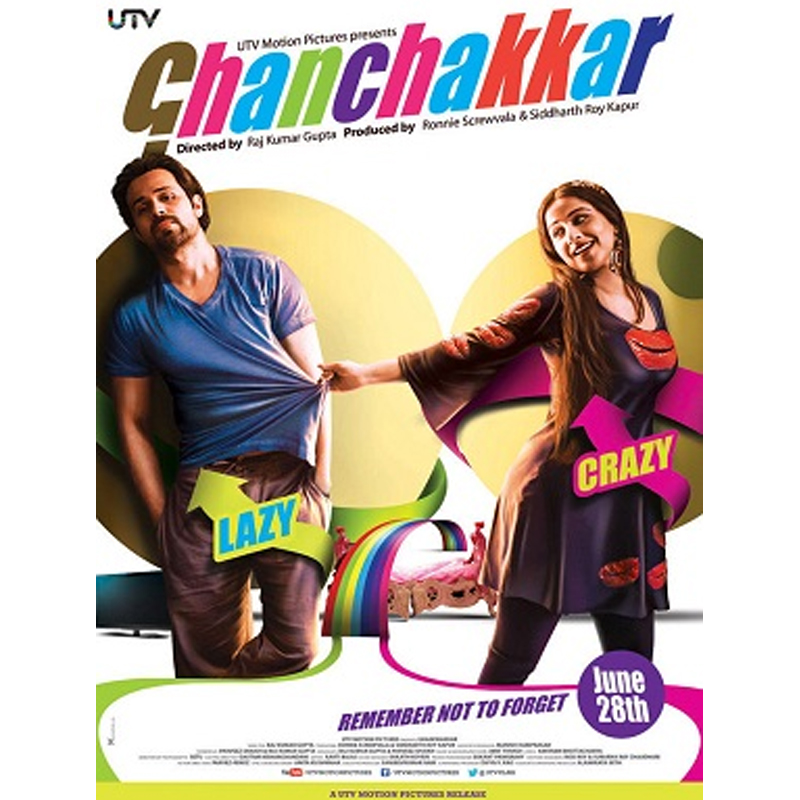
    Emraan Hashmi is a safebreaker on a sabbatical. He thinks he has made enough to take life easy and enjoy with his wife, Vidya Balan, who plays a Punjabi character for some unexplained reason. That is when an unidentified voice on the phone invites Hashmi to a huge bank heist; the bank, it seems, has a vault which only Hashmi can break open. The sum is expected to be huge, about Rs 35 crore and Hashmi‘s share would be Rs 10 crore.

    Balan subscribes to Vogue and such fashion magazines but gives her wardrobe her own version of fashion, usually loud and garish outfits being her thing. Her attempts at Punjabi slang or sounding like a loud Punjaban are as real as her dressing sense. Hashmi on his part has only one dream, to own the biggest television set available in the market. For the sake of this TV set, he agrees to meet the voice on the telephone. The rendezvous is set for 12.30 at night at Andheri station.

    The voice on the phone turns out to be Rajesh Sharma aka Pandit and a gun-toting Namit Das. They try to look mean and threatening but manage to look like two comics out of a C-grade farce. For Hashmi to be threatened by Das, half his size, and fat Sharma, does not convince the viewer and this is only the forewarning of what is to follow. The bank is robbed as easily as a deserted house with the three wearing masks of Dharmendra, Amitabh Bachchan and Utpal Dutt; the only scare to the robbers coming from a beat cop coming into bank at 2 am to take a leak. That is an idea; bank loos can double as Sulabh Sauchalayas during off hours and continue to make money!

    The bank is robbed, the three part ways with Hashmi given the responsibility to keep the money for three months till the heat settles after which they can take their own share. Three months are over and Sharma and Das demand their share. But Hashmi has had an accident in this duration and now suffers from anteograde amnesia due to which he has selective memory losses. He can‘t remember who these two are or which money they are referring to. The two kidnap Balan giving Hashmi a week to recollect where the money is hidden. Later they shift into Hashmi‘s house to finish that mandatory seven-day period. These seven days seem never-ending; they are supposed to be funny but are torturous for the viewer.

    The hero also follows the anterograde amnesia to the T as now his memory loss is becoming severe and he now suspects everybody including Balan and vents his anger on people around him. That is when an angel drops in from the blue, literally. He is the real villain who drops in without a warning and ends the painful saga by killing his two stooges, Sharma and Das, as well as Balan and Hashmi and finally his own self.

    With a cast of four out of which two are poorly etched, to carry through 138 minutes of pathetically scripted and directed fare, Ghanchakkar fails on all counts. Music is of the chalu kind. Dialogue is in poor taste.

    Ghanchakkar is boring and doomed to failure.