Tag: Nagesh Chhabria

  • VBS 2024: Stopping the leakages in the pay TV ecosystem

    VBS 2024: Stopping the leakages in the pay TV ecosystem

    Mumbai: India is in the grips of seisnic changes regarding video and broadband consumption. Pay TV cord-cutting is rampant even as free TV subscriptions are on the rise and OTT buy-ins are churning with the signs up for certain platforms stagnating even as others are seeing rapid increases and some are seeing cataclysmic drops. Aggregators of OTTs are popping up on the horizon promising cheap bundles along with value-added services for cable TV and DTH. There’s a rush to set up free advertising-supported TV channels by TV set manufacturers and smart TV device makers. There’s the Jio factor where it seeks to convert most pay TV customers to free streaming of video content by offering free access to consumers at no cost. The consumer continues to demand bandwidth higher than ever imagined even as prices drop. Margins are under pressure as every player goes one-up on each other to acquire and retain customers.

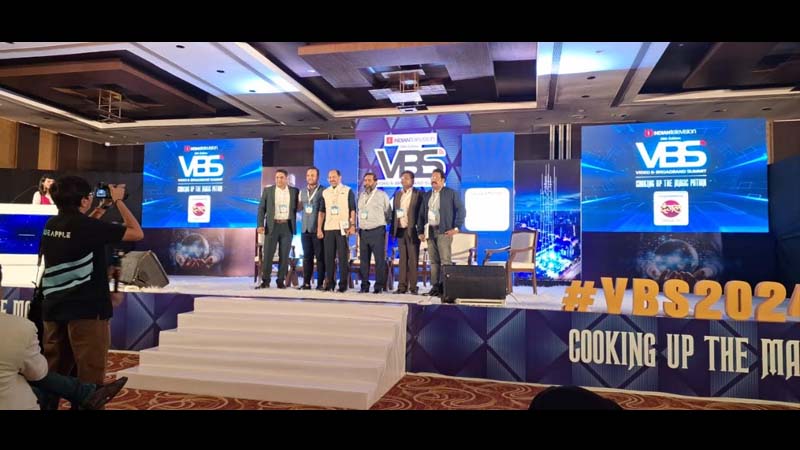
    The video and broadband distribution landscape has not been as vibrant as it is now.. How long will this pot-boiling continue? What will the magic potion of video and broadband look and taste like? And what’s the end game? Indiantelevision.com has held the 20th edition of Video and Broadband Summit better known as VBS at Sahara Star Hotel, Mumbai.

    The session chair for this panel is Elara Capital senior VP Karan Taurani along with the panellists: NXT Digital COO Rouse Koshi, MetroCast Network India promoter Nagesh Chhabria, Sabot One Pvt. Ltd. chairman & managing director Atul Saraf, Epic On & Stream-Sense CEO Sourajya Mohanty and KCCL and KVBL CEO Padmakumar N.

    In this session, Taurani discussed the TV industry, issues of piracy, decrease in pay TV subscribers, shift from traditional TV to connected TV.

    He asked Koshi on the assessment of piracy and the kind of loss the industry is suffering to which he said, “ Piracy has come down. On the linear side of it, I don’t see piracy as much of a problem right now. After digitisation, piracy has come down. Also on the technological front, we have good regulations in place. There is a concern though in a lot of illegal streaming apps rather than in the pay TV side. “

    Taurani then turned around towards Chhabria where he asked him his perspective on any innovation or data tracking he might have done towards his subscribers to see if piracy is there to which he said piracy is there first through our net and secondly in cable TVs where privacy is there in rural areas. In those areas, whichever state you go, there are small MSOs who are running with 2000 and 1500 base. When a businessman sees that they question how do they survive with such a small base? It is through privacy.”

    After an elaborating response, Taurani asked Padmukar on the lack of digitisation and household penetration level in South markets to which he said, “In protecting the content, we have done all the steps so there’s no chance of privacy as we give correct reports to the broadcasters and there is no suppressing data. As far as Kerala Vision is concerned, we are doing a good business. I’m Kerala our total cable TV homes will be 70 lakhs and out of this around 35 lakhs is dominated by Kerala Vision. We have more than 50 per cent market share in Kerala TV and more than 50 per cent in broadband also.

    Saraf said on the issue, “Piracy has been happening for the last three decades. As an OTT aggregator, we are not allowing anybody to download our app if they are not able to put their telephone number. We are doing B2B and doing B2C. There is one thing sure from our OTT department that piracy won’t happen from our end.

    Last but not the least, Mohanty replied, “First of all we will acknowledge the fact that piracy has been a menace not only in India but globally also. We have a three fold approach that we have adopted. First is to take initiatives around DRM. Secondly, we have taken our initiatives with the video URLs which are very minimal yet very effective. Third is we have taken initiatives in deploying agencies.

    Taurani ended the session by saying bundling is the way ahead and consolidation which will be beneficial to the platforms and distributors. 

  • Cable TV veteran Nagesh Chhabria announces new national MSO; $200 million investment

    Cable TV veteran Nagesh Chhabria announces new national MSO; $200 million investment

    MUMBAI: The Indian cable TV market is about to witness the emergence of a major multisystem operator: one which is backed by industry veteran Nagesh Chhabria. The former Indusind Media CEO and promoter of Bhima Riddhi Digital Services, runs cable TV networks in several towns in Karnataka, Maharashtra,  and some regions of the Goa and Gujarat border, and has been a powerful force in the cable TV distribution space.


    Now Chhabria has signed an agreement with Atlas Consolidated LLC – a joint venture between Greenwich Equity Partners and Jagran Infra-Projects led by Sanjiv Mohan Gupta – to create a national MSO with about $200 million being pumped into it..
     

    The Agreement was signed sometime back and the formalities for formation of the new MSO are in process.  “The name of the MSO and its brand will be announced shortly,” informs Chhabria.


    Not disclosing the equity share Chhabria will hold in the JV, he says, “We may in the future, based on the decision of the new members of the board, plan to list the company.”


    The new entity plans to have a pan India network with a target base of six million subscribers in the next 18 months. And in order to achieve the target, it will take both: the organic and inorganic route. “When I say organic it will be through a fibre rollout and converting a large analog base into a digitised set up with a fixed revenue share in place,” informs Chhabria.


    On the inorganic route, the company may apply two models: one, buy out the last mile, so it has complete control and two, look to have a majority stake in an existing network with a ready base. “We have numerous tie-ups in place which will enable us to reach to our targets in the required timelines,” opines Chhabria.


    In late May Chhabria acquired a 50 per cent stake in Mumbai-based Bhawani Rajesh Cable & Digitech Services, with the option to take it up to 74 per cent.


    The JV will also grow its business through the acquisition route. “The networks we are acquiring will be announced shortly. Ground level assessments are taking place as we speak,” he adds.


    The new entity has chalked out a foolproof plan for its successful launch. “We have a 45 cities rollout plan which will be announced shortly,” says he.   


    According to a recent Deloitte report, currently there are 80 million non-TV households and Chhabria will at the appropriate time look at tapping  those households as well. “Eventually most of the non TV households in the future will have screens to consume entertainment and data.”


    To start operations, initially 25 digital headends across the length and breadth of the country will be set up. “It’s likely that in eight to 12 weeks from now the new company will be in place. There will be a simultaneous rollout in all parts of the country,” he informs.


    Greenwich Equity is an emerging markets fund, based in the United States with a focus primarily on infrastructure and media. Jagran has a storied pedigree in the production and entertainment space. Atlas was created as a joint venture between Greenwich Equity and Jagran Infra and is the holding company for all of Greenwich and Jagran’s investments in the cable and media space.


    Atlas Consolidated LLC managing director Sanjiv Mohan Gupta says, “We plan to be one of the significant players in the cable TV industry similar to what we did in the other media business.”


    Adds Greenwich Equity Group managing director Suhas Kundapoor, “We are excited to be in this space at this time and find that there is tremendous potential in this industry.”


    What is interesting to note is that the announcement for the JV has come at a time when the general sentiment towards cable TV industry is negative. Chhabria is quick to respond, “Sentiments are like seasons.  Sometimes sunny, sometimes gloomy. But investments are made on fundamentals. The fundamentals of cable TV industry are in place and have tremendous potential that will be unlocked in the coming future.”  


    For him, digitisation has thrown open huge opportunities and set top boxes with the right middleware give opportunities for advertisers and content marketers. “Beside subscriptions, we are geared to deploy numerous Video and Non – Video VAS along with Broadband services,” he adds.


    Chhabria and his company currently have a subscriber base of one million which will be brought into the new entity initially. “Cable TV industry in India still requires 140 million boxes to completely digitise the universe. We firmly believe there is tremendous potential in aggregating direct subscribers in phase III and phase IV. We are in talks with numerous players in the market to acquire their networks,” feels Chhabria.


     The MSO will not stop at the $200 million investment or at the six million subscriber base. “This is just the beginning. Future plans will be shared at the appropriate juncture,” concludes Chhabria.  


  • ‘Digitisation will throw open acquisition opportunities’ : IndusInd Media and Communications chief executive officer Nagesh Chhabria

    ‘Digitisation will throw open acquisition opportunities’ : IndusInd Media and Communications chief executive officer Nagesh Chhabria

    T he Hindujas have started the first round of cable TV digitisation in the three metro cities of Mumbai, Delhi and Kolkata. The second phase will open up 15 more cities where IndusInd Media and Communications Ltd (IMCL), the cable TV company they own, operates. Aggression is being planned to take on 14 more cities through acquisitions, joint ventures or direct entries.


    The ambitious target set is deployment of four million digital set-top boxes (STBs) on top of the 1.5 million IMCL is expecting to achieve in the first phase of digitisation. The company is also planning to own one million last mile connections in two years, up from its current base of 300,000.


    IMCL, which operates its cable TV business under the Incablenet brand, will need Rs 6 billion in the new phase that will see 38 cities go digital by 31 March 2013. The company is in talks with private equity investors to raise $75 million.


    “There is a huge appetite now to invest in cable TV companies. The first phase of digitisation has been successfully implemented in the three metro cities of Mumbai, Delhi and Kolkata. There is also no uncertainty now about India’s digitisation programme across the country. We should see equity deals happening in the sector,” says IndusInd Media and Communications chief executive officer Nagesh Chhabria.


    Chhabria believes the cable TV ARPUs (average revenue per user) would rise to Rs 500 by 2015, while carriage income would see a 10-15 per cent drop in DAS (digital addressable systems) markets.


    “In the first phase, we are looking at a 15 per cent increase and believe our ARPU would settle at Rs 225. If the ARPU is lower than this, the local cable operator will not survive,” he says.


    In an interview with Indiantelevision.com’s Sibabrata Das, Chhabria talks about the changing cable TV environment and the multi-system operator’s (MSO) expansion plans.


    Excerpts:

    Q. Is IMCL in talks with private equity investors to raise capital for funding its cable TV digitisation programme?
    We are looking at raising $75 million and have mandated Ernst & Young for this purpose. There is a huge appetite now to invest in cable TV companies. The first phase of digitisation has been successfully implemented in the three metro cities of Mumbai, Delhi and Kolkata. There is also no uncertainty now about India’s digitisation programme across the country. We should see equity deals happening in the sector.


    Q. Will $75 million meet IMCL’s total funding requirement for the second phase?
    We will need Rs 6 billion as we expect to deploy four million set-top boxes (STBs). We have existing lines of credit from banks for $15 million. We can further raise $10 million of new debt. So along with equity financing, we should be comfortably placed. Of course, there is concern about the weakening of the rupee, which will mean STBs becoming costlier. But we are asking our STB manufacturer to offer us a better rate so that it offsets any rise in dollar value.


    Q. Hasn’t IMCL lined up vendor financing so that the pressure on funding upfront eases?
    We have not gone in for that option. The Cisco set-top boxes are 15-20 per cent more expensive than ours. Our model works out cheaper for us.


    Q. Isn’t your estimate of the STB requirement too high as IMCL operates in only 15 out of the 38 cities that fall under digitisation in the second phase?
    It is easier now to get into new cities because there is less entry cost. You don’t have to pay broadcasters for an assumed number of subscribers as digitisation would reflect your actual subscriber base. Capital expenditure, of course, is going to be higher but there is an assured revenue model.


    We plan to enter into 15 more cities and anticipate a requirement of two million STBs from the new operations. For our existing operational cities, we would need two million STBs.

    ‘Even in the second phase, DTH will hardly be able to make an impact. Since most of the cities that fall in this round of digitisation are carriage markets, the national MSOs have a presence in them. Already 10 per cent of this market is digitised by the MSOs‘
    Q. Will you take the acquisition route for entering into these markets?
    Digitisation will throw open acquisition opportunities. There are many operators who will find it difficult to fund for the STBS. So they will either want somebody to invest in their cable networks or completely sell out. We are in talks with many independent operators. We can also enter on our own through fibre or available bandwidth.
     

    Q. How are valuations getting decided?
    We look at the profits made in the last fiscal and offer four times that value. The other option is to look at future profits (sans STB investment) made from the first six months of digital operations and then fix a value. But this has few takers as nobody wants to take the risk.


    Q. Are you not looking at last mile acquisitions that will give IMCL direct ownership of the consumer homes without having to share a portion of the subscription revenue with the local cable operator?
    We have an aggressive plan to own last mile. Our target is to own one million primary points in two years, up from our current base of 300,000. The acquisition of primary points, however, is much costlier and the price could be in the region of ten times the subscription fee. In Mumbai, this could go up to 20 times. But with digitisation necessitating billing systems, the primary points will be up for grabs.


    Q. Has DTH been able to eat into IMCL’s subscriber base in the first phase?
    We have hardly felt the impact. Even in the second phase, DTH will not be able to win over cable TV consumers in a big way. Since most of the cities that fall in this round of digitisation are carriage markets, the national MSOs have a presence in them. Already 10 per cent of this market is digitised by the MSOs. DTH will stand a better chance in tier III and IV towns. Acquisition of primary points in these smaller places will be a good strategy for MSOs to follow.


    Q. How many STBs has IMCL deployed across three cities in the first phase?
    We have already seeded 1.3 million boxes and our target is to touch 1.5 million. In Mumbai we will do 850,000 million and 0.5 million in Delhi. The progress in Kolkata is slow but it will also pick up.


    ‘We are looking at raising $75 mn and have mandated E&Y. There is a huge appetite now to invest in cable TV companies. The first phase of digitisation has been successfully implemented in the three metro cities of Mumbai, Delhi and Kolkata. There is also no uncertainty now about India’s digitisation programme across the country. We should see equity deals happening in the sector‘
     

    Q. Is the conversion into second TV homes significant?
    The demand for second TV sets is higher in Delhi than in Mumbai. But at a combined level we are talking of a 25-30 per cent conversion rate. We are working out a pricing for second and third TV sets as we have to match the DTH offers. But we are yet to ink deals with broadcasters on this.


    Q. What is the kind of content deals that you have stitched with broadcasters?
    We have done cost-per-subscriber deals. This works out better in the long term and is a more transparent system. We get to know our cost per box and it is easier to work out negotiations later. Our content cost would work out to 33 per cent of our subscription revenue.


    We wanted to do three-year deals with broadcasters but they were not ready for it. Most of our content deals are on a yearly basis.


    Q. What is the revenue share you are giving to local cable operators?
    The value chain will take away 33 per cent of our subscription revenue. We also have operational costs and an investment on the STBs, but we also earn carriage or placement revenue. We are seeing a 10-15 per cent drop in our carriage deals for DAS (digital addressable system).


    Q. Will ARPUs go up?
    In the first phase, we are looking at a 15 per cent increase and believe our ARPU would settle at Rs 225. If the ARPU is lower than this, the local cable operator will not survive.


    ARPUs for MSOs should at least be Rs 300 for them not to be dependent on carriage income. MSOs with ARPUs below Rs 300 will have to be carriage dependent.


    Our forecast is that cable TV ARPUs would rise to Rs 500 by 2015. What will lift up ARPUs is HD and regional packages. Premium packages will also get sold.


    Q. So are we talking of financially healthy MSOs in digitised India?
    A lot on how the market shapes up will be decided over the next six months. We will know the actual seeding of boxes in consumer homes once the subscription collections happen.


    Q. Will IMCL rely only on video services or there is a serious plan to pump up broadband investments?
    We will be investing Rs 1 billion on broadband infrastructure in the next fiscal. We are also going to prepare for IPTV and OTT (over-the-top) services.


    Q. What about launching local cable channels?
    Yes, this is very much a part of the plan. Since there will be no constraints on bandwidth in the digital era, we are planning to put together 10-12 local channels, including local news. We are also looking at ad-free channels.