Tag: mythology

  • Hamara Vinayak takes faith online as God joins the digital revolution

    Hamara Vinayak takes faith online as God joins the digital revolution

    MUMBAI: Some friendships are made in heaven; others are coded in Mumbai. Hamara Vinayak, the first-ever digital original from Siddharth Kumar Tewary’s Swastik Stories, turns the divine into the delightful, serving up a story that’s equal parts start-up hustle and spiritual hustle.

    Some tech start-ups chase unicorns. This one already has a god on board. Hamara Vinayak takes the leap from temple bells to notification pings and it does so with heart, humour and a healthy dose of the divine.
    At its core, the show asks a simple but audacious question: what if God wasn’t up there, but right beside you, maybe even debugging your life over a cup of chai?

    The show’s tagline, “God isn’t distant… He’s your closest friend” perfectly captures its quirky soul. Across its first two episodes, screened exclusively for media in Mumbai, the series proves that enlightenment can come with a good punchline.

    The series follows a group of ambitious young entrepreneurs running a Mumbai-based tech start-up that lets people around the world book exclusive virtual poojas at India’s most revered shrines. But as their app grows, so do their ethical grey zones. Into this chaos walks Vinayak, played with soulful serenity and sly wit by the charming Namit Das, a young man whose calm smile hides something celestial. 

    Tewar extreme left with the caste

    He’s got the peaceful look of a saint but the wit of someone who could out-think your favourite stand-up comic. Around him spins a crew of dream-driven youngsters – Luv Vispute, Arnav Bhasin, Vaidehi Nair and Saloni Daini who run a Mumbai-based tech start-up offering devotees across the world the chance to book “exclusive” poojas at India’s most sacred shrines. It’s a business plan that blends belief and broadband – and, as the story unfolds, also tests the moral compass of its ambitious founders.

    “The first time I read the script, I found the character very pretty,” Namit joked at the post-screening interaction. “It’s a beautiful thought that God isn’t distant, he’s your closest friend. And playing Vinayak, you feel that calm but also his cleverness. He’s the friend who makes you think.”

    The reactions to the series ranged from smiles to sighs of wonder. Viewers were charmed by the show’s sincerity and sparkle, a quality that stems from its creator’s belief that faith can be funny without being frivolous.

    Among the cast, Luv Vispute shines brightest, his comic timing adding sparkle to the show’s more reflective beats. But what keeps Hamara Vinayak engaging is the easy rhythm of its writing – one moment touching, the next teasing, always gently reminding us that spirituality doesn’t have to be solemn.

    Luv spoke fondly of his long association with Swastik. “Since my first show was with Swastik, this feels like home,” he said. “Every project with them is positive, feel-good, and this one just had such a different vibe. I truly feel blessed.”

    Saloni Daini, who brings infectious warmth to her role, added that she signed up the moment she heard the show was about “Bappa.”

    “We shot during the Ganpati festival,” she recalled. “The energy on set was incredible festive, faithful, and full of laughter. It’s such a relatable story for our generation: chaos, friendship, love, kindness, and faith all mixed together.”

    vinyak

    Vaidehi Nair and Arnav Bhasin complete the ensemble, each representing different shades of ambition and morality in the start-up’s journey. Their camaraderie is easy and believable, a testament to how much the cast connected off-screen as well.

    This clever fusion of mythology and modernity plays to India’s two enduring loves, entertainment and faith. Mythology has long been the comfort zone of Indian storytellers, from the televised epics of the 1980s to the glossy remakes that still command prime-time TRPs. For decades, gods have been our most bankable heroes. But Hamara Vinayak tweaks the formula not by preaching, but by laughing with its characters, and sometimes, at their confusion about where divinity ends and data begins.

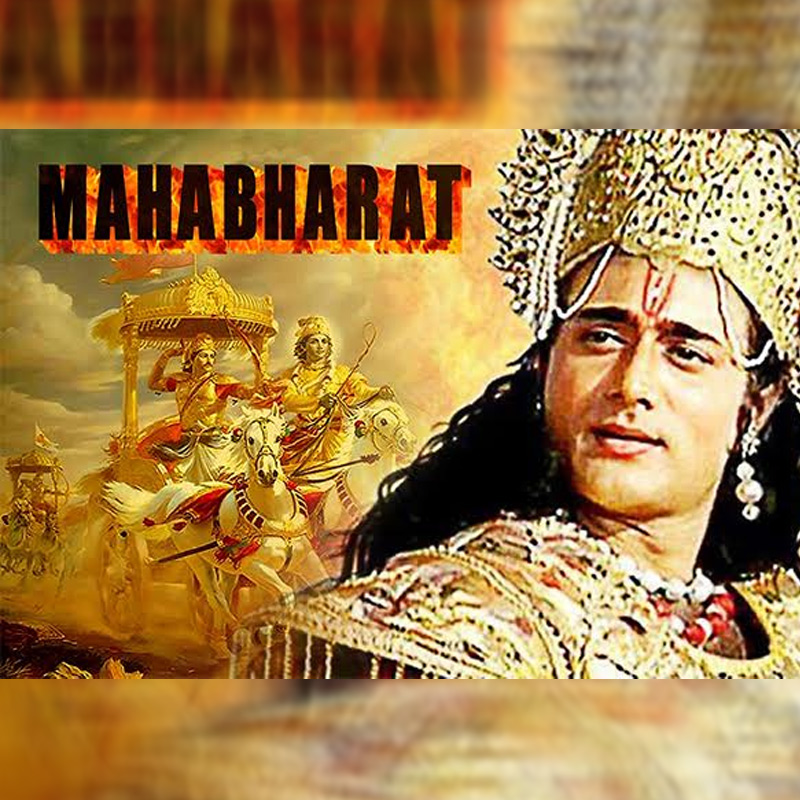
    Creator Siddharth Kumar Tewary, long hailed as Indian television’s myth-maker for shows like Mahabharat, Radha Krishn and Porus, explained the show’s intent with characteristic clarity, “This is our first story where we are talking directly to the audience, not through a platform,” he said. “We wanted to connect young people with our culture to say that God isn’t someone you only worship; He’s your friend, walking beside you, even when you take the wrong path. The story may be simple, but the thought is big.”

    That blend of philosophy and playfulness runs through the show. “We had to keep asking ourselves why we’re doing this,” Tewary added. “It’s tricky to make something positive and spiritual for the OTT audience, they’ve changed, they want nuance, not sermons. But when the purpose is clear, everything else aligns.”

    For the creator of some of Indian TV’s most lavish spectacles, Hamara Vinayak marks a refreshing tonal shift. Here, Tewary trades celestial kingdoms for co-working spaces and cosmic battles for office banter. Yet his signature remains: an eye for allegory, a love for faith-infused storytelling, and an understanding that belief is most powerful when it feels personal.

    Hamara Vinayak, after all, feels less like a sermon and more like a conversation over chai about what success means, what faith costs, and why even the gods might be rooting for a start-up’s Series A round.

    As Namit Das reflected during the Q&A, “Life gives us many magical, divine moments we just forget to notice them. Sometimes even through a phone screen, you see something that redirects you. That’s a Vinayak moment.”

    The series also mirrors a larger cultural pivot. As audiences migrate from television to OTT, myth-inspired tales are finding new form and flexibility online. The digital screen lets creators like Tewary reinvent the genre, giving ancient ideas a modern interface, without losing the emotional charge that’s made mythology India’s storytelling backbone for decades.

    In a country where faith trends faster than any hashtag, Hamara Vinayak feels both familiar and refreshingly new, a comedy that’s blessed with heart, humour and just enough philosophy to keep the binge holy.

    For a country where mythology remains the oldest streaming service, Tewary’s move from TV to OTT feels both natural and necessary. Indian storytellers have always turned to gods for drama, guidance and TRPs from Ramayan and Mahabharat on Doordarshan to glossy mytho-dramas on prime time. But digital platforms allow creators to remix reverence with realism, and in Hamara Vinayak, faith gets an interface upgrade.

    The result is a show that feels like a warm chat with destiny, part comedy, part contemplation. And in an age of cynicism, that’s no small miracle.

    As Tewary put it, smiling at his cast, “The message had to be positive. We just wanted to remind people that even in chaos, God hasn’t unfriended you.”

    With 5 episodes planned, Hamara Vinayak promises to keep walking that fine line between laughter and light. It’s mythology with memes, devotion with dialogue, and a digital-age reminder that even the cloud has a silver lining or perhaps, a divine one.

    If the first two episodes are any sign, the show doesn’t just bridge heaven and earth, it gives both a Wi-Fi connection.

  • Colors bets on nostalgia for successful ‘Mahabharat’ run

    Colors bets on nostalgia for successful ‘Mahabharat’ run

    MUMBAI: Mythological shows have come to the rescue of GECs struggling with a dearth in original content caused by the ongoing lockdown restrictions. And it has been a gala time for epic shows like Mahabharat. After a successful run on DD Bharati, the 1980’s epic by BR Chopra Mahabharat has made its way to Colors from 4 May.

    Viacom18 Hindi mass entertainment chief content officer Manisha Sharma says that during this pandemic, when people are seeking relief and hope, the epics are proving to be a perfect reminder of the golden times and a guiding light for how we wish to lead life from here on. The combination of purpose, nostalgia and the great narrative keeps bringing people back to watch these shows and take away something meaningful from it every time. Despite being produced almost three decades ago, the shows are backed by a strong storyline and impressive character outlines that make for a great entertainment proposition, regardless of the generation gap.

    Is it a good business call to air the show right after its conclusion on DD? Sharma says that demographically the audience of Colors is different. “For the ones who have not seen the show or the episodes before, it’s like watching a new show or catching up on the missed episodes. Secondly, it is also liked by viewers who have watched the show before and want to relive the charm as it evokes a sense of nostalgia. Both these sets of viewers cut across NCCS, age, gender, and geography,” she says.

    While DD aired the show at 9 pm, Colors chose to go with the 7 pm timeslot. The reason? Some of its best properties such as Balika Vadhu have performed well in the 6-8 pm slot.

    Sharma says: “Keeping the viewer's interest in mind and without disturbing the FPC, we decided to air Mahabharat in the 7-9 pm slot.

    With regard to the reach, there are a considerable number of consumers in the GEC universe who have not watched Mahabharat. That leaves us with enough scope to gain eyeballs.”

    Sharma further highlights that mythological shows such as Mahabharat help to bolster television audiences and attract advertisers. Time spent on such shows has consistently been increasing and brands that are relevant in today’s context should use it as an opportunity to create awareness and salience. She says that products with huge demand and ample supply, such as FMCG and retailers, are the revenue generators and contributing largely to the ad inventory.

    Digitalkites SVP Amit Lall says that mythological shows have been resonating with audiences for ages. It is only the distribution that has become robust now. “DD connects strongly with people from rural or tier II and III cities. On the satellite TV side, channels like Colors top your mind. Advertisers choose these channels because they have rural and urban audiences. Though 70 per cent of rural India viewers are DD-oriented, the other 30 per cent from these satellite channels play a big role. So, Colors is trying to capitalise that section of the society.”

    For promoting the show, Sharma says they have been closely mapping consumer sentiments and media consumption habits to ensure effective and collaborative engagement. “Looking at the audience’s strong penchant for mythological shows, we have gone all out on digital and TV to promote the show. We are also doing programmatic buying on digital and tapping the platforms to target viewers,” she adds.

    According to Lall, channels need to cater to their loyal audiences’ taste or else they may shift to other channels.  Sharma says: “We are closely monitoring the trends and looking at offering an ideal balance of the kind of content, thus staying true to our DNA of offering the best variety content for our loyal viewers.”

    Colors has also acquired the rights to air it in the Middle East. Colors ME has been telecasting Mahabharat from 6 May in a two-hour slot from 8-10 pm along with English subtitles. Back in India, Mahabharat will be aired only on Colors and won’t be seen on any other regional channels.

    The channel also holds some strong mythological and historical properties such as Karamphal Data Shani and Chakravartin Ashoka Samrat. The channel is monitoring viewership trends and may take a call for an appropriate time to re-run these.

  • Sahara One targets LC1 and LC2  with new brand image and shows

    Sahara One targets LC1 and LC2 with new brand image and shows

    MUMBAI:  Hindi GEC channel Sahara One aims to strengthen its position in the ratings race armed with niche content and new packaging. Rebranded under the tagline ‘ Har Pal Manoranjan ‘, the channel is looking at mythology and crime as its USP.  The channels new brand identity new brand statement statement and look will be kick started with a new crime show Masterminds, from 23 November onwards.
     

    “When Trilogic Digital went into a Bulk Airtime Purchase and Distribution Agreement (BAPADA) agreement with Sahara One in April 2014, the channel didn’t have a distinct USP or what it stood for. Post which, we did an extensive research on what works for our target audience and who are watching us, and realised that we clearly needed a brand statement for the channel to be communicated to our viewers, and therefore the rebranding ensued,” informed Trilogic Digital Media Limited (TDML), COO, Shivani Jaisingh, giving a premise for the rebranding.

    When it comes to the packaging, Sahara One has kept its design classy, while using bright colours that bring our a connect with its Indianness. Designed by Kolahoi Media, the trademark logo has a new look with a gamut of colours and the name of the channel in a new font. The multi-colour interface is a key component of the channel which personifies its identity and vibrancy. Right from promo bugs, transition windows, sponsor windows to the tickers, each element will propagate the brand philosophy of being fresh, innovative and progressive. Har Pal Manoranjan signifies the new brand promise of providing colossal entertainment.

    Explaining the new content strategy for the channel, Jaisingh said, “We are taking a distinct position on mythology and crime related shows and won’t be catering to all genres. Given that mythology, and crime especially, are working for our target group, we plan to dedicate a prime time band to the genre calling it ‘Prime Crime’, with two new shows launches. Apart from this we will also launch a new show Behula based on Bengali mythology sometime soon.”

    The two new shows that Sahara One will be launching under its new ‘Prime Crime’ band, Sahara One are– CBI Files and the above mentioned MastermindBehula will air in the afternoon band, Both CBI and Behula will hit the television airwaves in December.  TDML, being a content producer itself, is responsible for the creative content for the shows from its newly set up production office in Noida.
     

    The decision to rebrand and offer niche content also came in the wake of the BARC India ratings inclusive of rural data, indicating that this the perfect time for the channel to rebrand and reach out to the LC1 and LC2  market. “BARC’s rural data has given us a wakeup call and changed our lives. Hence the timing for the rebranding is absolutely right for us as our viewers is pretty much the same demographic and consuming our content for quite a long time. Our rebranding is targeted at them,” informed Jaisingh.
     

    Jaisingh delves deeper into the question of the channel’s target audience to explain how BARC ratings have prompted them to take the call for the revamp. “As per our research, most of our viewership comes from MP, UP, Bihar, Haryana, with some presence in Delhi. It’s basically the Hindi Speaking Market and North. These areas are pretty much single TV homes where the remote gets passed around, and prime time is male dominated. Therefore we see the crime shows working well for that demography.  We have kept to mythology and some repeats when women are watching,” Jaisingh elaborates.


    She further added, “We have made heavy investments in both distribution and programming. And thanks to BARC we have seen a sea change in the hierarchy in channel rankings. We plan to capitalise on that and enter the race with full gusto.”

    The timing also makes sense in terms of digitization that is in progress. Jaisingh  informed  indiantelevision.com that TDML is ready to reap the fruits of digitisation and is awaiting the completion of DAS Phase IV. In fact, a part of the revamping also sgetting more cable operators and MSOs on board.

    Under the BAPADA agreement, TDML is to invest in Sahara One in terms of distribution, marketing and programming content for the channel which allows it to collect the revenue the channel makes from advertisements and subscription as well. The rebranding and the launch of the new shows are big advantages for TDML.

    “For existing viewers, we are using promos to inform them of the rebranding. When it comes to marketing, we are concentrating mainly on the digital platform, as that’s where we need to have a presence that was missing for a very long time. We are concentrating on bringing new and younger viewers on board with that,” Jaisingh highlights their current marketing strategy. “Brand to brand approach is what TDML is going for,” Jaisingh adds.

    Right from production, execution to marketing, the channel is spending big money on rebranding itself. In fact, according a source close to the development, approximately Rs 5 crore will be burnt towards marketing, for the rebranding as well as the three new shows that are to launch.


    Considering the investment amount, a hike in advertising revenue seems logical. “We are keeping our fingers crossed but we expect a 30 per cent increase in our advertising revenue. In terms of subscription and international distribution, we have some interesting plans that we will announce soon,” Jaisingh concludes.

  • Epic’s marketing mantra: Digital innovations

    Epic’s marketing mantra: Digital innovations

    MUMBAI: One of the oldest civilisations in the world and thousands of stories to tell; Epic, the latest entrant in the Hindi entertainment channel space, is all about ‘Kahaniyaan Hindustan Ki’.

    Different from the rest, the channel which wants to be categorised as the country’s first genre specific channel, is taking a different approach when it comes to not only content, but marketing as well.

    Imagine a standard bus stop transformed into a royal seating chamber, equipped with fan bearers and thrones. Yes, to give a taste of yesteryears the channel has taken the conventional as well as unconventional ways to create the buzz around it.

    “We want to create a brand around history and mythology in television and therefore it was very important to have a strategic approach to our marketing efforts,” says Epic Television Networks founder and MD Mahesh Samat.  Apart from focusing on a 360 degree marketing plan, it has put a great deal of focus on digital innovations.

    “Social media is a much underutilised medium which we wanted to explore. We have a three-pronged approach – create relevance, generate meaningful engagement and offer a sense of uniqueness,” says Samat while elaborating on how the channel debuted first on YouTube a month before the launch of the channel and garnered over 1.2 million hits and subsequently, released a promo every week to build some pre-buzz in the market.

    “Our digital initiative, Epicgrams, has been an ongoing property that has helped create the relevant conversations surrounding Indian history, mythology and folklore, before the channel launched,” highlights Samat.

    Other than this, Epic is also being promoted in the traditional ways with radio, print, television and OOH.

    The channel did an in-depth research to create the blueprint of marketing strategy. “Our research suggested that our content appeals more to urban audiences given the contemporary format of storytelling. It also suggested that the content is more gender neutral unlike other entertainment channels. That being said, our content is focused on Indian history and we as Indians have an emotional connection to our past. We have had a longstanding tradition of storytelling that has faded over the last few decades. Urban audiences have turned away from Indian television because there isn’t enough content that caters to their sentimentalities. We felt that this was a space in television that was untapped and we wanted to bring audiences back to Indian television in a way that suits their consumption patterns. We felt that leveraging the digital medium would help us reach the intended audience and be an agent to bring them back to television,” he adds.

    The campaigns are season based wherein once the first season is over, the campaigns for the second season of shows will commence.

    Launched on 19 November, after more than a year’s wait, so far the channel has spent upwards of 50 to 60 per cent of its marketing budget.  As per industry sources, the channel is spending around Rs 20 crore to Rs 25 crore on marketing.

    So far, Epic is focusing on cities that have completed phase I of digitisation and the urban audience across the country, including Mumbai and Delhi and as digitisation takes its course across the country, the campaigns will begin there as well.


  • Our content will cross borders, says Mahesh Samat

    Our content will cross borders, says Mahesh Samat

    MUMBAI: After a wait for almost an year, Mahesh Samat’s Epic will finally see the light of day on 19 November.

    The news of the former Disney executive launching Epic Television Network first broke in 2012 and was supposed to launch the channel by August 2013. However, due to the delay in getting the licence from the Ministry of Information and Broadcasting, the venture backed by Anand Mahindra , Mukesh Ambani and Rohit Khattar, focusing on Indian history, folklore and mythology, had to wait a long time to entertain the audiences.

    As per media reports, Mahindra and Ambani each have a 25.8 per cent stake in the company and together have financial control. Also, there is an initial commitment of Rs 100 crore from the group of ‘angel investors’. Samat has a 48.5 per cent stake in the venture, as per the company’s filing with the Registrar of Companies (RoC).

    The HD pay channel, also available in down-scaled SD version, aims to change the way entertainment is being categorised today. “We are not what people think and call ‘general entertainment’. We are a brand that stands for something which Indian television industry doesn’t have,” says Samat while adding that Indian history has numerous stories to tell and that’s what the channel will do.

    Someone who has keen interest in history, Samat believes there are enough people in urban India who want to watch mythology and know about the historical aspects of the country. The channel, though slightly male skewed, while conventional GECs are heavily female skewed, wants to entertain the whole family.

    With months of research gone into creating the fictional shows like DharamaKshetra, Dariba Diaries as well as non-fictional shows like Adrishya, Raja, Rasoi aur anya Kahaniyaan have been shot in HD and sound recording is on 5.1 Dolby. “Technology is changing the way we tell stories today,” says Samat and highlights how it has also collaborated with Mumbai University and other institutions to help with the facts.

    The channel is working with a new-breed of producers like Bolt Media, Green Light Production, Pride Rock Television among many others, who are willing to take a contemporary take on age-old stories. The research was done by the production houses with the channel’s help. “We got enough creative freedom from the channel,” says a producer of a show soon to be aired on the channel and adds, “The cost of production is higher than that of a show on other channels, but one needs to know how to utilise and make the best of the resources available.” As per industry sources, the cost of production of a show could range from anything between Rs 12 lakh to Rs 20 lakh per episode.

    The shows are finite with most of the shows comprising 20+ episodes and will also see filmmakers like Pankaj Prashar creating content for the channel. “Today a lot of filmmakers want to enter the big world of the small screen. However, most of them don’t have time for infinite shows. Here we are giving them an opportunity to tell stories in a short period of time,” says Samat.

    “And depending on the response and love we get from the audiences we will look at bringing back the show through various seasons,” he adds. Samat believes in changing the way industry works today. “We don’t want to stretch story lines. Everywhere else in the world, seasons work. It’s time we did too.”

    That’s not all; he believes that the content will be so rich and unique that it can be sold to the world. “International syndication is important to me and I want to take our stories to the world,” says Samat. The channel has already got a good response from buyers at MipCom where it showcased the content and Samat believes that before the next edition, the content will have enough takers. “We will not just focus on conventional markets but non-conventional markets as well,” he adds while highlighting that as a pioneer he and his team of 40 have to take risks and go an extra mile to stand out of the crowd. YRF TV’s former head Ravina Kohli is the development head and Aparna Pandey is the business head who also takes marketing decisions.

    The channel will go on air with 13 to 15 shows which will be weekly with the primetime being from 8:30 pm to 11 pm. The morning and afternoon slot currently will show repeats. The channel plans to acquire historic films and programmes as well, which will be aired mostly on the weekends. “As our library grows, the FPC will change too,” he pin points.

    So far, the channel has got no advertiser on board; however, talks are on. “We want to give a week or two for brands to see the content and how they can relate with our philosophy,” says a confident Samat, who feels many will come on board soon. “We are not an AFP driven channel,” he says.

    Media planners too believe that brands will want to watch the content. “No one wants to take a risk,” says a media planner. He adds, “Lifestyle brands will hop on board. However, Reliance and Mahindra brands are always there.” However, several feel that the channel will take time to create a niche of its own as viewers still want to see daily soap operas.

    With a pan-India approach, the channel will be distributed and syndicated by IndiaCast. “Talks are on with all the major DTH players as well as cable operators in DAS area,” says IndiaCast group COO Gaurav Gandhi.

    Subscription rate for the HD channel is Rs 55 while SD will be available at Rs 10.5.

    Beamed off Intelsat 20, the channel will soon start the marketing regime. General entertainment channels (GECs), news as well as other genres will be targeted along with major dailies in the metros. Major hoarding sights will be targeted as well with a lot of focus on digital. Currently, on Youtube, the channel has 1530 subscribers and the first look of the channel has got more than 1.2 million views.

    “Our content will be available online, but will come at a cost,” informs Samat.

    Madison is the media agency while Jack in the Box is the digital agency. Dynamite is the creative agency, though a lot of creatives are done in-house as well.


    The channel has entrusted revenue monetisation to Helios Media which has emabrked on seeding the channel in advertiser market. “Everything about Epic is unique. And those with futuristic view will be on board soon,” says the agency’s MD Divya Radhakrishnan.


  • Epic channel set to roll out by end 2014

    Epic channel set to roll out by end 2014

    NEW DELHI: India’s first genre specific Hindi entertainment channel, Epic is all set go on air by the end of the year  and will showcase content based on Indian history, folklore and mythology in a contemporary format. It is the first segmented channel in Indian television.


    Mukesh Ambani, Anand Mahindra and Rohit Khattar are the three promoters of the company. Mahindra & Mahindra chairman and managing director Anand Mahindra speaking on the occasion said that the landscape of Hindi entertainment is undergoing a dramatic transformation and in order to appeal to an evolved audience, and to sustain their engagement, there was a need for a revolution in the broadcast space.


    “We have all been entertained with the history and mythology of India through books and grandparents’ stories. These stories will now come to life on television in a contemporary manner,” he added


    The channel identified fragmentation of audiences as a huge opportunity for differentiated and genre specific content. By integrating India’s rich heritage with the current consumption patterns, the channel is creating original content within the Indian history, folklore and mythology genre and will be using a contemporary story telling format.


    Epic Television network founder and managing director Mahesh Samat commented, “The ‘segmented’ content will allow viewers to choose and consume genre-specific content of their liking. Our vision is to create a brand in television that will translate our vibrant past into entertainment with the objective of creating new IPs, strong characters and new heroes that strike a chord with audiences.”


    The channel will have action, drama, comedy, supernatural and narrative non-fiction content, set against Indian history and mythology. The stories will be innovative with high production quality and a distinct look that will appeal to both men and women. Most of the content will be shot at real locations with HD cameras. The programming line-up has a mix of fiction shows, narrative non-fiction shows, short form content as well as films at launch.

  • Zee Marathi to launch Jai Malhar

    Zee Marathi to launch Jai Malhar

    MUMBAI: If Hindi general entertainment channels (GECs) are treating audiences to a growing number of mythology-based shows, why should regional channels be far behind?

    Following in the footsteps of Mahabharat, Mahadev and Maa Durga will be Zee Marathi’s Jai Malhar, a mythological show based on the reincarnation of Lord Shiva as Lord Khandoba aka Lord Malhar, Maharashtra’s most revered warrior god.

    Produced by actor-filmmaker and head of Kothare Vision, Mahesh Kothare, the show has been mounted on a lavish scale and promises to be like none other before it. Slated to premiere on 18 May, Jai Malhar will replace Tu Tithe Mee at 7:00 pm. Only the first episode will be for one hour and will be beamed on a Sunday.

    Zee Marathi business head Deepak Rajadhyaksha says, “Mythology has always appealed to Indian audiences but nobody in the Marathi industry has touched the subject owing to the extensive research and heavy investment involved in recreating it. Zee Marathi has made an ambitious attempt to transform the saga of Maharashtra’s Lord Khandoba into a gripping and thoughtful show with state-of-the-art visual effects and presentation. The original mythological narrative hasn’t been disturbed but what has been modified is the style of storytelling, making it riveting and in tune with contemporary screen techniques.”

    Jai Malhar has Kartik Kende as executive director, Rupesh Tatkari as director of photography, Nilima Kothare and Neeta Khandke as costume designers, Santosh Ayachit as creative head and scriptwriter, Pankaj Padghan as music director and Chandrabhan and Abhijat in charge of graphics. The 60-strong team is largely constituted by young and promising talent.

    For now, a deal for producing 312 episodes has been signed. With shooting having commenced on 31 March at Film City in Goregaon, the plan is to can seven to eight episodes by the end of this month, with 12-hour shooting schedules. For a show of such epic proportions, set designer Satish Panchal has re-created elements from Lord Khandoba’s palace, the fort of Jejuri, temples and ashrams to make it look as real as possible. Sources say nearly Rs 1.3 crore has been spent on the set itself. As for the central characters of Lord Khandoba and his two consorts, Mhalsa and Banai, were selected from more than 2,000 participants who auditioned in the cities of Mumbai, Nagpur, Aurangabad, Nashik and Kolhapur among others. The names of the protagonists have not yet been revealed. Two cameras are being used on the set for shooting in HD. In keeping with regulations, a medical officer is available on the set every day to oversee that the animals used for the shoot are treated ethically and not harmed in any way.

    “Once we were firm on the idea, we approached Zee Marathi and they instantly said yes to it,” says Kothare. “The show will appeal to all. For youngsters it’s a tale of a lover; for the elderly, it’s the tale of a God; and for kids, it’s the tale of a superhero. No show has ever been made on this scale in the Marathi genre.”

    Apparently, Kothare has been conceptualising the idea for the past three years and has been in talks with the channel for about a year and a half. Sources say that each episode could cost anywhere between Rs 3 lakh to Rs 5 lakh, pegging a year’s exercise at approximately Rs 10 crore to Rs 12 crore. Nearly Rs 50 lakh has gone into costumes alone including clothes, headgear and weapons.

    A marketing campaign has already begun in TV and print. On-air promos have already begun while a full-page ad spread was already published in leading Marathi newspapers such as Maharashtra Times and Divya Bhaskar. The full-fledged campaign will break approximately 10 days before the launch of the show on 18 May. The creative agency for the show is FCB Ulka while media planning has been done by GroupM.

  • Monster India shakes up passive jobseekers with new campaign

    Monster India shakes up passive jobseekers with new campaign

    MUMBAI: We wake up every morning; follow our usual routine, sleepwalk our way to work, complete our average jobs and then crib about not being happy. This is the situation with many people in the country and thus Monster India, one of the leading online career and recruitment solutions provider and flagship brand of Monster Worldwide, has launched a new campaign “Wake Up” with an aim to jiggle the passive jobseekers to take an action.

    Monster India has launched its new brand positioning of ‘Find Better’ with a tag line – ‘Get lucky. Get Active on Monster’. The campaign addresses a majority of jobseekers who become comfortable with their average jobs and are ignorant of the limitless opportunities that exist. The campaign urges them to rise above mediocrity, ‘Wake- up’ to their true potential and capitalise the opportunity.

    The company has put in a lot of creativity to grab the attention of jobseekers. “We had to come up with a creative idea that would not just make people sit up and notice but actually wake them up. So we thought of several ideas and ways to wake people up. Need we say, we put those many waking hours! We had a ball too, going from fiction to mythology to the jungles and almost everywhere. So while a shrilly opera singer, a bleating sheep and a goofy Tarzan try to wake up our protagonist, we had to go underwater to find the ideal one to wake our guy up – someone more dead than him!” said Dentsu Marcom National Creative Director Titus Upputuru.

    The new campaign has been launched after a recent global survey conducted by Monster and Gfk that revealed that “70 percent people have expressed that they are content with their current jobs but they are not”.

    “Their feedback made it evident that they would like to explore more. Hence, ‘Wake Up’ call is targeted at this vast majority of people who need to make the most out of the opportunity that exists out there,” said Monster.com managing director Sanjay Modi.

    ‘Wake Up’ is a unique proposition that uses interesting relatable characters to convey the core message strongly. The serious message of ‘wake up to the new opportunity’ is communicated in a unique and creative fashion with the use of animation that e-recruitment category in India has never seen. The campaign conveys the message in a direct, clean and humorous manner.
     

  • Monster India shakes up passive jobseekers with new campaign

    Monster India shakes up passive jobseekers with new campaign

    MUMBAI: We wake up every morning; follow our usual routine, sleepwalk our way to work, complete our average jobs and then crib about not being happy. This is the situation with many people in the country and thus Monster India, one of the leading online career and recruitment solutions provider and flagship brand of Monster Worldwide, has launched a new campaign “Wake Up” with an aim to jiggle the passive jobseekers to take an action.

    Monster India has launched its new brand positioning of ‘Find Better’ with a tag line – ‘Get lucky. Get Active on Monster’. The campaign addresses a majority of jobseekers who become comfortable with their average jobs and are ignorant of the limitless opportunities that exist. The campaign urges them to rise above mediocrity, ‘Wake- up’ to their true potential and capitalise the opportunity.

    The company has put in a lot of creativity to grab the attention of jobseekers. “We had to come up with a creative idea that would not just make people sit up and notice but actually wake them up. So we thought of several ideas and ways to wake people up. Need we say, we put those many waking hours! We had a ball too, going from fiction to mythology to the jungles and almost everywhere. So while a shrilly opera singer, a bleating sheep and a goofy Tarzan try to wake up our protagonist, we had to go underwater to find the ideal one to wake our guy up – someone more dead than him!” said Dentsu Marcom National Creative Director Titus Upputuru.

    The new campaign has been launched after a recent global survey conducted by Monster and Gfk that revealed that “70 percent people have expressed that they are content with their current jobs but they are not”.

    “Their feedback made it evident that they would like to explore more. Hence, ‘Wake Up’ call is targeted at this vast majority of people who need to make the most out of the opportunity that exists out there,” said Monster.com managing director Sanjay Modi.

    ‘Wake Up’ is a unique proposition that uses interesting relatable characters to convey the core message strongly. The serious message of ‘wake up to the new opportunity’ is communicated in a unique and creative fashion with the use of animation that e-recruitment category in India has never seen. The campaign conveys the message in a direct, clean and humorous manner.
     

  • Enjoy a devotional start to the day with big magic Bihar & Jharkhand

    Enjoy a devotional start to the day with big magic Bihar & Jharkhand

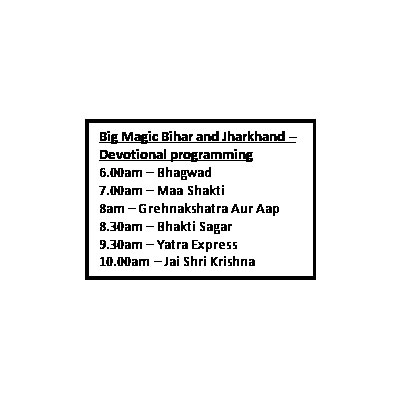
    MUMBAI: In Indian culture and diaspora where over 30,000 Gods co-exist, all good things begin with acknowledging the presence of this supreme power and reiterating an unwavering faith in His guidance. Moreover, in the Hindi Heartland, spirituality and devotion hold a special place in the hearts of adults and children alike.Celebrating this culture, BIG MAGIC Bihar and Jharkhand now ensures that viewers have a great start to their day by tuning in to the channel! With 5 new shows marking an exciting revamp of the morning slot, viewers can now enjoy devotional programming on their favorite channel with content ranging from devotional songs, musical recitals of Holy Scriptures, astrology, pilgrimage and mythology starting 30th September, 2013!

    The greatest and holiest of Hindu scriptures emphasizes the importance of Bhakti towards God. Viewers can start their day with Bhagwad at 6am where verses from the Holy Scripture will be presented as musical recitals. Viewers can then shop for spiritual products in the Teleshopping slot at 7am. Hindus have immense belief in astrology – to gain a scientific explanation to the ancient science of prediction, viewers can tune in to Grehnakshatra Aur Aap at 8am.

    Renownedastrological scholars Reena Kapoor and Astro Pandit Ramesh Bhojraj Dwivedi educate viewers about the calculations of the Planetary Movements that affects our life. Thereafter, viewers can enjoy devotional songs in Bhakti Sagar at 8.30am. India’s rich mythological past comes alive with numerous places of religious importance in Bihar and Jharkhand. Tour these mystic marvels with Yatra Express at 9.30am. The devotional band ends with the wonderful story of one of the favourite Hindu Gods – Lord Krishna. Catch the mythological story of the 8th avatar of Lord Vishnu in Jai Shri Krishna starting 10am.

    Commenting on the renewed programming, Mr. Sunil Kumaran, Business Head, Big Magic Bihar and Jharkhand said, “Big Magic Bihar and Jharkhand has been the No.1 channel in the region and we seek to consolidate our position by introducing brand new programming in the morning slot. We are confident viewers will enjoy their devotional mornings with us.”