Tag: Mumbai Film Festival

  • Netflix releases the trailer for Soni

    Netflix releases the trailer for Soni

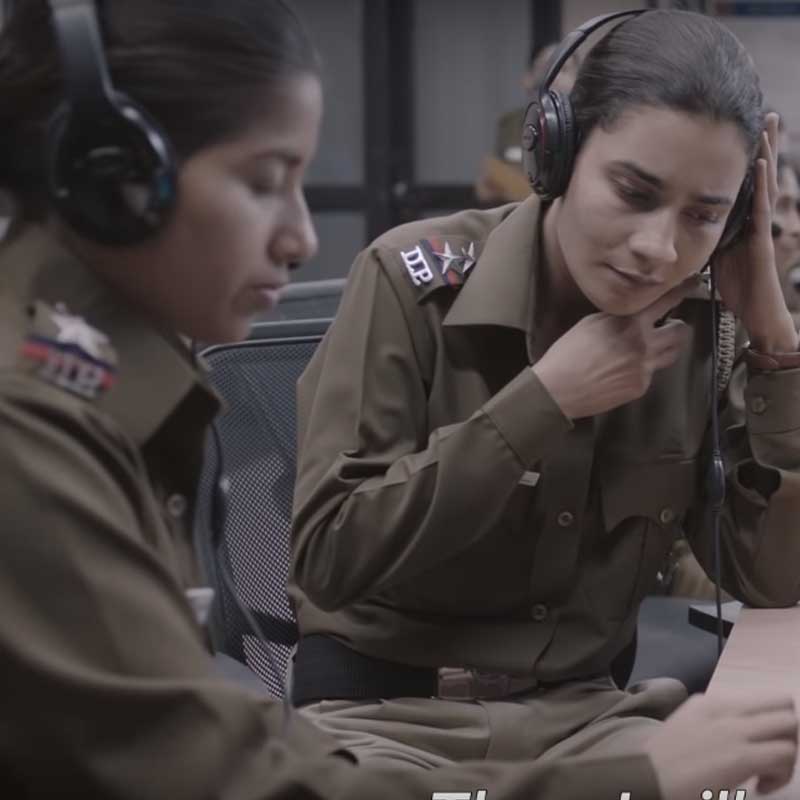
    MUMBAI: Netflix today launched the trailer for the critically acclaimed film Soni, will launch on the service in 190 countries on January 18, 2019. The film has been a festival favourite and featured across the programs at the 75th Venice Film Festival, the Mumbai Film Festival, BFI London Film Festival among others last year.

    Soni is directed by Ivan Ayr and features the talented star cast of Geetika Vidya Ohlyan (Soni) and Saloni Batra (Kalpana) – who with their strong and fierce performances are sure to win the hearts of audiences across the world!

    A thought provoking film chronicling around the injustices and struggles that the women face everyday, Soni explores how the society is confined to a narrow set of patriarchal ideologies and reveals the gender biases in the contemporary society.


  • Bangla film ‘Teenkahon’ wins two awards at maiden Kosovo filmfest

    Bangla film ‘Teenkahon’ wins two awards at maiden Kosovo filmfest

    NEW DELHI: Bengali feature film Teenkahon (Three Obsessions), which was premiered in India at the Mumbai Film Festival, has won the Best Screenplay award and Special Mention of the Jury for Cinematography at the Bridge Film Fest at Mitrovica, Kosovo.

    The maiden edition of the festival, in the partially-recognised state of Kosovo in south-eastern Europe, screened 10 feature films from across the globe.

    Teenkahon marks the directorial debut of advertising filmmaker Bauddhayan Mukherji and is independently produced by his Mumbai-based production company, Little Lamb films. The film is set for release next year.

    A triptych, Teenkahon features Dhritiman Chaterji, Rituparna Sengupta, Ashish Vidyarthi and Sabyasachi Chakraborty, among others.

    Spread over a 100 years, the three stories are structured in the manner of the classical Three Act Play with each story exploring one facet of an obsessive relationship outside the purview of marriage. Each story is a vignette of the period it is set in and looks at the populist trends of the time which has been restored in terms of props, costumes, make-up and hair etc. and these films have been digitally manipulated to imitate colour processes that were available in India during the periods in which each film is set.


  • HBO Premium channels presented a Masterclass at the 16th Mumbai Film Festival

    HBO Premium channels presented a Masterclass at the 16th Mumbai Film Festival

    MUMBAI: This year HBO premium channels had partnered with the 16th edition of the Mumbai Film Festival, organised by the Mumbai Academy of Moving Image (MAMI), to bring a Master Class with acclaimed French actor Catherine Deneuve and  Deepika Padukone.

    The afternoon session presented by HBO Premium Channels witnessed the two in conversation with Anupama Chopra that opened a new side of the veteran actress’ career.
     An interesting discussion ensued as the two actors shared candidly their experiences on a diverse range of issues from their personal to professional lives and their opinions on the difference between cinema in India, Europe and the rest of the world.

    Catherine Deneuve, known for her iconic roles in films such as Repulsion (1965), Belle de Jour (1967) and Tristana (1970), and more recently in Dancer in the Dark (2000) and 8 Women (2002), was conferred with the Lifetime Achievement award at the 16th Mumbai Film Festival. The festival will screen a selection of her movies to pay a befitting tribute to this coveted film actor.

    On this occasion HBO India South Asia managing director Monica Tata commented “We are very excited to have partnered with the Mumbai Film Festival this year, which like our HBO Premium Channels showcases the best of cinema. This partnership will further highlight the proposition that we offer award-winning cinematic content to our consumers.”

    The Mumbai Film Festival has several academic activities connected with it and attracts a significant number of International film celebrities and members of the film business community.
     

  • Sony Pictures acquisition Red Army to be screened at Mumbai Film Festival

    Sony Pictures acquisition Red Army to be screened at Mumbai Film Festival

    New Delhi, 13 Oct:

    The film ‘Red Army’, based on hockey, is being screened at the Mumbai Film Festival commencing tomorrow.
     
    The Festival, which continues till 21 October, is divided into nine sections: International Competition for the First Feature Films of Directors, World Cinema, Indian Frame, Dimensions Mumbai, Retrospectives, Above the Cut, New Faces in Indian Cinema and The Real Reel.
     
    Red Army is a feature documentary about the Soviet Union and the most successful dynasty in sports history, the Red Army hockey team. Told from the perspective of its captain, Slava Fetisov, the story portrays his transformation from national hero to political enemy.
     
    From the USSR to Russia, the film examines how sport mirrors social and cultural movements. It parallels the rise and fall of the Red Army team with the Soviet Union.
     
    Whether he was pitted against enemies in the political arena or on the ice, Fetisov’s story provides a rare glimpse behind the Iron Curtain of the 1970s and ’80s by mirroring the social and political forces at work in the world around him.
     
    While helping pave the way for his nation to cross over into the next century, this one man demonstrated how sports could not only be an avenue for creative expression in a world determined to suppress it, but also be something so inextricably intertwined with a nation’s cultural and political identity.
     
    The film, which has been acquired by Sony Pictures Classics, features Mark Deakins and Vyacheslav Fetisov who are among the erstwhile’s most-decorated athletes.

  • Mumbai Film Festival raises Rs 1.5 crore in two days

    Mumbai Film Festival raises Rs 1.5 crore in two days

    MUMBAI: Since the launch of a social media campaign to save the Mumbai Film Festival on 28 August, the festival has raised Rs 1.5 crore of the Rs 5 crore budget required. The campaign started after media reported that the festival had been called off due to lack of funds.


    The industry at large has pledged their support in ensuring the 16th edition of the Mumbai Film Festival will yet again be marked on the regions cultural and festival calendar.


    Well known producer-directors Vidhu Vinod Chopra, Rajkumar Hirani, producers Manish Mundra, Vivek Kajaria and Nilesh Navlakha, director Hansal Mehta and noted author and critic Anupama Chopra amongst numerous others have helped in the funding the film festival.


    Speaking on these developments, festival director, Srinivasan Narayan said, “I am extremely happy and humbled with the response that we have been getting from the film industry and film lovers in the city at large. We are delighted and grateful to Cinestaan Film Company, Anand Mahindra, Rohit Khattar and Manish Mundra for their generous contribution. Also we are extremely thankful to Vidhu Vinod Chopra, Anupama Chopra, Vivek Kajaria and others for ensuring that the festival rises like a Phoenix. Today for the first time ever it truly feels that the Mumbai Film Festival belongs to the patrons and lovers of the festival. I thank each and every one of those who strive to ensure that the festival continues to present the best of World cinema to our Indian audiences”


    Cinestaan Film Company, promoted by Anand Mahindra and Rohit Khattar have also stepped in with their support and has committed Rs 60 lakh for the cause.


    Talking about the lack of funding in the festival, Cinestaan Film Company chairman Rohit Khattar said, “Anand (Mahindra) & I believe that a festival as important as this should not belong to one sponsor or studio. As the youngest film studio, we would appeal to the larger studios, production houses and, in fact, to all film lovers in Mumbai to take joint ownership. This is our festival and even the smallest contribution would help fulfill our mission. The Mumbai Film Festival has become an integral part of our cinema heritage and as an industry we need to come together to raise it to new heights and nurture it together.”


    The Mumbai Film Festival is organised by Mumbai Academy of Moving Image (MAMI) – a trust comprised of Indian film industry stalwarts and was founded in 1997 by late filmmaker Hrishikesh Mukherjee. Noted filmmaker Shyam Benegal currently heads the organisation.


    To contribute, visit http://www.mumbaifilmfest.org/pledge . To contribute via cheque, write to director@mumbaifilmfest.com. The cheque will be collected by a festival representative.

  • Miss Lovely set for India, US release

    Miss Lovely set for India, US release

    MUMBAI: Ashim Ahluwalia’s Miss Lovely was one of the most critically acclaimed films at the international festivals in 2012. It was premiered at Cannes in Un Certain Regard in 2012 and won best film in the India Gold competition at last year’s Mumbai Film Festival.


    But as is the case with most independent films, Miss Lovely too was grappling to find a space in the theatres. However, the film is up for a January release in India through a start-up distributor Easel Films and Eagle Movies.


    Easel is the brainchild of distributor executive Abhishek Gautam and filmmakers Bikramjit Gupta, Atanu Mukherjee and Pooja Gupte. “We hope to release across 200-300 screens,” said Abhishek Gautam in a release.


    “As a team we want to focus on distributing independent cinema in India,” he added.


    Meanwhile, former IFC Films executive Ryan Werner and distribution agency Required Viewing are working on the US release of Miss Lovely, which is scheduled for March 2014. Cinetic Media’s FilmBuff is handling digital distribution for North America.

  • Mumbai film fest comes to a close

    Mumbai film fest comes to a close

    MUMBAI: After a week of celebrating movies, the final day of the 15th Mumbai Film Festival presented by Reliance Entertainment and organised by the Mumbai Academy of Moving Images (MAMI) unfolded.


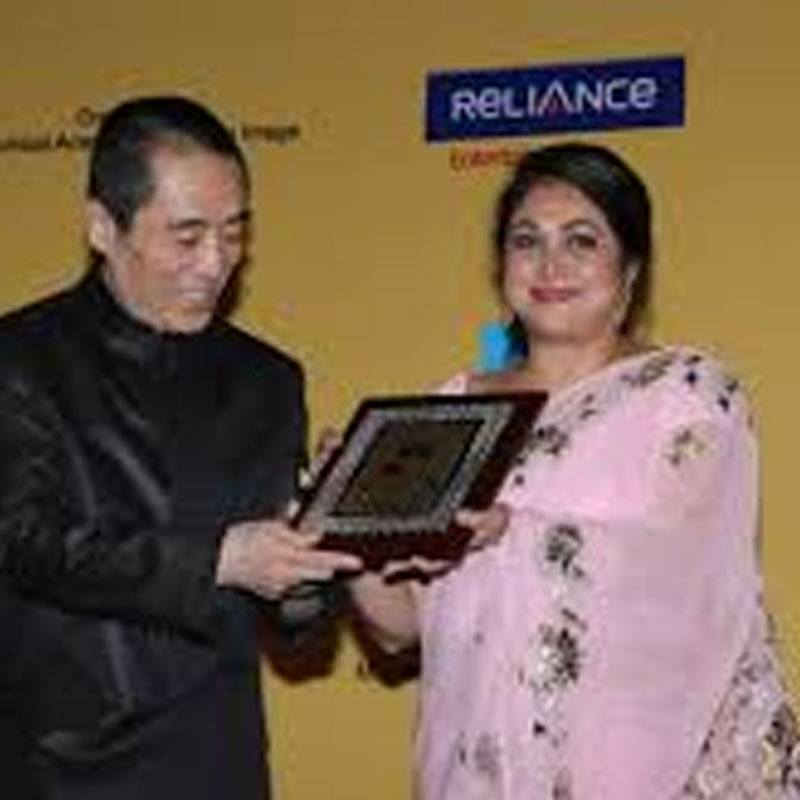
    As the curtains came down, some of the best films screened at the festival were awarded. The International Competition Jury of the 15th Mumbai Film Festival, headed by Bruce Beresford awarded the Golden Gateway of India for the Best Film in the International Competition section to La Juala De Oro directed by Diego Quemada-Diez and produced by Inna Payan, Luis Salinas and Edher Campos.


    The Jury Grand Prize was given with The Silver Gateway of India trophy to the Indian film, Fandry directed by Nagraj Manjule and produced by Vivek Kajaria and Nilesh Navlakha. Anthony Chen was awarded to Best Director for the film Ilo Ilo and Yann Yann Yeo won the Best Actress award for her role in the same movie. The Silver Gateway of India Trophy for Best Actor was awarded to Vincent Macaigne for his role in Tonnerre.


    The final few films screened at the festival included Red Wedding directed by Guillaume Suon and Lida Chan, Short Term 12 by Destin Cretton, Saving General Yang directed by Ronny Yu, Hiroshi Toda’s Seventh Cat, Five Years by Stefan Schaller, Costa Gavras’s Amen and the much acclaimed Z, A Few Days More by Om Prakash Srivastava among others.


    Legendary director Bruce Beresford conducted the last master class of the festival on Preparation by the Director. “I thought I would talk about the necessity of story boarding. These days, with tight budgets and short schedules, if you don’t plan them, you’ll make all sorts of horrible mistakes,” he said.


    The master class later turned into a panel discussion moderated by Variety Asia’s bureau chief, Patrick Rafter. The panelists included Academy of Motion Picture Arts and Sciences member and Digital Motion Picture Archive project lead Milton Shefter and Academy of Motion Picture Arts and Sciences’ Science and Technology Council director Andy Maltz.


    Andrew Commis for his cinematography in the movie The Rocket was conferred with the final award in the International Competition category.


    The HT Cafe Mumbai Young Critics Jury Award for the Best Film presented by Kavita Awasthi was given to the Voice of the Voiceless directed by Maximon Monihan. The HT Best Young Mumbai Critic Award presented by Daniel Kotenschulte was given to Yavar Ahmed of SCM Sophia College.


    Gloria directed by Sebastian Lelio was presented with Best Film award by the Harmony Celebrate Age Jury, headed by Hansal Mehta. Along with the Silver Gateway of India trophy, director Sebastian Lelio was awarded a cash prize too. Additionally, a cash prize was also awarded to director Matevz Luzar as his film Srecen Za Umret won the Silver Gateway of India trophy for Second Best Film.

    Oh, How I Long directed by Riyad Deis and Arefi, Der Hirte (Arefi, The Shepherd) directed by Daniel Asad Faezi elicited Special Mentions from the Jury.


    The Indian feature fiction films screened in the India Gold 2013 category brought to the fore many talented directors. However, Jury member Jill Bilcock in consultation with the members of the Jury announced Deepti Kakkar and Farhad Mustafa’s Katiyabaaz (Powerless) as the Best Film in the category. Qissa: The Tale of a Lonely Ghost directed by Anup Singh won Second Best Film while Manju Borah’s Ko:yad (A Silent Way) received the Special Jury Award.


    Directors below the age of 25 pit their skill in a short film competition “Dimensions Mumbai”. The brainchild of Jaya Bachchan, the competition is a fantastic launch pad for young and aspiring filmmakers. Headed by Shoojit Sircar, the Jury awarded director Keyur Kajavadra S’ In This City the silver gateway of India trophy for Best Film. Mumbaicha Vada Pav directed by Akshay Dhanavale won Second Best Film. Director Sameer Nerkar’s The Handicapped Colony and Abhiraj Rajadyaksha’s Share were given Special Mentions by the Jury.


    Festival Director Srinivasan Narayanan delivered the vote of thanks concluding this year’s festival, which was followed by the closing film of the festival. The Fifth Estate directed by Bill Condon was screened as the finale film of the festival.


    With over 200 films from 65 countries around the world screened and master classes that inspired, the 15th Mumbai Film Festival presented by Reliance Entertainment and organised by MAMI was truly a grand success.

  • Alternative distribution plans for indie films

    Alternative distribution plans for indie films

    MUMBAI: There are nearly 1,000 movies that are made in India every year, but only about 35-40 per cent actually mange to get a proper release across the nation. This is one of the major obstacles for small time independent filmmakers who work on a shoe-string budget on their dream projects.


    The Mumbai Film Festival in its fifteenth edition is trying to plug that hole. In what could have been termed as an intellectually and thought provoking discussion, a panel of dignitaries from the media and film space came together on one stage to show the way to independent filmmakers.


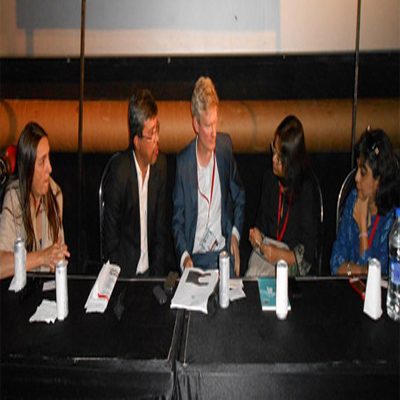
    The session held at Metro Cinema, was moderated by AV Pictures MD Chris Hainsworth and discussed the various alternative distribution avenues for independent films and filmmakers. The panel consisted of Guneet Monga, a film producer and CEO with Anurag Kashyap Films since 2009; Isabelle Dubar, head of distribution at Hapiness Distribution based in France; Anil Wanvari, Founder, CEO & Editor-in-Chief at indiantelevision.com; Nandini, a film producer and finally Shubhra Gupta, a film critic with Indian Express over the past two decades.


    The discussion kicked off with Guneet Monga who briefly started out by talking about her journey so far. “I started producing movies nearly six years ago, but started taking movies to festivals only with That Girl in Yellow Boots. I had no clue how to go about looking for buyers for the movie. But gradually, I realised that the deliverables that we have here in India is nowhere close to the scale at which films are marketed in the international film circuits, and I have learnt things the hard way.”


    On being quizzed on what would be the right place to look for buyers in the overseas market, Monga quips, “Why go anywhere when we have two very good home grown festivals – The MAMI (Mumbai Academy of Moving Image) and the Film Bazaar held in Goa every year – but yes, the scope for buyers is in plenty overseas as well. It’s just about delivering the right mix of content that is of universal appeal. And it is also important that those in the business get to know you and take you seriously because you are meeting them again and again.”


    Isabelle Dubar steps in while speaking about distribution of films. She was the one to take Gangs of Wasseypur (Part I & II) to the French market. “The French market is very outhouse in nature, with approximately 600 films from all over the world coming to the market every year,” says Dubar.


    She further clarifies that the French market is still not that open to Bollywood films and it never really caught on it in a big way, but after observing the response for Gangs of Wasseypur (GOW) at various festivals world over and the appreciation it got at Cannes, she was egged on to give it a shot.


    “We didn’t want to risk releasing both the parts together as a six hour long single feature film and thus adapted to how it was released in India. So, the first part was released around July and we promoted and marketed it like a contemporary Indian take on The Godfather,” Dubar remarks. The results were very pleasing. Though the expectations were high they still managed to get people to watch the movie.


    Dubar says, “We expected nearly 30,000 admissions, but we got 15,000 which is still a sizable number. The second part that we released during Christmas the same year didn’t get much favourable response with only 5,000 attendees. But Anurag Kashyap’s work has been appreciated and the market is open to more Indian films now, so that’s a positive sign.”


    Dubar further threw light on the fact that Kashyap’s Ugly will also be distributed by Hapiness Distribution in and around the French market. “We are also releasing The Lunchbox – a co-production with a French producer – on 11 December in France,” adds Dubar.


    Dubar finally went on to say that be it any language or genre what matters at the end is that the story and the characters should be able to have an universal connect and nothing can stop the film from being accepted and doing well globally.


    The point in question now is how will a film get the right platform to get buyers? “There are bigger markets than just festivals to be tapped into by independent filmmakers. There is Mipcom, Mip Doc and Mip TV, where nearly 11,000 people spend 1,300 Euros a piece to look for buyers or sellers of content, It’s the biggest content trade market in the world,” says Anil Wanvari.


    He further urges the independent filmmakers’ community to unite and pitch for more funding from the government in their distribution efforts. He gave the example of the UK where 50 per cent of all costs to market films and TV shows internationally at markets are paid back to the filmmakers to encourage them to find alternate streams of revenue while pushing the British  perspective and culture. “Even the Andhra Pradesh and Karnataka government offer incentives to producers of animation and gaming to attend markets worldwide to find new customers for their offerings,” he said and added, “Other state governments should be urged to do the same.”


    “Earlier, Prasar Bharti used to screen movies on Sundays from independent filmmakers, maybe that is one thing that needs to be started again. But the need of the hour is for the filmmakers’ community to get together and help raise awareness for these films. Use of social media to bring the importance of independent cinema to the government’s notice and also to transform it into a movement is very essential. More importantly, filmmakers and producers should be aware of the rights they should retain with themselves whether it is SVOD or PPV or NVOD or online or airline or shipping or DTH or whatever right. Never give away all the rights for the movies at once just because a distributor demands them and because you are a first time filmmaker struggling to get your film on the screen. You need to learn to monetise and keep monetising from the product you have created,” Wanvari expounds.


    Film producer and founder of Idyabooster.com Nandini Masinghka too thinks that the need of the hour is to get more clarity as a filmmaker whether the film he is making is for artistic pleasure or for monetising it. “Be clear about your audience; be clear how you will market, how will you distribute. Don’t just put all your money into creation and production,” she highlighted. “If you don’t have the expertise to manage this, then bring in someone who does. Thus, the industry needs more independent producers, who don’t just finance the project but are also responsible for monetising it rightly,” Nandini explains.


    After patiently listening to the conversation, film critic Shubhra Gupta says, “I am surprised that we are discussing the business of cinema without considering the art of it. If the movie is not made artistically, you anyway won’t get buyers for it.”


    Gupta also points out that after the emergence of multiplexes not many films from the independent space get their due at the box-office. “I am forced to see a Besharam on a Friday, when the movie I so wanted to see has been removed. So how will these movies get their due,” Gupta quizzes. She refers to the situation in Chennai where individuals backed and pushed the cause of independent cinema such as Pizza and made it successful.


    Monga highlighted one case in point during her early days as a film maker. “My first film was on cricket and the prints were in the theatres when news emerged that India has been eliminated from the World Cup in 2007. Immediately, the exhibitors sent me back my prints. So I took up the cause of distributing the film myself in Delhi and encouraging schoolchildren to watch it in their schools. I also sold the tickets to universities myself. I then moved this concept similarly to Punjab and made money there. I even made money on the DVD which a home video company had given up on by selling them in the foyers of the theatres where I screened the film. I never gave up on my dream and pursued monetisation from every angle.”

  • The Fifth Estate announced as the Closing Film of the 15th Mumbai Film Festival

    The Fifth Estate announced as the Closing Film of the 15th Mumbai Film Festival

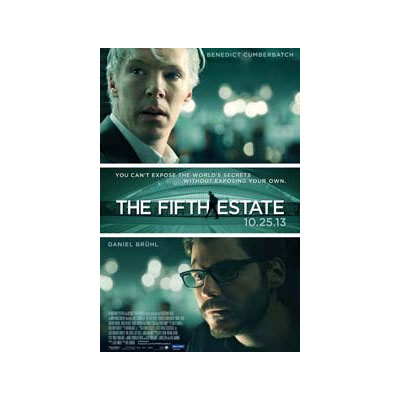
    MUMBAI : As the city’s most eagerly awaited cultural event, the 15th Mumbai Film Festival, organized by the Mumbai Academy of Moving Image draws closer, it has been revealed that this edition of the festival will conclude with the screening of ‘The Fifth Estate”as its Closing Film, a dramatic thriller directed by Bill Condon.

     The Fifth Estate is a dramatic thriller based on real events that reveals the quest to expose the deceptions and corruptions of power that turned an Internet upstart into the 21st century’s most fiercely debated organization. The film is co-produced by DreamWorks and Participant Media and opened the  Toronto International Film Festival 2013.

    The story begins as WikiLeaks founder Julian Assange (Benedict Cumberbatch) and his colleague Daniel Domscheit-Berg (Daniel Brühl) team up to become underground watchdogs of the privileged and powerful. On a shoestring, they create a platform that allows whistle-blowers to anonymously leak covert data, shining a light on the dark recesses of government secrets and corporate crimes. Soon, they are breaking more hard news than the world’s most legendary media organizations combined. But when Assange and Berg gain access to the biggest trove of confidential intelligence documents in U.S. history, they battle each other and a defining question of our time: what are the costs of keeping secrets in a free society-and what are the costs of exposing them.

    The festival promises to feature a lineup of over 200 movies from 65 countries and  has announced new initiatives as part of the Mumbai Film Mart (Filmy Room and India Project Room) and a brand new Experimental film section to the festival.

    The 15th edition of the Mumbai Film Festival will be held from the 17th – 24th October, 2013 at Liberty  Cinemas and Metro Cinema as the main festival venues and Cinemax, Andheri as the satellite venue. 

  • Delegate registrations open for 15th Mumbai Film Festival

    Delegate registrations open for 15th Mumbai Film Festival

    MUMBAI: It’s good news for movie lovers. The 15th edition of Mumbai Film Festival is officially open for delegate and media registrations. The iconic film festival which showcases award winning and acclaimed films from all over the globe has announced its online registrations with early bird discounts. The early bird registrations will close at 1900 hours on1 October.

    The eight day film festival which will be held from 17-24 October will showcase a stellar lineup of over 200 films from about 60 countries. National Centre for the Performing Arts (NCPA), Nariman Point and Metro Cinema are the main festival venues, while Cinemax, Andheri (West) will be the satellite venue.

    The registration process for both the delegate and media can be done online on the film festival’s website http://www.mumbaifilmfest.com.

    The delegates registering online will subsequently receive a confirmation through an e-mail. This year the festival has made arrangements for sms and e-mail alerts about delegate card pickups, on-line seat reservation system for screenings during the festival and important festival communication for registered delegates.

    For any problems related to online registrations, delegates can send an e-mail at registration@mumbaifilmfest.com. The registration form can be downloaded and later submitted along with fees at the Mumbai Film Festival office till 1October, between 11 am to 6 pm.

    Delegates must carry their college ID card, film industry card or film society membership cards for verification at the time of catalogue fee payment/collection of delegate cards.

    The early bird discounts for various categories of delegates are as under:

    1. Students – Rs 600
    2. Film industry associations & Film Societies – Rs 750
    3. General Delegates – Rs 1150