Tag: Multi-System Operators

  • Cable TV lobby slams TRAI’s DTH licence fee waiver call

    Cable TV lobby slams TRAI’s DTH licence fee waiver call

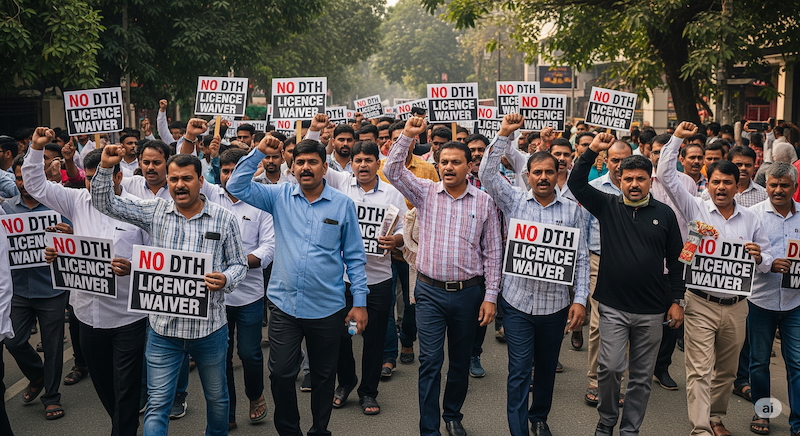
    NEW DELHI – India’s top cable lobby has sounded the alarm over TRAI’s proposal to slash and eventually scrap licence fees for Direct-to-Home (DTH) operators, warning it could wreck the delicate balance in the country’s broadcast distribution ecosystem.

    In a strongly-worded representation to the information and broadcasting ministry, the All India Digital Cable Federation (AIDCF) – which represents over 880 multi-system operators (MSOs) and 1.6 lakh local cable operators (LCOs) – said the move would “deepen regulatory inequality” and “threaten over 10 lakh livelihoods” linked to the cable TV industry.

    The AIDCF accused TRAI of tilting the scales in favour of DTH players who already enjoy “cost-free, administratively allocated spectrum” while cable operators continue to bleed under high Right of Way (RoW) charges and hefty underground infrastructure investments.

    “A DTH licence fee waiver will distort competition and violate regulatory neutrality,” an AIDCF spokesperson said, adding that any cut would hasten subscriber churn from cable to satellite platforms. The body flagged other disruptors like Free Dish, OTTs, Fast TV and digital DPOs as further stress points for the struggling cable sector.

    Rather than easing licence costs for satellite platforms, AIDCF wants the government to implement a fair cost recovery mechanism across distribution platforms, reflecting the true commercial value of spectrum. It has urged the ministry to junk TRAI’s recommendation in favour of a level playing field that safeguards the sector’s long-term viability.

  • Government updates list of mandatory must-carry cable TV channels

    Government updates list of mandatory must-carry cable TV channels

    MUMBAI: The ministry of information and broadcasting has issued a revised notification mandating changes to the list of channels that cable operators, including multi-system operators (MSOs) and local cable operators (LCOs), must carry under the Cable Television Networks (Regulation) Act, 1995. 

    In the latest directive, six existing mandatory channels have been updated, including:
    * DD Assam (Regional Entertainment)
    * DD Odia (Regional Entertainment)
    * Sansad TV-1 HD and Sansad TV-2 HD (Lok Sabha & Rajya Sabha News)

    Additionally, four new channels have been made mandatory:
    * DD National HD (Hindi Entertainment)
    * DD News HD (Hindi News)
    * DD Sports HD (Sports)
    * DD India HD (English News)

    The ministry emphasised strict compliance with the updated requirements, warning that violations would invite punitive action under the Act, associated Rules, and registration terms. Cable operators have been instructed to ensure proper categorisation and transmission of the channels within their network offerings. It issued the advisory to cable ops and MSOs on 30 January 2025.

  • Trai extends deadline to receive stakeholder comments on ‘renewal of MSO registration’ consultation paper

    Trai extends deadline to receive stakeholder comments on ‘renewal of MSO registration’ consultation paper

    Mumbai: The Telecom Regulatory Authority of India (Trai) has extended the deadline to receive comments & counter comments on the consultation paper ‘renewal of multi-system operators (MSOs) registration’. Stakeholders can submit their written comments by 24 August and their counter comments by 31 August.

    Trai decided to delay the deadline after stakeholders sought an extension of time for sending their comments on the consultation paper, however, no further requests for extension would be considered, it said.

    The consultation paper seeks the comments of MSOs on relevant issues about renewal of MSO registration including the quantum fee to be paid for such renewal.

    The key issues addressed in the consultation paper are 1) what should be the qualifying conditions, if any, to be prescribed for MSO renewal? 2) list of necessary compliances for renewal of MSO registration 3) period of renewal 4) whether a one-time fee should be levied at the time of renewal? 5) should there be a window to apply for renewal before expiry of MSO registration? 6) provision to ensure continuity of service to consumers on expiry of registration.

    The ministry of information and broadcasting (MIB) plans to revise the policy guidelines regarding the renewal period of MSOs to maintain uniformity with the direct-to-home (DTH) and broadcasting sector. It has proposed to keep the renewal period for MSO registration after every ten years.

    Also Read: MIB proposes to introduce policy guidelines for renewal of registered MSO and HITS operators

  • MIB proposes to introduce policy guidelines for renewal of registered MSO and HITS operators

    MIB proposes to introduce policy guidelines for renewal of registered MSO and HITS operators

    Mumbai: The Telecom Regulatory Authority of India (Trai) on Wednesday issued a consultation paper on the renewal of multi-system operators (MSOs) registration.

    The ministry of information and broadcasting (MIB) sent a reference to the telecom regulator seeking recommendations on issues pertaining to the MSO renewal procedure. As per the letter, MIB stated that the policy guidelines for uplinking/downlinking of channels prescribe ten years as the permission period. The renewal period is also mentioned as ten years. In the direct-to-home (DTH) sector, the guidelines mention the licence validity for a period of twenty years, renewable by ten years at a time.

    MIB said, “To maintain uniformity with the DTH and broadcasting sector and considering the validity of security clearance, MIB has proposed to keep the renewal period of MSO registration after every ten years.”

    MIB also noted that, at present, there is no provision for renewal in the existing guidelines for registration for headend-in-the-sky (HITS) services. It said that Trai may initiate a separate consultation for the renewal of HITS services.

    The consultation paper seeks the comments of stakeholders on relevant issues pertaining to the renewal of MSO registration, including the quantum fee to be paid for such renewal.

    The key issues addressed in the consultation paper are:1) what should be the qualifying conditions, if any, to be prescribed for MSO renewal? 2) list of required compliances for MSO registration renewal 3) Renewing period 4) Should a one-time fee be charged at the time of renewal? 5) Should there be a window to apply for renewal before the expiry of MSO registration? 6) provision to ensure continuity of service to consumers on the expiry of registration.

    Background

    The cable TV industry in India commenced as an unregulated service in the late 1980s. The services were driven by the need of customers for alternative entertainment options to Doordarshan. This sector saw exponential growth with the launch of channels such as Star TV and Zee TV in 1992. As more local cable operators mushroomed across the country, a need arose to regulate the service, leading to the promulgation of Cable Television Networks, Rules, 1995.

    Trai brought the broadcasting and cable services under the ambit of Trai in 2004, which ensured orderly growth of the sector while protecting the interests of consumers. According to EY, India is the second largest pay TV market after China, with 197 million TV households growing at a 7.5 per cent year on year rate.

    Pay TV services are primarily delivered through cable TV and direct-to-home (DTH) systems. Other modes of transmission, such as Internet Protocol TV (IPTV) and headend-in-the-sky (HITS), have a smaller subscriber base.

    The Cable Television Networks (Regulation) Act, 1995, formalised the cable TV sector in India but resulted in operational challenges for local cable operators (LCOs) who did not have sophisticated equipment or resources to receive broadcast signals from large numbers of satellites before sending them to their subscribers.

    This led to the launch of MSOs who received the signals of different television channels, combined them and transmitted this combined feed to multiple LCOs. The MSOs were the middle men in the hierarchy of the cable services sector, between the broadcasters on one hand and local cable operators on the other.

    The MSOs established head-ends in metros and major towns to receive TV signals from different TV broadcasters, aggregate and distribute these signals to LCOs, who further transmit them to subscribers through cables. In some instances, MSOs also provide the services directly to their consumers.

    The evolution of technology paved the way for the digitization of the cable TV sector. With the introduction of the digital addressable system (DAS), the government amended the Cable Television Networks Rules, 1994 by issuing the Cable Television Networks (Amendment) Rules, 2012.

    As per the amended rules, MSOs operating in DAS areas are required to obtain the necessary permission from MIB in addition to registration as a cable operator. As per MIB, the number of MSOs has grown from 29 in 2012 to 1762 in March 2022, as per MIB.
     

  • MIB grants four and cancels three MSO licences in July

    MIB grants four and cancels three MSO licences in July

    Mumbai: The ministry of information and broadcasting (MIB) granted four multi-system operator (MSO) licences between 4 July and 11 July and cancelled three licences between 6 and 14 July.

    MIB granted licences to CCNDS Cable & Network, Bargabhima Cable and Broadband Services, Inhome Infotainment and Bhusawal Cable Network.

    The ministry cancelled/closed the registrations of Yeoda Cable Network, Veer Teja Cable Network and Green City Communications

    The licence of MSOs Micro Multivision and Satellite Channels expired on 28 June.

  • MIB revokes 12 and grants 6 MSO licenses between April & July

    MIB revokes 12 and grants 6 MSO licenses between April & July

    Mumbai: The ministry of information and broadcasting has granted six new licenses to multi-system operators (MSOs) between 21 April to 4 July and cancelled 12 licenses between April and 4 July. The total number of registered MSOs stood at 1753.

    MIB granted licenses to M/s Infotainment Service & Communications Pvt Ltd, Softech Infosol Private Ltd, Bhumi Cable, Shabkha Taqnia Private Ltd, Tribeni Entertainment and Binodan Digital Ltd

    MIB cancelled the registration of Yadav Cable, Sri Laxmi Local Cable TV, Thulasis Technology Private Limited, Surbhi Diginet, Sahya Digital Networks LLP, LD Family Network, Krishna Cable Network, South Star Digital Network Private Limited, RK Digital Cable TV Network, Panduranga Cable Network, Rallyon Technology and Shivam Cable & Broadband Ltd.

    Four MSO registrations including Kailash Cable Network, Bhawani Rajesh Cable and Digitech Services, Asiant Network and Ashiana Communication Mcr expired in June. 

  • Trai directs DPOs to comply with provisions of interconnection regulations

    Trai directs DPOs to comply with provisions of interconnection regulations

    Mumbai: The Telecom Regulatory Authority of India (Trai) has directed all distribution platform operators (DPOs) to ensure compliance with the provisions of the interconnection regulations pertaining to the listing and display of TV channels on the electronic programme guide (EPG).

    The telecom regulator has also asked DPOs to furnish a compliance report within fifteen days from the date of issue of the direction.

    After analysing the data received from multi-system operators (MSOs), Trai observed that some MSOs have failed to comply with the provisions under interconnection regulations relating to the listing of channels in EPG and display of channels in EPG.

    In a letter dated 17 September 2020, Trai had advised all MSOs to ensure compliance with the provisions of the interconnection regulations related to assigning a unique channel number for each TV channel available on the distribution network and indicating genre of TV channels as declared by broadcaster in the interconnection agreement and to submit to the authority data with respect to the same.

    As per the regulations, “every broadcaster shall declare the genre of its channels and such genre shall be either ‘Devotional’ or ‘General Entertainment’ or ‘Infotainment’ or ‘Kids’ or ‘Movies’ or ‘Music’ or ‘News and Current Affairs’ or ‘Sports’ or ‘Miscellaneous.”

    “It shall be mandatory for the distributor to place all the television channels available on its platform in the electronic programme guide, in such a manner that all the television channels of a particular language in a genre are displayed together consecutively and one television channel shall appear at one place only.”

    “Every distributor of television channels shall assign a unique channel number for each television channel available on the distribution network.”

  • Trai to form committee for smooth rollout of NTO 2.0

    Trai to form committee for smooth rollout of NTO 2.0

    Mumbai: The Telecom Regulatory Authority of India (Trai) has decided to form a committee with representation from leading pay TV industry associations to ensure the smooth implementation of the New Regulatory Framework 2020 and identify impediments with counter-measures for the overall growth of the broadcast sector.

    In a letter dated 22 December, accessed by Indiantelevision.com, Trai had asked the Indian Broadcasting and Digital Foundation (IBDF), the All India Digital Cable Federation (AIDCF), and the DTH association to nominate a maximum of two representatives to be part of the implementation committee.

    Early this November, the regulator had notified stakeholders that implementation of the new tariff order (NTO 2.0) would be delayed until 1 April 2022. This decision was taken after various stakeholders expressed concerns to the regulator with respect to the timeframe for migration of 150 million pay TV consumers and sufficient time for service providers to upgrade their IT systems and incorporate various channels/bouquets before offering the same to consumers.

    In the latest development, Delhi-based Cable Operators Welfare Federation (COWF) has written to Trai to be a part of the implementation committee and include two local cable operator (LCO) representatives from four zones or four representatives from the All India Federation. “LCOs deserve to be treated as frontline workers who touch base with each subscriber at least once a month. During the implementation of the regulatory framework the best way to reach the subscriber is to communicate in person, in their language, using printed handouts to evaluate options and help subscribers make a well-informed decision,” the letter reads.

    The LCOs also argue that market discovery of prices of pay-TV channels and consumption pattern evolution cannot be back-end driven, rather the front-end instructions should drive the backend. “The DPOs manage the back-end that would implement the service requests coming in from the front-end and therefore should not impose any packages and choices on subscribers,” it added.

    COWF has now also written to prime minister Narendra Modi to halt the implementation of new tariff framework, discard NTO 2.0, and consider making “cable-operator friendly amendments” in Digital Addressable Systems (DAS) law. The operators also suggest that linear TV channels no longer be distributed on OTT platforms. They lettered dated 29 November, also says that the NTO 2.0 regulation will increase unemployment and result in the downturn of lakhs of people employed by the cable TV industry.

  • TRAI seeks conclusive views on ease of doing broadcast biz

    NEW DELHI: Noting that a business-friendly environment is a pre-requisite for the growth of a nation and makes a country a favorite business destination particularly with the fast changing regulatory framework for the media and entertainment sector,the Telecom Regulatory Authority has issued a consultation paper on the ease of doing business in broadcasting based on views received by it on a pre-consultation paper issued on 19 April this year.

    Responses to the paper, which poses around 18 questions to stakeholders, have to be sent by 28 August with counter-comments if any by 11 September 2017.

    Noting that the M and E sector in India is one of the fastest growing sectors, TRAI has noted that It not only leads to employment generation but also helps in the growth and development of an economy.

    The economic liberalisation measures initiated in the early 1990s had focused on reduction of regulatory burden on enterprises as an underlying objective of the reform process. The Government has launched an ambitious programme of regulatory reforms aimed at making it easier to do business in India. The programme aims to pinpoint the bottlenecks and ease them to create a more business-friendly environment. The efforts have yielded some results with India ranked at 130 according to the World Banks’ Doing Business report. But, there is still huge scope for further improvements.

    TRAI notes that the IMF has branded India as the brightest spot in the Global Economy. Several Global Institutions have projected India as the leading destination for FDI in the World and a number of recent global reports and assessments, show that India has considerably improved its policies, practices and economic profile. It is expected that enabling policies and determination to continue with economic reforms, various initiatives taken by the Government such as Make in India, Smart City Mission, Skill India Mission, Digital India, etc. would further spur the growth of the economy.

    The pre-consultation paper on the ease of doing business in broadcasting which covered all media came just a few months after a similar paper on telecom. In the new era of convergence, the two sectors are expected to complement each other.

    The aim is also to remove entry barriers by laying down well defined and transparent procedures and processes thereby creating level playing field and competition in the sector and to facilitate innovation and technology adoption for providing better quality of services to the consumers to steer further growth of the sector by attracting investment through investor friendly policies

    Subjects to be covered are related to processes and procedures for obtaining permission/license/registration for the following broadcasting services and subsequent compliance connected with these
    permissions.

    The fields include:

    (a)Uplinking of TV channels
    (b) Downlinking of TV channels
    (c) Teleport services
    (d) Direct-to-home services
    (e) Private FM services
    (f) Headend-in-the sky services
    (g) Local Cable Operators
    (h) Multi System Operators
    (i) Community Radio Stations

    The questions raised are:

    1. Is there a need for simplification of policy framework to boost growth of satellite TV industry? If yes, what changes do you suggest in present policy framework relating to satellite TV channels and why?
    2.  Is there a need in present policy framework relating to seeking permission for making changes in the name, logo, language, format, etc. related to an operational satellite TV channel? If so, what changes do you suggest and why?  Is there a need for simplification of policy framework to boost growth of satellite TV industry? If yes, what changes do you suggest in present policy framework relating to satellite TV channels and why?
    3. Do you agree witb some of the stakeholders comments at the pre-consultation stage that Annual Renewal Process of TV channels needs simplification?
    4. Do you agree with stakeholders’ comments that coordination with multiple agencies/ Government departments related to starting and operating of a TV channel can be simplified? If so, what should be the mechanism and framework for such single window system?
    5. Is present framework of seeking permission for temporary uplinking of live coverage of events of national importance including sports events is complicated and restrictive? If yes, what changes do you suggest and why?
    6. Do you feel the need to simplify policy framework for seeking permission/license for starting and running of following services:  
    (iii) Teleport services
    (iv) DTH service
    7. As per your understanding, why open sky policy for Ku band has not been adopted when it is permitted for ‘C’ band? What changes do you suggest to simplify hiring of Ku band transponders for provision of DTH/HITS services?
    8. What are the operational issues and bottlenecks in the current policy framework related to:
    (iii) Teleport services
    (iv) DTH service
    How these issues can be simplified and expedited?  
    9. What are the specific issues affecting ease of doing business in cable TV sector? What modifications are required to be made in the extant framework to address these issues?
    10. Is there a need to increase validity of LCO registration from one year? In your view, what should be the validity of LCO registration?  
    11. What are the issues in the extant policy guidelines that are affecting the ease of doing business in FM sector? What changes and modifications are required to address these issues?
    12. Is there a need to streamline the process of assignment of frequency by WPC and clearances from NOCC to enhance ease of doing business? What changes do you suggest and why?
    13. What are the reasons for delay for allocation of frequencies by WPC? What changes do you suggest to streamline the process?
    14. What are the key issues affecting the indigenous manufacturing of various broadcasting equipment and systems. How these issues can be addressed?
    15. Is there any other issue which will be relevant to ease of doing business in broadcasting sector? .
    16. Are there any issues in conducting trial projects to assess suitability of a new technology in broadcasting sector?  
    17. What should the policy framework and process for consideration and approval of such trial projects?

    ALSO READ :

    Ease of doing b’cast biz date extended to 19 May

    TRAI seeks ideas on ease of doing b’cast business

    New portal to help ease of broadcast business


  • Faced with deadline, MIB says all provisional MSOs will be deemed regular

    NEW DELHI: Faced with just less than one month to go before total switch-off of analogue signals, the Government today decided that all provisional multi-system operators will be deemed as having regular licence for ten years.

    Stressing that the period of ten years commences from the date they got registered as provisisional MSOs, the Government said that this will not apply to MSOs which stand cancelled or cancelled.

    However, if the continuation of registration of any MSO is at any time found to be or considered detrimental to the security of the State then the registration so granted is liable to be cancelled/suspended, the order placed on the Ministry website mib.nic.in specified.

    All other terms and conditions depicted in the provisional registration letter(s) Wlll continue to apply.

    Earlier on 27 January.2017, it had been decided that all registered MSOs are free to operate in any part of the country, irrespective of registration for specified DAS notified areas granted by this Ministry.

    However, they have to submit the details of Headend, SMS, subscribers list and a self-certificate that they are carrying all the mandatory TV Channels, within six months from date of issuance of MSO registration, to the Ministry, failing which the MSO registration is liable to cancelled/suspended.

    Hence, all deemed regular registered MSOs also are required to submit the details to the M/o within six months.

    The Government had itself extended the last date of the last phase of digital addressable system for cable television covering rural India on 31 March 2017.

    According to the Ministry, it had given registration to 1182 MSOs by the end of February 2017, which included 230 which had valid ten-year licences.