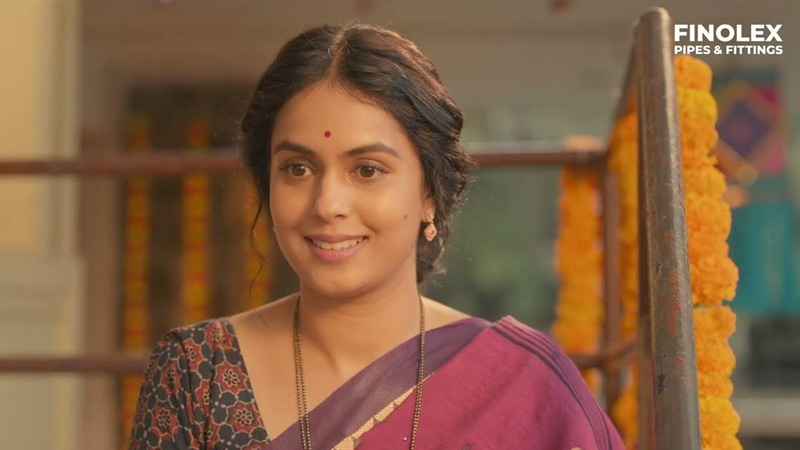
Mumbai: Finolex Pipes & Fittings has launched a Diwali short film that redefines prosperity through women empowerment.
What starts as a plumbing emergency during Diwali evolves into a story of divine intervention and entrepreneurial awakening. When a broken pipe threatens to disrupt a homemaker’s festival preparations, she meets a skilled female plumber who offers more than just technical help. Their interaction leads the homemaker to discover her hidden talent in apparel design, inspired by the plumber’s presence, akin to Goddess Laxmi’s grace, which shifts her from a domestic crisis to entrepreneurial success.
The film draws parallels between traditional blessings and modern prosperity. Just as Goddess Laxmi brings abundance, this contemporary Laxmi in a toolbelt not only repairs pipes but also paves the way for self-realisation, motivating the homemaker to start her own apparel design business.
Finolex Pipes & Fittings VP, marketing & communications, Sumit Bhatia expressed, ‘This Diwali, we aimed to create something beyond the usual promotional messages—a short film that resonates with the heart and soul. Through the intertwined stories of two remarkable women, we delve into the timeless values that Diwali embodies: hope, prosperity, and transformation. As their paths intersect in contemporary India, we witness how small acts of kindness can ignite significant change, much like the first diya that lights up an entire room. One woman’s journey from struggle to success mirrors the divine grace of Goddess Laxmi, illustrating that true prosperity is about empowering others and uplifting communities. The portrayal of a female plumber in our film is inspired by our dedicated CSR efforts. Through our partnership with Mukul Madhav Foundation, we have consistently supported and trained women plumbers, integrating them into the mainstream plumbing profession. This initiative has been actively encouraged by our founder, Prakash P. Chhabria. In this celebration of light over darkness, we are honored to be more than just observers; we are partners in India’s ever-unfolding story, connecting dreams, illuminating homes, and uniting hearts across generations.”
The narrative aligns with Finolex’s brand values of trust and durability while conveying a broader social message. By featuring a female plumber as a modern embodiment of Goddess Laxmi, the film challenges stereotypes and celebrates the various forms of prosperity in our lives.
As families across India light up their homes this Diwali, Finolex’s film reminds us that true prosperity comes from empowerment, breaking barriers, and fostering connections that enhance lives.
Mumbai: Child trafficking, though a disturbing reality, has hardly any takers as a subject of concern. Or even if it does, it isn’t as significant in the pie as much as women’s rights or matters of DEI at the workplace. In an evocative short film put together in tandem with Schbang, Mukul Madhav Foundation (MMF) seeks to give missing children a voice, narrating the tragic tales of children who lose their childhood due to child trafficking.
The film uniquely captures the essence of childhood innocence through the lens of a cherished soft toy, Balloo the teddy bear, which is a witness to the trauma faced by his best friend, Bittu. Balloo’s presence throughout the narrative mirrors the stark reality of countless children whose voices are stifled and their dreams shattered.
Bittu and Balloo’s story is more than just a film; it’s a public service announcement (PSA) call to action. It serves as a potent reminder of the thousands of Indian children whose potential remains unfulfilled. Through this film, MMF prompts us to remember and act for those fighting for their freedom.
Mukul Madhav Foundation (MMF), the CSR partner of Finolex Industries Ltd., is a registered charitable trust under the Bombay Charitable Act 1950. It has dedicated itself to uplifting underprivileged and vulnerable communities with opportunities that pave their path to success.
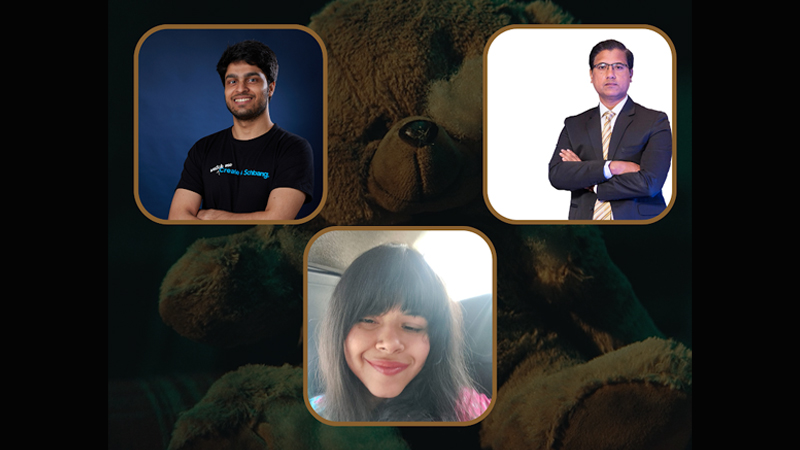
Indiantelevision.com spoke to Finolex Industries Ltd. vice president & head – marketing & communications Ashok Jaiswar, Schbang group creative manager Rishabh Pande, and Schbang for Good associate vice president Varsha Rohani about the creative thought behind the film, about MMF’s efforts on various issues, the research in putting this film together, and more.
Edited excerpts:
On touching upon the child trafficking issue
Jaiswar: Mukul Madhav Foundation, as an NGO, works on multiple causes across all 17 different UN Sustainable Development Goals (SDGs) right from healthcare to education to child rights, women empowerment, and more. And every single cause that we choose to work on is extremely close to our hearts. In the past MMF has also worked on raising awareness on various sensitive causes. This particular time, we wanted to work towards raising awareness about child trafficking because it often hides in plain sight. To the extent that we are almost desensitised to it, we see a 6-year-old innocent child begging on the streets and we barely question it twice.
Our work towards rescuing and rehabilitating children has made us understand the importance of citizen awareness and action.
On the brief given to Schbang for the film
Jaiswar: We have been working with Schbang for the past 7 years now, and they are just as aware of our initiatives, the impact, our reasons to believe, and our vision. Our brief for them was simple, we need to move people and touch their hearts. At no point do we want to go down the route of dramatizing the plight of the victims. We have a responsibility towards them and we didn’t want to sensationalise the cause in any way. The brief was to be gentle yet firm with the messaging. And the juxtaposition of a toy’s innocence against the harsh realities of child trafficking does that beautifully.
On the creative thought behind the campaign
Pande: If you look at the data, trafficking in India is a strikingly harsh reality. But that’s really it. The fact is that this reality is still in the data. This reality has not intersected with ours because it’s a conversation that unfortunately has not risen to the surface. No one is talking about it. And that was always the intent of the idea. To talk about it.
And because the topic would have been extremely new to people, it can also be extremely triggering. And that is why we had to approach this from a very sensitive lens. Hence the decision to tell the story through the lens of someone who is probably as aware of the reality as us, a soft toy that has been accidentally trafficked with the child. This creative device also allowed us to tell the story sensitively and without a lot of visual triggers. The idea was to tell half the story that Baloo could see and let the smart viewers complete the rest of it in their heads.
On the kind of insights & research helped in putting this film together
Pande & Rohani: There was a fair bit of research that we had to do, and interestingly enough a lot of this happened when we believed we already had the idea. While the data on trafficking was a good starting point, we had to make sure that a lot of the stuff we were writing about was being validated by research and wasn’t just a pre-existing notion or belief. Questions around where trafficking takes place, what the age group of the children that are victims of trafficking is, and what we can even achieve with this idea. All this needed a lot of finding, discussing, and changing.
On the media mix planned for this campaign
Jaiswar: We believe in the strength of this message and the simplicity of the film and we know that it will and has also already traveled far organically. We want to focus our efforts and resources on increasing the digital footprint of the film and are purely focusing on digital promotions to amplify this.
On the kind of response received for your efforts on child trafficking
Jaiswar: We have been supporting victims of child trafficking by collaborating with NGOs and initiatives that rescue and rehabilitate children. For causes such as this, our focus is on vertical efforts so we go deeper instead of going wider. Rescue operations are rather challenging and that’s just the tip of the iceberg. A lot of work also goes towards the rehabilitation of each child. Being exposed to such harsh realities at a tender age leaves an almost indelible mark on their minds.
On Schbang’s involvement in cause marketing
Rohani: Schbang has a dedicated team for cause marketing called Schbang for Good. Since the last three years, the team has exponentially grown and is serving some of the leading CSR brands in the country. We have been supporting these brands with a variety of services, right from fundraising to brand-building and social & behavior change campaigns. In our experience, the make or break for working on such campaigns and brands boil down to intent. The creative device, the strategies, and everything else in between can be figured. We have intentionally, always chosen to work with brands who have the same values as ours. Brands that put people first, care about representation but don’t stop at just that, they also always back these intentions and representations with the right actions to move the needle. Our fundraising campaigns have led to raising millions for many causes, our Diversity & Inclusion campaign has led to workplace policy changes and our awareness campaigns always touch hearts and leave an impact on people.
It’s been extremely gratifying and rewarding for the team to support India’s growth journey by supporting the brands that are working for the most marginalized communities in India.
On the difference between working for a social cause and brand marketing
Pande: While some of the principles of storytelling never change, there’s a lot more caution that one needs to take when writing for a cause. We think and rethink every line we write, and every visual we decide to write because writing for a cause as sensitive as trafficking comes with a great responsibility. There are many nuances, many intersectionalities and we should be ready to put in the work to understand those.
I also feel that when writing for social causes, you need to access a very different part of you and that process can take time.
On some of the other topics that MMF would like to touch upon in the future
Jaiswar: We work with a single goal of empowering people with dignity and opportunities. The causes can change, and so can our ways of amplifying them but our goal is clear. We have a lot lined up for the year, hopefully, just like Balloo & Bittu, others will also touch many hearts and create a deep impact.
Mumbai: Finolex Industries’ corporate social responsibility arm, the Mukul Madhav Foundation, has released a short movie, Baitullah. addressing child labour. The award winning short film is sure to open your eyes. The picture, picturing a little boy named Baitullah working at a tea stall in the city, poses the question to the viewer.
Directed, written and produced by Jitendra Rai (M/S Matheno Films), the main protagonist is played by child artist Om Kanojiya, supported by Ishtiyak Khan and Vipin Sharma. The film has been nominated and selected at 85+ international and national film festivals and has already won 26 awards.
“What does this child need to do to become like you?” is a question that is met with awkward silence in the film but hopes to ignite a conversation amongst viewers and the more fortunate.
Millions of children across the world, and especially in India, are exploited and denied their childhood every day. They are kept out of classrooms and forced to work as touts or earn a daily wage for their families due to poverty, lack of awareness, or just plain neglect and apathy. Most are hidden away in sweatshops making shoes, jewelry, and firecrackers. But some are in plain sight. ‘Chottu’ at your friendly neighbourhood tea stall or lunch place.
Speaking on the evolution of the film, the director Jitendra Rai said, “As a filmmaker, I look at the world around me with my eyes wide open. I couldn’t ignore the child labour I saw around me, but I was also left with a sense of helplessness. As a filmmaker, I chose to capture this helplessness, the silent appeal these children have in their eyes when they look at people better-off than them.”
Rai added, “This helplessness turned into hope, when I saw the work that is being done by organisations like the Mukul Madhav Foundation. I am also grateful for their support of this film.”
Mukul Madhav Foundation managing trustee Ritu Chhabria said, “This film asks a question that started us on our journey working with marginalised and vulnerable children: how could each child enjoy the things we take for granted in our lives? We set out to put things in place, one small block at a time.”
Established in 1999, the Mukul Madhav Foundation works with communities across India, uplifting the less fortunate with hope and dignity. Their work with children, especially those vulnerable to exploitation, assault, and trafficking, is slowly tilting the scale at the grassroots. Supporting children with initiatives in education, nutrition, and mental health. Offering a helpline, counsellors, and legal aid for children. Rescuing and rehabilitating exploited children and then reintegrating them back into the mainstream. But even more importantly, strengthening the community. Giving parents and youth access to healthcare, sanitation, skill development, and employment. Giving each of them a sense of dignity. With the belief that in order for children to be safe, their community must first feel financially and emotionally secure.