Tag: Mukta Adlabs

  • Kalasa Ent. allies Mukta Adlabs for e-cinema in South

    Kalasa Ent. allies Mukta Adlabs for e-cinema in South

    MUMBAI: Mukta Adlabs Digital Exhibition has joined hands with Chennai-based Kalasa Entertainment Media Private Limited (KEMPL) for digital delivery of movies in the southern states of India.

    Mukta Adlabs, the joint venture between Adlabs Films and Subhash Ghai’s Mukta Arts, already has a presence in other parts of the country. With this alliance, the joint venture plans to establish a foothold in the strong southern movie market.

    Mukta Adlabs will take care of the digital conversion of the southern movies as part of the operational partnership with KEMPL. The JV will also supply e-cinema audio interface systems and provide maintenance support to KEMPL. Singapore-headquartered GDC Technology will provide the digital servers.

    KEMPL, which launched its digital cinema initiative in June, plans to double its digital cinema installations to 10 in Tamil Nadu within a month. The company expects to install 65 theaters and release about 30 films in digital format in its first year of operations.

    KEMPL has received $ 0.5 million from Sat Pal Khattar, a founding partner of Singapore-based law firm Khattar Wong and Partners. “We are expecting another $ 2.5 million from foreign investors in the next two months,” says KEMPL CEO Ramesh V Subramaniam. Indian venture capitalists from Mumbai and Bangalore have also showed interest in investing in digital cinema, he adds.
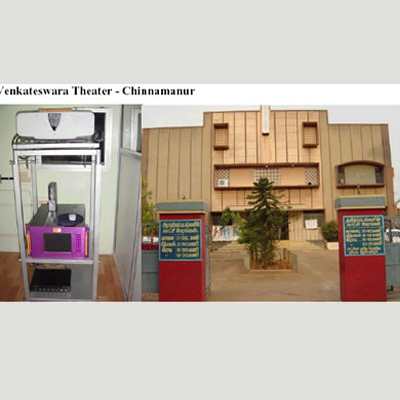
    One of the theatres in Tamil Nadu where KEMPL has installed digital cinema system

    KEMPL prefers ‘A2’ class theatres (which fall between A and B class theatres) in South India, while Mukta Adlabs has been targeting the ‘B’ and ‘C’ class theatres in other parts of the country for a digital cinema roll out.

    “Ticket rates in the A2 theatres range between Rs 15 – Rs 25 while in ‘A’ class theatres it is between Rs 25 – Rs 40. We are not targeting theatres in the ‘C’ category as ticket rates in such centres are very low. Recovering costs take a longer time,” says Subramaniam.

    Kalasa, set up in early 1998, has been specialising on all aspects of film sound recording and audio post-production. The company was rechristened as Kalasa Entertainment Media Private Limited (KEMPL) in April 2004 as it got into distribution of movies in the digital format.

  • Mukta-Adlabs Digital Exhibition to alter digital projectors

    Mukta-Adlabs Digital Exhibition to alter digital projectors

    MUMBAI: Mukta-Adlabs Digital Exhibition, the joint venture between Adlabs Films and Subhash Ghai’s Mukta Arts, has earmarked Rs. 40 million to replace its existing digital projectors with new Panasonic projectors. Mukta-Adlabs is involved in setting up digital cinemas and distributing digital film prints across the country.

    This is in addition to the Rs. 100 million the company has already invested in the digitisation project.

    Adlabs Films CEO Dr. Sunil Patil says technical failure of the existing system has forced the company to replace it with new Panasoinic 3-chip projector system in all its 74 digital cinemas across India. He has termed the technical fault as ‘lamp burn’.

    “The projector which we had been using did not live up to the expectations. It could not deliver the quality that we expected from it. Another reason behind the replacement is the huge running cost for these projectors. We have decided to replace the present projector system with a much stable, slightly expensive Panasonic 3-chip projector. And we hope that these projectors will give us the print like quality. So right now we are at a stage of consolidation, we are replacing our existing equipments with a much better one,” offers Patil.

    According to Patil, Mukta-Adlabs had a total of 90 digital installations. “We had to discontinue some because of the projector problems,” he offered.

    Patil said the first phase of the alteration process would start with 38 theatres in Maharashtra. Mukta-Adlabs has its digital screen presence in states Maharashtra, Delhi, Uttar Pradesh, Gujarat, Madhya Pradesh and West Bengal.

  • BroadcastAsia2004 to feature business, technology sessions and seminars

    BroadcastAsia2004 to feature business, technology sessions and seminars

    MUMBAI: Asia’s premier electronic media event BroadcastAsia2004 will be conducting an international conference and a number of adjacent events to equip the industry with the latest technologies, trends and insights. Parallel business and technology sessions, an audio technology seminar and masterclass are some of the programmes organised as part of the event that is to be held in Singapore from 15 – 18 June.

    The annual event BroadcastAsia gives the participating organisations ample opportunity to learn and network with the industry.

    The session media asset management and information technology scheduled for 15 June will focus on maximising content to the user’s advantage. The session will deal with media asset management and the use of information technology in content production. Audio restoration techniques to be held on 16 June will deal with techniques and methods for the preservation and restoration of audio material in sound archives. The session will be presented by the Asia-Pacific Broadcasting Union.

    Digital lifestyles session on 16 June discuss on the use of digital processing in content preparation and delivery. The session also reviews the implementation and opportunities of interactivity and broadcasting via mobile TV, mobile phones and PDAs. Asian D-Cinema summit scheduled for 16 June aims to set the direction for the industry by addressing the key issues of business models, rights management, delivery modes and security. Experts from organisations like Eng Wah, GDC Technology, Mukta Adlabs and SingTel will be sharing their views and vision for digital cinema in Asia in this session.

    Accountable management in broadcasting presented by Asia-Pacific Institute for Broadcasting Development aims at providing examples and best practices in broadcasting management in the scenario of media proliferation and technological changes. The session will be held on 16 June.

    Digital content delivery will have participants examining case studies of digital television systems and networks. The Digital Audio Broadcasting (DAB) conference will highlight developments in the world of DAB through the experiences and success stories of leading DAB players in Asia and Europe. The eighth session will have a regulatory forum on the topic Mobile Broadcasting – Bane or Boon? All these three sessions are scheduled for 17 June.

    On 18 June, there will be sessions titled digital radio, production tools and innovations, station/channel identity and planning of broadcasting projects . Digital radio will review and access the latest technologies that extend the traditional perception of radio broadcasting while production tools and innovations will explore new technical innovations and production opportunities. Station/channel identity will deal with the importance of TV channels having a clear and relevant identity according to its audience, as to promote its programmes. Planning of broadcasting projects will outline some of the basic concepts of planning for broadcasting projects and will focus on the requirements for a proper needs analysis.

    The audio technology seminar to be held on 17 June is targeted at all audio professionals involved in mid-range live sound for studio, theatres & auditoriums. Chief Engineers roundtable on the same day is an interactive programme where participants can team up to design state-of-the-art broadcast systems to deliver new revenue streams. The post-production masterclass that will touch on the creative challenges in directing and producing animation in Asia will be held on 18 June.

    The events graphite 2004 and VRCAI2004 will be co-located with BroadcastAsia 2004. The Graphite2004 conference will bring together people and technologies from a variety of locations and disciplines – to share ideas and form new partnerships in computer graphics and interactive techniques. VRCAI2004 will showcase the latest development of the state-of-the-art technology in the virtual reality continuum.

  • India to play a key role in BroadcastAsia2004

    India to play a key role in BroadcastAsia2004

    MUMBAI: Asia’s premier electronic media event BroadcastAsia2004 will be held in Singapore from 15 – 18 June. Themed Redefining Broadcasting, BroadcastAsia2004 will encompass the entire spectrum of the Electronic Media industry.851 exhibiting companies from 45 countries are expected to participate in the event.

    “The whole industry is revolving rapidly and the impact of digital technology has redefined the broadcast industry. BroadcastAsia2004’s aim is to provide a forum for companies in the industry to discuss these vital issues and share insights on industry developments,” said Singapore Exhibition Pte Services Limited (SES) Project Director, communications events, Ho Ko Leong. SES is the organiser of the event.Talking about India’s participation in the event, Leong offered that they would be having more Indian companies participating in the show this year.

    “We will be doing more visitor promotion trips to India because we feel that Indian companies have a lot to offer the world and BroadcastAsia will serve as a platform for Indian cinema operators to source suppliers of digital projectors, servers and digital cinema systems, while production houses will find the most cutting edge special effects and post-production software.”

    Leong pointed out that India’s software skills and competitive digital production facilities would be sought after by broadcasters and content providers as the country enjoys the added advantages of economical, qualified labour and an English-speaking population.

    “BroadcastAsia2004 will also offer Indian companies opportunities to promote their skills in this area to the Asian broadcasting scene,” Leong said.

    Leong identified Asian D-Cinema Summit, DAB Conference and Media Asset Management as key sessions to be held during the event.

    The Asian D-Cinema Summit will discuss on Digital Cinema in Asia. The Summit aims to set the direction for the industry by addressing the key issues of business models, rights management, delivery modes and security. Experts from Eng Wah, GDC Technology, Mukta Adlabs and Singtel will share their views and vision on the topic.

    Digital Cinema Day on 16 June included facility visits to one of Eng Wah’s digital cinemas at Suntec and movie screenings apart from various other exciting activities. Visitors can also attend important talks at the Asian D-Cinema Summit.

    The DAB Conference will highlight developments in the world of DAB through the experiences and success stories of leading DAB players in Asia and Europe. The conference will also probe new revenue streams that can be generated and their business potential.

    Media Asset Management conference will look into latest technologies and trends for media asset management, including a case study on Iran Broadcasting.BroadcastAsia2004 has roped in many prominent personalities from the industry to speak in the event. They include Digimax CG supervisor Douglas Creel and Digimax chief operating officer Nickson Fong.

    Mukta Ad Labs chief operating officer Dr. Sunil Patil will be one of the panelists in a panel discussion on D-cinema in Asia – The Way Forward, to be held on 16 June. MediaCorp Radio vice president, technology services, Assad Bagharib will speak about SmartRadio.

    “We expect 9 delegations from Taiwan, India, Hong Kong, Vietnam, Thailand and China. However, there may be more apart from these,” informed Leong. He said that they didn’t have any delegations from Europe yet.

    “The number of visitors attending BroadcastAsia has increased over the years,” said Leong. He said 12,000 visitors were expected to attend this year’s event while in 2002 it was 10,951.

    “The number of exhibiting companies has increased. 649 exhibiting companies from over 41 countries participated in BroadcastAsia2002. This year, we have surpassed the number of exhibiting companies in 2002. To date, we have 851 exhibiting companies, which will participate in BroadcastAsia. There has also been an increase in the number of participating countries from 41 in 2002 to 45 this year,” offered Leong.

    Leong identified areas where they would be facing challenges while staging an event of this magnitude.

    “Challenges include maintaining and expanding the broad range of solutions exhibited, attracting key movers and shakers of the industry to the event, to have the critical mass of exhibitors and trade visitors, and maintaining BroadcastAsia as a meeting point for major industry players. The biggest challenge, however, the biggest challenge is ensuring that the show theme is relevant to the current state of the industry,” offered Leong.

    Leong confirmed the recovery of Singapore industry after last year’s SARS scare. He pointed out that business travellers were travelling to the country again.

    “Recently, Singapore Airlines reported that that their passenger load has returned to normal. These are all very good signs,” Said Leong.
  • Gen Next urged to improvise technology to revolutionise cinema

    Gen Next urged to improvise technology to revolutionise cinema

    MUMBAI: The session “Cinema: NexGen” at the Ficci FRAMES 2004, began with the host CNBC TV 18 features editor Anuradha Sen Gupta introducing the distinguish line up of panelists – IMAX Theatre Systems, North Europe, Russia and Central Asia VP sales John M Schreiner, e-City Entertainment CEO Atul Goel, Hughes Communications’ Shivaji Chatterjee, Mukta Adlabs Digital Exhibition Pvt Ltd CEO Dr Sunil Patil and Barco Digital Saurabh Malhotra.

    Thereafter, Manmohan Shetty, giving a key note address, took over for a brief while to set the tone on how India needs to revolutionise cinema like Hollywood has. Generation Next must take up the cudgels in improvising technology, he opined.

    Schreiner triggered off a long speech on how IMAX can do the trick. Since the session was sponsored by IMAX, the length of the speech did not come as a surprise. Neither did the contents which were full of praises for IMAX, which is in more than 235 theatrres in 35 nations. Schreiner further conveyed that Harry Potter and Prisoner of Azakaban will be released in June 2004.

    Goel took it up to stress upon the need of cinema going digital. He said that this would allow the advertisers to choose a particular show to pitch in their products, unlike what we have now in celluloid cinema where the advertisers have to run their commercials for all shows on a booked day.

    Chatterjee explained that digital cinema would reduce shipping delivery and assembly cost, enhance editing quality and introduce integrated billing. According to him, the key benefit would be better distribution, production per print would reduce from 50,000 to 10,000, distribution per screen would lower from $22000 to $450, and piracy would be controlled.

    Patil elaborated on how the piracy would be controlled. He stated that, bu the time, the last print reaches in the B & C centres, seven to eight days have elapsed. This sets the tone for piracy. Why not have a system where all the prints are released in all the cinemas, simultaneously?

    However when asked that why had the multiplexes not embraced digital cinema so far, the panelists had nothing more to offer than say that the rates they proposed were unaffordable to them. Thus, the million-dollar question: “How in India do you expect to reduce the ticket cost which is is the major most reason for piracy, if you are rooting for digital cinema?” remained unanswered.