Tag: Mukesh Ambani

  • 2019: Media and entertainment deals that did not happen

    2019: Media and entertainment deals that did not happen

    MUMBAI: Can the mainstream media get it right?

    That’s a question we, at indiantelevision.com, asked through the year. 

    Canards, canards, canards, and more canards are what we read in the mainline dailies.

    Of course, it cut across politics, business, lifestyle, and what have you. But the business press got it so wrong time and again through the year.

    Journalists wanting to scoop each other came out first with a piece of news about a development, which was still to be born.  They were doing their jobs, and hence it made for interesting updates and information. But mostly it made for great merriment, gossip and entertainment. And of course, it impacted the price of the stock on the exchanges.

    We waited expectantly for the development to become a reality, but after promising time and again, it did not. It was a guessing game through the year: “It’s happening; it’s not. It’s happening, no, it’s not.”

    Zee Entertainment Enterprises Ltd (Zeel) was in the spotlight for much of the year . Talks were on between various interested suitors as the Zee promoters worked hard, looked high and low to get out of the tight spot they found themselves in. Their stake in Zeel had been pledged with institutions for funding to diversify and invest in infrastructure and grow as a group. The investment went sour as the infrastructure sector fell into a downward spiral.  And lenders wanted the money back or they would sell the pledged shares, was the fear. The Zeel promoters had a specific time to find alternative partners to bail them out, and  the amount was a hefty Rs 12,000 crore.

    Reports appeared that the Zee had cut a deal with Comcast; it was done or would be done soon, went the press.

    Then news reportedly surfaced that Sony Pictures Networks too had thrown its hat into the ring. A binding offer being received by Zeel from Comcast- Altairos-Lupa Systems was another story that broke; Zee spokespersons denied this was true in the same report.

    Following that with no deal falling in place the newspapers positioned the family as helpless and lost, with investors getting impatient and possibly offloading their equity. Finally, the biz press also said that the Subash Chandra family would be evicted as they would be left with a minority position in the company as investors were not happy at all with the tardiness of the family’s search for money from potential partners. One report said Chandra had left the country – a laughable proposition, knowing the man. Chandra is known to face the bullets and pay the price, no matter what and how much.

    Fast forward to the end of 2019  and none of the predictions came to pass.  

    Instead what happened was that the existing investors in Zeel stepped in to lend the family cash so that they could pay off their creditors and free themselves to focus on the business. The Zeel board then re-elected Punit Goenka as CEO for the next five years. Yes, some independent directors did resign, as did Subhash Chandra as chairman. The latter action was one of the more graceful ones we have seen in corporate India where promoters have stayed stuck to their seats after running their banks and firms to the ground, refusing to go, no matter what the opposition from the board or lenders of institutions. Here, Chandra’s act was voluntary, hence it is worthy of praise.

    But the investors showed faith and confidence in the family by putting down cash on the table and re-electing Punit. Sources, of course, indicate that Chandra though not holding the title of chairperson is still helping in giving direction to the top management at the company from the outside.

    For patriots who want businesses to be controlled by Indians, it was a happy turn of events. It meant that there is a great chance of the family fighting back and possibly over time getting back majority control.  

    Development No 2:

    Airtel is buying Dish TV India to create the world’s largest satellite company with about 39 million subscribers. These headlines ran in the biz press on more than two occasions.  On the first occasion, it said that talks died down because the Goyal family was not happy with the valuation that was being talked about: Rs 30-Rs 35 a share as against the expected Rs 45 or so the reports said.

    Earlier the same media had praised the acquisition of Videocond2h by Dish TV and soon after they were lambasting the deal.  Nonetheless, the M&A  buzz started again soon  Zeel promoters made their announcement that existing investors were helping the company in their times of difficulty.

    Of course, nothing of that sort developed even as Christmas was ending. Jawahar Goel the big boss of Dish TV India got re-elected as chairperson of Dish TV.

    Both Airtel and Dish TV had to issue notices to the exchanges that both companies continue to explore options for their business without confirming or denying whether a deal had been structured or was in the works.

    Observers believe it may never materialise. But we don’t want to add to the speculation that we are accusing the mainstream media of.

    Development No 3:

    Sony is merging its India entertainment operations with Mukesh Ambani’s TV18 ran the masthead in some publications to create a new entity.  They even detailed the deal structure: sony would keep 51 per cent of the new entity, Viacom 24 per cent and the Reliance group 25 per cent. It would be an all-stock deal, said the articles.  And the deal would be announced by 9 December when the senior management was scheduled to visit Mumbai’s famed Antilla home of Mukesh Ambani. It almost seemed like the deal was a certainty. 9 December has come and gone. No announcement has come. We are not saying it may not be realised, but we have to understand that deal-making is not just a shoo-in. That two parties – in this case, three – will agree to terms by just a snap of their fingers. Deal-making takes presentation, search for partners,  negotiation and agreement and then closure.  All through the process, one has to keep a cast-iron stomach, a stony face; squeamishness can be a deal-breaker.

    Who knows? 2020 may see the parleys between the three bearing fruit

    But until the organisations come out clean and make an official announcement: the Sony Pictures and TV18 will be in the realm of fictional imagination.

    Of course there were many other speculative stories that struck the media world wherein the hacks got it wrong. But these were some of the top highlight-able ones. Hope you had a good time reading them.

  • JOP Network’s journey from curating content to running 3 pay channels

    JOP Network’s journey from curating content to running 3 pay channels

    MUMBAI: It is often assumed that the TV broadcast market in India has reached a saturation point and is dominated by big media networks with deep pockets like Sony, Zee, Times Network, Disney-owned Star India (earlier owned by Rupert Murdoch) or Mukesh Ambani-owned Network18, leaving no room for start-ups to grow and establish themselves in this cluttered media space.
     
    However, JOP Network, a Delhi-based five-year-old content startup, has proved both these notions wrong. Not only has the startup that began its journey in 2014 as a content curator in the niche-segment of health and wellness grown by leaps and bounds in last five years, JOP Network currently runs three pay channels in India and Australia and plans to launch three more (1 GEC, 1 sports and 1 lifestyle) in the coming year.

    Owned by banker-turned-media entrepreneur Urvi Agarwal, JOP now produces and curates content for Indian and international markets and distributes via its own channels (Fitness Studio, Hollywood Masala, Life Mantra) as well as via global television networks such as Discovery, FOX Traveller, Airtel DTH, Tata Sky, Astro Malaysia and in-flight channels of Cathay Pacific, Lufthansa and Qatar Airways to name a few.

    JOP’s success demonstrates that even in a crowded and cluttered Indian broadcast TV market, it is possible to carve out a distinct space by curating and producing high-quality content and finding right market for your content.

    The beginning: 2014

    Talking about launching JOP Network in 2014, Agarwal says she realised at a very early stage that there was a dearth of speciality and niche channels in the Indian media landscape.

    “Globally, there were specific channels for one’s everyday lifestyle needs, from fitness to even fishing, but there was nothing that focussed on Indian masses.”
     JOP provided content to other channels for the first two years before getting its big break in 2016 when it signed a deal with SWIFT Network in Australia for spiritual lifestyle channel LifeMantra.

    The channel telecast content related to the philosophies of Ayurveda, yoga and balance and has been viewed by approximately one million viewers so far.

    Indian TV broadcast entry: 2018

    In 2018, JOP finally broke into Indian broadcast market by signing a Value Added Service (VAS) channel deal with Airtel DTH. Its first channel in India, Fitness Studio, was launched in January 2018 and featured celebs like Shilpa Shetty Kundra, Mandira Bedi, Vinod Channa, Namrata Purohit, and James Crossley amongst others.

    “On average, we produce approximately 60 to 70 hours of fitness and wellness content in-house in a year. We also have a strong network of partners globally from whom we acquire the remaining,” she says.

    Agarwal firmly believes that Fitness Studio (one of India’s industry-first pay channel in fitness genre) can contribute hugely in making India a sporting nation and in making fitness a social movement.

    “Television, even today, is the best medium to reach the Indian consumer in every part of the country and of all ages. Fitness of body and mind are essential if one wants to develop a sporting body and spirit. Even beyond sporting, a fit nation is a healthy nation and TV can play an important role in it,” she explains.

    Hollywood Masala

    Then in November 2018, JOP launched another channel, Hollywood Masala, which broadcast international blockbuster movies in Hindi.

    Agarwal says: “Hollywood Masala came into being after we observed a need gap in this segment. Most Indian audiences are comfortable in consuming content in Hindi or in regional Indian languages. The huge success of international movies such as Avengers, Bohemian Rhapsody can be attributed to them being released in theatres in Indian languages.”

    While JOP has hitherto focused on procuring already dubbed international movies, the startup is also investing in creating its own dubbing facility.

    “Mostly we try and procure movies which are already dubbed and censored. Currently, however, we are dubbing approximately 100 titles in Hindi, Tamil and Telugu and the average cost of dubbing and censoring a single title is Rs 1 lakh to Rs 1.2 lakh.”

    For 2020, Hollywood Masala has already acquired a huge catalogue distributed via PVR and some big titles from Paramount Pictures.

    NTO and Pay TV model

    JOP has launched both these channels (Fitness Studio, Hollywood Masala) as pay channels in 2018. Thus, they were well prepared for the February 2019 New Tariff Order (NTO) disruption that forced DTH, LCO and MSOs to move to a new tariff regime.

    Consequently, unlike other media networks, JOP has seen steady viewership growth in 2019 in the post-NTO era.

    “On average, we have seen a month on month increment of 5000 subscribers on both these channels,” she says, adding “celebrity content and big movies surge up the subscription even further.”

    Agarwal is also quick to underline that both these channels are also completely advertisement free. “That is the main USP of these two channels. We generate revenue via subscription.”

    However, have not JOP’s expansion plans suffered on account of not having distribution deals with local cable operators (LCOs) and multiple system operators (MSOs)?

    “We run these channels in collaboration with DTH operators as they are pioneers in the VAS field and have teams which focus on growing the business. MSOs and LCOs do not focus or specialise on VAS. Hathway runs a few VAS but prices them very low,” she says, adding that LCOs should think about adding robust VAS especially in the post-NTO environment when consumers are more receptive to the idea of paying for premium content.

    Content sales

    Apart from linear channel distribution, JOP’s other prominent stream of business is content sales.

    JOP has signed content sales deals with over 30 in-flight entertainment services across the world, including top airlines such as Lufthansa, Cathay Pacific, Alitalia, United Airlines, and Qantas.

    “We work with a French distributor for all our in-flight entertainment deals,” Agarwal says. The rates, however, vary from deal to deal, she adds.

    While JOP has sold content to OTT players from the very beginning, Agarwal is in no hurry to launch her own OTT platform. “We do not plan to launch our own OTT as of now. However, we have already started collaborating with various Indian and international OTT platforms for launching our content on them,” she says.

    The company is also in talks to raise funds to grow the company further and aims to invest this money in ramping up its own in-house production.
    2020 will be an interesting and challenging year for the five-year-old content startup. Not only does it plan to launch three new channels but also hopes to build its own dubbing and production capabilities.

    The success of three new planned channels in the cluttered Indian broadcast market and how soon JOP turns profitable remains to be seen. However, undoubtedly, JOP’s journey will serve as a testament on how to build a media network in crowded Indian broadcast media space. 
     

  • Maharashtra political dance pips English News ratings 24 per cent in week 48

    Maharashtra political dance pips English News ratings 24 per cent in week 48

    BANGALORE: The political dance, the shenanigans by various political parties for premiership in Maharashtra politics provided News channels with more eyeballs in week 48 of 2019 (Saturday, 23 November 2019 to Friday, 29 November 2019, week or period under review) as compared to the previous week according to Broadcast Audience Research Council of India (BARC) weekly data. 

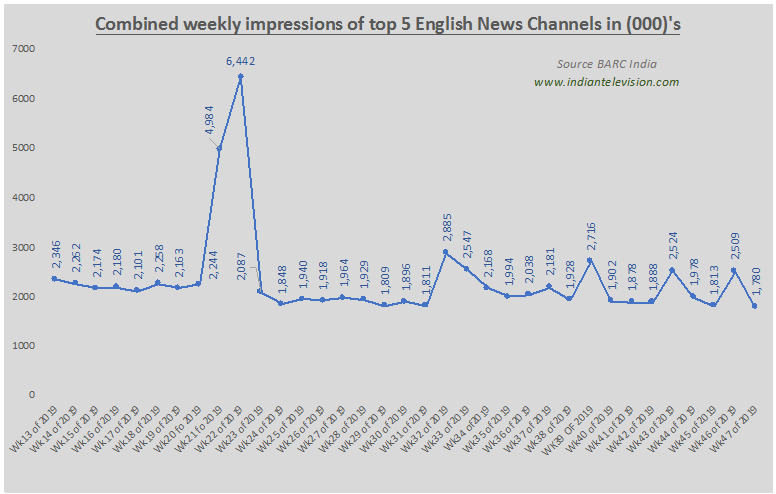
    BARC data for the Top 5 English News channels for the period under review saw the combined ratings of the top 5 channels from the genre spike up to 2.211 million weekly impressions from 1.780 million weekly impressions during the previous week. 

    While the channels in the lists for both weeks were the same, there was some tweaking in the ranks – Public broadcaster Doordarshan’s English News channel slipped to fifth rank in week 48 from third rank in week 47 of 2019. The India Today group’s India Today Television climbed up a place from fourth rank to replace DD India, while Network18’s CNN News 18 also climbed up a place to fourth rank in week 48 of 2019.

    As mentioned by us earlier, the combined ratings of the Top 5 English News channels had breached a new nadir during week 47 of 2019 to reach an all-time low since BARC recommenced publication of viewership data in the public domain in week 13 of 2019. For the optimist, viewership of the English News genre could only go up from that low of week 47 of 2019.

    Please refer to the figures below:

    Top 5 English News channels in week 48 of 2019

    The Arnab Goswami led Republic TV continued its dominance of the English News genre at first rank in week 48 of 2019 with an increase in weekly viewership of 35 percent or 0.197 million weekly impressions to reach 0.755 million weekly impressions from the 0.588 million weekly impressions it had garnered in the previous week.

    Times Now continued at second place with a 35 percent or 0.146 million weekly impressions increase in week 48 of 2019 to reach 0.561 million weekly impressions from 0.415 million weekly impressions in week 47.

    India Today Television climbed up a place to fourth rank with an increase of 36 percent or 0.102 million weekly impressions  in week 48 of 2019 to reach 0.383 million weekly impressions from fourth rank and 0.281 million weekly impressions in the previous week.

    CNN News18 also climbed up a place to fourth rank with an increase of 0.05 million weekly impressions in week 48 of 2019 to reach 0.268 million weekly impressions from fifth rank and 0.218 million weekly impressions in week 47.

    DD India slipped two places to fifth rank in week 48 of 2019 with a decline of 0.064 million weekly impressions to reach 0.244 million weekly impressions from third rank and 0.308 million weekly impressions in the previous week.

    Please refer to the figure below:

  • BARC week 47: English news ratings plunge to a new low

    BARC week 47: English news ratings plunge to a new low

    BENGALURU: After the previous week’s uptick, due to the Ayodhya and other Supreme Court of India verdicts, English News viewership plunged to a new nadir in 2019 in week 47. The combined weekly impressions of the Top 5 English News channels in week 47 of 2019 (Saturday, 16 November 2019 to Friday, 22 November 2019, period or week under review) were just 1.780 million weekly impressions according to Broadcast Audience Research Council of India (BARC) weekly data. Combined ratings of Top 5 English News channels viewership declined 28 percent during the week under review from the 2.509 million weekly impressions recorded in the previous week (week 46).

    BARC weekly data in this paper is being considered from week 13 of 2019 to week 47. Calendar year 2019 has been an eventual year as far as publication in the public domain of Broadcast Audience Research Council of India (BARC) weekly viewership data is concerned. First,the ratings  agency stopped publishing data in the public domain from week 6 of 2019 onward after the implementation of Telecom Regulatory Authority of India  (TRAI) New Tariff Order (NTO), ostentatiously to give time for viewership to stabilize and hence prevent ‘misuse’ of data. On coercion from TRAI, BARC started putting up data in the public domain from week 13 of 2019 onward, only to revert to an older version of treating data on the landing pages and outliers from week 23 of 2019. Hence the combined viewership of the Top 5 English News channels has been the lowest yet during the 35 weeks since week 13 of 2019.

    There was no change in the channels in BARC’s weekly list of top 5 channels in week 47 of 2019 as compared to weeks 45 and 46 of 2019. Even the ranks of the 5 channels were in the same order. Please refer to the figure below:

    Top 5 English News channels in week 47 of 2019

    As mentioned above, there was no change in list of channels in terms of rank and file during week 47 of 2019 as compared to week 46. Though the Arnab Goswami led Republic TV headed the pack at first rank during the period under review, it witnessed the largest fall in viewership among the top 5 English News channels in week 47 of 2019. Republic TV’s viewership declined 0.301 million weekly impressions or 35 percent in week 47 of 2019 to 0.558 million weekly impressions  from 0.859 million weekly impressions in week 46.

    Ranked second, Times Now witnessed the third steepest fall in percentage terms and the second in terms of absolute numbers among the top 5 channels of its genre with a decline of 0.150 million weekly impressions or 26.5 percent at 0.415 million weekly impressions in week 47 of 2019 as compared to 0.565 million weekly impressions in the previous week.

    PubcasterDoordarshan’s DD India witnessed the second steepest decline in percentage terms at 28 percent or a decline of 0.120 million weekly impressions (third most in absolute numbers) to 0.308 million weekly impressions in week 47 of 2019 as compared to 0.428 million weekly impressions in week 46.

    With a decline of 22.4 percent or 0.08 million weekly impressions, the India Today group’s India Today Television saw the least decline in percentage terms and the fourth lowest in absolute numbers with a fall of 0.080 million weekly impressions in week 47 of 2019 as compared to week 46. India Today Television scored 0.281 million weekly impressions during the period under review as compared to 0.361 million weekly impressions in week 46 of 2019.

    Mukesh Ambani’s Network18 associated CNN News18 saw ratings decline by 0.077 million weekly impressions or a fall of 26.1 percent in week 47 of 2019 to 0.218 million weekly impressions from 0.295 million weekly impressions in the previous week.

    Please refer to the figure below:


  • Jio Fiber service to launch on 5 Sept 2019

    Jio Fiber service to launch on 5 Sept 2019

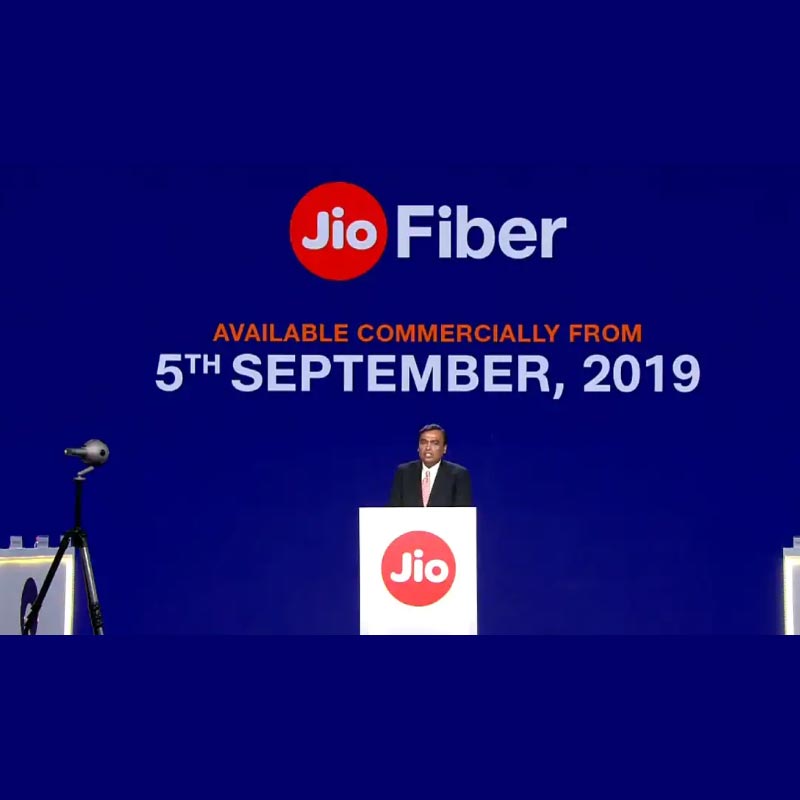
    MUMBAI: At the 42nd annual general meeting (AGM) of Reliance Industries Ltd (RIL), chairman and managing director Mukesh Ambani announced the much-awaited launch date for its fibre-to-the-home service. Jio Fiber will be launched on a commercial basis on 5 September on the third anniversary of the telecom giant’s launch.

    “Jio Fiber Services to be launched on commercial basis on 5 September 2019 – on the third anniversary of Jio’s launch. (We have) plan to reach 20 million residences and 15 million business establishments in 1,600 towns,” the business tycoon announced.

    In the last AGM of RIL, Ambani announced the high-speed fixed-line broadband services for retail customers. At the time of announced, Ambani revealed that it already invested more than $250 million in the industry. While the upcoming service has been on trial run since last year, he added that trial homes are, on average, consuming more than 100 GBs every month indicating the ever-increasing usage of internet in India.

    For a smooth rollout of the fibre service, Jio also made significant investments in two large multi system operators (MSOs) of India – Hathway and Den Networks. “Over the past months, we have upgraded our MSOs’ infrastructure to world-class standards. Now LCO partners can offer the largest bouquet of high-definition channels to customers with better features, reliability and customer experience than even DTH,” Ambani commented.

    Keeping the mixed economy structure of Indian internet users, Jio Fiber’s plans have been fixed from 100 mbps speed to all the way up to 1 Gbps. The pricing will range between Rs 700 per month to Rs 10,000 per month.

    To increase user engagement, Jio Fiber is set to offer various other entertainment opportunities to its consumers. Ambani also stated that Jio Fiber consumers will have access to premium over-the-top services. Moreover, Jio Fiber will launch a premium service where customers can watch movies at home on the release day itself, which will be launched in the middle of 2020.

  • The year M&A changed the face of the media and entertainment industry

    The year M&A changed the face of the media and entertainment industry

    MUMBAI: The emergence of numerous streaming platforms and convergence between technology, media, and telecom companies shook the core of the media and entertainment business globally. Giant tech and telco players, on the back of their direct customer reach, started taking content creation and distribution a lot more seriously. Rapid change in content consumption pressurised traditional players to invest more in technology and focus more on the B2C model. The ongoing flux brought the industry on the brink of instability, leading to consolidation in the form of mergers and acquisitions.

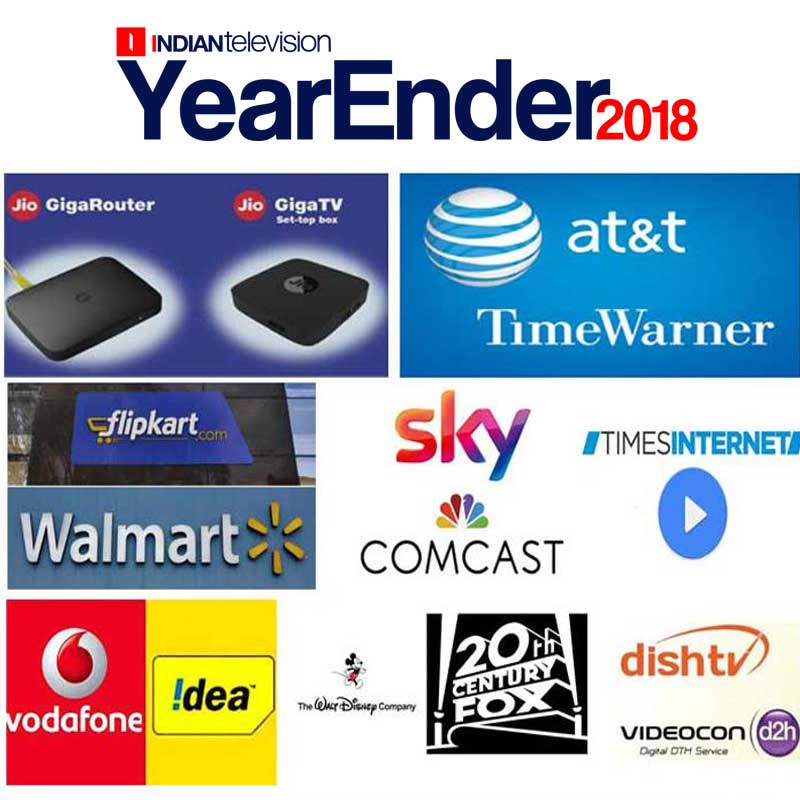
    In the last couple of years, the nature of competition in the global ecosystem has witnessed a gradual swing. Organisations like Netflix, Amazon Prime and Google have brought a structural shift forcing traditional players to rethink their approach to content and distribution. Legacy brands upped the ante to attract and retain more consumers even through cross-border deals. PwC India partner Raman Kalra points that everybody in this world of media disruption is trying to be relevant in reach and scale, the two critical factors that are driving deals. To corroborate his thesis, he highlights the AT&T-Time Warner deal where the former, with a huge reach, wanted to scale up its content play with the collaboration.

    Closer to home, billionaire Mukesh Ambani’s RIL rode the TMT convergence wave better than most. India’s richest man started the year with a bang, intensifying TV18’s stake to 51 per cent by acquiring 1 per cent of Viacom18’s equity from Viacom Inc. for a cash consideration of $20 million. The RIL-owned Jio Infocomm also acquired a controlling stake in two large MSOs – DEN and Hathway – building ammunition for its FTTH’s foray. That’s not all, RIL also pocketed a small but significant five per cent stake in Eros International.

    E&Y media and entertainment advisory services partner Ashish Pherwani expects more deals to materialise in 2019.

    “Especially technology-driven deals because so many changes are happening in that space, and consolidation, led by inbound investments. There are three types of deal. One type of deal is happening in order to build efficiency and scale in the business, led by cost pressures. Another type of deal is around relevance and market share – to get a bigger slice of the market to monetise a larger base of consumers.  The third type of deal which is happening is basically technology driven – for access to technology that could drive competitive advantage in the digital future. Hence, the three reasons market share, efficiency, technology are driving the deals,” he adds.

    There were other interesting deals struck through the year that are likely to reshape the media and entertainment business going forward.

    Birth of the world’s second largest DTH company

    The Indian market wasn’t exempted from the global merger frenzy. The coming together of two large DTH operators – Dish TV India and Videocon d2h – was finally concluded this year, creating the largest DTH service provider in the country with a subscriber base of about 29 million. Apart from leveraging their individual strengths, it was expected that the combined entity would benefit from economies of scale. One of the biggest attractions for Dish TV as the acquirer was Videocon’s significantly higher average revenue per user (ARPU). Significantly, the combined entity’s ARPU was Rs 207 in the second quarter as opposed to Dish TV’s standalone ARPU of Rs 144 pre-merger. The deal also helped Dish TV position itself better when it came to negotiating with broadcasters.

    Decks cleared for FTTH warfare

    From formally launching FTTH service Jio GigaFiber to acquiring majority stakes in two large MSOs to speed up the rollout, the Mukesh Ambani-led Reliance Jio was definitely the centre of attention in 2018. Reliance Industries Ltd (RIL) made an investment of Rs 2,290 crore for 66 per cent stake in Den and Rs 2,940 crore for 51.3 per cent stake in Hathway. It will save RIL the cost of reaching out to customers as well as making the last mile connectivity easier in its ambitious bid of seizing control over India’s wired broadband business. With the launch of its telecom service, RIL gave rise to what many call ‘digital democratisation’. As the Jio juggernaut marked its entry into India’s multi-billion-dollar cable TV and DTH businesses, traditional players eyed the development with a healthy mix of scepticism and optimism.

    Rivals joined hands

    The Indian telecom sector this year saw the marriage of two giant companies, creating the country’s largest telecom company. In the month of August, Vodafone India and Idea Cellular completed the merger after getting approval from National Company Law Tribunal (NCLT). The consolidation of India’s telecom sector was a direct result of Jio’s relentless pricing war. Post the Idea-Vodafone deal, India’s telco business now comprises of just three players. Analysts expect the combined entity to yield better coverage than before as it would have access to a more robust ecosystem of cellular towers. COAI also believes that as competitive pressures drive consolidation, customers and the industry stand to benefit from the greater stability and better networks which will emerge. Surprisingly, a few years ago, the Indian telco sector had 13 operators.

    Bansals became billionaires

    Walmart gained a strong foothold in India’s this year as it completed its much-talked-about $16 billion acquisition of the country’s largest e-commerce company Flipkart. Poster boys of India’s start-up community Sachin and Binny Bansal became billionaires in a big win for Indian talent and home-grown businesses. Despite protests from traders across the country, as the deal could potentially harm their business, the Competition Commission of India (CCI)’s green signal came earlier this year. The biggest e-commerce deal globally bolstered Walmart’s repertoire in its war with Amazon internationally. With India being one of the most attractive retail markets in the world, a strong play here is bound to further boost the American behemoth in a rapidly changing environment.

    Times Group joined the streaming sweepstakes

    With almost major broadcasters and media companies trying to grab a slice of the hottest piece of the M&E business – OTT, the Times Group too jumped on the bandwagon. To get a stronger foothold in the space, Times Internet invested over Rs 1,000 crore to acquire a majority stake in video playback app MX Player. According to media reports, the company will introduce a streaming service within the app. The large cross-border deal which surprised the industry will definitely help Times Internet in the OTT race thanks to the huge base and popularity of MX Player in south Asian countries. With over 30 OTT players vying for consumers’ attention in India, the game has just begun with enough opportunities for new platforms. Earlier in the year, MX Player content head Gautam Talwar had told Indiantelevision.com that like many other OTT platforms, MX Player too wants to tap into the millennial audience. It wants to cater to users with 50,000 to 100,000 hours of premium curated licensed content along with a high focus on originals, he further added. 

    The telco takeover

    Giant wireless carrier and telco AT&T’s acquisition of content powerhouse Time Warner is just one example of how the lines between distribution companies and content creators are blurring. With the $85 billion deal, the telco gained ready access to the content pool of CNN, HBO, and Warner Bros.

    “Under the terms of the merger, Time Warner Inc shareholders received 1.437 shares of AT&T common stock, in addition to $53.75 in cash, per share of Time Warner Inc.1 As a result, AT&T issued 1,185M shares of common stock and paid $42.5B in cash,” said AT&T providing the financial details of the deal.

    Though the deal was first announced in 2016, it had to negotiate past several subsequent legal hurdles. The Donald Trump-led US Department of Justice (DOJ) even filed a lawsuit against AT&T and Time Warner to block the proposed merger. Following a six week trial, a US district court approved the deal without any conditions on 12 June and also urged the government to not seek any stay. The main argument of the US administration was that the merger would hand over too much power to AT&T, making the market less competitive.

    A once-in-a-lifetime deal

    Another blockbuster deal that came through this year was the $71 billion acquisition of 21st Century Fox assets by Disney. After a long and sustained bidding war with Comcast, the Mouse House got its hands on much of the Murdoch empire. “Combining the 21CF businesses with Disney and establishing new ‘Fox’ will unlock significant value for our shareholders,” 21st Century Fox executive chairman Rupert Murdoch said. The shareholders of both the companies approved the deal immediately, with foreign approvals and regulatory reviews now the final procedural hurdle.

    Disney is now in pole position to take on streaming giants like Amazon and Netflix with its OTT Disney+. The company has also already indicated its desire to stop licensing content to Netflix by ending the deal in favour of its own B2C service. Moreover, Disney now has majority control of Hulu, Endemol Shine Group and Star India, making it the most powerful content owner in the world. The reaction to the growth of OTT services has clearly shown that joining forces with rivals and competitors is not unacceptable anymore to survive in the market.

    Second time lucky

    After a failed attempt to buy 21st Century Fox, US cable giant Comcast won the bid for European entertainment biggie Sky. The former sealed the deal for a controlling stake in the British broadcaster with a winning bid of $40 billion. Analysts said that Comcast and Sky would become the biggest private sector provider of pay TV in the world with 52 million customers. Given the vast reach and growing customer base of Sky in Europe, Comcast took the step to expand its international business with it losing ground in the domestic market. This deal was a direct effect of cord-cutting as Netflix’s growth in the US has posed a major threat to the likes of Comcast. According to an analysis from Ampere, post the media mega-mergers of Comcast/Sky and Disney/Fox, two in every 10 dollars spent on content worldwide will now be spent by these two entities.

    The merger madness from 2018 is likely to continue in 2019, as corroborated by experts we spoke to. Not only would it be interesting to track which companies opt for consolidation, but 2019 will also give us a sense of how the deals from 2018 take shape and play out.

  • 5G to challenge 4G services: Jio President

    5G to challenge 4G services: Jio President

    MUMBAI: With time, third generation services (3G) were replaced by fourth generation services (4G) and Reliance Jio played a vital role in the transforming phase. And once again India’s youngest telecom company is eager to quickly roll out the ultra-fast fifth generation services (5G).

    While speaking to the Economic Times, Jio president Mathew Oommen spoke about the challenges which 4G will face after the deployment of 5G.

    Oommen explained, “Once 5G digital services arrive, business will be based on the actual value that the telcos offer a consumer in terms of digital solutions, content, and services.”

    He briefed about traditional pricing models being revamped, “4G will be challenged by the imminent wave of 5G services that will no longer be charged based on minutes, bits or bytes anymore.” Rather telcos would adapt to a new pricing mechanism which would look to measure the “overall revenue per subscriber” for a combination of digital services.

    With that being said, Jio believes that it’s high time for telcos to “either disrupt the marketplace or face disruption”.

    Oommen stated that “normalcy would soon get restored” in the telecom sector as once the telcos catch up with the technological advancement which will only increase usage that would drive compensation from newer services.

    The 5G spectrum allocations will take place by the second half of 2019 according to the government. Jio Chairman Mukesh Ambani recently had said that India would be ready for 5G services by 2020. Jio has indicated its eagerness to roll out 5G services as it seeks an early auction of 5G airwaves, whereas Bharti Airtel and Vodafone Idea want the auction dates to be pushed back to late-2019 and 2020, respectively.

  • Sep-18: Wireline broadband subscriber base continued to fall

    Sep-18: Wireline broadband subscriber base continued to fall

    BENGALURU: India’s broadband internet subscriber base increased 3.89 per cent or by 1.805 crore (1805 lakh or 18.05 million) in September 2018 (month ended 30 September 2018, Sep-18, period under review) according to the latest Telecom Regulatory Authority of India (TRAI) data. There were 48.170 crore (4,817 lakh or 481.70 million) broadband internet subscribers as on 30 September 2018 as compared to 44.518 crore (4,451.8 lakh, 445.18 million) at the end of August 2018. Broadband subscribers through mobile devices such as phones and dongles grew 3.98 per cent or 0.774 crore (77.4 lakh, 7.74 million) in Sep-18 to 46.289 crore (4,628.9 lakh, 462.89 million from 44.518 crore (4,451.8 lakh, 445.18 million) at the end of August 2018.

    Wired internet services lost around 30,000 subscribers (0.18 per cent) in Sep-18 according to TRAI data.  The total number of wired broadband internet subscribers declined to 1.799 crore (179.9 lakh, 17.99 million) in Sep-18 from 1.802 crore (180.2 lakh, 18.02 million Aug-18.

    The number of broadband internet subscribers availing services through WiFi, Wi Max, Point to point, Radio, Vsat increased 81.67 per cent to 0.082 crore (8.2 lakh, 0.82 million) in Sep-18 from 0.045 crore (4.5 lakh, 0.45 million) in Aug-18.
    Please refer to the figure below:

    The top five broadband internet service providers constituted 97.86 per cent market share of the total broadband subscribers at the end of Sep-18. These service providers were Reliance JioInfocomm Ltd (Jio) – 25.225 crore (2,522.5 lakh, 252.25 million), Bharti Airtel or Airtel 9.929 crore (992.9 lakh, 99.29 million), Vodafone 5.182 crore (518.2 lakh, 51.82 million), Idea Cellular 4.79 crore (479 lakh, 47.90 million) and BSNL 2.012 crore (201.2 lakh, 20.12 million). 

    Wireless Internet

    As on 30 September 2018, the top five wireless broadband service providers were Jio 25.225 crore (2,522.5 lakh, 252.25 million), Airtel 9.705 crore (970.5 lakh, 97.05 million), Vodafone 5.181 crore (518.1 lakh, 51.81 million), Idea Cellular 4.789 crore (478.9 lakh, 47.89 million) and BSNL 1.079 crore (107.9 lakh, 10.97 million). Please refer to the figure below:

    The public sector BSNL continued to bleed subscribers in Sep-18. BSNL lost 0.022 crore (2.2 lakh, 0.22 million subscribers) in the month. BSNL’s wireless broadband internet subscriber base declined 2 per cent to 1.097 crore (109.7 lakh, 10.97 million) in Sep 18 from 1.119 crore (111.90 lakh, 11.19 million). BSNL’s wireless broadband internet subscriber base has declined to just half in Sep-18 from 2.195 crore (219.5 lakh, 21.95 million) as on 31 December 2017 (Dec-17) or 1 January 2018.

    Vodafone’s subscriber base grew by 0.056 crore (5.6 lakh, 0.56 million) in Sep-18 as compared to Aug-18, but has declined by 0.063 crore (6.3 lakh, 0.63 million) as compared to its base as on 1 January 2018. This was because of its merger with Idea cellular in August 2018. The Vodafone India and Idea Cellular combine had to forego about 140 lakh (14 million, 1.4 crore) subscribers in six circles and revenues of more than Rs 2,000 crore in three circles as the merged Vodafone and Idea Cellular entity would breach the Department of Telecommunications (DoT)-prescribed 50 per cent cap on subscribers and revenue in the respective states.

    Wireless Broadband Internet

    As on 30 September, 2018, the top five wired broadband service providers were BSNL (9.15 million), Airtel (2.24 million), Atria Convergence Technologies or ACT (1.36 million), MTNL (0.80 million) and Hathway Cable & Datacom (0.75 million). Three of the top 5 wired broadband internet services providers lost about 10,000 subscribers each, while the other two – Airtel and did not show any growth.

    Airtel added the highest number of wireline broadband subscribers in calendar year 2018 until Sep-18 with 90,000, followed by Atria Convergence Technologies (ACT) which added 80,000 subs during the period.

    Notes: According to TRAI, Broadband internet means services with speeds equal to or higher than 512 kpbs.

    TRAI provides data in millions and to the second decimal place, hence the granularity of the data in this report is 10,000.
     

  • Reliance Jio adds 13.1 mn mobile subscribers

    Reliance Jio adds 13.1 mn mobile subscribers

    MUMBAI: Reliance Jio has added 13.1 million mobile subscribers in September where other telecom operators Bharti Airtel, Vodafone, Idea lost 2.3 million, 2.6 million and 4 million respectively.

    Airtel, Vodafone Idea combined lost over 9 million subscribers in the month, according to telecom industry body, COAI’s data.

    COAI director general Rajan S Mathews said, “All the operators have expanded their services across the country, and have begun heavily diversifying their services beyond voice & data for the consumer.”

    As of September, Airtel, Vodafone and Idea held market shares of 33.75 per cent, 21.80 per cent and 20.94 per cent respectively, according to the reports. In August, Jio had over 239 million subscribers. Airtel continued to be at top position with 343.52 million subscribers followed by Reliance Jio which recently crossed the 250 million mark for its subscriber base, taking its total subscribers to over 252 million at the end of September. Moreover, Vodafone and Idea had subscriber base of over 221 million and 213 million respectively. The UP (East) circle remained at the top with a total of 87.53 million subscribers followed by Maharashtra at 84.70 million subscribers, the report said.

  • Interoperable Bharat Wi-Fi to provide 1mn hotspots by ’19-end

    Interoperable Bharat Wi-Fi to provide 1mn hotspots by ’19-end

    NEW DELHI: Indian Telecom Minister Manoj Sinha has said the country will rollout one million Wi-Fi hotspots in the country by December 2019 via Bharat Wi-Fi, a country-wide common inter-operable platform. His colleague, IT and Electronics Minister Ravi Shankar Prasad later highlighted the government was also taking steps towards effective data protection as the country becomes more digital.

    Announcing the connectivity initiative at the inauguration of the second edition of the India Mobile Congress 2018 (IMC) yesterday here, the Telecom Minister said Bharat Wi-Fi will be owned and operated by telecom service providers, ISPs and virtual network operators (VNOs) and consumers will have access to Wi-Fi hotspots of any of the partnering operators.

    The interoperable Wi-Fi initiative is part of the Indian government’s fibre optic project BharatNet that aims to connect the country’s 250,000 gram panchayats or local village administrations and has “put mobility in the centre of next digital revolution”, the Minister highlighted, adding rise in convergence of services has led to adoption of new technologies.    

    Pointing out that revenue generation in India’s telecom sector has seen a rise of 220 per cent in the last four years, Sinha said, along with the information technology segment, the two sectors presently contribute approximately 6.5 per cent to the country’s GDP and has the potential to grow further.

    Sinha, along with his other ministerial colleagues and industry stalwarts, including Reliance Industries’ Mukesh Ambani and Bharti Airtel’s Sunil Mittal, also unveiled the National Frequency Allocation Plan 2018 (NFAP), a roadmap for the Indian digital communications industry.

    The NFAP released a quantum of 605 MHz license-exempt spectrum in 5GHz band for wireless access services and radio local area networks in outdoor to meet the ever-growing appetite for data (from a current figure of 50 MHz since 2007).

    The frequency allocation plan also offered over 30 license-exempt bandwidths for short range devices (SRDs), ultra-wideband devices (UWDs) and additional spectrum for M2M services, creating opportunities for the public to enjoy benefits from technologies and enabling the industry to build domestic manufacturing eco-system. India has signalled its spectrum plans for 5G services aspiring to adopt the next generation technology.

    “The country is at the cusp of a digital revolution with disruptions happening in each and every sector and industry. With growing smartphone and internet penetration and with the finalisation of National Digital Communication Policy 2018, these are exciting times for the telecom sector, and the society at large,” Sinha said, adding that the launch of several innovative products will pave the path to accomplish Prime Minister Modi’s “vision of a digitally connected India”.

    The three-day India Mobile Congress 2018 has been organised by Department of Telecoms and Cellular Operators Association of India (COAI).

    Earlier in the day while RIL’s Mukesh Ambani said Jio is ready to again disrupt the market with its fixed-line broadband service, Bharti Airtel’s Sunil Mittal exhorted the government to make more telecom industry-friendly policies as the sector continues to be highly taxed, similar to the tobacco industry, which is proving to be detrimental.

    Among the key highlights of the first day of the IMC was the participation of 5G trials by companies like Reliance Jio InfoComm, Intel, Nokia and Qualcomm.