Tag: Mukesh Ambani

  • Q2-17: New initiatives lower TV18 operating profit

    Q2-17: New initiatives lower TV18 operating profit

    BENGALURU: The Mukesh Ambani group-owned TV18 Broadcast Limited (TV18) reported operating profit of Rs 9.1 crore for the quarter ended 30 September 2016 (Q2-17, current quarter) as compared to Rs 10.8 crore in the corresponding year-ago quarter. The company says in its earnings release that excluding the impact of new initiatives, the operating profit for the quarter was Rs. 21.2 crore.

    The company’s consolidated gross revenue including proportionate share of joint ventures (JV) in Q2-17 increased 8.6 per cent year-over-year (y-o-y) to Rs 653.47 crore as compared to Rs 608.53 crore. TV18’s total income from operations (TIO) in the current quarter increased 5.3 per cent y-o-y to Rs 239.83 crore as compared to Rs 227,68 crore.

    Consolidated media operations segment revenue (including share of JV) in the current quarter increased 14.4 per cent to Rs 647.19 crore as compared to Rs 565.91 crore in the corresponding year-ago quarter. The segment’s operating profit was just a fraction of the corresponding year ago period at Rs 1.33 crore as compared to Rs 19.75 crore.

    TV18 says that during the quarter the group remained in investment mode to position it well for the future. The information and entertainment bouquet was revamped with new launches, talent pool beefed up and accent was placed on creating/curating high quality content for both TV and digital media. Segment loss before interest and tax on a consolidated basis including the performance of joint ventures stood at Rs. 3 crore for the quarter versus. segment profit of Rs. 24.7 crore in Q2-16. Excluding the impact of new initiatives and one-time expense, the segment profit for the quarter was Rs.70.1 crore

    Film Production and Distribution segment reported 79.8 percent y-o-y drop in revenue at Rs 8.60 crore in Q2-17 as compared to Rs 42.62 crore. The segment reported operating loss of Rs 2.90 crore as against an operating profit of Rs 1.90 crore in the quarter ended 30 September 2015.

  • Q2-17: New initiatives lower TV18 operating profit

    Q2-17: New initiatives lower TV18 operating profit

    BENGALURU: The Mukesh Ambani group-owned TV18 Broadcast Limited (TV18) reported operating profit of Rs 9.1 crore for the quarter ended 30 September 2016 (Q2-17, current quarter) as compared to Rs 10.8 crore in the corresponding year-ago quarter. The company says in its earnings release that excluding the impact of new initiatives, the operating profit for the quarter was Rs. 21.2 crore.

    The company’s consolidated gross revenue including proportionate share of joint ventures (JV) in Q2-17 increased 8.6 per cent year-over-year (y-o-y) to Rs 653.47 crore as compared to Rs 608.53 crore. TV18’s total income from operations (TIO) in the current quarter increased 5.3 per cent y-o-y to Rs 239.83 crore as compared to Rs 227,68 crore.

    Consolidated media operations segment revenue (including share of JV) in the current quarter increased 14.4 per cent to Rs 647.19 crore as compared to Rs 565.91 crore in the corresponding year-ago quarter. The segment’s operating profit was just a fraction of the corresponding year ago period at Rs 1.33 crore as compared to Rs 19.75 crore.

    TV18 says that during the quarter the group remained in investment mode to position it well for the future. The information and entertainment bouquet was revamped with new launches, talent pool beefed up and accent was placed on creating/curating high quality content for both TV and digital media. Segment loss before interest and tax on a consolidated basis including the performance of joint ventures stood at Rs. 3 crore for the quarter versus. segment profit of Rs. 24.7 crore in Q2-16. Excluding the impact of new initiatives and one-time expense, the segment profit for the quarter was Rs.70.1 crore

    Film Production and Distribution segment reported 79.8 percent y-o-y drop in revenue at Rs 8.60 crore in Q2-17 as compared to Rs 42.62 crore. The segment reported operating loss of Rs 2.90 crore as against an operating profit of Rs 1.90 crore in the quarter ended 30 September 2015.

  • Jio signs up 16 million 4G  subs; target, 100 million

    Jio signs up 16 million 4G subs; target, 100 million

    MUMBAI: Think Big. Think Global. That’s been the motto of Reliance Industries chairman Mukesh Ambani. And, now the world’s biggest start-up Reliance Jio Infocomm Ltd. (Jio) — which he has been incubating for more than half a decade — has announced that it has achieved a global first.

    The number of registered sign-ups Jio has achieved in the first month of its 4G commercial launch – September 2016 — has crossed 16 million. That’s a faster adoption rate than that achieved by any telco or any start-up like Facebook, WhatsApp and Skype.

    And, of course, Ambani is pleased as punch by the consumer response. Said he in a press release: “We are delighted and humbled by the overwhelming response across India to the Jio Welcome Offer. Jio is built to empower every Indian with the power of data. We are delighted that people have recognized this and are utilizing our services to the fullest. We are customer-obsessed and committed to improve every day to exceed expectations of our customers.”

    Observers say Jio’s subscriber number could have been higher had Ambani and Jio managed to not run into a wall with older competitors like Airtel, Vodafone, Idea. Jio – which has made calls free – reported humungous amount of call failures because its rivals disallowed call connections by the newbie’s users.

    Jio is looking to disrupt the entire Indian telecom ecosystem. While all Indian telcos charge for calls, Jio announced that it would not be charging for calls made using its network. And it announced cheaper data plans than rivals. It has been running its Jio Welcome Offer wherein all its services – including data and apps – are free for customers until 31 December 2016. Last week, it announced an offer for iPhone users wherein buyers of the 7, the 7 Plus, the 6, the 6 Plus, 6S, 6S Plus, and the 5SE would not be charged for data and services for 12 months.

    To top it all, Jio has introduced Aadhaar-based paper-less Jio SIM activation across 3,100 cities and towns. This enables the customer to complete the SIM activation process in a matter of minutes, with only his/her Aadhaar number.

    The press release states that the “this process will be extended across the country and fully stabilized for satisfactory on-boarding experience in the next few weeks.”

    Ambani announced at the company’s AGM at the beginning of this month that Jio had set its ambitions high. His goal was to have 100 million subscribers to its services within a year.

    Rivals have been scrambling to ward off the Jio onslaught, dropping prices for data and bandwidth, as well as offering value added services at promotional rates.

    The overall Indian telecom sector has been seeing shifts too. According to the latest telecom data up to 31 July 2016, the wireless telecom subscriber base shrank to 1034.2 million as against 1035.1 million in end June. Amongst the big losers in the month were Reliance Communications which shed 32.4 lakh customers, and Tata Teleservices and Sistema lost 6,96,325 and 2,28,626 subscribers.

    Bharti Airtel led in the gainers table, adding a net 10.7 lakh new customers, taking its total sub base to 256.8 million, whereas Vodafone added 326,248 to take its tally to 199.7 million. Idea signed up 256,170 users taking its final number to 176.4 million.

    With Jio expected to spread out its availability further in the coming months, observers are expecting the battles to continue.

  • Jio signs up 16 million 4G  subs; target, 100 million

    Jio signs up 16 million 4G subs; target, 100 million

    MUMBAI: Think Big. Think Global. That’s been the motto of Reliance Industries chairman Mukesh Ambani. And, now the world’s biggest start-up Reliance Jio Infocomm Ltd. (Jio) — which he has been incubating for more than half a decade — has announced that it has achieved a global first.

    The number of registered sign-ups Jio has achieved in the first month of its 4G commercial launch – September 2016 — has crossed 16 million. That’s a faster adoption rate than that achieved by any telco or any start-up like Facebook, WhatsApp and Skype.

    And, of course, Ambani is pleased as punch by the consumer response. Said he in a press release: “We are delighted and humbled by the overwhelming response across India to the Jio Welcome Offer. Jio is built to empower every Indian with the power of data. We are delighted that people have recognized this and are utilizing our services to the fullest. We are customer-obsessed and committed to improve every day to exceed expectations of our customers.”

    Observers say Jio’s subscriber number could have been higher had Ambani and Jio managed to not run into a wall with older competitors like Airtel, Vodafone, Idea. Jio – which has made calls free – reported humungous amount of call failures because its rivals disallowed call connections by the newbie’s users.

    Jio is looking to disrupt the entire Indian telecom ecosystem. While all Indian telcos charge for calls, Jio announced that it would not be charging for calls made using its network. And it announced cheaper data plans than rivals. It has been running its Jio Welcome Offer wherein all its services – including data and apps – are free for customers until 31 December 2016. Last week, it announced an offer for iPhone users wherein buyers of the 7, the 7 Plus, the 6, the 6 Plus, 6S, 6S Plus, and the 5SE would not be charged for data and services for 12 months.

    To top it all, Jio has introduced Aadhaar-based paper-less Jio SIM activation across 3,100 cities and towns. This enables the customer to complete the SIM activation process in a matter of minutes, with only his/her Aadhaar number.

    The press release states that the “this process will be extended across the country and fully stabilized for satisfactory on-boarding experience in the next few weeks.”

    Ambani announced at the company’s AGM at the beginning of this month that Jio had set its ambitions high. His goal was to have 100 million subscribers to its services within a year.

    Rivals have been scrambling to ward off the Jio onslaught, dropping prices for data and bandwidth, as well as offering value added services at promotional rates.

    The overall Indian telecom sector has been seeing shifts too. According to the latest telecom data up to 31 July 2016, the wireless telecom subscriber base shrank to 1034.2 million as against 1035.1 million in end June. Amongst the big losers in the month were Reliance Communications which shed 32.4 lakh customers, and Tata Teleservices and Sistema lost 6,96,325 and 2,28,626 subscribers.

    Bharti Airtel led in the gainers table, adding a net 10.7 lakh new customers, taking its total sub base to 256.8 million, whereas Vodafone added 326,248 to take its tally to 199.7 million. Idea signed up 256,170 users taking its final number to 176.4 million.

    With Jio expected to spread out its availability further in the coming months, observers are expecting the battles to continue.

  • Jio, Reliance Retail offer freebies with iPhone7, 7+

    Jio, Reliance Retail offer freebies with iPhone7, 7+

    MUMBAI: Even before the iPhone7 became available in retail stores, Apple had announced that the flood of pre-orders had resulted it being sold out in the US. The Cupertino – hqed company is pulling out all the stops to ensure that its debut in India generates as much of good news. And it’s tie ups with the Mukesh Ambai owned Reliance Retail and Jio are steps in that direction.

    Buyers of a new iPhone7 and iPhone7 Plus, are being offered Rs 1,499 worth Jio Digital Life services complimentary for 12 months from 1 January 2017. This includes unlimited local, STD and national roaming voice, unlimited text, 20 GB of 4G Data, 40 GB of WiFi Data and Unlimited Night 4G Data, unlimited subscription to premium Jio Applications. The offer is valid in Delhi NCR, Mumbai, Ahmedabad and Bengaluru only.

    And it has also been extended to new purchases of older iPhone models such as the 6s, 6s+, 6, 6+, 5SE across all Reliance Digital stores and select Apple Premium Resellers (APR) and Apple Authorized Resellers (AAR).

    Plus of course, they are entitled to the three months of free data, voice and app services until 31 December 2016. Making it a total of 15 months of freebies if they buy one of the above iPhone models now.

    “Today’s announcement brings together India’s best premium 4G network with the incredible iPhone experience,” said Jio president Mathew Oommen. “Jio is India’s 4G-only network, providing high-speed internet across India. The true power of iPhones can now be experienced by all Indian iPhone users on the Jio network.”

    Reliance Retail is offering users the convenience of pre-ordering the iPhone models online and having them delivered, installed and activated with Jio services in their homes.

    “It’s a great initiative by Apple, Jio and Reliance Retail,” says a marketing consultant. “It should lead to volume uptakes. However, With Jio’s calls now getting connected with other mobile telcos easier than before, one will have to wait and watch whether it can provide consistent service in both data speeds and in voice.”

    Jio is currently under challenge from other mobile providers like Airtel, Vodafone and Idea who have also shaved their 4G wireless broadband prices, in line with it playing the volume and price warrior game.

  • Jio, Reliance Retail offer freebies with iPhone7, 7+

    Jio, Reliance Retail offer freebies with iPhone7, 7+

    MUMBAI: Even before the iPhone7 became available in retail stores, Apple had announced that the flood of pre-orders had resulted it being sold out in the US. The Cupertino – hqed company is pulling out all the stops to ensure that its debut in India generates as much of good news. And it’s tie ups with the Mukesh Ambai owned Reliance Retail and Jio are steps in that direction.

    Buyers of a new iPhone7 and iPhone7 Plus, are being offered Rs 1,499 worth Jio Digital Life services complimentary for 12 months from 1 January 2017. This includes unlimited local, STD and national roaming voice, unlimited text, 20 GB of 4G Data, 40 GB of WiFi Data and Unlimited Night 4G Data, unlimited subscription to premium Jio Applications. The offer is valid in Delhi NCR, Mumbai, Ahmedabad and Bengaluru only.

    And it has also been extended to new purchases of older iPhone models such as the 6s, 6s+, 6, 6+, 5SE across all Reliance Digital stores and select Apple Premium Resellers (APR) and Apple Authorized Resellers (AAR).

    Plus of course, they are entitled to the three months of free data, voice and app services until 31 December 2016. Making it a total of 15 months of freebies if they buy one of the above iPhone models now.

    “Today’s announcement brings together India’s best premium 4G network with the incredible iPhone experience,” said Jio president Mathew Oommen. “Jio is India’s 4G-only network, providing high-speed internet across India. The true power of iPhones can now be experienced by all Indian iPhone users on the Jio network.”

    Reliance Retail is offering users the convenience of pre-ordering the iPhone models online and having them delivered, installed and activated with Jio services in their homes.

    “It’s a great initiative by Apple, Jio and Reliance Retail,” says a marketing consultant. “It should lead to volume uptakes. However, With Jio’s calls now getting connected with other mobile telcos easier than before, one will have to wait and watch whether it can provide consistent service in both data speeds and in voice.”

    Jio is currently under challenge from other mobile providers like Airtel, Vodafone and Idea who have also shaved their 4G wireless broadband prices, in line with it playing the volume and price warrior game.

  • ‘Broadcasters could consider different pricing for rural-urban subscribers’

    ‘Broadcasters could consider different pricing for rural-urban subscribers’

    When DEN Networks promoter Sameer Manchanda set up the national MSO in 2007, one of the key professionals on his team, which was led by CEO Anuj Gandhi, was the cable TV veteran S.N. Sharma. The trio quickly ramped up the company and took it to national level status.  Gandhi then moved on in 2010 to join Network18. And, Sharma who was the president (operations), was promoted as the CEO a year or so later.

    He continued with the company, expanding it nationally, and seeing it through the first two phases of digitization before departing in 2015 to get on board India’s biggest and most funded  startup  — the Mukesh Ambani-backed Reliance Jio.  A former McKinsey professional Pradeep Parameswaran was roped in to lead the company in his place.

    Sharma, meanwhile, at Jio, worked on planning and building the team for company’s foray into cable TV along with another cable TV veteran K. Jayaraman.

    Then, in July 2016, Sharma made a sudden about-turn and decided to return to DEN Networks, a move that raised the eyebrows of many but cheered many in the trade. For he is known for his relationships and his deep understanding of how cable TV should be run in the Indian context.

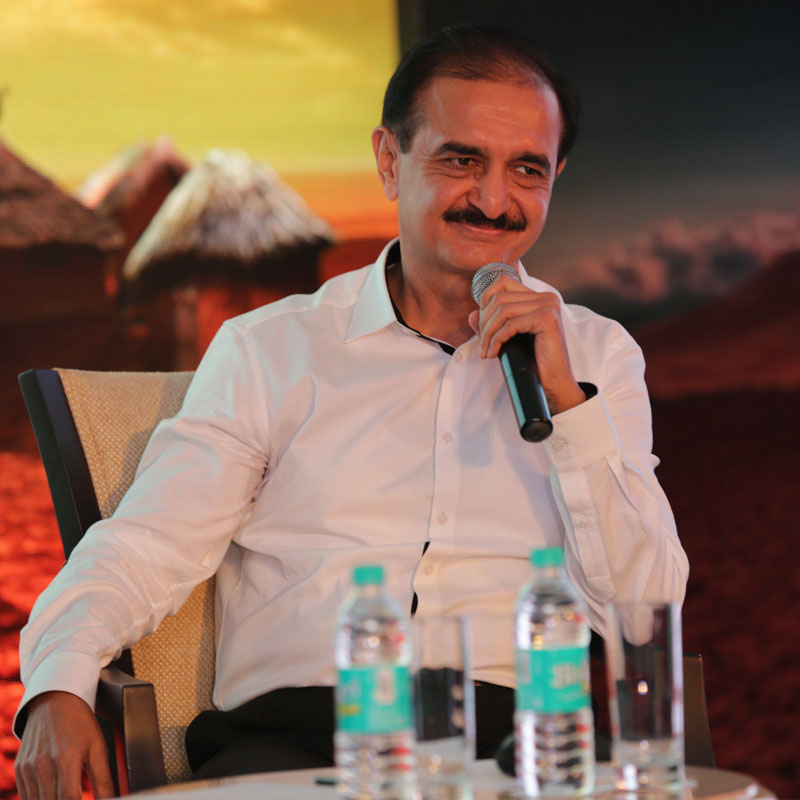
    Sharma was one of the key notes at indiantelevision.com’s Eleventh India Digital Operators Summit 2016 which concluded over the weekend at the Leela Hotel in south Goa. He had a one-on-one conversation with Indiantelevision.com Founder, CEO  & Editor in chief Anil Wanvari. Read on to get some insights into what is going on at DEN and with Sharma. Excerpts from the conversation:

    Why did you leave DEN in the first case, join Reliance and then why did you choose to come back?

    Having been into the cable industry for over 20 plus years, I thought, let me do something else. And, that’s why I moved to Reliance. Basically, I wanted to roll out fibre to the home (FTTH) over there. It would have been a great experience and learning (I thought). And it was, indeed. I learnt a lot in the short span of one and a half year. It was a wonderful learning that I brought in to my personality.

    But then, there was a call from my previous employer DEN, my friend Sameer.  I am one of the co-founders of DEN Network. And, I requested my employers at Reliance if I could leave. And they were kind enough to let me go back. It was more of an emotional decision than a professional one. All my learnings that I have had  at Reliance, I am
    sure, will help me learn to drive DEN in a better manner,in a positive direction in time to come.

    What are the challenges you are facing?

    The challenge as we all know is primarily monetization.  We started seeding boxes in 2010, now it is 2016. DAS came in 2012. And “hote hote” (by and by) it became 2013. Phase I and II happened quickly.

    There is a lag in monetization. Of course, we all can understand and you will appreciate that an industry which evolved since 1990, almost 30 year old industry, it  takes time for things to change. And, we took tiny, baby steps to monetize it.  But now, the time has come the boxes seeded in 2010 have almost lived their life and new technology is coming in. So my prime task is to see to it that we augment the process of monetization.

    The other challenge that I face immediately which I am working very aggressively on is to reduce the cost. We all know that Phase III digitization got into  a confused state, with boxes having got seeded, and the courts intervening.  Analogue signal has also been taken away from many of us. The MIB says 93 per cent  of digitization has happened. So the monetization process also has to start. But, in the bargain, we have already incurred some expenditure.  And unless I start recovering my revenue, the journey will be difficult.

    This time, in a short span of one and a half month, I addressed my cable TV partners, my business partners and my associates in a very transparent manner. We had a discussion – a whole day discussion wherein I shared with them my experiences with the telco. I shared with them the upcoming technology. I told them there is a change. The technology is not going to spare them.  We all used to think that last mile …last mile. But, my subscriber is not bound by last mile. My biggest threat today is the handset that I carry. The viewing habits are changing. Technology is bringing other alternatives. For the same viewer  who used to be watching their services. It is high time they realized it and accepted this change. And, they all agreed. I was surprised. It was a very open, frank and to-the-point discussion. I told them if we are willing to change, if we are willing to adopt, life will be there for us, otherwise the journey is going to be difficult. Everybody is cooperating. We hope to see a very good upside as far as collections are concerned.

    Third is making the LCOs, our partners realize the pains we are going through.  And, make them see the technology.

    And fourth is we have started conducting sessions with cable TV operator to sensitise them with the consumers. Like the regulator also said: Don’t force things on the consumer. He is in no mood. So the approach has to be friendlier than earlier. We have to change the face of our representative visiting the home of the subscriber. The
    presentation of our package has got lost.  We brought in a digital set-top box, we invested in that. But, we forgot in the process that we had not changed our face to the consumer. The cable TV operators accepted that we need to bring in a lot of ethics and discipline in that part.  You will see our representatives wearing uniforms. Uniform could be ours or the LCO’s.  It has to be in a presentable form. Today, if you are visited by a courier boy, the way he  is approaching is different.

    I am sure the cable TV operators will comply.

    Where are you reducing costs?

    Our priority early on was to penetrate the market, you increase your reach and when you penetrate certain areas, those can be reached through fibre or through links from telcos. After some time, you realize that you have spent an X amount in reaching an area and you have seeded 50 boxes. It does not make sense to you. So, you need to make a quick decision. You retract, you save money on that. Or you go to another MSO who is reaching the same area  and he has done it using a different pipe. And, he has 50,000 subscribers. So, I would tell him, why don’t we share the pipe. That process (of sharing)  has already started.  Then, we have started sharing the infrastructure also in another manner, in terms of content. If a competitor has a pipe serving more subscribers in the same area than I have less or vice-versa, I am open to sharing the pipe with the competitor. This is helping reduce costs. We have started sharing local content with cable operators. The cable operator has local content with him. So, instead of spending separately on the same content, we have started sharing that content too. Then, there are usual steps — reduction of manpower, to hire on a temporary basis, and cutting down the day-to-day expenses.

    Where are you getting your maximum margins?

    You see we have largely been a phase III player.  We have seeded 5.5 million in phase III, and 3-4 million are to go in phase IV. Of the 13 million subscribers, we have seeded 9-9.5 million. My upside will come from revenues of phase III boxes, which were yielding Rs 10-20. We have already crossed a milestone of Rs 40- 45 revenues, By December-end, it will touch  Rs 75 plus — that is a 45 per cent growth. Phase I is likely to give us 15-20 per cent.

    Who is going to get you this money – LCOs or the customer?

    You see the mood is set.  In the exercise, baby steps were taken to augment phase I revenues. It took us four years.  Phase III customer is also aware.  All studies and research show us is that the  buyingcapacity is there,  paying capacity is there too. HD is another example.  Around 70 per cent of TVs are HDTVs going into to Phase III
    areas. As it is for me to perform and deliver, I need my costs to be under control.  On the whole, we have also become very cost-conscious. We want our pie of the revenue.

    The cable sector has been bashed red and blue and cable TV bottomlines are stained with red ink? When will it turn around?

    You will see by Q3 end there should be an upside.

    You are very strong up north. Are you strengthening that or are you expanding into newer territories?

    As of now, my focus is to strengthen where we are. I have 13 million subscribers, I am happy to be limited where we are. As we start seeding boxes, it might go to 15 million as we deliver. I want to have a positive bottomline. I want a fair share of revenue. I want to move towards an era where sharing of revenues has be settled. As of now, there is always a dilemma, am I to stand by the TRAI that cable operators should get 35 per cent of revenue. The fact of the matter is that today we are receiving 35 per cent, and he is getting 65 per cent.

    I am very much focused that let’s first  set it right. It will take time and over few months. But, I see that over the next 12 months, this will move towards 50:50. And then, as we move forward, and add more values in the system, I am sure the operator will also get to earn  more through us if he wants to stay with us and be part of the journey.  If he says, he does not want to do broadband with, that’s his choice. If that arises, then we might go direct or we have leave that with him. I am very focused that instead of spreading thinly, focus where you, monetize it well. Settle a good business model. A good business case.  Business will follow.

    LCOs’ insecurity is less than earlier. Your comments.

    You can’t help it. Even MSOs. Nobody is secure. Times are changing. We have to adapt. You can’t ignore the technolgy. If I don’t change, just because my fellow LCO has not, and even I don’t, that’s a folly. Today, in  a matter of time, we started broadband. We have tested a broadband formula. We have close to 125,00 subscribers. We did this with a focused mind in Delhi and Kanpur. To test how the technology behaved, how the arithmetic works here. Now we find that, with 15-17 per cent of penetration, the project is breaking even. Now, anything added into it, is your upside.  The LCOs who are willing to work with us are very happy as they march around with us. And also, there is a learnin that the normal consumer is consuming 40 GB of internet at a speed of 10 mbps at a price of Rs 800. Broadband consumption is rising fast, 5 GB has gone to 10, and 20 GB has gone to 40 GB. Putting in everything into perspective, the cost is Rs 10 per GB.  Next year, I am sure it will be 100GB. And the speed will touch 50 MBPs. In such a scenario, if  I don’t move, somebody else will move.

    You must be happy Goldman Sachs invested but it was a discount to its earlier price, actually a deep discount What’s the way forward on the investment?

    It’s a subjective analysis . But, you should say that this proves that there is strength in the business model of DEN.

    On broadband there will be an increased investment going in. And besides broadband, we are incorporating OTT and value added services.

    So what’s the way forward on the pay TV market, with 31 December coming up?

    We are looking at it wholly. The boxes are going at a good speed. We are not really pushing. My focus is on getting Phase I, II III right. Once that business model is set in place, everything will also.  It is a matter of time, the  pull should come from the consumer, from the LCO. If he is willing to work with me. In the earlier case, in Phase I and II, we were subsiding the boxes. Today, it is a pure business case. This my product. You want to do business with me, please do.

    How can broadcasters assist the process of digitization till the tariff order comes out?

    There was a time when broadcasters used to have dual pricing policy. For rural, it was lower, and for urban, higher.  Now, that we have invested and are investing, all of a sudden  they have foregone  that policy of theirs, which they were following in analogue, and still they are following in some places even today. The moment we seed STBs in phase III, they start charging digital rates. I would urge broadcasters too relook at this.

  • ‘Broadcasters could consider different pricing for rural-urban subscribers’

    ‘Broadcasters could consider different pricing for rural-urban subscribers’

    When DEN Networks promoter Sameer Manchanda set up the national MSO in 2007, one of the key professionals on his team, which was led by CEO Anuj Gandhi, was the cable TV veteran S.N. Sharma. The trio quickly ramped up the company and took it to national level status.  Gandhi then moved on in 2010 to join Network18. And, Sharma who was the president (operations), was promoted as the CEO a year or so later.

    He continued with the company, expanding it nationally, and seeing it through the first two phases of digitization before departing in 2015 to get on board India’s biggest and most funded  startup  — the Mukesh Ambani-backed Reliance Jio.  A former McKinsey professional Pradeep Parameswaran was roped in to lead the company in his place.

    Sharma, meanwhile, at Jio, worked on planning and building the team for company’s foray into cable TV along with another cable TV veteran K. Jayaraman.

    Then, in July 2016, Sharma made a sudden about-turn and decided to return to DEN Networks, a move that raised the eyebrows of many but cheered many in the trade. For he is known for his relationships and his deep understanding of how cable TV should be run in the Indian context.

    Sharma was one of the key notes at indiantelevision.com’s Eleventh India Digital Operators Summit 2016 which concluded over the weekend at the Leela Hotel in south Goa. He had a one-on-one conversation with Indiantelevision.com Founder, CEO  & Editor in chief Anil Wanvari. Read on to get some insights into what is going on at DEN and with Sharma. Excerpts from the conversation:

    Why did you leave DEN in the first case, join Reliance and then why did you choose to come back?

    Having been into the cable industry for over 20 plus years, I thought, let me do something else. And, that’s why I moved to Reliance. Basically, I wanted to roll out fibre to the home (FTTH) over there. It would have been a great experience and learning (I thought). And it was, indeed. I learnt a lot in the short span of one and a half year. It was a wonderful learning that I brought in to my personality.

    But then, there was a call from my previous employer DEN, my friend Sameer.  I am one of the co-founders of DEN Network. And, I requested my employers at Reliance if I could leave. And they were kind enough to let me go back. It was more of an emotional decision than a professional one. All my learnings that I have had  at Reliance, I am
    sure, will help me learn to drive DEN in a better manner,in a positive direction in time to come.

    What are the challenges you are facing?

    The challenge as we all know is primarily monetization.  We started seeding boxes in 2010, now it is 2016. DAS came in 2012. And “hote hote” (by and by) it became 2013. Phase I and II happened quickly.

    There is a lag in monetization. Of course, we all can understand and you will appreciate that an industry which evolved since 1990, almost 30 year old industry, it  takes time for things to change. And, we took tiny, baby steps to monetize it.  But now, the time has come the boxes seeded in 2010 have almost lived their life and new technology is coming in. So my prime task is to see to it that we augment the process of monetization.

    The other challenge that I face immediately which I am working very aggressively on is to reduce the cost. We all know that Phase III digitization got into  a confused state, with boxes having got seeded, and the courts intervening.  Analogue signal has also been taken away from many of us. The MIB says 93 per cent  of digitization has happened. So the monetization process also has to start. But, in the bargain, we have already incurred some expenditure.  And unless I start recovering my revenue, the journey will be difficult.

    This time, in a short span of one and a half month, I addressed my cable TV partners, my business partners and my associates in a very transparent manner. We had a discussion – a whole day discussion wherein I shared with them my experiences with the telco. I shared with them the upcoming technology. I told them there is a change. The technology is not going to spare them.  We all used to think that last mile …last mile. But, my subscriber is not bound by last mile. My biggest threat today is the handset that I carry. The viewing habits are changing. Technology is bringing other alternatives. For the same viewer  who used to be watching their services. It is high time they realized it and accepted this change. And, they all agreed. I was surprised. It was a very open, frank and to-the-point discussion. I told them if we are willing to change, if we are willing to adopt, life will be there for us, otherwise the journey is going to be difficult. Everybody is cooperating. We hope to see a very good upside as far as collections are concerned.

    Third is making the LCOs, our partners realize the pains we are going through.  And, make them see the technology.

    And fourth is we have started conducting sessions with cable TV operator to sensitise them with the consumers. Like the regulator also said: Don’t force things on the consumer. He is in no mood. So the approach has to be friendlier than earlier. We have to change the face of our representative visiting the home of the subscriber. The
    presentation of our package has got lost.  We brought in a digital set-top box, we invested in that. But, we forgot in the process that we had not changed our face to the consumer. The cable TV operators accepted that we need to bring in a lot of ethics and discipline in that part.  You will see our representatives wearing uniforms. Uniform could be ours or the LCO’s.  It has to be in a presentable form. Today, if you are visited by a courier boy, the way he  is approaching is different.

    I am sure the cable TV operators will comply.

    Where are you reducing costs?

    Our priority early on was to penetrate the market, you increase your reach and when you penetrate certain areas, those can be reached through fibre or through links from telcos. After some time, you realize that you have spent an X amount in reaching an area and you have seeded 50 boxes. It does not make sense to you. So, you need to make a quick decision. You retract, you save money on that. Or you go to another MSO who is reaching the same area  and he has done it using a different pipe. And, he has 50,000 subscribers. So, I would tell him, why don’t we share the pipe. That process (of sharing)  has already started.  Then, we have started sharing the infrastructure also in another manner, in terms of content. If a competitor has a pipe serving more subscribers in the same area than I have less or vice-versa, I am open to sharing the pipe with the competitor. This is helping reduce costs. We have started sharing local content with cable operators. The cable operator has local content with him. So, instead of spending separately on the same content, we have started sharing that content too. Then, there are usual steps — reduction of manpower, to hire on a temporary basis, and cutting down the day-to-day expenses.

    Where are you getting your maximum margins?

    You see we have largely been a phase III player.  We have seeded 5.5 million in phase III, and 3-4 million are to go in phase IV. Of the 13 million subscribers, we have seeded 9-9.5 million. My upside will come from revenues of phase III boxes, which were yielding Rs 10-20. We have already crossed a milestone of Rs 40- 45 revenues, By December-end, it will touch  Rs 75 plus — that is a 45 per cent growth. Phase I is likely to give us 15-20 per cent.

    Who is going to get you this money – LCOs or the customer?

    You see the mood is set.  In the exercise, baby steps were taken to augment phase I revenues. It took us four years.  Phase III customer is also aware.  All studies and research show us is that the  buyingcapacity is there,  paying capacity is there too. HD is another example.  Around 70 per cent of TVs are HDTVs going into to Phase III
    areas. As it is for me to perform and deliver, I need my costs to be under control.  On the whole, we have also become very cost-conscious. We want our pie of the revenue.

    The cable sector has been bashed red and blue and cable TV bottomlines are stained with red ink? When will it turn around?

    You will see by Q3 end there should be an upside.

    You are very strong up north. Are you strengthening that or are you expanding into newer territories?

    As of now, my focus is to strengthen where we are. I have 13 million subscribers, I am happy to be limited where we are. As we start seeding boxes, it might go to 15 million as we deliver. I want to have a positive bottomline. I want a fair share of revenue. I want to move towards an era where sharing of revenues has be settled. As of now, there is always a dilemma, am I to stand by the TRAI that cable operators should get 35 per cent of revenue. The fact of the matter is that today we are receiving 35 per cent, and he is getting 65 per cent.

    I am very much focused that let’s first  set it right. It will take time and over few months. But, I see that over the next 12 months, this will move towards 50:50. And then, as we move forward, and add more values in the system, I am sure the operator will also get to earn  more through us if he wants to stay with us and be part of the journey.  If he says, he does not want to do broadband with, that’s his choice. If that arises, then we might go direct or we have leave that with him. I am very focused that instead of spreading thinly, focus where you, monetize it well. Settle a good business model. A good business case.  Business will follow.

    LCOs’ insecurity is less than earlier. Your comments.

    You can’t help it. Even MSOs. Nobody is secure. Times are changing. We have to adapt. You can’t ignore the technolgy. If I don’t change, just because my fellow LCO has not, and even I don’t, that’s a folly. Today, in  a matter of time, we started broadband. We have tested a broadband formula. We have close to 125,00 subscribers. We did this with a focused mind in Delhi and Kanpur. To test how the technology behaved, how the arithmetic works here. Now we find that, with 15-17 per cent of penetration, the project is breaking even. Now, anything added into it, is your upside.  The LCOs who are willing to work with us are very happy as they march around with us. And also, there is a learnin that the normal consumer is consuming 40 GB of internet at a speed of 10 mbps at a price of Rs 800. Broadband consumption is rising fast, 5 GB has gone to 10, and 20 GB has gone to 40 GB. Putting in everything into perspective, the cost is Rs 10 per GB.  Next year, I am sure it will be 100GB. And the speed will touch 50 MBPs. In such a scenario, if  I don’t move, somebody else will move.

    You must be happy Goldman Sachs invested but it was a discount to its earlier price, actually a deep discount What’s the way forward on the investment?

    It’s a subjective analysis . But, you should say that this proves that there is strength in the business model of DEN.

    On broadband there will be an increased investment going in. And besides broadband, we are incorporating OTT and value added services.

    So what’s the way forward on the pay TV market, with 31 December coming up?

    We are looking at it wholly. The boxes are going at a good speed. We are not really pushing. My focus is on getting Phase I, II III right. Once that business model is set in place, everything will also.  It is a matter of time, the  pull should come from the consumer, from the LCO. If he is willing to work with me. In the earlier case, in Phase I and II, we were subsiding the boxes. Today, it is a pure business case. This my product. You want to do business with me, please do.

    How can broadcasters assist the process of digitization till the tariff order comes out?

    There was a time when broadcasters used to have dual pricing policy. For rural, it was lower, and for urban, higher.  Now, that we have invested and are investing, all of a sudden  they have foregone  that policy of theirs, which they were following in analogue, and still they are following in some places even today. The moment we seed STBs in phase III, they start charging digital rates. I would urge broadcasters too relook at this.
  • Jio battles incumbents as Airtel launches Rs 1495 free data plan

    Jio battles incumbents as Airtel launches Rs 1495 free data plan

    MUMBAI: The fisticuffs continue in the 4G telecom marketplace. Even as Reliance Jio has been waging a war of press releases, highlighting how many of its subscribers’ calls are being refused by Idea, Airtel and Vodafone, the Sunil Mittal-led telco today too issued a press release through which it is taking a jab at the Mukesh Ambani-owned telco’s free call and data offer.

    Airtel says it has started offering a free data package for Rs 1495 only, and for prepaid customers only. If you are paying for it, then how is it free? Airtel explains that consumers can surf at wild speeds up to the 30GB data and 90-day limit, after which the accelerator needle will drop to 64kbps. And that’s when the free part of surfing will come in – but at super slow speed.

    At the price of Rs 1495 for 30 GB means the data is coming your way cheaper than the Reliance Jio offer of Rs 50 for a GB. The only difference is you are plonking down the money upfront.

    Will Reliance Jio react to this outrageous offer from a rival telco? No one knows, but it definitely has reacted to rival telco Idea on another front: that of call drops. It says that the Aditya Birla group-owned Idea is blocking out calls from Jio customers, refusing them connectivity. Says the Jio press release: “Adequate interconnection capacity so that call failure rate is less than 5 per 1,000 is a license obligation of all telecom operators. As against this, over 750 calls per 1,000 are failing per day between Idea and Jio networks, which translates to four crore calls failing per day. Over 12 crore calls fail daily between Jio and the networks of Airtel, Vodafone and Idea. This is a breach of licence conditions by the incumbent operators and severely impacts customer interests. This is against zero call failures on the Jio network.”

  • Jio battles incumbents as Airtel launches Rs 1495 free data plan

    Jio battles incumbents as Airtel launches Rs 1495 free data plan

    MUMBAI: The fisticuffs continue in the 4G telecom marketplace. Even as Reliance Jio has been waging a war of press releases, highlighting how many of its subscribers’ calls are being refused by Idea, Airtel and Vodafone, the Sunil Mittal-led telco today too issued a press release through which it is taking a jab at the Mukesh Ambani-owned telco’s free call and data offer.

    Airtel says it has started offering a free data package for Rs 1495 only, and for prepaid customers only. If you are paying for it, then how is it free? Airtel explains that consumers can surf at wild speeds up to the 30GB data and 90-day limit, after which the accelerator needle will drop to 64kbps. And that’s when the free part of surfing will come in – but at super slow speed.

    At the price of Rs 1495 for 30 GB means the data is coming your way cheaper than the Reliance Jio offer of Rs 50 for a GB. The only difference is you are plonking down the money upfront.

    Will Reliance Jio react to this outrageous offer from a rival telco? No one knows, but it definitely has reacted to rival telco Idea on another front: that of call drops. It says that the Aditya Birla group-owned Idea is blocking out calls from Jio customers, refusing them connectivity. Says the Jio press release: “Adequate interconnection capacity so that call failure rate is less than 5 per 1,000 is a license obligation of all telecom operators. As against this, over 750 calls per 1,000 are failing per day between Idea and Jio networks, which translates to four crore calls failing per day. Over 12 crore calls fail daily between Jio and the networks of Airtel, Vodafone and Idea. This is a breach of licence conditions by the incumbent operators and severely impacts customer interests. This is against zero call failures on the Jio network.”