Tag: MSO

  • The final word on cable TV digitisation

    The final word on cable TV digitisation

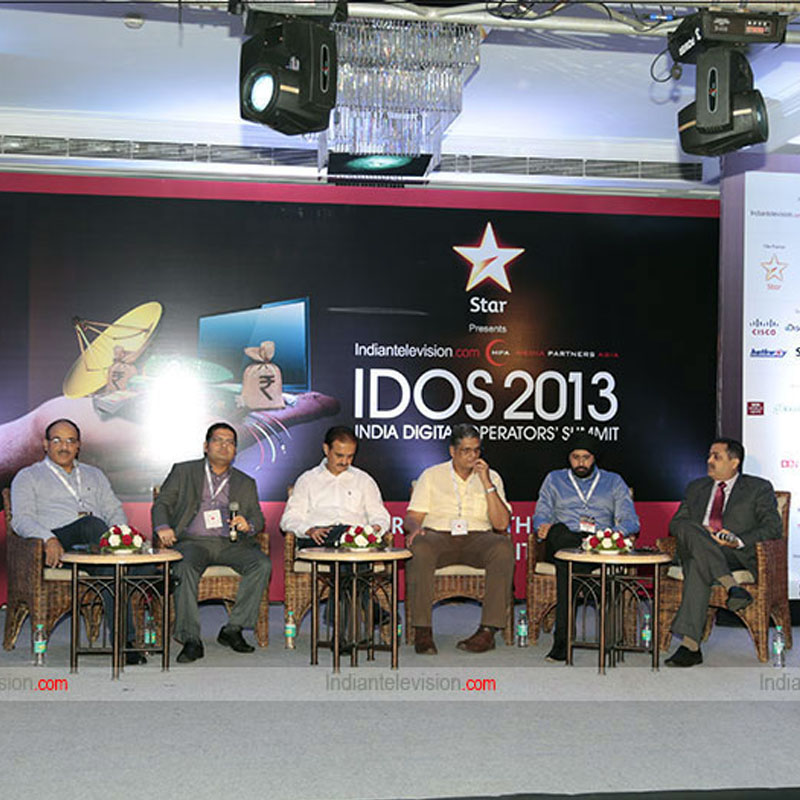
    GOA: With phase I and phase II on the cusp of completion, what are the lessons the digitising cable TV ecosystem has learned from their efforts? And how can this be put to use when industry moves into phase III and phase IV? This was the focus of the last session of the well-attended (it was houseful even on day two) IDOS 2013 in Goa.

    DEN Networks CEO SN Sharma said that his cable TV network was willing to take the punt and had enough investment to push into the territories it was targeting. “It won’t be easy but we are totally committed to doing it. Additionally, a lot of phase II was also done by local MSOs.  We see consolidation. In UK it happened. Five MSOs consolidated and are feeding around 90 per cent of the population there.”

    Hathway president Milind Karnik said that the last mile owner in many parts of phase III and phase IV has already upgraded and has awareness of and has already done some upgradation of infrastructure. “They will form cooperatives and consolidate and do what is needed. We too are going to move ahead forging relationships with local cable operators there, apart from serving some communities with our own headends.”

    Telecom Regulatory Authority of India (TRAI) principal advisor N Parameswaran said: “We expect like the telecom sector there will be some sharing of infrastructure.  We have learnt from phase I and phase II and there are many things we could have done better and will put those learnings in practice. There has to be some hygiene brought in terms of transparency and every other part of the process. Bill has to be generated to the subscriber. Service has to be provided. There will not be any looking back after that.”

    He urged MSOs and other players to understand that the dividends from phase I and phase II will start coming in with the addition of broadband delivery to subscribers. He further said a model has to be worked out between the MSOs and LCOs and TRAI would facilitate that.

    Also, in the wake of the continued depreciation of the Indian rupee against the dollar, the MSOs and LCOs feel that the government should give some subsidy to local manufacturers who are interested in setting up local units in the county to give a fillip to the industry.

    “We have got to come together. It has to be done together to resolve all the issues,” said Indian Broadcasting Foundation secretary general Shailesh Shah.

    Shah further added that the stakeholders would have to think how they can go deeper while addressing infrastructure problems. Carriage issue would also get resolved in a phased manner.

    Magnaquest CMO Ramakrishna Mashetty felt the landscape for the next phase of digitisation is different as compared to phase I and II as the cities are fragmented and low markets are there in the chart. “Most of the LCOs and market are unorganised,” he said.

    Telecom and Media lead analyst Rajiv Sharma said if the digitised headends start delivering incremental revenues in terms of services and ARPUs go up, return on investment (ROI) will improve. “Lot of external foreign investors are watching the space carefully,” he stated, adding that this imperative that some element of broadband be built in to the set top box so that the incremental revenues start accruing very quickly.

    Chrome Data Analytics & Media founder and MD Pankaj Krishna said the campaign in phase III and IV would be different. “The first two phases communicated and played on the principle of fear of blackout for consumers. The communications to the consumer during the third and fourth phase should focus on the benefits that a box can provide to users.”

    Parameswaran also addressed the issue of entertainment tax. “We have been working on understanding taxation levels which are a state subject versus a federal TDS or income tax,” he said. “But we are not averse to once again address this issue.”

    But what added spark to the panel discussion was the disclosure that the ministry of information and broadcasting was working with the department of telecommunications and MSOs to enable them to use already existing government and other infrastructure to help them as things start moving into phase III.

    The other good news is that bills – especially in Delhi – are slated to go out to subscribers in October, and online bills will follow later but interests of the LMO will be kept in mind.

    Parameswaran had the final word. Said he: “Digitisation will go ahead as planned. We are totally committed to it.”
  • TRAI gives final deadline for filling CAFs, SMS

    TRAI gives final deadline for filling CAFs, SMS

    New Delhi: Multi System Operators (MSOs) can now collect duly filled consumer application forms (CAFs), along with choice of channels and services and entry of complete details in their subscriber management systems (SMS) in 38 cities covered under phase-II of DAS implementation, by 15 November.

    Extending the deadline, the Telecom Regulatory Authority of India (TRAI) said ‘this is the last and final extension.’ The earlier deadline set by TRAI was 20 September. 

    A meeting was held in TRAI with leading MSOs on 25 September to review the progress in this regard. The authority observed that there is still substantial pendency on this account. The MSOs cited the enormity and complexity of the task involved as the prime reason for the pendency and requested for an extension in the time -line for completion of the task. 

    The extension is being given to achieve full coverage by 15 November, and ‘with a view to minimise consumer inconvenience that could result from MSOs disconnecting set top boxes immediately’.

    Consumers were requested by TRAI to cooperate and submit the CAFs, complete in all respect, to the respective cable operator/ MSOs in accordance with the revised deadline of 15 November, as ‘this is truly the very last opportunity’.

    In event of failure to do so, MSOs will have no option but to switch off the signal to those consumers who have not submitted their CAF, otherwise such MSOs would be in breach of the law.

  • Kolkata based MSOs, LCOs receive summons from service tax department

    Kolkata based MSOs, LCOs receive summons from service tax department

    KOLKATA: The Kolkata based Multi System Operators (MSOs) and local cable TV operators (LCOs) had uninvited guests last week. They were taken by surprise when the service tax officials conducted two raids to probe into their alleged financial irregularities. And, this in a digital addressable system (DAS) cable TV ecosystem which reveals the business and operations of these players at length.

    Apart from service tax, the income tax department also searched the premises of one of the big MSOs. And if sources are to be believed, the MSO made an upfront payment of around Rs 50 lakh – Rs 75 lakh to the income tax authorities.

    More than 350 cable operators have been issued summons for evading service tax payments for the past five years, sources said. “As per market reports two MSOs were raided last week, who then had to cough up huge amounts to the service tax authorities. The officials questioned the accountant of the MSOs on the financial details,” said a cable TV industry insider.

    It is also learnt that another MSO who had evaded service tax amounting to Rs 15 crore – Rs 20 crore spanning over four years, had to cover up the case by paying a huge amount to the authorities. “It is learnt that the company deposited a huge amount, though I am unsure of the exact amount,” the source added.

    Though the second MSO, whose office was raided on Thursday paid Rs 2.5 crore (approximately) to the service tax department officials. “Another Rs 50 lakh – Rs 75 lakh was given to the income tax department,” he informed.

    “The raid was part of a probe into financial transactions for suspected alleged tax evasion by the cable TV operators in Kolkata,” he said.

    A cable operator under Gujarat Telelink, an MSO, informed that as per the summons, the operator has to furnish details of the number of set top boxes installed and also the account details for the past five years. “If we don’t furnish it, we might be in trouble,” he said.

    Cable industry sources inform that cable TV operators are liable to pay 12.36 per cent as service tax to the authorities from the subscription amount collected every month from the customers.

    Kolkata based operators are treading in troubled waters. First it was the Telecom Regulatory Authority of India (TRAI) which planned to take strict action against the MSOs and LCOs for not collecting and feeding the CAF details into the system for DAS implementation and now they face the wrath of tax inspectors.

    Seems like it is time for operators to buck up and clear all past payments to avert any embarrassing situation in the DAS environment.

  • Kolkata’s cable TV customers feel CAF heat as blackouts spread

    Kolkata’s cable TV customers feel CAF heat as blackouts spread

    KOLKATA: Kolkata is seeing some frenetic activity on the cable TV front. The city’s multisystem operators (MSO) have started switching off signals in several pockets in Kolkata where cable operators have failed to comply with the Telecom Regulatory Authority of India (TRAI) norms and not provided them with the KYC or CAF forms of their subscribers. But MSOs have also been prompt in bringing the disconnected customers back online once the CAFs are submitted and fed into their systems.

    Apparently, the consensus amongst the cable TV fratenity is that cable TV subscribers are understanding the gravity of the situation with their cable TV connections being cut. And they have been a hurry to submit their CAFs now. “About 30,000 boxes had been deactivated and then reactivated after we received filled out forms from them,” said Manthan director Sudeep Ghosh.

     “We are in touch with the MSOs and we have been told that nearly two lakh set top boxes have been deactivated across the city and about 1.3 lakh boxes have been downgraded to DD channels only,” says a TRAI official.”And this is working as all the MSOs are saying that they are being flooded with CAFs as compared to earlier when there was lethargy.”

    The phase-wise deactivation of set top boxes had proved to be effective in sending out the intended message to consumers, he said.

    Consumers are confused and are complaining that there had been no intimation to them about the forms.

    A DTH service provider said that its call centres are receiving extra call loads with cable TV subscribers enquiring about the options available to them. “Our callers have expressed that it is better to settle with the seamless connection instead of haggling with the cable operator, who is ill-informed and not up to date with what is expected to be done,” says the DTH executive.

    We will have to simply keep our eyes glued to see if those callers will migrate to DTH. Going by past track records in other cities in phase I and phase II, it probably does not seem likely. Though many have expressed that a paradigm shift is needed.

  • I&B officials: Digitisation drive will accelerate further

    I&B officials: Digitisation drive will accelerate further

    NEW DELHI: For all those who think that there’s going to be a slowdown in cable TV digitisation. It is time to think again. All thanks to the focus of the Information and Broadcasting Ministry on the preparations for the upcoming elections next year.

    In fact, the teams at I&B and TRAI, which have been spearheading the drive along with TRAI representatives, has been informed by  new secretary Bimal Jhulka and TRAI chairman Rahul Khullar, to keep the foot on the accelerator pedal and if possible rev the digitisation drive even more.

    Last week, I&B sources told Indiantelevision.com that MSOs and other television ecosystem players are being told to start planning for phase III and phase IV of digitisation from now itself. Phase III and phase IV have been compressed into a single deadline which will end in December 2014.

    “The learnings from phase I and phase II are being put into place,” says an I&B source. “We will be setting up deadlines for import of set top boxes and for rollout of the boxes. There will also be a clear game plan about which channels will be switched off to force the pace of digitisation and CAF forms in the smaller towns and rural areas. We want the transition from analogue to digital to be smoother in the next phase.”

  • Stakeholders have until next week for TRAI consultation paper

    Stakeholders have until next week for TRAI consultation paper

    MUMBAI: It was early this month that the Telecom Regulatory Authority of India (TRAI) sent out a consultation paper which if implemented will reduce the aggregators’ importance in a digitised cable TV environment. The stakeholders: broadcasters, aggregators and MSOs, who had been asked to file their responses today, have now been granted an extension till 3 September.

    Confirming the extension, IBF secretary general Shailesh Shah says, “All our members thought that there should be a foolproof plan before going any forward. So we suggested TRAI to extend the date to have thoughtful and insightful responses.”

    The aggregators who are still working on the responses will be sending out the response first through an email. Subsequently, an Open House Discussion (OHD) on the issues dealt with in the consultation paper, will be held at Delhi on12 September. The date, time and venue for the same will be intimated separately.

    The aggregators have welcomed the extension. “We had more or less completed the responses, but the extension will only give us more time to prepare ourselves better,” says The One Alliance president Rajesh Kaul.

    The consultation paper issued on 6 August attempts to regulate the distribution of television channels from broadcaster to platform operators and discipline the distributors (aggregators). The paper involves amendments to the Tariff and Interconnection orders, and Register of Interconnect Regulations.

    The essence of the paper was to clip the immense clout that the four main aggregators MediaPro Enterprises (distributes 75 channels), IndiaCast UTV Media Distribution (distributes 35 channels), Sun Distribution Services and MSM Discovery (distributing 30 channels each) have on the TV ecosystem in India.

    The aggregators who feel that the regulator has been mislead by the MSOs have got one more week to present their case better. Though, IBF stresses on 3 September deadline being the final date with no further extensions, we wonder if this common norm will see another extension.

  • Around 1.80 lakh defaulters in Kolkata face TV blackout as of 26 August

    Around 1.80 lakh defaulters in Kolkata face TV blackout as of 26 August

    KOLKATA: With the Telecom Regulatory Authority of India (TRAI) pressuring service providers in Kolkata to disconnect the television connections of customers for not submitting the subscriber application forms, multiple system operators, more than 1.80 lakh customers have experienced a black out till Monday evening.

    While talking about the snapping of the connection which started from Saturday morning, Den Networks, Hathway Cable and Datacom and Manthan Broadband Services snapped the maximum number of cable connections, out of 80,000 which were disconnected on August 24.

    Also, with just around 45 days remaining for the grand festival of Durga Puja, some cable operators are relaxed and have assured the customers that they can send the details after the festival is over, said a customer, using the service of one of the players, which has maximum penetration in KM area.

    Industry sources said: “The consumer application forms (CAF) of these MSOs were not ready as compared to other players like SitiCable. As a result, the three MSOs had to switch off the connection,” adding that the MSO will continue to switch-off few connections at a time in the coming days to guard against law-and-order problem.

    As per the TRAI mandate, the MSOs were supposed to switch-off the cable connections of those customers, who had not filled-up the CAFs in Kolkata post midnight of 23 August.

    Committee of the Association of Cable Operators, Cable Operators Digitalisation convener Swapan Chowdhury said the MSOs have been asked by the TRAI to provide details of TV connections running illegally in the KM area.

    Siticable that has disconnected more than 90,000 subscribers till Monday evening, has seen a good response from customers. “We are not switching off the connections of CAF non compliance customers at a go. We are doing it in small numbers – say 15,000,” expounded Siticable director (Kolkata) Suresh Sethia.

    Manthan Broadband Services which has installed 6.5 lakh to seven lakh set top boxes, had alone disconnected around 30,000 connections on Saturday, said Manthan Broadband Services director Sudip Ghosh.

    “Our purpose is not to switch-off the connection. But after snapping say four connections, more than 100 customers have approached from the vicinity,” he added.

    Seeing the fast response from the customers, it can be easily assumed that in the KM DAS area, CAFs rate is likely to be 70 per cent to 80 per cent in next six days – seven days, Ghosh predicted.

    Den Networks and Hathway Cable and Datacom could not be asked specifically about the connections snapped by them in KM area.

    Cable Shilpa Bachao Committee convener Mrinal Chatterjee said instead of disconnecting the TV sets, TRAI should penalise the MSOs and not the customers by asking MSOs to switch off the connection; as the CAFs were not given to the customers on time.

    With no official extension notice from the regulatory body, will Kolkata see deactivation of set-top boxes of more and more defaulters at this juncture? Watch this space for the latest updates.

  • TRAI adamant on 23 August deadline in Kolkata, blackout to follow

    TRAI adamant on 23 August deadline in Kolkata, blackout to follow

    KOLKATA: With the Telecom Regulatory Authority of India (TRAI) strictly adhering to the 23 August deadline for collection of the customer application forms (CAFs) to help in the implementation of Digital Addressable Cable TV Systems (DAS), 50 per cent of the 30 lakh cable television consumers of the Kolkata metropolis area, might see their television sets going blank.

    Till 3:00 pm on Friday, CAFs for around 45 per cent of the cable consumers had been completed, a TRAI official told indiantelevisioin.com. “By midnight we expect the details of around 50 per cent consumers,” the official added.

    However top placed industry sources said that a 14 member team from the TRAI office is likely to come to Kolkata on 26 August (Monday), to decide the fate of the customers who have not yet filled the forms with required details. “This simply proves that MSOs will not be asked to disconnect the TV subscribers,” he said.

    It should be noted that the broadcasting regulator had set a deadline of 23 August for cable TV viewers here for filling up the CAFs including choice of channels in the subscriber management system some 40 days ago and failing which services would be stopped, it notified not once but many a times, added the TRAI official. “In fact we had two meetings with MSOs in the last one month,” he further stated.

    “In this weekend the MSOs and operators will work harder and try to feed in as much details as they can,” said people associated with the cable industry.

    Manthan Broadband Services which has more than 6.5 lakh to seven lakh subscribers has managed to collect around 35 per cent of its CAFs. “We will abide by the law. South Kolkata has done well as compared to North and Central Kolkata in terms of form submission,” said Manthan Broadband Services director Sudip Ghosh.

    “However, we expect to receive more such details on coming Saturday and Sunday,” added Ghosh.
    While SitiCable which has set up around 11.5 lakh digital addressable systems here has achived 60 per cent collection of forms and is optimistic of reaching the 70 per cent mark by midnight.

    SitiCable director (Kolkata) Suresh Sethia informed that the MSOs have received a new format from TRAI and the MSOs have been asked to send the details to the regulator on an everyday basis. “Details like number of boxes switched off, number of boxes reactivated and CAFs received,” should be filed everyday said Sethia.

    While a Hathway Cable and Datacom official stated till 3:00 pm, they had received details of more than 57 per cent customers and will be looking at 80 per cent by tonight. “We will act as per the instruction of TRAI,” he said.

    TRAI member R K Arnold who was in Kolkata recently said: “We are not going to extend the deadline beyond 23 August. In this if subscriber details including channel preference is not done, his connection is liable to be disconnected.”

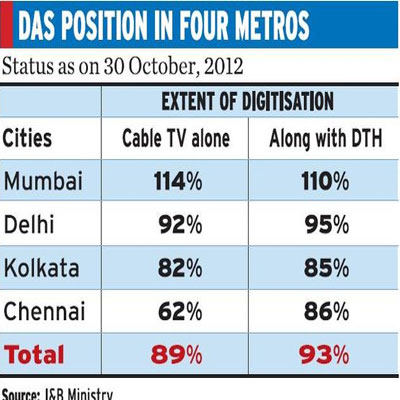
    Kolkata remains to be the last metro where DAS is yet to be implemented.

    Will TRAI ask the MSOs in Kolkata to disconnect the non complying subscribers from 24 August, if the subscriber data is not updated?

    If TRAI wanted the MSOs to switch off the TV connections, it would have informed the players by now but it seems that people will get some breathing space for some hours to complete the mandate, said an analyst.

    Even if the TV screens go blank, it can be connected in two hours to three hours, after the customers send all the details via their cable operators, concluded a MSO.

  • Manthan Broadband to invest big bucks to expand reach

    Manthan Broadband to invest big bucks to expand reach

    KOLKATA: The kingpin of the Multi System Operator (MSO) ecosystem in the East, Manthan Broadband Services has drawn an aggressive plan to secure its current position. Aware of the competitive market, this Kolkata-headquartered MSO plans to invest Rs 450 crore by 2014 end to upgrade its cable TV operations and also expand its reach in the eastern region.

    The cable operator which planned to install around 36 lakh Set Top Boxes (STBs) in the entire eastern region including Kolkata, rest of Bengal, Orissa, Jharkhand, Meghalaya and Assam by September 2014, has already installed around seven lakh STBs in Kolkata.

    While for the subscribers’ management system (SMS), Manthan is likely to sign a contract with an international brand soon. “We will soon be signing Rs 120 crore contract for the management work for 10 years. We will also invest to build best infrastructure which includes network, encryption, SMS and call centre,” informed Manthan Broadband Services director Sudip Ghosh.

    Created way back in 2002 through a merger of the operations of nine cable TV operators, Manthan has indeed come a long way.  The MSO caters to 30 lakh households, serving a greater part of Kolkata and West Bengal and other eastern regions with four digital headends and 40 analogue headends. It has more than 2,500 cable operator partners in the region.

    Manthan had earlier earmarked an investment of Rs 600 crore, out of which around Rs 150 core was spent in the markets of Kolkata and Jharkhand. “We will now spend Rs 450 crore in other states of the east. The promoters would invest a part of it and Manthan is looking at raising debt from banks,” added Ghosh.

    The company has a market share of 34 -35 per cent in the installed STBs offering 350 channels in Kolkata Metropolitan Area (KMA). Manthan has penetration in areas like Kolkata, Howrah, Hooghly, Baraipur and Chandannagar among others.

    On the company’s plans to hit the capital market with its initial public offering (IPO) to fund its expansion plans in the next two to three years, Manthan Broadband Services director Gurmeet Singh said, “We have started the backend work. There are many regulatory issues which we have to look at.”

    Also on the back of Indian rupee depreciating against the US dollar and Manthan as a company is likely to import more than 30 lakh STBs in the next one year. Ghosh said the import of the boxes have become costlier now as compared to when the rupee to dollar rate was Rs 46 – Rs 47 a dollar.

    “Even if the import cost for us is Rs 2,000, we give a subsidy to consumers and sell at Rs 999,” he hinted, saying that apart from other cable operators, it has a tough war to fight with direct-to-home (DTH) players. “We feel a hit at the revenue but it does not strike the bottom line up since we are in other added services too,” he said.

    Singh said that the company imports STBs mainly from China and added that if any local manufacturer sets up an assembling unit upon getting benefits and incentives from the government, it would help the industry people immensely.

    Manthan currently employs more than 300 people. This number will go up by another 30 per cent by 2014 end. The MSO currently serves more than 25 lakh households in the states of eastern region. “Of this we have around 18 lakh analogue cable connections,” he informed.

    According to sources, by September 2014, the rest of Bengal will witness 50 lakh STB installations. Also Orissa will see seven lakh installations, Jharkhand eight lakh-10 lakh, Meghalaya and Assam will register five lakh STB installations each.

    Commenting on the reach of Manthan, Hathway Cable and Datacom MD and CEO Jagdish Kumar G Pillai said, “The fragmented cable TV is likely to see some consolidation and the same applies to eastern region too. Manthan’s investment plans in the eastern region shows its commitment.”

    While aother MSO on the condition of anonymity stated: “Manthan had been performing well in the past but with digitisation kicking in, it has lost its hold on the market and dropped in its position. In terms of box supply and system integration, the company could not stand at par with its competitors. In fact recently due to funding issues, it has become difficult for it to operate in locations like Mednipur, Kharagpur and Bankura among other locations.”

    Industry sources feel that the company in order to move ahead and achieve such ambitious plans will have to work jointly with other companies, going forward.

  • Kolkata MSOs racing against time to meet DAS deadline

    Kolkata MSOs racing against time to meet DAS deadline

    KOLKATA: Multi System Operators (MSOs) and local cable operators (LCOs) in Kolkata are busy collecting the consumer application forms (CAF) and feeding in details for the complete implementation of the Digital Addressable System (DAS).

    “There’s a huge increase in workload, and everything has to be collected quicker and reported quicker,” says a Kolkata headquartered MSO. While a LOC says: “It’s very tiring to go home and get called back in again, and go home and get called back in again for clarifications and further clarifications.”

    With the Telecom Regulatory Authority of India (TRAI) confirming last week that it will strictly adhere to the 23 August deadline for implementation of subscriber management system (SMS) rollout in Kolkata, the MSOs and cable operators are collecting the know your client (KYC) form details and subscribers’ choice of channels swiftly and are racing against time to feed the data into their systems day and night.

    So far 30-35 per cent of the subscriber management system (SMS) data of cable consumers in Kolkata is completed as per the TRAI data.

    SitiCable which controls a substantial share of cable TV users in Kolkata said the call centers would update the details overnight. “We will work overnight and plan to achieve as much of the work before the deadline,” said SitiCable (Kolkata) director Suresh Sethia.

    SitiCable has set up around 11.5 lakh digital addressable systems (DAS) here.

    While for Manthan Broadband Services there are no holidays and Sundays. “We have 6.5 lakh to seven lakh subscribers. The CAF rate was around 25 per cent for us last week,” said Manthan Broadband Services director Sudip Ghosh.

    “The operators connected with Manthan are working 10 times faster than before,” added Ghosh.
    While Manthan Broadband Services director Gurmeet Singh, said: “With the regulation, we have to collect 100 per cent details. We have no other choice than asking the operators to work and achieve the target.”

    DEN Networks CEO SN Sharma said the CAF collection rate for it’s close to three lakh STBs in Kolkata is nearly 40 per cent-45 per cent.

    “Before the deadline, we aim to achieve 85 per cent -90 per cent work,” said Sharma with assurance.

    “The operators are so lethargic that the customers have not yet got the forms and we are getting calls from frantic TV viewers now,” said a MSO. “We have asked them to download the form from the website and fill it up, scan and mail it to us if possible so that their TV screens do not go blank,” he added.

    With just five days in hand to meet the switch-off date, other MSOs and LCOs said that they have deployed more personnel on shift and temporary basis.

    “Consumer Application Form (CAF) collection rate is expected to be around 70 per cent-75 per cent altogether in Kolkata by 23 August,” assumes Sethia.

    “Achieving 100 per cent target by 23 August is next to impossible. Kolkata will miss the deadline,” said Association of Cable Operators, Cable Operators Digitalisation Committee convener Swapan Chowdhury. “But the cable TV industry people are toiling hard now,” he expounded.

    On the other hand industry sources on the condition of anonymity said it is not possible to give authentic data in just five days. “Filling up more than 18 lakh CAFs is not a matter of joke. The LCO may tick mark the preference of the users themselves,” he said. “For not providing genuine information, the MSOs may face dreadful consequences,” he hinted.

    If around 5,000 local cable operators and 14 MSOs, which provide service in DAS areas do not abide by the deadline of submitting the CAFs, TRAI may file a case against any MSO, concluded a source.

    With the clock ticking and TRAI not willing to give any leeway, the MSOs and LCOs have their work cut out.