Tag: MSM Discovery

  • Discovery India’s Amol Majumdar no more

    Discovery India’s Amol Majumdar no more

    Mumbai: Discovery Communications India’s associate director – distribution and Eurosport strategy Amol Majumdar has passed away due to a heart attack on Sunday morning.

    Majumdar has been associated with Discovery Communications since December 2014. Prior to that, he was deputy associate director at MSM-Discovery, a broadcast distribution joint venture (JV) between Multi Screen Media (MSM) or Sony Pictures Networks India (SPN) and Discovery networks that came to an end in January 2015. He has been associated with the JV company since July 2004.

    Majumdar’s former colleague Rahul Johri who is president – revenue at Zee Entertainment Enterprises Ltd, has expressed his shock at the sudden demise of his friend on Facebook.

  • Star India’s senior VP legal Pulak Bagchi quits company

    MUMBAI: Star India senior VP, legal and regulatory, Pulak Bagchi, is moving out of  India’s biggest broadcasting and content company to seek new challenges  in a sector that’s quite far removed from  the country’s hectic and complex media industry.

    June 30, 2017 would be the last day for Bagchi at Star where he along with his boss — Deepak Jacob, president, legal and regulatory affairs and general counsel — drafted solutions to many a legal issue and articulated at various forums Star and Indian media industry’s views on complex issues ranging from media ownership, mergers & acquisitions, licensing of content, etc., apart from policy evangelism in general.

    Sources in Star confirmed the development saying Bagchi, who shuttled every week between Mumbai and New Delhi on official work, put in his papers some time back after almost seven and half years of eventful stay in the company.

    Bagchi’s LinkedIn profile makes clear his desire to be at the confluence of cutting edge/emerging technologies, ideas and concepts and adding value through evolving state of the art/next gen legal/regulatory knowledge — basically being part of convergence.

    Before joining Star India, the 40-something Bagchi, a graduate of Calcutta University’s Jogesh Chandra Choudhury College of Law, had done stints at MSM Discovery, a JV between Sony Entertainment Television and The Discovery Channel, Vodafone Essar and law firm Singhania & Co LLP. If one thinks lawyers are serious people, who they are, of course, this gentleman has an active interest in Hindi, Bengali and English music and loves to explore the world via travels.

    Recently, Star India communications head Parul Sharma too had quit the company after over a decade to pursue new challenges and interests, including photography.

    ALSO READ:  Star India’s Parul Sharma puts in her papers


  • Videocon d2h ropes in Himanshu Dhoreliya as content head

    Videocon d2h ropes in Himanshu Dhoreliya as content head

    MUMBAI: Videocon d2h has appointed Himanshu Dhoreliya as content head. Reporting to CEO Anil Khera, he will be based in Videocon d2h’s Mumbai headquarters. 

    Himanshu Dhoreliya comes to Videocon d2h with an impressive track record and more than a decade of experience in content development, content management and channel distribution for leading media and entertainment companies.  


    Videocon d2h executive chairman Saurabh Dhoot said, “The expertise that Himanshu Dhoreliya brings to the table will definitely add to and strengthen our content management bandwidth. This is an especially vital role & I believe that with his extensive experience & leadership, he will bring the best for brand Videocon d2h.”


    Videocon d2h CEO Anil Khera dded, “We are very pleased to welcome Himanshu Dhoreliya as content head, a role that will benefit greatly from his intuitive knowledge of the DTH industry. We are hopeful that he will help lead Videocon d2h in developing innovative content acquisition strategies while maximizing the use of our services to fulfil the needs of our valued customers – all, of course, keeping in sync with Videocon d2h’s goal of being the best in the industry.” 


    Dhoreliya former CEO and co-founder of TelevisionPost.com, has held positions with MSM Discovery Private Limited, the joint venture broadcast distribution company owned by Multi Screen Media and Discovery Networks, as well as ESPN Software.

  • TDSAT directs Ambala MSO to clear arrears of Rs 72 lakh due to MSM Discovery

    TDSAT directs Ambala MSO to clear arrears of Rs 72 lakh due to MSM Discovery

    NEW DELHI: The Telecom Disputes Settlement and Arbitration Tribunal (TDSAT) has allowed a petition by MSM Discovery for recovery of Rs 71.60 lakh from Ambala Communication, Haryana, which is outstanding dues on account of subscription fees.


    TDSAT chairman Justice Aftab Alam and member Kuldip Singh decided the matter ex parte as no one appeared on behalf of the Ambala MSO.


    The parties had entered into a subscription agreement dated 7 July, 2010 for a period from 1 April, 2010 to 31 December, 2010. It was stated that the agreement would be automatically renewed on the same terms and conditions provided therein for successive years starting from 1 January and ending on 31 December of the following year unless terminated.


    The agreement between the parties was on a subscriber base of 3523, for which subscription fees of Rs 5,55,357 exclusive of taxes (Rs 6,12,498 with taxes) was to be paid.


    Following a petition by the MSO in January 2012 asking for reconciling the accounts and for directions to MSM not to impose channels which the MSO did not want, TDSAT had said that the ends of justice would be served if the subscriber base was kept at 6000. (It had been contended by MSM during the hearing that the MSO had entered into an agreement with the Star group of channels at a subscriber base of 10,000).


    In the present petition filed by MSM last year, it was contented that in accordance with the directions of the Tribunal, it had raised invoices on the respondent at a reduced monthly subscription fees of Rs 3,72,599 exclusive of taxes (Rs 4,18,652 with taxes) but the MSO continuously defaulted in paying the due subscription fees despite numerous reminders and requests from the petitioner. 


    Ultimately, MSM served a notice dated 13 March, 2013 and finally deactivated the signals of the MSO on 17 May, 2013. 

  • TDSAT stays MSM Discovery’s disconnection orders against Meghbala

    TDSAT stays MSM Discovery’s disconnection orders against Meghbala

    NEW DELHI: The Telecom Disputes Settlement and Arbitration Tribunal (TDSAT) directed MSM Discovery Private Ltd not to give effect to its disconnection notices to Meghbala Cable and Broadband Services Pvt. Ltd. in Kolkata, Behrampur, Haldia and Bankura pending final orders of the Tribunal.


    The vacation bench of TDSAT chairman Aftab Alam listed the matter for 20 July, issuing notice to MSM Discovery to file its reply by 3 July and Mebhbala to file rejoinder thereto by 10 July.


    The Tribunal said MSM Discover will remove the OSDs running on the petitioner’s network provided the petitioner makes an on account payment of Rs 50 lakh to the MSM in two installments, the first installment of Rs 25 lakh payable by 15 June and the second installment of Rs 25 lakh by 30 June.


    It said the payment will be without prejudice to the rights and contentions of the parties and will abide by the final outcome of these petitions. 

  • Six broadcasters, content aggregators directed to provide signals to AP MSO

    Six broadcasters, content aggregators directed to provide signals to AP MSO

    NEW DELHI: The Telecom Disputes Settlement and Arbitration Tribunal (TDSAT), on 22 April, directed six broadcasters and content aggregators to enter into agreements with the Andhra Pradesh based multi-system operator Wiretel Digital Networks.


    In the judgement pronounced on Tuesday, the TDSAT bench comprising chairman Aftab Alam and member Kuldeep Singh said the agreements will be based on reference interconnect offer.


     The broadcasters/aggregators are ESPN, MediaPro, MSM Discovery, Sun, Ma TV and ETV.


     The petitioner, who holds a digital addressable system licence, had approached TDSAT in February 2013 after the respondents delayed/refused to provide signals to it on DAS mode.


     The bench for the first time also interpreted the DAS Regulations with regard to mandatory provisioning of signals on DAS mode – ‘the must provide’ obligation.

  • TRAI’s lifeline for content aggregators

    TRAI’s lifeline for content aggregators

    The Telecom Regulatory Authority of India’s  latest notification of regulations for content aggregators has attempted to curb their muscling power, even as it has allowed them to continue as agents carrying out the same function.


    TRAI on Monday notified amendments to its regulations barring content aggregators from bundling of channels belonging to different broadcaster groups and mandated broadcasters to themselves sign Reference Interconnect Offers (RIOs) with Distribution Platform Operators (DPOs). The broadcasters have, however, been allowed to appoint authorised agents to market their bouquets, which could be the existing aggregators.


    The amended regulations change the status of content aggregators from entities that aggregated television channels and marketed them in bundled packages to television distribution platforms to that of agents of broadcasters.


    But the role of content aggregators may not change radically. Content aggregators as agents of broadcasters might still be able to perpetuate their dominance, though in a slightly diluted form.


    The concerns flagged by TRAI vis-?-vis the business of content aggregation were:


    a. Top three content aggregators – MediaPro Enterprise India, IndiaCast UTV Media Distribution, MSM Discovery – controlled 58.6% of the total pay TV market.

    b. Content aggregators forced all-channel bouquets on the DPOs, validated by the fact that even though the largest bouquets offered by the aggregators in their RIOs are in the range of 13 to 20 channels, the agreements entered into are for a package of channels consisting of almost all the channels they are authorised to distribute.

    c. Content aggregators grossly discriminated against independent DPOs, charging 62 per cent to 85% more than DPOs which are established by broadcasting groups.


    The outcome of the amendments to the TRAI regulations could be the following:


    a. End of the era of clout wherein aggregators used to bundle channels of various broadcaster groups into  package cluster and thrust them down the DPOs throats.

    b. Making it obligatory for broadcasters to publish RIOs will result in relative transparency of pricing of channels.

    c. The margin of discrimination against independent DPOs may substantially get narrowed.

    d. The existence of content aggregators gets erased from the regulatory point of view. The regulations make the broadcasters responsible for the actions of content aggregators, now described as authorised agents of broadcasters.


    The issues the amendments have not addressed:


    a. By allowing channels from broadcasters within a corporate group to be packaged, the TRAI has allowed weak channels to piggyback on highly dominant  and popular channels. This could lead to problem and conflict in future when these networks swell as they add more and channels.

    b. Agents have been allowed to sell channels of different broadcaster groups though as separate bouquets. This does not completely eliminate the bargaining power of agents. They can bargain with DPOs for weak bouquets in exchange for a supposedly more favourable deal on dominant bouquets.

    c. Though TRAI made a mention of the undue advantage enjoyed by content aggregators owned by broadcasters, it stopped short of clamping down on the cross-holding norms for them, meaning it has continued to allow different broadcast networks to own a distribution agent.

    d. Independent DPOs will still be discriminated against, though the scale of bias against them is expected to significantly narrow.


    The amended regulations may have shaken up content aggregators. For the past six months, executives working in these companies were filled with trepidation that they would be forced to shut down their operations. But by allowing them to continue as agents, the TRAI has offered them a lifeline.

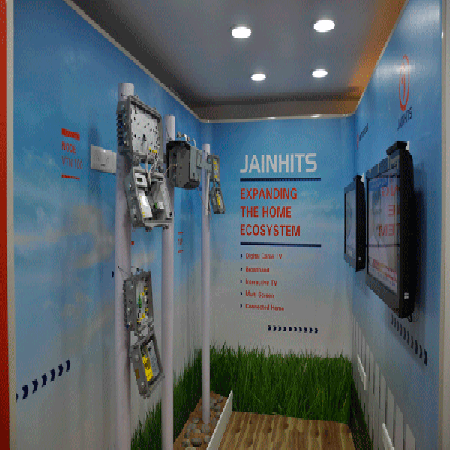
  • Decks cleared for JAINHITS to get TV signals of MSM Discovery, ESPN and SUN channels

    Decks cleared for JAINHITS to get TV signals of MSM Discovery, ESPN and SUN channels

    NEW DELHI: In less than two months since Media Pro Enterprises India was given directions to supply the channels it distributes to JAINHITS, the country’s only headend-in-the-sky (HITS) platform, the Telecom Disputes Settlement and Appellate Tribunal (TDSAT) today directed Sun, Sony (MSMD) and ESPN to provide their television channel signals to the platform by this evening.

    The three channel aggregators between them provide more than fifty prominent channels, but had been delaying giving their channels to Noida Software Technology Park Ltd (NSTPL) – which manages JAINHITS – which had approached the authorised content aggregator for these channels owned by Sony, Sun and ESPN.

    TDSAT Chairman Justice Aftab Alam and member Kuldip Singh were not impressed by the argument that all operators had created fresh Reference Interconnect Offer for HITS which was yet to get the clearance of the Telecom Regulatory Authority of India (TRAI). They asked the counsel for respondents whether this did not amount to breach of violation of section 3.2 of the Digital Access System (DAS) regulations of the cable interconnect agreement.

    With this, JAINHITS will now be able to transmit over 250 channels to consumers all over the country. The 12 September order relating to Media Pro had brought a total of around 75 channels into the JAINHITS fold.

    The only satellite-based platform for the distribution of digital TV channels, NSTPL is currently the only distribution platform of TV channels that is providing advanced HITS services to consumers through local cable operators.

    NSTPL founder and chairman of Jain TV Group Dr. J.K. Jain said, “The mission of JAINHITS is to build and operate digital highways in collaboration with cable network owners. We thank TDSAT for the ruling as this is an important announcement not only for the 60,000 cable operators across the country but also to the consumers. Without proper digitisation, government is losing huge revenue.”

    Senior counsel for NSTPL Vivek Chib told indiantelevision.com that this order would not only be in the larger interest of the government’s digitisation policy, but would ultimately benefit the end-user with greater choice and better quality.

    NSTPL had filed the petition under sections 14 and 14A of the TRAI Act 1997 seeking directions to enter into the Interconnect Agreement on mutually agreed terms or in case the two sides are unable to come to any mutually agreed terms, as per the respondent’s Reference Interconnect Offer (RIO) and to provide to it the content/TV channels under the latter’s control.

    NSTPL obtained from the Information and Broadcasting Ministry in 2003 the licence to establish, install, operate and maintain “headends in the sky” system to provide digital cable services in India. Apparently, the licence was granted even before provisions were made for accommodation of the HITS operator in the regulatory framework. Suitable provisions were made in the regulations to accommodate the HITS operators.

    NSTPL claimed that it had even got its system checked by the Broadcast Engineering Consultants (India) Ltd.  

  • Stakeholders have until next week for TRAI consultation paper

    Stakeholders have until next week for TRAI consultation paper

    MUMBAI: It was early this month that the Telecom Regulatory Authority of India (TRAI) sent out a consultation paper which if implemented will reduce the aggregators’ importance in a digitised cable TV environment. The stakeholders: broadcasters, aggregators and MSOs, who had been asked to file their responses today, have now been granted an extension till 3 September.

    Confirming the extension, IBF secretary general Shailesh Shah says, “All our members thought that there should be a foolproof plan before going any forward. So we suggested TRAI to extend the date to have thoughtful and insightful responses.”

    The aggregators who are still working on the responses will be sending out the response first through an email. Subsequently, an Open House Discussion (OHD) on the issues dealt with in the consultation paper, will be held at Delhi on12 September. The date, time and venue for the same will be intimated separately.

    The aggregators have welcomed the extension. “We had more or less completed the responses, but the extension will only give us more time to prepare ourselves better,” says The One Alliance president Rajesh Kaul.

    The consultation paper issued on 6 August attempts to regulate the distribution of television channels from broadcaster to platform operators and discipline the distributors (aggregators). The paper involves amendments to the Tariff and Interconnection orders, and Register of Interconnect Regulations.

    The essence of the paper was to clip the immense clout that the four main aggregators MediaPro Enterprises (distributes 75 channels), IndiaCast UTV Media Distribution (distributes 35 channels), Sun Distribution Services and MSM Discovery (distributing 30 channels each) have on the TV ecosystem in India.

    The aggregators who feel that the regulator has been mislead by the MSOs have got one more week to present their case better. Though, IBF stresses on 3 September deadline being the final date with no further extensions, we wonder if this common norm will see another extension.

  • Max and Six back on Reliance Big TV

    Max and Six back on Reliance Big TV

    MUMBAI: With six days left for the Indian Premier League (IPL), direct-to-home operator Reliance Big TV has sorted out its dispute with MSM Discovery, the exclusive distributor of IPL‘s official broadcasters Sony Max and Sony Six.

    MSM Discovery, the joint venture between Multi Screen Media (MSM) and Discovery Communications that manages TheOneAlliance, had earlier in the day pulled the plug on Reliance Big TV by switching off signals of Max and Six for non-payment of dues.

    However, Reliance Big TV cleared the outstanding dues that finally led to TheOneAlliance agreeing to resume signals effective tonight.

    MSM Discovery President Rajesh Kaul confirmed that the dispute with Reliance Big TV has been amicably resolved. “Yes, we have resolved our issues with Reliance Big TV. The signals of Max and Six to Reliance Big TV will resume tonight,” Kaul told Indiantelevision.com.

    Reliance Big TV spokesperson refused to comment on the issue.

    The decision to switch off signals to Reliance Big TV would have affected almost two million subscribers who would have had to miss one and a half months of IPL action that kicks off on 3 April.

    Earlier, TheOneAlliance had issued a public notice in Economic Times and Business Standard informing subscribers of an impending switch off.