Tag: MRSI

  • Making sense of success, one click at a time

    Making sense of success, one click at a time

    MUMBAI: If taste had a strategy and smell could sell, brands would already be halfway to market glory. At a Mumbai session titled “Winning With The Senses: How Sensory Science Drives Market Success”, industry experts dived nose-first into the subtle science of sight, sound, touch, taste, and smell, and how these sensations can turn ordinary products into emotional experiences.

    The panel brought together Supriya Dang, independent consultant and ex-Unilever strategist; Sandeep Budhiraja, director and promoter of Spark Sensory; and Nirmala Metwal, consumer sensory insights leader at Mondelez International. Moderated by Sunder, the discussion explored how brands can quite literally strike the right chord, or scent, with consumers.

    Supriya opened the floor by showing how sensory design acts as a bridge between product and perception. She cited Surf Excel’s packaging “click,” the lid’s sound mimicking a washing machine shutting, as a clever cue for reliability and completion. Touch also took the spotlight, with tactile beads in handwash formulations creating a more interactive, premium experience. And who could ignore the irresistible pull of freshly baked cookies? Their aroma, Supriya said, doesn’t just smell good, it sells.

    Sandeep followed with a more technical look at how sensory science replaces guesswork with data. From quantitative descriptive analysis to temporal dominance tests, he explained how trained sensory panels map out taste, texture and aroma, turning subjective preferences into measurable insights. He noted that in a market flooded with “me-too” products, sensory cues are the secret ingredient for differentiation. “When brands blend science with storytelling, loyalty follows,” he said.

    Nirmala brought in the brand perspective, sharing how her Mondelez team cracked what “refreshing” really means for an orange drink. It wasn’t just about flavour, it was about the right hue of orange, a balanced sweet-sour taste, and a smooth mouthfeel that left a clean finish. Aligning sensory cues with consumer expectations, she said, is what keeps products both loved and remembered.

    As the discussion wrapped up, all agreed that in today’s cluttered market, sensory science is no longer just about testing, it’s about translating feelings into formulas. From the satisfying click of a cap to the comfort of a familiar scent, brands that appeal to the senses are the ones that make sense to consumers.

  • Kantar Insights & Airtel bag top honour at MRSI’s 33rd research seminar

    Kantar Insights & Airtel bag top honour at MRSI’s 33rd research seminar

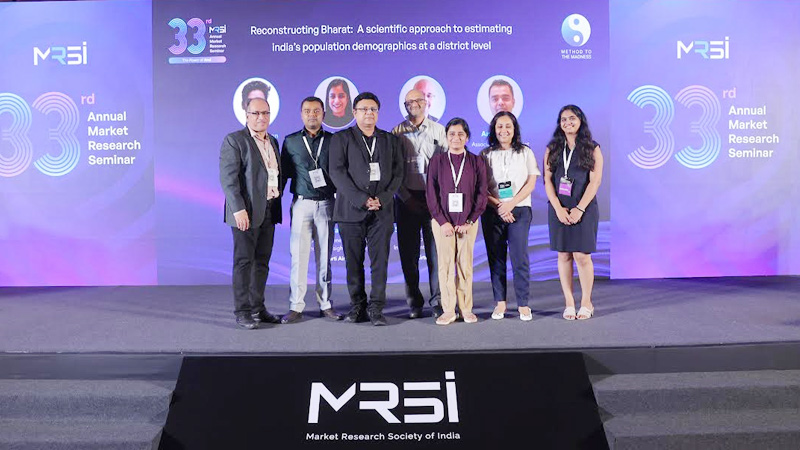
    MUMBAI: Held in Mumbai, the event crowned Kantar Insights and Bharti Airtel Ltd as winners for their paper, ‘Reconstructing Bharat: A scientific approach to estimating India’s population demographics at a district level.’ The research tackled the challenge of building a sharper, district-level picture of India’s vast and varied population.

    The runner-up slots went to Knowledge Excel for ‘Guardians of the survey: Fighting fraud to protect research integrity and data quality benchmarking’ and to Zee Entertainment Enterprises with Third Eye Integrated Services for ‘Streaming the paradox: Gen Z and the intergenerational remix.’

    This year’s theme, ‘The Power of And’ attracted over 100 submissions, with 22 shortlisted papers presented on stage.

    The seminar opened with a keynote by Ministry of statistics & programme implementation, secretary, dr Saurabh Garg, who underlined the importance of data-driven policymaking in India’s journey towards Viksit Bharat. He highlighted innovations in AI, machine learning, and geospatial data as tools that are strengthening decision-making.

    Panels through the day kept conversations lively, from the ‘Joys and dilemmas of insight in the age of technology’ to candid discussions on how brands can authentically connect with India’s cultural and economic diversity.

    MRSI, president, Nitin Kamat set the tone and said, “The industry must embrace integration between technology and creativity, data and human stories, clients and agencies to shape the future of market research.”

    Committee chair Rituparna Dasgupta added, “The diversity of ideas, from academic breakthroughs to brand case studies, reflects the ambition of India’s insights industry.”

    With thought leaders from healthcare, hospitality, FMCG, and media in attendance, the seminar reinforced MRSI’s role as the beating heart of India’s research ecosystem and a champion of ethical, future-ready insights.


  • MRSI puts the power of ‘and’ at centre of 33rd annual seminar

    MRSI puts the power of ‘and’ at centre of 33rd annual seminar

    MUMBAI: The Market Research Society of India (MRSI) is set to bring fresh energy to Gurugram this month, with its 33rd annual market research seminar promising a heady mix of data, ideas and debate under the banner “The Power of And”.

    Dr Saurabh Garg, secretary at the ministry of statistics and programme implementation, will deliver the opening keynote on “Driving impact through data insights: harnessing public-private synergies for a Viksit Bharat at 2047”. His address will anchor two days of panels, papers and provocations at The Leela Ambience on 11–12 September.

    The line-up features Karthik Nagarajan of Hogarth, Aradhana Lal of Lemon Tree Hotels and Aditya Kasyap of Unilever, alongside sessions on navigating “many Indias” and a panel on the “joys and dilemmas of insight in the age of technology” with senior voices from HUL, Nestlé, Airtel, Kantar, Smytten and more.

    This year drew over 100 research paper submissions, with 22 shortlisted across four themes: bending and breaking methodologies, innovating at the edges, technology as an intersection, and the human mosaic of future leaders.

    “The seminar has long been the cornerstone of India’s research and insights industry,” said Rituparna Dasgupta, chairperson of the 33rd edition and EVP at Zee entertainment. “This year’s theme captures how our world is being shaped.”

    With Smytten Pulse AI as lead partner and heavyweights such as Kantar, Nestlé, ITC and Hindustan Unilever backing sessions, MRSI is positioning its flagship gathering as more than a talking shop.
     

  • AI reshapes market research: insights get faster, sharper, smarter

    AI reshapes market research: insights get faster, sharper, smarter

    MUMBAI: The Market Research Society of India (MRSI) turned the spotlight on AI’s game-changing role in insights at a buzzing webinar on 25 June, titled The Future is AI: Revolutionising Market Research for Tomorrow’s Insights.

    Hosted by independent marketing measurement consultant Sunder Muthuraman, the session featured ,  Ipsos India practice lead – innovation, understanding & client advisory  India Krishnendu Dutta, and ITC Foods, vice president – head of insights and analytics  Vara Prasad.

    Vara Prasad kicked things off by breaking down AI’s impact on market research—declaring traditional methods slow and outdated in a world that demands speed and scalability. At ITC Foods, AI now does the heavy lifting: mining public data, analysing sentiment in customer care calls, listening to social chatter for trend-spotting, and even crafting product concepts. With predictive dashboards in the mix, AI is also helping sharpen business strategy. “AI needs context to shine,” said Prasad, adding that when trained right, it can evolve into a serious innovation engine.

    Krishnendu Dutta pulled back the curtain on Ipsos’s “Facto” — a bespoke AI sandbox built for researchers to safely explore new tools without the chaos. From translation to topline extraction and even creating agentic personas that replace dusty old segmentation decks, Facto is bringing AI to daily insight generation. Ipsos is also tapping into synthetic data to stretch the life and depth of small datasets.

    But both speakers hit pause on the hype with a key reminder: AI won’t replace humans—it’ll supercharge them. Whether it’s prompt engineering, model training or strategic activation, the real magic still needs a human touch.

    To watch the full session, click here.

  • Ipsos secures dual honours at MRSI Golden Key Awards

    Ipsos secures dual honours at MRSI Golden Key Awards

    MUMBAI;  Global market research firm Ipsos has won two prestigious accolades at the Market Research Society of India (MRSI) Golden Key Awards 2024.

    The company shared “the Most Effective Storyteller” award with Ikea for their work creating immersive consumer engagement narratives that helped Ikea’s workforce better understand customer needs. The collaborative effort was led by Naina Jayarajan from Ikea and Garima Mall from Ipsos.

    Ipsos also claimed “The Best Developmental Research” award for its socio-economic survey of the marginalised Putthrai Vannar community, conducted for the Directorate of Adi Dravidar Welfare. The research, led by Tripti Sharma’s public affairs team, will inform future welfare policies and interventions.

    Ipsos India  CEO Amit Adarkar said: “Our endeavour is to deliver impactful work that achieves clients’ goals of topline growth and healthy bottomlines. Being recognised at this prestigious industry forum encourages us to keep enhancing our client delivery.”

    The MRSI Golden Key Awards recognise excellence in India’s market research and insights industry. Ipsos operates in 90 markets globally with over 20,000 employees.

  • MRSI elects new managing committee with Manish Makhijani as president

    MRSI elects new managing committee with Manish Makhijani as president

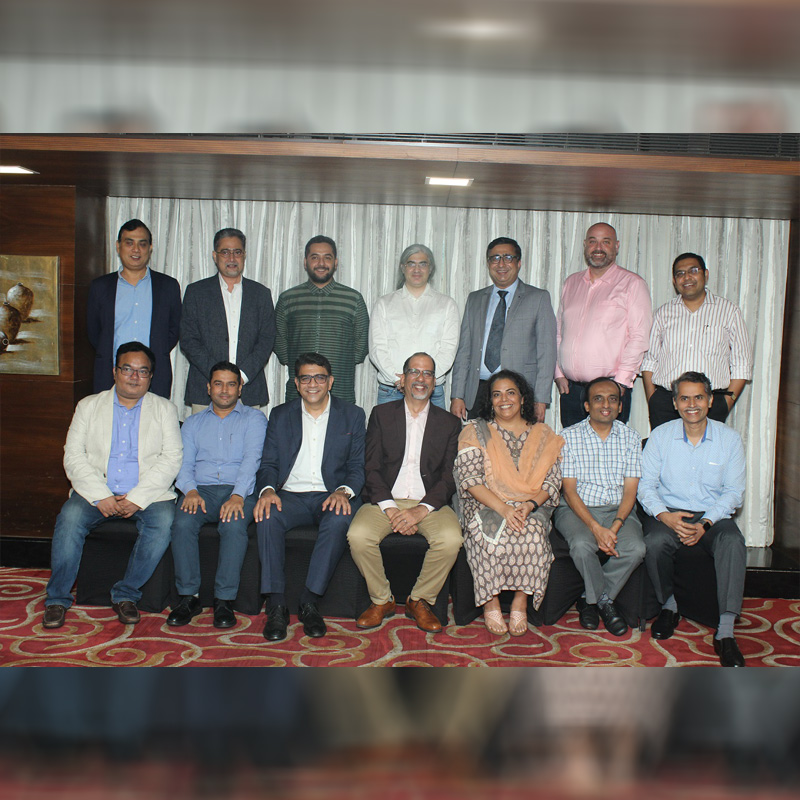
    Mumbai: India’s foremost industry-led market research body Market Research Society of India (MRSI) on Friday announced the formation of the managing committee for the tenure of 2022-2024. Hindustan Unilever global insights director Manish Makhijani was elected as the new president and took over from Datamatics Global Services executive vice president and global head – research & analytics solutions Sandeep Arora. 

    Manish worked as the Vice President of MRSI for the last three years and has been instrumental in creating and delivering several initiatives like the Golden Key Awards, Hackathon event at the Annual Seminar, etc. Manish is also a passionate advocate of nurturing talent and has been at the forefront of inspiring new talent to come to the industry and contribute toward business growth.

    Additionally, Paru Minocha and Saurin Shah were elected as Vice-Presidents, Prashant Kolleri as the Secretary, and Nitin Kamat as the Treasurer for MRSI. The election of the new managing committee members was held at MRSI’s 34th Annual General Meeting on 7 July 2022 in Mumbai.  

    MRSI’s managing committee is represented by companies across research agencies, research users and service providers in the market research industry. The newly-elected managing committee continues to stay focussed on maintaining and ensuring the highest quality standards thus establishing India’s dominant position in the global market research industry.  The focus of MRSI for the next couple of years would be to build on the momentum it has created in the last few years and focus on building a stronger network where all the members can benefit from each other, building a talent pipeline in the industry and instilling a sense of pride in the work being done.

    Congratulating the newly elected president, Datamatics Global Services executive vice president and global head – research & analytics solutions and Market Research Society of India’s outgoing president Sandeep Arora said, “I thank the MRSI members for supporting the current managing committee with their trust, especially when we had to change our course and plans drastically during the unprecedented Covid period. Thankfully, most of the key initiatives (locally and globally) we launched during that time have given a new direction and scale to the vision of the association going forward. I wish the incoming managing committee under the leadership of Manish Makhijani all the best to carry this momentum forward.”

    The 2019-2021 managing committee took on some of the MRSI’s most significant initiatives till date. The committee was responsible for the successful release of India’s first-ever comprehensive market sizing report titled ‘The Indian Research & Insights Industry 2021’. The report stated that the approximately $2.3 billion Indian research and insights industry is expected to grow at a CAGR of 12 per cent to 14 per cent to reach $4.2 billion by 2025-26. Rising to the numerous challenges on account of the Covid-19 pandemic, the former managing committee under the leadership of Sandeep Arora embraced online and hybrid formats to drive engagement. The committee also supported fieldwork investigators who are the foot soldiers of the industry through the MRSI Freelance Investigator Fund in 2020.

    On being elected as MRSI’s president for the next two years, Hindustan Unilever global insights director Manish Makhijani said, “I am incredibly privileged to carry forward the legacy of so many stalwarts in the industry. Our industry has come a long way and sits at the intersection of changing consumer behaviour, technology, and marketing solutions. It is now up to us to really bring out the contribution of insights into the growth of the business in this complex and evolving world.”

    Here’s the list of MRSI’s managing committee member for the term of 2022-2024:

    [[{“fid”:”1084159″,”view_mode”:”default”,”fields”:{“format”:”default”,”alignment”:””,”field_file_image_alt_text[und][0][value]”:”1″,”field_file_image_title_text[und][0][value]”:”1″},”type”:”media”,”field_deltas”:{“1”:{“format”:”default”,”alignment”:””,”field_file_image_alt_text[und][0][value]”:”1″,”field_file_image_title_text[und][0][value]”:”1″}},”attributes”:{“alt”:”1″,”title”:”1″,”class”:”media-element file-default”,”data-delta”:”1″}}]]

  • Indian Research and Insights industry to grow 2X by 2026 to $4.2 bn: MRSI

    Indian Research and Insights industry to grow 2X by 2026 to $4.2 bn: MRSI

    Mumbai: The Indian research and insights (R&I) industry is expected to grow at 12-14 per cent CAGR to $4.2 billion (Rs 31,300 crore) by 2025-26, compared to $2.1 bn (INR 17,200 crore) in 2020-21, according to a new report.

    The latest analysis was presented by the Market Research Society of India which launched its inaugural edition of the Indian Research & Insights (R&I) Industry Report, here on Thursday. As per the report, India is fast becoming the global analytics hub, with international markets accounting for three-fourth of its revenues. The Indian R&I sector currently employs more than 125,000 people.

    During 2020-21, marketing analytics services accounted for 52 per cent of the total Indian R&I industry revenues, while traditional market research and syndicated/ publishing services stood at 32 per cent and 16 per cent, respectively. By 2025-26, analytics services would account for 59 per cent, while custom market research and syndicated/ publishing services would account for 27 per cent and 14 per cent, respectively, the report forecasts.

    At present, the FMCG and retail sectors are the largest consumers for research and insights with a share of 27 per cent, followed by information, communications & telecom (16 per cent) and BFSI (15 per cent).

    “The Indian research & insights industry has staged a robust recovery and is emerging as the most sought-after destination for analytics, globally. The availability of talent coupled with proven expertise in data handling, technology, infrastructure, and cost competitiveness will lead to an orbital shift in the industry by 2030,” said MRSI president Sandeep Arora. “We not only expect the R&I industry to grow 2X in the next five years but can safely estimate the industry size to reach $10 bn by 2030, especially with the strategic direction that most providers are adopting to move towards MR 3.0.”

    MRSI partnered with Value Notes as the research partner for ensuring methodological objectivity of the 150+ report. The study curates the findings from exhaustive desk research, secondary data of 198 companies, and more than 140 interviews conducted with industry professionals.

  • BARC India’s Derrick Gray appointed as MRSI VP

    BARC India’s Derrick Gray appointed as MRSI VP

    Mumbai: BARC India’s chief of measurement science and business analytics Dr Derrick Gray has been appointed as vice president of the Market Research Society of India (MRSI).

    Earlier this year, Gray was also appointed as chair of the professional standards committee at MRSI that was established to ensure strong ethical and professional standards for the Indian market research industry.

    “I am quite honored to assume the role at MRSI India,” said Dr Gray. “With my experience over the years in statistical research, measurement and data science, I am looking forward to working collaboratively with the team at MRSI. We hope to be able to make significant progress together as a team.”

    A veteran audience measurement and advanced analytics executive, Gray brings with him a global experience of two decades in audience measurement and audience information systems for various media including linear TV, digital video, and radio. He has lead several statistical research, measurement science, data science functions during his distinguished career.

    He has previously served on the board of directors of the Marketing Research and Intelligence Association (MRIA) of Canada.

    “We at BARC India are extremely proud of Derrick’s recent appointment and would like to congratulate him. We wish him all the success for this new role and look forward to him guiding market research in India to even greater heights,” said BARC India CEO Nakul Chopra.

  • IMRB gets ‘MR Agency of the Year’ award

    MUMBAI: IMRB International (formerly Indian Market Research Bureau) has been bestowed the title of “Mr Agency of the Year” at the recently concluded 22nd Annual Seminar of the Market Research Society of India (MRSI).

    The market research, survey and business consultancy firm has bagged this honour for the sixth time since the inception of the award in 2005.

    The annual MRSI seminar is a competitive showcase of the best work carried out by research professionals during the year. It highlights the latest technological and statistical developments in the market research industry.

    The seminar this year was focused on the theme Research in the Age of Pragmatism‘. The research industry showcased how the industry is reinventing itself by reinterpreting and redesigning its offers, approaches and solutions.

    11 of the 21 competitive papers presented at the Seminar were from IMRB and six of these were awarded for their excellence.

    A panel of senior marketing and research professional shortlisted the best papers from the entries submitted by researchers and marketing professionals. These were showcased at the two day conference held in Delhi on 17 and 18 December.

    IMRB International president Thomas Puliyel said “This is indeed a very proud moment for us. This peer recognition of IMRB‘s quality, coming on the back of the award of the ISO 20252 Certification for our Field and Analytics units is a great way to end 2012.”

    Established in 1971, IMRB International is a part of Kantar. IMRB‘s footprint extends across South Asia, Middle East & North Africa and Europe through its 26 offices. IMRB International‘s specialised areas includes consumer market research both quantitative and qualitative, industrial market research, business to business research, social and rural market research, media research, retail and shopper research and consumer panels.

  • MRUC, MRSI unveil new SEC grading system

    MRUC, MRSI unveil new SEC grading system

    MUMBAI: The Media Research Users’ Council (MRUC) and the Market Research Society of India (MRSI) have unveiled a new Socio-Economic Classification (SEC) system.

    The new system will replace the previous one crafted in the mid-1980s.

    The formulation of the new SEC system has largely been done using the Indian Readership Survey (IRS) database. The developmental work has also used IMRB’s ‘Household Panel’ data.

    The decision to revisit the SEC grading system was initiated over five years ago by MRUC and MRSI.

    MRUC chairman and Tata Teleservices corporate monitoring president Lloyd Mathias said, “In 2006, extensive research and inputs from industry experts had thrown up a burning need to revisit the classification system, given that the market environment, as also consumer profiles, preferences and attitudes had undergone a sea-change over the last three decades.”

    The findings led to the setting up of a core team to work on putting together a new SEC system that would reflect the standing of Indian households.

    The new system classifies Indian households by using two parameters — educational qualifications of the chief wage owner in the household; and the number of assets owned (out of a pre-specified list of 11 assets). Based on these two parameters, each household will be classified in one of 12 SEC groups — A1, A2, A3, B1, B2, C1, C2, D1, D2, E1, E2 and E3. These 12 groups are applicable to both urban and rural India.

    The top-most new SEC class A1 comprises 0.5 per cent of all Indian households. Nearly 2 per cent of urban households and less than 0.1 per cent of rural households belong to the new SEC A1. More than half of all SEC A1 households reside in the top six Indian cities — Delhi, Mumbai, Kolkata, Chennai, Bengaluru and Hyderabad.

    At the other end of the spectrum, the bottom-most new SEC class E3 comprises 10 per cent of all Indian households. Only 2 per cent of urban households and 13 per cent of rural households belong to new SEC E3. Nearly 93 per cent of all SEC E3 households are in rural India.

    A committee representing both MRUC and MRSI had identified some key requirements for the development of a new SEC System:

    The new SEC system needed to be more discriminating, with sharper identification of the upper-most segment of the society;
    The new system needed to continue to be easy to administer; and There needed to be a common classification for urban and rural India
     
    IMRB International president Thomas Puliyel said: “The new Socio-Economic Classification system is the culmination of many years of hard work by some of the best brains in the industry. With the growth of the economy and of small towns and rural, it has become imperative to look at a single system for both urban and rural India.”

    Praveen Tripathi, who has been involved with the development of the new system, said, “Given that the new SEC system classifies households on parameters different from the old system, it will not be proper to compare the old SEC classes with their equivalent ones from the new SEC — even if the two carry the same alphanumeric tags e.g., class A1 of the new SEC system should not be confused with class A1 of the old system. Indeed, New SEC A1 is more homogenous, owns more assets, and is more affluent than old SEC A1.”