Tag: MPA

  • APOS 2025: JioStar reboots Indian storytelling: bold themes, small-town creators, and a Gen Z gold rush

    APOS 2025: JioStar reboots Indian storytelling: bold themes, small-town creators, and a Gen Z gold rush

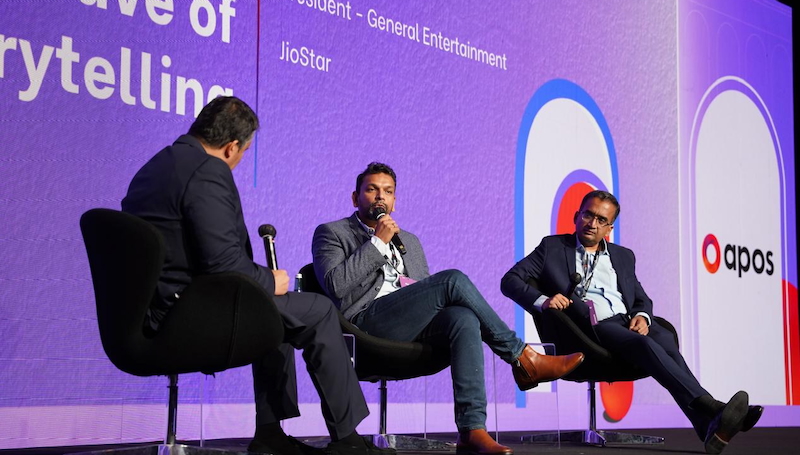
    Bali: India’s entertainment juggernaut JioStar is rewriting the playbook for streaming success. Speaking  on Day one with MPA founder & executive director Vivek Couto at the Asia Pacific Video Operators Summit (APOS) in Bali, president, general entertainment Alok Jain and head of cluster – entertainment (south) Krishnan Kutty laid out a turbocharged strategy rooted in youth, cultural authenticity, and fearless innovation.

    Kutty didn’t mince words. “Streamers haven’t done enough for Gen Z,” he said, announcing plans to ramp up youth programming in the south by seven to ten times. “Today’s boldness isn’t about spectacle — it’s about challenging societal norms. But we’re not in California. This has to be rooted in India.”

    Jain backed it up with numbers and narrative. Thukra Ke Mera Pyaar, a 19-episode romantic drama with 50-minute episodes and a debut director, shattered expectations. “The audience embraced it because it felt fresh, not because of familiar faces,” he said. “Innovation isn’t just a tactic — it’s our baseline.”

    The pair’s APOS session, titled Inside the next wave of Indian storytelling, was a no-holds-barred manifesto for resetting the country’s content economy. “We’re not here to gatekeep,” said Jain. “Today’s creators are format-agnostic — moving from Instagram Reels to primetime drama to long-form docu. We want to build a creative ecosystem where they grow across mediums.”

    Kutty spotlighted small-town storytellers as the engine of this shift. “We’re backing young creators from Tirunelveli to Kochi who bring lived-in authenticity. Eighty per cent of our Malayalam content consumption comes from outside Kerala. Great stories transcend language and geography — that’s our sweet spot.”

    The duo also called out industry dysfunction. “Streaming has broken the economic model,” Kutty said. 
    “Producers have become B2B vendors serving platforms, not audiences. Talent and production costs have soared. We need a reset.”

    On the theatrical front, Jain was blunt. “Three-hour films don’t cut it in an age of 15-second videos. People only show up at cinemas for something really worth their time. Theatres need to reinvent — on price, experience, everything.”

    India’s scale, youth and appetite for change were central to JioStar’s bullish outlook. With over 300M subscribers on JioHotstar and 800M viewers across its TV network, JioStar sits atop 320,000  hours of content in 22 languages. “The only common thread?” said Jain. “Emotional truth. That’s what travels.”

    From microdramas to macro themes like justice and aspiration, the message from JioStar is clear: in a country bursting with creators, languages, and formats, the only limit is imagination.

  • APOS 2025: MPA and JioStar release report on how IPL scored new records

    APOS 2025: MPA and JioStar release report on how IPL scored new records

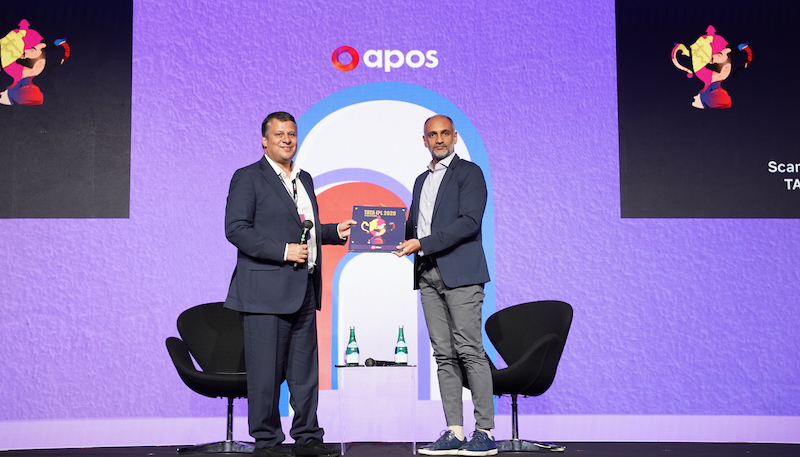
    BALI: At the APOS summit in Bali, JioStar dropped its much-anticipated report titled TATA IPL 2025: A Year of Firsts—and it reads like a victory lap for both the broadcaster and the billion-plus fans who tuned in. Produced in partnership with Media Partners Asia (MPA), the report reveals how IPL 2025 turned into a fan-first, tech-powered juggernaut that smashed records, redefined storytelling, and blurred the lines between sport, spectacle, and screen.

    JioStar’s digital reach alone crossed 652 million, while Star Sports pulled in 537 million viewers, pushing total reach to a record-shattering 1.19 billion. Women accounted for 47 per cent of TV audiences—marking a seismic shift in cricket’s traditional demographic. The IPL final alone drew 426 million fans, with JioHotstar peaking at 55.2 million concurrent users and soaring to 300 million subscribers.

    “TATA IPL 2025 was a season where the lines between sport, storytelling, and shared experiences truly blurred. It wasn’t just about broadcasting matches – it was where creativity, culture and commerce converged, with fan connections at the heart of it all,” said JioStar chief executive of sports and live experiences Sanjog Gupta. “ At JioStar, we set out to make every screen feel personal, every interaction meaningful, and every moment unforgettable. From deep consumer journeys to a rich spectrum of viewing experiences, this was a celebration of fandom in all its forms. The real success of the IPL isn’t measured in numbers, but in the moments that moved millions.”

    JioStar delivered 840 billion minutes of cricket watch-time, riding on innovations like MaxView 3.0 (a TikTok-style vertical experience), 360° VR streaming, and voice-assisted search on connected TVs. Over 44 per cent of mobile viewers played along live with the ‘Jeeto Dhan Dhana Dhan’ game, while AI-powered highlights and live expert commentary translations made the sport more accessible than ever.

    Regional viewership surged with Telugu up 87 per cent, Tamil up 52 per cent, and Kannada up 65 per cent—showing that cricket’s heart beats strong beyond the metros. Accessibility also hit new highs with Indian Sign Language interpretation and audio descriptive commentary for the visually impaired.

    Advertisers swarmed the platform, with over 425 brands onboard—including 270 first-timers across 40 categories. Nielsen-measured ROI, play-along games, and AI-personalised ads helped deliver what marketers crave: measurable impact at scale.

    JioStar’s IPL 2025 wasn’t just a tournament—it was a case study in what the future of sports broadcasting could look like: immersive, inclusive, interactive, and insanely watchable.

  • Spain’s pirate party: nearly half of OTT viewers sail the high seas of illegal streaming

    Spain’s pirate party: nearly half of OTT viewers sail the high seas of illegal streaming

    MUMBAI:  While the Motion Pictures Association (MPA)  loves pointing fingers at India for its piracy woes, they may want to swivel their gaze towards Europe. New data from consultancy firm GECA reveals that a staggering 47.4 per cent of OTT viewers in Spain are tucking into pirated content—no paid subscription in sight.

    The pirate’s treasure chest? Movies top the loot list at 32.8 per cent, followed closely by TV series (30.6 per cent) and sports (18.4 per cent).

    The biggest buccaneers are aged 18–24, followed by the slightly older but no less rebellious 25–34 crew. Even the silver surfers are getting their share—piracy among the 55+ age group has jumped 4.5 points, now clocking in at 32.6 per cent.

    Notably, piracy among 25–34-year-olds surged 5.2 points, hinting at an underground boom even among the prime-income streamers. Whether it’s a protest against high prices or just a thrill of the steal, one thing’s clear—Spain’s illegal streaming scene is alive, well, and growing.

  • MPA Report: APAC video market to hit $165B by 2029;  streaming set to dominate

    MPA Report: APAC video market to hit $165B by 2029; streaming set to dominate

    MUMBAI: To use a cricket analogy, television is going to go  even  more on the backfoot while online video shall come charging down the pitch to hit revenues out of the park. 

    That’s the latest prediction of Singapore-based  Media Partners’ Asia (MPA) in its  2025 report, outlining transformative trends in the Asia-Pacific (APAC) video and broadband industry.

    Among its key findings and predictions are:

    Industry growth & transition
    * Market Expansion: APAC video revenue is projected to grow by $16.2 billion, reaching over $165 billion by 2029 (CAGR: 2.2 per cent).
    * Online video explodes: Online video revenues projected to climb from $64 billion in 2024 to $89 billion by 2029, marking a 40 per cent increase. Gap with the US (at $140 billion in 2029) will have narrowed. 
    * Traditional TV contracts:  In contrast, traditional TV revenues are expected to shrink by $8 billion during the same period.
    * Streaming overtakes TV: Streaming revenues will surpass traditional TV by 2027, with their industry share rising from 44 per cent in 2024 to 54 per cent  by 2029, led by India and China.
    * Subscription video on demand (SVOD) services are expected to grow their share of the Asia-Pacific (APAC) video industry’s revenue from 44 per cent in 2024 to over 54 per cent by 2029.

    Revenue drivers & contributions
    * Key markets: India, China, and Japan will drive 64  per cent of the growth, with India alone accounting for 26 per cent.
    * Content growth: User-generated content (UGC) and social video platforms will lead, contributing $10.7 billion in new revenue. SVOD ($8.4 billion) and premium AVOD ($5.0 billion) follow closely.
    * Advertising leadership: Advertising will account for 65 per cent  of online video revenue growth, increasing its share of total video revenue from 52 per cent in 2024 to 54 per cent by 2029. Premium ad-supported video on  demand platforms driving growth.

    Shifting dynamics
    * SVOD boom: Subscriptions are set to rise from 644 million in 2024 to 870 million by 2029, driven by sports, Asian entertainment, and US content.
    * Connected TV surge: Penetration will exceed 85 per cent  in developed markets like Australia, Korea, and Japan by 2029, with notable growth in India, Indonesia, and Thailand.
    * Local players gaining ground: Global giants like YouTube, Netflix, and TikTok, which held 67 per cent market share in 2024, will see this decline to 62 per cent by 2029 as regional platforms strengthen.

    Vivek Couto, Executive Director at MPA, stated, “The APAC video market is undergoing rapid transformation, with streaming driving deeper engagement and improved monetisation. However, the decline of traditional TV and challenges in local streaming profitability are pushing the industry toward consolidation, particularly in markets like India, Japan, and Southeast Asia

  • Belinda Lui steps down as MPA head – APAC; Urmila Venugopalan to replace her

    Belinda Lui steps down as MPA head – APAC; Urmila Venugopalan to replace her

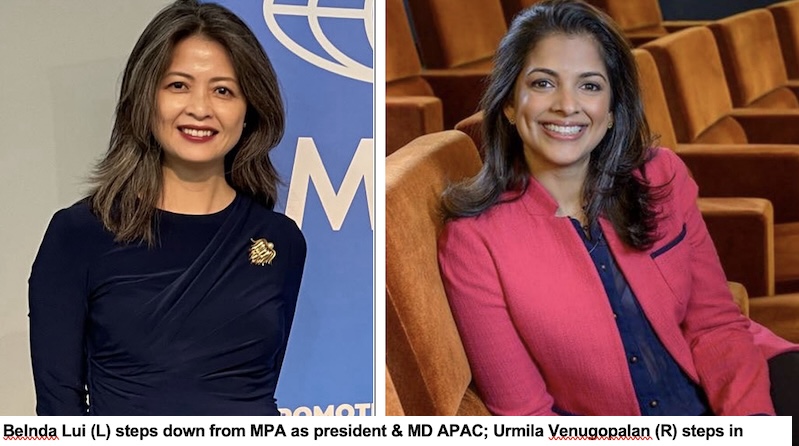
    MUMBAI: It’s time to say  goodbye to the Motion Picture Association (MPA). Belinda Lui who led the MPA for the past five years as president & managing director for the Asia Pacific has decided to hang up her boots.

    Belinda during her five years did a lot of work to take the Asia Pacific film industry forward  as well as  push Hollywood in the region. According to her during her term, the MPA:

    • Improved cultural exchanges between nations, through expanding access for American films and TV dramas to priority markets like China and achieving 15-20 per cent incremental box office revenue.

    • Fueled local economies and built capacity in markets like Australia, Japan, India, New Zealand and Thailand through competitive film and TV production incentives (up to 40 per cent in tax rebates in Australia alone).

    • Supported thousands of emerging filmmakers from almost 30 countries/territories in the Asia-Pacific through our film grants and LA training programs, with some of those projects going on to win the Academy Award and international Emmy.

    Belinda, who,  through her 30 year career,  worked for companies like Warner Media, Microsoft and Baker McKenzie, has decided to offer her services to companies as an independent non-executive director and spend as much time as she can with her family.

    She is being replaced on 31 January by Urmila Venugopalan , currently executive vice president of strategy & global operations at the MPA.   In her new role, Venugopalan will work on expanding access to local markets and promoting production in new areas, as well other advocacy activities across the region. She also will work with the MPA’s anti-piracy arm, the Alliance for Creativity and Entertainment, or Ace. Venugopalan will retain her duties as the MPA’s corporate board liaison.

    She will be based in Tokyo and report to MPA senior vice president, global policy &  government affairs Gail MacKinnon.

    MPA chairman & CEO Charles Rivkin said in a statement that Venugopalan “is a veteran leader who thrives at the complex intersections of business, public policy, and global affairs.” 

    He said that she “joined the MPA (in 2017) at a time of critical change and helped revitalise and realign its structure and priorities, strengthening our organisation from the inside out. I have full confidence that her deep experience working with every aspect of our global business operations, coupled with her existing corporate board liaison responsibilities, will advance our members’ objectives across the Asia Pacific and beyond.”

    “Venugopalan is a trusted advisor who has earned the respect of colleagues and member companies. Her work has already touched every part of our organization, and she maintains a wide-angle lens on key political and sectoral trends – all while remaining laser-focused on how we can best tell the story of a creative industry that drives local economies, creates jobs, and connects communities everywhere,” said  MacKinnon. “With her at the helm of our APAC operation, I am confident the MPA will achieve even greater impact in the fastest-growing region. I am also grateful to Belinda for her effective stewardship and counsel, which has greatly benefited the MPA and our member studios in the region.”

    “The Asia-Pacific region has already played an important part in the history of our industry – and is set to assume a starring role in the future of great storytelling,” said Venugopalan. “At this critical juncture for the film, television and streaming industries, MPA members are more excited than ever about the vitality of this region – its enthusiastic and engaged audiences, its relentless dynamism, and its immensely talented casts and crews. I look forward to supporting our member studios and their local partners in their collective efforts to fuel local economies and enrich cultures across the region.”

    Before joining the MPA, Venugopalan served as a member of the policy planning staff at the US state department in Washington and as a senior consultant at the Albright Stonebridge group. She holds a bachelor’s degree from McGill University and a master’s degree from the London School of Economics & Political Science.

  • LucidLink gets MPA TPN gold certification for  providing highly secure services

    LucidLink gets MPA TPN gold certification for providing highly secure services

    MUMBAI: Storage collaboration platform LucidLink has got the stamp of approval from the Motion Picture Association (MPA). It recently got the  Trusted Partner Network gold shield certification from the association. The milestone highlights LucidLink’s unwavering commitment to safeguarding the most valuable assets of the media and entertainment (M&E) industry.

    The TPN, a global initiative by the MPA, is designed to protect against leaks, breaches, and hacks in the media supply chain. The gold shield certification represents the most rigorous evaluation process, conducted by accredited third-party evaluators, and exceeds the scope of self-assessments like TPN blue certification.

    LucidLink’s gold certification signifies its ongoing guarantee of building stringent security measures, crucial in an industry where protecting intellectual property and sensitive content is vital.

    LucidLink’s assessment was conducted by CISC Ltd,  an accredited TPN-certified third-party auditor with expertise in evaluating security in the M&E industry. The results of this assessment are now accessible to TPN Studio members via the TPN+ platform, enabling a streamlined and centralised review process for all stakeholders.

    The M&E industry is increasingly relying on cloud-based workflows. LucidLink addresses the sector’s rising digital security needs. With its innovative solutions, it says it ensures customers can confidently access, share, and collaborate on large-scale media projects without compromising on security or efficiency.

    “LucidLink has consistently prioritised security as one of the cornerstones of our solutions,” said LucidLink CEO Peter Thompson. “Achieving the TPN gold shield certification reaffirms our dedication to providing secure, cloud-native workflows that empower creatives to collaborate globally without compromising sensitive media assets.”

    LucidLink’s storage collaboration platform, known for its its zero-knowledge encryption model, ensures that only end-users can access their data—neither LucidLink nor storage providers have visibility. This level of security is particularly critical for M&E companies handling high-value projects like Oscar-winning films and award-winning TV programs.

    “By earning the TPN gold shield, LucidLink aligns itself with the MPA content security best practices, demonstrating its readiness to protect creative works across the evolving digital landscape,” said TPN president Terri Davies. “Commitment to securing cloud-based solutions is essential for modern media workflows, and earning a TPN gold enables software providers such as LucidLink to provide more reliable content creation while safeguarding against evolving threats.”

    LucidLink, says its dual achievement of SOC 2, Type II compliance earlier this year, and now  the TPN gold shield certification positions it as a trusted partner for studios, broadcasters, and post-production houses transitioning to cloud-based operations. These certifications validate its adherence to the most stringent security protocols, ensuring the safety and integrity of sensitive workflows across the global M&E supply chain.

  • Consumer spending on video grew 9% in APAC in 2020

    Consumer spending on video grew 9% in APAC in 2020

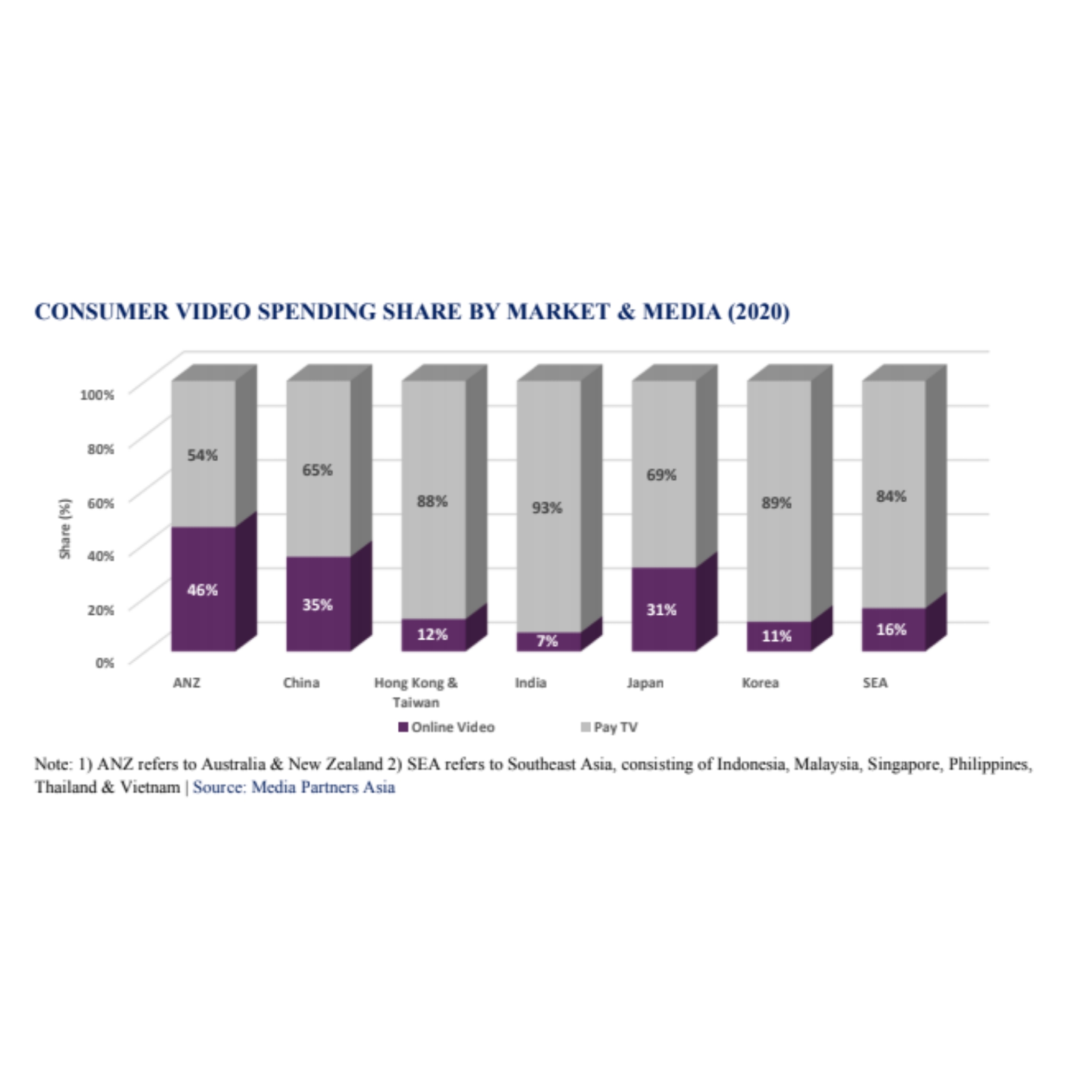
    New Delhi: Consumer spending on video in the Asia Pacific (APAC) region grew nine per cent in 2020 to reach $58.3 billion in aggregate, according to a new analysis and research released by Media Partners Asia.

    The report projects growth to rise a further six per cent CAGR to $79.3 billion, led by the fast-expanding online SVoD sector. MPA forecasts that the online SVoD consumer spending revenue is likely to grow at 15 per cent CAGR over 2020-25 to reach $31.6 billion by 2025. This will represent a 40 per cent market share while consumer spends on pay-TV will grow at two per cent CAGR to reach $47.8 billion, representing a 60 per cent market share.

    The findings were released on the first day of MPA’s APOS Summit which was held virtually this year.

    All the markets increased spending on SVoD services with strong activity in peak pandemic periods during the first half of 2020, and robust spending in the second half of 2020 due to new launches from major players.

    China remains the largest market in APAC for consumer spending on video with $27.6 billion in revenue, led by SVoD and IPTV services. Japan comes in second with $9.2 billion with SVoD representing more than a third of consumer spend, while India is third with $6.5 billion with pay-TV contributing having greater than 90 per cent market share, it stated.

    Korea with $5.7 billion in revenue in 2020 and Australia with $2.9 billion remain formidable markets; Malaysia led southeast Asia with $962 million in revenue with pay-TV contributing more than 90 per cent of market share.

    “Consumer spending on entertainment and sports through video platforms was robust in 2020 due to growth of SVoD in a peak pandemic year along with new competition and consumer choice in many Asian markets,” said MPA executive director Vivek Couto. “

    While SVoD growth will decelerate in 2021, MPA sees "a bright future for the SVoD sector and the stacking of various services across sports, entertainment and deeply integrated local services.”

    According to Couto, China, Japan, India, and Korea will lead the way as the market for SVoD slowly deepens in the key markets across southeast Asia, led by Indonesia, the Philippines, and Thailand. Pay-TV will remain vital in Korea (led by IPTV), India, Malaysia, and the Philippines, he added.

  • Netflix global TV head Bela Bajaria dishes on ‘local impact strategy’

    Netflix global TV head Bela Bajaria dishes on ‘local impact strategy’

    KOLKATA: Among a host of over-the-top (OTT) platforms in India, Netflix has always been considered as the “premium” one in terms of pricing and content. To break the stereotype, the streaming giant has taken several measures like launching a mobile-only plan. Netflix global TV head Bela Bajaria said the platform wants to “please many more members” with its diverse content offering as well.

    Speaking on day one of APOS 2021, Bajaria, who smilingly disclosed her “personal bias” for the market because of her ethic roots, remarked that the platform wants to have a wider breadth of offerings for the country. She pointed to the much-hyped slate of more than 40 originals which consist of different categories of originals.

    “I think sometimes when we’re in a country, we make the first couple shows people externally and even sometimes [viewers] internally perceive us as just a platform having premium or edgy dramas… We want to please many more members than that,” she said during the discussion with Media Partners Asia executive director & co-founder Vivek Couto.

    Of all its Indian originals, Masaba Masaba really struck a chord with audiences. She also spoke of the recently launched women centric Bombay Begums, and the upcoming season of the highly acclaimed web series Delhi Crime that she believes will be compelling for viewers. She went on to reveal that more exciting shows would be launched in Q3 & Q4.

    Considerably, she noted the presence of family drama in Netflix’s upcoming slate. “I think it was important because we still want to have everybody’s favourite show. We want to have a show you could co-view with your family,” Bajaria commented.

    While Netflix is highly focusing on staying true to local stories, having a strong local team is really important, as is being part of the local ecosystem. For any local market the focus is always on “massive local impact”, not on making shows popular across markets. Netflix India took its localisation a step ahead with Monika Shergill’s appointment.

    “People sometimes think we want to make a show global or international. The most important thing is we make it the most authentic and specific vision in that country and it has the most local impact and people love it in that country. If people love it in that country, other people will love it too,” she stated.

    However, local shows like La Casa De Papel, Barbarians, Lupin, Who Killed Sara? and Space Sweepers have seen global success. In its home market, non-English viewership has grown by 50 per cent as the viewership of anime has increased by 100 per cent, while Korean drama consumption has tripled.

    “Traditionally, Hollywood has exported stories. Now what we are doing is we are exporting local authentic stories and shows everywhere around the world. All of these stories are different in point of views, from different lenses and very specific to the cultural lens,” she stated.

    Netflix has grown exponentially in other Asian countries too. South Korea has been the most prominent market for the streamer. It has a mix of licensed, regional, the original film in the market. While some of the licensed shows like K-Dramas have performed well, Korean shows in other categories also travelled. More importantly, Netflix could continue its production in Korea the whole time during the pandemic. Hence, the OTT platform has a “pretty solid” slate in Korea for 2021.

    The streamer is gearing up its efforts in Japan by building studios and partnering with local talent. Along with investing in anime which is very successful for the platform, it is also betting big on live-action and non-fiction in the Japan market.

    “The strategy is always going to be, we want to have the best shows. If the best shows are original shows, that’s great. If the best shows are a combination of acquisitions and partnerships and co-productions and originals, then that’s what we do,” Bajaria contended.

    To build a solid global footprint of Netflix, the other goal is it wants to be a part of the creative community in each country. There will be new places the platform starts making more original content in, she added. For instance, it was only a year and a half ago it started doing originals in Africa.

    “We’ve barely scratched the surface. There are so many great storytellers in so many parts of the world. There are great stories that can be told on a global scale in so many places,” she said.

    The media executive has worked across mediums, starting her career with millennial TV, spending a chunk of it at Studios. She has seen the growth and progression of the M&E business, especially the rapid change in the last three to five years. It has always been very important to create a supportive environment for creators and for executives to do the work.

    “I think what has been interesting about working at Netflix is typically the speed. The speed of decision making. There are not many layers like other traditional media companies I worked in. What I had to learn is to move very quickly,” she signed off.

  • Pay-TV revenue to grow at 7 per cent CAGR over 2020-25: MPA report

    Pay-TV revenue to grow at 7 per cent CAGR over 2020-25: MPA report

    New Delhi: India is among a handful of countries where there is great scope for further penetration of television. Since the turn of the millennium, pay-TV connections have more than doubled in Indian households, though data in the public domain indicates there still remain an additional 100 million homes to penetrate.

    Now, a new report published by Media Partners Asia (MPA) forecasts India’s pay-TV industry will grow at roughly seven per cent CAGR between 2020-25. The growth will be accompanied by a significant uptick in the total industry revenues, including subscription and advertising which will reach $12.3 billion by 2025, said the industry analysts.

    The report, entitled India Pay-TV Distribution 2021 released on Monday, predicts that more than 96 per cent of India’s pay-TV homes will be digitalised by 2025.  The total pay-TV subscribers will further expand from 127 million in 2020 to 134 million during the period.

    Distribution dynamics

    The MPA has pegged India’s active DTH homes to grow from 58 million in 2020 to more than 68 million in 2025. Meanwhile, cable’s share of pay-TV subscribers will decline from 54 per cent in 2020 to 46 per cent by 2025; IPTV will pick up a small share after rolling out later in 2021.

    MPA India vice president Mihir Shah said, “Robust backend systems, the ability to offer consumers flexibility in choosing channel packages under NTO and the exit of leading private channels from DD Free Dish helped the DTH pay-TV sector grow even after the new TRAI tariff regulations came into effect.”

    Going forward, DTH will be the key driver of growth fulfilling the needs of the majority of new TV households entering into the pay-TV ecosystem. “Premium cable subscribers in urban centers remain vulnerable to churn as uptake of quality fiber-based broadband services including IPTV grows in affluent pockets of urban India,” he added.

    Monetisation, investment and the outlook for broadcasters

    The total pay-TV industry revenue, including subscription and advertising, had declined 10 per cent year-on-year in 2020 to $8.9 billion as the economic downturn post-Covid eroded advertising. The projections show that the recommencing of fresh content and live sports together with improvements in consumer and economic sentiment will lead to a sharp recovery in 2021. Pay-TV advertising will grow at 12 per cent CAGR over 2020-25 after a 25 per cent contraction last year.

    During 2020, pay-TV broadcasters generated $4.4 billion in total revenue (62 per cent from advertising and 38 per cent from subscription), down 17 per cent year-on-year. A sharp recovery is expected over the next two fiscals with the channel business and advertising primarily driving this expansion.

    According to Shah, TRAI’s heavy spate of regulations in recent years depressed investment in pay-TV content, which could have a detrimental impact on the quality of content available for the mass market.

    “We expect that more consolidation will play out in the broadcasting industry as recent tariff amendments force incumbent broadcast networks to recalibrate existing channel portfolios. The economics of less popular channels and several niche channels are no longer viable. A new and less draconian regulatory framework will help revitalise content creation in the pay-TV industry while also helping to bolster pricing power for pay-TV platforms,” he stated.

  • Gaming & entertainment content are emerging as major growth areas for Twitter in Asia: Maya Hari

    Gaming & entertainment content are emerging as major growth areas for Twitter in Asia: Maya Hari

    KOLKATA: It has been a while now since when the digital platforms have started reorienting their focus on the Asia Pacific (APAC) region. Amid intense competition, Twitter is also tapping into the new wave of users across the market. While the California-based social media platform has been scaling its operations gradually in the region, gaming and media-entertainment are emerging as key potential segments.

    At the second phase of APOS 2020, Twitter APAC VP & managing director Maya Hari spoke about the interesting consumption behaviour which emerged this year. Twitter recorded 45 million conversations around gaming- in just the first four months of 2020 in the southeast Asia region, up nearly 50 per cent year-on-year. The predominantly millennial internet audience is preferring gaming with social interactivity more.

    The social media platform polled users at the end of the first half of this year. Nearly half of the users in Australia have two subscriptions for content but interestingly over a third of Twitter users have more than two subscriptions for entertainment content. Despite this, the users were willing to access more entertainment content. In addition to that, tweets of live videos also doubled in the first half of the year. 

    This massive upsurge is not a surprising trend because gaming and entertainment consumption has been seeing an upward trend for quite some time now. What these changed circumstances have done is the expediting of this process in a more “pronounced fashion." However, due to the absence of new film releases, TV and OTT content have seen massive consumption this year.

    “One of the big elements that we are focusing on is partnering around premium video content and this has been a consistent strategy for the past two-three years. In Asia, we have partnered with over 60 content creators including broadcasters, content rights owners across the region. Our focus has been this year has challenged as large scale sports and events have been challenged. We found that better balance in being able to drive monetisation around content has come from getting brands to double down on cultural moments or market at scale,” Hari said.

    Other social media platforms like Facebook, YouTube are also aggressively upping their focus on the region. As Hari pointed out, the experience of live videos sets Twitter apart from its foes. She termed the concurrent audience around live moments as the crown jewel of the platform. Hence, all of Twitter’s partnerships with publishers, the content providers are being driven around that pillar. The depth of fan engagement around premium video has been another key differentiator.  

    “I have been driving the region for a little over three years and it has been consistently exciting with the ability to grow and innovate. We have talked about how APAC has been a growth engine for us, even coming out of Q2, we had recovery in markets of Asia to be ahead of the world and some parts of the market were on year-on-year growth territory. So, it has been a really exciting region to lead,” Hari revealed. 

    Twitter has witnessed 37 per cent year-on-year growth on the monetizable daily active users (DAUs) in the international markets. Talking about the different regions, north Asia offers incredible growth opportunities, especially in terms of gaming. Hari mentioned that south east Asia has been very interesting in case of rapid adaptation of any product. She also added that brand marketers are willing to put their money where the mouth is. 

    “India has been a very strategic market for a while. We are constantly thinking to bring new product innovations there. We launched Fleets recently and we have seen the usage of Fleets to be very interesting. There is always something unique about that market in terms of how it adapts and embraces content,” Hari highlighted.

    Although the growth of digital platforms has been tremendous lately, Social media companies have been under pressure about the proliferation of misinformation on their platforms. Speaking on this issue, Hari emphasised that the platform is highly focused on healthy conversations both globally and regionally. According to her, the understanding of the right combination of automation, content review and human intervention could be an answer to the threat of fake information. The platform used past experiences to keep away misinformation during Covid2019 as well. “It's something we are very committed to. Its one of the largest and biggest focus for us to make sure that the health of the conversations on the platform is strong,” she signed off.