Tag: MovieMe

  • MovieMe reveals shift from love stories to societal issues in Hindi cinema

    MovieMe reveals shift from love stories to societal issues in Hindi cinema

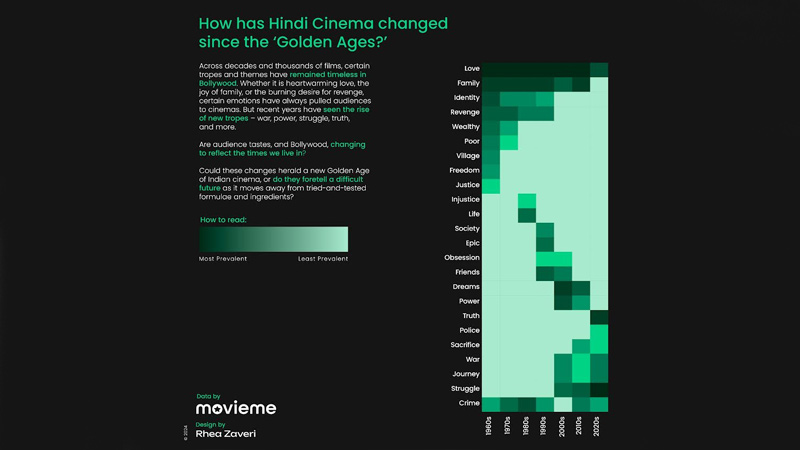
    Mumbai: The evolution of Hindi cinema over the decades reflects both changing societal values and audience tastes. In the aftermath of the golden age of Indian cinema, certain themes came to dominate narratives and audience expectations. MovieMe, an entertainment tech and content discovery platform has done a detailed study to understand the evolutions of the different themes.

    In the 1960s and 1970s, themes like love, family, and identity dominated, while more recent narratives have begun to explore themes of struggle, war, truth, and justice, a study by MovieMe reveals. While some classic tropes, such as revenge and familial bonds, remain timeless, contemporary cinema increasingly focuses on deeper societal issues like inequality, freedom, and power.

    As the world has changed and Indian society evolved alongside, so too has the content of Hindi films, reflecting the times and concerns of the present day. The new themes we see prevalent today represent a shift in Bollywood’s storytelling approach, moving away from formulaic plots to more diverse, complex narratives.

    Could this thematic evolution herald a new golden age of cinema, or does it signal a move toward uncharted territory? Clearly, Indian cinema has come a long way over the decades – and continues to evolve in its role as a mirror to Indian society.

  • MovieMe study reveals regional films’ impact on Indian cinema

    MovieMe study reveals regional films’ impact on Indian cinema

    Mumbai: India’s regional cinema landscape is vast and diverse, with each industry offering unique narratives, cultural contexts, and filmmaking styles. To better understand regional cinema success and growth, MovieMe- a cutting-edge entertainment tech and content discovery platform did a detailed study where they compared five key regional film industries—Malayalam, Kannada, Tamil, Telugu, and Hindi—and their 10 most popular releases post-COVID (2020-2024). MovieMe looked at film budgets, box office (BO) earnings, and genres to get a sense of what makes each regional cinema industry in India unique.

    The study by MovieMe reflects that, despite the significant average budget and average BO earning differences, each industry is contributing significantly to the Indian cinematic experience, delivering a variety of content that caters to both local and national audiences. For instance, while Malayalam and Kannada cinema appear to deliver compelling narratives at relatively lower budgets, Telugu and Tamil films appear to be bigger-budget blockbusters that garner massive box office success across India.

    Hindi cinema, often regarded as mainstream, continues to dominate national box offices, but regional industries like Kannada and Telugu are catching up with high-grossing films like KGF 2, RRR, and Kalki 2898 AD. Certain genre preferences also stood out from these movies, with action flicks and family dramas dominant across most industries.

    MovieMe’s data shows that Indian regional cinema is thriving, transcending linguistic barriers and appealing to diverse audiences across the country. Especially in Tamil and Kannada industries with increasing competition amongst titles to capture attention at the box office, regional movies are set to get a growing share of the market in the coming years.

    Moreover, as audience preferences shift towards authenticity, complex characters, and culturally significant narratives, regional cinema is well-positioned to establish fresh trends and explore artistic limits. 

  • Reviving cinema culture: Why National Cinema Day needs a rethink

    Reviving cinema culture: Why National Cinema Day needs a rethink

    National Cinema Day, a day ostensibly designed to promote the cinematic experience, has become a hollow gesture. While the intent is noble—to encourage more people to experience the magic of the big screen—it’s a misguided approach that’s actually hurting the industry.

    The concept is simple: offer massive discounts for one day only to entice audiences into theatres. But this artificial boost in attendance numbers is a temporary fix that masks a deeper problem: audiences are losing interest in cinema. The reason isn’t a lack of affordability; it’s a lack of value.

    Reducing ticket prices inadvertently reinforces the notion that cinema is a cheap commodity. It’s as if the industry is saying, “We know our product isn’t worth much, so we’ll give it to you at a discount.” This is a self-defeating strategy that undermines the very essence of cinema.

    Instead of resorting to gimmicks to artificially inflate attendance numbers, the industry should focus on creating engaging, high-quality content. Movies like Stree 2 demonstrate that good cinema can still draw crowds without the need for massive discounts.

    National Cinema Day is a misguided attempt to address the decline of cinema attendance. Instead of relying on short-term gimmicks, the industry must focus on creating high-quality content, investing in the theatrical experience, and embracing innovative data. By doing so, we can ensure that cinema remains a vibrant and essential part of our culture.

    The decline of cinema attendance

    The decline in cinema attendance is a multifaceted issue with roots in both industry practices and societal shifts. According to some reports, Indian cinemas had been pulling in a tad over 1.4 billion footfalls before the pandemic.

    The rise of streaming platforms has offered audiences a convenient and affordable alternative to the traditional theatrical experience. Blockbuster franchises, often prioritised over original content, have led to a sense of cinematic fatigue among audiences. The increasing cost of tickets, concessions, and transportation has also made going to the movies a less appealing option for many.

    However, while streaming platforms offer convenience, the theatrical experience remains irreplaceable. The immersive power of the big screen, coupled with the shared experience of watching a film with an audience, creates a unique and unforgettable atmosphere. The film industry must invest in technologies and amenities that enhance the theatrical experience and make it a compelling choice for audiences.

    The dangers of discount culture

    National Cinema Day, with its promise of heavily discounted tickets, perpetuates a culture of discounting in the film industry. This culture sends a message to audiences that cinema is not worth its full price, eroding the perceived value of the theatrical experience. It also incentivizes studios to prioritise short-term gains over long-term sustainability.

    The key to revitalising the film industry lies in a renewed commitment to quality content. Studios should focus on producing original, thought-provoking films that resonate with audiences on an emotional level. Diverse storytelling, featuring voices from different backgrounds and perspectives, can also help to attract a wider audience.

    Recent reports acknowledge that the biggest hindrance to cinema-going is the sizable variance in the quality of the movies being created. Uncertainty about the quality of films, and the absence of a strong string of films as a given, prevents people from investing time, energy, and money in going to cinemas. Unless the movie industry tackles this challenge head-on, footfalls in cinemas are unlikely to increase.

    Data: The missing piece of the puzzle

    The film industry must embrace data analytics to better understand audience preferences and tailor content accordingly. By analysing audience behaviour, demographics, and social media trends, studios can identify emerging trends, identify gaps in the market, and develop films that resonate with specific audiences. Data analytics can also help optimise marketing campaigns, ensuring that films reach the right people at the right time.

    National Cinema Day is a fake obituary for cinema. It’s a desperate attempt to keep the lights on in theatres, but it’s not a sustainable solution. The real cure lies in making movies that people actually want to see. It’s time to stop treating cinema as a commodity and start recognizing it as an art form.

    The article has been authored by MovieMe founder & CEO Bhavesh Joshi.

  • AI’s future in content discovery promises more intuitive and immersive entertainment: MovieMe’s Bhavesh Joshi

    AI’s future in content discovery promises more intuitive and immersive entertainment: MovieMe’s Bhavesh Joshi

    Mumbai: Navigating the vast sea of entertainment options can be overwhelming, with countless choices often making it hard to find content that truly resonates. MovieMe addresses this challenge with a groundbreaking approach to content discovery.

    Founded by Bhavesh Joshi, a film enthusiast with a background from the UK’s National Film and Television School, MovieMe harnesses machine learning to deliver hyper-personalised recommendations, making it easier for users to find content that truly resonates with their unique tastes. MovieMe is reshaping how we interact with cinema and television by offering features like ‘Scenes’ and ‘real-money game’.

    Indiantelevision.com’s Arth Chakraborty caught up with MovieMe founder and CEO Bhavesh Joshi to delve deeper into their offerings, future trends and more.

    Edited Excerpts:

    On the inspiration behind MovieMe, and the ways in which it is disrupting the traditional entertainment landscape

    The inspiration for MovieMe stemmed from my deep love for cinema and the realisation that, despite the abundance of content available today, many viewers still struggle to find films and shows that truly resonate with them. I wanted to bridge this gap by creating a platform that does not just recommend what’s popular, but what aligns with each user’s unique tastes and preferences. MovieMe is disrupting the traditional entertainment landscape by leveraging machine learning to offer hyper-personalised recommendations. We are moving away from a one-size-fits-all approach, giving users a curated experience that feels tailor-made just for them, which I believe is the future of content consumption. We are also extremely focused on enhancing the cinematic experience for audiences, giving them new tools and ways in which to interact with their favourite content, and celebrate their love for cinema.

    On MovieMe’s AI-driven recommendation system working to personalise user experiences

    MovieMe’s AI and ML-driven recommendation system is built on sophisticated algorithms that analyse a wide array of data—from a user’s viewing history and interactions on the platform to broader trends in content consumption, and over a thousand data points of movies (story arc, character development, plot tropes, etc.). By continuously learning from user behaviour, our system evolves to provide more accurate and relevant suggestions over time. It’s not just about recommending what’s trending; it’s about understanding the nuances of each user’s preferences and providing them with options they might not have discovered on their own.

    On ways in which MovieMe has transformed content discovery for its users

    One of the most gratifying aspects of MovieMe is hearing from users who have discovered hidden gems they would have otherwise missed. For instance, we’ve had users who primarily watched mainstream Hollywood films but, through our recommendations, found themselves exploring indie and international cinema that they ended up loving. Another example is our ‘Scenes’ feature, where users can discover movies based on short scenes or clips they enjoy, which has opened up a new dimension of content discovery, making the experience both personal and emotionally engaging.

    On the role that machine learning plays in understanding user preferences and predicting trends on MovieMe

    Machine learning is at the core of MovieMe’s ability to understand user preferences and predict trends. By processing vast amounts of data—from individual user habits to broader viewing patterns—we can anticipate what content will resonate with different audience segments. This allows us to not only recommend existing content but also provide insights into emerging trends that could shape future viewing habits. Our machine-learning models constantly evolve, ensuring that MovieMe remains ahead of the curve in predicting what our users want to watch next.

    On MovieMe ensuring data security while providing personalised recommendations

    Data security is a top priority for MovieMe. We employ robust encryption protocols and data anonymisation techniques to ensure that user information is protected at all times. Additionally, we are transparent with our users about how their data is used to enhance their experience. We believe that maintaining user trust is crucial, which is why we have implemented strict policies to safeguard privacy while still delivering the personalised recommendations that our users value.

    On MovieMe adapting to the cultural trends that are currently shaping the entertainment industry

    MovieMe is deeply attuned to the cultural trends shaping the entertainment industry, from the rise of diverse storytelling to the growing demand for localised content. We have incorporated these trends into our recommendation algorithms, ensuring that users are introduced to a wide range of voices and perspectives. Additionally, our platform is constantly updated to reflect the latest in entertainment, whether that’s emerging genres, the resurgence of certain formats, or shifts in how content is consumed.

    On MovieMe’s unique features like ‘Scenes’ and ‘real-money game’ and its impact on user engagement

    Our ‘Scenes’ feature allows users to explore movies based on short scenes or clips of content that resonate with them—whether it’s a thrilling chase sequence or a heartfelt conversation. The idea is to offer a new form of content discovery and allow users to discover content that truly strikes a chord with them. Of course, it also functions as an endless repository of bite-sized content, great for watching stuff in those little in-between moments when you don’t have time to watch full episodes or movies. This feature has significantly enhanced user engagement by offering a new way to connect with content on a deeper level.

    The ‘real-money game’ – or forecast game, as we call it – is another innovative addition where users can predict box office earnings and win cash prizes. This gamified experience adds a layer of excitement and drives engagement by integrating users into the entertainment ecosystem in a more interactive way. It also helps us generate valuable data points about audience expectations around different movie titles and their genres, cast members, production teams, etc. These data can then help industry professionals make informed decisions about various components of their future releases, including production, marketing, and distribution.

    On envisioning the future of AI in content discovery and entertainment, and MovieMe’s future plans for innovation in this space

    The future of AI in content discovery is incredibly promising, with the potential to make entertainment experiences even more intuitive and immersive. At MovieMe, we’re exploring new ways to leverage AI to enhance personalisation, including more advanced predictive analytics and real-time recommendations based on mood or social context. We are also looking at how AI can be used to create more interactive and dynamic content experiences. Our goal is to continue pushing the boundaries of what’s possible in content discovery, making MovieMe not just a recommendation engine, but a comprehensive entertainment companion that evolves with its users.