Tag: MoU

  • Network18 signs MoU with St Stephen’s College

    Network18 signs MoU with St Stephen’s College

    MUMBAI: Network18, promoter of news brands CNN-IBN and IBN7, has signed a Memorandum of Understanding with St Stephen’s College, which will further the aim of educational inclusivity. As part of this initiative, Stephen’s College will offer a certificate course in Citizenship & Cultural Richness.


    Under the course, St Stephen’s College will hold weekly classes conducted by its regular faculty and alumni including top serving and retired judges, bureaucrats and renowned academicians.


    The lecture content will be hosted across the digital and social media platforms of Network18 (ibnlive.com & ibnkhabar.com) and St Stephen’s College.


    While inaugurating the course, Supreme Court judge Justice Madan B Lokur, said, “This course is ready to reach out to people to make them better citizens and to help the society.”


    St Stephen’s College principal Valson Thampu feels the very purpose of the course is to enable students and citizens to live a rich life and to become responsible citizens. “I am delighted that Network 18, particularly CNN-IBN has gladly come forward to support this initiative, which is a signal of the robustness of media,” said Thampu.  


    Network18 president – news Umesh Upadhyay added, “We will help in every way possible to promote this course and make this an initiative that will make our youth into responsible citizens, who contribute to the growth of this country. We are grateful to St Stephen’s for partnering us on this mission to help make media more responsible and conscientious.”


    CNN-IBN and IBN7 will align their Citizen Journalist show with the course offered under the joint initiative.  The idea is to encourage the citizens enrolled in the course to become citizen journalists and highlight issues and problems around them as faced by the common man.

  • Sahara One deeper in red in Q2-2015; cancels content MOU with Trilogic

    Sahara One deeper in red in Q2-2015; cancels content MOU with Trilogic

    Updated: 20 November 2014 (2:00 PM)


    BENGALURU: The board of directors of Sahara One Media and Entertainment Limited (Sahara One) had decided on 11 November 2014 to terminate the MoU entered into on 21 May 2014 with Triologic Digital Media (trilogic) for sale of TV contents etc., in terms of letter dated 16 August 2014 received from Triologic. This decision was conveyed by the company to the bourses today. Sahara One had earlier entered into a MOU with Trilogic for purchase of content from the company and to appoint the company as sole entity to seek, appoint and engage production houses for producing programme contents.


    “Only the content MoU has been terminated, which was the logistical documental exercise between Sahara One and Triologic. The management outsourcing is still with us and we continue to run Sahara One and Filmy and all the teams continue reporting into us and we continue running the programming, distribution, sales and marketing of Sahara One and Filmy,” informs Triologic promoter and director Vishal Gurnani. 


    With the termination of the content MoU, Sahara One and Filmy will no longer purchase content from Triologic. “We will purchase it directly from the production houses. The channel still continues to be run by us,” clarifies Gurnani.


    Sahara One reported less than half (1/2.4 times) Income from operations (TIO) for Q2-2015 at Rs 9.38 crore as compared to the Rs 22.61 crore in Q2-2014 and 16.2 per cent lower than the Rs 11.19 crore in Q1-2015. HY-2015 TIO also fell to less than 1/2.4 times at Rs 20.56 crore from Rs 50.02 crore in HY-2014.


    Note: 100,00,000 = 100 lakh = 10 million = 1 crore


    The company’s loss in Q2-2015 was Rs 10.36 crore as compared to a profit of Rs 4.1 crore in Q2-2014 and loss was more than four times (4.5 times) the Rs 2.32 crore in Q1-2015. Loss in HY-2015 was Rs 12.67 crore versus a profit of Rs 5.31 crore in HY-2014.


    Sahara One’s Total Expenditure (TE) in Q2-2015 at Rs 20.33 crore (216.8 percent of TIO) was 7.1 percent higher than the Rs 18.99 crore (84 per cent of TIO) and 34.6 per cent more than the Rs 15.10 crore (135 per cent of TIO) in Q1-2015. TE in HY-2015 at Rs 35.43 crore (172.3 percent of TIO) was 25.5 per cent lower than the Rs 47.53 crore (95 per cent of TIO) in HY-2014.


    A major portion of TE in Q2-2015 was decrease in inventory – this reduced by Rs 10.96 crore versus an increase of inventory by Rs 3.64 crore in the corresponding quarter of last fiscal and reduction of inventory of Rs 0.97 crore in Q1-2015. Inventory reduced by Rs 11.93 crore in HY-2015 versus an increase of inventory by Rs.1.91 crore in HY-2014.


    The company’s purchase of content cost fell to one third at Rs 5.26 crore (56.1 per cent of TIO) in Q2-2015 as compared to the Rs 17.51 crore (77.4 per cent of TIO) in Q2-2014 and was 46.8 per cent lower than the Rs 9.90 crore (88.5 per cent of TIO) in Q1-2015. Purchase of content cost in HY-2015 was 1/2.6 times at Rs 15.26 crore (74.2 per cent of TIO) from Rs 39.23 crore (78.4 percent of TIO) in HY-2014.

  • Indian weavers to get an online platform now

    Indian weavers to get an online platform now

    MUMBAI: With a view of giving a boost to the handloom industry of the county, the Ministry of Textiles has announced that the Ministry through Development Commissioner for Handlooms has signed a Memorandum of Understanding (MoU) with e-commerce platform Flipkart. The aim of the partnership is to provide online marketing coverage to the sector.


    The collaboration will empower the weavers and boost manufacturing in the country. Through this exclusive agreement, Flipkart’s aim is to provide weavers in India online marketing platform, infrastructural support in data analytics and customer acquisition to help them get remunerative prices for their products and scale up their business.


    The MoU was signed in the presence of the Minister of State (Independent Charge) Textiles, Santosh Kumar Gangwar, Flipkart VP – Marketplace, Ankit Nagori, Development Commissioner (Handlooms) SK Panda and other officials of the Ministry of Textiles.


    The Minister for Textiles while speaking on the occasion congratulated the heads all the organisations and maintained that they must work tirelessly for the uplift of weavers and ensure the success of the venture. He mentioned that periodic review of the sales and progress of the weavers in the targeted clusters should be carried out emphasising that the focus of this association should be to help weavers and weaver entrepreneurs to produce products in tune with the buyer requirements and grow significantly so that they may become manufacturers not only at a local but also at a national level.


    According to the release by Ministry; this kind of a coordinated effort has been planned and executed for the first time with Flipkart for handloom weavers which will bridge the missing linkages of market intelligence, market access and logistics and help the Indian weavers in getting remunerative prices for their products.


    The weavers will sell their products under their brand name and evolve as an entrepreneur selling his products directly to buyers across the country without stepping out of their workplace. The data analytics and market intelligence provided by Flipkart will help the weavers focus only on producing better saleable product ranges. This in turn will help them plan their production and inventory and expand their business.


    This partnership will connect the artisans directly to the buyers and the guidance by Flipkart in packaging, collecting and delivering to the buyer will motivate the artisans in rural India.


    Earlier this month, Flipkart signed a MoU with the Ministry of Labour and Employment’s Directorate General of Employment & Training (DGET), aiming to train at least 5,000 students by December. Flipkart joined hands with the government to train people from semi-urban and rural areas and possibly employ them at the company or its business partners.

  • DD, Prasar Bharati sign MoU with Korea’s Arirang TV

    DD, Prasar Bharati sign MoU with Korea’s Arirang TV

    MUMBAI: In September 2012, when Prasar Bharati CEO Jawhar Sircar led the Indian delegation to the General Assembly of the Asia-Pacific Broadcasting Union at Seoul, he called on the then President of  Korea and other dignitaries. Since then the Korean Broadcasting System and Prasar Bharati have on-going partnerships.


    However, a new partnership was sought to be made between the Korean International Broadcasting Foundation, Arirang TV and Doordarshan for which Sircar and CEO of Arirang TV Jie-Ae Sohn renewed correspondence recently in November, 2013.


    And now the two stations have signed a Memorandum of Understanding (MoU) which will allows them to share content. The CEOs from the two stations met in New Delhi on Friday and agreed to an exchange that will foster cultural ties between Korea and India.


    The Korean Minister expressed hope for a deeper cultural understanding between India and South Korea. One of the officials was quoted as saying on the Arirang News website, “Through this exchange of broadcasting and broadcasters, we can jumpstart this cultural exchange between two very strong culturally rich countries.”


    The deal took shape when ministers from both the countries were meeting to sign an MoU on Mutual Recognition of Digital Signature Certificates for Efficient E-Governance/Cross Border Trade Facilitation. Minister for Communications and Information Technology, India Kapil Sibal and Minister for Science, ICT and Future Planning, Republic of Korea Mun-kee Choi were present there.


    Under the agreement, Arirang and Doordarshan aim to make their global channels available on satellite platforms in both nations by 2014. Both parties will even explore co-production opportunities related to matters of mutual interest and share TV programmes in the cultural, educational, scientific, agricultural, entertainment, sports, news and any other possible fields. The MoU will be valid for a period of three years from the date of signature and will be automatically renewed for every following three years, unless terminated by either party by giving a written notice of three months.

    Interestingly, as the MoU was being signed, a documentary produced by Arirang TV was being aired on Doordarshan throughout India. The documentary explains the vision for the “creative economy” that President Park Geun-hye has advocated since the very beginning of her term last February.


  • Prasar Bharati and Radio-Television Slovenia sign a deal

    Prasar Bharati and Radio-Television Slovenia sign a deal

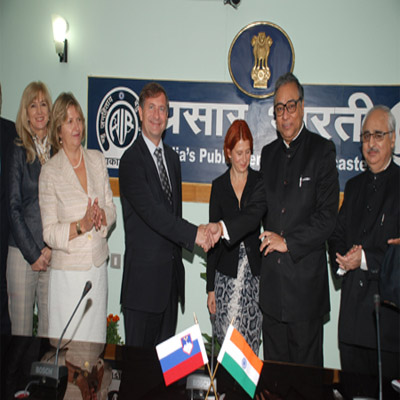
    NEW DELHI: India’s largest broadcasting network, Prasar Bharti has found a potential business partner in Radio-Television Slovenia (RTV SLO). The two got together recently and have agreed to explore further opportunities in potential projects of co-production of programmes along with significant cultural, economic, political, social and festive events in the respective countries.


    A Memorandum of Understanding (MOU) for cooperation in the field of broadcasting was signed between Prasar Bharati and RTV SLO. It aims at trading expertise of each of the broadcasters and entails exchange programmes in the fields of culture, education, science, entertainment, sports, and news on their respective networks, besides provision for personnel exchange and training of staff.


    To sign the deal, a high level delegation that included Slovenia led by Deputy Prime Minister and Minister of Foreign Affairs Karl Viktor Erjavec, along with his team of ministers and officials – Mrs. Darja Bavdaz Kuret, Vlasta Vivod, International Department (RTV SLO) Head Suzana Vidas Karoli, and Boris Jelovsek visited Prasar Bharti.  


    The agreement was signed between Karoli and Prasar Bharati Member (Personnel) Brig (Retd.) V.A.M. Hussain.


    In his speech, Erjavec emphasised the importance of the MoU and said: “In today’s world, TV is the medium with the most significant impact in the life of culture, education, science, entertainment, sports, and news. And I am sure this agreement will bring additional opportunities to strengthen so important people-to-people contacts and bring better understanding of our nations. Your contribution to these strengthened people-to-people contacts and better understanding of our nations will also lead to deepening of cooperation in economic, political, scientific, educational and cultural fields. And we thank you for that.”


    The RTV SLO director GM Marko Filli could not attend the meeting, but he sent across a message that was read out by Karoli. He remarked: “Cooperation between media organisations is crucial for their quality work and development of programmes for the public they serve. New technologies are diminishing the distances that used to be a barrier for cooperation. The world is changing in such a way that not only small media organisations can learn and benefit from bigger ones, but also big media organisations are able to discover new ways of working and possibilities of cooperation with the small ones. At the same time the public is interested in the quality and contemporary content of the programmes and not so much of where the content is coming from.”


    In his message, he also emphasised that the exchange of programmes in the fields of culture, education, science, entertainment, sports and news will help us to broaden content offer and make both parties stronger and more influential in their home lands. “I must point out this cooperation is of great importance especially for Slovenian public service and therefore we look forward for this first operational exchange. As the production of programme is depending more and more on technical knowledge, exchange of programme content can be and will be upgraded with exchange of expertise between personnel and providing the training with technical staff. We can learn from each other and certainly we will benefit from each other. The ultimate goal must always be satisfaction of our public,” he said in the message.


    Prasar Bharati CEO Jawhar Sircar pointed out that India has always given importance to friendship with Slovenia. He stressed that cooperation in exchange of programmes, participation in each other’s cultural events are far more effective tools that enrich the knowledge and perception about nations and that Prasar Bharati would strive to reach the heart of Slovenian people through heightened co-operation as envisaged in the MoU.

    This MoU is directed towards developing and strengthening friendly relations between the two countries through an increased co-operation in the field of broadcasting thus enabling the two countries to share their rich cultural heritage that includes a gamut of events and festivals.


  • B’desh and West Bengal film industries join hands

    B’desh and West Bengal film industries join hands

    MUMBAI: The film industries of Bangladesh and West Bengal have come together in their zeal for mutual cooperation for co-production and exhibition of Bengali movies.

    In the presence of Bangladesh information minister Hasanul Hoque Inu, members of the two film industries announced that a memorandum of understanding (MoU) would be signed by them in the next few days.

    “We have always felt that the film industries at both places have been kept divided. If we can unite the two industries as one, then the resultant market would be a huge one,” said Bengali actor-producer Prosenjit Chatterjee.

    The West Bengal film industry has proposed to release all current Bengali films produced this year in Bangladesh. They also want to join hands in creating and developing cinema halls together on both sides of the border. Besides exhibition, the MoU will also harp on increasing joint venture production of films.

    “Our final target is to ensure that Bengali films get releases in both places on the same day,” Prosenjit said.

  • Al Jazeera Children’s Channel signs MoU with Malaysia’s Multimedia Development Corporation

    Al Jazeera Children’s Channel signs MoU with Malaysia’s Multimedia Development Corporation

    MUMBAI: Middle East broadcaster Al Jazeera Children’s Channel (JCC) has signed a Memorandum of Understanding (MoU) with the Multimedia Development Corporation in Malaysia (MDeC),

    Al Jazeera Children’s Channel vice chairman Dr. Sheikh Hamad bin Nasser al-Thani says, “I am pleased to see the attempts and efforts of the past months come to fruition. This extended collaboration demonstrates our mutual commitment to pursue common projects and develop business alliances to ensure high standard Television and Media productions”.

    The strategic partnership with JCC is expected to benefit the Malaysian content industry as it created opportunities for local players to take up content development work tailor-made to the requirements of JCC in the areas of animation, games, mobile and digital content.

    MDeC will work with JCC to create and promote awareness among the Organization of Islamic Conferences (OIC) member countries on policies and key issues affecting the development of the content industry.

  • Pyramid Saimira plans Rs 3 billion film funding, ties up with banks

    Pyramid Saimira plans Rs 3 billion film funding, ties up with banks

    MUMBAI: Financial institutions are structuring film financing in innovative ways. Chennai-based cinema chain operator Pyramid Saimira Theatre Ltd has tied up with banks, an insurance company and a film completion bond firm to provide an annual corpus of Rs 3 billion for funding film producers.

    IDBI Bank and HDFC have taken the lead and the guarantees from Infinity Film Completion Services (IFCS) will be re-insured by General Insurance Corporation (GIC). IFCS is a division of Infinity India Advisors Pvt Ltd.
    Pyramid Saimira plans to produce 25 movies through this route. “Our company will act as the guarantor to the banks for funding the producers. We will own all rights of exploitation including theatrical, satellite TV and international. This will provide a content pipeline of 25 films for our theatres. As we are also in film distribution, this will complete the value chain in the movie business,” says Pyramid Saimira managing director PS Saminathan.

    Pyramid has entered into an MOU with IFCS which will issue the completion guarantee for films to be procured by the company in the languages of Tamil, Telugu, Kannada and Malayalam. These guarantees are fully re-insured by GIC. This agreement is a major step towards creation of film content supply chain for us and in effect indirectly funds close to Rs 3 billion of working capital as off balance sheet funding,” says Saminathan.

    The company will, thus, be able to build of library of movies while feeding the supply chain to the theatres and the distribution business. “Besides, film producers will get access to cheaper and organised finance. The banks will be charging around 14 per cent interest as against the unorganised charge of 40 per cent,” says Saminathan.

    Pyramid Saimira recently raised Rs 844.4 million through a public float to part-finance its expansion plans. This included refurbishing theatres after taking them on long term lease and installing digital systems of delivery.

  • Mukta arts to take Whistling Woods to South Africa and Dubai

    Mukta arts to take Whistling Woods to South Africa and Dubai

    MUMBAI: Filmmaker Subhash Ghai is planning to set up Whistling Woods, a film and media arts institute, in South Africa and Dubai through joint ventures with local partners.

    “We see opportunity in Dubai and South Africa. We have signed an MoU with the provincial government of the Western Cape and are in talks with Dubai Media City,” says Mukta Arts CEO Ravi Gupta.

    Whistling Woods International Ltd, a subsidiary company, will jointly conduct a feasibility report for each of these markets. “The cost of setting up each institute will be close to Rs 1 billion. We would want to do it along with local partners,” adds Gupta.

    Ghai, has signed with Ibrahim Rasool, the premier of the Provincial Government of the Western Cape, Republic of South Africa, a declaration of intent to work out a collaborative strategy for establishment of a film and media institute in Cape Town. “We expect to complete the feability study in three to four months. We will take a decision only after that,” says Gupta.

    Mukta Arts has already pumped in Rs 600 million to set up Asia’s biggest film, television, animation and media arts institute in Mumbai. The aim is to create a talent pool for the rapidly-growing Indian film and animation industry.

    Whistling Woods, which is offering two-year courses, has tied up with technology majors including nVidia, Apple, Sony, AMD, Belden, Nortel, Seneca, DigiDesign, Recreate Solutions, ToonBoom and Sennheiser.

    The institute provides specialisations in direction, ccreenwriting, editing, acting, business of film and television, cinematography, art and techniques of animation and sound recording and design.

  • VSNL plans cable link to India, Middle East, Western Europe

    VSNL plans cable link to India, Middle East, Western Europe

    MUMBAI: Tata group company Videsh Sanchar Nigam Ltd (VSNL) has inked an MoU with global telecom firms to construct a new submarine cable linking India, Middle East and Western Europe (IMEWE). 

    The company has joined hands with Etisalat, Saudi Telecom, Telecom Egypt, Telecom Italia Sparkle to work jointly on the new submarine cable.

    The cable will connect the major countries in the region including India, UAE, Kingdom of Saudi Arabia, Egypt, Italy and France to provide interconnection facilities with several existing and emerging systems in the regions.

    The telecom consortium expects to get the IMEWE cable ready for service by mid 2008. The construction contracts are expected to be being awarded by end 2006.

    The network, upon its commissioning, will provide high-speed connectivity to the Asian, Middle East, North & East Africa and Western Europe regions, and meet their exponentially growing bandwidth requirements.