Tag: Mobile Internet

  • PM Modi launches 5G services in India

    PM Modi launches 5G services in India

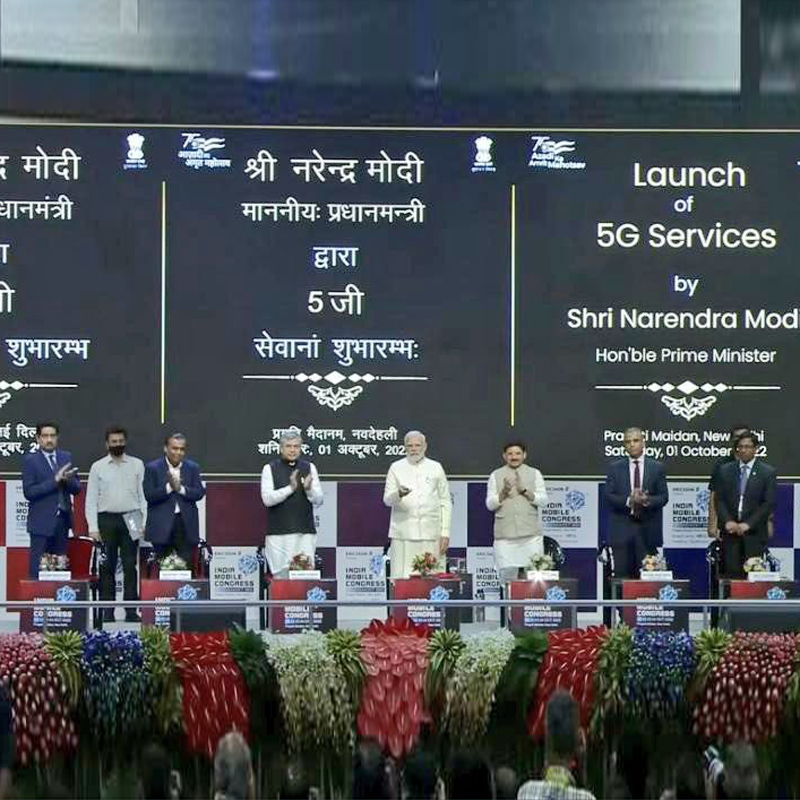
    Mumbai: On Saturday, prime minister Narendra Modi launched 5G services in India at the India Mobile Congress in New Delhi.

    At the launch, while addressing the nation, Modi said that 5G technology will revolutionise the telecom sector and that it is a historic day for India in the twenty-first century. “The launch of 5G is a gift from the telecom industry to 130 crore Indians. It is a step toward a new era in the country, and is the beginning of infinite opportunities.”

    He emphasised how digital India’s success is based on four pillars, including the cost of a device, digital connectivity, data costs, and the digital first approach.

    Over the next few years, the services will gradually expand to cover the entire country. The fifth generation (5G) service, capable of supporting ultra-high-speed internet, is expected to open up new economic opportunities and societal benefits, serving as a transformative force in Indian society.

    Also read: Reliance Jio to roll out 5G services in major cities by Diwali

    “Earlier, the cost of one GB of data was about Rs 300. It has come down to about Rs 10 per GB now. On average, a person in India consumes 14 GB per month. This would have cost about Rs 4,200 per month but costs Rs 125-150. It’s the efforts of the government that led to this,” he added.

    Speaking further, Modi said, “With developments in technology and telecom, India will lead the industry’s 4.0 revolution. This is not the decade of India, but the century of India.”

    At the event, Modi was accompanied by telecom minister Ashwini Vaishnaw, junior telecom minister Devusinh Chauhan, and Reliance Industries chairman Mukesh Ambani, Bharti Enterprises founder & chairman Sunil Bharti Mittal, and Aditya Birla Group chairman Kumar Manglam Birla.

    After officially opening the show, Modi visited pavilions set up by several telecom carriers and technology providers to get a first-hand look at what 5G is capable of. He began at the Reliance Jio booths.

    Reliance chairman Mukesh Ambani thanked the prime minister for inspiring the vision of a developed nation by 2047. “Every action and policy of the government is skillfully crafted to propel India towards that goal. Steps taken to fast-track India’s march into the 5G era provide compelling proof of our prime minister’s determination.”

    He narrated the possibilities of 5G in key areas like education, education, and climate change, etc. “Your leadership has raised India’s prestige, profile, and power globally like never before. In today’s fast-changing world, there will be no stopping a resurgent India from soaring to the top,” Ambani concluded.

    Bharti Enterprise chairman Sunil Bharti Mittal remarked that the launch of 5G is the beginning of a new era and since it is happening during “Azadi Ka Amrit Mahotsav,” it makes it even more special. “With the efforts of the prime minister, this will usher in new energy in the country. We are fortunate to have a leader in the prime minister who understands technology very well and has deployed it to the development of the country in an unmatched manner,” he noted.

    Mittal further said that it will open up a sea of opportunities for people, especially in our rural areas. He recalled the PM’s initiatives in the fields of infrastructure and technology from his Gujarat CM days. He said that during the pandemic, traffic shifted to villages and homes and the country’s heartbeat did not stop even for a second. Credit for that goes to the digital vision. He also praised the audacity and achievement of the vision of “Make in India.” “Along with “Digital India,” the prime minister also took forward the “Start-up India” campaign and, soon enough, India started producing unicorns,” Shri Mittal added. “With the advent of 5G, I’m sure that the country will add many more unicorns to the world.”

    Aditya Birla Group Chairman Kumar Mangalam Birla called the advent of 5G a transformational event that proves India’s prowess on the global stage and reiterates the role of telecom technology as the bedrock of India’s growth. He thanked Modi for his vision and leadership for a generational leap in technology that has resulted in India’s making a mark on the global stage. He also thanked the PM for his inspirational role in supporting the telecom industry during the ongoing pandemic and for the path-breaking telecom reforms in the industry.

    Birla said that the launch of 5G marks the beginning of an exciting journey for India. “We will see limitless potential for 5G development and use cases in the years to come,” he added.

    Reliance Jio connected a teacher from a school in Mumbai with students in three different locations in Maharashtra, Gujarat, and Odisha.

    The Vodafone Idea test case demonstrated the safety of workers in an under-construction tunnel of the Delhi Metro through the creation of a ‘Digital-Twin’ of the tunnel on the dias.

    In the Airtel demo, students from Dankaur, Uttar Pradesh, witnessed a lively and immersive educational experience to learn about the solar system with the help of virtual reality (VR) and augmented reality (AR).

  • BharatNet project will boost rural broadband services: Telecom Minister

    BharatNet project will boost rural broadband services: Telecom Minister

    NEW DELHI: There are 412.60 million broadband connections in the country of which 106.52 million are in rural areas, Communication Minister Manoj Sinha said yesterday.

    Sinha said in the Lok Sabha or India’s Lower House of Parliament that broadband services in rural areas have seen good progress on the back of substantial development in the telecommunication sector.

    “The number of broadband connections in the country as on 31 March 2018 stood at 412.60 million out of which rural broadband connections are 106.52 million, which constitutes 25.82 per cent of total connections,” he said, adding that the government is implementing the flagship BharatNet project to link each of the 250,000 gram panchayats or the local village administrations in the country through optical fibre network.

    This is the largest rural connectivity project of its kind and is the first pillar of the Digital India programme, he said.

    Phase-I of the project has been completed in December 2017 and over 100,000 village administrations have been made service-ready. Phase II of BharatNet project, which aims to connect 150,000 gram panchayats (GPs) through high speed broadband, has been launched and is targeted to be completed by March 2019.

    The optical fibre being laid under the BharatNet project is expected to be the primary means for internet backhaul, which can be leveraged to service the telecommunications towers in the rural areas. This, in turn, will give a boost to mobile internet availability and adoption in the rural areas. 

    As part of BharatNet project, the last mile connectivity, through Wi-Fi or any other suitable broadband technology is being provided at all the GPs in the country. At each GP, on an average five access points are envisaged that include three points for government institutions and two for public places.

    Overall mobile Internet penetration in the country has seen major changes in the last four years. The total number of Base Transceiver Stations (BTS) across the country has increased from 790,000 in 2014 to more than 18,00000 as of March 2018 of which 905,000 BTS are of 4G. The increased number of BTS has resulted in greater adoption of mobile internet across the country, the Minister said. 

  • Mobile internet revenues in India growing at 40 per cent annually: Study

    Mobile internet revenues in India growing at 40 per cent annually: Study

    MUMBAI: Mobile internet revenues in India are growing at a whopping 40 per cent a year as compared to countries like China and Brazil, where the growth is pegged at 25 per cent annually.


    Even in most mature mobile markets, such as Japan and South Korea, mobile Internet revenues are growing at 10 per cent a year, much faster than overall GDP.


    In 13 countries that represent about 70 per cent of global GDP, the mobile Internet is already generating some $700 billion in revenues annually, the equivalent of $780 per adult, and has created employment for about three million people. Mobile Internet revenues will have grown to $1.55 trillion across these countries by 2017, an annual increase of 23 per cent.


    The 13 countries surveyed are Australia, Brazil, Canada, China, France, Germany, India, Italy, Japan, South Korea, Spain, the United Kingdom, and the United States. The single largest contributor to mobile Internet revenue growth in the next several years will be the apps, content, and services component of the ecosystem, driven by the rapid expansion of mobile shopping and advertising.


    Revenues are growing especially quickly in developing markets, according to a report released today by The Boston Consulting Group (BCG), The Growth of the Global Mobile Internet Economy, fueled by competition among the various mobile Internet ecosystems. The resulting innovation and choice are leading to better devices and falling prices for consumers.


    The new BCG report, which was commissioned by Google, examines the economic impact of the digital economy related mobile devices (such as smartphones, tablets, and wearables) and excludes economic activity generated by the broader mobile technology industry, such as revenues generated by phone calls, SMS “texting,” the manufacturing of non-Internet-enabled devices (feature phones, for example), and capital expenditures for non-digital data activities on mobile networks.


    Consumers are by far the biggest beneficiaries of the mobile Internet. On a per capita basis in the 13-country sample, the average consumer surplus — the perceived value that consumers themselves believe they receive over and above what they pay for devices, applications, services, and access — is about $4,000 a year, or seven times what consumers pay for devices and access. The mobile Internet’s consumer surplus across the 13 countries is approximately $3.5 trillion a year. The largest aggregate consumer surplus is in the US ($827 billion), followed by China ($680 billion). On a per capita basis, consumers in Japan, Germany, France, and Australia all enjoy mobile Internet surpluses of more than $6,000 per year.


    “Competition throughout the mobile Internet ecosystem is driving innovation, growth, jobs, and a continually improving experience for consumers and businesses. Increasing mobile access everywhere is leading to new uses of the Internet — in fields from banking to education and from health care to the delivery of public services — further propelling growth. Policy makers can help keep the mobile Internet economy moving by pursuing proven policy goals that encourage continued improvement in these areas, as well as innovation, value creation, and consumer welfare and choice,” said BCG partner and coauthor of the report Dominic Field.


    Competition occurs at every layer of the mobile ecosystem — among service providers, enablement platforms, and companies providing apps, content, and services. Competition is particularly intense — and evolution especially fast paced — among device manufacturers and operating system companies. As recently as 2010, the BlackBerry and Symbian platforms accounted for more than half of all smartphone sales in the 13-country sample; they now represent less than five per cent. Today, Apple’s iOS, Google’s Android OS, and Microsoft’s Windows Phone OS are fighting for market share while keeping an eye on newer entrants, such as Amazon’s Fire OS, Nokia’s X platform, Xiaomi MIUI, Firefox OS, and Tizen, which are further augmenting user choice and competition. All of this leads to faster innovation, more capable devices, and lower prices.


    A big part of the mobile Internet success story is the flourishing app economy. There have been more than 200 billion cumulative downloads from the various app stores since the first app was developed in 2008. More than 100 billion downloads took place in 2013 alone. Leading app-store operators paid developers more than $15 billion between June 2013 and July 2014.


    “The growth of the mobile Internet economy is propelled by increasing affordability and accessibility, as well as by advances in technology and infrastructure. The rapid advent of more affordable phones — those costing $100 or less — will drive both greater penetration and new uses,” said BCG partner and coauthor of the report Paul Zwillenberg.


    Zwillenberg also noted that while only about 20 per cent of smartphone shipments in 2013 comprised devices priced below $100, a fast-growing array of global, local, and new-entrant manufacturers are now making affordable smartphones.


    Large majorities of consumers in the 13-country sample would forgo most offline media (the one exception is TV) before losing their mobile Internet access. Two-thirds or more would give up chocolate and alcohol. More than half are willing to forgo coffee and movies. A third are willing to give up their cars, and more than a quarter would abstain from sex.

  • TRAI: Activation of VAS only on second confirmation

    TRAI: Activation of VAS only on second confirmation

    NEW DELHI: With the aim of reducing complaints relating to value added services (VAS) offered by telecom service providers, the Telecom Regulatory Authority of India (TRAI) on 10 July said any will be activated only after receiving a second confirmation from the customer.

    In the directions issued by it, TRAI says the service provider has to provide a system which takes a second consent from the customer before providing a value added service through any means – OBD, IVRS, WAP, Mobile Internet, USSD, SMS, Tele-calling or any other mode of activation.

    The first offer of a service is on the service providers‘ platform and a second confirmation from the customer is through a dedicated consent gateway which is owned by a third party and not by the service provider.

    At the outset, TRAI said activation of VAS by service providers has been the cause of many customer complaints. The Authority has been addressing, from time to time, consumer issues, which have come to its notice through consumer complaints, relating to activation of value added service through different modes, without the explicit consent of the consumer. These directions essentially prescribe the manner in which the explicit consent of the consumer is to be obtained for activation of value added services through different modes. While issuing these directions, the Authority has also considered the interests of the service providers and growth of value added service industry.

    In partial modification of existing directions, TRAI has directed all Service providers to implement a uniform procedure for taking explicit consent of the consumer for activation of value added service and for deactivation of value added service.

    A Common de-activation procedure using toll Free Common Short Code 155223 has been provided and all requests for de-activation have to be completed in four hours).

    VAS activation procedure will henceforth include all forms of activations and scenarios – OBD, IVRS, WAP, Mobile Internet, USSD, SMS, Tele-calling and any other mode of activation.

    The deactivation procedure should be publicised through advertisements in newspapers, updation in the website and SMS blasts.

    A full 24 hours before auto renewals of the VAS services, information about renewals to be provided to the customers, through SMS and Outbound Dialing (OBD).

    In case of wrong activation, the amount will be refunded within 24 hours of the customer‘s request. Such customer requests should be within 24 hours for VAS with validity of more than one day and within 6 hours for VAS with validity of one day.

    In case of USSD and SMS mode of activation, no activation response time should be more than 10 seconds and 60 minutes respectively and in case of non-response, the same should be treated as ‘no activation required‘.

    Upon activation of VAS service, the de-activation number, the validity of the VAS service and charges for renewal should be explicitly informed.

    A Monthly report on activations, de-activations and complaints received and their redressal to be submitted to TRAI.

    The directions for obtaining explicit consent of consumers for subscribing, renewing and deactivation of Value added services are available on TRAI website http://www.trai.gov.in

  • 130 Million Mobile Internet Users by March 2014: IAMAI

    130 Million Mobile Internet Users by March 2014: IAMAI

    MUMBAI: India will have 130.6 million mobile internet users by March 2014 according to the Mobile Internet Report by Internet and Mobile Association of India (IAMAI) and Indian Market Research Bureau (IMRB).

    According to the report, in December 2012 there were 87.1 million mobile internet users. Meanwhile, in October 2012, there were 78.7 million mobile users who had accessed internet in the last one month, which include Laptop with dongles, tablet, dongles that connects to Internet. Of this number, there are 61 million Off-Deck Users (accessing sites other than sites of the operator), 15 million On-Deck Users (accessing only sites specified by the operator) and the rest 2.7 million users accessed the internet using dongles (i.e. connected to Internet using 2G, 3G or high-speed data cards).
     
    The report further reveals that an average monthly bill of a user who access Internet on mobile devices is Rs 460. Of which, the user spends Rs 198 towards Internet expenses.

    According to the company, this is a very healthy trend as it shows willingness of the users to spend nearly 40 percent of the bill towards Internet access. The rest is spent on voice services.

    Email, social networking services (SNS) and messengers have high usage among mobile internet user. Accessing online videos, games or reading online news are done approximately 2-6 times a week. While online games are accessed by nearly 50 per cent of the Mobile Internet users, less than 30 per cent of users read online news and watch online videos.