Tag: MK Anand

  • ET Now joins hands with NSE for new show ‘Nivesh India’

    ET Now joins hands with NSE for new show ‘Nivesh India’

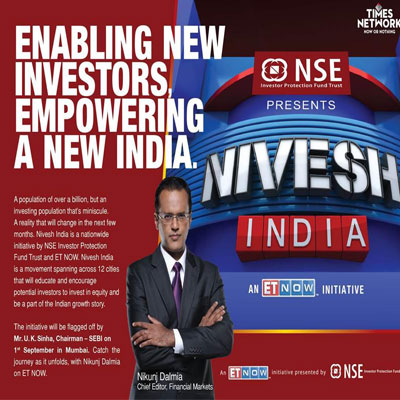
    MUMBAI: News broadcaster ET Now has partnered with India’s National Stock Exchange (NSE) to simplify the stock exchange for its viewers through a new show titled Nivesh India. The idea behind the new show is to create a 12 city outreach programme that sheds light on equity investment to passive and novice investors.


    Times Network MD and CEO MK Anand said, “We, in India, are culturally and financially still caught in an agrarian mindset. Most of our wealth still goes into real estate and gold and stays locked yielding less than inflationary returns. What is needed is a mindset change which is a communication job and education task, a mission that a media group of our stature is most suited to do. ET Now will take on the daunting task of clarifying and simplifying stock market to Indian investors. Under SEBI’s guidance and with NSE as our partner, we are certain that what we are starting here will snowball into the largest invest tor education drive in the world.”


    Under chief editor of financial markets, Nikunj Dalmia, NSE and ET Now will travel to 12 cities namely Bangalore, Indore, Jaipur, Cochin, Lucknow, Coimbatore, Nagpur, Surat, Vizag, Patna, Bhubaneswar and Siliguri – and speak to close to 1000 people across 19 on-ground forums and educate them to invest in equity markets and showcase how beneficial it is for their future. The show will also reveal success stories of investors from each of these cities, who will talk to people and clarify their doubts and remove their apprehensions on investing in equity markets.


    SEBI chairman MK Sinha, who flagged off the event at NSE said, “I want to compliment NSE and ET Now for jointly working out this strategy on investor relations. Such initiative can reach out to millions of people across the country.”


    The entire initiative right from its launch to culmination will be integrated editorially into content where anchors will talk about and promote it on air urging viewers to be a part of the programme in every city.


    The idea is to educate and encourage non-investors to invest in equity through the SIP and ETF route and be a part of the Indian growth story.


    NSE MD and CEO Chitra Ramkrishna said, “As part of NSE LIFE (Learning Initiatives for Financial Empowerment), our tie ups spread to five state boards, the CBSE board and 17 universities etc across India. Nivesh India, in partnership with ET Now, is another step in that direction. Something unique about this programme is that we have tried to reach tier 2 and tier 3 cities this time.”


    She added that such initiatives help resolve doubts and questions that an ordinary person has about capital markets.

  • “Any channel that we launch in the future, will be successful in year one:” MK Anand

    “Any channel that we launch in the future, will be successful in year one:” MK Anand

    Heading the broadcasting expertise of a media conglomerate, which has been operating in India since 1838 is certainly a job of immense pressure. But there is someone who has been doing it with élan and that too at a time when every day gives birth to a new trend, every month, a new competitor enters and claims to be different. He is none other than Times Network CEO and MD MK Anand.


    Not long back, acknowledging the emergence of digital and new media, Anand spearheaded a staggering move in which the Times Television Network was transformed into Times Network. Despite having an English movie channel championing the ratings week after week, he marked the launch of another channel in the same genre, with a bigger and better philosophy. Under his leadership, various channels of the network secured pole position on numerous occasions in their respective genre. 


    Speaking exclusively to Indiantelevision.com’s Anirban Roy Choudhury, Anand shares his vision for the media industry especially the English entertainment industry and the road map ahead for Times Network. 


    Excerpts:


    Can you give an overview of Times Network’s news and entertainment channels and which segment is priority?


    Being in niche broadcasting, I believe all sectors need attention because it’s a highly competitive industry with some strong players. So innovation needs continuous attention. Our leadership position has been good in both English movies and news space. On the other hand, Zoom needed some specific product attention in the first quarter with reference to the re-launch, marketing etc.


    What next for the news sector? Property Now is launching soon and you already have Times Now and ET Now. Is there a Hindi news channel foray on the cards?


    Not really. I don’t think there is sense in it right now. The portfolio that we already have needs to be adequately and correctly monetized. I think there is headroom for both in subscription as well as ad sales, which we have seen in the past six quarters or so. We have been able to continuously move the needle on that and until we exhaust that, I don’t think there is sense in stretching and going into a different language all together.


    As of now, we are leaders and I feel we will be able to sustain this leadership in the top end category of the broadcast audience. There is a lot to be done there before we move into regional news etc.


    The network already had a English movie channel in Movies Now, what was the reason behind launching MN+? Was it to attract advertisers?


    I don’t think it is right to launch products for consumers because you have an advertising business opportunity. You launch products because you have consumer demand. So, the launch of Movies Now and now MN+ is to acknowledge the fact that with DAS Phase I and II and now as we go to Phase III and IV, the potential to launch more and more niche channels and to reach out to specific viewers is better and cheaper than it was with analog.


    Niche is the way to go. Niche is to acknowledge that specific groups in a large population and vast universe have different tastes. Movies Now is more descriptive as it caters to the whole English viewership but within that there is romance, action and slow movies sector. When you acknowledge the specific niches, you can come up with products like MN+. These channels come up because of niche recognition not because of advertising opportunities.


    What has been advertisers’ reaction so far to MN+?


    We are delighted with advertisers’ reaction. It is one of the channels, which has almost reached a maturity level in the shortest period of time.


    Speaking of the English entertainment genre as a whole, a few international channels have found it difficult to find a foothold in India. On the other hand, we have Colors Infinity and MN+ launching in the wake of the HD boom. What do you think is the need of the hour when it comes to English entertainment in India?


    The HD market is definitely growing. It is the natural progression of television viewing just like black and white went to colour, terrestrial went to cable and satellite. Similarly, HD technology is getting diffused and being adopted.


    The top of the pyramid is obviously the best place for advertisers to be, whether it is in print or television and therefore the returns on HD from an advertiser’s point of view will be much more than the other areas. HD is the future of all broadcasting. In fact, soon there’ll be someone launching a 4K channel and then 4K will be the future. So technological advancement per se will be the future of all broadcasting.


    English entertainment was mainly targeted at the metros at one point of time. Do you see the target group growing now given the fact that we are seeing growth everywhere?


    All this is happening because of digitisation. More channels per cable allows for better penetration. Secondly, in the past when TAM in its panel change introduced LC1, there was a rush to reach those markets.


    I think advertising optimized distribution and the way niche channels or networks distributed in the past is now gradually changing. One of the reasons why the base is expanding is because of digitization and the possibility that subscription revenues will eventually start flowing from consumers to cable operators in a more transparent manner and through MSOs and DTH operators to broadcasters. 


    Broadcasters know that in the next two to five years, subscription revenue will be a lot more transparent. From that point of view, it is a bet that we take and go to those markets.


    OTT player HOOQ armed with English entertainment content has entered the Indian market. With Netflix speculated to launch in India next year, do you think OTT services are a threat to traditional television model in a country like India?


    There will always be a huge base of Indian consumers who will be consuming English news, English entertainment, English GEC content. It could be through Netflix or it could be through Movies Now or MN+. The fact of the matter is that consumption is not going to go down.


    So if you’re asking me whether broadcasters should now stop investing in content because Netflix is coming in; I don’t think so.


    Just because a YouTube exists, does it mean that other apps are not going to survive or will get lost? These are all businesses, which have been built over the last ten years. You never know what’s going to happen in the next ten years. A Netflix equivalent or a bigger player may be coming out of India in the next ten years. However, that will happen only when Indian entrepreneurs – whether it is broadcasters or otherwise – play in that market with their own hands. So we won’t fade away because some competitor is coming into play.


    Do you think the time is right for India to create original English entertainment content? What is the scope for such content?


    That has already started with the infotainment segment whether it is travel or lifestyle type of content. There is a lot of stuff, which is made for India and can also travel across. However, creating entertainment content for Indian production companies will take some time and even if it happens, those will have wings to fly only when they are produced for the global market and not for the Indian market alone. The Indian market is not big enough for that as of now.


    Do you foresee digital overtaking television when it comes to news consumption? Or do they complement each other? Arnab Goswami recently said that by 2020, digital will probably overtake television. What is your viewpoint?


    In some sectors like news, yes, digital is likely to overtake television, but certainly not in all sectors. News will be travelling across multiple platforms.


    Brands like ZoOm and Times Now, which started on the broadcast medium, can now co-exist on the mobile platform with the emergence of the digital medium. I am not very sure if that will be the case with other genres. Maybe in the next elections, we will have a lot more apps giving competition to the broadcast platform. At the same time, television channels will also have a lot more viewership on apps. In the foreseeable future, both the platforms will complement each other and happily co-exist.


    What kind of push and emphasis is the network giving to the digital medium?


    We are ready to go full-fledge in terms of the launch of Times Now app. Video-on-demand (VOD) totally depends on Intellectual Property (IP) and we have some very strong IP in terms of Times Now’s News Hour and Frankly Speaking. However, to venture into VOD, we will need more IP. 


    Arnab is someone who every CEO would love to have in his team but do you sometimes feel that he is becoming bigger than the brand?


    (Laughs) That is like asking a production company if they were happy to have Johnny Depp or Salman Khan in their team. What I would say is that we are happiest to have him inside rather than outside. 


    Times Network recently promoted Arnab as the editor in chief of ET Now. What is the road ahead for ET Now and what role will Arnab play?


    ET Now has completed six years. The channel, in its first three and half years of existence, was able to challenge CNBC and become number one. The fact that we have been able to challenge CNBC is a big achievement.

    Getting numbers, viewership or reach is not what we want out of this market. ET Now’s challenge is something larger, which is to be appealing to a broader base than just the so-called ‘stock market players’ or ‘business viewers.’ And that is exactly where Arnab would be useful. 


    Can you throw some light on ZoOm’s positioning and the way forward?


    When we had launched ZoOm, music formed 80 per cent of the programming mix, whereas now that number has come down to 60 per cent. So 40 per cent of the channel’s programming is now content. Ideally, as we go forward, I see almost 65 per cent of the channel’s content comprising Bollywood trends, lifestyle and trivia. And viewers will be able to consume this content on the broadcast platform, as well as on platforms like digital and social media.


    Is the Indian media and entertainment industry moving towards more subscription and less ad revenue model? What is the scenario at Times Network?


    In the industry, we are already subscription positive. When it comes to Times Network, we are yet to shake off the burden of carriage fees and hence, we are still advertising led. Moreover, that is also because we don’t have a large channel, which at times is a handicap when it comes to distribution. 


    But yes, over the last two years, significant headway has been made. DTH operators and MSOs have started acknowledging the fact that we are a useful bunch to increase ARPUs. When it comes to the high-end consumers, you cannot have a distribution and subscription pack without including the Times Group channels. We have subsequently been able to use that to our advantage to improve our carriage versus subscription position. Our net income has improved. We are sure that it will continue to improve and we will get to a positive situation in a year or so and that’s big.


    Going forward what is the road map ahead for Times Network? Will there be any new launches?


    We would like to launch at least one or two channels every year complementing our catalogue. Property Now is a complement to ET Now, whereas MN+ complements Movies Now. So we will launch a new channel wherever we feel a need gap, which can be profitably filled.


    One thing I am sure of – both the channels that we have launched or any channel that we launch in the future, will be successful in year one.


    For the next couple of years, what we need to articulate is the fact that the sum is a lot more than individual parts. What I mean by this is, when you look at the holistic picture, we are talking to top two per cent of Indians. India’s population is 134 crore and India’s monthly English viewership is 2.6 crore, which is exactly two per cent of country’s population.


    On a regular basis, we are talking to 1.3 crore people, which means that we reach out to one per cent of India every day. However, when you look at that one per cent, it’s not just any one per cent. We are serving India’s most influential broadcast audience, and that is very important because that’s not just any audience. We are reaching to the decision makers. Last year, we managed to secure 30 per cent growth. My primary target is to secure 30 per cent CAGR for the next two years as that will take us to a very strong position as a network.


    What is your take on the digitisation progress so far?


    Given the size of the market, its ability to pay for boxes and the current state with reference to the mostly unorganized sector, DAS Phase I and II have really happened at commendable speed. Now we need to wait and watch the progress that takes place in the Phase III and IV. However, I am not very satisfied with the way Phase III has progressed.


    Has the new government addressed key issues bothering the media and entertainment industry? 


    I don’t think we are in a situation where things can be changed overnight. What we all are now looking at is Phase III and IV of digitization. The most important contribution I expect from the new government is to pace up the economy. If the pace is good, media will be good. Businesses like ours are very heavily advertising led and advertising follows the economy. As of right now, if we have done so well last year as well as this year until now, it’s because of the new government.


    What’s your take on BARC?


    I am very happy with BARC fundamentally because we have been able to hold on to our leadership. Moreover in the case of ET Now and Movies Now, our ratings have improved.


    Overall, the transition was smooth. And even though there have been some teething issues, I think things will get sorted in time. The management team and the technology are able and good.
     

  • Times Network goes full throttle with launches & revamps

    Times Network goes full throttle with launches & revamps

    MUMBAI: There has been a lot of action going on at the broadcast arm of Vineet Jain helmed Bennett, Coleman and Company Limited (BCCL).


    Ever since its revamp in April this year, the Times Television Network (TTN) has gone full throttle with major revamps of its existing channels as well as new channel launches. 


    TTN revamped its Bollywood and lifestyle channel Zoom, which was followed by the launch of a new movie channel MN+. What’s more, a new niche channel called Property Now is also slated to launch soon.


    With digital being the future, the network is notably also stressing on strengthening its digital presence.


    Revamp of Times Television Network


    With an aim to become more inclusive, the network decided to drop the ‘television’ from its name and rechristened as Times Network with a new tagline—‘Now or Nothing.’


    At the time of the revamp, Times Network CEO and managing director M K Anand had said, “We have strong branches but the trunk needs to be strengthened and the revamp is to ensure that. Moreover, we don’t want to restrict ourselves as a television network only. Hence we decided to break a few boundaries and expand.”


    Realising the growing importance of digital, Times Network is now targeting the medium. Be it with launching the Times Now app or with the increasing focus on digital with the recent revamp of Zoom.  


    “There is a serious attempt from our side to establish ourselves on the digital platform,” Anand had said on the sidelines of the network’s plans to launch an app for Times Now. The app which is now live, has close to 10,000 downloads on Android.  


    Zoom’s programming ‘Turn On’


    On 26 June this year, Times Network revamped its 10 year old Bollywood and lifestyle brand Zoom with a new tagline ‘Turn On.’


    The channel now plans to change itself drastically. “The customers are evolving and so we too had to,” said Zoom as VP and product head Sunder Venkatraman.


    According to Venkatraman, the research by the team shows that consumers today want fast, short and quick content, especially for a channel like Zoom. “We already have a digital platform to support us and so with the revamp, we have decided to stress on TV, digital and short programming, which is smarter,” he added.  


    As part of the revamp, five new properties have been added to the channel. These include Kangana Ranaut’s My Life and StyleOn the Road with Farhan Akhtar, Man Up with Randeep Hooda, Funtanatan with Sugandha and Ishqwala Love with Miss Malini. “All these are five to 10 minute short shows,” informed Venkatraman. 


    The channel currently has only one long form (half an hour) show called Planet Bollywood. This will go up to two, with the launch of a food and lifestyle show Thank God It’s Fryday, this August“These shows will be used for appointment viewing,” he said.   


    In order to market the revamped channel, Zoom has readied a four week long marketing plan, which kickstarted on 26 June. “The whole of BCCL is behind us and we have a strong asset supporting us,” Venkatraman informed. The channel has taken 200 hoardings in about 15 cities to promote the new look. That apart, a lot of promotion will be done across digital platforms. 


    Additionally Zoom has set up an entire branded content team, which is looking at a large number of brand association shows. The first of this will go on air in August with Philips Air Fryer Thank God It’s Fryday.


    Post the revamp, the channel is investing heavily on content packaging. “A lot of brands in the lifestyle space are already showing a keen interest in joining hands with us to create properties for the channel. All conversations are ongoing,” he informed adding that a lot of shows will be launched by the end of this year.   


    MN+ for the English movie enthusiasts


    The English movie channel from the Times Network stable went live on 1 July. The new channel MN+ is for niche English movie fans.


    “MN+ is an all new English channel experience that will showcase must-watch movies in HD – movies that are universally celebrated and debated. It will offer an experience that will make every moment valuable for the viewer, and thereby give them the Gold Class Experience of Hollywood,” said Times Network senior vice president and head English entertainment cluster Vivek Srivastava.


    The MN+ library, which comprises over 1500 movies across genres, will sell ad slots at a premium rate, with just six minutes of advertisement.

    The network, which is currently emphasising on digital, has decided to spend 25 per cent of its marketing budget on digital media.


    Launch of Property Now


    The network is also gearing up to launch a real estate channel in Property Now. According to sources the channel will launch in September, this year.

    With all the high octane activity up its sleeves, the Times Network will be the one to watch out for in the coming months.

  • Zoom undergoes packaging, programming revamp

    Zoom undergoes packaging, programming revamp

    MUMBAI:Bollywood entertainment channel from Times Network stable, Zoom is all set to unveil a brand new look with Bollywood actor Kangana Ranaut as its brand ambassador.


    The channel known for its Bollywood shows will be unveiling a whole new packaging and a slate of new Bollywood focused content under its new logo and tagline, ‘Turn On’. 


    Post the revamp the channel will go beyond just dishing out Bollywood news and improve consumers’ social quotient, by connecting them to the latest trends, which are curated straight out of Bollywood. 


    Times Network MD & CEO MK Anand said, “We are delighted to reveal Zoom’s fresh programming and unique and exciting style of presentation today. The Times Network is a unique bouquet of channels which cater to the top two per cent of Indian television viewers – the discerning, top-end, premium audience. Zoom’s Innovative new media inspired format and its revamped and truly world-class on-air packaging will reflect this. We have always been close to Bollywood and will continue to do so with content that reflects the latest and trendiest that Bollywood has to offer with our own twist.” 


    Anand added, “Zoom has been the pioneering Bollywood channel and we are delighted to work with Kangana as the face of our new avatar. She has made a mark in Bollywood as the first real female superstar purely on her own grit and confidence. The choice of the brand ambassador reflects our new brand philosophy. We promise to inspire and lead our consumers to ‘Turn On’ the next best version of themselves – to live more and better.”


    The revamped Zoom has all the aspects of Bollywood showcased in a way that will suit the new palette of consumers: short, crisp and unpredictable.


    Zoom vice president & product head Sunder Venkatraman said, “Content strategy on Zoom centres around ‘trends’ and ‘youth’, which are the hottest genres on social media today. 


    The new offerings on Zoom will be shorter format – more like the T-20 of entertainment. They will vary in duration from a minute-and-a-half to seven or eight minutes to longer formats of 20 minutes; there is no fixed duration. But what is certain is that the content will really be Bollywood through fashion, gossip, style, humor, news, music, relationships and more.”


    He described the revamped channel on-air look as “a fresh look and feel young packaging. Small innovations with great impact. For instance a progress bar has been used for the first time ever on television.”


    The new look of the channel has been designed by Mayur Tekchandaney of Briefcase with the internal team at Zoom. 


    In an industry where marketing content is the norm, the channel has decided to leverage its superior content to drive a marketing blitzkrieg. 


    The first step is the exclusive music video shot by global expert Harvey Brown. The song composed by Sachin-Jigar has been sung by Anuskha Manchanda. The video, titled Hotel Zoom will be unveiled on the launch day across platforms and will also drive engagement on social media.

  • Industry reactions on BARC India’s first TV ratings data roll out

    Industry reactions on BARC India’s first TV ratings data roll out

    MUMBAI: The seeds for a new television measurement body were sown in 2008 and after a good seven years, on 29 April 2015, the Broadcast Audience Research Council (BARC) India, a joint industry body, rolled out its first set of data for week 16.


    Post the release of the data, BARC India said in a statement, “It’s a momentous day in the history of Indian television that will change how content consumption will be monitored and measured. The wait for the industry is over as BARC India rolls out its first set of data.”


    The body will be releasing data for 1lakh+ C&S markets, which corresponds to a sample size of 10,760 households. BARC India will actually monitor 12,000 sample households for this, using a stratified random sampling technique that is proven statistically. This will go up to 20,000 reporting homes, with addition of the less than 1 lakh urban markets and rural areas to represent “What India Watches” in line with the Government of India, January 2014 notification.


    Speaking on the industry body’s new journey, BARC India CEO Partho Dasgupta said, “I am thrilled to share the first set of Data and Highlights. Solving this puzzle has been an exciting experience and Team BARC India is proud to be creating history as the world’s largest and future ready television audience measurement service. Thanks to IBF, AAAI, ISA and all our partners for coming together and making this happen.”


    Just a few minutes after the first data was rolled out, BARC India chairman and ZEEL MD and CEO Punit Goenka tweeted, “The launch of BARC India’s world class television audience measurement system makes it a historic day for the entire industry! With the implementation of @BARCIndia , the ecosystem has certainly turned absolutely transparent! @BARCIndia will certainly be the best solution to report what the nation is actually watching! I would like to thank @parthodasgupta, @paritoshZero ,#ShashiSinha,#SmitaJha & the entire @BARCIndia team for their commitment and hardwork!”


    According to Goenka, BARC India is committed to build a world class television audience measurement system. “With an aim to bring in utmost transparency within the ecosystem, BARC India will certainly be the best solution to report what the nation is actually watching,” added Goenka.


    Dentsu Aegis Network chairman and CEO South Asia Ashish Bhasin said, “Well I think overall BARC is a great step for us as a television measurement system as for the first time we will have transparent, robust measurement. While a lot of excitement is being generated over the data but the only word of caution I would give is that this is one week data of household level. We should give it a few months time for the data to stabilize before the real trends start emerging.  A trend is formed by several data points’ and this is just one. We will have to wait for a while for more trends to emerge.”


    Times Network MD and CEO MK Anand is happy with the results as it shows the network’s strength. “We are happy that the new measurement system is finally in place. We look forward to reaping the benefits of this evolved system to the maximum. BARC is technologically advanced and is larger than the erstwhile base of meters by almost two-and-a-half times. An extended viewer base will certainly help bring in more consumers into the analysed set and improve our services to them and thus generate more value. With BARC, we have retained the No.1 spot across channels, and we continue to lead the broadcast space in the respective genres we are present in with a clear margin. Times Network’s ‘Now or Nothing’ philosophy, helps us sustain our leadership across genres with differentiated and hard hitting content and stay on top of the audience pyramid as always.”


    Times Now editorial director and editor in chief Arnab Goswami added, “I am delighted with the BARC numbers. It shows us dominating half the market with the other half shared between the smaller English news channels. At 9 pm, we have 2/3rds of the audience with us, with the other one third shared between the smaller channels. Proves our theory that the viewer always chooses the number one news team. In English news now, there is no number 2.”


    On the other hand, India Today group CEO Ashish Bagga believes that the ratings by BARC India only adds credibility to the leadership status of Aaj Tak and the trust it enjoys with the news viewers. “The channel’s superiority is backed with years of unwavering focus towards excellence in journalism. I would like to congratulate the entire team at Aaj Tak for crossing another milestone and likewise to BARC for putting together a robust measurement system,” he said.


    Network 18 group CEO AP Parigi said, “The first week’s data shows CNBC TV18 as the #1 English business channel, CNBC Awaaz as the #1 Hindi business channel and CNN IBN as the #2 English news channel and IBN 7 as the #6 Hindi News Channel. Colors is #1 Hindi General Entertainment Channel in the prime time slot (7 pm to 11:30 pm). We should be patient and not jump to conclusions; a deeper understanding of how viewership numbers should be interpreted suggests that while one celebrates BARC’s roll out it would be prudent to wait till the system evolves.”


    Times Network senior VP and head- English entertainment cluster Vivek Srivastava said, “The first week BARC numbers are in sync with our expectations. Both our brands Movies Now and Romedy Now have been consistent leaders in their respective genres on TAM and we continue to lead the pack on BARC as well.”


    Contradicting the general reaction, Helios Media managing director Divya Radhakrishnan said, “These are initial knee jerk reactions. One will have to wait for individual level data as one cannot do media planning with household level data. Secondly, it does not cover all the markets. And thirdly in terms of upsets, it’s more or less the same pecking order except for one or two and there are real reasons why they are not featuring as well.”


    Knee jerk reactions aside, over the coming few weeks it will nonetheless be interesting to analyze, evaluate and interpret data from a larger television audience base as recorded by BARC.

  • Media fraternity welcomes GST; few pose doubts over implementation

    Media fraternity welcomes GST; few pose doubts over implementation

    MUMBAI: Amidst strong controversy, Arun Jaitley led finance ministry of India tabled the Goods and Service Tax (GST) in the parliament for further debate. GST is often termed as India’s most ambitious indirect tax reform plan by economists, which aims to stitch together a common market by dismantling fiscal barriers between states. It is a single national uniform tax levied across the country on all goods and services.


    The indirect tax system in India is currently mired in multi-layered taxes levied by the Central and State governments at different stages of the supply chain such as excise duty, central sales tax (CST), value added tax (VAT) and octroi tax, among others. In GST, all these will be subsumed under a single regime. 


    Even as the entire opposition party, led by Sonia Gandhi, posed a walk out from the Parliament in protest against the procedure and particulars of the amendment, Indiantelevision.com took the opportunity to seek reactions of the vanguards of the media, cable and Direct-to-Home (DTH) industries on GST. While industry stalwarts welcomed the thought behind GST unanimously, a few posed doubts over its successful implementation.


    Dish TV CEO RC Venkateish says, “It will be good for the DTH sector. At present we are victims of multiple taxation system where we pay various taxes in entertainment tax, service tax etc. With GST, it will all get rolled under one. If the GST is approved and rolled out, we will have a tax reduction of three to 3.5 per cent and hence it will be a good move for the sector.”


    Welcoming GST wholeheartedly, Videocon D2H CEO Anil Khera opines, “GST is a welcome move. It will help the DTH sector to prosper. DTH is the biggest victim of multiple taxation policy and GST will simplify that. The industry needs a uniform taxation system and the sooner it comes the better it is.”


    Explaining why GST is good for the economy in the long run, Times Network CEO MK Anand says, “GST brings uniformity and transparency and therefore better administration. However, in the short term, there are expected to be issues. Broadcasting will move from CST, which we believe will be lower than GST as we expect and that is going to put pressure on our pricing. The broadcast ecosystem at the bottom end has elements like consultants or local operators, who may try to push for absorbing into prices. The other thing is the state wise registration and filing of GST as against the current centralised filing. This is also an additional activity that we will now have to account for and so it increases costs to some extent.”


    GTPL Hathway COO Shaji Mathews supports the concept behind GST but has doubt on its successful implementation. He explains, “Taxation has been the biggest issue when it comes to digitisation. With digitisation, often only three stakeholders are associated namely: multi system operators (MSO), broadcasters and local cable operators (LCO). However in actuality, there are two more parties involved – the government and consumers. Government has been the major gainer so far from digitisation and they have been trying to shift the tax burden on to the consumer. However the consumer is not ready to take it and hence operators have been bearing the brunt of it all. With GST, the concern is over entertainment tax, which varies from state to state. No clear information is provided whether entertainment tax will be included in GST and if yes, then at what slab. So overall, while the thought behind GST is good, there are a lot of question that are still unanswered. Moreover, since the government hasn’t made any efforts to rationalise taxation, the implementation is something that remains to be observed closely. The problem is with the mechanism that the government follows, where they don’t consider the tax payers’ point of view while implementing an amendment.”


    Another senior official from the cable fraternity asserts, “GST has the potential to emerge as a blessing in disguise. As we proceed with digitisation, uniformity in taxation is the least that we can expect. It has been very harsh on us, as we operate across different states and at times we end up paying tax for an already taxed item, which is not something that we should be facing. Overall, I welcome GST and see it as an encouraging move though only time will unfold the real story.”


    NDTV executive vice chairperson KVL Narayan Rao adds, “Frankly, GST deals more with Goods and Service providers and doesn’t impact us directly but I consider it as a beneficial move. For example, if I have to set up a new studio at a new location, GST will help me as I won’t pay multiple taxes and hence it affects the pricing.”


    Backing GST, entrepreneur Ronnie Screwvala opines, “A business friendly environment had to be developed in India and taxation is a key element to that. With the Goods and Service Tax, service tax will come down to 16 per cent, which solves many problems. Hence GST is a firm step forward towards developing a business friendly scenario in India and it will surely help the country to ensure economic growth.”


    As per information available, the government is expected to rollout GST by April 2016.With absolute majority in the Lok Sabha, it will not be a challenge for the government to pass it through in the lower house. However the bigger obstacle will come from the Rajya Sabha as Jaitley and company will have to penetrate through a larger opposition. The entire business fraternity will keenly observe the next few days of proceedings in both houses of the Parliament.

  • YouTube to launch ad free subscription based model in India

    YouTube to launch ad free subscription based model in India

    MUMBAI: Google’s popular video hosting platform YouTube has been a boon to independent content makers as it enables them to exhibit their talent to a worldwide audience. Now, in order to enhance user experience, YouTube is all set to launch a subscription based ad free model in India. According to sources close to the development, YouTube is planning to launch the innovation around mid June for Indian consumers.


    While viewers are offered a wide range of content on the platform, almost all content on YouTube starts with an advertisement wherein the option of skipping it is sometime available and sometimes not. Ads often pop up in the middle of the content too, which interrupts the flow of the viewers.


    The new subscription based ad free platform will ignite the long sustaining debate of the whether a video on demand (VOD) platform should follow the advertising or subscription based revenue model. Advertising revenue mode is directly proportional to rating and when it comes to YouTube, its views. It is often very difficult to satisfy both consumer and advertiser at the same time and hence the content and root idea behind it gets compromised.


    Subscription based model also has its own drawback, poor online payment infrastructure, lower number of credit or debit card holders are a few of them.


    Times Network CEO and MD MK Anand is of the opinion that though subscription model has a lot of positives, India is not yet ready for it. “Consumer behaviour is the biggest challenge besides payment gateway and card penetration. A huge part of digital savvy young population refrains from using card transactions for various reasons and hence at this moment advertisement revenue model is the only option. Going forward, if the number of card holders increase and the consumers behaviour towards e- transactions becomes friendlier then we may see a new revenue model emerging.”


    YouTube’s new offering will enable a consumer to either choose the ad free platform or stick to the available one. From content creators’ perspective, Ping Network co-founder Rajeshree Naik asserts, “The new innovation from YouTube will cater to the growing need of sophistication of a consumer. We can take example from the newly launched HD channels, the same content is available on the SD platform too but consumers are paying to get quality content. The innovation will help us satisfy more people with the content we are offering.”


    When asked if Ping Network will create fresh content exclusively for the paid platform, Naik adds, “Not at the moment. For now the platform will only provide better and uninterrupted viewing experience to the consumers. But going forward if the platform makes a sustainable impact creating exclusive content can be an option.”


    According to the 2014 KPMG report, 12 per cent of the digital ad spend mix is acquired by videos and the spend on digital video has increased by five per cent compared to 2013. When questioned whether the ad free platform from YouTube will impact advertising, Maxus South Asia head of digital Unny Radhakrishnan says, “There will not be any significant impact on advertising immediately. As per the news reports, YouTube has said that advertising will still be their core revenue. The share of consumers who will go for paid subscription will be very small initially. In the long run, this would perhaps lead to more investments and therefore increase in the quality of content and in turn paid subscription. An India roll-out of this is not expected in the near future.”


    It remains to be seen if the new initiative from YouTube breaks the mould and creates a new sustainable revenue model, which will satisfy both producers and consumers.


  • Times Network restructures sales team; aims to accelerate growth

    Times Network restructures sales team; aims to accelerate growth

    MUMBAI: Times Network has restructured its sales team, which reflects a new stronger growth-oriented operating model.


    As part of the restructuring, Times Network head branded content Hemant Arora has been elevated as Times Now and ET Now sales head. Arora has more than 17 years of experience in media sales, including print, internet and television. He started his career at The Times of India in 1997. 


    Hersh Bhandari has been given the charge as Times Now national head of ad sales. I expect Hersh to restore the true premium value that the lead English News platform deserves to the business,” said Times Network MD & CEO MK Anand.


    Shilpa Shetty will take over as ET Now national head of ad sales. Since joining ET Now, Shetty has been instrumental in increasing the channel’s revenue. A tough taskmaster, she is also the first woman to rise to the position of head of sales from within the Times Network.


    Gaurav Dhawan has been made the head of English Entertainment channels’ cluster. With 17 years of extensive experience in managing advertising revenue driven business across television, print and web, Dhawan has an advantage in meeting his challenging new assignment, where he is pitted against Star’s English Entertainment business.


    ET Now north head Jogajyoti Pati has been elevated as Times Network national head of ad sales, whereas Rohit Tugnait will don the new role of zoOm national head of ad sales & brand solutions. 


    The initiative aims at providing significant growth opportunities and greater responsibilities to the existing leadership in the advertising and sales team, which will also inculcate the Network’s new brand philosophy of – ‘Now or Nothing.’


    Anand added, “This refinement in our working model is designed to keep up with the momentum we had been sailing on through whole of the last year. While 2015 was one of hygiene improvements, 2016 will be a watershed year during which we will make an all-out effort to correct our price:value equation and build our revenue base.”

  • Times Now comes with creative campaign to question crisis

    Times Now comes with creative campaign to question crisis

    MUMBAI: News channel Times Now has launched a campaign with the conviction to shape a better tomorrow. It was since the New Year that the channel had started to strengthen the core philosophy of the brand through sharp-focused positioning with ‘Times Now: Action Begins Here.’ The channel also launched a series of hard-hitting, issue-based films to raise social issues that bothers the society on a daily basis.


    Times Television Network CEO & managing director MK Anand said, “’Action Begins Here’ truly articulates what Times Now stands for, it explains what we are really doing. As India’s leading news brand, we are well aware of the power our voice has in society. And we constructively use that power to give voice to issues that affect our nation and raise the right questions that lead to Action. Action that leads to concrete solutions, to change for a better India. The re-positioning will be reflected in the overall brand communication coupled with intense and engaging content.”


    Times Now editor in cheif Arnab Goswami added, “Times Now has been the popular choice for more than seven years as the number one channel. We have changed news delivery from deadpan to passionate; from uninvolved to journalism that steps forward to fight for the citizen. ‘Action Begins Here’ is a campaign that reflects this new age journalism, and showcases our fundamental strength of direct reporting to viewers across the globe.”


    The 360 degree marketing plan includes extensive print, OOH, cinema, digital and cross-channel promotions.


  • Times Television Network to host ‘Digital India Summit 2015’

    Times Television Network to host ‘Digital India Summit 2015’

    MUMBAI: Times Television Network, part of the Times of India Group, will be hosting the ‘Digital India Summit 2015’ on the 3 & 4 February 2015, in New Delhi. The summit based on the theme:  Digital India: Bits & Bytes of a Billion Dreams, will be inaugurated by Shri Ravi Shankar Prasad, Hon’ble Minister, Ministry of Communication who will also deliver the keynote address. The two-day summit will bring together the most important stakeholders of the digital revolution from across industry, government, academia and civil society.


    Digital India Summit 2015 is envisioned to realize the dream of Digital India – a digitally empowered society and knowledge economy, offering world class services at the click of a mouse. Digital technology can play a vital role in transforming the fortunes of 1.2 billion Indians. Everything from economic productivity to social services–including education and healthcare—to governance at central, state and municipal levels can be improved through deployment of robust information technology.


    MK Anand, MD & CEO, Times Television Network said, “Digital India Summit 2015 will provide a public platform to hold discussions that will prepare India to face technological challenges and devise solutions that will aim to contribute towards realizing the implementation objectives of Digital India. The entire campaign will be substantive as the suggestions, ideas, insights, research and conclusions of the discussions will all be curated by our research team along with a leading global consulting firm to produce an action plan ‘white paper’.


    “Times Television Network brings India’s first and most comprehensive Information Communication Technology (ICT) forum – Digital India Summit 2015”, added MK Anand. 


    The forum will invite transformative ideas from all significant stakeholders that aim to realize IT (Indian Talent) + IT (Information Technology) = IT (India Tomorrow). Conceived with the aim of lasting a full 5 year term, the summit promises to bring to the forum the best ideas every year and follow up on its progress the next year.


    The initiative is being supported by leading organizations like MAIT (Manufacturers Association for Information Technology), EY (Ernst & Young) and the Nasscom Foundation.


    Tune in to catch the ‘Digital India Summit’ series, starting shortly, exclusively on TIMES NOW & ET NOW.