Tag: MK Anand

  • Times Network MD & CEO MK Anand speaks out on l’affaire Arnab

    Times Network MD & CEO MK Anand speaks out on l’affaire Arnab

    MUMBAI: Times Network MD & CEO MK Anand is known to be a rather reticent kind of executive. He would rather keep a low profile and speak only when he is approached. So, when he decides to open up to the media, there’s obviously something he wants to set right.

    Says he: “Ever since Arnab’s departure, the rumour mills have been running amok and a lot of canards have been let loose. I would like to set them right.”

    According to Anand, first is the buzz that Arnab left because he was being sidelined, and that he did not have much editorial independence. “The fact is that there was zero pressure on him,” he says. “We don’t meddle with the editorial policy. I have spoken to him on content matters only twice since I have been here. And, the shareholders do not really get in to day-to-day operations at all.”

    Anand shares that it was Arnab who announced his departure to his team before putting out his resignation to him, and let it to go viral on social media.

    “We share a good relationship. We continued carrying his picture and name on the shows he used to host for a long time even after he announced his departure. Even on the last day, I had lunch with him and there was no negativity. I would have loved to retain him. I was saddened to see him go and, of course, I miss him,” he acknowledges.

    Anand berates the fact that there seems to be a campaign to malign Times Now. “People were saying that Times Now and Arnab are synonymous. That Times Now has sunk after Arnab. BARC data shows otherwise. Week 1-45 of this year, Times Now had an audience share of 41 per cent; week 46-50 it has the same 41 per cent,” he says.

    Then, there is the rumour that the news channel lost Rs 100 crore in revenue post-Arnab. “Untrue again. While I believe it’s worth that much, I wish we made so much money on NewsHour that he used to anchor,” he expresses.

    Market estimates are that Arnab’s prime time shows contributed around Rs 50-60 crore to the channel’s top line, figures which Anand is unwilling to confirm.

    “The advertisers who were there when Arnab was anchoring are there even when he is not,” says he. “Just take a look at the Adex data for October and November.”

    What Anand wants to finally rectify is the perception that hordes of journalists have followed in the wake of Arnab. “Times Now has 320 employees,” he says. “Nine have left. We have a normal attrition rate of 25 per cent which is about 80 people leaving each year or around six to seven staffers each month. If we lose nine people, it does not mean there has been an exodus. 311 staffers have chosen to stay on.”

  • Times Network MD & CEO MK Anand speaks out on l’affaire Arnab

    Times Network MD & CEO MK Anand speaks out on l’affaire Arnab

    MUMBAI: Times Network MD & CEO MK Anand is known to be a rather reticent kind of executive. He would rather keep a low profile and speak only when he is approached. So, when he decides to open up to the media, there’s obviously something he wants to set right.

    Says he: “Ever since Arnab’s departure, the rumour mills have been running amok and a lot of canards have been let loose. I would like to set them right.”

    According to Anand, first is the buzz that Arnab left because he was being sidelined, and that he did not have much editorial independence. “The fact is that there was zero pressure on him,” he says. “We don’t meddle with the editorial policy. I have spoken to him on content matters only twice since I have been here. And, the shareholders do not really get in to day-to-day operations at all.”

    Anand shares that it was Arnab who announced his departure to his team before putting out his resignation to him, and let it to go viral on social media.

    “We share a good relationship. We continued carrying his picture and name on the shows he used to host for a long time even after he announced his departure. Even on the last day, I had lunch with him and there was no negativity. I would have loved to retain him. I was saddened to see him go and, of course, I miss him,” he acknowledges.

    Anand berates the fact that there seems to be a campaign to malign Times Now. “People were saying that Times Now and Arnab are synonymous. That Times Now has sunk after Arnab. BARC data shows otherwise. Week 1-45 of this year, Times Now had an audience share of 41 per cent; week 46-50 it has the same 41 per cent,” he says.

    Then, there is the rumour that the news channel lost Rs 100 crore in revenue post-Arnab. “Untrue again. While I believe it’s worth that much, I wish we made so much money on NewsHour that he used to anchor,” he expresses.

    Market estimates are that Arnab’s prime time shows contributed around Rs 50-60 crore to the channel’s top line, figures which Anand is unwilling to confirm.

    “The advertisers who were there when Arnab was anchoring are there even when he is not,” says he. “Just take a look at the Adex data for October and November.”

    What Anand wants to finally rectify is the perception that hordes of journalists have followed in the wake of Arnab. “Times Now has 320 employees,” he says. “Nine have left. We have a normal attrition rate of 25 per cent which is about 80 people leaving each year or around six to seven staffers each month. If we lose nine people, it does not mean there has been an exodus. 311 staffers have chosen to stay on.”

  • Rahul Shivshankar appointed chief editor of Times Now

    Rahul Shivshankar appointed chief editor of Times Now

    MUMBAI: It’s official now. Times Network has announced the appointment of Rahul Shivshankar as the chief editor at Times Now. This would be his second stint with the network after a gap of close to 6 years.

    In his new role, Shivshankar will lead the editorial team of Times Now and will work closely with the business and leadership teams to ensure that the channel grows significantly and profitably.

    “This is my second stint with Times Now and it’s more like a homecoming. Leading a channel that has already set a very high benchmark is always a challenge. I look forward to taking on this mantle and hope to help Times Network achieve our objectives,” added Shivshankar.

    Based out of Mumbai, he will directly report to Times Network MD and CEO MK Anand.

    “I am pleased to welcome Rahul as the Chief Editor of Times Now. We are confident that the vast knowledge and domain expertise which he brings with him will hold TIMES NOW in good stead and reaffirm the channel’s leadership position in the market,” said Anand.

    In a career spanning almost 20 years, Shivshankar has served as editor in chief of NewsX, executive editor of Headlines Today (TV Today Network) and as senior editor of Times Now. He has also worked for the editorial page of The Times of India.

  • Rahul Shivshankar appointed chief editor of Times Now

    Rahul Shivshankar appointed chief editor of Times Now

    MUMBAI: It’s official now. Times Network has announced the appointment of Rahul Shivshankar as the chief editor at Times Now. This would be his second stint with the network after a gap of close to 6 years.

    In his new role, Shivshankar will lead the editorial team of Times Now and will work closely with the business and leadership teams to ensure that the channel grows significantly and profitably.

    “This is my second stint with Times Now and it’s more like a homecoming. Leading a channel that has already set a very high benchmark is always a challenge. I look forward to taking on this mantle and hope to help Times Network achieve our objectives,” added Shivshankar.

    Based out of Mumbai, he will directly report to Times Network MD and CEO MK Anand.

    “I am pleased to welcome Rahul as the Chief Editor of Times Now. We are confident that the vast knowledge and domain expertise which he brings with him will hold TIMES NOW in good stead and reaffirm the channel’s leadership position in the market,” said Anand.

    In a career spanning almost 20 years, Shivshankar has served as editor in chief of NewsX, executive editor of Headlines Today (TV Today Network) and as senior editor of Times Now. He has also worked for the editorial page of The Times of India.

  • English Entertainment TV channels: At inflection point?

    English Entertainment TV channels: At inflection point?

    MUMBAI: In George Bernard Shaw’s Pygmalion, Professor Higgins tells his acquaintance Colonel Pickering that he can make the colloquial sounding flower girl Eliza Dolittle speak like a duchess by teaching her how to speak proper English.

    Times Network CEO MK Anand is playing the role of Professor Higgins these days as far as the English language is concerned. He wants advertisers, those working in the 30-odd English language channels, agencies to look at the genre differently.  He believes that it has viewers in smaller towns, and even in the heartlands. That it is not just a six metro phenomenon; it is touching the masses.  Hence, it deserves that much more respect. And that the genre has only one way to go – up.

    Says Anand: “The entire idea of English being niche has been propagated by advertisers at some level. They have talked to us and have coached us and probably mesmerised and hypnotised us and we also started believing it. It’s like a self fulfilling prophecy which has led us to consider it is as so called niche. I don’t think we are niche at all. Someone started it with by saying that Hindi is predominant  prominent everywhere especially in rural. Then people thought that English is only focused on the six metros, which is no longer true.”

    Indeed English language broadcasters are and have been focusing on pushing their services in non-metros.  According to cable TV tracker Chrome Data, EECs used to get 80 per cent of their viewers from the six metros; 20 per cent from non-metros not so long ago. With digital addressable systems and set top boxes spreading in phase II and phase III areas of India, the pendulum has swung in the direction of the non-metros. Today, 60 per cent of the viewership is from the six metros; while 40 per cent is from non-metros.

    The 30 channels mentioned above account for a genre viewership share of just 0.5 per cent, according to the Ficci-KPMG 2016 report; as against Hindi GEC’s giant share  of 58 per cent.  According to another study, the average monthly reach of English language is around 208 million domestically. And the ad revenue all of English Entertainment TV channels generated last year was Rs 400 crore.

    What bodes well for this genre?  Well, for one, the fact that understanding and speaking English is very aspirational in smaller towns and in rural areas in the new India that is opening up economically to the world. Knowledge of English puts you at an immediate advantage over non-English speakers.  

    And the cult of Hollywood is beginning to spread nationally with American films being distributed theatrically in more screens with different language dubs over the past few years. These movies have started challenging Bollywood films in India in terms of theatrical business. Films like Fast and Furious 7, Avengers: Age Of Ultron, Jurassic World, Batman vs. Superman – Dawn Of Justice, etc. have opened higher than many big ticket Hindi releases.  The seventh edition of the Fast and Furious franchise racked up Rs 120 crore at the India box office.

    “Younger audiences are consuming English movies and entertainment more than Bollywood movies. At least, in some areas nationally.  Bollywood is no longer the predominant attraction there,” says media veteran Cyrus Oshidar.

    What’s additionally helping English TV channels get a hold on newer audiences in non-metros are the language subtitles. A study revealed that 79 per cent of viewers said that they find subtitles on English movie channels extremely useful. Explains AXN and Sony Pix business head Saurabh Yagnik: “Subtitles not only help viewers to follow the content better buts also boosts their language. Many players have also started dubbing shows for this reason.”

    Even as the audience for Hollywood movies on English channels has gone up, the viewership for English TV shows is not keeping pace and has gone down.  Shows such as Game of Thrones attract only niche audiences.

    According to Helios Media CEO Divya Radhakrishnan, that’s because the content, the format of American TV shows and their language don’t go down well Indian TV viewers in the interiors, because of the one TV household phenomenon there.

    Adds media analyst and IIM Calcutta professor  Chandradeep (CD) Mitra: “If the content is heavy and serious, people might not understand it. The content should be easy to follow and should be appealing with simple dialogues.”

    Finally, there is the issue of piracy. Audiences in metros are unwilling to wait for the delayed release of prize-winning TV series on Indian TV as compared to the first airing on American or British TV. “Piracy is a major worry for TV shows and with internet broadband and data costs coming down, more and more shows are being downloaded from torrent sites and watched on computers or on mobile devices,” says a media watcher.

    However, action channels are an exception as they continue to lure the young audiences, reveals Mitra.

    Overall English Entertainment channels  have been hit by rising content costs which are being demanded by international studios and distributors. A source points out that content acquisition costs for English entertainment have increased by 150 per cent as compared to three years’ ago. An estimate is that the cost per hour for an international  TV series comes close to Rs 4.5 lakh to Rs 6 lakh, irrespective of whether it is a hit overseas or not.

    English GECs attract premium brands who do large inventory deals as advertisers.. TV spot rates on an average are around Rs 4,000 for 10 seconds during weekdays while they could go up to Rs 40,000 for the weekend marathons.
    But advertising spends on the English entertainment genre is growing by 10-15 per cent annually, which is what makes it attractive. Observers expect new entrants to come in as the potential is only going to grow with increasing digitization.

    Says Vibrant Advertising VP Kartik Lakshminarayan: “I think it will increase in one year’s time with the push the genre gets from digital and social media.”

    “It is a vast market and the reach will get broader and broader with time,” adds Oshidhar.

    “Digitization is a natural tonic for them. The channels will get a better potential to distribute and the major part of the revenue is going to come out of distribution over time. By the end of this year, Indian broadcast and new media will obtain the wave for English  entertainment channels to grow so much that it will only explode from there,” concludes Anand.

    What is the reach of the English entertainment genre? Take a look at the following numbers to get an understanding.

    * It is but natural that the English entertainment channels have a amazing reach in India’s commercial capital Mumbai. AXN has a reach of 60 per cent, Zee Cafe attains 61 per cent,  Colors Infinity, Comedy Central have 63 per cent. Star World reaches 54 percent and FX reaches 53 per cent..

    * Star World has the maximum reach of 46 per cent households in Bangalore followed by AXN with 46 percent and Comedy Central with 45 per cent. Colors Infinity reaches out to 28 per cent while FX accounts for 22 per cent reach.

    * In India’s capital,  Star World has a  44 per cent reach making it the undisputed champ. Comedy Central has a grip of 34 percent, while FX,  Colors Infinity, and AXN manage a score  33 per cent, 32 per cent and 30 per cent respectively.

    * Down east in Kolkata,  Zee Cafe and Colors Infinity reach  35 per cent of the households, whereas Star World and Comedy Central are in the 33 per cent range.  FX and AXN have 31 per cent  and 30 per cent reach respectively.

    * The recently launched Colors Infinity has a major stake in the Chennai region with 51 per cent reach whereas Star World’s figure is at  48 per cent. AXN, Comedy Central, Zee Café, FX have a reach of  36 per cent, 33 per cent, 29 and 19 per cent respectively.

    * Coming to the non-metros, AXN and Star World are the two leaders with a 47 per cent reach each. Comedy central has a hold of 33 per cent while old timer Zee Café Colors and FX reach 27 per cent of huseholds each. Colors  Infinity is the straggler at approximately  24 per cent.

  • English Entertainment TV channels: At inflection point?

    English Entertainment TV channels: At inflection point?

    MUMBAI: In George Bernard Shaw’s Pygmalion, Professor Higgins tells his acquaintance Colonel Pickering that he can make the colloquial sounding flower girl Eliza Dolittle speak like a duchess by teaching her how to speak proper English.

    Times Network CEO MK Anand is playing the role of Professor Higgins these days as far as the English language is concerned. He wants advertisers, those working in the 30-odd English language channels, agencies to look at the genre differently.  He believes that it has viewers in smaller towns, and even in the heartlands. That it is not just a six metro phenomenon; it is touching the masses.  Hence, it deserves that much more respect. And that the genre has only one way to go – up.

    Says Anand: “The entire idea of English being niche has been propagated by advertisers at some level. They have talked to us and have coached us and probably mesmerised and hypnotised us and we also started believing it. It’s like a self fulfilling prophecy which has led us to consider it is as so called niche. I don’t think we are niche at all. Someone started it with by saying that Hindi is predominant  prominent everywhere especially in rural. Then people thought that English is only focused on the six metros, which is no longer true.”

    Indeed English language broadcasters are and have been focusing on pushing their services in non-metros.  According to cable TV tracker Chrome Data, EECs used to get 80 per cent of their viewers from the six metros; 20 per cent from non-metros not so long ago. With digital addressable systems and set top boxes spreading in phase II and phase III areas of India, the pendulum has swung in the direction of the non-metros. Today, 60 per cent of the viewership is from the six metros; while 40 per cent is from non-metros.

    The 30 channels mentioned above account for a genre viewership share of just 0.5 per cent, according to the Ficci-KPMG 2016 report; as against Hindi GEC’s giant share  of 58 per cent.  According to another study, the average monthly reach of English language is around 208 million domestically. And the ad revenue all of English Entertainment TV channels generated last year was Rs 400 crore.

    What bodes well for this genre?  Well, for one, the fact that understanding and speaking English is very aspirational in smaller towns and in rural areas in the new India that is opening up economically to the world. Knowledge of English puts you at an immediate advantage over non-English speakers.  

    And the cult of Hollywood is beginning to spread nationally with American films being distributed theatrically in more screens with different language dubs over the past few years. These movies have started challenging Bollywood films in India in terms of theatrical business. Films like Fast and Furious 7, Avengers: Age Of Ultron, Jurassic World, Batman vs. Superman – Dawn Of Justice, etc. have opened higher than many big ticket Hindi releases.  The seventh edition of the Fast and Furious franchise racked up Rs 120 crore at the India box office.

    “Younger audiences are consuming English movies and entertainment more than Bollywood movies. At least, in some areas nationally.  Bollywood is no longer the predominant attraction there,” says media veteran Cyrus Oshidar.

    What’s additionally helping English TV channels get a hold on newer audiences in non-metros are the language subtitles. A study revealed that 79 per cent of viewers said that they find subtitles on English movie channels extremely useful. Explains AXN and Sony Pix business head Saurabh Yagnik: “Subtitles not only help viewers to follow the content better buts also boosts their language. Many players have also started dubbing shows for this reason.”

    Even as the audience for Hollywood movies on English channels has gone up, the viewership for English TV shows is not keeping pace and has gone down.  Shows such as Game of Thrones attract only niche audiences.

    According to Helios Media CEO Divya Radhakrishnan, that’s because the content, the format of American TV shows and their language don’t go down well Indian TV viewers in the interiors, because of the one TV household phenomenon there.

    Adds media analyst and IIM Calcutta professor  Chandradeep (CD) Mitra: “If the content is heavy and serious, people might not understand it. The content should be easy to follow and should be appealing with simple dialogues.”

    Finally, there is the issue of piracy. Audiences in metros are unwilling to wait for the delayed release of prize-winning TV series on Indian TV as compared to the first airing on American or British TV. “Piracy is a major worry for TV shows and with internet broadband and data costs coming down, more and more shows are being downloaded from torrent sites and watched on computers or on mobile devices,” says a media watcher.

    However, action channels are an exception as they continue to lure the young audiences, reveals Mitra.

    Overall English Entertainment channels  have been hit by rising content costs which are being demanded by international studios and distributors. A source points out that content acquisition costs for English entertainment have increased by 150 per cent as compared to three years’ ago. An estimate is that the cost per hour for an international  TV series comes close to Rs 4.5 lakh to Rs 6 lakh, irrespective of whether it is a hit overseas or not.

    English GECs attract premium brands who do large inventory deals as advertisers.. TV spot rates on an average are around Rs 4,000 for 10 seconds during weekdays while they could go up to Rs 40,000 for the weekend marathons.
    But advertising spends on the English entertainment genre is growing by 10-15 per cent annually, which is what makes it attractive. Observers expect new entrants to come in as the potential is only going to grow with increasing digitization.

    Says Vibrant Advertising VP Kartik Lakshminarayan: “I think it will increase in one year’s time with the push the genre gets from digital and social media.”

    “It is a vast market and the reach will get broader and broader with time,” adds Oshidhar.

    “Digitization is a natural tonic for them. The channels will get a better potential to distribute and the major part of the revenue is going to come out of distribution over time. By the end of this year, Indian broadcast and new media will obtain the wave for English  entertainment channels to grow so much that it will only explode from there,” concludes Anand.

    What is the reach of the English entertainment genre? Take a look at the following numbers to get an understanding.

    * It is but natural that the English entertainment channels have a amazing reach in India’s commercial capital Mumbai. AXN has a reach of 60 per cent, Zee Cafe attains 61 per cent,  Colors Infinity, Comedy Central have 63 per cent. Star World reaches 54 percent and FX reaches 53 per cent..

    * Star World has the maximum reach of 46 per cent households in Bangalore followed by AXN with 46 percent and Comedy Central with 45 per cent. Colors Infinity reaches out to 28 per cent while FX accounts for 22 per cent reach.

    * In India’s capital,  Star World has a  44 per cent reach making it the undisputed champ. Comedy Central has a grip of 34 percent, while FX,  Colors Infinity, and AXN manage a score  33 per cent, 32 per cent and 30 per cent respectively.

    * Down east in Kolkata,  Zee Cafe and Colors Infinity reach  35 per cent of the households, whereas Star World and Comedy Central are in the 33 per cent range.  FX and AXN have 31 per cent  and 30 per cent reach respectively.

    * The recently launched Colors Infinity has a major stake in the Chennai region with 51 per cent reach whereas Star World’s figure is at  48 per cent. AXN, Comedy Central, Zee Café, FX have a reach of  36 per cent, 33 per cent, 29 and 19 per cent respectively.

    * Coming to the non-metros, AXN and Star World are the two leaders with a 47 per cent reach each. Comedy central has a hold of 33 per cent while old timer Zee Café Colors and FX reach 27 per cent of huseholds each. Colors  Infinity is the straggler at approximately  24 per cent.

  • FICCI Frames 2016: Digitization is a boon, but subject to how it is utilized by all stakeholders

    FICCI Frames 2016: Digitization is a boon, but subject to how it is utilized by all stakeholders

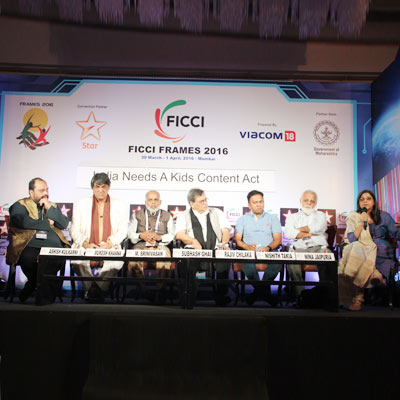
    MUMBAI: Even as a general consensus emerged on digitization being a boon, questions were raised at the ongoing FICCI FRAMES meet on whether the concept and advantages of the concept have been fully understood.

    Even as the TV industry has leapfrogged to more than 800 channels, and Indian Pay TV made the leap from analogue to digital and travelled from single to multi-platforms, the session on ‘Future Proofing Broadcast Distribution’ showed there are still some apprehensions on how the new technology can be used.

    The panelist included Times Network MD& CEO MK Anand, Ortel Communication CEO Bibhu Prasad Rath, Indusind Media and Communication MD & CEO Tony D Silva and Microsoft Corporation India Microsoft Azure and server business country head Srikanth Karnakota. The session was moderated by Zee Network president (Legal & Regulatory) Avnindra Mohan.

    Mohan set the ball rolling with a perplexing question on whether the industry had fully understood the implications of ditigization and convergence and whether stakeholders realized that they can use the same network for delivering different content through different modes of mediums. Thus, he said it shows a paradigm shift in the entire gambit of the distribution system.

    “Digitization has been a boon for the broadcast industry. From the broadcaster point of view, digitization started when the Direct to Home (DTH) system launched in 2003 in India. English news and other English general entertainment channels were being treated as the outsiders for the broadcast business. We had 65 million viewers in English from 2000 to 2005 whereas the total number of television viewers was 400 million. The number of English viewers has grown to 200 million now and that happened because of digitization,” says Anand.

    Anand added that in the next five to ten years, the English entertainment viewership should cross 300 million which is almost close to Hindi general entertainment channels viewership due to digitization.  “Times Now has a very strong and loyal audience in a month we cross the viewership of two and half crores but people don’t know that we have 13 crores of viewers on New Media platform,” informs Anand.

    Being a multi-system operator sharing views on the kind of business opportunities Ortel Communication can have in such a scenario, Rath felt India has grown in a unique fashion for the last two decades but the quality of the networks has been compromised. “The Set Top Box is not a solution to a network and we need to handle Phase III and IV in a different manner and not as Phase I and II”, he added.

    Noting that “we in India do not have one definition for Digitisation.It has been portrayed differently by others”, D’silva asked what the country wanted to achieve through digitization. “I believe there should a national objective about what they want to achieve from digitization. In most the industry today including DTH, 50 per cent of revenue goes in tax”. He felt progress was difficult unless the tax was supportive, but this was not going to happen. “It is the MSOs who are putting up the money and buying the STBs. So there has to be a logical regime of taxation. The STB is the only starting point of digitization. There should be an environment where technology and digitization should go hand in hand,” he felt.

  • FICCI Frames 2016: Digitization is a boon, but subject to how it is utilized by all stakeholders

    FICCI Frames 2016: Digitization is a boon, but subject to how it is utilized by all stakeholders

    MUMBAI: Even as a general consensus emerged on digitization being a boon, questions were raised at the ongoing FICCI FRAMES meet on whether the concept and advantages of the concept have been fully understood.

    Even as the TV industry has leapfrogged to more than 800 channels, and Indian Pay TV made the leap from analogue to digital and travelled from single to multi-platforms, the session on ‘Future Proofing Broadcast Distribution’ showed there are still some apprehensions on how the new technology can be used.

    The panelist included Times Network MD& CEO MK Anand, Ortel Communication CEO Bibhu Prasad Rath, Indusind Media and Communication MD & CEO Tony D Silva and Microsoft Corporation India Microsoft Azure and server business country head Srikanth Karnakota. The session was moderated by Zee Network president (Legal & Regulatory) Avnindra Mohan.

    Mohan set the ball rolling with a perplexing question on whether the industry had fully understood the implications of ditigization and convergence and whether stakeholders realized that they can use the same network for delivering different content through different modes of mediums. Thus, he said it shows a paradigm shift in the entire gambit of the distribution system.

    “Digitization has been a boon for the broadcast industry. From the broadcaster point of view, digitization started when the Direct to Home (DTH) system launched in 2003 in India. English news and other English general entertainment channels were being treated as the outsiders for the broadcast business. We had 65 million viewers in English from 2000 to 2005 whereas the total number of television viewers was 400 million. The number of English viewers has grown to 200 million now and that happened because of digitization,” says Anand.

    Anand added that in the next five to ten years, the English entertainment viewership should cross 300 million which is almost close to Hindi general entertainment channels viewership due to digitization.  “Times Now has a very strong and loyal audience in a month we cross the viewership of two and half crores but people don’t know that we have 13 crores of viewers on New Media platform,” informs Anand.

    Being a multi-system operator sharing views on the kind of business opportunities Ortel Communication can have in such a scenario, Rath felt India has grown in a unique fashion for the last two decades but the quality of the networks has been compromised. “The Set Top Box is not a solution to a network and we need to handle Phase III and IV in a different manner and not as Phase I and II”, he added.

    Noting that “we in India do not have one definition for Digitisation.It has been portrayed differently by others”, D’silva asked what the country wanted to achieve through digitization. “I believe there should a national objective about what they want to achieve from digitization. In most the industry today including DTH, 50 per cent of revenue goes in tax”. He felt progress was difficult unless the tax was supportive, but this was not going to happen. “It is the MSOs who are putting up the money and buying the STBs. So there has to be a logical regime of taxation. The STB is the only starting point of digitization. There should be an environment where technology and digitization should go hand in hand,” he felt.