Tag: missed call

  • Tata Sky targets DAS Phase III areas with celebrity driven ad campaign

    Tata Sky targets DAS Phase III areas with celebrity driven ad campaign

    MUMBAI: In a bid to capture a chunk of analogue cable users in Phase III areas of Digital Addressable System (DAS), direct to home (DTH) platform Tata Sky has launched a celebrity driven ad campaign to generate awareness about digitisaton.


    The ‘Missed Call’ ad campaign, which features actors Kangana Ranaut and Dhanush, aims to bring on board customers who are still on analogue cable.


    With this campaign, Tata Sky is looking to target the 40 million households residing in 7,000 towns and cities, which will now witness the next phase of digitisation.


    Tata Sky CCO Malay Dikshit said, “When we asked new Tata Sky subscribers on what motivated them to come aboard our platform, they gave us some brilliant insights on why they saw great value in getting Tata Sky at home. This campaign presents these insights in simple and direct narratives delivered through rooted and relatable characters played by Kanagna and Dhanush, both fine actors. This is our initiative to drive digitisation in DAS III markets.”


    The series of three ad films with each actor, leaves viewers with a sense of realisation and a smile. It also highlights payment flexibility options such as daily recharge and various monthly subscription packs.


    The ‘Missed Call’ campaign launched in the South with Dhanush is targeting 1200 towns that have been identified under DAS III and have the least DTH penetration. Tata Sky offers a range of innovative offerings and has been expanding its bouquet of channels across regional languages.


    Commenting on the thought process behind the new communication, Ogilvy India ECD Sukesh Nayak said, “Tata Sky is the segment leader who is known for innovation and redefining the sector with its value propositions. The hard hitting, single take talkies are delivered by Kanagna and Dhanush, who play an average Indian consumer, who are delighted with a Tata Sky connection at home.”


    Ensuring its reach is extended to the hinterland, Tata Sky has launched the campaign in 11 languages namely Hindi, Marathi, Gujarati, Punjabi, Assamese, Odiya, Malayalam, Telugu, Tamil, Kannada and Bengali as well as in four dialects namely Manipuri, Bhojpuri, Marwadi and Tulu.


    The ‘Missed Call’ marketing campaign includes TV, print, outdoors, cinema halls and radio.

  • IPL & Twitter launch new initiatives to enhance user experience

    IPL & Twitter launch new initiatives to enhance user experience

    MUMBAI: Continuing from their partnerships in 2013 and 2014, the Indian Premier League (IPL) and Twitter have come together for the eighth season to bring new products and experiences to enhance the cricket viewing experience for fans around the world.


    Cricket enthusiasts and IPL aficionados, who are online or offline, watching on any type of device or screen, those on the Twitter mobile app, desktop web to SMS will all be able to participate in the festival this year.


    Speaking about the partnership, IPL governing council chairman Rajiv Shukla said, “IPL has always strived to put fans first. The evolution of our partnership with Twitter means that this season will be even more accessible to fans with real-time, interactive experiences both online and offline.”


    Highlights of the initiatives launched are as follows:


    IPL Hashflags


    Waving the flag for your team has never been easier, as IPL will become the first sports league in the world to use hashflags on Twitter. “Hashflags are a fun and easy way to add some colour to tweets, and IPL fans on Twitter who use their favourite team’s hashtag will see that team’s flag appear after the text. The official hashtags for Hashflags are #IPL, #CSK, #DD, #KKR, #KXIP, #MI, #RCB, #RR and #SRH,” informs BCCI secretary Anurag Thakur.


    Missed Call to follow IPL


    In another global first, IPL will become the sports league that debuts the opportunity for sports fans to stay connected to their Twitter account via missed calls. Fans, who give a missed call to IPL on 011 3008 2008, will receive up to six tweets per day from @IPL that contain the hashtag #live as SMS. This service is free and will make the IPL even more accessible for fans as they can get Twitter updates from IPL even without an Internet connection.


    IPL Timeline 


    With BCCI having introduced cricket timelines on Twitter, a special IPL Timeline has been created within all of Twitter’s platforms, from iOS to Android and also twitter.com. The two distinct timelines, one each for the tournament and live games, which will give fans all they need to know, from IPL to the fans, experts to the teams. Game timelines can be found by using match specific hashtags like #KKRvMI, #CSKvDD, #KXIPvRR, #CSKvRR. Users will also be to tweet with the tournament and match hashtags from right within this timeline. For mobile, this experience is available to all users who have updated to the latest version of the Twitter app.


    IPL tweet-Wall-of-Fame


    The IPL tweet Wall of Fame will give fans an opportunity to be seen by viewers watching the IPL around the world. The IPL will select the best tweets from users tweeting with #PepsiIPL and showcase them in the live global TV broadcast of every match. Fans whose tweets are showcased on air will then receive a tweet from @IPL with the screenshot of their tweet going on live TV. These tweets will also be featured on a dedicated IPL tweet-Wall-of-Fame page on iplt20.com


    IPL Q&As on Periscope


    Innovating with live mobile video broadcast, IPL will also take fans behind-the-scenes like never before with surprise, real-time Q&As. Fans on iOS will be able to watch and type in questions to their favourite players and commentators as they engage with them from the IPL Periscope account.


    IPL #OrangeCap and #PurpleCap


    In the latest season of the IPL, fans will also have the opportunity to tweet and create their own #PurpleCap and #OrangeCap leaderboards by using #PepsiIPL and #<Player’s last name> or his Twitter handle. The results will be displayed in real-time on a special leaderboard in the IPL on Twitter section of iplt20.com from the end of Week 1 to the end of the season.


    Twitter India and Southeast Asia market director Rishi Jaitly said, “The IPL has led the way with cutting edge innovations and we are thrilled that they are giving Twitter users the opportunity to consume and engage with such premium content and content participation experiences again this season. It is a reflection of their commitment to reach and engage a mobile, global fanbase across all screens and devices.”

  • Missed call from FB will accelerate digital engagement: Valerie R Wagoner

    Missed call from FB will accelerate digital engagement: Valerie R Wagoner

    It was in April that Facebook announced that it had 100 million active users in India, and was aiming at touching the one billion landmark. The social networking site which now has an established subscriber base, is looking at launching more ad inventories. The latest from its kitty is the missed call ad product, which according to Facebook has already started generating some buzz.  


    The announcement of this new ad format had come at a time when Facebook COO Sheryl Sandberg was visiting India hobnobbing with government officials, and small and medium business owners.


    Facebook has partnered with ZipDial, a Bangalore based mobile agency for this. Indiantelevision.com’s Priyanka Nair speaks to ZipDial founder and CEO Valerie R Wagoner at length to understand the mobile marketing ecosystem in India, partnership with Facebook, the agency’s journey and much more.


    How has marketers’ demand from mobile marketing changed in recent years? 


    In emerging markets where the vast majority of consumers are still not online and still pay for things in cash, there is exceptionally little data on consumers and their preferences and behaviours. However, only this year, marketers we work with, are ready to embrace a comprehensive data strategy.


    Four years ago at the end of 2009 when we started ZipDial, marketers were barely getting comfortable with using the mobile at all, and it was an era of small experiments. By around two-three years ago in early 2012, using the mobile for media activations had become an industry standard. By now, marketers are truly embracing both, bridging offline-to-online consumer experience over the long-term, and driving a real business impact from data and analytics.


    You have been in the business for four years. How were the initial days?


    The idea for ZipDial was born from a brainstorming session between Sanjay Swamy (now chairman of ZipDial) and me on a late night flight back to Bangalore from New Delhi. Over next couple months, we fine tuned the idea further with as many as 600 varied user cases.


    The idea just stuck, and within a few more weeks, we had launched a minimum viable product. I think the ideation and execution happened within a short time. But ideas are cheap. Anyone can have an idea. To be really successful, an entrepreneur has to be great at execution, to think strategically about how to drive real inflection points in the business, and have the stamina to see through. What was launched as a mere polling product, over time transformed into a full-fledged mobile marketing and analytics platform.


    ZipDial founder and COO Amiya Pathak and the tech brain created a prototype during IPL 2010 wherein users could give a missed call and get live cricket scores. With zero marketing, within a couple of months, millions of users were zipdialing millions of times a day. It took off completely word-of-mouth. That was the first sign of success. Shortly thereafter we cracked P&G Gillette as our first big client, and we never looked back.


    How did you partner with Facebook? Can you elaborate on how the partnership will work?


    We launched the Facebook-ZipDial missed call ad product with Facebook as its partner for emerging markets (only company in the world). We collaborated and drove conception, design, development, sales, and analytics. In fact, given that the vast majority of the engagement happens on ZipDial after the user clicks on the Facebook ad, we have a lot of interesting data comparing performance across different media as well as performance between Android and feature phones.


    The purpose of the Facebook-ZipDial ad product is to create online-to-offline engagement and driving results. Facebook can track to the level of a click and online engagement. Upon user dialing, ZipDial takes over the consumer experience to drive actual outcomes in the offline world via retargeting, for example reminders to the user encouraging them to buy a product, visit an outlet, watch a particular TV channel, download particular content or an app, etc. Everything is 100 per cent permission-driven by the user and is targeted to them.


    We also need to track performance of Facebook v/s other media channels because ZipDial integrates across all media channels, including print, TV, OOH, and non-Facebook digital ads. We can track which media drives higher RoI for the advertiser.


    To put this in simple words, Facebook is the media where the ad is displayed. The user clicks on the ad. As soon as the user responds to the ad, it bridges from Facebook into a 100 per cent ZipDial experience.

    Coca-Cola (Coke Studio), L’Oreal (Garnier Men), P&G (Gillette), Mondelez (Cadbury Dairy Milk), Disney Channel and Nestle are a few campaigns that have used the inventory so far.


    We also need to give a performance analysis across media. This includes results from analysing the cost effectiveness of each media in terms of driving unique user acquisition. The metric used is user acquisition cost = spend on media / number of unique users who engaged from that media, averaged across all client campaigns.


    It can be noted that digital (including Facebook and non-Facebook digital) performed 10.40 times better than print and Facebook performed 3.02 times better than non-Facebook digital ads.


    How does the Garnier Men campaign for which Facebook has partnered with you work?


    Garnier Men had been for long planning to run a campaign with ZipDial for print and digital media. ZipDial designed and implemented the campaign on the platform in order to drive engagement with brand content around IPL 2014. The ZipDial campaign for Garnier Men was planned well in advance.


    Luckily the Facebook-ZipDial product was launched in time such that Facebook could also become part of L’Oreal’s marketing plan for the Garnier Men campaign. The results have been phenomenal with the Facebook-ZipDial ad performing 16 times better in terms of RoI than the same ZipDial integration with Garnier’s Print Ads.


    What according to you makes a campaign hit on mobile?


    There are many reasons. But, one of the major reasons is that today almost 100 per cent of all emerging market consumers have mobile phones. There is an ease of use in the design format that makes it a single click transition from online to offline in a seamless and user-friendly manner.


    Mobile is the unique ID for the customer. Even when consumers bridge from the on-Facebook experience to an offline experience such as watching a TV show or purchasing a product, there can be an offline-engagement in a targeted way.


    What are the key things that brands should keep in mind to build a healthy social conversation? 


    We strongly believe in the six best practices for social and mobile activations. One, know your customer; a visit from an anonymous user is not enough. All engagement should be verified and known-user engagement so that the brand can personalise the experience later.


    Two, don’t lose your customer, use re-targeting and follow-up engagement, don’t just make it a one-off transactional experience. However, never ever spam your consumers, and always make the experience permission-driven and privacy protected. Three, there is simplicity in the call-to-action, do not overwhelm consumers with too many options. Give them one single compelling message and way to engage.


    Four, there is multiplicity after the call-to-action. Target your response to users on a personalised basis in terms of content and interface. No two users with different profiles should receive the same content/interface. Five, it allows to measure your media. Never run a campaign without the ability to track and measure response rates and RoI. This applies across all digital and traditional channels, including print, television, etc.


    Six, every media can go viral, including offline. Never miss an opportunity for a viral campaign. ZipDial achieves between 60-400 per cent increase in reach of media through viral campaigns even when the only media used is offline traditional media. This improves RoI immensely.


    Mobile being a personal medium, there is a lot that a brand needs to keep in mind before making that one missed call. How do you make sure that a user doesn’t hang up?


    The ZipDial platform does all the hard work automatically for the brand. Marketers only need to think about what their brand benefits and the message they want to get. The ZipDial platform does all of the hard work in analysing data and results, profiling users based on preferences and behaviours, and automatically delivering the right personalised message to the right user at the right time, and even through the right user interface (i.e. voice, text, WAP, Apps).


    ZipDial always puts the consumer’s interests and the consumer’s privacy first. If this is broken, then ultimately it reflects poorly on the brand. Conversion rates on ZipDial campaigns are between 9-45 per cent compared to industry standard conversion rates of less than 0.5 per cent. Users trust the privacy-protected and personalised ZipDial experience and therefore stay more engaged.


    Typically how does ZipDial help a brand to roll out its mobile campaign?


    ZipDial keeps a close watch on the needs and trends in the market before advertisers even realise it themselves. We invest in developing our engagement, retargeting and analytics to keep the industry move forward.


    We also work closely with all for brand marketing as well as for trade marketing. Our focus is also to integrate our advanced platform into their overall consumer loyalty, data and marketing strategies. We work hand-in-hand with our most forward thinking marketers and then replicate and scale the solutions across the industry.


    How has H1 of 2014 been for Digital ZipDial?


    ZipDial has already more than doubled its revenue run rate in the first quarter of the financial year. We look forward to working further with clients about their comprehensive mobile, data and loyalty strategies.


    What is at top of your wish list for 2014? 


    Taking ZipDial’s innovative platform global is one of our main priorities for this year. We have already started to expand into the rest of Asia, but we are even more excited to take our expansion further into Africa very soon.
  • Missed call? It might be Facebook calling India

    Missed call? It might be Facebook calling India

    MUMBAI: Missed call: most of us have used it at some time or the other to connect with our friends when we are low on our mobile phone balance on our low end feature phones. Now Facebook is hoping to rake in the moolah courtesy this quirky habit amongst India’s light walleted mobile users.

    It announced a new ad format based on the missed call habit this morning through a post by its emerging markets ad products specialist Kelly MacLean.

    Describing it she writes:   “When a person sees an ad on Facebook they can place a “missed call” by clicking the ad from their mobile device. In the return call, the person will receive valuable content, such as music, cricket scores or celebrity messages, alongside a brand message from the advertiser — all without using airtime or data.”

    Facebook says 66 per cent of the 100 million or so of its users in India access the social networking site on their low-end feature phones using 2G services. Despite India being its second largest market, it contributed only Rs 75 crore to its top line last year, according to online site Quartz.

    “That’s a teeny-weeny fraction of its total global revenues of $5.49 billion (around Rs 33,000 crore),” says a media observer. “And it clearly needs to get India to generate more greenbacks.”

    Facebook says it has been testing the missed call ad product in India for sometime now and it has generated some success. It expects to give it a further push in the next few months as it rolls it out to advertisers.

    Among the advertisers which have used it is Garnier Men- a L’Oreal brand –  during the recently concluded cricket mega success, the IPL, from April to May 2014, says Facebook in  a case study it has published online.

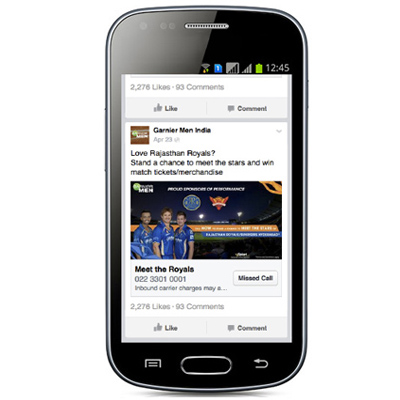
    As part of the campaign, photo ads were placed on News Feed, targeting men between15-35, asking them to click to call for a chance to meet players from the Rajasthan Royals and win match tickets or official merchandise.

    “When someone clicked on the ad unit, a number was auto-populated in their phone dialer and a number was called. The call then dropped after a couple rings and the caller received an SMS with trivia questions to answer to enter the contest. The caller was also presented with a Flipkart link to purchase products,” Facebook says in the Garnier case study. It had partnered with Bengaluru based missed call services provider ZipDial for the promotion. 

    The social networking platform says the campaign saw Garnier achieve its goal of reaching 15 million of the target audience. 16 times more calls were generated from the Facebook missed call ad unit  than all other digital and print media combined, and its sales rose a claimed two and a half times year on year.

    Garnier general manager Rupika Raman had this say about the test: “When we were approached by Facebook to become the first brand globally to take part in the click to missed call innovation, we were excited to try it out. It has reaped rich dividends and has been highly impactful.”

    Facebook has partnered with India’s largest mobile phone service provider Airtel, and missed call platform provider ZipDial, as it begins rolling out the new ad unit in India.

    The site says that it will soon start offering features such as life-stage targeting (new moms and dads, graduation moments) to advertisers, while it has already started offering geo-targeting options wherein advertisers can target people by state or even multiple states in India without having to list multiple cities.

    And to get around the doubting Thomases about its efficacy as an ad medium it has partnered with Nielsen to serve polls to people on feature phones. “Our new measurement solution provides advertisers with greater tools to measure brand sentiment, purchase intent and ad recall for the first time on mobile as well as desktop,” Facebook has highlighted in the post.

    The announcement of the new ad format has come at a time when Facebook COO Sheryl Sandberg is visiting India hobnobbing with government officials, and small and medium business owners.

    (Pix courtesy: Facebook)