Tag: MIPJunior

  • MIPJunior: Can Indian animation make its mark?

    MIPJunior: Can Indian animation make its mark?

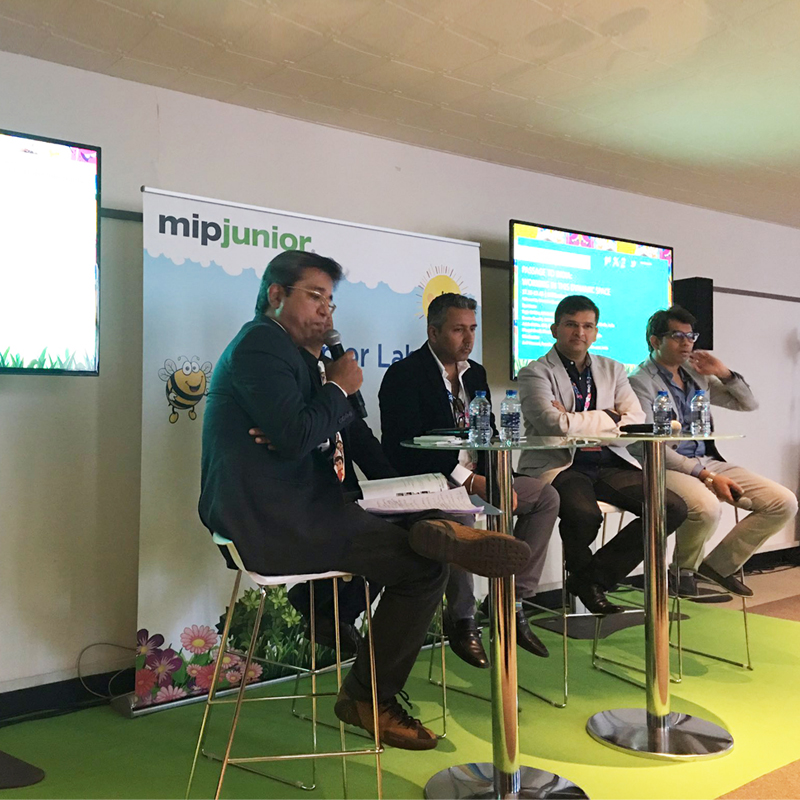
    CANNES: As the MIPJunior Lab got filled with an inquisitive audience, “The Passage to India” session began with the moderator, Indiantelevision.com founder, CEO and editor-in-chief Anil Wanvari, giving facts and figures about the kids broadcasting space in India.

    Wanvari started off by mentioning the humungous size of the 0-14 year population group – at 350 million at last count, which is expected to touch 375 million or so by 2020. Which is why the Indian market is attractive, he pointed out for kids programming and animation. Highlighting statistics from 2015 data, he stated that localization is helping the 20-plus kids channels operating in India up the local-international ratio from 10:90 to 80:20. With that wide a ratio and language dubs of each channel, content from the US dominates the television market with about 44 per cent, Japan 17 per cent, India 16 per cent, the UK and France four per cent, Canada one per cent; and if compared to statistics of 2014, it was 42 per cent, 17 per cent, 13 per cent, seven per cent and four per cent, three per cent, respectively.

    These statistics clearly paint the picture of how locally produced shows are being favoured not just by the audience but also the broadcasters. The top six to eight spots of the kids genre are occupied by locally produced programmes such as Motu-Patlu and Chotta Bheem, among others.

    Wanvari pointed out that kids genre accounts for six minutes per cent of total viewership and most of the kids content is in animation format the production cost of which per 30 minutes is between Rs 1.5 to six million.

    After introducing the panelists – Green Gold Animation founder and CEO, Rajiv Chilaka, Viacom18 Digital Ventures COO Gaurav Gandhi, Cosmos-Maya founder, Anish Mehta, and Graphiti Multimedia director and COO Munjal Shroff, Wanvari threw the question to the panelists asking what makes the prospects of the Indian animation sector so bright this time around; earlier attempts have failed.

    He also queried them about how the Indian animation space has changed over the years, in which areas are the opportunities available for international players, and what content works for broadcasters and digital platform for kids.

    Chilaka mentioned, “Back in 2001, there was only one channel catering to kids segment and now, there are 25-plus channels which showcase content produced locally as well. Over the years, the quality of animation, the technology, the services provided all have improved, and to support that, are the increased budgets.”

    Speaking about the international market, Shroff commented, “Through our show ‘Kulveera’, we did a case study with Cartoon Network UK wherein we produced a pilot episode and gauged the response of the audience and it was interesting to see that kids loved the show.” So, as long as one’s series has a strong storytelling going on, the place from where the content originates hardly matters.

    Mehta’s animation studio Cosmos-Maya has been doing wonders and, at present, has three co-production deals going on. “Our co-production deals are with Italian, French and German companies. We will be launching the French co-produced show ‘Captain Cactus’ which was made in association with Euope’s well-known film maker Olivier Jean-Marie,” expounded Mehta.

    “Over the period of 20 years, our work has evolved from being a service company to IP production, and finally we are at a stage where we can co-produce.”

    With the advent of digital platform, and Voot being probably the biggest kids SVOD service, Gandhi added, “It’s said that, in next three years, more homes will be have the streaming device than television sets. We are an open market, and ready to buy any good content.”

    Mehta also stated that, for co-productions to work, it’s necessary that one needs to understand the demographics. “Personally, after doing research, we follow a mixed model which blends well with both the countries.

    Since ‘Captain Cactus’ is a co-production between India and Europe, the animation style and narrative is set according to the tastes of audience of both the countries.”

    The session was wrapped up with Q&A round wherein many people were interested in learning more about how can they work with not just Indian animation studios but also on how their content can work across the various platforms.


  • MIPJunior: Can Indian animation make its mark?

    MIPJunior: Can Indian animation make its mark?

    CANNES: As the MIPJunior Lab got filled with an inquisitive audience, “The Passage to India” session began with the moderator, Indiantelevision.com founder, CEO and editor-in-chief Anil Wanvari, giving facts and figures about the kids broadcasting space in India.

    Wanvari started off by mentioning the humungous size of the 0-14 year population group – at 350 million at last count, which is expected to touch 375 million or so by 2020. Which is why the Indian market is attractive, he pointed out for kids programming and animation. Highlighting statistics from 2015 data, he stated that localization is helping the 20-plus kids channels operating in India up the local-international ratio from 10:90 to 80:20. With that wide a ratio and language dubs of each channel, content from the US dominates the television market with about 44 per cent, Japan 17 per cent, India 16 per cent, the UK and France four per cent, Canada one per cent; and if compared to statistics of 2014, it was 42 per cent, 17 per cent, 13 per cent, seven per cent and four per cent, three per cent, respectively.

    These statistics clearly paint the picture of how locally produced shows are being favoured not just by the audience but also the broadcasters. The top six to eight spots of the kids genre are occupied by locally produced programmes such as Motu-Patlu and Chotta Bheem, among others.

    Wanvari pointed out that kids genre accounts for six minutes per cent of total viewership and most of the kids content is in animation format the production cost of which per 30 minutes is between Rs 1.5 to six million.

    After introducing the panelists – Green Gold Animation founder and CEO, Rajiv Chilaka, Viacom18 Digital Ventures COO Gaurav Gandhi, Cosmos-Maya founder, Anish Mehta, and Graphiti Multimedia director and COO Munjal Shroff, Wanvari threw the question to the panelists asking what makes the prospects of the Indian animation sector so bright this time around; earlier attempts have failed.

    He also queried them about how the Indian animation space has changed over the years, in which areas are the opportunities available for international players, and what content works for broadcasters and digital platform for kids.

    Chilaka mentioned, “Back in 2001, there was only one channel catering to kids segment and now, there are 25-plus channels which showcase content produced locally as well. Over the years, the quality of animation, the technology, the services provided all have improved, and to support that, are the increased budgets.”

    Speaking about the international market, Shroff commented, “Through our show ‘Kulveera’, we did a case study with Cartoon Network UK wherein we produced a pilot episode and gauged the response of the audience and it was interesting to see that kids loved the show.” So, as long as one’s series has a strong storytelling going on, the place from where the content originates hardly matters.

    Mehta’s animation studio Cosmos-Maya has been doing wonders and, at present, has three co-production deals going on. “Our co-production deals are with Italian, French and German companies. We will be launching the French co-produced show ‘Captain Cactus’ which was made in association with Euope’s well-known film maker Olivier Jean-Marie,” expounded Mehta.

    “Over the period of 20 years, our work has evolved from being a service company to IP production, and finally we are at a stage where we can co-produce.”

    With the advent of digital platform, and Voot being probably the biggest kids SVOD service, Gandhi added, “It’s said that, in next three years, more homes will be have the streaming device than television sets. We are an open market, and ready to buy any good content.”

    Mehta also stated that, for co-productions to work, it’s necessary that one needs to understand the demographics. “Personally, after doing research, we follow a mixed model which blends well with both the countries.

    Since ‘Captain Cactus’ is a co-production between India and Europe, the animation style and narrative is set according to the tastes of audience of both the countries.”

    The session was wrapped up with Q&A round wherein many people were interested in learning more about how can they work with not just Indian animation studios but also on how their content can work across the various platforms.

  • Exploring Indian kids’ content opportunities at MIPJunior

    Exploring Indian kids’ content opportunities at MIPJunior

    CANNES: The world’s kids programming screenings and conference MIPJunior is slated to commence today 15 October at the prestigious Hotel Martinez in Cannes. The little French Riviera village was under heavy black cloud cover the whole of 14 October and a constant drizzle through the day forced everyone to bring out their brollies and their rain jackets.

    But that won’t be necessary today and the next three to four days. Reason: the weatherman has forecast that the weekend is going to be mostly sunny through to Monday.

    The sunny weather is expected to encourage some brisk meetings, conferences, workshops, keynotes, panel discussions, networking through the day at the famed Hotel. And of course champagne, wine is expected to overflow through the day at the lunches and in the restaurants as the world’s top animation and kids content executives huddle together to figure out what the world and their distribution platforms are going to look like in the coming few months.

    One session that is being watched with increasing curiosity is in the MIPJunior Lab at 17:15 pm on 16 October Titled Passage to India: Working in this dynamic space, it is being moderated by Animationxpress.com and Indiantelevision.com founder, CEO and editor in chief Anil Wanvari.

    India’s top animation studio heads – Rajiv Chilaka of Chhota Bheem and Green Gold Fame, Anish Mehta of Motu Patlu and Cosmos Maya renown, Munjal Shroff of Graphiti Multimedia – and India’s only kids OTT platform Voot CEO Gaurav Gandhi – will be throwing light on how why it makes sense to look at the growing Indian kids market, and how international studios can make head room for themselves in India in the area of co-productions.

    “Indian animation is just waiting to explode on to the world stage,” says Wanvari – who also represents Reed Midem’s MipCom, MipTV, MIPJunior, MipCancun, and Mipim events for India, Pakistan, Sri Lanka, Bangladesh and Nepal. “We have the talent, the right stories, and even now the focus to make in India for the world with the Narendra Modi government laying an emphasis on it. An animation requires many partnerships for it to achieve global success. Through this workshop we want to demystify many notions or perceptions that the world community has about Indian studios and the kids content marketplace. Reed Midem and MIPJunior have been very supportive of India’s efforts to build a global IP in kids’ animation. If we succeed in enabling even one partnership or co-production or spark one such opportunity, we will have been successful.”

    Shall we say amen to that?

  • Exploring Indian kids’ content opportunities at MIPJunior

    Exploring Indian kids’ content opportunities at MIPJunior

    CANNES: The world’s kids programming screenings and conference MIPJunior is slated to commence today 15 October at the prestigious Hotel Martinez in Cannes. The little French Riviera village was under heavy black cloud cover the whole of 14 October and a constant drizzle through the day forced everyone to bring out their brollies and their rain jackets.

    But that won’t be necessary today and the next three to four days. Reason: the weatherman has forecast that the weekend is going to be mostly sunny through to Monday.

    The sunny weather is expected to encourage some brisk meetings, conferences, workshops, keynotes, panel discussions, networking through the day at the famed Hotel. And of course champagne, wine is expected to overflow through the day at the lunches and in the restaurants as the world’s top animation and kids content executives huddle together to figure out what the world and their distribution platforms are going to look like in the coming few months.

    One session that is being watched with increasing curiosity is in the MIPJunior Lab at 17:15 pm on 16 October Titled Passage to India: Working in this dynamic space, it is being moderated by Animationxpress.com and Indiantelevision.com founder, CEO and editor in chief Anil Wanvari.

    India’s top animation studio heads – Rajiv Chilaka of Chhota Bheem and Green Gold Fame, Anish Mehta of Motu Patlu and Cosmos Maya renown, Munjal Shroff of Graphiti Multimedia – and India’s only kids OTT platform Voot CEO Gaurav Gandhi – will be throwing light on how why it makes sense to look at the growing Indian kids market, and how international studios can make head room for themselves in India in the area of co-productions.

    “Indian animation is just waiting to explode on to the world stage,” says Wanvari – who also represents Reed Midem’s MipCom, MipTV, MIPJunior, MipCancun, and Mipim events for India, Pakistan, Sri Lanka, Bangladesh and Nepal. “We have the talent, the right stories, and even now the focus to make in India for the world with the Narendra Modi government laying an emphasis on it. An animation requires many partnerships for it to achieve global success. Through this workshop we want to demystify many notions or perceptions that the world community has about Indian studios and the kids content marketplace. Reed Midem and MIPJunior have been very supportive of India’s efforts to build a global IP in kids’ animation. If we succeed in enabling even one partnership or co-production or spark one such opportunity, we will have been successful.”

    Shall we say amen to that?

  • MipCom 2015: Combating nature’s fury, and winning

    MipCom 2015: Combating nature’s fury, and winning

    MUMBAI: The world’s largest TV content market Mipcom was hit by a freak storm and floods. It all started on Saturday 5 October when late in the evening what was predicted to be an evening of gentle rain, turned out to be three hours of a raging thunderstorm. Something that had not happened in 50 years. Seven inches of rain fell in one fell swoop. Some 20 people died, and cars were swept out to sea. 

    The Hotel Martinez where MipJunior (the kids content screening and conference) was being held was the most affected. It lost power because of the flooding, internet went off and its ballrooms were water logged. As were most of Cannes and its surrounding towns.

    Reed Midem, the organiser of MipCom and MipJunior acted fast. Overnight the MipJunior screenings and conferences were shifted to the higher levels of the Palais des Festivals.

    The Palais itself was hit by the storm. The basement area (P-1), which constitutes a large part of the exhibition area and where most of the Indian exhibitors are located, had patches, which were damaged courtesy the flooding. The management of the Palais des Festivals and Reed Midem’s operations executives worked through late Saurday night and Sunday to mop up the excess water, used drying machines, changed carpeting, to get the exhibition area spic and span.

    Came Monday morning and to the astonishment of exhibitors and participants, MipCom started on time. Almost as if the resort town had not faced a natural catastrophe. There were queues at the registration desk, and queues waiting to get into the exhibition area. The rest of Cannes, was however, struggling with some areas being without power, most without internet and telephone lines. And most bank ATMs and credit machines were not working.

    In fact, the mayor of Cannes, has made an appeal to the world of film, television and the rich to contribute to get Cannes back on its feet. The town and its businesses have suffered a loss of Euro 45 million courtesy the freak rain.

    During Mipcom business deals, and alliances were struck and TV premieres held. .Hollywood and British celebrities such as Dennis Quaid, Chris Carter, Lily James, Tuppence Middleton and Stephen Rea mingled with attendees after the screenings in the Grand Auditorium. The opening party was shifted to the Carlton Hotel from the Martinez and the red carpet, however, was canceled. Sponsored by Turkey, which was the country of honour or focus, it was one of Mipcom’s finest organised parties in recent times. The food and wine flowed till past midnight.

    Overall, 13,700 executives from 112 countries did make it to Mipcom, a record of sorts. More than 150 broadcasting, production, animation, digital, content distribution, and buyers and sellers from Pakistan, Bangladesh and Sri Lanka jetted their way to Cannes – a record number for the region this year. Each probably has his or her own story on what he/she did during the deluge. We present a first person account of what one such group went through during the storm and thereafter. Read on:

    The lightning shards continuously cut through the dark incessant rain as the 500 or so guests at MipJunior’s opening night inside the tent on The Martinez Beach in Cannes partied.

    They sipped away at their glasses of wine and munched away at the entrees, exchanging business cards on programming pitches – blissfully unaware that the French Riviera village was going through its worst thunderstorm in almost 50 years.

    As the clock ticked away, the gusts of wind grew stronger, and one such blast shattered a few wine glasses, the chandeliers overhead swayed. A couple of the lights went out. Then the water from the sea outside started seeping under the tent as the angry storm pushed the waves higher.

    Jackie – the event and operations in charge of Reed Midem was worried – as she – like Laurine and Jerome and most of us attending the world’s largest content market – had heard the metro department’s report that there would be rain – but the prediction was that it would be a passing shower. Not a continuous cloud burst on account of which the village and other surrounding ones would be inflicted with the equivalent of more than a month and a half of rain in just three hours.

    The situation was getting alarming as the rain, loud thunder, lighting and wind continued. Would the tent hold? The DJ had already been told to pack his console, the wine and food put away by the stewards. And the guests, who had thinned down to 200 odd by then,  had to be kept safe. Thus a decision was taken to evacuate.

    A warning shout went up: “The entire Croisette is flooded. I tried to cross but there’s too much water.”

    But evacuate we had to. So some of us took off our shoes and jackets, packed them in the Mask of Zorro bags, which the concierge provided us, rolled up our trousers, walked out of the tent. And indeed where earlier in the evening there was beach sand, all we could see was water. Carefully, we walked through it and up the stairs to the Croisette.

    What greeted us was a sea of water all through the main street of Cannes. We stepped into it and it reached up to our knees. And it was cold, bitingly cold. But gritting our teeth and with sheer disbelief in our hearts we trudged through it across the street to the famed Hotel Martinez – which has been home to the world’s biggest celebrities. Were we in Cannes the famed beach town of France to which the world flocks every summer? Or were we in some south east Asian country or in India where such flooding is rather common?

    As we reached the Martinez Hotel we heard there were no shuttles to ferry us across to our apartments or hotel rooms. And that we were on our own. We picked up a couple of hotel umbrellas and decided to make our journey home.

    Every street, by lane and tony street was flooded. To make matters worse, the village’s sewer and drainage system had spewed and vomited out all the waste – including feaces – which its denizens had earlier through the day dumped down commodes or waste disposal systems.

    Most of the by lanes leading to the Croisette were angry torrents of fast paced water through which it was very difficult to swim, forget about walking. And yet everywhere we looked there were executives – both men and women – plodding through the knee-deep water. It was a struggle, no doubt, but move everyone had to know because the water was chilling.

    Thankfully, there were no open manholes or sewers, but we were cautious nonetheless courtesy Mumbai’s dangerous streets during the monsoons every year.

    What was even more shocking was that expensive stores, hawking the most premium brands, which line the main street opposite the Croisette were hit by the water flowing down the streets towards the sea. Many of the stores were forced to garbage some of the goods, costing thousands of euros, which were damaged by the flowing waters.

    We waded through the water, taking care not to get clothes wet. Close to our apartment building, a SUV came racing, through the flooded street and the wave hit us as well as the restaurant, which was already knee deep in water. And all my efforts to keep my trousers dry came to naught.

    Even the apartment’s stairwell was flooded. But we made our way up and thankfully our flat had power, unlike others which went without any electricity throughout the night. We took quick hot showers and sipped hot cups of coffee and it was around 1 am that we managed to get some shuteye.


    Posted by Larysa Wanvari on Sunday, October 4, 2015


  • Localisation of content is key to tasting success in kids entertainment: MIPJUNIOR

    Localisation of content is key to tasting success in kids entertainment: MIPJUNIOR

    CANNES: The animation industry globally is going through a renaissance period, wherein we get to see many success stories from not just the larger well known studios like Walt Disney, DHX Media and DreamWorks Animation, but also smaller mushrooming studios who believe in creating content that is true to the roots of the country of their origin, but still hold great promise in the global front.


    In a session at MIPJUNIOR 2015, this was precisely what was closely looked at. Titled – ‘How to make it in the global market, the session saw a mix of content creators who are involved in not only creating original content but also taking the IP ahead into various other touch points and giving their IPs a 360 degree presence.


    The most pertinent question today is: How do you evolve from a local independent producer into a highly-influential studio developing global-appeal animation brands across multiple platforms This aspirational and practical workshop attempted in providing actionable takeaways for some of the successful producers.


    Moderating the panel was Christophe Erbes, a consultant for kids media. He was accompanied by panelists Henry Becket from Ideas at Work, a studio outfit of UK, with Victor Migel from Anima Kichent and Nazli Guney Uysal from Dusyeri Animation Studio.


    Becket had a few interesting stats to share to kick off proceedings, when he stated that 1 of 100 concepts actually make it to the pilot stage, 1 of those then go onto become a series and further on 1 of those 100 series gets a multi-season deal and 1 of the popular children’s property then gains the status of a brand.


    Uysal, on the other hand, shared the journey of her studio, which in the last seven years has grown to become a 90 man strong team providing 360 degree solutions for not just their own properties but for their clients as well.


    ”We began with the idea of creating original content to fill the void, which was present in the Turkish broadcast space and that is precisely what we achieved through our stories and characters,” Uysal said. On the question of overcoming resistance from kids’ broadcasters for local content, she added, ”We did face a tough time initially, but when the public broadcaster was looking to promote locally created content, we grabbed the opportunity with both hands and what followed is other kids broadcasters lining up to license our content for their channels.” 


    This is precisely what the Indian kids entertainment space needs to take inspiration from as currently with a publishing house, licensing arm and two animation studios, Dusyeri Animation Studio is enjoying revenue flows to the tune of a few million dollars annually.

  • ‘Peanuts Re-imagined’ at MipJunior 2014

    ‘Peanuts Re-imagined’ at MipJunior 2014

    CANNES: “We are looking closely at India,” said Peanuts Worldwide SVP media Kim Towner during the MipJunior keynote which focused on the glorious 50 years of Peanuts and the 65th anniversary of the comic strip. While Peanuts may make in-roads to India in the future, currently the important markets for it are Japan, China, Brazil and Germany, apart from the US and France. 


    The keynote themed: ‘Peanuts Re-imagined’ was moderated by author and consultant Christopher Erbes and was attended by France Télevisions executive director Julien Borde, Normaal Animation producer Alexis Lavillat and Towner. It focused on the new TV series, a huge theatrical premiere and many other innovative initiatives being undertaken by Peanuts.  


    The year is big for Peanuts which has restored its entire library to 4K quality for modern viewers. “We have re-signed the deal with ABC for five years,” announced Towner. Not only this, the company has done production deals with Fox and Blue Sky as well. Talking about the other developments, Towner said that Peanuts: The Movie, a 3D CGI animation will see its premier in November 2015. “With development budget of $100 million, the movie will be distributed in over 100 countries. Another $100 million will be put for marketing the property,” she said.


    With audience moving towards digital, Peanuts is also looking at partnering with a major gaming company. “We will announce the partnership soon,” added Towner. With this, Peanuts aims at building on the 15 million downloads of its existing apps. Currently, the animation sees one billion social media impressions in a year. “We see 1.8 million engagements at any given week,” she said, while adding that “2015 is the year of Peanuts.”


    Talking about its strategy on apps, Towner said that while currently most of the apps are games for kids, they do realise the diverse audience.


    The key to Peanut is to make it funny and heartwarming for kids. “We want to find humour for kids,” said Lavillat.


    Giving a background to the new show, which will be a seven minute episode, Borde said that Peanuts has been re-imagined, since family oriented programming is important for television today.

  • MipJunior 2014: Upfront funding from b’casters for kids’ programme on a decline?

    MipJunior 2014: Upfront funding from b’casters for kids’ programme on a decline?

    CANNES:  Producers in Asia and the MENA (Middle East and North Africa) are in for some trouble, if IHS Technology principal analyst TV Tim Westcott is to be believed. According to a study conducted by IHS Technology in 28 countries comprising a mix of producers and broadcasters, upfront funding is seeing a downward trend. While most producers still get funding from broadcasters before they get into production, overall, the producers in Asia and MENA are less likely to receive upfront funding.


    In the same study, while 58 per cent of the producers accepted that they still get upfront funding from broadcasters for children’s programming, 42 per cent of producers did not receive any such funding. The observations were shared during a session on ‘Kids and Multi Media’ on the first day of MipJunior.


    This apart, another key finding of the survey was that broadcasters today place strong emphasis on original programming in their budgeting. “More than half the broadcasters surveyed spend a majority of their budget on original programming. Not only this, one pubcaster spent 100 per cent of its budget on original programmes, while other broadcasters spend 80-85 per cent of their budget,” said Westcott.


    A majority (63 per cent) of producers expect broadcaster budgets to decline, while 9 per cent of those surveyed are still optimistic. Another point that came to the fore was that producers tend to not stream the programmes on their own sites. “People are not seeing a great deal of revenue coming from digital and certainly not enough to compensate from any decline they’re having from linear TV sales,” said Westcott.


    According to Westcott, episodes are more likely to be streamed on a third party site and then on the producer’s own site. Of those surveyed, 37.5 per cent of respondents still do not have their content online. “Over the top subscription like Netflix was cited as the most significant revenue stream for online content,” he added. This is followed by free to the end user streaming, supported by advertising.


    Kids are moving beyond linear television. With 34 per cent of British kids in the age group of 5 to 15 years, using smartphones and tablets to view content, linear TV could just be witnessing a downward trend. Westcott during his presentation said that kids in the US, UK, France, Netherlands, Sweden and Germany have shown a decline in linear TV viewing.


    So is digital making up for the losses caused due to decline in linear TV viewing? Answered TVE head of children’s content Santiago Fandino Lousa, “Things are changing year by year. Today, broadcasters face difficulty in formulating long term strategies. Kids today want the content they like, at the place of their choice.”


    While broadcasters may be facing difficulties, Hit Entertainment VP global productions and content Keenan Christopher is quite happy with the development. He said, “All of our content is character based. Kids find time to invest in these characters, regardless of the platform. For us, the second screen has become the first screen, which is good as there is decline in linear television viewing.” For Toca Boca VP brand and marketing Jonas Carlsson, second screen is highly immersive. 

  • The new Alisa`s adventures: the Russian animated series will be presented at MIPJUNIOR

    The new Alisa`s adventures: the Russian animated series will be presented at MIPJUNIOR

    MUMBAI: The new Russian children’s animated series by Bazelevs, (Riki grou) and Studio Moskva Alisa Knows What To Do! based upon the Kir Bulychov`s series Alisa’s Journey will be presented at the world’s showcase for kids programming MIPJUNIOR, which will take place in Cannes, France, on October 11-12, 2014.
    The animated series will be presented as a part of Russian Animation stand, organized by the Cinema Fund with the support of the Ministry of culture of the Russian Federation.

    In March of this year, Alisa Knows What To Do! was marked by a special award of the XIX Open Russian animation festival in Suzdal as the animated series with the highest international potential. The nomination was established by Reed MIDEM, the organizer of world`s markets of audiovisual programming – MIPJUNIOR and MIPCOM in Cannes (France). As a prize, the project team was awarded by an offer for the world`s showcase for kids programming in Cannes in October 2014. Here, the creators of “Alisa” are going to present to foreign buyers not only the animated series, but the full-length animation feature as well.

    Timur Bekmambetov, producer: “We hope the story about adventures of a common Moscow schoolgirl Alisa will be close and understandable for children from all over the world. There is no secret Kir Bulychov`s books have been translated into many languages and published in millions of copies. This story is about that age when kids hardly differ from each other. Therefore, to my mind “Alisa” undoubtedly has a great potential to make an immediate appeal to viewers in other countries. It’s really important for us the project to become a significant phenomenon both in Russian and around the world. And for this reason story must be highly amusing, funny, touching and sincere, what we are seeking”.


    Anton Malyshev, head of the Russian Cinema Fund: “A high valuation of the Russian project by international professional community will give an opportunity to draw attention not only to the concrete project, but also to the modern Russian animation in general. The Russian animation has already gained certain achievements at international markets and one of the strategic priorities of the Cinema Fund is supporting Russian full-length animation feature projects, which give to the Russian studio an opportunity to reach a new qualitative level and to draw the youngest kids` audience to cinemas, thus to generate sustained interest for a qualitative Russian animation programming”.


    Alisa Knows What To Do! series tells a story about fantastical adventures of Alisa and her four friends – 12-year-old schoolchildren, placed in the near future, in the year 2093. The series is filmed in 3D graphics. The first season is completed. It consists of 24 episodes. Currently the second season is being created. Co-production of the series by Bazelevs, the RIKI Group and Animation Studio Moskva with the support of the Ministry of culture of the Russian Federation. The artistic head of the project is the famous Russian-American director of animation cinema Igor Kovalev. Producers: Timur Bekmambetov, Ilya Popov, Elena Malenkina. Production of the full-length animation feature has started this autumn and is provided with the support of Cinema Fund on the terms of partially refundable financing. The release is scheduled for spring 2016. Producers: Timur Bekmambetov, directors: Olga Baulina and Viktor Gluhushin.


  • Lucy Smith named director of MIPDoc MIPFormats & MIPJunior

    Lucy Smith named director of MIPDoc MIPFormats & MIPJunior

    MUMBAI: Reed MIDEM today announced that Lucy Smith, director of conferences for Reed MIDEM’s Television Division, is named director of MIPDoc, MIPFormats and MIPJunior.


    In her new role, Smith will continue to manage all MIPTV and MIPCOM-related conferences in addition to developing MIPDoc, MIPJunior and MIPFormats.


    “Over the past seven years, Lucy has done an outstanding job producing conferences that are at the cutting-edge of the key issues facing the entertainment industry. She has been instrumental in attracting world class speakers and making our MIPTV and MIPCOM conference programmes an integral part of the event experience. She has been a key player in the launch of well-received competitions and screenings and her strategic understanding of the documentary, youth and format sectors makes her the ideal choice to develop MIPDoc, MIPFormats and MIPJunior,” comments Laurine Garaude, Director of Reed MIDEM’s Television Division.


    MIPJunior exists since 1993. It is the leading international conference networking and screening showcase for kids and youth programming. MIPJunior provides over 500 buyers with the chance to view more than 1,000 programmes and discover new projects that are seeking funding.The event takes place in October on the weekend prior to MIPCOM.


    Launched in 1998, MIPDoc is the world’s leading factual co-production, screenings and conference event held inApril on the weekend before. MIPDoc brings together factual programming producers and distributors with over 400 buyers who access in excess of 1,500 programmes and projects.


    MIPFormats is the only international conference, networking and screenings event dedicated to the fast-growing formats community. Launched in 2010, MIPFormats provides unique access to some of the main players in the format business as they discuss success stories and major trends. The screenings showcase the best and newest ideas in the format sector.