Tag: Mipcom

  • Nippon TV heading to Mipcom with new drama series, new entertainment series, and new format

    Nippon TV heading to Mipcom with new drama series, new entertainment series, and new format

    MUMBAI:  Marking the 10th Anniversary of its popular format Dragons’ Den (Shark Tank in the US), Nippon Television Network Corporation (NipponTV), the leading commercial broadcaster and network in Japan offering entertainment, anime, documentaries and news, announced today that the company will be heading to MIPCOM with a new drama series, Death Note (11 x 60’), a new entertainment series, MATSUKO-ROID (13 x 30’), and its newest format, the observational reality/game show The Kindergarten (13 x 30’). The announcement was made today by Yukiko Kimishima, Divisional President of International Business Development.


    “One of our key mottos at Nippon TV is ‘viewers come first’ and we are confident that these three news projects will be well received by our Japanese audiences, as well as viewers around the world for our format The Kindergarten,” commented Kimishima.  “We are also delighted to be celebrating the 10th Anniversary of our international format hit Dragon’s Den which continues to soar in both popularity and ratings in over 25 countries and regions.”


    The first title up for Nippon TV is Death Note which is based on the world-renowned comic book serialized between 2003 and 2006 that currently boasts over 30 million copies printed in Japan. This live-action drama series follows Light Yagami’s quest to kill off all criminals and create a world without bad people while using a notebook.


    Nippon TV – MIPCOM 2015 – New Titles2-2-2-2-2 known as Death Note.  The animation remake of this series has been broadcast and/or streamed in over 150 countries and regions and remains highly popular. In addition, two live-action movies and a musical have been produced, making it a truly multi-platform content. 


    Next up is the new entertainment series MATSUKO-ROID that marks the world’s first TV show where one of the hosts is an android.  The series features Japan’s most famous cross-dressing commentator Matsuko Deluxe and his life-size android Matsuko-Roid, made by cutting edge technology that was developed with the supervision of Professor Ishiguro of Osaka University. The android travels to various places, sometimes to rural areas far from Tokyo, and talks with local people. The real host in Tokyo is connected by Internet and shares his good advice with the locals. This program discusses what television and the world will be like when androids become mainstream.


    Rounding out the slate for Nippon TV is The Kindergarten, an observational reality/game show series.  The Kindergarten has been successful for over 17 years in primetime Japanese TV and is now being offered as a format for the first time. Utilizing fun tactics, including mysterious monsters, a quiz game, and on-camera confessions, this show captures the adorable moments of kids when cameras are placed in kindergarten classes revealing the sweet charms of children’s daily life through engaging games.

  • “You should never underestimate the power of good writing”: Namit Sharma

    “You should never underestimate the power of good writing”: Namit Sharma

    MUMBAI: Utilising his 15 years of experience across genres, he has created great programming for Zee TV. From broadcasting to content generation, it’s an amalgamation of several aspects.


    Here we are talking about Zee TV’s programming head Namit Sharma who with his creative thoughts has bought some best ideas to the table. For ‘The Content Hub’, indiantelevision.com had a quick chat to get his views on today’s story-telling and the power of story writers.


    According to Sharma, our stories are universal and emotion driven. “Of course”, comes a prompt reply from Sharma when asked whether Indian content has the ability to travel international. “It all depends on who’s selling it and who’s buying it.”


    He cites the example of MIPCOM, the global market for entertainment content across all platforms. “At MIPCOM, there are Latin American companies selling Telenovelas which get bought by Indian companies. The difference between what we do here and what they do there is, they market them better,” he says.


    According to him, the channel’s current offering Jamai Raja can easily travel internationally. On the contrary, he feels that a concept like Satrangai Sasural won’t be accepted abroad because it is culturally very sensitive.


    Finding good script writers is difficult in every genre and one needs to keep building talent pool that they want to work with.


    “We will never arrive at a time when we say ‘Oh! We are happy with the amount of good writing talent we have’. We will always be hungry for more. We will always keep on looking and creating,” he emphasises.


    He believes that one should never underestimate the power of good writing. “A lot of people look down upon GEC shows and the quality of writing on it, but what they don’t realise is that it takes equal effort to write these shows as it takes to write intelligent shows.” The GEC shows talk to the masses, more than the biggest Bollywood blockbuster.


    He believes that Indian content shifting its paradigm can mean different things to different people. “It depends on which viewer is asking the question. For some it might be ‘when they will only do crime thrillers’ or ‘stop doing saas-bahu soaps’ or ‘produce only love stories’. For us as broadcasters, the only relevant questions come from the audience. So we are happy to listen to their questions and answer them and that’s the crux of what we do,” says he.


    Zee TV was a pioneer in creating seasonal shows when it launched two seasons of Choti Bahu and Punar Vivaah. He feels that there must be seasonal shows, but nobody should be forced to do it because it is a fad or a trend. “One should do seasonal shows because they want to do it. Every story has its own destiny and fate and nobody should really judge somebody else’s work in the field of writing specifically with one uni-dimensional filter,” signs off Sharma.

  • “Unlike the west, we don’t have developed comedy genre”: Anooj Kapoor

    “Unlike the west, we don’t have developed comedy genre”: Anooj Kapoor

    MUMBAI: Think you can tell great stories? If yes, then here is your chance to meet the best from the industry and learn from them.


    The growth of the visual medium, from traditional television to online short format content to mobile TV content, has changed the way it is created and especially how it is consumed. Now, more than ever before, there is a constant need for new and exciting content, and as a result, a requirement of dynamic creators and scriptwriters.


    Bringing together writers, creators, producers, artistes and broadcast executives, both for TV and digital, Indiantelevision.com’s Content Hub aims to bridge that gap.


    The initiative is aimed at established professionals, newbies and anyone who is keen on taking the plunge into the fascinating world of writing, producing and creating for television and the digital space.


    In the first of the series, indiantelevision.com profiles a broadcaster, which has never shied away from taking risks that too in the space of comedy. Sab sr EVP and business head Anooj Kapoor talks about the scope of Indian content going international, the different kind of concepts the channel is looking for, the demand for good story tellers and much more.


    Sab, the only channel dedicated to comedy has given viewers popular shows like Taarek Mehta Ka Ooltah Chashmah, Chidiya Ghar, F.I.R and Lapataganj. But according to Kapoor it wasn’t an easy journey.


    He says that unlike the west, it is very difficult to create comedy in India. “Sab has become the first dedicated comedy channel on the Indian television space and that has only happened in the last five years and therefore we have to make do with whatever restricted but very talented bunch of people that are present in the comedy genre in television. Therefore, yes, it is difficult to tell interesting stories in the genre of comedy,” he pin points.


    Moreover, since it taken upon itself the challenge of doing daily comedies, the task has become doubly difficult. “However, not only are we able to sustain the channel with good quality content albeit with a very restricted talent pool but at the same time through our marketing initiatives like Chai Pe Chutkule we are trying to source fresh talent and expand the talent base. I hope that as we go along not only do we grow as a channel, not only does comedy grow as a genre but also the talent pool of comedy writers, actors, directors and producers also increases,” states Kapoor.


    To further engage with the audience and give them some little more of entertainment, it tried its stint with stand-up comedy with Tu Mere Agal Bagal Hai which ran for 60 episodes and got a decent response from the viewers.


    The channel can also be credited for bringing paradigm shift in Indian content, moving away from melodrama to light hearted family entertainment.  “And, within that, the fact when the rest of the GECs were talking about the negatives of the joint family system, Sab was talking about the positives of the joint family system,” explains Kapoor.


    He further goes on to say that in the recent times, more and more general entertainment channels (GECs) have realised and recognised that the saas-bahu genre is passé and therefore one sees a lot more new and fresh themes now being tried across other channels.


    Is there some fatigue setting in comedy? Kapoor reverts saying that on Sab, he ensures that whenever a fatigue is setting on a comedy show, it is immediately replaces it.  “This is why we have a robust product line up and as well as, perhaps, one of the few channels in the television space which launches fresh programs at regular intervals,” says Kapoor.


    Kapoor believes, the Indian content definitely has the potential to go international. The channel’s show Gutur Gu, a silent comedy, first of its kind produced on Indian television was successfully sold at last year’s Mipcom in Cannes to several countries.

  • Brisk sales for Rai Com’s TV and movie content at MIPCOM

    Brisk sales for Rai Com’s TV and movie content at MIPCOM

    MUMBAI: Rai Com’s MIPCOM sales have been moving at a brisk pace over the last few days, with many titles being picked up for significant territories.
     
    The market was especially strong for TV content. Season 1 and 2 of Anti Drug Squad was sold to MHZ (US), with negotiations ongoing for the Czech Republic and Croatia. In these last two countries, there is also strong interest in the series Rosso San Valentino and Una Buona Stagione.
     
    Rogers Omni TV (Canada) has acquired a large package of programming hours for two slots in Italian with English subtitles.
     
    The series Volare was sold to Russian Kultura TV. The Russian market also showed great general interest in period series.
     
    Inspector Montalbano and The Young Montalbano continue their success story all over the world. For both series as well as for the series Don Matteo, Rai Com is in promising negotiations with Strong Media as part of this group’s initiative to launch a new TV channel serving francophone Africa (Senegal, RDC, Ivory Coast).
     
    Movie rights have also sold briskly. The Mafia Only Kills in Summer by PIF was sold to YLE in Finland, HBO Eastern Europe, MTVA in Hungary and Czeska Televize in the Czech Republic. Finnish group YLE also acquired the rights to Viva La Liberta by Roberto And? and, straight from the Venice Film Festival, The Dinner by Ivano De Matteo.


  • MIPCOM 2014: What do buyers want in 4K?

    MIPCOM 2014: What do buyers want in 4K?

    MUMBAI: 4K is on everyone’s mind. Even when Indian direct to home (DTH) players, Videocon d2h and Tata Sky launched their 4K set top boxes (STBs), everyone questioned if there was enough content available in 4K. The same was discussed even at the just concluded MIPCOM 2014 at Cannes in the session ‘What do buyers want in 4K?’


    The session which saw Sky Deutschland EVP programming Gary Davey, France Télévisions director of future media Eric Scherer, Atlantic Productions director of operations Ruth Sessions and Red Bull Media House head of commercial distribution Bernhard Hafenscher speaking on the issue which was moderated by journalist & industry consultant Chris Forrester.


    Talking about the general prospect for 4K in the world, Davey said that a platform like Sky Deutschland is excited about the sea change that content is set to witness. “We will be very active on 4K. While we haven’t decided a launch date as yet, we are committed to it,” said Davey.


    What is interesting is that the take-up for 4K has outperformed even high definition (HD). So, is it the broadcasting push, the industry push or the consumer pull? Said Davey, “According to me, people just love the idea of big screen viewing with higher resolution.”


    For Sessions, content creators today are telling stories for multiple platforms and so a lot of them are filming it in 4K. Atlantic Productions has been filming in 4K for the past four years. “We have always been hungry for resolution and I believe in future proofing. So for the right projects, where we thought that stories that we are saying today will be relevant for the next 10-15 years, we film in 4K,” said Sessions adding that stories benefit when told in 4K.


    Television today has the risk of being over passed by new barbarians-Netflix and by millennial kids. “France TV too, have decided to test with 4K,” added Scherer.


    During the discussion, one thing which came out clearly was that it is sports and sports events which will be most important in 4K. “People can become a part of the sport, when they watch it in 4K. Once the market grows, we will have a lot of content in 4K,” said Hafenscher.


    The other content created in 4K will include high end documentary movies and arts content. “You have to pick the projects for 4K. It needs to mean something and add value,” informed Davey.

    In 3D and 4K quality, there is a lot of information in every shot. “There is so much going on in the image, because of the depth,” said Sessions.


    While content creators are excited about filming in 4K, the extremely high production cost is what keeps them on their toes. “The cost depends on the category of the content. It is expensive, but not multiple of costs. The cost increases also because of multiple use of cameras,” informed Scherer.


    So will 4K percolate to broadcasters? “It will take a little longer than people expect. For a long time, we will be cherry picking the content in 4K. In fact all the promise that ultra HD had made has not been realised as yet,” informed Davey.


    According to the panel, in the next five years, the world could see two-three 4K channels, which would start as special events and then move to a full-fledged channel.


  • Turkey named the new ‘Country of Honour’ for MIPCOM 2015

    Turkey named the new ‘Country of Honour’ for MIPCOM 2015

    CANNES: Reed MIDEM has announced that Turkey will be the ‘MIPCOM 2015 Country of Honour.’


    Organised by Reed MIDEM, MIPCOM 2015 will take place in Cannes, from 5-8 October 2015.


    Turkey, which is one of the most dynamic and prolific drama-producing nations, takes the torch from Mexico, which was ‘Country of Honour for MIPCOM 2014’. Turkish produced shows are currently aired in more than 100 countries worldwide. The territory’s annual drama exports exceed $150 million. Major international hits from Turkey include the Ottoman Empire costume drama series Magnificent Century now in its fourth season, which has been a top-rated show in the international market.


    Turkey has a population of more than 76 million, giving it a strong domestic market for TV content. Its high-quality output covers all genres including drama, feature films, documentaries and animation. In recent years, the country has become a fresh source for adaptable formats. At the crossroads of Europe and Asia, Turkey also acts a valuable production hub, offering quality technical infrastructure.


    Istanbul Chamber of Commerce vice president Dursun Topcu said, “The Turkish television industry ranks as the second-fastest growing in the world. As the Country of Honour, we would like to share this dynamism at MIPCOM 2015, which provides a global showcase for Turkey to advertise its treasures to the world.”


    The MIPCOM focus on Turkey will feature a series of high-level conferences from Turkish industry figures, screening showcases to preview the country’s latest programme, and business networking events.


    “The Country of Honour programme allows TV executives from around the world to discover the richness of Turkey’s TV and entertainment industry,” commented Reed MIDEM director- television division Laurine Garaude.


  • MIPCOM 2014: Best time to invest in India, say Indian media barons

    MIPCOM 2014: Best time to invest in India, say Indian media barons

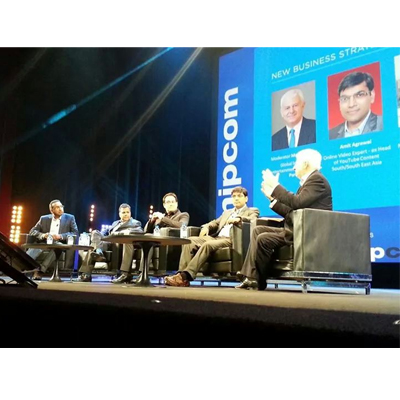
    CANNES: Indian content market is going through an exciting phase, and putting the scenario upfront to the world, through one of the biggest stages at the ongoing MIPCOM 2014 was the India panel which comprised of Colors CEO Raj Nayak, Balaji Telefilms group CEO Sameer Nair, Rajshri Entertainment managing director and CEO Rajjat Barjatya and online video expert and ex-head of YouTube content south/south east Asia Amit Agrawal. The session on ‘New business strategies from India’ was moderated by PwC global leader, entertainment and media Fenez Marcel.


    Setting the stage for some heated discussion was Nayak when he highlighted one of the biggest issues the country faces: lack of broadband. “Lack of connectivity is an issue. If the experience of watching becomes smooth, it will be a game changer,” he said.


    Comparing the online market in India with that of the world, Agrawal said that the Indian market has both traditional medium and online play “and both are very strong,” he informed adding that this meant huge opportunity to tap into.  


    Agrawal went on to say that while India consumes a lot of content online, almost 30-40 per cent of this content is not made in India. “That’s a huge chunk. I am seeing an emergence of micro-communities with technology. This will enable the content producer to tackle the right community. It will happen and very soon, may be in the next 12-18 months,” he stressed.


    There is too much of fragmentation in the country, currently. Mentioning the Telecom Regulatory Authority of India’s regulation about ad-cap for pay TV, Nayak said, “Once this happens, the supply and demand ratio will change. This will also help in the yield going up, because the demand will go up. We have to come at a point where the FTA channels will carry advertising with no limitations, pay channels which will have 10+2 advertising and very premium channels will have no advertising.”


    Barjatya who wears the hat of both traditional movie maker and digital feels that India is at a cusp of digital revolution. “For me the opportunity is to reach the global audience, especially through mobile. Traditional media rules cannot be applied on mobile,” he said.  


    The YouTube journey in India started with traditional media content that was distributed to audience which was moving away from traditional media. “But now, over the last one and a half years, I see so many online channels coming up on comedy, food, music, news, tech bloggers have all come up,” informed Agrawal.  


    With a contradicting viewpoint, Nayak said that YouTube is the biggest competitor to the broadcaster. And that it is due to this, that the broadcaster, since the last month, has taken its hit show Comedy Nights with Kapil off YouTube. “I am a big believer of digital media and I feel it is the future, but I also feel that it will co-exist with television and they will grow parallel.”


    Viacom itself is looking at a lot of short formats. “But the problem is that unless broadband issue is not addressed, monetisation will remain a huge problem. If you look at the money, YouTube does Rs 500-600 crore business from India, where television is a Rs 7000 crore business, so the numbers are small and that will not grow until and unless the bandwidth issues are addressed,” said Nayak.


    Nayak believes that no one in India has so far mastered the art of monetising content on the digital media, social media the way it should be, given its increasing reach and targeting abilities.. 


    “Monetisation will happen with broadband and hopefully this should be resolved with the rollout of 4G,” he added.


    The panel also put forth its wish list for the new government formed under Prime Minister Narendra Modi. According to Nair regulation for content already exists, which is beneficial to the whole industry. Highlighting PM Narendra Modi’s ‘come make in India’ campaign, he said that the government is giving open invitation for people to come to India. “As for Raj’s point that producers in India are not partnering with broadcasters and thus not sharing risks, we are looking at that very seriously and are encouraging everyone else to do it. If there is a risk-reward mechanism, everyone can benefit,” explained Nair.  

    As for Nayak, keeping in mind the dynamic & tech-savvy PM the country currently has, who understands the power of the Digital media, connectivity and broadband will get addressed in a much faster footing.  Given that electricity is still erratic in rural India, people will communicate and consume content through mobile phones. “I would ask him to release spectrum because that’s a big issue that’s coming in the way of growing business. Another thing that I would request  is complete implementation of the digitisation, process which is expected to be over by 2016 . He further added that broadcasters are not getting their fair share of subscription revenue and this can only happen once the digitisation process is complete and all stakeholders start seeing the benefits,” he said.


    Barjatya’s wish list consists of wiring up India and encouraging Indian entrepreneurs to have a global outlook rather than be restricted to Indian audiences alone. “We need to appeal to the audience outside of India,” he said.


    For Agrawal, the government should remove hurdles. “Out of all the YouTube content that we produce, more than 70 per cent of the viewership for programme comes from global audiences. We haven’t done a great job in marketing ourselves and make people aware of the country,” he added.


    Nayak is hoping for a dynamic change in the media industry, with the new PM.   


    The discussion also touched upon the consumer behaviour in the country.  “We see a lot of consumption happening on handheld devices. When we began, 10 per cent of our views were from handheld devices, today it is almost 50-50 and that number is higher in India than in the rest of the world. India’s next billion people will access internet on mobile, and will not know about PCs,” opined Barjatya.


    Agreeing to this, Nayak said that the reason it will happen is because for mobile, one doesn’t need electricity. “We have 160 million homes and 900 million handheld devices right now, which is expected to go up to 1.5 billion handsets. So the explosion is happening. Power will take a lot of time to be addressed, but if you have internet, you can consume content,” he informed.


    Nair classified the audiences and the programmes being made. He said, “The television industry currently is programming for newer audiences who are more into household dramas. Then there are also those who have already lived through all this and are now looking for more. The audience is evolving. There will be more niche channels.”  


    All the panelists felt that this is the best time to invest in India. “In India, people are ready to match dollar to dollar. And we are ready to put the money where our mouth is,” announced Nair.  


    Concluding the session with one advice to entrants in the market, Nair said, “It is important to be patient. We are still at the ground floor, but we can build.”

  • MIPCOM 2014: Aamir Khan’s three conditions before starting ‘Satyamev Jayate’…

    MIPCOM 2014: Aamir Khan’s three conditions before starting ‘Satyamev Jayate’…

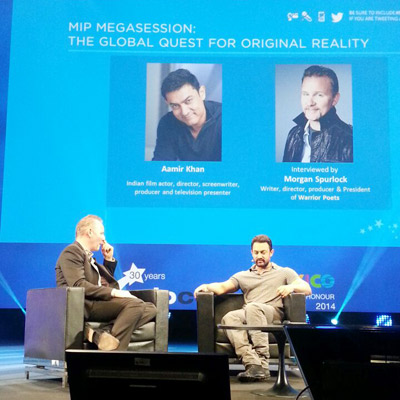
    CANNES: He is a man who can make his mark even on a distant land, far away from home. Yes! We are talking about Indian film actor Aamir Khan, who was in Cannes, giving the MIP Megasession keynote at the ongoing MIPCOM 2014 in a packed Grand Auditorium about his landmark show Satyamev Jayate (SMJ). Indiantelevision.com founder, CEO and editor in chief Anil Wanvari is the Indian representative for all MIP markets.


    So how did it all start? Said Khan, “It all started, becuase I was very inspired from my friend Satya (Satyajit Bhatkal, director of SMJ), who was my friend and class topper from school, was working in the social space. And I being an actor, was doing well in my career, but wasn’t doing much on this.”


    He further went on to say that as TV grew in India, this idea, of doing something on this front, grew bigger. “Star India CEO Uday (Shankar) offered me a game show, which I refused, he then asked me if I could do anything on TV. So I asked him if we could work on something that can bring some change. And he agreed,” he added.


    Khan and his small team comprising Satyajit worked together to create the show, which has gone down in the history of Indian television as one of the most popular shows. “Through the show, we try to understand the society. We try and put the issues to the people, be it child abuse, honour killing, rights and responsibilities etc,” he informed the audience which comprised of content creators from across the globe.  


    All that we see on television wasn’t created in a day. “We took a year to work on research. The reason we researched was to find out if we had a show,” he said. In order to be sure, the team researched with four topics “and once we were confident, it didn’t matter to us if Star would take the show or not. We knew we could go ahead with it and put it on YouTube or anywhere,” he said adding that it took just five minutes for Shankar to approve the concept of the show.


    But, it was not all that easy. Khan then put three conditions in front of Shankar before agreeing to go ahead with Satyamev Jayate.


    One, he wanted the programme to be in multiple languages, since he wanted to reach out to people in their language. “I just didn’t want the main Star channel, but wanted the whole network, which would air the show at the same day and time.”


    The second condition was that in the states, where Star didn’t have a presence, the show was to be given to its competitor and the third was to give it to the terrestrial network Doordarshan. “Many villages in India do not have satellite TV even now and we wanted to reach those homes through Doordarshan,” he announced.  


    But, Shankar, coming from a journalism background, understood where Khan was coming from. “I was talking of a show where I was not investing money but investing time. Star and my team is a part of the show which is made of love,” he said.


    Of the 1.2 billion population in India, 600 million people watch SMJ every week. “We didn’t know if people would be interested in a show like this. It was heartwarming to see how people connected emotionally. There is a huge vacuum of content on social issues and people want a show like SMJ,” he added.


    So how does Satyamev Jayate impact the society? “Well, we empower people by selecting an organisation each week so that one can help financially. What we also do is have partners, who help us on issues.” So far the show has been able to raise $ 45 million for the NGOs connected with it.


    Khan also mentioned how the political and administrative class of the country had also shown interest in the show. “Our show hits out on political and administrative class most of the times and so we didn’t know how they would respond, but I can tell you that there have been 9-10 examples where these people have come ahead and supported us.”


    Explaining the reasons for the show doing so well, Khan said, “There was a need and desire for things to change. India is on a cusp of change so a show like this helps them understand the issue and move towards change,” he said.


    “Sometimes when we research, we feel angry about certain things. But we have to approach people with love. We can’t attack them, if we do that, we will close the door for ourselves,” he added.


    Khan feels that the audiences in India today are looking for content that is engaging. “Even serious content can be made engaging.”


    One of the things that they do to catch the attention of the audience is keep the topic of the show a secret. “No one knows the topic, till the episode is aired. This attracts them to the show.”


    Khan also believes that serious issues can be presented in a way that people can relate to. Giving an example he said, “So when I talk about female foeticide, I do not start with the fact that women are being forced into abortion. That drives away audience, what I do is, I start by asking them, their most favourite person and then go on talking about their mother, my mother and then tell them the reality,” he narrated.


    Khan and his team is taking journalism and combining it with drama and storytelling. “My job as a storyteller is to be engaging,” he concluded.  

  • MIPCOM 2014: Spark, Astro Malaysia & Moving Visuals join hands to launch Spark Asia

    MIPCOM 2014: Spark, Astro Malaysia & Moving Visuals join hands to launch Spark Asia

    CANNES: Spark, Astro Malaysia and Moving Visuals International (MVI) have signed a joint venture to set-up Asia’s first dedicated HD factual and documentary channel, Spark Asia.


    The JV was signed on the first day of MIPCOM 2014.


    The channel, which will go live in the first half of 2015, will offer a wide variety of exclusive Asian and global HD content. In addition, Spark Asia will empower the local community of producers and filmmakers by offering an alternative platform to showcase their documentaries and through various training initiatives.


    Leveraging on the strengths of its joint venture partners, the new channel will have both linear TV and digital content that will resonate among audiences across Asia. Spark Asia will promote knowledge; celebrate Asian values and traditions and bring Asia to the world in an exciting way. The content will include genres like science & technology, exploration, history, environment, nature and wildlife. The channel will also draw its programming from the vast library of Autentic and ZDF Enterprises.


    Asia is the latest launch of the factual entertainment brand Spark, which is also available in Eastern Europe as well as in Africa.


    Astro Malaysia CEO Rohana Rozhan said, “As one of Southeast Asia’s leading content and consumer companies, Astro is always exploring new ways to meet the audiences’ changing preferences. With the growing interest in Asian content, there is a huge opportunity in Asian factual content that resonates not only with audiences in Asia but around the world. In line with our strength in the creation of IPs and content brands we believe that the aggregation of Asian-centric stories and factual content in an Asian branded documentary channel is timely and has tremendous potential. This joint venture with like-minded partners enables Astro to take a stake in content that will resonate in Asia and around the world.”


    MVI director Galen Yeo added, “As the world’s most populous continent, Asia has long deserved a channel to harness its thriving diversity of culture, history, people and stories. We are pleased to work together with Spark GmbH and Astro on this landmark venture to promote Asian documentary filmmaking, and provide producers a unique platform that will support and promote their work to audiences all across Asia. Spark Asia welcomes opportunities to collaborate and work together with storytellers from around Asia and the world.”


    Spark GmbH CEO Patrick Hoerl said, “Being close to our viewers’ lives and hearts has always been at the core of the Spark brand. We can only deliver on that promise, if we team up with the best experts in our business in each region we operate in. It’s hard to think of better partners than Astro and Moving Visuals for a truly Asian channel.”


  • Bomanbridge Media Announces Multiple Sales at MIPCOM

    Bomanbridge Media Announces Multiple Sales at MIPCOM

    CANNES:  Singapore-based distribution/production agency Bomanbridge Media announces a round of deals closed at MIPCOM from several countries.
     
    “This is our best MIPCOM ever, we came strong with our recent expansion, including major investment from Hera Capital; opening our Korean and Mongolian offices and new hires. We are thankful to all our broadcast partners who trust us to bring them the best programs from around the globe which we are confident will ensure great ratings,” said Sonia Fleck, CEO of Bomanbridge Media.

     
    India
    – Latin Angels sold to Fox Life
    – Nutri Ventures (produced by Nutri-Ventures) educational animated series on nutrition, sold toSun TV India


    Indonesia
    – Nutri Ventures, (Nutri-Ventures) educational animated series on nutrition, DVD deal with Pt.Unggul Cipta

     
    Japan
    – FBI Files: Polly Klaas Kidnapped and Diagnosis Unknown: New Epidemics produced by New Dominion, sold to TV Asahi


    Malaysia ( Pan Regional)
    Cake Walk (13 X 60) from D360 and Food Truck Face Off  from Peace Point; sold to Li TV for SE Asia feed  


    Malaysia
    It Only Hurts When I Laugh and Planet’s Funniest Animals sold to Media Prime
    (distributed by TV FILMBIZ)

     
    Mongolia
    Bomanbridge procures Mongolian rights for telenovelas La Impostura (NBC Telemundo) and Eva Luna (Venevision)

     
    Singapore
    – Nutri Ventures (Nutri-Ventures) educational animated series on nutrition, sold toMediacorp’s Okto & Toggle