Tag: Ministry of Information & Broadcasting

  • Govt seeks professional help for DD revival

    Govt seeks professional help for DD revival

    NEW DELHI: Fazed by private sector television channels’ stridency in terms of revenues and viewership in an increasingly digital India, the government is seeking outside professional help in “transformation of Doordarshan.”

    A tender has been issued by an organisation under the Ministry of Information and Broadcasting (MIB) to look for a consultant to revamp Doordarshan into a leading public broadcaster that becomes a highly successful medium of mass communication.

    Amongst the objectives listed in the tender documents by the Broadcast Engineering Consultants India Ltd. (BECIL) a stated aim is to engage a consulting firm to support Doordarshan in achieving this “transformation goal by undertaking a comprehensive view on the projects and initiatives to be executed” by the Indian pubcaster.

    Pointing out that in the last couple of decades after introduction of cable television and technological changes in a country that’s now openly flirting with digital consumption of video and audio on multiple platforms, the government admitted DD’s monopoly days are over and it is not the target media for a large swathe of Indian population. “Given the potential television has, not just commercially but also as a means for socio-economic transformation, it’s critical to revitalize Doordarshan and develop it into a powerful and commercially successful organization of mass communication,” BECIL said in a note enumerating the objectives for the project.

    The consultant would have to undertake a comprehensive view on the projects and initiatives to be executed by Doordarshan, engage all stakeholders to arrive at trouble-spots and prepare a solution map for addressing those difficulties. The government is hoping that the consultant will identify in medium term goals for “quick wins” and further help Doordarshan develop a long-term strategic roadmap.

    The interested bidders are expected to send in their queries by 2 November 2016 and get responses in a pre-bid meeting on 4 November. The technical bids will be opened on 15 November at 1530 hours. Dates for presentations by bidders and opening of financial bids will be intimated later by BECIL.

    Interestingly, Minister of State for MIB Rajyavardhan Rathore few days back had admitted at a media conference that Prasar Bharati, DD’s parent, lacked adequate programming and marketing capabilities and was open to seeking help from private players.

    Doordarshan is one of the largest broadcasting organizations in the world in terms of studios and infrastructure and claims to cover 90 per cent of the total Indian population — a claim that, however, doesn’t aptly reflect in audience measurement data. DD, which offers 23 TV channels in various Indian languages, provides television, radio, online and app-based mobile services throughout India and overseas.

    ALSO READ:

    Prasar Bharati lacks content & marketing; open to tie-ups: MIB Minister
     

  • Govt seeks professional help for DD revival

    Govt seeks professional help for DD revival

    NEW DELHI: Fazed by private sector television channels’ stridency in terms of revenues and viewership in an increasingly digital India, the government is seeking outside professional help in “transformation of Doordarshan.”

    A tender has been issued by an organisation under the Ministry of Information and Broadcasting (MIB) to look for a consultant to revamp Doordarshan into a leading public broadcaster that becomes a highly successful medium of mass communication.

    Amongst the objectives listed in the tender documents by the Broadcast Engineering Consultants India Ltd. (BECIL) a stated aim is to engage a consulting firm to support Doordarshan in achieving this “transformation goal by undertaking a comprehensive view on the projects and initiatives to be executed” by the Indian pubcaster.

    Pointing out that in the last couple of decades after introduction of cable television and technological changes in a country that’s now openly flirting with digital consumption of video and audio on multiple platforms, the government admitted DD’s monopoly days are over and it is not the target media for a large swathe of Indian population. “Given the potential television has, not just commercially but also as a means for socio-economic transformation, it’s critical to revitalize Doordarshan and develop it into a powerful and commercially successful organization of mass communication,” BECIL said in a note enumerating the objectives for the project.

    The consultant would have to undertake a comprehensive view on the projects and initiatives to be executed by Doordarshan, engage all stakeholders to arrive at trouble-spots and prepare a solution map for addressing those difficulties. The government is hoping that the consultant will identify in medium term goals for “quick wins” and further help Doordarshan develop a long-term strategic roadmap.

    The interested bidders are expected to send in their queries by 2 November 2016 and get responses in a pre-bid meeting on 4 November. The technical bids will be opened on 15 November at 1530 hours. Dates for presentations by bidders and opening of financial bids will be intimated later by BECIL.

    Interestingly, Minister of State for MIB Rajyavardhan Rathore few days back had admitted at a media conference that Prasar Bharati, DD’s parent, lacked adequate programming and marketing capabilities and was open to seeking help from private players.

    Doordarshan is one of the largest broadcasting organizations in the world in terms of studios and infrastructure and claims to cover 90 per cent of the total Indian population — a claim that, however, doesn’t aptly reflect in audience measurement data. DD, which offers 23 TV channels in various Indian languages, provides television, radio, online and app-based mobile services throughout India and overseas.

    ALSO READ:

    Prasar Bharati lacks content & marketing; open to tie-ups: MIB Minister

     

  • Giving information effectively a major challenge: Naidu

    Giving information effectively a major challenge: Naidu

    NEW DELHI: Information & Broadcasting Minister M Venkaiah Naidu has said information is “ammunition to fight social evils such as corruption, poverty, illiteracy and terrorism”.

    To ensure last mile reach and keep pace with the changing communication paradigm, the government communication needs to incorporate innovative and out of the box ideas. Innovative ideas such as Prime Minister Narendra Modi’s Mann ki Baat and the MoU signed with Amar Chitra Katha for comic books on Swachh Bharat Abhiyaan influenced the masses at large.

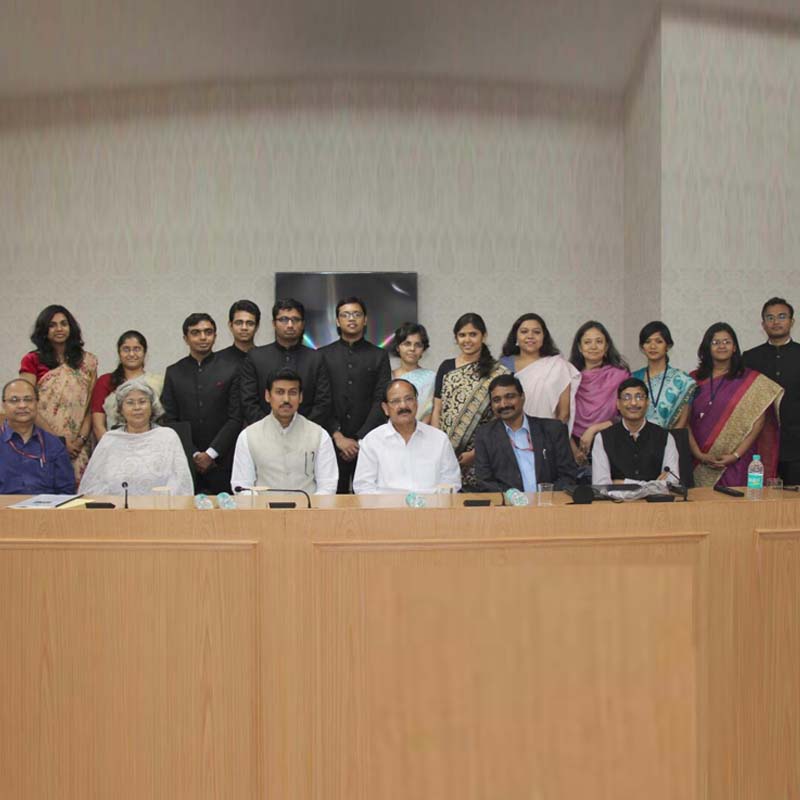
    Naidu was addressing the Indian Information Service Officer Trainees of 2015 batch currently undergoing at training at Indian Institute of Mass Communications (IIMC) here, who had called on President Pranab Mukherjee yesterday. Minister of State for I and B Rajyavardhan Rathore and senior officers of the Ministry were also present on the occasion.

    Naidu said to effectively design communication strategy for various government programmes and flagship schemes was a major challenge for government communication managers. He added that communicating success stories about developmental programs like Swachh Bharat Abhiyaan (Clean India campaign) would inspire and motivate citizens and would engage them as stakeholders in the governance process.

    The Minister emphasized on the need for India Information Service (IIS) officers to learn and adapt to the new technologies, tools and techniques to enhance reach of the government; especially in the age of social media.

    “The social media perspective has changed the way we communicate and govern today, which provided challenges and opportunities for the officers to enhance government outreach,” Naidu said.

    In his interaction, the Minister emphasized on the need to be progressive in thought and take pride in the role and responsibility assigned to each officer. He specifically mentioned the initiative taken by the Ministry to institutionalize capacity building through appropriate training programs at different career levels. Naidu also assured the officer-trainees that the quality aspect associated with capacity building issues in the training programs would be improved to meet the communication challenges.

    Rathore advised the officer trainees that there was a need to continuously learn and add value to their skills as well as the organization where they would be working.

    IIS Officer Trainees also shared their experiences of the past nine months of training with the two Ministers.

  • Giving information effectively a major challenge: Naidu

    Giving information effectively a major challenge: Naidu

    NEW DELHI: Information & Broadcasting Minister M Venkaiah Naidu has said information is “ammunition to fight social evils such as corruption, poverty, illiteracy and terrorism”.

    To ensure last mile reach and keep pace with the changing communication paradigm, the government communication needs to incorporate innovative and out of the box ideas. Innovative ideas such as Prime Minister Narendra Modi’s Mann ki Baat and the MoU signed with Amar Chitra Katha for comic books on Swachh Bharat Abhiyaan influenced the masses at large.

    Naidu was addressing the Indian Information Service Officer Trainees of 2015 batch currently undergoing at training at Indian Institute of Mass Communications (IIMC) here, who had called on President Pranab Mukherjee yesterday. Minister of State for I and B Rajyavardhan Rathore and senior officers of the Ministry were also present on the occasion.

    Naidu said to effectively design communication strategy for various government programmes and flagship schemes was a major challenge for government communication managers. He added that communicating success stories about developmental programs like Swachh Bharat Abhiyaan (Clean India campaign) would inspire and motivate citizens and would engage them as stakeholders in the governance process.

    The Minister emphasized on the need for India Information Service (IIS) officers to learn and adapt to the new technologies, tools and techniques to enhance reach of the government; especially in the age of social media.

    “The social media perspective has changed the way we communicate and govern today, which provided challenges and opportunities for the officers to enhance government outreach,” Naidu said.

    In his interaction, the Minister emphasized on the need to be progressive in thought and take pride in the role and responsibility assigned to each officer. He specifically mentioned the initiative taken by the Ministry to institutionalize capacity building through appropriate training programs at different career levels. Naidu also assured the officer-trainees that the quality aspect associated with capacity building issues in the training programs would be improved to meet the communication challenges.

    Rathore advised the officer trainees that there was a need to continuously learn and add value to their skills as well as the organization where they would be working.

    IIS Officer Trainees also shared their experiences of the past nine months of training with the two Ministers.

  • No plans to regulate TV content through CBFC: MIB

    No plans to regulate TV content through CBFC: MIB

    NEW DELHI: Even as debates rage on regarding film and television content with the government admitting complaints regarding vulgar advertisements on TV are received regularly and addressed, Ministry of Information and Broadcasting (MIB) has said there’s no move yet to regulate TV content via an existing body.

    Dwelling on the Central Board of Film Certification (CBFC), its recent run-ins with films producers on alleged censorships and a proposed restructuring of the certification body, Minister of State for MIB Rajyavardhan Rathore has said government doesn’t propose to regulate TV content via CBFC.

    Rathore made these observations regarding CBFC and TV content regulation in Parliament last week

    Holding forth on CBFC, the minister admitted that a restructuring report by the Shyam Benegal Committee was “under examination”,  but added the government had not received any formal complaint/representation from the Indian film industry regarding the functioning of CBFC.

    Rathore told Lok Sabha (Lower House of Parliament) late last week that differences in opinion relating to certification of individual films do exist between the producers and the Board. Such cases are dealt with in accordance with the provisions of the Cinematograph Act 1952, he added.

    The existing system under the Cinematograph Act, 1952 provides the requisite checks and balances as far as certification of films is concerned. Periodical reviews by expert committees are undertaken. Sufficient provisions for addressing grievances of film producers with regard to film certification exist in present regulations, the junior MIB minister informed fellow parliamentarians.

    A review committee under noted film-maker Shyam Benegal was constituted by MIB some time back. The committee has given its report suggesting some radical changes in the CBFC’s functioning and role.

    Complaints regarding vulgarity in TV ads

    A total of 49 complaints – four in 2016 – for vulgarity in advertisements on television channels were reported to MIB since 2013.

    In most cases, advisories were issued to TV channels concerned, but there were a few cases where the channels had to run apology scrolls or were forced to shut down for a fixed period.

    There were also two instances of advisories to all channels in these years.

    According to figures available with MIB, there were 26 complaints in 2013, nine in 2014, eleven in 2015 and four so far this year.

    Only Manoranjan TV, FTV, and NTV have figured thrice in these years for broadcast of vulgarity in advertisements.

    Under existing regulatory framework, all programmes and advertisements telecast on TV channels and transmitted/retransmitted through cable TV networks and DTH platforms are required to adhere to the Programme and Advertising Codes prescribed under the Cable TV Networks (Regulation) Act, 1995.

    Action is taken suo-motu as well as when violations are brought to the notice of the ministry.

    These codes contain a whole range of parameters to regulate programmes and advertisements, including provisions to address content of obscenity, vulgarity and violence in TV programmes and advertisements.

    Information from the Electronic Media Monitoring Centre (EMMC) and other sources like an Inter-Ministerial Committee (IMC) are collated on prima facie violation of the Programme and Advertising Codes for the MIB to pursue the matter.

    Government said directions to the States have been issued to set up district-level and State-level monitoring committees to monitor content telecast on cable TV channels. These are recommendatory bodies, which function to aid and assist MIB.


  • No plans to regulate TV content through CBFC: MIB

    No plans to regulate TV content through CBFC: MIB

    NEW DELHI: Even as debates rage on regarding film and television content with the government admitting complaints regarding vulgar advertisements on TV are received regularly and addressed, Ministry of Information and Broadcasting (MIB) has said there’s no move yet to regulate TV content via an existing body.

    Dwelling on the Central Board of Film Certification (CBFC), its recent run-ins with films producers on alleged censorships and a proposed restructuring of the certification body, Minister of State for MIB Rajyavardhan Rathore has said government doesn’t propose to regulate TV content via CBFC.

    Rathore made these observations regarding CBFC and TV content regulation in Parliament last week

    Holding forth on CBFC, the minister admitted that a restructuring report by the Shyam Benegal Committee was “under examination”,  but added the government had not received any formal complaint/representation from the Indian film industry regarding the functioning of CBFC.

    Rathore told Lok Sabha (Lower House of Parliament) late last week that differences in opinion relating to certification of individual films do exist between the producers and the Board. Such cases are dealt with in accordance with the provisions of the Cinematograph Act 1952, he added.

    The existing system under the Cinematograph Act, 1952 provides the requisite checks and balances as far as certification of films is concerned. Periodical reviews by expert committees are undertaken. Sufficient provisions for addressing grievances of film producers with regard to film certification exist in present regulations, the junior MIB minister informed fellow parliamentarians.

    A review committee under noted film-maker Shyam Benegal was constituted by MIB some time back. The committee has given its report suggesting some radical changes in the CBFC’s functioning and role.

    Complaints regarding vulgarity in TV ads

    A total of 49 complaints – four in 2016 – for vulgarity in advertisements on television channels were reported to MIB since 2013.

    In most cases, advisories were issued to TV channels concerned, but there were a few cases where the channels had to run apology scrolls or were forced to shut down for a fixed period.

    There were also two instances of advisories to all channels in these years.

    According to figures available with MIB, there were 26 complaints in 2013, nine in 2014, eleven in 2015 and four so far this year.

    Only Manoranjan TV, FTV, and NTV have figured thrice in these years for broadcast of vulgarity in advertisements.

    Under existing regulatory framework, all programmes and advertisements telecast on TV channels and transmitted/retransmitted through cable TV networks and DTH platforms are required to adhere to the Programme and Advertising Codes prescribed under the Cable TV Networks (Regulation) Act, 1995.

    Action is taken suo-motu as well as when violations are brought to the notice of the ministry.

    These codes contain a whole range of parameters to regulate programmes and advertisements, including provisions to address content of obscenity, vulgarity and violence in TV programmes and advertisements.

    Information from the Electronic Media Monitoring Centre (EMMC) and other sources like an Inter-Ministerial Committee (IMC) are collated on prima facie violation of the Programme and Advertising Codes for the MIB to pursue the matter.

    Government said directions to the States have been issued to set up district-level and State-level monitoring committees to monitor content telecast on cable TV channels. These are recommendatory bodies, which function to aid and assist MIB.


  • DTT could be thrown open for pvt sector companies

    DTT could be thrown open for pvt sector companies

    NEW DELHI: The Indian government is exploring possibilities of throwing open the digital terrestrial transmission or DTT services for private sector participation.

    Broadcast carriage and telecoms regulator TRAI is poised to start a public consultation in this regard soon.

    Presently, terrestrial transmission, analogue or digital, is a monopoly game with India’s pubcaster Doordarshan being the only player.

    A senior level source in Ministry of Information & Broadcasting (MIB) admitted that in near future DTT could see involvement of private sector companies as seen in the area of cable and satellite broadcasting.

    The MIB source also pointed out that in this connection TRAI has already been consulted and the regulator is in the process of fine-tuning a background paper on DTT that will form part of the consultation with industry stakeholders.

    Some of the issues that could be put up for discussion include whether it’s correct in this age of fast-evolving technology to keep DTT a playing arena for only DD; whether DTT services with private sector involvement would be in an encrypted or unencrypted form and technologies to be used.

    Quite a few Asian countries like Hong Kong, Thailand and Singapore — considered more sophisticated media markets in terms of ARPUs in comparison to India — have private sector companies providing DTT services.

    According to ViaSat magazine, telco PCCW, for example, in Hong Kong recently announced launch of a new set-top box (STB) that will be an all-in-one, 4K-ready device providing IPTV, DTT and over-the-top (OTT) services to subscribers.

    However, it must be remembered that even if TRAI comes out with a consultation paper on DTT and finally recommends that private sector companies be allowed to provide DTT services, along with DD, the final say on the matter would be with MIB.

    In an earlier story Indiantelevision.com had reported that DD, one of the largest broadcasting organisations in the world in terms of the studios and transmitters, has commenced DTT services in 16 cities.

    DD move to also replace its analogue transmitters with digital transmitters will allow up to 8 channels to be carried from a single transmitter.

    Interestingly, while listing the many advantages of DTT services, Doordarshan on its website points out that “DTT secures greater plurality in Platform ownership, ensuring that no single platform owner is so powerful that they can exert undue influence on public opinion or political agendas.”

    ALSO READ:

    Doordarshan launches Mobile TV in India, needs no internet

    http://www.indiantelevision.com/television/tv-channels/terrestrial/doordarshan-launches-mobile-tv-in-india-needs-no-internet-160404

    DD moving to digitisation through Freedish and DTT: Rathore

    http://www.indiantelevision.com/regulators/i-and-b-ministry/dd-moving-to-digitisation-through-freedish-and-dtt-rathore-141202


  • DTT could be thrown open for pvt sector companies

    DTT could be thrown open for pvt sector companies

    NEW DELHI: The Indian government is exploring possibilities of throwing open the digital terrestrial transmission or DTT services for private sector participation.

    Broadcast carriage and telecoms regulator TRAI is poised to start a public consultation in this regard soon.

    Presently, terrestrial transmission, analogue or digital, is a monopoly game with India’s pubcaster Doordarshan being the only player.

    A senior level source in Ministry of Information & Broadcasting (MIB) admitted that in near future DTT could see involvement of private sector companies as seen in the area of cable and satellite broadcasting.

    The MIB source also pointed out that in this connection TRAI has already been consulted and the regulator is in the process of fine-tuning a background paper on DTT that will form part of the consultation with industry stakeholders.

    Some of the issues that could be put up for discussion include whether it’s correct in this age of fast-evolving technology to keep DTT a playing arena for only DD; whether DTT services with private sector involvement would be in an encrypted or unencrypted form and technologies to be used.

    Quite a few Asian countries like Hong Kong, Thailand and Singapore — considered more sophisticated media markets in terms of ARPUs in comparison to India — have private sector companies providing DTT services.

    According to ViaSat magazine, telco PCCW, for example, in Hong Kong recently announced launch of a new set-top box (STB) that will be an all-in-one, 4K-ready device providing IPTV, DTT and over-the-top (OTT) services to subscribers.

    However, it must be remembered that even if TRAI comes out with a consultation paper on DTT and finally recommends that private sector companies be allowed to provide DTT services, along with DD, the final say on the matter would be with MIB.

    In an earlier story Indiantelevision.com had reported that DD, one of the largest broadcasting organisations in the world in terms of the studios and transmitters, has commenced DTT services in 16 cities.

    DD move to also replace its analogue transmitters with digital transmitters will allow up to 8 channels to be carried from a single transmitter.

    Interestingly, while listing the many advantages of DTT services, Doordarshan on its website points out that “DTT secures greater plurality in Platform ownership, ensuring that no single platform owner is so powerful that they can exert undue influence on public opinion or political agendas.”

    ALSO READ:

    Doordarshan launches Mobile TV in India, needs no internet

    http://www.indiantelevision.com/television/tv-channels/terrestrial/doordarshan-launches-mobile-tv-in-india-needs-no-internet-160404

    DD moving to digitisation through Freedish and DTT: Rathore

    http://www.indiantelevision.com/regulators/i-and-b-ministry/dd-moving-to-digitisation-through-freedish-and-dtt-rathore-141202