Tag: Milkybar

  • How Nestle Milkybar is bringing ‘Wonders of Ocean’ to kids in their homes

    How Nestle Milkybar is bringing ‘Wonders of Ocean’ to kids in their homes

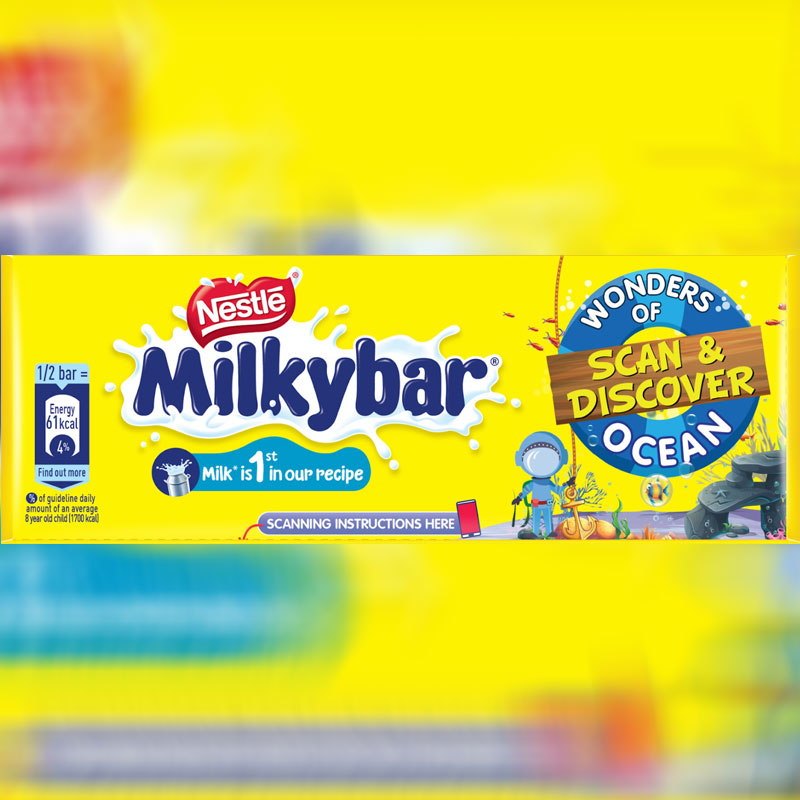
    NEW DELHI: For kids, the last year was pretty desultory – stuck at home, no school to attend, no exciting outdoor activities to partake of. Things had been looking up, only for Covid to come knocking again – once again depriving the little ones of the endless possibilities and adventures that the world offers. In an attempt to cheer up their target group, Nestle's Milkybar has rolled out a new campaign that offers children a virtual aquarium experience. 

    Using advanced immersive augmented reality (AR) technology, this campaign aims to partner mothers across India and encourage their children to learn about science and nature through playful fun, and yummy, creamy milk chocolates. 

    As a part of this campaign named Wonders of Ocean, selected packs of Nestle Milkybar, and Milkybar Moosha have been activated with scanner codes. On scanning these packs, the children can get to experience an immersive virtual tour of an aquarium on their parents’ mobiles. There is a variety of experiences where they get to meet new aquatic creatures every day and learn something cool about them.

    "The Wonders of Ocean campaign is an effort to help mothers and kids have a virtual experience of visiting an aquarium at their homes as going out and having a great time with family is difficult in the current times,” said Nestle India foods and chocolate & confectionary director Nikhil Chand. “What makes this campaign unique is the usage of immersive augmented reality technology aimed at making the child’s experience more exciting and engaging and to act as a trigger for their imagination to learn about science and nature in a fun and playful manner."

    Chand added that the new campaign from Nestle will be warmly welcomed by children in the nation, and suggested that the Wonders of Ocean could help children to learn about marine life this summer. 

  • F&B cos reduce sugar to target health-conscious customers

    F&B cos reduce sugar to target health-conscious customers

    MUMBAI: There’s never been a better time for fitness brands with the younger generation becoming more and more health conscious. With almost sedentary lifestyles, people are opting for healthier eating and exercise options to stay fit.

    Brands are ensuring their communication shows their commitment to health but the challenge lies for brands that have stuck for a decade with high sugar and salt content and are now finding it difficult to change that perception.

    The answer: either promote the product for its taste and goodness or alter its key ingredient to make it more appealing for the health conscious consumer. Recently, world’s largest food and beverage company Nestle announced that it will further cut the amount of sugar, salt and saturated fats in its products as it tries to improve the image of packaged foods.

    The move may also be viewed as a safeguard measure by Nestle against the recently accounted sugar tax in the UK, wherein soft drink companies will now be required to pay a levy on drinks with added sugar. Nestle has Nesquik, Nestea and MILO in its drinks portfolio. The new tax was designed to curb rising levels of obesity in the UK. 

    Nestle and its rivals (Mondelez and Mars) are under pressure from a shift in consumer preferences towards healthier food and away from processed products such as instant noodles and frozen pizza. The maker of KitKat chocolate bars and Maggi soups is responding with healthier products and is also moving into higher growth categories, such as coffee, pet care, bottled water and infant nutrition.

    It also confirmed its commitment made in 2014 to reduce saturated fats by 10 per cent in all relevant products that do not meet World Health Organisation recommendations. Nestle chief executive Mark Schneider remarked, “The trend towards healthier foods is to be observed worldwide. Combining the convenience of packaged foods with healthy good nutrition, that is where our sweet spot is.”

    Nestle spent 1.72 billion Swiss francs ($1.71 billion) on R&D last year. The company launched over 1000 new products last year to meet the nutritional needs of children and wants to further enhance products for kids with fruits, vegetables, fibre-rich grains and micronutrients. Reformulating recipes to make its products healthier is part of Nestle’s effort to keep its products attractive for consumers. This year it launched a new Milkybar white chocolate bar that has 30 per cent less sugar.

    Although the F&B giant has decided to take the healthier route in UK, it wouldn’t come as a surprise if it decides to alter the ingredients in all its operating markets to reach more consumers. India has lately become the playing field of all major brands and the move may or may not be implemented here, as the Indian chocolate industry was worth Rs 78 billion at the end of 2016 and is predicted to reach Rs 122 billion with a compounded annual growth rate of 16 per cent by 2019.

    According to the 2016 Euromonitor International report, the chocolate confectionery market in India is projected to grow at around eight per cent per annum between 2016 and 2021 to reach Rs 16,200 crore (on constant value) from Rs 11,256 crore in 2016, backed by better retailing across rural areas.

    Given Indians’ love for sweets, whether or not global giants tweak their recipes here will not impact sales. A consumer in rural India will buy a product, regardless of the alteration of ingredients, because he has little knowledge about the health aspect. However, consumers in urban and metro cities are the ones who are cautious and tweaking the sugar and salt quantity is likely to get them to add the product to their basket.

  • Nestle India’s marketing budget Rs 450 crore for FY-2014?

    Nestle India’s marketing budget Rs 450 crore for FY-2014?

    BENGALURU: One of the biggest spenders on advertisement and sales promotion in India is nutrition, health and wellness company Nestle India Limited (Nestle). The company which owns brands such as Nestle, Maggi, Everday, Barone, Munch, Kitkat, Milkybar, Polo, Alpino among others is expected to spend in excess of Rs 400 crore towards advertising and sales promotion (ASP) during the current calendar year that ends on 31 December 2014 (FY-2014).


    Notes: 100,00,000 = 100 Lakhs  = 10 million = 1 crore.


    Let us look at the company’s numbers over the last ten years starting FY-2004 until FY-2013.


    As per Figure 1 below, Nestle’s total revenue from operations (TIO) has had a compounded annual growth rate (CAGR) of 16.93 per cent from Rs 2227.57 crore in FY-2004 to Rs 9109.05 crore in FY-2013. Its ASP has grown by 14.04 per cent CAGR from Rs 121.26 crore (5.4 per cent of TIO) to Rs 395.48 crore (4.3 per cent of TIO) during the same period. Using 14.04 per cent ASP growth as a yardstick, the company is expected to spend around Rs 450 crore in FY-2014 towards ASP.


    Background: Over the last 10 years, the company’s ASP has always increased in absolute rupees with an average y-o-y growth of 14.4 per cent. However, ASP in 2004 was 10.9 per cent lower than the ASP in FY-2003, which was 9.7 per cent lower than the ASP in FY-2002, which in turn was lower by 3.0 per cent as compared to the ASP in FY-2001.


    If Nestle’s TIO rows at 16.93 per cent, it would be reach around Rs 10,640 crores for FY-2014. Assuming ASP as 4.3 per cent of TIO, Nestle should spend around Rs 460 crore towards marketing. Nestle’s TIO in FY-2014 grew at 9.2 per cent as compared to the Rs 8334.53 crore in FY-2012. Assuming a growth of 9.2 per cent and ASP as 4.3 per cent of TIO, the corresponding numbers of TIO and ASP for FY-2014 are about Rs 9940 crore and Rs 432 crore.


    While in absolute rupee terms the company’s ASP shows a linear increasing trend, in terms of percentage of TIO, the linear trend is downwards. Across 10 years, the company’s average ASP is 4.82 per cent, of TIO, with a maximum of 5.5 per cent of TIO in FY-2005 and a minimum of 4.3 per cent of TIO in FY-2011, FY-2012 and FY-2013. Hence, company’s ASP across the last 3 years of 4.3 per cent is much below the 10 year par.


    Disclaimer: Being a part of a multi-national group, the company is generally quite tight lipped about sharing financials unless it has to legally do so. Details about the company’s advertisement spends are not indicated even in the company’s annual reports – what you have is a combination of the advertisement and sales promotion spends declared as a single entry in the notes forming the part of the company’s annual financials. There is really no way that one could pin an exact number for these spends unless one has an inside track on the company’s marketing budgets. The projections in this report are pure conjecture based on the historical annual numbers revealed by the company in its annual reports. The author has no knowledge about Nestle’s strategy, past or present.


    The numbers deduced in this report may be quite similar or way off the mark from the numbers that the company will reveal in its annual report for FY-2014 early next year. The company’s financial year ends on December 31, hence Q1-2014 and Q2-2014 means quarter ended March 31, 2014 and June 30, 2014 respectively in this report.


    Some more: For Q2-2014, the company reported y-o-y growth of 9.4 per cent in TIO at Rs 2431.97 crore from Rs 2222.71 in Q2-2013, and 4.8 per cent more than the Rs 2321.51 crore in the immediate trailing quarter. Nestle’s HY-2014 TIO at Rs 4753.48 crore was 6.2 per cent more than the Rs 4478.06 crore reported for HY-2013. Even if one were to go by the lowest figure of 4.8 per cent growth, TIO for FY-2014 would be Rs 9534.09 crore. Maintaining ASP of 4.3 per cent of TIO, the company’s marketing spend for FY-2014 works out to about Rs 414 crore.


    Given the fact that the company has been witnessing consistently lowering rate of growth since FY-2011 past few years, a marketing push would help Nestle reverse the trend, besides other strategies like launch of new products or revamping of old or existing products.


    The company, in its Q2-2014 earnings release, says that it has recently launched Nestle Sweet Lassi, Nestle Buttermilk and Ayurvedic Herbs and Spices and Maggi Oat Noodles to its portfolio.


    Based on the above numbers and launches, marketing spend in range of Rs 450 crore with a variation of + 10 per cent seems a reasonable number for FY-2014.

  • ZenithOptimedia to continue to handle Nestle’s media biz

    MUMBAI: ZenithOptimedia has retained the media duties of Nestle India following a multi-agency pitch that took place a month ago.

    The size of the business is estimated to be around Rs 1.8 billion.

    The agency has been handling the media business of Nestle since 2005.

    Nestle India owns brands like Nescafe, Maggi, Milkybar, Kit Kat, Bar-One, Milkmaid and Nestea.

    In recent years the company has also introduced products of daily consumption and use such as Nestle Milk, Nestle Slim Milk, Nestle Dahi and Nestle Jeera Raita.