Tag: Mick Gordon

  • Ipsos India appoints Amit Adarkar as its managing director

    Ipsos India appoints Amit Adarkar as its managing director

    MUMBAI: Ipsos India has found a new country head and managing director in Amit Adarkar, who will take charge from first week of September. He replaces Mick Gordon who successfully held the role and will now take up a senior regional responsibility within Ipsos.


    Gordon has been CEO of Ipsos India since November 2011 and managing director of Synovate India since September 2008. He has been responsible for substantial growth of revenue and profits over the period and merger of two large businesses of Ipsos and Synovate in India.


    Commenting on Adarkar’s appointment, Gordon said, “I am confident that with the experience and expertise of Amit, Ipsos will continue to delight our clients and he will prove to be an immensely capable successor.”


    “I am delighted to be appointed as Ipsos India’s new managing director. Ipsos is at a decisive point in its history and I am looking forward to working with the Board, the Regional Directors and Ipsos India staff to ensure we take this opportunity to create a stronger and more effective organisation for the future,” added Adarkar.


    Adarkar who had joined Ipsos InnoQuest, India as its managing director in January 2013 has been a member of the India management team ever since.


    He has been in the research industry for over 22 years, and has worked for organisations such as IMRB, Synovate, and Org-Marg. He was earlier MD at Market Probe, and a VP at Nielsen-Bases. He also has rich experience with a number of key Ipsos InnoQuest clients.


    He is a chemical engineer from Indian Institute of Technology, Bombay (1987-91).  Post engineering, he completed Post Graduate Diploma in Business Management (PGDBM), from XLRI, Jamshedpur (1991-1993).

  • India fourth most economically confident country: Ipsos Study

    India fourth most economically confident country: Ipsos Study

    MUMBAI: Little did anyone know that the Modi sarkar that had vowed to boost growth, control inflation and restore investor confidence will actually work wonders at such a short span.


    According to the study conducted by Ipsos, India’s economic confidence has got a major boost primarily due to a landslide victory of the business-friendly government led by Narendra Modi.


    ‘Ipsos Economic Pulse of the World’ survey reports that the country’s economic confidence shot up by six points to 66 per cent in May 2014 compared to April 2014, making it the fourth most economically confident country in the world after Saudi Arabia, Germany and China.


    Indians are the most optimistic people in the world and are very confident of good time coming soon. For the very first time India (60 per cent) tops the list of countries whose citizens expect that its economy will be stronger in next half year. Marginally less than a half of Indian citizens (43 per cent) believe their local economy which impacts their personal finance is good, a significant rise of five points.


    “All the data points in the Ipsos report indicate that India’s economic confidence has shot up substantially, which is also corroborated by the fact that India’s current account deficit has significantly eased, the currency has stabilised, inflation has substantially pulled back, stock market had a dream run so far and corporate earnings are improving,” said Ipsos CEO Mick Gordon in India.


    “However, recent high food inflation, conflict in oil-producing Iraq and the fear of a below normal monsoon is big challenge for the new government,” added Gordon.


    The online ‘Ipsos Economic Pulse of the World’ survey was conducted in May 2014 among 19,242 people in 25 countries. For the results of the survey herein, a total sample of 19,242 adults aged 18-64 in US and Canada, and aged 16-64 in all other countries, were interviewed between 1 and 15 April 2014.


    For a second month in a row, the average global economic assessment of national economies surveyed in 25 countries remains unchanged as 39 per cent of global citizens rate their national economies to be good.


    Although down two points since last round, Saudi Arabia (87 per cent) is in the lead once again, with Germany (75 per cent), China (66 per cent), India (66 per cent), Canada (65 per cent), Sweden (64 per cent) and Indonesia (59 per cent) following behind. European countries dominate the bottom of the global average: France (9 per cent), Italy (9 per cent), Spain (10 per cent), Romania (10 per cent), Hungary (18 per cent) and Argentina (18 per cent).


    Countries with the greatest improvements in this wave: South Africa (28 per cent, 10points), Indonesia (59 per cent, 9 points), Russia (58 per cent, 8points), India (66 per cent, 6points), Great Britain (43 per cent, 6points), Poland (31 per cent, 6points) and Belgium (42 per cent, 2points).


    Countries with the greatest declines: Australia (53 per cent, -7pts), Hungary (18 per cent, -6pts), Brazil (20 per cent, -6pts), South Korea (19 per cent, -4pts), Sweden (64 per cent, -2pts), Saudi Arabia (87 per cent, -2pts) and China (66 per cent, -2pts).


    Up three points since last sounding, Saudi Arabia (67 per cent) leads the local economy assessment which impacts their personal finance, followed by Germany (55 per cent), Sweden (51 per cent), China (48 per cent), India (43 per cent), Canada (42 per cent), and Indonesia (39 per cent). Ranked the lowest in this measure this month is Italy (9 per cent), followed by Spain (11 per cent), Romania (12 per cent), Hungary (13 per cent), France (13 per cent), Japan (14 per cent) and Argentina (15 per cent).


    New leader emerges, as for the first time India (60 per cent) tops the list of countries that predict their local economies will be stronger in the next six months. The rest of the highest-ranking countries are: Brazil (56 per cent), Saudi Arabia (53 per cent), Indonesia (50 per cent), China (39 per cent), Mexico (31 per cent) and Argentina (31 per cent). Only 6 per cent of those in France expect their future local economies will be “stronger” in the next half year, followed by South Africa (11 per cent), South Korea (13 per cent), Hungary (14 per cent) and Japan (14 per cent).

  • Indians Optimistic About Future: Ipsos Study

    Indians Optimistic About Future: Ipsos Study

    MUMBAI: 50 per cent Indians are optimistic about Indian economy and expect that the economy will be stronger in next six months, a rise of two points, according to a report by global research firm Ipsos.


    According to the “Ipsos Economic Pulse of the World” study, India’s economic confidence level has declined to 58 per cent in March 2014, a decline of three points. However, India continues to hold sixth position as the most economically confident country in the world after Saudi Arabia, Sweden, Germany, China and Canada.


    Only 35 per cent Indians believe that the local economy which impacts their personal finance is good, a drop of two points.


     “Inflation in India increased on account of higher food costs in March, breaking a three-month easing trend, this would give RBI little scope to support the economy amid fresh signs of slowdown,” said Mick Gordon, CEO, Ipsos in India.


     “However Indians are hopeful that the new central government which will come to power with fresh mandate in May will bring in stability, push economic growth and build investor confidence,” added Gordon.


    The online Ipsos Economic Pulse of the world survey was conducted in March 2014 among 18,675 people in 25 countries.


    Holding steady for a second month in a row, the average global economic assessment of national economies surveyed in 24 countries remains unchanged this month as 38 per cent of global citizens rate their national economies to be ‘good.’


    Saudi Arabia (86 per cent) remains the top-ranked country on this measure, but runner-up countries are not far behind: Sweden (80 per cent), Germany (76 per cent), China (69 per cent), Canada (66 per cent) and India (58 per cent). Those least likely to rate their national economies as ‘good’ are in Spain (6 per cent) and Italy (6 per cent) followed by France (10 per cent), South Korea (16 per cent), Hungary (17 per cent) and Argentina (18 per cent).


    Countries with the greatest improvements in this wave: Sweden (80 per cent, 11pts), Russia (39 per cent, 7pts), South Africa (21 per cent, 4pts), Canada (66 per cent, 3pts), Hungary (17 per cent, 3pts) Germany (76 per cent, 2pts) and France (10 per cent, 2pts).


    Countries with the greatest declines: Egypt (36 per cent, -20pts), South Korea (16 per cent, -7pts), Japan (25 per cent, -4pts), Argentina (18 per cent, -3pts), Poland (22 per cent, -3pts), Australia (54 per cent, -3pts) and India (58 per cent, -3pts).


    Six in ten Brazilians (58 per cent) indicate they predict their local economies will be stronger in the next six months. The rest of the highest-ranking countries are: India (50 per cent), Saudi Arabia (49 per cent), Indonesia (42 per cent), China (36 per cent), Argentina (33 per cent) and Egypt (33 per cent).


    Only one in twenty (5 per cent) of those in France expect their future local economies will be “stronger” in the next half year, followed by  Belgium (8 per cent), Hungary (12 per cent), Poland (14 per cent), and South Korea (14 per cent).

  • Indias economic confidence revives says Ipsos study

    Indias economic confidence revives says Ipsos study

    MUMBAI: India’s economic confidence revived substantially due to healthy farm output, a sharp boost in exports and narrowing of current account deficit, according to a report by global research firm Ipsos.


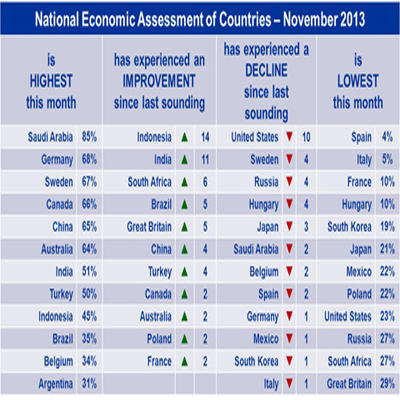
    According to the “Ipsos Economic Pulse of the World” study, India’s economic confidence jumped sharply by 11 points to 51 per cent in the month of November compared to the month of October 2013. India now stands as the seventh most economically confident country in the world after Saudi Arabia, Germany, Sweden, Canada, China, and Australia.


    Three in ten (32 per cent) Indians believe a health increase of five points. Indians are very hopeful about stability and growth in future with general election in the first half of 2014; four in ten (42 per cent) people expects that the economy in their local area will be stronger in next six months, a slender rise of one point.


    “Indian economy has bottomed out after a two-year slump and it is likely to see a positive growth trend from here on with positive indicators like narrowing CAD, revival of exports, growth of manufacturing sector and increasing investor confidence,” said Ipsos in India CEO Mick Gordon.


    “Good Monsoon resulted in bumper crop output, which in turn generated rural demand for goods such as tractors, motorcycles and consumer goods leading to growth of the manufacturing sector,” added Gordon.


    The online Ipsos Economic Pulse of the World survey was conducted in October 2013 among 18,083 people in 24 countries.


    After a significant decline last month, the average global economic assessment of national economies surveyed in 24 countries took a one-point turn for the better this month as 37 per cent of global citizens rate their national economies to be “good.”


    Saudi Arabia (85 per cent) continued to dominate the global ratings of national economies, followed in a distance by Germany (68 per cent), Sweden (67 per cent), Canada (66 per cent), China (65 per cent) and Australia (64 per cent). Once again, only a handful of those in Spain (four per cent) rate their national economies as ‘good’, followed by Italy (five per cent), Hungary (10 per cent), France (10 per cent), and South Korea (19 per cent).


    Countries with the greatest improvements in this wave were Indonesia (45 per cent, 14 points), India (51 per cent, 11 points), South Africa (27 per cent, six points), Brazil (35per cent, five points), Great Britain (29 per cent, five points) and China (65 per cent, four points).


    Those from Brazil (62 per cent), once again, hold the strongest future outlook for their local economy in the next six months. The other high-ranking countries, which followed at a distance, were: Saudi Arabia (48 per cent), India (42 per cent), China (39 per cent), Indonesia (37 per cent) and Argentina (37 per cent).

  • Indias Economic Confidence Uncomfortably Uncertain: Ipsos Study

    Indias Economic Confidence Uncomfortably Uncertain: Ipsos Study

    MUMBAI: India’s economic confidence recovered marginally but it remains uncomfortably uncertain as food inflation remains sky high and economic growth dwindling, according to a report by global research firm Ipsos.


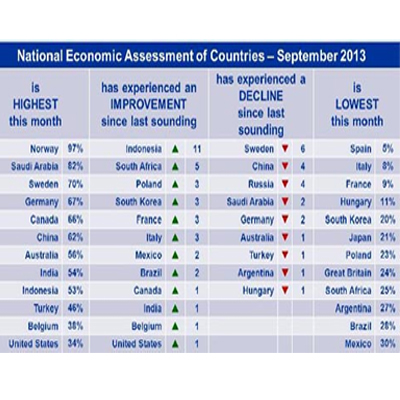
    According to the “Ipsos Economic Pulse of the World” survey, India’s economic confidence increased by only 1 points to 54 percent in the month of September compared to the month of August 2013, however its rating further got pulled down to eighth most economically confident country in the world, as sentiments in G8 and other developed countries improve.


    Thirty four percent Indian Citizen believe a further decline of 2 points. However, what is alarming is generally optimist Indians have turned pessimist, with only 40 per cent people expecting that the economy in their local area will be stronger in next six months, a drop of further 3 points.


    Mick Gordon, CEO, Ipsos in India said, “India’s sizable current-account deficit compared to its economic output, nearly double-digit inflation in consumer prices and dwindling economic growth is making India’s economic sentiments uncomfortably uncertain.”


    “Perhaps the crucial general election next year is limiting governments’ ability to make politically unappetizing economic decisions to implement drastic reforms to revive economic growth and to boost the weakening rupee,” added Gordon.


    The online Ipsos Economic Pulse of the World survey was conducted in August 2013 among 18,503 people in 25 countries.


    After a stagnant June/July, the average global economic assessment of national economies surveyed in 25 countries takes a turn for the better this month as 39% of global citizen’s rate their national economies to be ‘good.’ This shift largely reflects the inclusion of Norway in the global aggregate. Without Norway, the average is 37%, up one point from last sounding.


    Source: Ipsos
    A substantial margin continues to exist at the top of the global ratings between global leader Norway (97%), and runners-up Saudi Arabia (82%), Sweden (70%), Germany (67%), Canada (66%), China (63%), Australia (56%) and India (54%). Only a handful of those in Spain (5%) rate their national economies as ‘good’, followed by Italy (8%), France (9%), and Hungary (11%)


    Countries with the greatest improvements in this wave: Indonesia (53%, 11pts), South Africa (25%, 5pts), Poland (23%, 3pts), South Korea (20%, 3pts), France (9%, 3pts) and Italy (8%, 3pts).


    A strong majority of Brazilians (64%) continue to indicate they predict their local economies will be stronger in the next six months. A gap persists in between Brazilian ratings and the rest of the highest-ranking countries: Saudi Arabia (51%), Argentina (41%), India (40%), Indonesia (37%) and China (35%).

  • Economic confidence of Indians shaky: Ipsos

    MUMBAI: India’s economic confidence remained shaky due to gloomy investor sentiments, chronic gaps in infrastructure, high inflation and interest rate, according to a report by global research firm Ipsos.

    According to the Ipsos Economic Pulse of the World Survey, India‘s economic confidence dropped further by two points to 70 per cent in the month of May compared to the previous month.

    However India continued to hold the second most economically confident country position after Saudi Arabia which stayed at the top of the table with a wide margin at 88 per cent.

    Ipsos India CEO Mick Gordon said, “The symptoms of Indian economy being in poor health are building fast with growth rate slipping to a nine-year low of 6.5% in 2011-12, current account deficit touching a high of 4% and inflation at a high of 7.55% in May. Rupee has plunged sharply in recent weeks especially on account of foreign fund outflows and gloomy investor sentiments. It has lost over 20% against the US dollar over the past few months.”

    “The chronic gaps in infrastructure, a shortage of skilled labour, unproductive farming, government expenditure on inefficient subsidies, barriers to overseas companies looking to invest and a proposal for punitive retrospective taxation on foreign companies has added to the already slowing growth,” added Gordon.

    Half of the Indian population believe their local economy is good and 54 per cent people expect that the economy in their local area will be stronger in the next six months.

    “Now hopes of revival are pinned at Dr. Manmohan Singh who takes over the finance portfolio. He is expected to bring in changes to revive the stalled economic growth, arrest the rupee‘s fall and deal with the fallout of a possible breakup of the euro zone, a tough task,” added Gordon.

    The Ipsos report, which examined citizens‘ assessment of the current state of their country‘s economy, said that the overall global economic engines has lost significant steam in May and has dropped another point to 37 per cent, the lowest it has been since the economic downturn of 2009.

    The Ipsos Economic Pulse of the World survey was conducted in May 2012 among 18,713 people in 24 countries such as Argentina, Australia, Belgium, Brazil, Canada, China, France, Germany, Great Britain, Hungary, India, Indonesia, Italy, Japan, Mexico, Poland, Russia, Saudi Arabia, South Africa, South Korea, Spain, Sweden, Turkey and the United States of America.

    Saudi Arabia again shows the strongest proportions of people rating their current national economic situation as ‘good’ (88 per cent). They are followed by: India (70 per cent), Germany (69 per cent), Sweden (64 per cent), China (63 per cent) and Canada (62 per cent).

    Only a handful of those in Spain (three per cent), Italy (three per cent) and Hungary (three per cent) rate their national economies as ‘good’, followed by Japan (nine per cent), France (nine per cent) and Great Britain (10 per cent).

    Countries with the greatest improvements in this wave are Belgium (+7 to 28%), Argentina (+7 to 45%), Indonesia (+4 to 40%) and Russia (+3 to 36%).

    The nations that saw the sharpest declines are Brazil (-10 to 49 per cent), Sweden (-7 to 64 per cent), Mexico (-5 to 28 per cent) and the US (-4 to 23 per cent).

  • Hansa Research, Ipsos sign MoU to jointly bid for IRS

    Hansa Research, Ipsos sign MoU to jointly bid for IRS

    MUMBAI: Hansa Research and Ipsos have entered into a Memorandum of Understanding (MoU) to jointly bid for the new Indian Readership Survey (IRS) contract that starts with IRS 2013.

    Hansa Research has been conducting the IRS since 2003. So far, Hansa has been doing it with Media research Users Council (MRUC).

    The Indian Readership Survey (IRS) has been owned and administered by Media Research Users’ Council (MRUC), an Industry body set up in 1994. Earlier in 2011, MRUC and ABC (Audit Bureau of Circulation) decided to merge their parallel readership studies by entering into an alliance to form the RSCI, which is now taking charge of administering the IRS.

    Hansa Research Group MD Ashok Das said, “We are happy and excited to work with Ipsos on this prestigious project, and hope to bring in a number of new ideas into the IRS.”

    This joint bid will combine Hansa’s experience of readership measurement in the Indian context with Ipsos’ global expertise of conducting readership surveys in 60 countries.

    Ipsos-India CEO Mick Gordon said, “We are delighted to be working with Hansa on this very exciting project and we hope we can persuade RSCI (Readership Studies Council of India) that our combination will be a very big plus for the industry. Ipsos measures readership in more than 60 countries around the world and has made a name for itself in introducing many innovations into this specialist area of market research – we were the first to use CAPI and DS-CAPI in readership measurement, for example. We believe we can add significant value to Hansa‘s proven expertise and experience on the ground in India.”

    Through the joint participation of these two entities, the two companies expect to make a very strong and forward looking pitch for the new IRS contract.

    The current sample size of the IRS is 262,000.

    Hansa Research is a global full service market research agency headquartered in India, conducting market research in 77 countries with offices in India and US. Over the last few years, Hansa has developed sound mechanisms to reduce fieldwork related issues that has been widely acclaimed by research users for its ability to minimise some long standing industry weaknesses.

    The Pulitzers are given out annually by Columbia University on the recommendation of a board of journalists and others. Each award carries a $10,000 prize except for the public service award, which is a gold medal.

    Matt Wuerker of Politico, Massoud Hossaini of Agence France-Presse, and Craig F. Walker of The Denver Post bagged the prize in Editorial Cartooning, Breaking News Photography and Feature Photography respectively.

  • Indians second most confident about their economy: Ipsos Global Study

    Indians second most confident about their economy: Ipsos Global Study

    MUMBAI: India‘s Economic Confidence grew by six points to 75 per cent in the month of October compared to the previous month, becoming the second most economically confident country, according to the global economic report released by Ipsos, the market research company.


    The report, titled ‘Ipsos Global @dvisory: The Economic Pulse of the World‘ is based on 18,682 recent interviews in 24 countries around the world; and examines citizens‘ assessment of the current state of their country‘s economy for a total global perspective.


    Ipsos in India MD Mick Gordon said, “The Indian economy has been well insulated from global economic conditions as it has been fueled by domestic consumption and the increased FDI into the country. Our economy has remained steady at a robust 8.1% and this positive consumer sentiment is seen reflected in our survey.”
     
    How are some of the other global economies performing?


    The global aggregate national assessment was dragged by Europe (-2 points to 24 per cent), which was 16 points lower than the next lowest region, North America (40 per cent). In fact, all the regions have reported declining national economic assessments – the Middle East and Africa (-2 to 60 per cent); Asia Pacific (-1 to 41 per cent); except Latin America (46 per cent) which experienced no change in October.


    Despite all the ups and downs, two countries gained significantly – India gained six points to reach 75 per cent; while South Africa gained five points to reach 39 per cent. So, if one looks at the pecking order: Global leader Saudi Arabia experienced a six-point drop to 83 per cent but continued to hold its pole position; India as mentioned earlier bagged the second spot at 75 per cent; Sweden lost five points and was third at 69 per cent; Canada was unchanged at 66 per cent; China too was unchanged at 65 per cent.


    The countries at the bottom of the heap were the same as last month with abysmally low consumer sentiments: Hungary lost two points and was at 2 per cent; Spain gained 2 points but was low at 5 per cent; Japan further lost two points and was 6 per cent; France lost 1-point and was at 6 per cent and Italy was unchanged at 8 per cent. Sadly, Europe continued to lag by Belgium dropping 6 points to 25 per cent; Great Britain (-6 to 11 per cent) experienced the greatest drop in this wave after Indonesia (-7 to 35 per cent).


    Future Outlook for Local Economy was reported unchanged at 24 per cent. The predictions of global citizens regarding whether their local economy would be “stronger”, “weaker” or “about the same” six months from now stagnated at 24 per cent, agreeing it would be stronger – unchanged since August 2011.
     
    Brazil‘s assessment levels on this measure made the world‘s recent zigzag look flat. Though it consistently stood at the top of 24 countries measured, Brazil (+9 to 74 per cent) has swung up and down throughout 2011: down 6 in March (67 per cent), up 5 in April (72 per cent), down 7 in June (64 per cent), up 7 in July (71 per cent), down 6 in September (65%), and was up 9 points in October (74 per cent).


    After Brazil, India (+2 to 56 per cent) emerged the strongest on this measure followed by Saudi Arabia (-4 to 53 per cent), Argentina (-2 to 50 per cent) and China (-5 to 39 per cent).


    France (unchanged at two per cent) remained at the bottom of the rating, followed closely by Hungary (-1 to five per cent), Great Britain (-2 to 8 per cent), and Belgium (unchanged at eight per cent).


    Brazil experienced the greatest rise (+9 to 74 per cent), followed by Spain (+8 to 23 per cent), Russia (+5 to 20 per cent) and Canada (+4 to 19 per cent).


    Turkey once again showed the greatest decline (-5 to 35 per cent) on this measure followed by China (-5 to 39 per cent) and a four-point decline in Poland (15%), Germany (12 per cent) and Saudi Arabia (53 per cent).