
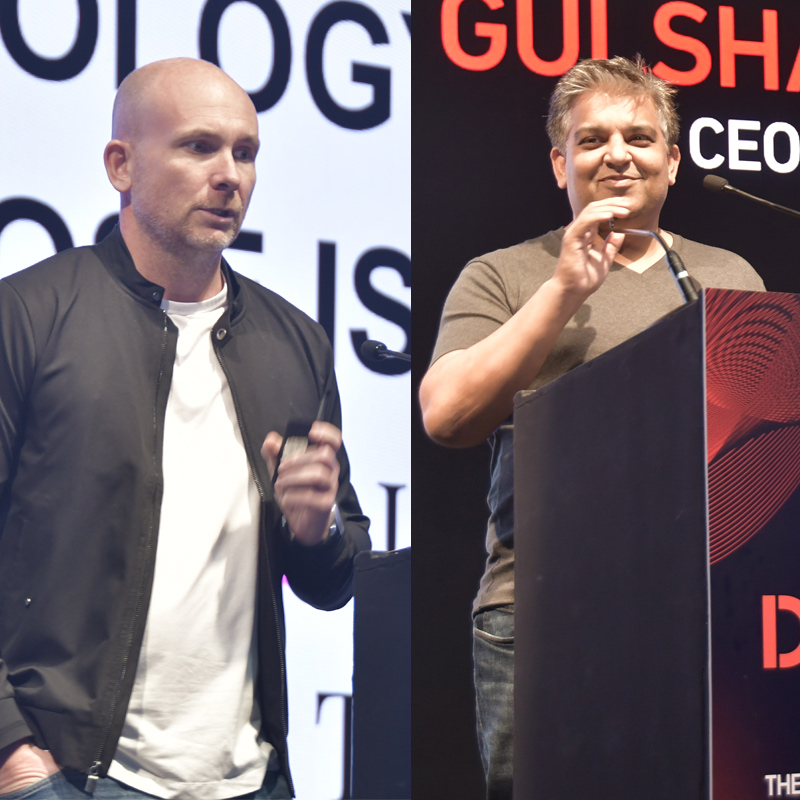
Tag: Michel de Rijk

  • “Run separate creatives for demographic, behavioural campaigns”: Jio Ads CEO Gulshan Verma

    “Run separate creatives for demographic, behavioural campaigns”: Jio Ads CEO Gulshan Verma

    Mumbai: At The Advertising Club’s third edition of D: CODE, Jio Ads CEO Gulshan Verma shed light on the power of targeting the geolocation insights in campaigns. He enlightened the audience on the scale and solutions offered by Jio Ads.

    Offering advice for people using digital, he said that one should run separate creatives for demographic and behavioural campaigns. You have to know what you want to do differently given the tendency to feel that digital is everything. He does not believe in this view. He feels that customers are different, whether based on demographics or based on behaviour. People make the mistake of over-targeting and trying to be super efficient. “My point of view is that if you look at people who buy toys, 50 per cent are parents, 30 per cent are gifts, and 20 per cent are random. If you only focus on people who are willing to buy your product, then you will never build a new product.”

    Also, one must remember that omnichannel and geo-location insights offer the opportunity to understand consumers at scale. One should not only focus on online signals. One per cent of Indians have a pet. The key is to figure out who has visited a vet in the last six months. That is how you can find that one per cent. His advice is to not ignore geographical and real-world signals. Finally, brands must remember to put privacy first when they run digital campaigns and build a digital strategy. Why should consumers trust you with their information and give you their insights? How will you create value for them? One has to put privacy first.

    “We are the advertising arm of Jio. A year ago, the team was just the two of us. We are now 170 people. We are a platform that links consumers in multiple contexts.”

    He noted the billions of relationships that the company has with consumers who work with the company and carry its SIM cards. The company is also a content provider and aggregator. Jio, he said, also happens to be the country’s largest retailer. It works closely with companies like ONDC. The aim is to build an idea of how all three work for marketers digitally. 450 million consumers trust Jio with their identity, billing relationships, and what they watch. 13.47 million people have ordered fast food. 12.69 million people have bought mutual funds. Many of them are parents. There is a difference of opinion on how many are on EMI. Many watch OTT. The company brings all this data together and puts it out for advertisers. 

    The company worked with the mutual fund association, AMFI. What is interesting is that every ad goes after people deterministically. So, for instance, the ad can target someone who has an EMI with the message, why have an EMI? Mutual funds should be an investment. One ad was targeted at people who the company knows have bought mutual funds. Marketing effectiveness can be tracked to determine whether or not those individuals are still active in mutual funds. Is the campaign able to add more customers? What is interesting is that the mobile reflects both one’s online and real life. That is how the company is able to understand both the consumers’ lives.

    He also gave the Tata Sky campaign as an example of creative excellence. The message is that the DTH service provider watches you while you watch it. It can take the viewers’ emotions from that. A range of emotions were shown. It was not just a video. There were A.I. filters, influencers, different screen sizes, people watching on the train, in the bar together. This concept, he said, was super powerful. I executed fabulously well and took the interesting opportunity.

    Meanwhile, S4 Capital CEO – Asia Pacific Michel de Rijk presented the Tata Tea example done for Independence Day and emphasised how the integration of data and content with technology enables agencies to create high-quality content overnight in just their own studio. He said that media monks aim to make a positive impact by integrating data and content with technology at the heart of everything that the agency does. The aim is to make things real on digital screens. But technology with a purpose is useless, he warned. It needs real intention to create new digital worlds. One of the principles his agency follows is ensuring that there is a real impact on consumers. The unreal engine is used to deliver real business growth for the agency’s partners. Tata Tea had approached the agency two weeks before Independence Day.

    It wanted to connect with every state in the country. The aim was to spread the message that the company truly understands India and spread the pride of the nation on Independence Day. Another objective was CSR. The campaign was about iconic moments that happened since Independence and the impact that those moments still have today. It was filmed in a studio in Delhi. The agency did not visit any locations. It was shot in one day. It was about unleashing the power of hyper localisation through virtual production. Creating the experience in a cost-efficient digital way is the focus. He said that the unreal engine is a tool developed by Epic that not only significantly changed the gaming, cinema industry but now has moved into the ad industry. One can create high quality film content in a cost efficient manner.

    The other thing he noted is that it works in real time. One can create quick, snappy content for the digital environment on the different platforms that are out there. This is especially important for brands with different SKUs or localisation needs, which are very strong. The third thing is Meta. It is about creating avatars that are close to real environments, real identities. He said this is going to be a massive improvement from what it is today. It is about combining real and unreal worlds. The broad application of web3 will be important. On the real world side, he said that he believes that when tech supports art to create meaningful interactions for consumers, real business outcomes are achieved. This was seen in Tata Tea. Real cultural changes will happen. It is important to pioneer tech-driven creativity, which is what his agency focuses on.

  • Group M to launch Xaxis in India in 6 months

    MUMBAI: Xaxis, Group M‘s audience buying company is initiating a nine-market roll out in the the South Asia region over the next six months. The company has announced the opening of a headquarter in Singapore, while the next markets will include India, Malaysia, Taiwan, Vietnam, Indonesia and Hong Kong.

    According to an official communiqué, the existing Xaxis operations in Australia will also come under the umbrella of the new headquarters, which represents the industry‘s most comprehensive network of digital endpoints across online, mobile, social and video platforms.

    Global digital media executive Michel de Rijk will be joining Xaxis Asia-Pacific as managing director. Prior to Xaxis, de Rijk was with a digital ad firm EyeWonder as senior executive. He has also worked for Dutch publisher De Telefoongids.

    de Rijk said, “As the largest audience-buying company in the world, Xaxis has an unmatched understanding of the global digital media-buying space along with local presence and expertise in each market it operates in. This combination allows Xaxis to deliver proven audience solutions that are custom-fit for executing targeted campaigns market by market. From mobile in Indonesia to video in Taiwan, Xaxis offers maximum precision when delivering ads in all markets.”

    Xaxis CEO Brian Lesser added, “This commitment to expansion throughout the Asia-Pacific region follows a year of success and growth in North America, Europe and Australia. Ad spend in the region is expected to reach $170 billion within the next two years with online ad spend making up 31 per cent of the growth. Our clients have asked us to apply our knowledge and experience executing audience campaigns to the region. This launch displays the first step in our commitment to the region and will be followed with an aggressive expansion.”

    Xaxis provides audience buying solutions to more than 700 global advertisers, delivering over 300 billion impressions each year. The proprietary Xaxis data management platform (DMP) houses the collection of audience portraits. Xaxis DMP allows advertisers to measure attribution, offline ROI, audience insights and brand impact based on the entire digital plan, not just the Xaxis portion of the plan.

    GroupM Asia Pacific CEO Mark Patterson said, “We have ambitious plans with Xaxis in the region. Our drive for value and improved audience delivery for our clients, as well as ownership of that capability – versus outsourcing as many groups do – will help us deliver on both, securely and rapidly, for our clients across the region and the digital spectrum.”

    By year‘s end, Xaxis plans to have offices in over 25 markets around the world.

