Tag: Michael Schlesinger

  • India’s OTT content market expected to touch Rs 1420 cr by 2020

    India’s OTT content market expected to touch Rs 1420 cr by 2020

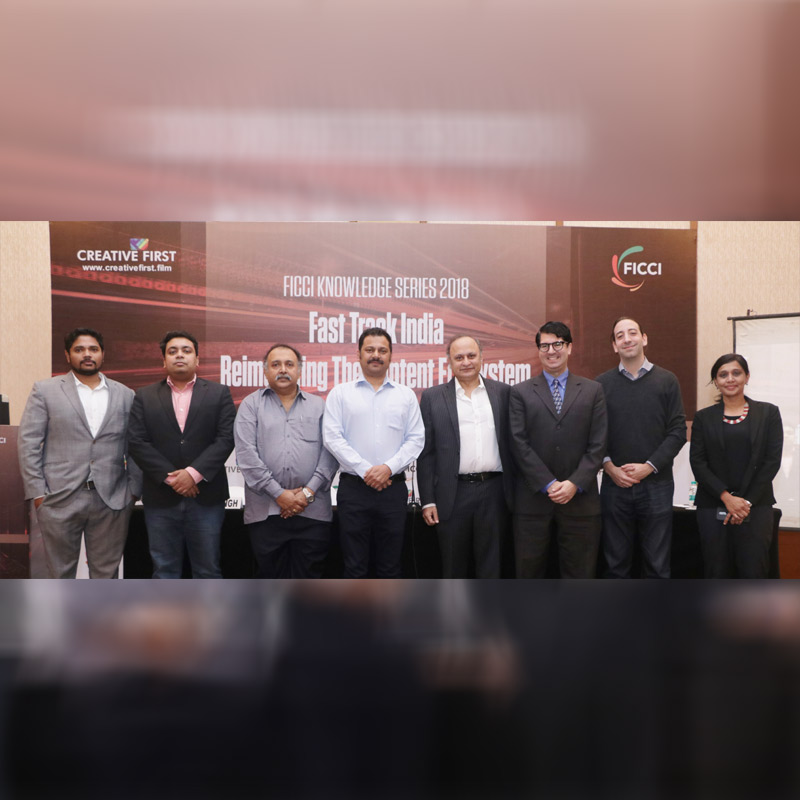
    MUMBAI: The Indian OTT content market is expected to grow at a CAGR of 26 per cent and touch Rs 1420 crore by 2020, as per the ‘2018 Fast Track India: Reimaging the Content Ecosystem’ forum. In 2017, the market was estimated to be Rs 710 crore.

    The 2018 Fast Track India: Reimaging the Content Ecosystem is a knowledge series forum by the Federation of Indian Chambers of Commerce (FICCI).

    At the inaugural address, Maharashtra government secretary & director general, information & public relations and special inspector general of police, cyber Brijesh Singh said, “India has a rich cultural history and a vibrant content industry. The time is right for digital content players to showcase India’s soft power through homegrown stories that connect with a global audience. Sectoral regulations and policies will create new opportunities for the domestic industry in addition to boosting innovation and growth.”

    Disinformation and integrity of the data ecosystem have raised several questions for the industry and for regulators globally. The heavy dependence on data-based innovation and regulatory responses to privacy challenges, further raise policy questions for India. As governments and market participants seek to devise appropriate accountability and liability frameworks for global media platforms, isolated policy decisions can be detrimental to projected growth outcomes.

    On liability regimes evolving globally for intermediary platforms, MPA VP and regional legal counsel, Asia Pacific Michael Schlesinger said, “India stands on the verge of a bright digital future, one in which creators, consumers and intermediaries all function symbiotically in a healthy internet ecosystem. Still, unique challenges like online piracy must be addressed. Thankfully, India is starting to ensure appropriate rules of the road, including site blocking to reduce piracy traffic, an infringing website list to choke ad revenues, and domain seizures by the Maharashtra cyber unit to keep the internet ecosystem in India more honest. Steps like these should accompany others to ensure all players including internet platforms are more accountable.”

    Speaking in a panel on online content regulation, Eros International Media Ltd group general counsel Aamod Gupte said, “While we have been discussing the need for self regulation of content by OTT players, in a sense we may have missed the bus. With the institution of the Digital Communications Regulator of India (DCRAI), there is possible regulatory oversight for digital content and that is something we need to watch out for. This is not just a name change but clear policy change.” 

    India is on track to becoming the second largest video-viewing audience globally; it is expected to reach 500 million by 2020 from 250 million in 2017.

    On the ‘Video Market: Harnessing Innovations and Partnerships’ panel, Shemaroo Entertainment Ltd COO Kranti Gada said, “As digital video consumption goes mass and the market gets more and more crowded, audiences will compel us to innovate and this may not be just limited to technology and content but also in collaborations and partnerships. While we at Shemaroo sit on premium content and years of consumer insights, we are of the philosophy that collaborations and partnerships eventually make businesses sustainable and scalable.”

    “Viewers have demanded a world of technology innovation where content lives on multiple screens, the exciting task for creators is to now tell innovative stories. We need to weave plots and characters that, as never before, live across traditional media, digital media, and social media,” said TV and virtual reality producer Jonathan Dotan.

  • Strong regulatory ecosystem vital for safeguarding IPR if M and E industry has to grow in the international market

    Strong regulatory ecosystem vital for safeguarding IPR if M and E industry has to grow in the international market

    MUMBAI: The subject of intellectual property rights and piracy keep coming up at the FICCI FRAMES year after year and appeals are made by creative artistes for stringent measures to check this.

    With digitization and if India is to become a media and entertainment hub, this gains urgency and is even more imperative that steps are taken for a strong legal and regulatory ecosystem safeguarding intellectual properties.

    Saving intellectual Property in a world without boundaries saw panelists and legal experts referring to global practices and emphasizing on the importance of IPR for the growth of the Indian media and entertainment sector.

    In fact, World Intellectual Property Organization Director General Francis Gurry stressed the need for stringent laws in an upcoming market like India where creativity was growing at such a speed. He also referred to how WIPO was helping member countries to deal with these problems.

    The session was moderated by Saikrishna & Associates partner Ameet Dutta. The panelists were Motion Picture Association of America Asia Pacific VP regional legal counsel Michael Schlesinger, Star India senior VP legal and regulatory Pulak Bagchi and Zee Network president legal and regulatory affairs Avnindra Mohan.

    Dutta said the focus of the context in digital India has shifted from copyrights to user rights. This underlines the challenges that intellectual property faces. The question that he posed before the panelists was where India stood on the world map in terms of economics.

    Schlesinger said: “India is a mine of creativity. This is evident with the number of features films, television channels or other platforms available in India. Our existence will depend on a surge of creativity and invention. India is maximizing its potential but has to find a place on the global map. For example, India showed total box office collection of $2.5 million in 2015 while China had $6.5 million and US had $11.1 million. These figures clearly show that just making products or content in India will not help until India can acquire international content as well. India has to maximize a lot of things like job creations, movie screenings etc.”

    Mohan shared the scenario about the regulatory environment in India. “For the broadcasting sector, there is no copyright at all since 2003. It is always user rights. In India, the content producers and broadcasters are same to the extent of 90 per cent unlike US. If a distributor comes to you, you have to provide content on non-discriminatory basis with equal prices irrespective of the size. This is the only sector where a broadcaster is asked to provide its content with prices frozen in 2003. I am forced to give my content to the distributors at a frozen price.”

    Bagchi generally agreed with Mohan and said with the challenges faced by the entire sector, the impact of regulatory laws on channels and the challenges faced by broadcasters cannot be neglected. “Consumers are our kings. I agree with Mohan about the prices being frozen since 2003. Imagine what would happen if the Indian government asks Bill Gates to sell all the Microsoft versions and its tools today on the prices that were relevant in 2003,” said Bagchi. He stressed that this was one reason why international parties hesitate on investing in Indian IPs, and the archaic guidelines and regulations prevent the growth of intellectual property.

    For a session that was aimed at how one can survive the digital divide, it ended with the panelists agreeing on the importance of having sectoral regulations in sync with the copyright laws. This will also retain the India IPR regime with the best practices in the field of intellectual property rights.

  • Strong regulatory ecosystem vital for safeguarding IPR if M and E industry has to grow in the international market

    Strong regulatory ecosystem vital for safeguarding IPR if M and E industry has to grow in the international market

    MUMBAI: The subject of intellectual property rights and piracy keep coming up at the FICCI FRAMES year after year and appeals are made by creative artistes for stringent measures to check this.

    With digitization and if India is to become a media and entertainment hub, this gains urgency and is even more imperative that steps are taken for a strong legal and regulatory ecosystem safeguarding intellectual properties.

    Saving intellectual Property in a world without boundaries saw panelists and legal experts referring to global practices and emphasizing on the importance of IPR for the growth of the Indian media and entertainment sector.

    In fact, World Intellectual Property Organization Director General Francis Gurry stressed the need for stringent laws in an upcoming market like India where creativity was growing at such a speed. He also referred to how WIPO was helping member countries to deal with these problems.

    The session was moderated by Saikrishna & Associates partner Ameet Dutta. The panelists were Motion Picture Association of America Asia Pacific VP regional legal counsel Michael Schlesinger, Star India senior VP legal and regulatory Pulak Bagchi and Zee Network president legal and regulatory affairs Avnindra Mohan.

    Dutta said the focus of the context in digital India has shifted from copyrights to user rights. This underlines the challenges that intellectual property faces. The question that he posed before the panelists was where India stood on the world map in terms of economics.

    Schlesinger said: “India is a mine of creativity. This is evident with the number of features films, television channels or other platforms available in India. Our existence will depend on a surge of creativity and invention. India is maximizing its potential but has to find a place on the global map. For example, India showed total box office collection of $2.5 million in 2015 while China had $6.5 million and US had $11.1 million. These figures clearly show that just making products or content in India will not help until India can acquire international content as well. India has to maximize a lot of things like job creations, movie screenings etc.”

    Mohan shared the scenario about the regulatory environment in India. “For the broadcasting sector, there is no copyright at all since 2003. It is always user rights. In India, the content producers and broadcasters are same to the extent of 90 per cent unlike US. If a distributor comes to you, you have to provide content on non-discriminatory basis with equal prices irrespective of the size. This is the only sector where a broadcaster is asked to provide its content with prices frozen in 2003. I am forced to give my content to the distributors at a frozen price.”

    Bagchi generally agreed with Mohan and said with the challenges faced by the entire sector, the impact of regulatory laws on channels and the challenges faced by broadcasters cannot be neglected. “Consumers are our kings. I agree with Mohan about the prices being frozen since 2003. Imagine what would happen if the Indian government asks Bill Gates to sell all the Microsoft versions and its tools today on the prices that were relevant in 2003,” said Bagchi. He stressed that this was one reason why international parties hesitate on investing in Indian IPs, and the archaic guidelines and regulations prevent the growth of intellectual property.

    For a session that was aimed at how one can survive the digital divide, it ended with the panelists agreeing on the importance of having sectoral regulations in sync with the copyright laws. This will also retain the India IPR regime with the best practices in the field of intellectual property rights.