Tag: Michael D. Eisner

  • Disney’s Eisner receives honorary doctorate from California State University

    Disney’s Eisner receives honorary doctorate from California State University

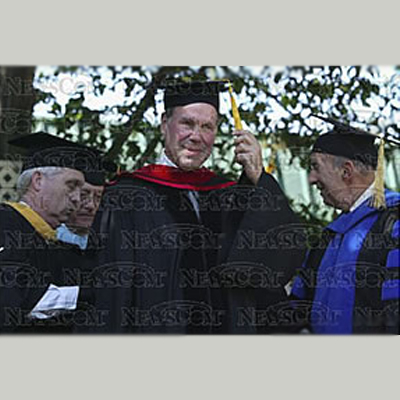
    MUMBAI: The Walt Disney Company CEO Michael D. Eisner was conferred an honorary Doctor of Fine Arts degree by the California State University, Northridge (CSUN).

    Eisner received his degree during commencement ceremonies for the university’s College of Education, which is named in his honor.

    “It has been a thrill for me and for my family to be associated with CSUN. There is no more important mission for any society than the education of its youth. It is here that the teachers of the future are being educated, and I’m truly honored to play a role in this process,” Eisner said during the ceremony.

    In 2003, CSUN — which trains more teachers than any other public university in California and is nationally known for its innovative programs — dedicated the Michael D. Eisner College of Education, the first time in its history that the university named a college after an individual.

    The Eisner Foundation, founded by Eisner and his wife Jane, awarded CSUN a $7 million grant to establish the college of education’s new Center for Teaching and Learning. The Center provides national leadership in preparing teachers to support the educational and emotional needs of all children in the classroom.

    CSUN president Jolene Koester conferred the degree on Eisner saying, “Michael Eisner and his wife, Jane, through their foundation, have demonstrated a commitment to education and the belief that all students deserve an opportunity to learn. This goes to the core of what our College of Education strives for. I am delighted that we are honoring such an extraordinary individual.”

    Eisner, who has served as The Walt Disney Company’s CEO since 1984, received his B.A. in English literature and theater from Denison University. He serves on numerous boards, including the California Institute of the Arts, the American Hospital of Paris Foundation, the Aspen Institute, the UCLA Executive Board for Medical Science, the World Trade Center Memorial Foundation and that of his alma mater, Denison University. He is also a member of The Business Council. This is Eisner’s first honorary degree.

    The Eisner Foundation provides financial support to organisations that undertake innovative and concrete programs designed to enhance and enrich the lives of children who are underserved, or who have learning differences, and their families. The Foundation recognises that all aspects of a child’s life are linked to their community including personal health, economic stability, appropriate mentors, living conditions and educational opportunities.
  • Tremors in media land over Comcast’s bid for Disney

    Tremors in media land over Comcast’s bid for Disney

    MUMBAI: Following the $66 billion unsolicited bid made by US cable TV biggie Comcast for the Walt Disney Company yesterday, many developments have come forth from various bodies in the US.

    First and foremost, the two companies’ share prices were affected after the announcement. While the share prices of Comcast fell ; that of the Walt Disney Company saw a rise on the stock market.

    The deal, if it comes through, would create a new rival to Time Warner and also to Rupert Murdoch’s News Corp. In a separate conference called yesterday, Murdoch was asked if the regulatory approval of a Comcast-Disney merger would clear the path for him to go after EchoStar Communications Corp. Murdoch replied in the negative and was quoted in media reports saying that he was not interested in making a bid for Walt Disney.

    Comcast president and CEO Brian Roberts said at a news conference in New York yesterday that he had not talked with any Disney board members or shareholders, including Roy Disney. Roberts further said that the ball was in Disney’s court and they had to take a call on it. Disney chief executive Michael D Eisner, who rebuffed Roberts’ request for merger talks earlier, had no comment on the offer, which the company said it would “carefully evaluate.” The directors of Disney further said that there was no action for shareholders to take in the meanwhile.

    The possible merger would also face intense regulatory scrutiny from the Federal Communications Commission (FCC) because of the combined company’s potential to squeeze customers. The FCC’s longstanding rules on media ownership were meant to guard against such threatening combinations. The perceived danger was that the gatekeepers for the viewer’s television screen could be in a position to dictate information and entertainment choices.

    Keeping this in mind, the federal government barred any company from owning more than one broadcast network and barred networks from owning cable systems, or too many stations, either nationally or in a single market. But reports say that because both companies have little overlap, the deal was likely to be approved by the FCC. FCC chairman Michael K Powell promised that “a merger of that magnitude will undoubtedly go through the finest filter at the commission as is possible.”

    One media report quoted the Center for Digital Democracy executive director Jeff Chester as saying, “It’s clear that Brian Roberts knows no limits to his media ownership ambitions. That Comcast would make the announcement the same day that a federal Court of Appeals in Philadelphia is holding a crucial hearing on new FCC media ownership policies suggests that they are out of touch with how millions of Americans – who opposed the recent ownership changes – feel about further media consolidation.”

    According to a media report, a Comcast-Disney merger would need regulatory approval on two fronts. One is an antitrust review, conducted either by the Federal Trade Commission or the Department of Justice. The second review will be conducted by the FCC on the more nebulous ground of the public interest.

    Owing to all this, the Walt Disney Co. reported improved fiscal first-quarter earnings that exceeded Wall Street expectations on the strength in its film business and improved TV networks and theme park trends yesterday following the announcement of the bid. Disney’s net income for the fiscal first quarter rose to $688 million from $36 million a year ago. Excluding the effect of an accounting change, the year-ago figure would have been $107 million. The revenue rose 19 per cent to $8.55 billion. The results were declared by the company yesterday morning rather than after the market close — as originally planned — as investors started the day focusing their attention on Comcast’s unsolicited bid for the Mouse House.

    In another development, Comcast struck a deal with programming guide provider Gemstar -TV Guide International Inc. worth $250 million for licensing its program-guide technology on account of which Gemstar’s shares soared yesterday. The deal includes a one-time $250 million cash licensing payment from Comcast to Gemstar, as well as the creation of a joint development group controlled by Comcast to develop interactive programming guides for cable operators.

  • Transcript of the letter from Comcast to Disney

    Transcript of the letter from Comcast to Disney

    MUMBAI: Given below, is the letter addressed to Disney’s Michael D Eisner from Comcast’s president and CEO Brian L Roberts.

    I am writing following our conversation earlier this week in which I proposed that we enter into discussions to merge Disney and Comcast to create a premier entertainment and communications company. It is unfortunate that you are not willing to do so. Given this, the only way for us to proceed is to make a public proposal directly to you and your Board.

    We have a wonderful opportunity to create a company that combines distribution and content in a way that is far stronger and more valuable than either Disney or Comcast can be standing alone. To this end, we are proposing a tax-free stock for stock merger in which Comcast would issue 0.78 of a share of its Class A voting common stock for each share of Disney. This represents a premium of over $5 billion for your shareholders, based on yesterdays closing prices. Under our proposal, your shareholders would own approximately 42% of the combined company.

    The combined company would be uniquely positioned to take advantage of an extraordinary collection of assets. Together, we would unite the countrys premier cable provider with Disneys leading filmed entertainment, media networks and theme park properties. In addition to serving over 21 million cable subscribers, Comcast is also the countrys largest high speed internet service provider with over 5 million subscribers. As you have expressed on several occasions, one of Disneys top priorities involves the aggressive pursuit of technological innovation that enhances how Disneys content is created and delivered. We believe this combination helps accelerate the realization of that goal – whether through existing distribution channels and technologies such as video-on-demand and broadband video streaming or through emerging technologies still in development – to the benefit of all our shareholders, customers and employees.

    We believe that improvements in operating performance, business creation opportunities and other combination benefits will generate enormous value for the shareholders of both companies. Together, as an integrated distribution and content company, we will be best positioned to meet our respective competitive challenges.

    We have a stable and respected management team with a great track record for creating shareholder value. In fact, our shares have consistently outperformed leading stock indices by significant margins, including the S&P 500 by a margin of more than 2 to 1 since Comcast went public in 1972.

    The Comcast management team greatly appreciates and is highly respectful of the Disney heritage. We know that there are many talented executives at Disney who we envision would also play a key role in managing the combined company. We also would welcome directors from your Board joining our Board.

    We have analyzed the issues associated with regulatory approval and are confident that all necessary approvals can be obtained in a timely fashion. Given the landscape that has evolved in our industry over the past few years, the creation of integrated content and distribution companies is essential to increasing the level of competition. The FCCs existing program access and program carriage rules ensure that the combined company will continue to make all of its satellite-delivered national and regional cable networks available on a non-exclusive, non-discriminatory basis and that there will be no discrimination against unaffiliated programming services, all consistent with the undertakings made by News Corp. in its recent acquisition of DirecTV.

    We hope that the Disney Board will pursue the opportunity that this proposed combination presents to your shareholde