Tag: MIB

  • TRAI issues consultation paper on regulating local TV channels

    TRAI issues consultation paper on regulating local TV channels

    MUMBAI: The Telecom Regulatory Authority of India (TRAI) is going to look at putting in place regulations relating to local TV channels now.


    In a consultation paper released today, the TRAI has sought stakeholders’ opinions on the regulatory framework that could be drawn up for local content channels in order to put them on a par with TV channels that are broadcast via satellite.


    The ministry of information and broadcasting (MIB) – through its secretary Uday Kumar Verma (in January 2013) – had asked the regulator to come up with its recommendations for the same.


    The TRAI consultation paper states that MSOs, LCOs, DTH operators, HITS and IPTV service providers (all called as distribution platform operators – or DPOs-  henceforth) are running local channels aka platform services (PS) that don’t have the MIB’s permission. Some channels that are transmitted by the DPOs through the PS channels have content similar to regular TV channels.


    TRAI has made it clear in the consultation paper that DAS has changed the context for DPOs and their PS as far as cable TV operators are concerned. The reason: with digitization, it is only the MSOs who can transmit encrypted signals from their headends on cable TV networks; LCOs can no longer transmit their own local ground based channels.


    The regulator states that there has been a debate on whether PS channels can be considered as a conventional TV channel or a value added service (VAS) because broadcast TV channels are charaterised by continuous dissemination of content in a push mode to all subscribers through DPOs. On the other hand, PS channels provide content in a pull mode triggered by a specific need or demand of consumers.


    TRAI has queried whether stakeholders agree with the following definition of a PS and if not then to suggest an alternative: “PS are programs transmitted DPOs exclusively to their own subscribers and does not include Doordarshan channels and TV channels permitted under downlinking guidelines.”


    Programmes on PS


    PS generally includes music, movies, news, devotional, entertainment, local news, live events, teleshopping, kids programs, serials, documentaries, regional programs, local plays, infotainment, market news, educational, and interactive games.


    TRAI has asked stakeholders to provide their views on whether a PS channel cannot transmit news or current affairs, coverage of political events, programmes already shown on DD or other TV channels, international/national and state level sporting events or games like IPL, Ranji Trophy. Whether what it shows can include programmes such as movies, VOD, interactive games, coverage of local events and festivals,  traffic, weather, educational/ academic programs (such as coaching classes), information regarding examinations, results, admissions, career counseling, availability of employment opportunities, job placement, Public announcements pertaining to civic amenities like electricity, water supply, natural calamities, health alerts etc. as provided by the local administration,  Information pertaining to sporting events excluding live coverage, live coverage of sporting events of local nature i.e. sport events played by district level (or below) teams and where no broadcasting rights are required.


    It has also asked the timeframe for reviewing whether a PS is trespassing into the domain of a regular TV broadcaster.


    Eligibility criteria for PS


    All categories of DPOs, apart from MSOs, are required to be registered under the Companies Act. To ensure uniformity in the legal status of all DPOS, TRAI suggests that a DPO offering a PS must register under the same. Therefore, the process of incorporation as a company has been simplified. Since the act allows even one person to register as a Company, small MSOs that are registered with the MIB can now register under the Companies Act.


    TRAI has asked whether it is mandatory for all DPOs to be registered as companies to be allowed to operate PS or to suggest an alternative.


    FDI limit for PS


    Currently news channels are allowed only 26 per cent FDI and a recommendation to increase it to 49 per cent is pending with the government. On the other hand, MSOs can have FDI up to 74 per cent. The regulator states that exclusion of ‘news and current affairs’ category of programmes from a PS channel would address this unevenness. It asks views on the same.


    Other issues


    As per the downlinking guidelines, an applicant company needs to have a minimum net worth of Rs 5 crore to downlink of its first TV channel and Rs 2.5 crore for any additional channel. It asks if there is a need for a minimum net-worth requirement for offering PS channels. Additionally, it also seeks to know if such channels should be subject to similar security clearances as applicable to private satellite TV channels.


    The TRAI also requests inputs on registration of PS channels with the MIB for which it would introduce a time bound centralised online registration system. Registration can be for 10 years with renewal for another 10 years. At the time of registration, the DPO should also declare the type of programmes it will transmit and any changes should be informed 30 days prior to a change.


    Although TRAI feels market forces would compel the DPOs to restrict transmission of channels to a local geographical area, it still asks for stakeholders’ views on should there be any limit in terms of geographical area for PS channels. Also, if there should there be a limit on the number of PS channels which can be operated by a DPO.


    Inputs on other obligations/restrictions that need to be imposed on DPOs for offering a PS such as non-sharing of a PS with another DPO and compliance with the programming and advertising code and TRAI’s regulations on quality of service and complaint redressal are also sought.


    Certain DTH operators transmit radio channels while some radio stations provide it through the net as over the top services. It asks whether a DPO should be permitted to re-transmit already permitted and operational FM radio channels under a suitable arrangement with the FM operator and if there should be a limit on the number of such channels.


    In order to monitor the kind of content that is being transmitted through the PS channels, DPOs may be mandated to keep a record of programmes for 90 days and produce it as and when required. The regulator asks for a monitoring mechanism.


    Whether a PS should be penalised in a manner similar to TV broadcasters, is also asked. Lastly, it seeks a timeframe for the registration of existing PS channels  once it is notified by the MIB.


    Comments are required to be submitted by 14 July and counter comments by 21 July.


    Click here to read the TRAI consultation paper on regulating local TV channels
  • MIB issues advisory to channels over depiction of rash driving scenes

    MIB issues advisory to channels over depiction of rash driving scenes

    MUMBAI: The death of minister of rural development Gopinath Munde a few days after him taking charge of the office shook not just the nation but the government as well. Taking note from the incident, the Information and Broadcasting Ministry (MIB) has issued an advisory to channels regarding depiction of rash, negligent or dangerous driving scenes/images.


    The Ministry of Road Transport and Highways (MRTH) has highlighted that depicting such incidences on programmes, news features and serials could be against public interest. Therefore, the MIB has advised TV channels that on the request of the MRTH such images or scenes may not be usually portrayed on TV channels.


    In the case where such a depiction becomes unavoidable, the scenes/images must be accompanied by messages such as ‘over speeding kills’ , ‘driving two-wheeler without helmet is dangerous and illegal’ and ‘driving four-wheeler without seat belt is dangerous and illegal’.


    The MIB urges all TV channels including Doordarshan to be extremely cautious with regard to such situations. Letters have been sent to the News Broadcasters Association, Broadcast Contents Complaints Council, The Advertising Standards council of lndia, All TV Channels and Doordarshan.


    The advisory is applicable to print publications as well.

  • FICCI welcomes MIB’s assurance of stable policy regime

    FICCI welcomes MIB’s assurance of stable policy regime

    NEW DELHI: The Federation of Indian Chambers of Commerce and Industry (FICCI) has applauded the statement of Information and Broadcasting Minister Prakash Javadekar that the new government would follow a stable policy regime and time-bound speedy mechanism with transparency.

    FICCI also expressed satisfaction on the assurance of the Minister that providing information, entertainment and knowledge to the citizens would be the priority of his Ministry.


    “Opening 1000 community radio stations is a good move. This will help in spreading knowledge and information among the common citizens of the country and also will help in generating employment,” FICCI said.

    FICCI had earlier met the Minister and shared with him FICCI’s ‘Policy Roadmap for the Media and Entertainment Sector in India,’ comprising key recommendations for the television, film, print, radio, AVGC and live events sectors.


    FICCI expressed confidence that the implementation of these recommendations will provide the much-needed boost to the media and entertainment sector, which has tremendous potential for dynamic growth and multiplier effect on employment generation without much spending from the public exchequer. 


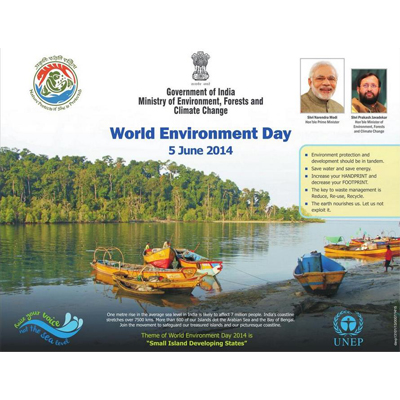
  • MIB marks World Environment Day on social media

    MIB marks World Environment Day on social media

    MUMBAI: It was during his open session at last week’s GoaFest that Union Minister for Environment and Information & Broadcasting Prakash Javadekar spoke of the need for a paradigm shift in Indian political advertising.


    Javadekar went on to explain that he was disappointed to see creatives of half-page print ads scheduled for release on World Environment Day without any message. That’s when he thought of taking a different route to political advertising.


    Indeed, Javadekar has kept his word on World Environment Day today. Apart from gifting a plant to each and every minister, including Prime Minister Narendra Modi, the new Environment and I&B Ministry at the centre has refrained from run-of-the-mill print ads across newspapers. Rather, it has made a splash on social media through creatives on the official Facebook and Twitter pages of the Ministry of Information & Broadcasting (MIB), live updates from Javadekar’s own Twitter handle, tweets released from Modi’s official account and Javadekar’s conference via YouTube.


    There’s also a video doing the rounds of social media.


    Click here to watch the video 

  • Broadcasters and teleports asked to update contact info, again

    Broadcasters and teleports asked to update contact info, again

    NEW DELHI: A fortnight ago, the Information & Broadcasting Ministry had asked the broadcasters and teleport operators to provide full details relating to the companies operating them.


    However, the MIB has, so far, received responses from a very few companies on the same. To remind the stakeholders of the appeal again, the Ministry has sent out a fresh reminder for seeking full details relating to the companies.


    In view of the tardy response, the Ministry extended the date to 15 April. The earlier date was March-end.


    The MIB has pointed out that it is the responsibility of the company to intimate any changes to the Ministry promptly. 


    In fresh letters sent to all television channels and teleport operators, the Ministry has asked among other things for contact details of the company including the registered address, any additional address, e-mail IDs, and telephone and fax numbers.


    Also, the channels and teleports have been asked to supply the name of the authorised representative with his/her e-mail ID and mobile number.


    The information has to be sent from the company’s e-mail to broadcastercontactdetails@gmail.com.

  • TAM applies for registration with MIB

    TAM applies for registration with MIB

    MUMBAI: When Kantar Market Research Services, a shareholder of India’s only operational ratings agency TAM Media Research, decided to go to court against the government’s cross-shareholding norms for television ratings agencies, there was a big question mark on the future of TAM.


    But as Kantar on 11 February succeeded in obtaining a stay on the cross-shareholding norms from the Delhi High Court till a judgement is delivered on its petition, it had some hope that TAM could continue to operate as a television ratings service provider.


    The court granted TAM two weeks after the guidelines take effect on 15 February to apply for registration with the ministry of information and broadcasting (MIB).  It had time till the end of next week to apply, but it submitted its registration application much earlier, on Friday.


    Kantar CEO Eric Salama confirmed to indiantelevision.com that TAM has submitted its application for being registered as a television ratings service provider.


    However, there is no clarity on the period within which the ministry will take a decision on TAM’s application for registration.


    There are various scenarios that can play out in the coming weeks for TAM. Further hearing on the Kantar petition will happen on 6 March.


    The first but highly unlikely scenario is the ministry acting on TAM’s application and before 6 March accepts the company as eligible to be granted a registration certificate. The next step will be the company, its board of directors, MD, CEO and CFO going through a security clearance.


    The second scenario is that the ministry rejects TAM’s application before 6 March, which also seems highly unlikely, or that the application is rejected after the hearing on 6 March. This could lead to Kantar filing an appeal against the government’s rejection of its application either in the High Court or in the Supreme Court and praying for allowing continuity in their business in the country. While granting the stay on cross-shareholding  norm, the court had also allowed TAM to continue to publish their television ratings.


    The third scenario could be the government asking TAM to submit more documents. In such a case, Kantar could approach the Delhi High Court for more time to submit the documents sought by the government.


    The fourth and more probable scenario is that the ministry may not act on TAM’s application till the Delhi High Court verdict on cross-shareholding is delivered. If the ministry finally rejects TAM’s application, Kantar may go in appeal against it.


    Finally, in the event of the Delhi High Court upholding the cross-shareholding norm, Kantar could either go in appeal against the verdict in the Supreme Court or may decide to restructure shareholding of TAM to comply with the government’s shareholding regulations.


    The government’s norm requires that shareholders of a television ratings agency should not hold more than a 10 per cent stake in broadcasters, advertising agencies or other television ratings agencies.


    In all, it seems like TAM has got some time to continue publishing its television viewership ratings in the country.

  • 786 licensed Indian channels as on 31 January

    786 licensed Indian channels as on 31 January

    MUMBAI: The MIB has released the list of permitted private satellite TV channels in India as on 31 January, 2014.

    According to a report published by the Information & Broadcasting Ministry (I&B Ministry), as of 31 January, 2014, the number of permitted private satellite TV channels in the country stands at 786; out of which 389 are news and current affairs channels, while the remaining 397 are non-news and current affairs ones.

    An earlier report published by the I&B Ministry pegged the number of permitted private satellite TV channels in India as on 2 December, 2013 at 784, with 395 of these being non-news and current affairs channels, implying two non-news and current affairs channels have been added to the list between 2 December, 2013 and 31 January, 2014.

    Out of the 786 channels, 664 TV channels have been permitted for uplink as well as downlink from India. 31 TV channels permitted for uplink but not downlink in India and 91 channels have been permitted only to downlink into India (uplinked from aboard).


    Of the 786 permitted private satellite TV channels in the country, 369 news channels and 295 non-news channels have both up-linking and down-linking permission, four news and 27 non-news channels have permission only to uplink, while 16 news and 75 non-news channels have permission just to down-link

    Sometime ago, indiantelevision.com had reported how the I&B Ministry – already under the scanner for being too liberal in issuing licenses to broadcasters – was exercising restraint in a damage control exercise of sorts.

    It doesn’t come as a surprise that the Ministry official list released on 20 December, 2012 had 848 permitted private satellite TV channels which has gone down to 786 in the latest list.

  • TRAI awaits call from Madras High Court for Arasu hearing

    TRAI awaits call from Madras High Court for Arasu hearing

    MUMBAI: More than four weeks have passed since the Madras High Court gave the interim order restraining the Telecom Regulatory Authority of India (TRAI) from taking any coercive steps against the Tamil Nadu state government-owned MSO Arasu Cable TV Corp for giving analogue signals in Chennai.


    However, there has been no follow up by the Madras HC on what it intends to do following the stay. 


    Anticipating a date soon, TRAI lawyers are already up on their toes and are compiling their response so that it can be submitted to the court. “We are still waiting for a date of the hearing. We haven’t heard anything from the court,” says a senior TRAI official.


    The case filed against two parties – the Ministry of Information and Broadcasting (MIB) and the TRAI will hopefully be  heard soon where the respondents from both the parties will get a chance to present their individual viewpoints. 


    The entire issue cropped up because Arasu has not been granted a digital addressable system (DAS) licence to run its business in the state even after continuous efforts to secure it. The MSO is still giving out analogue signals, thus keeping Chennai as the only city from Phase I to not go the whole hog on digitisation. 


    In its order which it passed late December 2013, the court states that the Inter-ministerial Committee (IMC) formed to decide the fate of Arasu has to move quickly on it. The order also mentions that Arasu abided by the rules and applied for a licence even after the Cable TV Networks (Regulation) Act, 1995 was amended in 2012.


    “It is not known to this Court as to why the first respondent (MIB) has not taken any decision so far on the application of the petitioner,” states the order. 


    The TRAI view on this is quite clear. Says a senior official at the regulator: “The decision on granting the licence lies with the MIB. In our recommendation we said that state governments should not be given the licence. The IMC is working on it but we haven’t yet got any response from them.” 


    The HC also states that since Arasu had followed the rules for applying for a licence, the MIB is not justified in keeping the matter pending and not arriving at a conclusion. It has also directed the Ministry to come out with a decision at the earliest.


    If MIB follows the TRAI’s cue and bars Arasu from securing a licence, the regulator  can take action against the MSO, according to the official. “If the MIB disqualifies Arasu from getting a licence, it cannot operate and if they do, they will be in violation of the law,” he says.


    As of now, nothing can be done against Arasu due to the interim order given by the Madras HC. But which direction this case moves is extremely crucial as the country is soon entering phase III and IV of digitisation. And it will decide whether the city of Chennai remains an analogue island in a sea of digitised India. 

  • TAM’s moment of truth

    TAM’s moment of truth

    MUMBAI: The Ministry of Information & Broadcasting (MIB) has finally put its stamp on the TV rating guidelines and the government order is already out on the Ministry’s website for all those who want to read it. The bottomline of the ratings order coming out is that TAM has to shape up or ship out.


    As per the TV rating guidelines which were given the cabinet’s nod last week, TAM has to work a miracle to meet them in the time frame that it has been given. There are several guidelines, but the most challenging appear to be ownership and expanding the people meter sample to 20,000. That too in a ultra slim  period of just 29 days if it wants to continue to be in the business.


    According to a highly placed industry source, TAM’s stakeholders will have to meet sooner than later to decide on what its next course of action should be. “It is a major decision it has to take: whether to take on the might of the law and the government; its move will have to be very calculated,” says the source.


    Industry insiders think that TAM’s options have narrowed down further as compared to earlier when it was playing the waiting game; waiting to see if the MIB will pursue and pass the order. Today it has two choices: either it approaches the court for some relief and gets a stay on MIB’s diktat, which will give it some more time to try and fulfill the guidelines; or, it will have to wind up its business, which is not going to be easy, considering how much it has invested in ratings, and the number of staffers on its rolls.


    The Broadcast Audience Research Council (BARC) had met the Ministry on Thursday, 16 January to update it on the progress it is making. However, the Council also tabled a request in front of the Ministry to allow TAM to exist till BARC is ready. That’s because with TAM on the blink in 29 days, there will be no ratings till October 2014, when BARC says its ratings will be up and running.


    The industry has been pushing TAM to go to court to get the stay; but it seemed reluctant to move ahead then. Now, with the time bomb ticking away, the urging from industry will only get stronger.


    Whether the ratings agency will move ahead on industry’s goading is a big question mark: its CEO LV Krishnan is sure to have memories of the caning he has been getting from broadcasters over the years. They have always complained TAM ratings are suspect; even as recently as last year, a bunch of them took him to the cleaners, threatening to shut off the subscription pipe to it. Advertisers and agencies kind of stood by him, but he had to face most of the flak.


    Will LVK do it this time too when TAM’s moment of truth has arrived?

  • MIB orders WB to stop transmission for one day

    MIB orders WB to stop transmission for one day

    NEW DELHI: It seems the Ministry of Information & Broadcasting (MIB) keeps a close watch on channels that don’t follow the guidelines set for them. That is what is evident from a recent incident where the Ministry has cracked its whip on the international movie channel, WB (Warner Brothers). The Ministry has prohibited the transmission or retransmission of the of WB TV channel for one day throughout India later this month as a penalty for telecasting a V/UA certified film It’s a Boy Girl Thing on 7 January, 2013 at 11.51 am.


    The prohibition on any platform throughout India will be with effect from 00.01 am on 24 January till 00.01 am on 25 January.


    The action has been taken under in exercise of the powers conferred by sub-section (2) & (3) of Section 20 of the Cable Television Networks (Regulation) Act 1995 and under paras 6.1 and 6.2 of the Guidelines for Downlinking from India.


    The Ministry had issued a notice to the channel on 20 August last year as the telecast appeared to violate late Rule 6(l) (a), 6 (tXd), 6(l) (k) 6(l)(o) & 6 (5) of the Cable Television Networks Rules 1994 under the Cable Television Networks (Regulation) Act 1995 and the channel was asked to show cause within fifteen days.


    While asking for a personal opportunity to explain their position, M/s Turner International India, the parent company of WB channel, in their reply of 2 September said it was not aware about the Central Board of Film Certification (CBFC) suggesting 15 voluntary cuts and l6 compulsory cuts in the film until the Ministry issued the notice. It further said all content telecast on the channel was reviewed by its Standards and Practice Department which had very strict mechanism to ensure that only appropriate material was played out in accordance with Indian requirements.


    Turner further said that immediately upon receipt of the notice, the channel withdrew and stopped all further telecast of the film and indicated that the channel was willing to re-apply to the CBFC for re-certification of the film and would not telecast the same until a certificate was obtained by the CBFC. Furthermore, it said the CBFC Certificate available with it contained only the compulsory cuts without any reference to the voluntary cuts and that it had not questioned the completeness of the Censor Certificate and had made the edition and cuts based on the belief that the Censor Certificate available with them was the only, valid and complete Censor Certificate issued by the CBFC.


    In the personal hearing given by the Inter-Ministerial Committee, the Turner representative issued an unconditional apology for airing the film with offensive content on television and admitted that it was a mistake on the part of their programme team. The Committee previewed the CD containing the film, considered the reply of the channel and the personal submissions made by the representative of the channel.


    The Committee held that the channel had clearly violated the provisions of the Programme Code and observed that this kind of violation of the provisions of the 1995 Act and Rules framed there under was not acceptable. Though the channel had accepted their fault and apologised for their mistake, ‘they cannot escape the responsibility of ensuring that the content on their channel is in conformity with the Programme Code at all times. Moreover, before telecasting any film due diligence has to be done by the channel to assure that only certified version fully compliant with all necessary and voluntary deletions/editions is aired.


    The Ministry said the film telecast by the channel shows ‘highly objectionable visuals which denigrate Women’.


    ‘The Visuals shown are very offensive and obscene as the private parts of male and female are focused upon. The portrayal of the sex change is in bad taste and is indecent. The visuals are not fit to be viewed by children and also not suitable for unrestricted public exhibition. These visuals also denigrate women,’ remarks the notice.


    Rule 6 (1) (a) of the Programme Code contained in the Cable Television Networks Rules, 1994 provides that no programme should be carried in the Cable Service which offends good taste or decency. Rule 6 (l) (d) provides that no programme should be carried in the Cable Service which contains anything obscene, defamatory, deliberate, false and suggestive innuendos and half truth. Rule 6 (l) (K) provides that no programme should be carried in the Cable Service which denigrates women through the depiction in any manner of the figure of a women, her form or body or any part thereof in such a way as to have the effect of being indecent or derogatory to women. Rule 6 (l) (o) & 6 (5) provides that no programme should be carried in the Cable Service which is not suitable for unrestricted public exhibition and children viewing’.


    In view of the apology by the channel and its reply, the Committee recommended the prohibition of the transmission/re-transmission of the channel throughout India for one day.