Tag: MIB

  • FM P-III: A disappointing fortnight of slow & low bids

    FM P-III: A disappointing fortnight of slow & low bids

    NEW DELHI: Although Hyderabad and Dehradun continued to lead with bids of Rs 23,43,48,266 and Rs 15,61,00,590, respectively in the FM radio’s Phase III auctions for frequencies, the first fortnight remained disappointing with little movement in the bids or the price percentage increase on completion of 55 rounds.

    In fact, the number of rounds fell from four to three for the first time on the 14th day of auction on 21 November 2016. While Muzaffarpur showed a price percentage increase of one, 44 cities have still failed to attract any bids.

    Agartala has joined the band of Alappuzha (Alleppey), Erode, Hubli-Dharwad, Nellore, Salem, Vellore and Vijaywada where bids remained at just over Rs 70 million. Bids for Tiruchy increased to just above Rs 50 million and Tirupathi and Puducherry to a little over Rs 40 million. Amravati, Bhavnagar, Jamnagar and Ujjain bid a little over Rs 35 million and Mysuru a little over Rs 32 million.

    Thus, apart from minor rise in Agartala and Ujjain, there has been little movement in other cities over the past week. The first day of auction on 26 October 2016 saw a winning price of Rs 1,820 million against the aggregate price of Rs 1,792 million, while the second day saw low bids and no bids from three cities.

    Meanwhile, South Asia FM Ltd has been declared as the winning bidder for five radio FM channels, just a day after the commencement of the auction for the second batch of Phase III. The company will be allotted frequencies in Surat, Amritsar, Patna, Chandigarh and Jammu.

    South Asia FM Limited, one of the 14 shortlisted bidders, is a public incorporated entity. It is classified as a non-government company and is registered at Chennai. Its authorized share capital is Rs. 6,550,000,100 and its paid up capital is Rs. 6,153,605,100.It is involved in motion picture, radio, television and other entertainment activities.

    Ministry of Information and Broadcasting (MIB) sources told indiantelevision.com that the aim was to continue till all the channels slated in the second batch were auctioned.

    This data has been compiled on the basis of system-generated “Final Round Result Report” and “Frequency Identification Report” accessible through auction administrator role.

    Also Read

    FM radio Phase III frequency allocation to bidders completed in three rounds


  • IFFI 2016: India, S. Korea keen on co-productions

    IFFI 2016: India, S. Korea keen on co-productions

    NEW DELHI: Minister for Information and Broadcasting (MIB) M Venkaiah Naidu has said the government is keen to work and cooperate with South Korea in the domain of film production in a way that could benefit both countries.

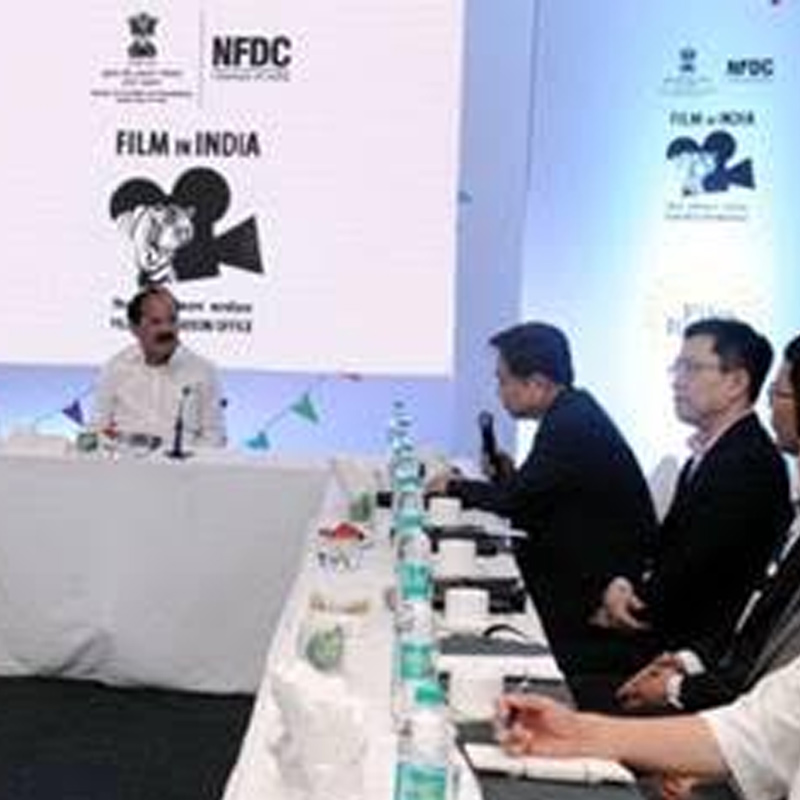
    Speaking at a meeting with the Korean delegation yesterday in Panaji, the Minister said the government gave great importance to the 2014 agreement between the two countries on co-production and exchange of ideas and expressed satisfaction at Korea being the main partner in the cultural sphere and the focus country at the International Film Festival of India (IFFI).

    MIB Secretary Ajay Mittal said the Film Facilitation Office was set up by the National Film Development Corporation (NFDC) to address issues on film production and facilitating mutual cooperation.

    Korean ambassador to India Cho Hyun shared his ideas and themes for future film making. The delegation also expressed its happiness of the remake of the South Korean movie `Montage’. Hyun also remembered the role India played on the peace keeping operations in the Korean War.

    A large Korean delegation is attending the IFFI this year and veteran Korean filmmaker Im Kwon Taek had been awarded the Lifetime Achievement Award at the inauguration of the festival.

    A total number of 18 films are being screened from South Korea and the opening film was `Tunnel’ whose director Kim Seong-hun said later at a press meet that it was his first visit to India and he was thrilled to meet a new audience at this venue. The other directors and producers present at the event talked about their films’ genres and storylines.

    The Korean Film Council (KOFIC) representative, also present at the conference, talked about the screening of 18 films at the fest and further strengthening the foundation of Indo-Korean relationship through this step. He added that Korea produces three films per year under co-production and has a budget of $ 300,000.

    Director Lee Joon-ik of ‘Dongju: The Portrait of a Poet’ spoke about the removal of censorship in South Korea and its impact on the Korean film industry. He said that in the 70s, Hollywood had 80 per cent share in the Korean market. But with the complete removal of censorship, now the Korean cinema has gained 30 per cent of the market share, reducing Hollywood share by up to 50 per cent.

    Korean Film has come of age in terms of technology and production said Korean filmmakers. The directors believe that if the Indian audience enjoy Hollywood cinema, they will surely like Korean cinema as well, because just like Hollywood, Korean cinema is also technology-driven and, at times, is way ahead of Hollywood.

    The film ‘Tunnel’ tears down the conventional disaster movie genre. Through a disaster, which seems lifted from ordinary reality, the film reminds us all of the forgotten dignity of human life. The director shifts smoothly between emotional extremes to create a distinctive and realistic disaster movie that brings something new to the genre.

  • IFFI 2016: India, S. Korea keen on co-productions

    IFFI 2016: India, S. Korea keen on co-productions

    NEW DELHI: Minister for Information and Broadcasting (MIB) M Venkaiah Naidu has said the government is keen to work and cooperate with South Korea in the domain of film production in a way that could benefit both countries.

    Speaking at a meeting with the Korean delegation yesterday in Panaji, the Minister said the government gave great importance to the 2014 agreement between the two countries on co-production and exchange of ideas and expressed satisfaction at Korea being the main partner in the cultural sphere and the focus country at the International Film Festival of India (IFFI).

    MIB Secretary Ajay Mittal said the Film Facilitation Office was set up by the National Film Development Corporation (NFDC) to address issues on film production and facilitating mutual cooperation.

    Korean ambassador to India Cho Hyun shared his ideas and themes for future film making. The delegation also expressed its happiness of the remake of the South Korean movie `Montage’. Hyun also remembered the role India played on the peace keeping operations in the Korean War.

    A large Korean delegation is attending the IFFI this year and veteran Korean filmmaker Im Kwon Taek had been awarded the Lifetime Achievement Award at the inauguration of the festival.

    A total number of 18 films are being screened from South Korea and the opening film was `Tunnel’ whose director Kim Seong-hun said later at a press meet that it was his first visit to India and he was thrilled to meet a new audience at this venue. The other directors and producers present at the event talked about their films’ genres and storylines.

    The Korean Film Council (KOFIC) representative, also present at the conference, talked about the screening of 18 films at the fest and further strengthening the foundation of Indo-Korean relationship through this step. He added that Korea produces three films per year under co-production and has a budget of $ 300,000.

    Director Lee Joon-ik of ‘Dongju: The Portrait of a Poet’ spoke about the removal of censorship in South Korea and its impact on the Korean film industry. He said that in the 70s, Hollywood had 80 per cent share in the Korean market. But with the complete removal of censorship, now the Korean cinema has gained 30 per cent of the market share, reducing Hollywood share by up to 50 per cent.

    Korean Film has come of age in terms of technology and production said Korean filmmakers. The directors believe that if the Indian audience enjoy Hollywood cinema, they will surely like Korean cinema as well, because just like Hollywood, Korean cinema is also technology-driven and, at times, is way ahead of Hollywood.

    The film ‘Tunnel’ tears down the conventional disaster movie genre. Through a disaster, which seems lifted from ordinary reality, the film reminds us all of the forgotten dignity of human life. The director shifts smoothly between emotional extremes to create a distinctive and realistic disaster movie that brings something new to the genre.

  • DAS Phase IV pace slack; MIB to meet Indian STB makers

    DAS Phase IV pace slack; MIB to meet Indian STB makers

    NEW DELHI: A miniscule percentage of set-top boxes have been seeded in DAS Phase IV after August 2016 as compared to those seeded earlier in four phases when six weeks are left for the deadline for switching off analogue signals is reached.

    Although the total number of set-top boxes seeded in the country for four phases of the digital addressable system is 92.424 million till 25 October 2016, a mere 1.966 million STBs were seeded in the Phase IV areas after 31 August 2016.

    Also, the much-touted indigenously manufactured STBs with iCAS or Indian CAS too have not found much favour with industry players as no major purchase orders had been placed.

    The MIS system shows that about 2.843 million including 8,76,000 STBs in Phase III for which the deadline was 31 December 2015 have been seeded, according to figures released at the 18th Task Force meeting held on 26 October 2016.

    (Phase IV areas, needing approximately 75 million STBs according to industry estimates, mostly comprise rural India’s smaller hamlets and towns where selling the idea of digitisation and getting a STB at home itself is considered a challenging task by LCOs, MSOs and other stakeholders.)

    The Task Force was told that the Nodal Officers have been supplied with the passwords to access state wise specific reports from the MIS system. Information and Broadcasting Ministry Joint Secretary Mihir Singh who chaired the meeting said the Ministry may analyze the district wise seeding data and send the district wise status of progress of seeding to the respective States for further action.

    Meanwhile, the meeting was informed that five of the 45 cases transferred to the Delhi High Court relating to Phase III following Supreme Court directives had been disposed off. Two cases had been returned to the respective High Courts as these did not relate to DAS implementation; 23 cases were listed for hearing before a Division Bench headed by Chief Justice G Rohini and 13 cases before a single bench. Two cases are yet to be listed for hearing. The Chairperson directed that the Ministry should ensure that the court notices are delivered to the petitioners according to the directions of the court.

    Referring to the public awareness campaign through television commercials, the Chairperson said broadcasters need to increase the frequency of these spots particularly during prime time for greater impact. He directed the broadcasters to carry these spots at least four times a day, of which two should be during the prime time from 7 pm to 11 pm.

    Giving an update on the status of public awareness campaign for Phase lV, Advisor (DAS) Yogendra Pal said broadcasters, including Doordarshan, are giving wide publicity using two AV spots developed by the Ministry. He added that in addition to these spots, the Indian Broadcasting Foundation had also developed its own spot. Scrolls are also being run by broadcasters on their channels.

    The representative of the News Broadcasters Association said 62 channels of their members are carrying AV spots and are also carrying scrolls developed by them.

    The Ministry has issued an advisory to about 4500 cable operators to apply for registration as multisystem operators immediately if interested, failing which they would not be able to work as MSOs after the cut-off date of 31 December 2016. In this regard, advertisements were also published in all regional newspapers on 9 September and 1 October 2016. In order to ensure that only registered MSOs are operating in all DAS notified areas, the Ministry had requested lBF, NBA and ARTBI to provide the names of the registered MSOs, phase-wise and area-wise, with whom they have entered into interconnect agreements for pay channels to the Ministry by 28 October 2016. lt was clarified to the representatives of IBF that information has been asked in a particular format and has to be sent for all phases.

    However, the date had been put off to 4 November 2016 on the request of representatives of IBF and NBA.

    Representatives of national MSOs mentioned that the seeding in Phase IV areas was not satisfactory due to various court cases for phase III and the status will drastically change once these cases are disposed off by the Delhi High Court. It was also mentioned that most of the head-ends serving phase IV areas are located in phase III areas and hence transition to digital in phase IV areas should not pose any problem.

    The Chairperson asked the members to suggest measures to implement phase IV of digitisation by the notified cut-off date of 31 December 2016.

    Members made some suggestions in this regard. One was that the Ministry should as a pre-emptive measure consider filing caveats and the Ministry should consider extending the date till March 2017 in line with the draft revised tariff orders of Telecom Regulatory Authority of India.

    The TRAI representative opposed this, saying that revision of regulations and tariff orders is a routine exercise and cut-off date should not be linked with the issue of draft tariff orders.

    The representatives of CEAMA and DTH also opposed any extension of the cut-off date.

    Welcoming the judgement, SITI Networks Limited executive director and CEO VD Wadhwa said, “This is a landmark moment in the Digital India journey as it will also clear the passage for timely implementation of DAS Phase 4 of digitisation. The industry had been suffering due to pending litigation, and with this welcome move, all hurdles have been cleared. It is now obligatory on part of broadcasters and other players to disconnect analogue signals within two weeks.”

    All India Digital Cable Federation (AIDCF), the industry body representing Digital Multi System Operators (MSO), has asked all its members to work with broadcasters to switch off analogue signals and implement digitisation is DAS Phase III markets immediately. This will also pave the way for digital revenues to flow in from these areas as per the directives of the TRAI.

    AIDCF has also urged all local cable operators, MSOs, broadcasters and government bodies to help complete digitisation at the earliest. Federation president VD Wadhwa said: “On behalf of AIDCF, I urge all MSOs, cable operators, broadcasters to switch off analogue feeds in two weeks to comply with the honorable court’s order. We would also request government bodies to extend their good support in meeting the digitisation deadlines.”

  • DAS Phase IV pace slack; MIB to meet Indian STB makers

    DAS Phase IV pace slack; MIB to meet Indian STB makers

    NEW DELHI: A miniscule percentage of set-top boxes have been seeded in DAS Phase IV after August 2016 as compared to those seeded earlier in four phases when six weeks are left for the deadline for switching off analogue signals is reached.

    Although the total number of set-top boxes seeded in the country for four phases of the digital addressable system is 92.424 million till 25 October 2016, a mere 1.966 million STBs were seeded in the Phase IV areas after 31 August 2016.

    Also, the much-touted indigenously manufactured STBs with iCAS or Indian CAS too have not found much favour with industry players as no major purchase orders had been placed.

    The MIS system shows that about 2.843 million including 8,76,000 STBs in Phase III for which the deadline was 31 December 2015 have been seeded, according to figures released at the 18th Task Force meeting held on 26 October 2016.

    (Phase IV areas, needing approximately 75 million STBs according to industry estimates, mostly comprise rural India’s smaller hamlets and towns where selling the idea of digitisation and getting a STB at home itself is considered a challenging task by LCOs, MSOs and other stakeholders.)

    The Task Force was told that the Nodal Officers have been supplied with the passwords to access state wise specific reports from the MIS system. Information and Broadcasting Ministry Joint Secretary Mihir Singh who chaired the meeting said the Ministry may analyze the district wise seeding data and send the district wise status of progress of seeding to the respective States for further action.

    Meanwhile, the meeting was informed that five of the 45 cases transferred to the Delhi High Court relating to Phase III following Supreme Court directives had been disposed off. Two cases had been returned to the respective High Courts as these did not relate to DAS implementation; 23 cases were listed for hearing before a Division Bench headed by Chief Justice G Rohini and 13 cases before a single bench. Two cases are yet to be listed for hearing. The Chairperson directed that the Ministry should ensure that the court notices are delivered to the petitioners according to the directions of the court.

    Referring to the public awareness campaign through television commercials, the Chairperson said broadcasters need to increase the frequency of these spots particularly during prime time for greater impact. He directed the broadcasters to carry these spots at least four times a day, of which two should be during the prime time from 7 pm to 11 pm.

    Giving an update on the status of public awareness campaign for Phase lV, Advisor (DAS) Yogendra Pal said broadcasters, including Doordarshan, are giving wide publicity using two AV spots developed by the Ministry. He added that in addition to these spots, the Indian Broadcasting Foundation had also developed its own spot. Scrolls are also being run by broadcasters on their channels.

    The representative of the News Broadcasters Association said 62 channels of their members are carrying AV spots and are also carrying scrolls developed by them.

    The Ministry has issued an advisory to about 4500 cable operators to apply for registration as multisystem operators immediately if interested, failing which they would not be able to work as MSOs after the cut-off date of 31 December 2016. In this regard, advertisements were also published in all regional newspapers on 9 September and 1 October 2016. In order to ensure that only registered MSOs are operating in all DAS notified areas, the Ministry had requested lBF, NBA and ARTBI to provide the names of the registered MSOs, phase-wise and area-wise, with whom they have entered into interconnect agreements for pay channels to the Ministry by 28 October 2016. lt was clarified to the representatives of IBF that information has been asked in a particular format and has to be sent for all phases.

    However, the date had been put off to 4 November 2016 on the request of representatives of IBF and NBA.

    Representatives of national MSOs mentioned that the seeding in Phase IV areas was not satisfactory due to various court cases for phase III and the status will drastically change once these cases are disposed off by the Delhi High Court. It was also mentioned that most of the head-ends serving phase IV areas are located in phase III areas and hence transition to digital in phase IV areas should not pose any problem.

    The Chairperson asked the members to suggest measures to implement phase IV of digitisation by the notified cut-off date of 31 December 2016.

    Members made some suggestions in this regard. One was that the Ministry should as a pre-emptive measure consider filing caveats and the Ministry should consider extending the date till March 2017 in line with the draft revised tariff orders of Telecom Regulatory Authority of India.

    The TRAI representative opposed this, saying that revision of regulations and tariff orders is a routine exercise and cut-off date should not be linked with the issue of draft tariff orders.

    The representatives of CEAMA and DTH also opposed any extension of the cut-off date.

    Welcoming the judgement, SITI Networks Limited executive director and CEO VD Wadhwa said, “This is a landmark moment in the Digital India journey as it will also clear the passage for timely implementation of DAS Phase 4 of digitisation. The industry had been suffering due to pending litigation, and with this welcome move, all hurdles have been cleared. It is now obligatory on part of broadcasters and other players to disconnect analogue signals within two weeks.”

    All India Digital Cable Federation (AIDCF), the industry body representing Digital Multi System Operators (MSO), has asked all its members to work with broadcasters to switch off analogue signals and implement digitisation is DAS Phase III markets immediately. This will also pave the way for digital revenues to flow in from these areas as per the directives of the TRAI.

    AIDCF has also urged all local cable operators, MSOs, broadcasters and government bodies to help complete digitisation at the earliest. Federation president VD Wadhwa said: “On behalf of AIDCF, I urge all MSOs, cable operators, broadcasters to switch off analogue feeds in two weeks to comply with the honorable court’s order. We would also request government bodies to extend their good support in meeting the digitisation deadlines.”

  • Pratidin Time clarifies that News Time Assam is recepient of MIB ban for a day

    Pratidin Time clarifies that News Time Assam is recepient of MIB ban for a day

    MUMBAI: Guwahahti-based Yash TV Entertainment has clarified that its channel Pratidin Time is not the one which has been asked to go off the air on 9 November by the information & Broadcasting ministry (MIB) for gross violations of the content code.

    Indiantelevision.com received an email message from Pratidin Time general manager Gaurav Goswami saying that “both channels are running successful on air as can be seen on the MIB list. But it is News Time Assam which has met with the MIB disapproval.”

    The facts now: Yash TV Entertainment is a part of the Pratidin group founder Jayanta Baruah and his family, which own Assamese daily Asomiya Pratidin, Sadin, a weekly tabloid and a women’s monthly magazine Nandini.

    News Time Assam is actually owned by the Kolkata-based Brand Value Communications but is run by the Guwahati-based UB Photo Group. The channel’s content producer Utpal Baruah told The Hindustan Times that the channel would be switched off on 9 November. “The channel has not being doing well. Hopefully, the free publicity will help us bring in investors,” he told the newspaper.

    Utpal Baruah clarified that the Pratidin group had acquired the assets of News Time Assam last year, which later went on to launch its own channel Pratidin Time. However, the channel licence continued to be with Brand Value Communications, which later leased it to him.

    Baruah additionally told The Hindustan Times that while the channel had been hauled up for three violations one of the violations was under the watch of the Pratidin group and the I&B punishment relates to that period.

    An Assam based media observer clarified that “the confusion has arisen because Pratidin Time had on its Twitter and Wikipedia pages announced that News Time Assam was being renamed as Pratidiin Time. When the deal did not go through, corrections were not issued to all concerned, hence the misunderstanding that it was Pratidin Time which was being given correctional punishment by the MIB.”

  • Pratidin Time clarifies that News Time Assam is recepient of MIB ban for a day

    Pratidin Time clarifies that News Time Assam is recepient of MIB ban for a day

    MUMBAI: Guwahahti-based Yash TV Entertainment has clarified that its channel Pratidin Time is not the one which has been asked to go off the air on 9 November by the information & Broadcasting ministry (MIB) for gross violations of the content code.

    Indiantelevision.com received an email message from Pratidin Time general manager Gaurav Goswami saying that “both channels are running successful on air as can be seen on the MIB list. But it is News Time Assam which has met with the MIB disapproval.”

    The facts now: Yash TV Entertainment is a part of the Pratidin group founder Jayanta Baruah and his family, which own Assamese daily Asomiya Pratidin, Sadin, a weekly tabloid and a women’s monthly magazine Nandini.

    News Time Assam is actually owned by the Kolkata-based Brand Value Communications but is run by the Guwahati-based UB Photo Group. The channel’s content producer Utpal Baruah told The Hindustan Times that the channel would be switched off on 9 November. “The channel has not being doing well. Hopefully, the free publicity will help us bring in investors,” he told the newspaper.

    Utpal Baruah clarified that the Pratidin group had acquired the assets of News Time Assam last year, which later went on to launch its own channel Pratidin Time. However, the channel licence continued to be with Brand Value Communications, which later leased it to him.

    Baruah additionally told The Hindustan Times that while the channel had been hauled up for three violations one of the violations was under the watch of the Pratidin group and the I&B punishment relates to that period.

    An Assam based media observer clarified that “the confusion has arisen because Pratidin Time had on its Twitter and Wikipedia pages announced that News Time Assam was being renamed as Pratidiin Time. When the deal did not go through, corrections were not issued to all concerned, hence the misunderstanding that it was Pratidin Time which was being given correctional punishment by the MIB.”

  • MIB puts  NDTV India ban on hold until further notice

    MIB puts NDTV India ban on hold until further notice

    MUMBAI: The twists and turns in l’affaire NDTV continue.  The ministry of information and broadcasting (MIB) late in the evening today issued another order stated that its earlier diktat banning Hindi TV news channel NDTV India for a day on 9 November 2016 is to be held in “abeyance until further orders.”  What this means is that NDTV need not pull the plug on its Hindi news channel for a day for violations during its coverage of  the Pathankot terrorist attack earlier this year.

    The reason the MIB has stated is that NDTV has made a representation to it , which it is currently examining. And until it does so fully, the earlier order prohibiting transmission or retransmission of NDTV India under the Cable TV Networks Regulation Act is on hold.

    Earlier today, the NDTV management approached the Supreme Court challenging the MIB’s directive.

    And NDTV co-founder and executive chairperson Prannoy Roy met with I&B minister Venkaiah Naidu later in the day exhorting him that his channel’s views on it had perhaps not been fully and adequately appreciated.  Roy also wanted the decision to be reviewed. Following this, a new order was issued by the MIB putting its earlier order on hold.

     “Clearly the Modi government and the MIB have both faced a lot of political heat on account of the ban. It probably had not idea how much of verbal artillery fire it would face from the fourth estate when it took its step to ban NDTV India,” says a media observer. “It’s good that the MIB is taking it as it comes and has retracted its order temporarily until it examines NDTV’s stand. At least it will be able to say it gave the network a chance to make its representation and redeem itself in the public’s eyes which is stating that harsh days are ahead for the media. That the era of the Indira Gandhi emergency is upon us.”

    Earlier today Zee group chairman and BJP MP  Subhash Chandra had said that the actions against NDTV were in order and that instead of a day long ban, a lifelong ban against it should be issued. He also added that even the Indian courts would not overrule the MIB verdict as it had threatened Indian security with its reportage.

    Also Read:

    NDTV challenges I&B Ministry order in Supreme Court

    NDTV India has been singled out: NBA

    Govt hands NDTV India 24-hr ban for breach of content code

  • MIB puts  NDTV India ban on hold until further notice

    MIB puts NDTV India ban on hold until further notice

    MUMBAI: The twists and turns in l’affaire NDTV continue.  The ministry of information and broadcasting (MIB) late in the evening today issued another order stated that its earlier diktat banning Hindi TV news channel NDTV India for a day on 9 November 2016 is to be held in “abeyance until further orders.”  What this means is that NDTV need not pull the plug on its Hindi news channel for a day for violations during its coverage of  the Pathankot terrorist attack earlier this year.

    The reason the MIB has stated is that NDTV has made a representation to it , which it is currently examining. And until it does so fully, the earlier order prohibiting transmission or retransmission of NDTV India under the Cable TV Networks Regulation Act is on hold.

    Earlier today, the NDTV management approached the Supreme Court challenging the MIB’s directive.

    And NDTV co-founder and executive chairperson Prannoy Roy met with I&B minister Venkaiah Naidu later in the day exhorting him that his channel’s views on it had perhaps not been fully and adequately appreciated.  Roy also wanted the decision to be reviewed. Following this, a new order was issued by the MIB putting its earlier order on hold.

     “Clearly the Modi government and the MIB have both faced a lot of political heat on account of the ban. It probably had not idea how much of verbal artillery fire it would face from the fourth estate when it took its step to ban NDTV India,” says a media observer. “It’s good that the MIB is taking it as it comes and has retracted its order temporarily until it examines NDTV’s stand. At least it will be able to say it gave the network a chance to make its representation and redeem itself in the public’s eyes which is stating that harsh days are ahead for the media. That the era of the Indira Gandhi emergency is upon us.”

    Earlier today Zee group chairman and BJP MP  Subhash Chandra had said that the actions against NDTV were in order and that instead of a day long ban, a lifelong ban against it should be issued. He also added that even the Indian courts would not overrule the MIB verdict as it had threatened Indian security with its reportage.

    Also Read:

    NDTV challenges I&B Ministry order in Supreme Court

    NDTV India has been singled out: NBA

    Govt hands NDTV India 24-hr ban for breach of content code

  • NDTV challenges I&B Ministry order in Supreme Court

    NDTV challenges I&B Ministry order in Supreme Court

    MUMBAI: NDTV has challenged in the Supreme Court the I&B Ministry’s order of one-day ban on its Hindi news channel NDTV India. The Ministry of Information & Broadcasting (MIB) had directed NDTV India to go off air for 24 hours from 9 November 2016 00:01 hrs as a penalty for showing strategically-sensitive information while covering the Pathankot military operation in January this year.

    In response, the company argued that it was not the only channel that disclosed the information for which it is being penalised. NDTV has petitioned the Supreme Court challenging the order.

    In a BSE filing, the news network said that it has filed a writ petition before the Supreme Court, inter-alia, challenging the constitutional validity of the said order, and the provisions of law pursuant to which the said order has purportedly been passed.

    The Editors Guild of India, the Broadcast Editors Association (BEA), the News Broadcasters Association (NBA) and several influential personalities such as Rajdeep Sardesai, Sagarika Ghose, Rana Ayyub, Rahul Kanwal, Praveen Swami, and journalists from the channel — Ravish Kumar, etc have shown solidarity towards the channel and have come up in full support against the government’s order. They have demanded its immediate revocation.

    Others such as Zee group chairman Dr Subhash Chandra have said that the government is being soft on NDTV and that the ban should be for a lifetime for daring to carry reports which could harm the country’s security. He additionally said on twitter that if the channel dares to go to court to challenge the ban, its appeal will be rejected.

    The blackout of NDTV India comes at a crucial time when the news channels, apart from covering the current affairs, will be providing extensive coverage of the US Presidential Elections 2016.