Tag: MIB

  • Arnab blinks; switches to ‘Republic TV’

    Arnab blinks; switches to ‘Republic TV’

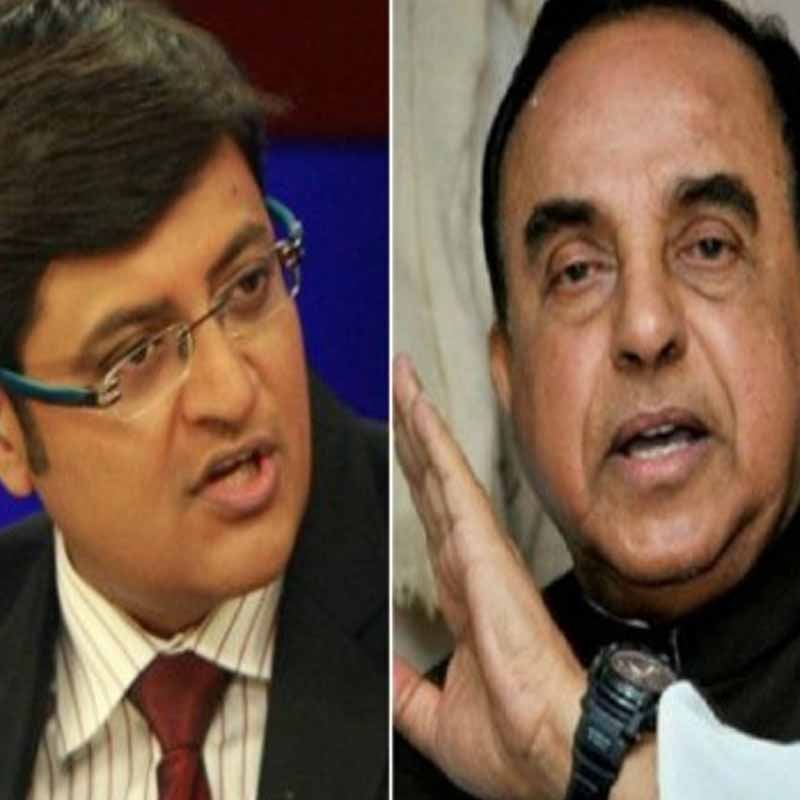
    MUMBAI: Dramatics personified well-known news anchor Arnab Goswami has declared the new name of his news channel to be ‘Republic TV’, switching from the original ‘Republic’.

    BJP Member of Parliament Subramaniam Swamy had questioned the use of the world ‘republic’ for commercial use, citing Indian law.

    In a letter dated 13 January 2017, Swamy wrote to the secretary, ministry of information and broadcasting (MIB) : “It has come to my notice that a new TV channel under the name of “Republic” is in the process of being launched… It may be noticed that certain names and emblems are prohibited from being used under the Emblems and Names (Prevention of Improper Use) Act, 1950 for professional and commercial purposes. As per the schedule accompanying the statute, under Item 6, there is an express prohibition from using the phrase, “Republic”. ”

    Now, in a letter dated 28 January to the under-secretary to the government of India (MIB), Republic TV’s MD and editor-in-chief, on behalf of ARG Outlier Media, Goswami stated that the documents needed were being submitted to facilitate the name change.

    Goswami may have eventually chosen to start the real news battle later, when he is fully prepared, rather than the ‘namesake’ fight.

    ALSO READ:

    BJP MP Swamy finds holes in Arnab Goswami’s ‘Republic’

    RBNL ex-CBO Khanchandani joins Arnab’s Republic

    Arnab’s Republic widens footprint on Facebook, Twitter

  • No DAS III extension beyond 31 Jan, reiterates MIB

    No DAS III extension beyond 31 Jan, reiterates MIB

    MUMBAI: Cable Subscribers in DAS Phase III urban areas, who have not yet taken set-top boxes, are advised to obtain the same from the MSO/cable operators in their areas immediately, failing which they would not be able to watch TV services through Cable TV Networks after 31 January, 2017.

    It is brought to the notice of all concerned that Ministry of I&B would not grant any extension beyond 31 January, 2017 to switch off analog signals in Phase III urban areas. In this connection, Chief Secretaries of all States/UTs have been requested recently to ensure that the Authorized Officer get acquainted with their powers and specified rules to enforce them against defaulters if they continue to carry analog signal in Phase III urban areas after 31 January, 2017.

    The Ministry had issued instructions to all the broadcasters, multi-system operators (MSOs) and local cable operators (LCOs) to ensure that no analog signals are transmitted over the cable networks in Phase III urban areas after 31st January, 2017. “Authorised officers” under Sec 11 of the Cable TV Networks (Regulation) Act can seize the equipment of the MSOs/Cable Operators, if they continues to carry analog signal in Phase III urban areas after 31 January, 2017.

    On account of court proceedings, Ministry of Information & Broadcasting had earlier given time up to 31 January, 2017, to switch over to digital mode of transmission in Cable TV Networks in Phase III urban areas.

    Also Read:  MSO registrations remain slow even as DAS deadlines approach

    Also Read:  Slow pace of court cases, MSO registration may delay DAS deadline

  • No DAS III extension beyond 31 Jan, reiterates MIB

    No DAS III extension beyond 31 Jan, reiterates MIB

    MUMBAI: Cable Subscribers in DAS Phase III urban areas, who have not yet taken set-top boxes, are advised to obtain the same from the MSO/cable operators in their areas immediately, failing which they would not be able to watch TV services through Cable TV Networks after 31 January, 2017.

    It is brought to the notice of all concerned that Ministry of I&B would not grant any extension beyond 31 January, 2017 to switch off analog signals in Phase III urban areas. In this connection, Chief Secretaries of all States/UTs have been requested recently to ensure that the Authorized Officer get acquainted with their powers and specified rules to enforce them against defaulters if they continue to carry analog signal in Phase III urban areas after 31 January, 2017.

    The Ministry had issued instructions to all the broadcasters, multi-system operators (MSOs) and local cable operators (LCOs) to ensure that no analog signals are transmitted over the cable networks in Phase III urban areas after 31st January, 2017. “Authorised officers” under Sec 11 of the Cable TV Networks (Regulation) Act can seize the equipment of the MSOs/Cable Operators, if they continues to carry analog signal in Phase III urban areas after 31 January, 2017.

    On account of court proceedings, Ministry of Information & Broadcasting had earlier given time up to 31 January, 2017, to switch over to digital mode of transmission in Cable TV Networks in Phase III urban areas.

    Also Read:  MSO registrations remain slow even as DAS deadlines approach

    Also Read:  Slow pace of court cases, MSO registration may delay DAS deadline

  • MIB urgently seeks pending 78 channels’ equipment details

    MIB urgently seeks pending 78 channels’ equipment details

    MUMBAI: The government of India expects all TV channels to submit technical details of their respective equipment for the purpose of monitoring. In all, 78 channels have failed to do so.

    The Ministry of Information and Broadcasting issued a Notice dated 9 December 2016 to 194 TV channels to provide a set of Professional IRD for each TV channel permitted to them which can give SD-SDI output (in case of HD channels, HD-SDI output) along with one spare IRD per bouquet, to EMMC.

    Alternatively, the pay TV broadcaster/ service  provider  should  provide  Viewing  card  (VC)  with matching  CAM  module  for interfacing with de-modulators to decrypt and demodulate the channel over IP. TV channels are also required  to  provide  the  technical  parameters  as Satellite,  Frequency,  location of teleport etc.

    Accordingly, the details/ equipment from 78 TV channels have not been received so far. The Broadcasting companies of these TV channels are required to send the details/ required equipment urgently.

    The  equipment   details may   be  sent  to  Director, Electronic Media Monitoring Centre, BECIL,  Soochna Bhawan, New Delhi.

    Also Read:  81 teleports permitted to uplink, downlink TV channels

    Also Read:  The TRAI broadcasting & cable tariff order simplified

    Also Read:  TRAI may moot MRP for bouquet TV channels; no price cap on unbundled premium products

    Also Read:  53 TV channels, six teleports’ licences up for renewal in ’17

  • MIB urgently seeks pending 78 channels’ equipment details

    MIB urgently seeks pending 78 channels’ equipment details

    MUMBAI: The government of India expects all TV channels to submit technical details of their respective equipment for the purpose of monitoring. In all, 78 channels have failed to do so.

    The Ministry of Information and Broadcasting issued a Notice dated 9 December 2016 to 194 TV channels to provide a set of Professional IRD for each TV channel permitted to them which can give SD-SDI output (in case of HD channels, HD-SDI output) along with one spare IRD per bouquet, to EMMC.

    Alternatively, the pay TV broadcaster/ service  provider  should  provide  Viewing  card  (VC)  with matching  CAM  module  for interfacing with de-modulators to decrypt and demodulate the channel over IP. TV channels are also required  to  provide  the  technical  parameters  as Satellite,  Frequency,  location of teleport etc.

    Accordingly, the details/ equipment from 78 TV channels have not been received so far. The Broadcasting companies of these TV channels are required to send the details/ required equipment urgently.

    The  equipment   details may   be  sent  to  Director, Electronic Media Monitoring Centre, BECIL,  Soochna Bhawan, New Delhi.

    Also Read:  81 teleports permitted to uplink, downlink TV channels

    Also Read:  The TRAI broadcasting & cable tariff order simplified

    Also Read:  TRAI may moot MRP for bouquet TV channels; no price cap on unbundled premium products

    Also Read:  53 TV channels, six teleports’ licences up for renewal in ’17

  • SC to MIB: Get mechanism to deal with complaints on TV, radio shows

    SC to MIB: Get mechanism to deal with complaints on TV, radio shows

    NEW DELHI: The Supreme Court on Thursday asked the Central Government to set up a statutory mechanism to deal with citizens’ complaints against TV and radio programmes.

    A bench comprising Chief Justice J S Khehar and Justice D Y Chandrachud asked the Ministry of Information and Broadcasting (MIB) to use the power under section 22 of the Cable Television Networks (Regulation) Act and set up a body to deal with complaints against television and radio channels, PTI reported.

    The court considered the submission of the Centre that there was a mechanism to deal with such cases. “The Union of India said that there is a mechanism. We, however, feel that it needs adequate publicity so as to enable common public to seek redressal of grievance,” the court was quoted in the PTI report.

    Advocate Prashant Bhushan, appearing for NGO Common Cause, said that “this business of self regulation business doesn’t work”.

    At present while the News Broadcasters’ Association of India (NBA) has a self-regulatory mechanism to look into complaints received from citizens and viewers relating to its member-TV channels, there is no such set-up for the non-news TV channels in the country.

    Broadcast and telecoms regulator TRAI oversees the carriage and tariff related issues pertaining to broadcast and cable. The content side of the industry is still regulated by MIB, which issues show-cause notices to various TV channels on content-related issues after receiving complaints or suggestions from viewers in general. The government also has a state-of-the-art on-air content monitoring facility in Delhi.

    Most recently, MIB had asked NDTV India news channels to shutter for a day as a penalty for breaching content code as envisaged in various government rules and regulations and amended from time to time. NDTV India issue related to airing of programmes and information allegedly considered to compromise the nation’s security. However, under media and public pressure, the government kept the order in abeyance late last year.

    ALSO READ : MIB puts NDTV India ban on hold until further notice

    Govt hands NDTV India 24-hr ban for breach of content code

    Content Regulation on Private TV Channels


  • SC to MIB: Get mechanism to deal with complaints on TV, radio shows

    SC to MIB: Get mechanism to deal with complaints on TV, radio shows

    NEW DELHI: The Supreme Court on Thursday asked the Central Government to set up a statutory mechanism to deal with citizens’ complaints against TV and radio programmes.

    A bench comprising Chief Justice J S Khehar and Justice D Y Chandrachud asked the Ministry of Information and Broadcasting (MIB) to use the power under section 22 of the Cable Television Networks (Regulation) Act and set up a body to deal with complaints against television and radio channels, PTI reported.

    The court considered the submission of the Centre that there was a mechanism to deal with such cases. “The Union of India said that there is a mechanism. We, however, feel that it needs adequate publicity so as to enable common public to seek redressal of grievance,” the court was quoted in the PTI report.

    Advocate Prashant Bhushan, appearing for NGO Common Cause, said that “this business of self regulation business doesn’t work”.

    At present while the News Broadcasters’ Association of India (NBA) has a self-regulatory mechanism to look into complaints received from citizens and viewers relating to its member-TV channels, there is no such set-up for the non-news TV channels in the country.

    Broadcast and telecoms regulator TRAI oversees the carriage and tariff related issues pertaining to broadcast and cable. The content side of the industry is still regulated by MIB, which issues show-cause notices to various TV channels on content-related issues after receiving complaints or suggestions from viewers in general. The government also has a state-of-the-art on-air content monitoring facility in Delhi.

    Most recently, MIB had asked NDTV India news channels to shutter for a day as a penalty for breaching content code as envisaged in various government rules and regulations and amended from time to time. NDTV India issue related to airing of programmes and information allegedly considered to compromise the nation’s security. However, under media and public pressure, the government kept the order in abeyance late last year.

    ALSO READ : MIB puts NDTV India ban on hold until further notice

    Govt hands NDTV India 24-hr ban for breach of content code

    Content Regulation on Private TV Channels


  • ‘Interconnexion’ for transparent broadcaster-MSO deals launched

    ‘Interconnexion’ for transparent broadcaster-MSO deals launched

    MUMBAI: Chrome Data Analytics and Media has launched Chrome Interconnexion for broadcasters and distribution service-providers.

    Chrome Interconnexion is an unprecedented, exclusive database of distribution interconnections across urban India. It is an online application which has been designed to depict feed tracking for each headend, from the parent headend till the last headend.

    The tool delivers the following range of actionable insights for broadcasters and distribution service providers:

    Tracking of Parent/ Same Feed

    Areas of Operations Audit

    Headend Count by Subscriber

    Registered MSO Names(MIB)

    Subscriber Revenue as per Ground

    Speaking at the launch, Chrome DM founder and CEO Pankaj Krishna said, “The objective of offering such a comprehensive platform to broadcasters is to ensure transparent deals in the broadcaster-MSO ecosystem. With Chrome Interconnexion, broadcasters will be able to track source feed of fluctuations and take prompt corrective action.”

    Also Read:    TRAI order: Chrome has new method of analyzing impact on broadcasters

  • ‘Interconnexion’ for transparent broadcaster-MSO deals launched

    ‘Interconnexion’ for transparent broadcaster-MSO deals launched

    MUMBAI: Chrome Data Analytics and Media has launched Chrome Interconnexion for broadcasters and distribution service-providers.

    Chrome Interconnexion is an unprecedented, exclusive database of distribution interconnections across urban India. It is an online application which has been designed to depict feed tracking for each headend, from the parent headend till the last headend.

    The tool delivers the following range of actionable insights for broadcasters and distribution service providers:

    Tracking of Parent/ Same Feed

    Areas of Operations Audit

    Headend Count by Subscriber

    Registered MSO Names(MIB)

    Subscriber Revenue as per Ground

    Speaking at the launch, Chrome DM founder and CEO Pankaj Krishna said, “The objective of offering such a comprehensive platform to broadcasters is to ensure transparent deals in the broadcaster-MSO ecosystem. With Chrome Interconnexion, broadcasters will be able to track source feed of fluctuations and take prompt corrective action.”

    Also Read:    TRAI order: Chrome has new method of analyzing impact on broadcasters

  • Regulations 2016: Of DeMon challenges, changing goalposts & rampant litigation

    Regulations 2016: Of DeMon challenges, changing goalposts & rampant litigation

    The regulatory regime in 2016 not only continued to struggle keeping pace with fast-marching technology (4G is passé, 5G is being talked in some countries), but lack of consensus amongst stakeholders on major issues meant that litigation was rampant, thus leading to changing milestones. It was also about the government trying to enforce censorship via the backdoor and, hence, despite the best of intentions, only average dividends accrued to the media and entertainment sector in India, which is still described as a market with huge potential, but also a challenging place to do business.

    The biggest policy (that ultimately turned into a regulatory challenge) initiative of 2016 — some would say the biggest hiccup — was PM Modi’s demonetisation bomb aimed at unleashing a surgical strike on black money and parallel economy in the country that, according to an earlier government narrative, made the poor poorer and gave a fillip to corruption. Debatable long term gains of such a move, notwithstanding, the media industry immediately felt the heat of cash crunch.

    As collections from the ground dropped for LCOs, it affected the MSOs too, though many big MSOs insisted that making high-value currency notes illegal from November 9, 2016 could act as a catalyst for LCOs to make their business more transparent.

    From an earlier estimate of Rs. 600 crore or Rs. 6 billion loss to the media and advertising segments owing to demonetisation, loss estimates ballooned to almost Rs 300 billion towards the end of the year when most corporate adspends were slashed owing to low on-ground collections. FMCG companies led this trend and are likely to do so the in the last quarter of the 2016-17 financial year too. The cascading effects on all segments made them yelp with pain.

    Demonetisation also made the telecoms and broadcast carriage regulator the Telecom Regulatory Authority of India (TRAI) scurry to issue guidelines to facilitate the government push towards a cashless economy. For example, reduction of the ceiling tariff for the use of unstructured supplementary service data (USSD)-based mobile banking services from Rs 1.50 to Rs.0.50 and amendment to the mobile banking (quality of service) regulations to increase the number of stages from 5 to 8 per USSD session.

    Though the government’s reluctance to interact with the media directly continued throughout the year as government representatives, led by PM Modi, relied more on social media to communicate with the country at large, like many regimes in the past this government too attempted to curb media freedom. The Ministry of Information and Broadcasting (MIB) directive to NDTV India, on suggestions from an inter-ministerial committee, to shutter for a day as a penalty for breaching content code on issues related to national security was one such example.

    The government initially tried to justify the move saying national security was compromised by NDTV India, a Hindi news channel, but ultimately MIB buckled under pressure from a large section of the media frat and populace in general to go in for a face saver and the directive was kept in abeyance. However, the message couldn’t have been louder and clearer to not only the media, but also the critics: don’t underestimate the government’s resolve to crack the whip even though the Constitution grants Indians certain freedom of expression and free media be damned.

    However, it would be unfair to criticise the government for doing nothing except increasingly crack the whip. As part of overall reforms, the government did liberalise FDI norms for several sectors, including the media, in June. Foreign direct investment limits in broadcast carriage services like DTH, cable distribution, teleports, HITS, mobile TV, etc were allowed up till 100 per cent with certain caveats. Norms for FM radio broadcasts too were liberalised.

    Still, foreign or global media players didn’t start pouring money immediately in ops in India. Government data on FDI till September 2016 makes it clear that the media and entertainment sector was not amongst the top 10 sectors where foreign investment flowed in and its share was comparatively small despite liberalised norms and New Delhi’s attempts to further work on ease of doing business in India.

    The MIB did manage to shave off to an extent the time period taken to obtain a licence for uplink or downlink for TV channels and teleports, but failed on many counts to be proactive on developing issues (like controversial appointments in several MIB-controlled media institutions and attempted content regulation by non-authorised organisations), for example. Its reactionary approach complicated matters further.

    Widely criticised for over regulating the telecoms and broadcast & cable sectors, the TRAI stuck to its avowed and stated aim of attempting to create a regulatory regime that would reduce ambiguities and create a level playing field for all stakeholders.

    From trying to deal with issues in a piecemeal fashion (Net Neutrality being one) to smoothening the road ahead for the players via various guidelines and recommendations, TRAI, under chairman RS Sharma, has not shied away from confronting any bull (like Facebook) — some players, however, say it acted like a bull in a China shop.

    Whether it was the issue of Net Neutrality or zero tariffs offered by telcos for certain services or tariffs, interconnect and quality of services in the broadcast carriage sector or pushing MSOs on digital rollout or suggesting free limited data to rural India to give a fillip to the digital economy or cracking the whip on mobile phone call drops, or interoperable boxes for DTH and cable TV services, the TRAI has been trying to walk the tight rope between regulations and industry and political lobbying.

    But it must be agreed that TRAI has done less of flip-flops compared to organisations like the MIB or ministry of telecommunications and stuck on its stated route to regulation. It also has been talking straight. For example, TRAI could not have been more apt when Chairman RS Sharma told indiantelevision.com in a year-end interview that the regulator has to step in only when industry stakeholders fail to resolve issues amongst themselves. Because the industry has consitently been disastrous on managing this and thrives on ambiguities and rampant litigations, the regulator has had to time and again had to step in to remove doubts, even if that means minimalistic regulations, Sharma opined.

    On cue, it seems, towards the fag end of the 2016, Star TV and Vijay TV moved the courts against draft TRAI regulations on tariff, interconnect and quality of services, pleading the regulator could not hold sway in areas where already established domestic and international laws are there. Till further hearing later this month, the Madras High Court directed TRAI to maintain the status quo.

    With the digitisation goalpost shifted to March 2017 it is to be seen whether MIB can push through some ongoing reforms and withstand pressures arising out of demonetisation and from political allies.