Tag: MIB

  • MIB minister cautions against unlicensed TV channels

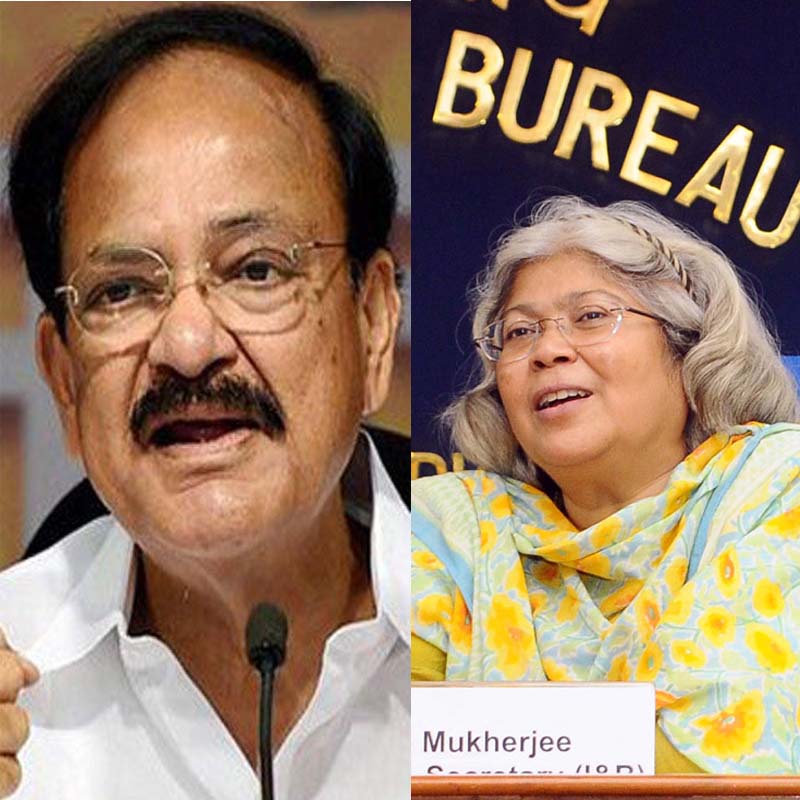
    NEW DELHI: Minister for Information and Broadcasting M Venkaiah Naidu while cautioning against transmission of unauthorized TV channels in the country said that content generation in local languages and dialects was important to reach out to communicate with people.

    Adopting innovative ways and leveraging new media in information dissemination was necessary to keep pace with the changing communication paradigm, the Minister stated Thursday while chairing a review meeting of regional media units of MIB.

    Stressing upon the need to ensure effective implementation of Cable TV Act in order to restrict airing of objectionable content and unauthorized channels, the Minister urged Union territories to appoint nodal officers to assist local administrators in this regard.

    During the review meeting, Naidu announced that the All India Radio would be commissioning of two new shortwave solid state digital transmitters of 100 kw power each for dissemination of content across the border for Afghanistan- Pakistan region by the end of August 2017. The transmitters shall be installed in Delhi.

    Those who were present during the meeting included junior MIB Minister Col. Rajyavardhan Rathore, Andaman & Nicobar Islands LG Jagdish Mukhi, MIB secretary N K Sinha and representatives from UTs.

    Also Read:

    Report illegal TV channels, Govt alerted 

    ‘Inappropriate content’ on TV & radio to be regulated

    127 channels violating 12 min/hr ad-cap rule, TRAI releases details

  • Analogue equipment may be seized, warns MIB

    Analogue equipment may be seized, warns MIB

    NEW DELHI: Stressing that the law permits seizure of equipment of defaulting cable operators. all state-level administrators have been asked to direct district magistrates (DMs) to take action against those operators who were still distributing analogue signals.

    In its letter to all states, the Ministry said that Section 11 of the Cable TV Networks (Regulation) Act 1005 gives powers to act against the defaulters. The letter wanted the administrators to allot about half an hour time to the Ministry, in any one of the meetings held by them with DMs in near future to highlight their role/powers.

    The Ministry also said it wanted to get the issue monitored by senior officers like Divisional Commissioner, Revenue Secretary or inspectors general. At the outset, the Ministry also said “hardly any compliance reports are being received” despite instructions given earlier.

    At the outset, the Ministry said that it had been mandated that only digital encrypted signals can be carried on the cable television networks in the country from 1 April.

    “However for its successful implementation, it is important that regular monitoring is carried out by the authorised officers {DM, SDM and CP as per Section 2 of the Cable Act to ensure that cable operators carry only digital encrypted signals, follow the provisions in the  Act and the Rules framed thereunder, and prompt action is taken against the defaulters.”

    The Ministry has prepared a Check List for inspection of MSOs by the Authorised Officers. Copy of the checklist is available at the MIB website.

    Also Read:

    Analogue signals: MIB to take action against defaulters 

    37 new MSOs in 45 days takes total to 1421, seven among 59 cases sub-judice

    LCOs to get unique TRAI number to ensure fair deals, says advisor Gupta

  • 37 new MSOs in 45 days takes total to 1421, seven among 59 cases sub-judice

    NEW DELHI: In an attempt to give a spurt to digitisation, as many as 37 multi-system operators were registered during May and the first fortnight of June to take the total number to 1421.

    Following the decision of the government to deem all provisional multi-system operators as having regular licence and giving a provisional licence to the Tamil Nadu Arasu TV Corporation, there is a composite list instead of separate lists for provisional or permanent (ten year) licencees.

    In addition, the ministry of information and broadcasting (MIB) has released a list of 59 MSOs, of which seven are pending in courts and the others have been treated as closed. Faced with just less than a month before the switch-off of analogue signals, the government had, on 6 March 2017, decided to treat all MSOs as permanent but with the condition that the period of 10 years commences from the date they got registered as provisional MSOs.

    However, if the continuation of registration of any MSO is at any time found to be or considered detrimental to the security of the state, then the registration so granted is liable to be cancelled/suspended, the order placed on the ministry’s website specified. All other terms and conditions stated in the provisional registration letter(s) will continue to apply.

    Earlier, on 27 January 2017, it was decided that all registered MSOs are free to operate in any part of the country, irrespective of registration for specified DAS notified areas. However, they have to submit the details of Headend, SMS, subscribers list and a self-certificate that they are carrying all the mandatory TV Channels, within six months from date of issuance of MSO registration, to the ministry, failing which the MSO registration is liable to cancelled/suspended.

    Hence, all deemed regular registered MSOs also are required to submit the details to the ministry within six months.

    The Tamil Nadu-Government-run TACTV was granted provisional licence on 18 April 2017 to operate as a MSO in the state on the condition that it switches off analogue signals in the state within three months which has now been extended to 17 August 2017.

    The MIB had then told indiantelevision.com that it had been made clear that the provisional licence was subject to the Centre taking a final decision on the recommendation of the Telecom Regulatory Authority of India that no government-owned body should be permitted in the field of running or distributing television channels. TRAI had, in 2008, 2012 and 2014, held that state governments and political parties should not be permitted to own TV channels or distribution channels.

    In Tamil Nadu where there is a court stay in operation since Phase I, TACTV had warned MSOs and LCOs against switching off analogue signals anywhere in the state after 31 March 2017.

    Arasu had been granted provisional licence in 2006 at the time of the Conditional Access System on certain conditions based on the TRAI report but this had not been renewed when Digital Addressable System came into force.

    Also read

    Including Arasu, total number of MSOs goes up to 1376, to ensure DAS implementation

  • MIB scheme evaluation: Tenders invited from Chrome DM, IMRB & Nielsen etc

    NEW DELHI: Offers have been invited by the information and broadcasting ministry for the evaluation of its schemes from 11 short-listed agencies which include Chrome and IMRB.

    Tenders have been invited by 23 June 2017. The bids will be opened in the presence of authorised representatives of the bidders. The date and time of opening of the bids of the eligible bidders will be intimated separately. The ministry has made clear that it is not permissible for the addresses to transfer this invitation to any other Institution.

    A notice on the website of the ministry includes Terms of Reference (TOR) of the Schemes for Assignment, the standard form of certificates to be included in the proposal and the standard form of agreement. The evaluation of the proposals will be done by the Evaluation Committee.

    A detailed proposal including the technical bid and the financial bid need to be submitted in two separate sealed covers. The reference number of the letter and the title of the assignment should be superscribed on the envelope containing the proposal.

    The short-listed agencies are:

    National Institute of Public Finance and Policy (NIPFP),
    National Council of Applied and Economic Research (NCAER),
    National Institute of Labour Economic Research and Development (NILERD),
    National Institute of Financial Management (NlFM),
    Centre for Media Studies
    Nielsen (India) Pvt. Ltd
    Sambodhi Research & Communication Pvt. Ltd.
    GFK Mode Pvt Ltd.
    Frost and Sullivan
    IMRB International, and
    Chrome Data Analytics & Media

    The schemes include:

    Broadcasting Sector:
    i) Supporting Community Radio Movement in India
    ii) Prasar Bharafi
    a) Grant in aid to Prasar Bharati
    b) Grant in aid to Prasar Bharati for Kisan Channel

    Film Sector:
    i) National Museum of Indian Cinema
    ii) Infrastructure Development Programme relating to Film Sector
    a) Upgradation, modernisation and expansion of CBFC and certification process
    b) Upgradation of Siri Fort Complex
    c) Upgradation of building infrastructure of Films Division
    d) Grant-in-Aid to FTII – Upgradation and Modemisation of FTII
    e) Infrastructure development in SRFTI
    D Development Communication & Dissemination of Filmic Content
    a) Promotion of Indian cinema through film festivals and film markets in lndia and abroad
    b) Production of films and documentaries in various Indian languages
    c) Webcasting of Film Archives
    d) Acquisition of archival films and film material
    iv) National Film Heritage Mission
    v) Anti-Piracy initiatives
    vi) Setting up a Centre of Excellence for Animation, Gaming and VFX

    Information Sector:
    i) Up-gradation of IIMC to International Standards
    Media Infrastructure Development Programme
    Development Communication & Information I)issemination Iluman Resource Development
    a) Training for Human Resource Development (excluding Prasar Bharati)
    b) International Media Programme
    c) HRD of Film MediaUnits
    d) Payment for Professional Services

  • Involve MIB in transponder allocation to DTH, says House panel

    NEW DELHI: The Public Accounts Committee of Parliament has expressed that no meeting of the INSAT Coordination Committee (ICC) has taken place despite the fact that leasing of transponders to direct-to-home operators involved the information and broadcasting ministry as much as it concerned the Department of Space.

    In its action-taken report relating to its fortieth (2016) report on the subject, it has said that interactions, even if formal, between officials of DoS and MIB during the said period is entirely different from that of a decision  taken in the  meeting of ICC consisting of secretary-level  officers  of the concerned  Departments as stipulated   under SATCOM Policy.

    The Committee, while finding no merit in the DoS contention that it acted based on the  “delegated powers”  of ICC, said the Department cannot overrule the norms prescribed in SATCOM Policy.

    The Committee,  therefore, reiterated its earlier observation that DoS did not follow the prescribed procedure and exceeded  its sphere by taking unilateral decisions bypassing the mechanism on issues which were beyond its mandate and wanted to be apprised  whether any punitive action has been taken in this regard.

    At the same time, the Committee regretted that the Information and Broadcasting Ministry had failed to give its action taken reply on the observation of the Committee last year, and reiterate its earlier recommendation that all the stakeholders be involved in the sound planning and judicious decision for allocation of transponder capacity, paving way for a more transparent approach which would help in re-building of trust and faith of DTH service providers in the DoS and the Ministry.

    The Committee while noting from the reply of the DoS that the ICC meetings are being regularly convened as and when required wanted to be apprised of the total number of meetings held after 2011 and the capacity earmarked by the ICC for allocation to non-governmental users.

    The Committee  observed  from  the  reply  of  the  DoS  that  MIB is a member of the ICC and fully aware of the formal mechanism  as part of the deliberation in the 67th meeting of the ICC that “all   applications for TV uplinking and space segment requirements  are being forwarded  to DoS for clearance before licenses are issued”.  The Committee was of the ‘considered view’ that forwarding of all applications for clearance is again different from allocating satellite capacity without earmarking for non-governmental users by the ICC.

    The Committee highlighted that since DTH was a broadcasting service, it came directly under the purview of MIB as it was responsible for all matters relating to broadcasting in the country. According to the SATCOM policy, all allocations were made by DoS with the approval of the ICC. Being a· member of the ICC, MIB was also involved in satellite capacity allocation. Since the ICC was not convened, MIB and other members were inadvertently left out of the decision making process. The Committee was “shocked to note the lackadaisical approach of the Ministry of Information & Broadcasting as it remained a mute spectator while DoS was flouting norms by directly allocating satellite capacities and the MIB even did not bother to intervene for convening the ICC of which it was a member”.

    The Committee was of the view that it was high time that the different wings of the Government be proactive in their approach and keeping in view the national interest, coordinate properly for taking decisions which were crucial both commercially and strategically.

    The Committee recommended that the Ministry as well as DoS make sincere and concerted efforts to convene the ICC meetings regularly so that all the relevant stakeholders were involved in the sound planning for allocation of transponder capacity thereby paving way for a more transparent approach which could help in re­ building of trust and faith of DTH service providers in the DOS and the Ministry.

    Also Read:

    SES 15 launches successfully on 18 May

    MIB: No DPO request for infra sharing, DTH ops’ transponder demand up

  • New portal to help ease of broadcast business

    NEW DELHI: A new online ‘broadcastseva’ portal has been launched by the ministry of information and broadcasting (MIB) as part of its initiative to provide a single point facility to various broadcast-related stakeholders and applicants for various permissions, registrations, licences, etc

    The portal broadcastseva.gov.in is in keeping with the commitment to promoting ease of doing Business, Digital India and Make in India.

    The Government said the MIB was committed to provide efficient and transparent regime for the growth and management of the Broadcast sector.

    Accordingly, the following four modules have become Live on the portal:

    i) Payment of Annual Permission Fees for TV Channels/teleports
    ii) Application for Temporary uplink of Live Events
    iii) Application for setting up of Community Radio Stations
    iv) Application for registration as Multi-System Operators

    The Ministry has invited suggestions for better utilization and improvement of the portal.

  • MIB cracks whip on illegal analogue signals, states asked to ensure compliance

    MIB cracks whip on illegal analogue signals, states asked to ensure compliance

    NEW DELHI: Exactly three weeks into the new era of digital addressable system for cable television in the country, the government has requested state government officers to ensure that no analogue signals are transmitted by any cable operator.

    In an advisory sent to the designated officers in state governments, information and broadcasting ministry additional secretary Jayashree Mukherjee said that, in case any MSOs/cable operators is not complying with these directions/orders, action can be initiated under Section 11 of the Cable TV Networks (Regulation) Act for  violating Section 4A of the Cable TV Act, under intimation to the Ministry.

    She added that some complaints for carriage of analogue signals are being received in the Ministry and these are being sent to the respective Authorised officers separately for taking action.

    However, conflicting reports continue to come in -particularly from Phase IV areas – of non-compliance with DAS and the continuation of analogue signals. The DTH operators have also stepped up their marketing campaigns to net the customers in these areas.

    The Ministry on 23 December 2016 had extended the cut-off date of switch over to digital in Phase IV areas to 31 March 2017 and a circular was issued on 30 March 2017 to ensure switch off of analog signals in Phase IV areas by 1 April 2017.

    Under Section 4A of the Cable Television Network (Regulation) Act 1995, it is obligatory for every cable operator to transmit or re-transmit programmes of any channel in an encrypted form through a digital addressable system with effect from the dates as may be specified or notified by the Ministry from time to time. Section 2 of the Act says the DM, SDM and CP are the authorised officers who have powers under Section 11 to seize the equipment used for operating Cable TV Network if there are violations of provisions of the Cable Act, including Section 4A.

    Also Read :

    DAS: Even official figures show cable TV digitisation is incomplete

    DAS: MSOs, LCOs give low figure of STB seeding, official sources admit it’s under 80%

    Analogue signals: MIB to take action against defaulters

    Action to be taken against analogue-using  MSOs / LCOs in urban areas

  • DD FreeDish poised to increase channel capacity to 250

    NEW DELHI: Doordarshan DTH platform FreeDish, which already has a capacity of 124 channels including HD channels, will soon getting approval to increase this capacity to 250 channels over the next two years. The minister of state for information and broadcasting Rajyavardhan Rathore told the Parliament that Doordarshan’s DD National Channel has been uplinked in the High Definition (HD) format since 1 January this year.

    With analogue having been largely switched off, many stakeholders feel that FreeDish is the best option in Phase IV which covers rural India. The Ministry had itself said  in the Parliament last month that HITS (Head-end In The Sky), private DTH and DD FreeDish are the options in remote rural areas while discussing the issue of the concerns expressed by operators that over 20 per cent of rural and remote areas were not financially and technically viable.

    The only free-to-air DTH platform in the country, FreeDish – which conducted its 33rd auction this week – earned Rs 2.8665 billion through auction of 54 slots in six auctions from 30 March 2016 to 14 February 2017. In comparison, DD had earned Rs 1.8034 billion in 2015-16. The last e-auction – the 32nd e-Auction – on 14 February 2017 fetched Rs. 655 million.

    Despite the reserve price of Rs 48 million, the highest bid for a slot was Rs 73 million for Sony Pal. The reserve price in the first five auctions was Rs 43 million and was raised to Rs 48 million in the 32nd auction. The reserve price for the 33rd auction was Rs 80 million.

    A new era begun with the adoption of MPEG4 helping FreeDish take the first major step to mark towards its target of 104 television channels by March end with its 32nd e-auction which helped it cross the capacity of eighty channels. FreeDish touched the figure of 104 with its 32nd Auction.

    In line with the ‘Digital India’ and ‘Make in India’, DD has decided to implement Indian CAS (iCAS) on DD Free Dish Platform. iCAS (which is an initiative of the central government) is being introduced in 24 MPEG-4 channels. The introduction of iCAS will provide enhanced viewing experience.

    DD officials said these additional 24 MPEG-4 SDTV channels will be available to viewers in FTA mode. The existing viewers will continue to get 80 SDTV channels, but will have to obtain iCAS-enabled authorised set-top boxes for accessing all 104 channels.

    Although FreeDish will remain free to air with no monthly or periodic fee, the viewers will be required to register with DD FreeDish on getting the new STB from Doordarshan authorised STB dealers.

    DD earned Rs 980 million in 2014-15, Rs 1800 million in 2015-16, and Rs 1040 million till September in 2016-17.

    FreeDish was launched with a modest bouquet of 33 channels in December 2004, and now carries eighty TV channels and 32 radio channels. This includes 22 Doordarshan channels and two parliamentary channels, seven general entertainment channels, 18 movie channels, 13 news channels, seven music channels, three religious channels and eight channels of other genres. All All India Radio stations also piggy-back on the platform.

    Also read

    MIB favours switching to DTH if consumers have problems with MSOs or LCOs

    FreeDish aims to reach 150 channels, earned Rs 3 bn in a year

  • Could India blocking ABS’ FTA TV signals lead to breach of ITU norms?

    MUMBAI: Government of India, it seems, could find itself in a Catch-22 situation over a directive to Department of Space (DoS) to block free-to-air channels available in India broadcast through Asia Broadcast Satellite (ABS)-2, a foreign `bird’ not licensed to provide KU-band or DTH services in India. Reason: such a blockade may breach international laws relating to spillover of satellite signals.

    Signals of ABS-2 satellite —hosting on its South Asian beam a Nepalese and a Bangladeshi DTH service licensed in their respective countries — have been spilling over into India and a mix of Indian, Nepalese and Bangladeshi TV channels are available to Indians as a FTA service that can be accessed via some plain vanilla hardware (read set-top boxes and an antennae) at a nominal cost. This has raised the heckles of India authorities over possible national security.

    While last week junior minister for Ministry of Information and Broadcasting (MIB) Rajyavardhan Rathore informed Parliament that his ministry has requested DoS to block the “unauthorized” DTH or KU-band ABS-2 service, the foreign satellite operator feels it has not broken any Indian regulations.

    ABS source claimed that the issue is of “natural spillover” of satellite signals into neighboring countries that are outside the service area of the countries offering licensed DTH services, but falling within the coverage area of the satellite. Such issues have been debated by the International Telecommunications Union (ITU) where it was concluded that such a spillover or overlap of coverage areas (countries) is in “full compliance” with ITU provisions. “Consequently, ABS is not in violation of any existing provisions/guidelines stipulated by the government of India,” a company source explained.

    ITU is the United Nations specialized agency for information and communication technologies or ICTs. It allocates global radio spectrum and satellite orbits, develops technical standards that ensure networks and technologies to seamlessly interconnect and strives to improve access to ICTs to underserved communities worldwide. Originally founded in 1865 as the International Telegraph Union, ITU is one of the oldest existing international organizations. India is also a member of the organization and Indian satellites’ slots too are co-ordinated by ITU.

    Categorically denying that the company has “been providing” a DTH service in India, ABS sources said ABS-2 satellite has two customers on its South Asian beam. The customers are Bangladeshi DTH service provider marketing under brand name Realvu and Nepalese Humro TV platform. Both these services are licensed in their respective countries, the sources claimed, adding there was a “natural spillover” of these services into India that is being lapped up by Indian viewers as it has a mix of regional content in an un-encrypted format.

    ABS also clarified that it does not sell any hardware in India, nor does it advertise or provide any service to the Indian TV channels within the country. The ABS series of satellites are owned by the Bermuda-based Asia Broadcast Satellite, a comparatively young global satellite operator with offices in the United States, UAE, South Africa, Philippines, Indonesia and Hong Kong.

    Of course, this ABS-2 service is available to Indian consumers at no monthly charge and all they need to do is install a standard STB, easily available in the open electronics hardware market, which also means that the TV channels on the platform stand to gain from additional eyeballs that can be used for marketing purposes by the TV channels.

    According to an estimate, presently there are approximately 20 satellites broadcasting over the Indian skies beaming channels into India and viewers wanting to watch those channels can watch via an ordinary STB and pointing the antenna to the desired satellite’s geo-stationary location. Though this synchronization of antennae with a specific satellite’s position may be technical in nature, there would be hordes of service providers in India with adequate knowledge to do so for a small price.

    Free to view platforms have an advantage over paid DTH services like Dish TV or Tata Sky or Videocon d2h or Reliance BIG TV in the rural areas of the country where consumers may not be too quality conscious. This FTA phenomenon is evident from the considerable reach of pubcaster Doordarshan’s KU-band or FTA DTH service, FreeDish, and a clamour amongst private TV channels too to be on the platform that has a limited shelf capacity.

    Rathore, while responding to queries from three Members of Parliament last week, had said the move to block ABS-2 signals was being done keeping in view any threat to national security via a service not licensed in India. He said MIB was the licensing authority for DTH services in India and it had not received any application or reference from ABS regarding ABS-2 services. However, the minister also admitted that there was no violation of downlinking guidelines by licensed Indian channels on the ABS-2 platform.

    ALSO READ:

    Block illegal DTH FTA, space dept. told


  • DD Kisan viewership is 7.2m a month, received Rs 800m govt funds for 17-18

    NEW DELHI: A sum of Rs 1.2225 billion was released from 2014-15 to 2016-17 to Prasar Bharati by the information and broadcasting ministry for Dordarshan Kisan Channel.

    The total fund allocated for 2017-18 is Rs 800 million, the minister of state for information and broadcasting Rajyavardhan Rathore has told the Parliament.

    Fund allocated to DD Kisan are:


    2014-15

    2015-16

    2016-17

    260 million.

    262.5 million.

    700 million.


    The annual operating cost incurred by the channel in the year 2014-15 is Rs.231.1  million. .


    DD Kisan was launched in May, 2015. The source of revenue is commercial advertisements aired during the programme. The revenue earned by DD Kisan other than government funding, since its launch from May, 2015 is:


    Period

    Revenue

        April, 2015 to March 2016

    Rs 14 million

        April, 2016 to February 2017

    Rs 19 million

    In reply to another question, he said DD Kisan has introduced two daily News Bulletins at 1:30 pm and at 07:00 pm.

    The channel continuously receives feedback from its viewers. There is a daily one hour live interactive programme “Hello Kisan”. The farmers can call on the toll free line to ask questions to experts or give their opinion. The channel takes their reactions for improvising the content.

    A number of field based shows and programmes are also planned. There is a direct communication at grass root level with the channels’ representatives. The social media links such as web, Facebook and Twitter are also prominently displayed on the channel so that viewers can give their suggestions. Feedback/suggestions, as available, are regularly analysed for improving the programmes and content on the Kisan Channel.

    These programmes are produced continuously depending upon the requirement of the channel. There is no proposal at present to translate the programme in other regional languages.

    Answering another question, he said Doordarshan telecasts agriculture programmes through its network on National Channels as well as other DD regional channels.

    DD Kisan is available throughout the country. As a new initiative, a daily programme titled “Uttar Purvi Rajyon Se” has been scheduled which contains programmes from North Eastern states in their respective languages.

    Viewership of DD Kisan channel according to data received from Broadcast Audience Research Council is an average 7.2 million per month.

    : :

    Average Monthly Viewership (in million)

           Market: All India

    Month

    DD Kisan

    January      2016

    8.8

    February     2016

    15.3

    March         2016

    7.3

    April            2016

    6.7

    May             2016

    4.3

    June            2016

    4.5

    July             2016

    5.6

    August        2016

    6.4

    September  2016

    7.1

    October       2016

    8.2

    November   2016

    5.5

    December   2016

    5.8

    January       2017

    7.3

    February     2017

    7.3

    Average

    7.2