Tag: MIB

  • MIB show-causes MSOs on incomplete digitisation info

    MIB show-causes MSOs on incomplete digitisation info

    NEW DELHI: Ministry of Information and Broadcasting (MIB) has issued show-cause notices to those MSOs who have failed to provide digitization details to the government, including the number of boxes seeded in their areas of operation.

    Quoting earlier government directives, MIB told the errant MSOs today in an official note that they had not submitted details of their headends, subscriber management system, number of mandatory TV channels being carried on their networks, apart from the total number of boxes seeded in the market. This information was to have been uploaded by MSOs at a designated place earmarked by MIB.

    “Whereas you have failed to furnish the said details to the Ministry within the stipulated time frame…why not your MSO registration be terminated/canceled?” the government has asked, directing the MSOs to provide the details within 15 days from 31 August 2017.

    Officially, the whole country was deemed digital on 1 April 2017, but in private both the government and industry stakeholders opine that pockets of analog TV distribution still persist and boxes are still being seeded in phase IV areas comprising small towns and villages primarily in rural areas and India’s hinterland.

    ALSO READ:

    DAS: MSOs, LCOs give low figure of STB seeding, official sources admit it’s under 80%

    Arasu DAS licence: Stakeholders fear flurry of similar requests & permissions

  • MIB seeks all new MSO applications online

    MIB seeks all new MSO applications online

    NEW DELHI: Multi-system operators seeking registration for distribution of digital addressable signals to cable television networks can only do so online from 1 September 2017.

    In a directive, the information and broadcasting ministry has said that MSOs can apply on broadcastseva.gov.in and digitalindiamib.com. The directive says it had earlier on 1 May this year given the facility to apply both online and offline (physical submission) but had decided to stop taking offline applications.

    It noted that a number of applications had in fact been received online since then. The procedure for submission of applications online is available on these two websites.

    The total number of registered MSOs as on 31 July was 1455. Early this year, the government had said all provisional multi-system operators will be deemed as having regular licence.

    Faced with just less than one month to go before total switch-off of analogue signals, the government had on 6 March 2017 decided to treat all MSOs as permanent but with condition that the period of 10 years commences from the date they got registered as provisional MSOs.

    However, if the continuation of registration of any MSO is at any time found to be or considered detrimental to the security of the State then the registration so granted is liable to be cancelled/suspended, the order placed on the Ministry website specified. All other terms and conditions depicted in the provisional registration letters will continue to apply.

    Earlier, on 27 January 2017, it had been decided that all registered MSOs are free to operate in any part of the country, irrespective of registration for specified DAS notified areas granted by this Ministry.

    However, they have to submit the details of Headend, SMS, subscribers list and a self-certificate that they are carrying all the mandatory TV Channels, within six months from date of issuance of MSO registration, to the Ministry, failing which the MSO registration is liable to cancelled/suspended.

    Hence, all deemed regular registered MSOs also are required to submit the details to the Ministry within six months.

    ALSO READ :

    Godfather, Kal, Digi Cable & Intermedia licence cancellation stayed, 50 ‘pan-India’ MSOs’ op area changed

    Including Arasu, total number of MSOs goes up to 1376, to ensure DAS implementation


  • TDSAT ‘no’ to stay Star Bharat launch, DPO payments subject to adjudication

    TDSAT ‘no’ to stay Star Bharat launch, DPO payments subject to adjudication

    NEW DELHI: Even as it declined to stay or restrain the launch of Life OK channel as Star Bharat, the Telecom Disputes Settlement and Appellate Tribunal (TDSAT) yesterday said the amounts paid to the distribution platform operators or DPOs will be subject to the final orders of the tribunal.

    The bench, comprising TDSAT chairman Shiva Keerti Singh and members B B Srivastava and A K Bhargava, observed that the agreements between broadcaster Star India and DPOs Dish TV and Videocon d2h (both entities in the process of merging) will continue to operate and the cost being offered by the broadcaster cannot be reduced unilaterally.

    While Star India was given four weeks to reply, the two DTH platforms were asked to file their counter-affidavits too. Thus, the next hearing may come up some time in October 2017.

    The tribunal said if it is proved that the presence of Star Bharat on Prasar Bharati’s free to air DTH platform FreeDish is tantamount to the channel’s conversion from pay to FTA, then both Dish TV and Videocon d2h will be entitled a refund from Star.

    Star India had contended that merely making a channel available on FreeDish platform does not tantamount to a conversion in the nature of the channel for which the DPOs are being charged.

    Dish TV and Videocon d2h had moved the tribunal earlier this week alleging that Star India was converting its pay channel Life OK into a FTA network by putting the rebranded channel (Star Bharat) on FreeDish platform without informing the Telecom Regulatory Authority of India (TRAI). In its defense before the court, Star India responded by saying that “we are only rebranding” and not “converting our pay channel” into FTA.

    Interestingly, this petition came just two days after Essel/Zee Group’s Dish TV had sent a letter to the Ministry of Information and Broadcasting, Indian cricket board BCCI, TRAI and monopoly watchdog Competition Commission of India. In the letter Dish MD Jawahar Goel had alleged that Star was trying to create a monopoly over cricket broadcast rights in the country, a move that would be detrimental for all stakeholders, including consumers who would ultimately dish out more subscription money to watch cricket on telly.

    To buttress his arrangements, Goel had contended that Star had even challenged rge sector regulator TRAI’s jurisdiction to fix tariff charges — a case that’s pending before the Madras High Court.

    ALSO READ:

    Dish TV moves TDSAT against Star Life OK name change & turning FTA

    Dish TV shoots off letter to IBF; alleges discrimination by b’casters, OTT platforms

    Jawahar Goel raises alarm of emerging Star cricket monopoly (updated)


  • Smriti Irani tweets industry body advisory urging restraint by TV news channels

    Smriti Irani tweets industry body advisory urging restraint by TV news channels

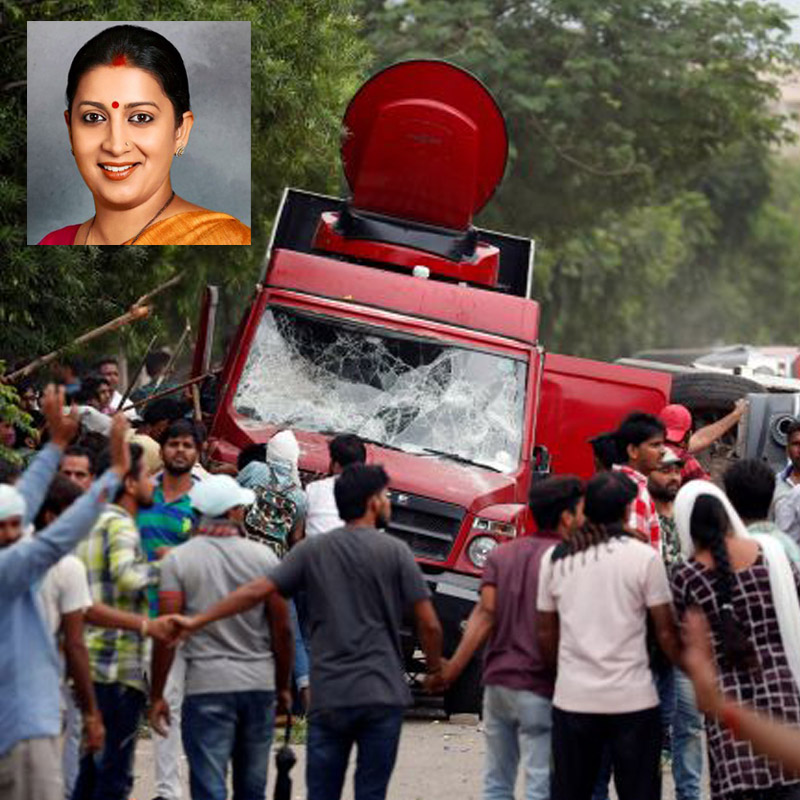
    NEW DELHI: Minister for Information and Broadcasting Smriti Irani yesterday in tweets amplified advisories issued by news industry associations, which had cautioned TV news channels to exercise restraint while reporting on the violence unleashed in the states of Haryana, Punjab, parts of Uttar Pradesh and Delhi in the aftermath of self-styled godman Ram Rahim being convicted of rape charges by a local court on Friday.

    At around 20.59 Irani tweeted: “Drawing attention of news channels to Clause B of Fundamental Std. of NBSA refraining channels from causing panic, distress &undue fear.”

    As social media exploded questioning the minister’s tweet and intentions — some even supported her assertions, though, saying the media was reporting falsely on incidents of mob violence — she followed up her first tweet with another one stating: “Kindly note this advisory has been given by the offices of the National Broadcasters Association.” In another message she also condemned the attack on media and damage to property.

    News Broadcasters Association (NBA)’s self-regulatory body News Broadcasting Standards Authority or NBSA had actually re-circulated among member-news channels the organisation’s ethics and codes that overall harp about restraint.

    On reporting news involving armed conflicts, communal violence, public disorder and internal disturbances, the NBSA guidelines urge TV news channels that telecast of such incidents should be tested on the “touchstone of public interest”.

    Broadcast Editors Association (BEA), an apex body of editors of national and regional television news channels in India, too issued an advisory on Friday cautioning TV news channels to “keep a careful eye on the content and views that can inflame people.”

    “All editors should take utmost care while playing violence visuals of the coverage of Baba Ram Rahim case. Please verify the facts before putting them on air because lots of rumours are floating around,” the BEA statement said.

    While NBA did issue a statement condemning the violence and attacks on the media (OB vans were damaged and some media people were assaulted), it urged “the chief ministers of Haryana and Punjab to take action urgently to bring the situation under control in order that the media/press are able to perform their duties without fear.”

    For the records, NBSA does have extensive code of ethics and broadcasting standards. In the section Principles of Self-regulation, the code states: “Television news has greater reach, and more immediate impact than other forms of media, and this makes it all the more necessary that channels exercise restraint to ensure that any report or visuals broadcast do not induce, glorify, incite, or positively depict violence and its perpetrators, regardless of ideology or context. Specific care must be taken not to broadcast visuals that can be prejudicial or inflammatory…”.

    Meanwhile, a Punjabi language news channel reporter received injuries in attacks allegedly by followers of the Dera Sacha Sauda chief Ram Rahim in Haryana while the video journalist accompanying him has gone missing after the assault. 

    Rakesh Kumar, a reporter with PTC News, said he and his video journalist Shipendar Happy were attacked near the Dera headquarters when they went there to report after Dera head Gurmeet Ram Rahim’s conviction in a rape case. “They thrashed us brutally leaving me with a fracture in my right hand. My cameraman Happy is still missing. They also torched our vehicle and equipment,” Rakesh told news agency PTI.

    ALSO READ:

    NBSA hauls up news channels; fines them, demands apology

    BCCC gets more complaints on harm than sex, obscenity & nudity on TV

  • BCCC directs ‘Pehredaar Piya Ki’ to late night slot with disclaimers

    NEW DELHI: The Broadcasting Content Complaints Council (BCCC), a self-regulatory body under the Indian Broadcasting Foundation umbrella, has asked Sony Pictures Network India to move its fictional serial Pehredaar Piya Ki, aired on one of its channels, to the 10 pm slot and simultaneously run a scroll that it doesn’t promote child marriage.

    The soap opera, with a story-line where a minor boy is shown married to a young-adult woman, who also doubles up as his security guard, had come under criticism for allegedly promoting regressive ideas like child marriage, which is an offence under Indian laws.

    The BCCC directive to Sony Pictures Networks India, which came on Wednesday, was the first one chaired by its new chief Justice (retd) Vikramajit Sen, according to news agency IANS.

    “We had a monthly meeting and the channel officials were called for a discussion, which went on for quite long. After everything, they were directed that the timing of the show should be shifted to a late night slot of 10 pm  and that they must run a disclaimer. They (Sony Pictures Networks India) will have to comply,” a BCCC executive was quoted by IANS as saying.

    Indiantelevision.com could not independently reach out to SPNI for its comments on the BCCC directive till the time of writing this report, which is based on what news agency IANS has filed.

    Since the last BCCC meeting, the body received around 138 fresh complaints against `Pehredaar Piya Ki’, which is produced by Shashi Sumeet  Productions and went on air last month. The makers had been defending it, saying viewers must understand the circumstances in which the girl has to marry the boy child, the news agency report stated.

    Earlier, some media reports quoted the minister of information & broadcasting (MIB) Smriti Irani, when asked about the controversy surrounding the Sony Pictures Networks India serial, saying that her ministry has asked the BCCC to look into the issue.

    The serial stars Tejaswi Prakash Wayangankar as Diya Ratan Singh and Afaan Khan as her husband Prince Ratan Singh.

    Set up in June 2011, BCCC is an independent self-regulatory body for non-news general entertainment channels under the Indian Broadcasting Foundation, an apex body of a large number of general and factual entertainment TV channels operating in India. IBF website states its members manage 350+ channels and about 90 per cent of television viewership across country.

    ALSO READ:

    BCCC gets more complaints on harm than sex, obscenity & nudity on TV

    Modify or shift ‘double entendre’ progs, cautions broadcasting council

    TV content: Madras HC seeks Centre’s clarification on regulatory mechanism

    State-level television committees to monitor FM & Community Radio

  • MIB: Set up cable TV regulatory panels, Century, Chinar & Pan India among 6 FM licences revoked

    NEW DELHI: The information and broadcasting ministry has issued directions to states to set up district-level and state-level monitoring committees to regulate content telecast on cable TV/FM radio channels/community radio stations to ensure adherence to the AIR Broadcast Code.

    Meanwhile, the licences of a total of six FM radio channels being operated by six companies in different parts of the country were revoked under FM Phase II. The six are — Century Communication, Chinar Circuits, Kushal Globalo Ltd. Pan India Network, Positive Radio Pvt Ltd, and Singla Property Dealer Pvt Ltd.

    According to ministry sources, a total 312 private FM radio channels are being operated by 44 Indian companies.

    The sources told Indiantelevision.com that during the last three years and the current year, the ministry issued four show-cause notices to 93.5 Red FM, Hit 95 FM, 94.3 FM Radio One and Radio City 91.1 FM on 23 January 2015, 17 February 2016, 2 September 2016 and 1 August 2016, respectively, for airing allegedly vulgar, obscene and objectionable content in violation of the provisions of GOPA and programme and advertising code as followed by All India Radio (AIR).

    Action was taken eight times on violation of provision of GOPA and Programme and Advertising Codes as followed by AIR by private FM radio channels by airing of obscene, vulgar and objectionable content during the last three years and the current year. These include two advisories to all channels and one only to Tamil Nadu-based FM channels. The channels that came under the scanner were ENIL Patna (Radio Mirchi), Malayala Manorama Kochi (Radio Mango), Digital Radio Broadcasting (Delhi) Ltd (Red fM), Clear Media (India) Pvt Ltd (Hit 95 FM), and Next Radio Delhi (94.3).

    Private FM Radio broadcasters have to follow the rules and regulation prescribed in the Grant of Permission Agreement (GOPA) signed by them with the Government. Private Satellite TV channels are required to abide by the terms and conditions as mentioned in the Policy Guidelines for Uplinking and Downlinking of Private Satellite TV channels in India.

    Only Indian companies registered under the Company’s Act, 2013 are eligible for bidding and obtaining permission for FM radio channels. The conditions are elaborated in the Policy Guidelines for expansion of FM radio broadcasting through private agencies Phase-III.

    GOPA provides that FM Radio Channels should follow the same Programme and Advertisement Codes as followed by All India Radio. These codes contain a whole range of parameters to regulate content on FM channels.

    ALSO READ :

    State-level television committees to monitor FM & Community Radio

    No plan for one-stop broadcast authority at present, says Rathore

    MIB flags issue of anti-national content on cable channels, seeks industry advisory

  • TRAI’s final recommendations on net neutrality likely by September

    NEW DELHI: India’s telecoms and broadcast regulator Telecom Regulatory Authority of India (TRAI) is expected to come out with its final recommendations on net neutrality next month.

    TRAI chairman R S Sharma told indiantelevision.com  that after detailed discussions were held in Bengaluru last month on the consultation paper on Net Neutrality (NN) issued mid-2016, a similar round has been fixed for 30 August 2017 in Delhi after which TRAI will begin work on its final recommendations to ensure national security and customer privacy.

    However, the issue of NN has different meanings in different parts of the globe and depends on how regulators view the issue in terms of their own markets. For example, the present FCC chairman Ajit Pai is in favour of repealing of a regulatory framework that allowed his predecessor to establish robust rules of the road for the internet and is in the process of dismantling the previous regime’s regulatory framework for NN. In Asia too, NN is defined and regulated differently and there is no uniform approach to the issue.

    One of the chief arguments for Net Neutrality, senior tech journalists have argued, is that without rules in place, the internet could well grow into a system of tiers, akin to cable television, in which large content companies would dominate because of their ability to pay for better access to consumers.

    Asked whether the tariff order — which has been in suspended animation for few months now owing to some stakeholders moving Indian courts against its implementation — will come into effect on 2 September 2017, Sharma refused to commit anything as the matter would be subject to the outcome of court decisions.

    Referring to a paper on data protection, he said the present aim was only to start a discussion on the subject. He denied that the consultation paper had anything to do with the controversy around Apple refusing to cooperate on certain demands of the Indian regulator or had been prompted by it. “In fact, the controversy had been kicked off just over a week earlier whereas the paper had been under preparation earlier,” Sharma said.

    Elaborating on TRAI’s guiding principles, the chairman said that the organisation issues a paper or initiates a public debate or comes out with recommendations  for “transparency, (to) ensure non-discrimination, consumer protection, industry’s growth and encourage positive competition.”

    At a time when online piracy and theft of online data is gaining momentum in India, as also criticism of the country’s lack of a comprehensive legislation to protect data, including those mentioned in Adhaar, Sharma said TRAI has taken all the necessary steps to protect consumer data that it collects via its various apps.

    Though Sharma refused to be drawn into the online piracy issue (largely that falls under the domain of Commerce Ministry), he did say that inter-operable set top boxes, being tested by some government organisations in collaboration with TRAI, had provisions for dealing with pirated software.

    When questioned about the permission granted to Tamil Nadu government owned Arasu to distribute digital TV signals and consequent leanings towards similar set-up in the states of Telangana and Punjab, Sharma said the Authority had thrice given recommendations advising that state governments and political or religious groups should not be permitted to enter the broadcasting sector. “We still stand by those recommendations. But the ministry (MIB) has said the recommendations were under consideration,” he added.  

    He agreed that technologies were converging and said that regulations, attitude and outlook will “soon have to move in that direction.”

    ALSO READ :

    Star & Vijay TV amend plea, TRAI asked by Madras HC to file response

    Tata Sky & Airtel DTH pleas against TRAI tariff in Delhi HC on Friday

    “There would be  a lot on TRAI’s plate in 2017” – RS Sharma


  • No pre-censorship of TV shows, reiterates MIB

    NEW DELHI: The government today reiterated in the parliament that there is no proposal for any censorship or any rules and norms for private TV channels for broadcasting their pre-recorded programmes.

    The question in the Rajya Sabha were related to pre-recorded programmes or ‘fabricated videos pretending as live telecast.’

    Minister of State for Information and Broadcasting Rajyavardhan Rathore said under the existing regulatory framework, all programmes and advertisements telecast on private satellite TV channels and transmitted/re-transmitted through the Cable TV network are required to adhere to the Programme and Advertising Codes prescribed under the Cable Television Networks (Regulation) Act, 1995 and Cable Television Network Rules, 1994 framed thereunder.

    The Act does not provide for pre-censorship of any programme and advertisement telecast on such TV channels.

    However, it prescribes that all programmes and advertisements telecast on such TV channels including regional language channels should be in conformity with the prescribed Programme Code and Advertising Code enshrined in the said Act and the rules framed thereunder, which contain a whole range of parameters to regulate programmes and advertisements including the content aimed at instigating communal violence and fear in the minds of common people on TV channels.

    Apart from this, this Ministry had issued an Advisory to news and current affairs TV channels on 20 September 2013 advising them to follow the provisions of the Programme Code scrupulously and exercise restraint and sensitivity while reporting such incidents and refrain from telecasting any material which could ignite communal passions and create law and order problem.

    The Ministry has set up Electronic Media Monitoring Centre (EMMC) to monitor the content telecast on private TV channels with reference to the violation of Programme and Advertising Codes.

    An Inter-Ministerial Committee (IMC) has also been set up in the Ministry to look into the specific complaints or suo-motu take cognizance against the violation of Programme and Advertising Codes. The IMC has representatives from the Ministries of Home Affairs, Defence, External Affairs, Law, Women and Child Development, Health & Family Welfare, Consumer Affairs, Information & Broadcasting and a representative from the industry in Advertising Standards Authority of India (ASCI). The IMC meets periodically and recommends action in respect of violation of Programme and Advertising Codes by private TV channels.

    Apart from this, the Ministry has also issued directions to States to set up District level and State level Monitoring Committees to regulate content telecast on cable TV channels.

    Also Read:

    Prasar Bharati’s main role is of pubcaster, not revenue generator, says Rathore

    Analogue signals: MIB to take action against defaulters 

  • MIB asks teleport operators to give exact location in 7 days

    NEW DELHI: All teleports operators have been asked by the ministry of information and broadcasting (MIB) to provide information with regard to the exact location of their teleport alongwith the longitude and latitude details.

    This follows the decision of the ministry to prepare a GIS (Geographic Information Systems) Plotting of all teleports permitted by the ministry. Teleports have been asked to furnish the required information within seven days from the date of issue of the notice.

    In March this year, the ministry had reminded all teleports about giving information about television channels uplinked or downlinked by them and warned that permissions other than those in the report of the Teleport Operators will be considered as lapsed and action will be taken to cancel such permissions.

    The ministry said on 17 March that all teleports have to report within 15 days according to the formula attached to the notice on the ministry’s site.

    The ministry had, on 7 January 20I3, directed all the teleport operators having permission for up-linking and down-linking of TV channels to furnish the detailed list of TV Channels being uplinked from their teleport every month.

    The note said: “It has come to the notice of this Ministry that some of the teleport operators are still not furnishing the above monthly report and those who are furnishing the report, the data do not match with the permissions issued by this Ministry for uplinking/downlinking of TV channels from their respective teleports.

    The Ministry had decided that all the teleport operators having permission for up-linking and down-linking of TV channels shall immediately furnish details of the permissions issued by Ministry till date for uplinking/downlinking of TV channels from their teleports in the fixed proforma.

    Teleports who do not give such information will be presumed to be non-functional and action will be initiated for cancellation of the teleport permission.

    “Furnishing this information is mandatory and non-compliance will be construed as violation of the uplinking guidelines,” the Ministry said.

    Also Read:

    Report details of TV channels by Mar-end or face action, teleports warned

    81 teleports permitted to uplink, downlink TV channels

    53 TV channels, six teleports’ licences up for renewal in ’17

  • MIB scheme evaluation: Revised tenders invited from 20

    NEW DELHI: Nine more agencies have been added to the revised tender for the evaluation of its schemes to be continued beyond the 12th Plan by the ministry of information and broadcasting, taking the total number of short-listed agencies to 20.

    Interestingly, development of community radio and anti-piracy programme in the film sector which were a part of the tender notice of 6 June have been taken off the new list of schemes to be covered. The number of schemes has also been reduced to seven and their sub-schemes against 12 in the earlier tender announcement.

    Tenders have been invited by 24 July and will be opened on the morning of 27 July in the presence of authorised representatives of the bidders. The ministry has made it clear that it is not permissible for the addresses to transfer this invitation to any other institution.

    A notice on the website of the ministry includes Terms of Reference (TOR) of the Schemes for Assignment, the standard form of certificates to be included in the proposal and the standard form of agreement. The evaluation of the proposals will be done by the Evaluation Committee.

    A detailed proposal including the technical bid and the financial bid need to be submitted in two separate sealed covers. The reference number of the letter and the title of the assignment should be superscribed on the envelope containing the proposal.

    The short-listed agencies are:

    1. Academy of Management Studies,
    2. AFC India Ltd.,
    3. National Institute for Entrepreneurship and Small Business Development (NIESBUD),
    4. MAPCON Limited,
    5. Datamation Consultants Pvt. Ltd.,
    6. Chrome Data Analytics & Media
    7. Transnational Altemate Learning for Emancipation and Empowerment through Multimedia (TALEEM),
    S. GFK Mode Pvt. Ltd.,
    9. Development & Research Services Pvt. Ltd.,
    10. Nielsen (India) hrt. Ltd.,
    I l. Sigma Research and Consulting Pvt. Ltd.,
    12. Ipsos Research Pvt. Limited.,
    13. Sreejak Media Pvt. Ltd.,
    14. IMRB Intemational,
    15. Kadence Research lndia Pvt Ltd.
    16. Mott McDonald Pvt. Ltd.,
    17. Operations Research Group Pvt. Ltd.,
    18. KPMG, Building No. 10,
    19. McKinsey & Company,
    20. Quality Council of India.

    The schemes include:

    Broadcasting Sector

    Prasar Bharati

    a) Grant in aid to Prasar Bharati
    b) Grant in aid to Prasar Bharati for Kisan Channel

    Film Sector

    i)  Infrastructure Development Programme relating to Film Sector
    a)  Upgradation, modernisation and expansion of CBFC and certification process
    b)  Upgradation ofSiri Fort Complex
    c)  Upgradation of building infrastructure of Films Division
    d)  Grant-in-Aid to FTII – U pgradation and Modernisation ofFTll
    e)  Infrastructure development in SRFTI
    ii) Development Communication & Dissemination of Filmic Content a)  Promotion  of Indian  cinema  through film festivals and film markets in India and abroad
    b)  Production of films and documentaries in various Indian languages
    c)  Webcasting of Film Archives
    d)  Acquisition of archival films and film material
    iii)National Film Heritage Mission
    iv) Setting up a Centre of Excellence for Animation, Gaming and VFX (NCoE)

    Information Sector

    i)   Media Infrastructure Development Programme
    a)  Revamping & Restructuring of DA VP
    b)  Modernisation of PIB
    c)  Opening up of New Regional Centers of IIMC
    d)  Revitalisation, upgradation and modernisation of Publications Division and Employment News
    e)  National Centre of Photography and Special Drive for North Eastern States
    f)   Strengthening of RNT Headquarters

    ii) Development Communication & Information Dissemination
    a)  People’s Empowerment through Development Communication (Conception and Dissemination)
    b)  Media Outreach Programme and Publicity for Special Events
    c)  Direct Contact Programme by Directorate of Field Publicity
    d)  Live Arts and Culture
    e)  Social Media Platform

    Also read:

    MIB scheme evaluation: Tenders invited from Chrome DM, IMRB & Nielsen etc

    Tenders invited for agency to evaluate MIB schemes in information, broadcasting and films