Tag: MIB

  • MIB’s new secy Amit Khare joins office

    MIB’s new secy Amit Khare joins office

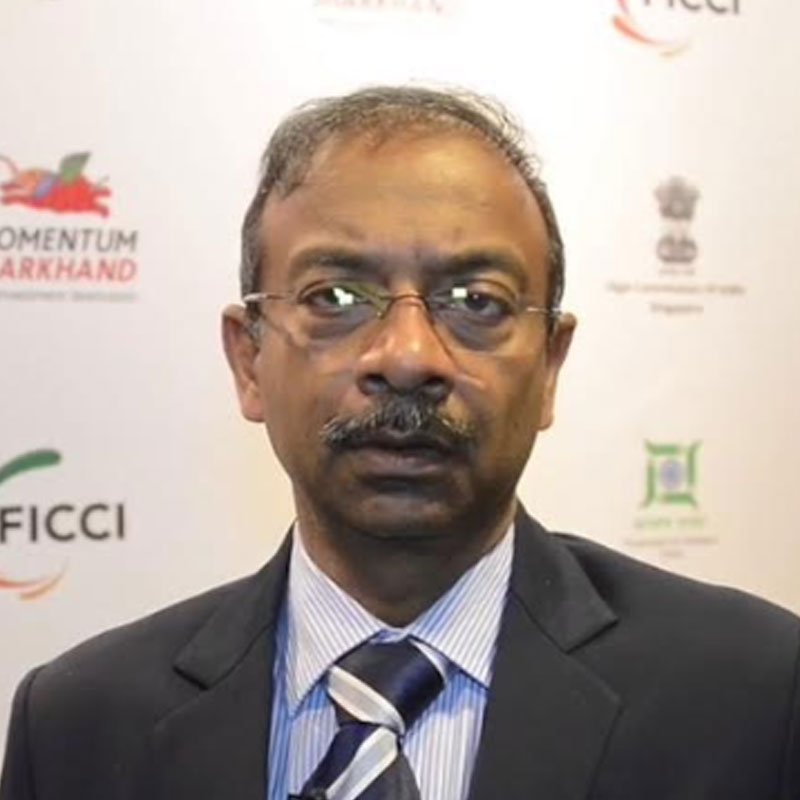
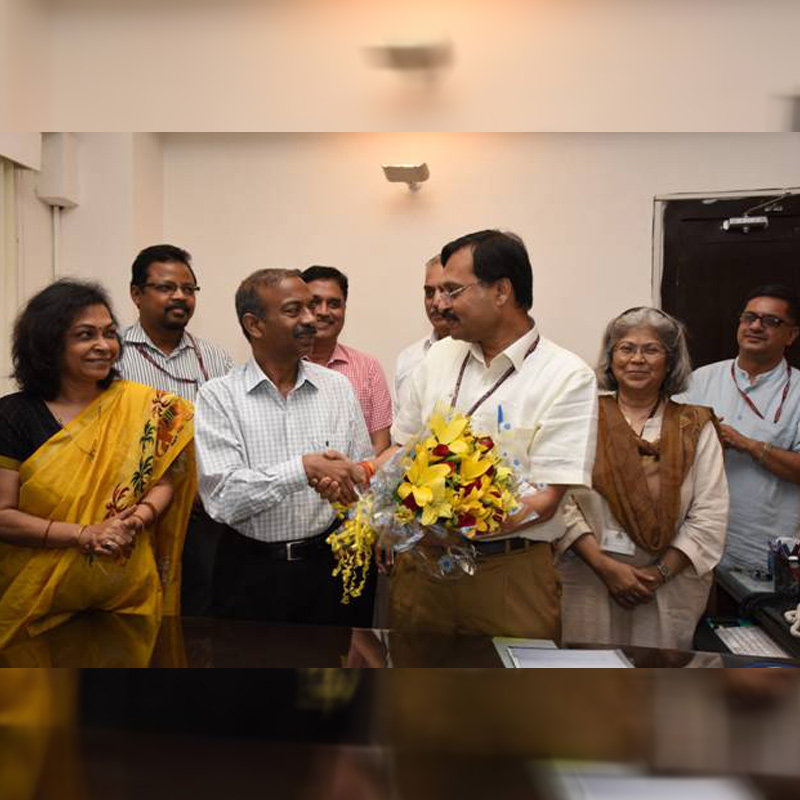
    NEW DELHI: In what could be termed as challenging times, Amit Khare (third from left in the pix) yesterday assumed charge as secretary in the Ministry of Information & Broadcasting on superannuation of Narendra Kumar Sinha.

    Khare is a 1985 batch Indian Administrative Service officer and was posted at a senior level in the state of Jharkhand before he was nominated to take over from Sinha at MIB. Considered an upright civil servant, he is credited for unearthing the multi-million-dollar fodder scam two decades ago in Bihar for which some powerful politicians, including former Bihar chief minister Lallu Yadav, and senior officials have been handed jail sentences of varied time period.

    Some of the issues that would need Khare’s immediate attention, as also his boss MIB minister Rajyavardhan Rathore, include putting in motion the process of quick decision-making at this important ministry, which is responsible for policy-making and their implementation for multi-billion dollar sectors of television, radio, films and advertising.

    With the media and entertainment industry undergoing changes with the arrival of newer technologies, like online distribution of content of all types, MIB needs to keep pace without upsetting the ecosystem that has been reeling under the impact of a sluggish economy and after effects of several other financial policies taken over the last 24 months by the government.

    To give some momentum, Khare would need to hit the road running working along with sector regulator TRAI that has made several recommendations relating to policies, which are yet to be acted upon by MIB, apart from working with the regulator on guidelines that could be in the offing, including uplink and downlink guidelines, DTH licencing norms, online content regulation, removal of bottlenecks in the film sector on opening up more screens and cajoling sister government organisations like Department of Space to have a more liberal approach. Not to mention soothe ruffled feathers at pubcaster Prasar Bharati.

    Media reports have indicated that in the last nine months, inaction had come to such a head at MIB that inter-departmental power games stalled a decision on over 100 applications for new TV channels. It was only about 10 days back that some channel permissions were processed and conveyed to stakeholders.

    During a career span of more than 33 years, Khare has held various field postings and worked at both the state and federal levels.

  • Merged Dish TV reports maiden numbers for fiscal 2018

    Merged Dish TV reports maiden numbers for fiscal 2018

    BENGALURU: The merged entity comprising of two Indian DTH players – Dish TV India Ltd reported its maiden fourth quarter and fiscal numbers for the periods ending 31 March 2018 (Q4 2018, quarter under review, FY 2018 year or fiscal under review). The two entities of the new behemoth Dish TV India Ltd were – Dish TV India Ltd and Videocon d2h Ltd before the merger. Dish TV and Videocon d2h had reported profit after tax (PAT) of Rs 82.12 crore and Rs 30.44 crore respectively for fiscal 2017. Individual revenues in fiscal 2017 were Rs 3,014.38 crore and Rs 3,071.73 crore for Dish TV and Videocon dh2 respectively. On 22 March 2018, Videocon d2h had merged with and into Dish TV India Ltd with the appointed date of the merger being 1 October 2017, or for the latter half of financial year 2018. The post merger consolidated operating revenue of Dish TV post merger for FY 2018 was Rs 4.634.16 crore and consolidated net loss was Rs 84.50 crore. Subscription revenue was Rs 4,216.7 crore. Consolidated total comprehensive loss (TCL) for FY 2018 was Rs 81.33 crore.

    Dish TV’s fiscal 2018 numbers are not comparable with FY 2017 in the form presented by the company for FY 2018. Financials of Dish TV India Ltd for the quarter ended 31 March 2018 thus represent three months’ financial performance each of Dish TV India Ltd and Videocon d2h Ltd. Similarly, financials of Dish TV India Ltd for the year ended 31 March 2018 represent 12 months’ financial performance of Dish TV India Ltd and six months financial performance of Videocon d2h Ltd. Both companies had reported separate financials for the quarter ended 31 December 2018 (Q3-2018, immediate trailing quarter, previous quarter).

    Subscriber numbers

    The merged company – Dish TV India Ltd had a subscriber base of 2.3 crore with a market share of about 37 per cent at the end of Q4 2018. This makes it the largest private DTH player in the country. ARPU (average revenue per user) of the merged entity for Q4 2018 was Rs 201. For Q3 2018, individually Dish TV had reported ARPU of Rs 144, while Videocon d2h had individually reported ARPU of Rs 208.

    Let us look at the other numbers reported by the merged Dish TV

    Simple consolidated EBIDTA for fiscal 2018 was Rs 1316.02 crore (28.4 per cent of operating revenue). Total expenditure for FY 2018 was Rs 4,786.23 crore. Employee benefit expense during the year under review was Rs 209.61 crore. Operational cost in fiscal 2018 was Rs 2,476.60 crore. Finance costs were Rs 396.37 crore. Other expenses were Rs 620.82 crore.

    Dish TV’s numbers for the fourth quarter

    Since the Dish TV-Videocon d2h merger happened in the third quarter of fiscal 2018, a year on year (y-o-y) comparison would not be an apples-to-apples comparison. We have compared how it fared in the fourth and third quarters (quarter over quarter or q-o-q) of 2018.

    The merged Dish TV India Ltd consolidated revenue from operations reduced 5.1 q-o-q in the quarter under review to Rs 1,532.37 crore from Rs 1,614.33 crore in Q3-2018. Consolidated total revenue reduced 5.7 per cent q-o-q to Rs 1,545.11 crore from Rs 1,638.50 crore.

    The merged entity reported consolidated PAT of Rs 118.21 crore (7.7 per cent of operating revenue) as compared to a loss of Rs 118.21 crore in the immediate trailing quarter Q3 2018. Consolidated simple EBITDA in Q4 2018 was 19.5 per cent lower q-o-q at Rs 400.65 crore (26.2 per cent of operating revenue) as compared to Rs 497.84 crore (30.8 per cent of operating revenue). Adjusted consolidated EBITDA (Dish TV claims that a onetime merger expense of Rs 60 crore was accounted for in Q4 2018) was 7.5 per cent lower q-o-q in Q4 2018 at Rs 460.65 crore (30.1 per cent of operating revenue) as compared to Rs 497.84 crore). Consolidated TCI in Q4 2018 was Rs 119.86 crore as compared to a consolidated TCL (total comprehensive loss) of Rs 166.31 crore in the previous quarter.

    The merged Dish TV’s consolidated total expenditure was almost the same at Rs 1,611.80 crore in Q4 2018 as compared to Rs 1,612.36 crore in Q3 2018. Operational cost in Q4 2018 increased 2.2 per cent q-o-q to Rs 866.36 crore from Rs 847.74 crore. Employee benefit expense during the quarter under review reduced 0.7 per cent to Rs 66.856 crore from Rs 67.30 crore in Q3 2018. Finance cost in Q4 2018 reduced 7.3 per cent q-o-q to Rs 132.94 crore from Rs 143.38 crore. Other expenses in Q4 2018 reduced 1.5 per cent q-o-q to Rs 195.97 crore from Rs 198.92 crore.

    Company speak

    In Dish TV’s earnings release, the company’s CMD Jawahar Goel said, “There is significant growth potential both in the short and the long term when it comes to acquiring new subscribers. While in the short term, digitisation will continue to feed subscriber additions, government schemes focused on bridging the urban/rural divide, increasing farm incomes and electricity connection to rural households will create demand for new televisions and pay-tv connections in the years to come.”

    On the merged Dish TV, Goel said, “It’s time to now put all thoughts to action and deliver what is expected from two leading platforms when they come together. I am happy to share that merger integration across functions has been successfully completed and new roles, responsibilities and key deliverables have been well received by our team.”

    “I see a new sense of passion and urgency all around in the company and believe that we have everything we need to surge ahead,” added Goel.

    Three well recognised and powerful brands- Dish TV, d2h and Zing are now being marketed under the Dish TV India Ltd umbrella. Dish TV group CEO Anil Dua said, “Revenue would be further fortified through Value Added Services, some of which have already been cross rolled-out on all three brands. With demonetization, poor rural demand and merger related distractions behind us, we are confident of a sharp turnaround in our operating and financial performance in this fiscal.”

    Also Read :

    Videocon d2h, Dish TV merger comes to fruition

    Dish TV-Videocon d2h to bank on economies of scale

    Videocon d2h delists from NASDAQ, merger with Dish TV likely on 22 March

  • HC orders stay on MIB’s licence cancellation directive to Alliance Broadcasting

    HC orders stay on MIB’s licence cancellation directive to Alliance Broadcasting

    MUMBAI: The Delhi High Court has ordered a stay on a Ministry of Information and Broadcasting (MIB) directive to a channel where it had withdrawn the channel’s licence stating that it lacked security clearance.

    Alliance Broadcasting had taken MIB to court for the issue since stating that since its security clearance had been withdrawn by the Ministry of Home Affairs (MHA), it was liable to have its licence taken away. It even rejected its application to extend the renewal for 10 years. Further responses on this case have been sought from the MHA and MIB.

    The channel got its licence in 2007 when it was known as Real Estate and in 2014 it rebranded to News7 Tamil. Since then, the channel has maintained its reputation and had even given the required annual licence fee. In November 2017, MIB issued a show cause notice to it. After a joint hearing, the MIB ordered cancellation of its licence due to lack of security clearance certificate.

    While approaching the court, it not only wanted to overturn this but also get its extension of 10 years. It even wants the MHA to disclose the reasons for which its security clearance was rejected.

  • MIB cancels permission to two channels

    MIB cancels permission to two channels

    BENGALURU: Permissions to two private channels – one news and current affairs and one non-news and current affairs channel have been cancelled in this calendar year as on 28 February 2018 as per the information put out by the Ministry of Information and Broadcasting (MIB). The total number of private satellite and pay TV channels having valid permissions as of 28 February 2018 stood at 875 as compared to 877 as on 31 December 2018. As on 28 February 2018, the number of private news and current affairs channels that were permitted in India stood at 388, while the number of permitted private non-news and current affairs channels was 487.

    There has been a dearth of licences being handed out in the last nine months. So far, 2018 has seen the addition of only two new channel licences namely Discovery Jeet HD and DSport HD. Before that, the last licence was issued in September 2017.

    Of the 875 permitted private TV channels, 774 channels were permitted to both uplink and downlink to India. 368 of the TV channels that were permitted to both uplink and downlink were news and current affairs channels, while 406 were non-news and current affairs channels. 16 private channels were permitted to uplink from India, but not to downlink in India. Five of these channels were news and current affairs channels and 11 were non-news and current affairs channels. The total number of private channels that were permitted only to downlink to India was 85 as on 28 February 2018. The breakup of these channels was 15 news channels and 70 non-news channels.

    The government had issued licenses to 45 channels in 2017 as compared to 75 in the previous calendar year (2016). In all, permission has been granted to 1,101 channels. Permission was cancelled for 226 channels, with 66 in 2017 alone. 44.3 percent or 388 of the permitted channels were news and current affairs channels.

    Also Read :

    No new channels added in December 2017

  • Comment: 3 areas that new MIB minister Rathore needs to target

    Comment: 3 areas that new MIB minister Rathore needs to target

    In a recent reshuffle of his cabinet colleagues and their portfolios initiated by PM Modi, a surprise move was not Ministry of Information and Broadcasting (MIB) minister Smriti Irani’s removal, but handing the independent charge of the portfolio to her till-now junior, Rajyavardhan Rathore.

    There is some merit in giving Rathore full responsibility of MIB, which was conceptualised by the nation’s founding fathers to be the government interface with the media and public, in general. That MIB could have lost its relevance in this digital age – an issue being debated in certain quarters – is another story altogether for some other time. Why Rathore at the helm of MIB seems just what the doctor advised?

    First, he is young and suave. Second, he comes with a good pedigree of being an army officer and an Olympic medalist. Third, he’s comparatively young and has built a youth and people-friendly image, apart from his work as independent charge holder at Ministry of Youth Affairs and Sports – his latest initiative on Twitter, #HumFitTohIndiaFit , aimed at encouraging fitness by inviting celebs is already a hit on social media.

    As Rathore has served as a junior MIB minister long enough to get to know the complex issues that come with the terrain, it is expected that he is best suited to address the challenges being faced by the media industry. But for that, he needs to aim at the following three areas and hit the bull’s eye.

    Content Regulation

    The previous MIB minister waded into controversies because of her largely perceived unpopular move to create a panel in April this year to explore regulations for online media/news portals and online content. It did not help her or the government’s cause as this announcement, though being hinted at for several months, came close on the heels of a widely protested move to cancel the accreditation of journalists if found peddling fake news, while the government did not define clearly what constituted a fake news. Though the order was rescinded at the behest of the PM’s Office, the online content committee lingers on directionless and with nobody willing to father the baby presently. That this move antagonised not just online journalists, but also social media players (many of whom are backed and funded by government’s sympathisers) and video-on- demand portals is a story in itself.

    Rathore knows media in India enjoys certain constitutional freedoms, including the right to exercise freedom of speech and expression. Therefore, any move targeted at “regulating” such content shall only be interpreted as silencing criticism. That the online committee is packed with government officials with minuscule industry representation and zero presence of online media raises questions on government’s motives.

    What’s more, doubts have also been raised on the jurisdictional propriety of MIB to create such a committee in the first place. The government allocation of business rules that determine the remit of various government agencies clearly highlights that for all “policy matters relating to information technology; electronics; and Internet” only Ministry of Electronics and IT (MeITY) is competent to make decisions. The ambit of MIB is limited only to “the enunciation and implementation of the law relating to radio and television broadcasting in India by private Indian companies or Indian nationals”.

    With multiple laws applicable on online content, there seems to be no need of any additional regulation for online content, though MeITY could think otherwise, but it’s for it to take a call. Still, a self-regulating mechanism that places uniform standards over user-generated content platforms and video-on-demand portals is the need of the day. This shall also be in line with Rathore’s views expressed after assuming full charge at MIB where he stressed upon self-regulation as the only means of regulating media.

    As the final authority at MIB now, Rathore needs to walk the talk on online content regulation and, probably, let the committee set up by his predecessor die a natural death.

    Online content aside, in the world of traditional broadcasting there is a need to strengthen the already established self-regulatory mechanisms such as the Broadcasting Content Complaints Council (BCCC) of the IBF and a similar self-regulatory set-up of the NBA India.

    Ease of Doing Business

    It would be an understatement to say that the past year has been a difficult period for the Indian media and entertainment (M&E) sector what with after-effects of demonetisation of high-value currency notes and a new tax regime of GST rolled out last year. The story remains the same for ease of doing business in the sector as well.

    On this aspect, Rathore could focus on the recommendations made by Telecom Regulatory Authority of India (TRAI) on`Ease of Doing Business in Broadcasting Sector’ and implement them in letter and spirit.

    A unilateral decision by the previous leadership of MIB to impose a processing fee of Rs 100,000 per day/channel on temporary live uplinking of events (such as sports) and the same amount for seeking minor amendments (like change in name, logo, etc) has been causing heart burns.

    What was the rationale behind such moves to review processing fees? Allegedly non-revision for several years and that such a move could bring in some revenue for the government. But, should a government use licensing/permission fee as means of revenue maximisation? Probably, no.

    Another issue that demands attention from Rathore is the denial of permissions by DoS to satellite TV channels using private satellite capacity, especially foreign. Here, the newly appointed minister shall have to display his trademark leadership and try to resolve the concerns of his constituents (TV channels, DTH operators, teleport operators, etc) vis-a-vis DoS.

    Building an Investment Friendly Environment

    In the recently held global Asia Media Summit 2018 in New Delhi, PM Narendra Modi said that Asia has emerged as a promising region for media businesses and offers opportunities for international cooperation. This statement highlights his government’s push for increasing investment inflow across sectors of the Indian economy – including creative industries such as M&E.

    In this respect, Rathore will have to hit the road running — which he has done — and look at all the factors impeding investments in the sectors under him. This could necessitate reviewing licensing conditions and guidelines, which many in the industry believe hamper investments.

    Can Rathore bite the bullet and recreate the magic that he unveiled one fine day years back to get India the first Olympic medal in an individual event? Certainly, he can. Keep tuned in for the next episode.

    Also Read :

    MIB clears TV channel applications; Rathore calls for stakeholder meets

    Comment: India’s NTP 2018 gets digital makeover but needs complimentary policies

    Comment: MIB’s botched whip on fake news akin to testing waters

    M&E to add 1 mn jobs in 5 years: Sudhanshu Vats
  • Jaipal Reddy calls for doing away with MIB

    Jaipal Reddy calls for doing away with MIB

    MUMBAI: Junk the ministry of information and broadcasting (MIB). That’s the call that once MIB minister Jaipal Reddy – who held the portfolio during the Congress I regime in the previous decade – is giving these days. Writing a column in The Hindu last week, he said “It is important to note that no advanced democracy, be it in western Europe or in North America, has a ministry called I&B. Those democracies instead have independent commissions. In the US, for example, the Federal Communications Commission has been effective in regulating the functions of television companies for more than a half a century.”

    Reddy points out in the column that “Sardar Vallabhbhai Patel briefly handled the home ministry after India attained independence, and he also handled the MIB. He used the MIB portfolio to reach out to the people with urgent messages during the country’s formative and most difficult period.”

    He highlights that the “the political demand for conferring autonomy of DD gained volume only in the 1970s, because of which the BG Verghese Committee went into the question and submitted its recommendations. But it assumed the shape of a specific statute only in 1990 when leaders from all parties, including Rajiv Gandhi as the opposition leader, reached a consensus. It fell on me as the I&B minister in 1997 to notify the Act — the Prasar Bharati (Broadcasting Corporation of India) Act, 1990. At that time, I made a public statement that the time had come for abolishing the I&B Ministry.”

    According to Reddy, Prasar Bharati can truly enjoy independence when it is given financial independence. Says he in the column: “The BBC enjoys financial autonomy as the citizens pay fees compulsorily and directly to it. As a consequence of this freedom, the BBC sometimes takes on the British Prime Minister as well, not to speak of the government.”

    So why garbage the ministry? Reddy has his reasoning. Says he: If a minister is there for the portfolio, he/she cannot sit idle; they poke their nose into the functioning of such institutions by way of self-employment. Hence, the urgency to abolish this portfolio.”

    There’s nothing really new about his yelling about this from the rooftops – he’s done it in the past too – as he mentions in his column. He was instrumental in the drafting of the Broadcasting Regulatory Authority of India Bill in 1998. Nothing came of it then. Will someone in the Modi government listen to him this time?

  • Amit Khare appointed as new MIB secretary

    Amit Khare appointed as new MIB secretary

    MUMBAI: Jharkhand state development commissioner and a whistle-blower civil servant Amit Khare has been named as the new secretary of the Ministry of Information and Broadcasting (MIB). He will take over from NK Sinha who is due to superannuate on 31 May 2018 after a comparatively quiet stint of approximately nine months at a high profile ministry that has constantly remained in the news after finance minister Arun Jaitley gave up the MIB portfolio in 2016 to concentrate on India’s economy.

    The announcement regarding MIB and Khare came on Friday as part of a big bureaucratic reshuffle initiated by the government that is now gearing up for general elections either late this year or first half next year as its five-year term in New Delhi officially comes to an end in May 2019.

    Khare is a 1985 batch Indian Administrative Service officer and is presently serving in Jharkhand. Considered an upright civil servant, he is credited for unearthing the multi-million dollar fodder scam two decades ago in Bihar for which some powerful politicians, including former Bihar chief minister Lalu Yadav, and senior officials have been handed jail sentences of varied time periods.

    Meanwhile, media industry observers hoped that with Khare’s arrival next month and junior minister Rajyavardhan Rathore entrusted with independent charge of MIB last week, some freshness and action would also arrive at the ministry, which has been under fire in recent months for not only taking controversial policy decisions (one of them relating to regulation of fake news being rolled back after PM’s Office intervened), but also angering its own foot soldiers or the Indian Information Service officials by arbitrary transfer postings and allegedly bungling on a film award event where the president of the country was to be present.

    A senior TV executive on condition of anonymity said both Rathore and Khare would hopefully end power games within MIB and actually work to live up to PM Modi’s claims of easing norms for doing business in India; especially as the media industry has been straining to get some helping hand from the government in difficult economic times when the sector is still in the process of recovering from after-effects of demonetisation of high value currency notes in 2016 and a new tax regime of goods and services tax of 2017.   

    Rathore’s senior Smriti Irani, a former TV actress who was handed the dual charge of MIB along with textiles ministry almost a year back, has somehow been in the news for wrong reasons and was divested of the portfolio last week when the Prime Minister initiated a reshuffle of his cabinet colleagues.

    Broadcast industry has been complaining of arbitrary policy decisions being taken by MIB under Irani, including attempts at creating artificial entry-level barriers by insisting on TV channels shift to Indian satellites from foreign ones and hiking administrative processing fees many folds. Industry organisation Indian Broadcasting Foundation recently petitioned the PM’s Office drawing attention to the likely ill-effects on the industry if certain norms regarding uplinking and downlinking, being debated at MIB and regulatory body TRAI, came into force.

    Media reports have also indicated that in the last nine months inaction had come to such a head at MIB that inter-departmental power games had stalled a decision on over 100 applications for new TV channels, apart from other sundry issues. So, media industry stakeholders expect a breath of fresh air to blow in the corridors of New Delhi’s Shastri Bhawan, which houses the MIB along with some other ministries, with Rathore-Khare duo taking charge.

    Earlier this week, Vikram Sahay was appointed as a joint secretary in the MIB.

    ALSO READ:

    Smriti Irani moved out of MIB as Rajyavardhan Singh Rathore gets independent charge

    MIB moves to regulate online media: various organisations join issue   

    PMO directs MIB to withdraw guidelines on fake news

    Time to have rules ensuring no one player dominates media: Smriti Irani

    Smriti Irani exhorts DD to leverage reach better

  • Prasar Bharati Board approves finalising FreeDish policy

    Prasar Bharati Board approves finalising FreeDish policy

    MUMBAI: The Prasar Bharati board, at a meeting held on Monday, decided to finalise the FreeDish policy. According to an Asian Age report, the public service broadcaster gave its approval to Doordarshan which operates the entity. The finalised version will be submitted to Ministry of Information and Broadcasting (MIB).

    According to the referred report, the policy is likely to consider MIB’s direction to stop all e-auction of channels. However, in last meeting the decision was delayed with a fear that the directive could “wreck the finances of Prasar Bharati”.

    Meanwhile, PTI reported that the broadcaster was earlier asked by the MIB to review the continuation of FreeDish. It felt that the programme benefited only private channels and brought recurring liability to the government. FreeDish boasts a reach of 22 million subscribers.

    The matter had reached the Telecom Disputes Settlement Appellate Tribunal last year when channels reacted to its decision to suspend auctions after which an interim order allowed channels to continue at a pro rata basis till it decides on a new policy. The halting of auctions was done soon after Smriti Irani took charge as MIB minister. FreeDish was also looking at MPEG4 technology to carry more channels. Currently, it holds 80 channels.

    Also Read:

    DD Free Dish looks at  advertising for monetisation 

    10 FreeDish slots may fall vacant by Oct-end as renewals hang fire

  • Smriti Irani moved out of MIB as Rajyavardhan Singh Rathore gets independent charge

    Smriti Irani moved out of MIB as Rajyavardhan Singh Rathore gets independent charge

    MUMBAI: There’s change at the top at the ministry of information and broadcasting (MIB).  Smriti Irani has been moved out of her post as mininster and kept solely in charge of the textiles ministry. Replacing her is Rajyavardhan Singh Rathore – her minister of state – who has now been given independent charge of the MIB.

    That things were afoot in the ministry was sounded out earlier this week.  Irani cancelled her trip to Cannes where a strong Indian delegation is attending the film festival. Earlier it was announced that she would be leading an eight member panel to the famed French Riviera cinema confab.

    Rathore – a former sportsman and army man – has been a permanent fixture in the ministry for the past four years as a state minister. He has patiently waited on the sidelines over that period and has finally earned his stripes getting independent charge of the MIB as the government gears up for the coming national elections in 2019.

    Irani had, a couple of days ago, delivered the Sardar Patel Memorial Lecture 2017 themed ‘Model of Broadcast: Landscape for Democracies’ during the course of which she had called the broadcast news landscape as a “spectator sport” in which the rush for audience ratings has reduced everything to “headlines competing with hashtags” in the wake of social media explosion taking place in the country that has provided a new pathway for information dissemination.

    The media has been speculating about the reasons for her departure. Among them: the recent National Film Awards run in with president’s office about his presenting the citations to winners; and her views on fake news and journalists, and wanting to bring in curbs on online media. Sources close to the government rubbish these allegations as canards, stating that Irani has been a loyal party person and she steps into – and out of any – role that the high command asks her get into.

    The Narendra Modi led government also announced other changes last evening. Finance minister Arun Jaitley- who has been ailing and was successfully operated for his kidney ailment on Monday – has been replaced by railway minister Piyush Goyal, who has been given its additional charge. That is until Jaitley gets back into action.


    Also read:

    Smriti Irani gets additional charge as MIB minister

    MIB minister Smriti Irani orders review of DD prime time auction process

    MIB moves to regulate online media: various organisations join issue   

    Online media professionals write to Smriti Irani expressing regulation concerns


  • Time to have rules ensuring no one player dominates media: Smriti Irani

    Time to have rules ensuring no one player dominates media: Smriti Irani

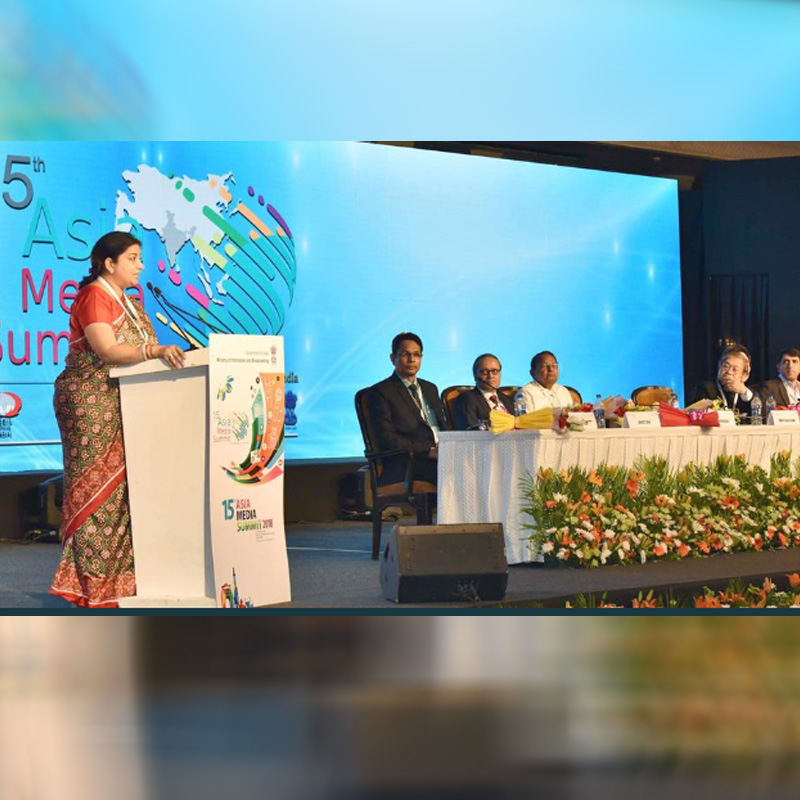
    NEW DELHI: Minister for Information & Broadcasting Smriti Zubin Irani yesterday said that the time has come to put laws, ethics and rules into place that will help in balancing the media industry so that no one dominant player can rule the roost. She, however, did not elaborate what those parameters should or could be.

    Speaking at the 15th Asia Media Summit (AMS) 2018 yesterday, she, however, hinted at her version of what good content could be, throwing oblique references to the growing digital-spurred edgy content in Indian media, including television.

    Pointing out that India will have around 969 million internet users by 2021 and that the media industry looks upon the digital world “not only as a challenge but also as an opportunity”, Irani asked, “How do we attract, retain and develop talent, which frees good content from the trappings of revenue needs and brings about a balance in media institutions?” 

    She hoped that the media event would deliberate on ways to “delve and deliberate on Asia values”, and the need for good stories to be told.

    Dwelling on the need for regulations to ensure level playing field for all, the minister referred to an address made by media baron Vineet Jain, group MD of Times Group, before her at the media conference to drive home a point that present laws may be inadequate to deal with the changing landscape of the Indian media.

    Jain, during his address to the delegates at AMS 2018, had said, “But for Indian media to realise its full potential, regulatory reforms are needed across the board – to make it easier to do business, remove anomalies in the system, and above all, ensure a fair marketplace that benefits the consumer.”

    Carrying forward, Irani said the India media is getting more consumer-centric because of the opportunities (and challenges) that the digital ecosystem is offering stakeholders, apart from the overall evolution of the industry.

    Giving a perspective of the expanding Indian media industry, Irani said India was one of the fastest growing advertising market that is expected to touch $10.59 billion by the end of 2018, while the mobile spend was estimated to grow to $1.55 billion in the current year. “We have a vibrant media industry, which has a direct established impact of Rs 1.35 lakh crore and indirect and induced benefits of Rs 4.5 lakh crore, with close to 4 million people associated with it,” she added.

    The three-day 15th Asia Media Summit is being hosted by the Ministry of Information and Broadcasting jointly with the Indian Institute of Mass Communication (IIMC), and Broadcast Engineering Consultants India Limited (BECIL) in New Delhi. The theme of this year’s summit is ‘Telling Our Stories – Asia and More’, which would encourage regional and bilateral dialogue and cooperation to respond to challenges to the broadcasting sector in the region.

    The minster expressed hope that the event will throw up new ideas so that pathways to strengthen media institutions for a better mankind could be explored.

    Addressing the inaugural session, Minister of Information from Bangladesh Hasanul Haq Inu outlined six complex challenges the world faces today: poverty, gender disparity, terrorism, ICT revolution, climate change and uneven globalisation. Expressing concern at cybercrimes, he stressed upon the need to fight a war against cyber-criminals to keep the media safe and expanding.

    This is the first time that the Asia Media Summit is being held in India. Over 220 foreign delegates representing 39 countries (SAARC, ASEAN, East Asia, Africa, Oceania, Europe, Syria, Uzbekistan, USA, China) and senior officials of the government and members of Indian media industry are participating in the event.

    Also Read:

    MIB moves to regulate online media: various organisations join issue   

    Online media professionals write to Smriti Irani expressing regulation concerns

    TRAI seeks to regulate online streaming platforms