Tag: MIB

  • Star Sports 1 Telugu to launch on 7 December

    Star Sports 1 Telugu to launch on 7 December

    MUMBAI: Star Sports is all set to unveil its third regional channel after launching Star Sports 1 Hindi and Star Sports 1 Tamil. The next language market of focus for the company is Telugu and the channel will go on air on 7 December 2018 i.e. Friday, a source close to development informed Indiantelevision.com. As the Vizag leg of Pro Kabaddi League (PKL) starts on 7 December at Rajiv Gandhi Indoor stadium.

    Star Sports 1 Telugu testing is in process on AsiaSat 7 at 105 degree east.

    The formal launch of the channel will be done at a press conference at Taj Krishna, Banjara Hills in Hyderabad on 5 December.

    In an interview with Indiantelevision.com, Star Sports CEO Gautam Thakar in September had said that Telugu and Kannada were going to be priority language markets for him.

    Telugu feed of the sports event like IPL was aired on Star Maa Movies this season.

    Under the new tariff order, Star Sports 1 Telugu and Star Sports 1 Kannada (yet to be launched) have been priced at Rs 19 for the TV consumers.

    In September this year, Star Sports also launched Star Sports 3, a multi-lingual channel in place of Channel V.

    Towards the end of last year Star India contemplated taking Channel V off air, with Star Sports 1 Kannada as its substitute, with 16 November 2017 having been fixed as the launch date.

     However, the broadcaster was unable to get the necessary approvals from Ministry of Information and Broadcasting (MIB).

    Star Sports currently boasts of 14 channels, including Star Sports 1 Telugu, in its bouquet, with nine Standard Definition (SD) and five High Definition (HD) channels.

  • TRAI directs DPOs to remove TV channels from landing page

    TRAI directs DPOs to remove TV channels from landing page

    NEW DELHI: The Telecom Regulatory Authority of India (TRAI) on Monday directed all distributors of TV channels and broadcasters to restrain with immediate effect from placing registered television channel, whose TV rating is released by ratings agency, on the landing page or the boot-up screen.

    The reason behind this order, according to TRAI, was to protect the interest of service providers and consumers while ensuring “orderly growth of the sector”.

    Though the TRAI diktat comes into effect immediately, the regulator has given some breather to stakeholders to become fully compliant by 31 March 2019 by making necessary changes in agreements that may have been already signed. However, distributors and TV channels have been asked to revert to the regulator with updates within seven days.

    Landing channel or landing page or landing logical channel number (LCN) refers to the default LCN that is displayed whenever a STB is switched on. TV channel placed on this page is available to all STBs connected to the network of a distributor and is regarded as a prized real estate by DPOs.

    During a consultation process on the issue, many broadcasters had admitted that placing a TV channel on the landing page could influence the audience data or TV rating points (TRPs), while MSOs and other distributors had stated there were no such influence on ratings or if any, they were minimal.

    TRPs, according to TRAI, indicate the popularity of a programme or a TV channel by providing information about the television watching habit (for example, time spent by a viewer on a particular TV channel) of viewers from different socio-economic backgrounds. In an environment that prevails in India, despite digitisation of TV services, advertisers and corporate media planners still depend on TRPs while budgeting media spend on television.

    The issue of landing page had cropped on when some stakeholders cried foul over a year back and the regulator had been forced to issue interim orders, which were challenged at the disputes tribunal TDSAT. Ministry of Information and Broadcasting too had directed BARC India , collators of audience data, to desist from including data from landing page channels for its overall weekly figures.

  • Dish TV’s Jawahar Goel writes to TRAI on rationalizing DTH costs, taxes

    Dish TV’s Jawahar Goel writes to TRAI on rationalizing DTH costs, taxes

    MUMBAI: Even as the Indian government is readying a new DTH policy, aimed at providing some succor to the financially beleaguered sector, Dish TV MD Jawahar Goel has written to the broadcast and telecom regulator TRAI exhorting it to rationalize costs and taxes being levied presently on the operators.

    “With regard to our request for allowing deduction of the subscription amount paid to the broadcaster for determining the DTH license fee, it is stated that DTH services operators have been regularly appraising the TRAI and MIB [Ministry of Information and Broadcasting] on the matter of the heavy cost they have been incurring for the provision of the services,” Goel points out in a recent letter.

    According to the communication, reviewed by Indiantelevision.com, Indian DTH operators not only pay taxes to the tune of 33 per cent, but also cough up around 30- 35 per cent of their revenue as content cost. There are huge investments in subsidizing the consumer premises equipment to the consumers of which the STB being the major component, the letter states.

    Pushing for a major reduction in annual license fee to 6-8 per cent of the gross revenue of an operator, Goyal, who had earlier too bemoaned neglect of the sector by the government, contends that the principle of application of license fee on the adjusted gross revenue (AGR) should be similar to what is done for the telecom sector.

    “The AGR in case of DTH service should mean total revenue as reflected in the audited accounts from the operation of DTH, as reduced by (a) subscription fee charges passed on to the pay channel broadcasters (b) sale of hardware including integrated receiver decoder required for connectivity at the consumer  premise, [and] service/entertainment   tax  actually  paid to  the  Central/State  government  if gross revenue had included them,” Goel argues in his missive to the regulator.

    This is not the first time that the feisty Goel has fired salvos at the government and the regulator. Not only has he raised issues pertaining to the DTH sector, but has also voiced his concern on general matters relating to the Indian entertainment and broadcast sectors as Dish TV and its other siblings have had to grapple in recent times with lackluster economy and government apathy.

    In an effort to garner more support from the regulator, Dish TV highlights that a consultation paper on the DTH sector prepared by TRAI had acknowledged the satellite platforms needed a level playing field vis-a-vis cable operators who paid no license fee. “The DTH services are subjected to multiple taxation, which inter-alia includes service tax @ 12.36 per cent, entertainment tax at different rates by State governments and VAT@ 12.5 per cent. In addition, if license fee @10 per cent is also added, the cumulative taxation would come to a significant amount, which leads to high incidence of levies and taxes for DTH service[s],” Goel contends.

    “Since the Government is in the process of finalizing the terms and conditions of the new DTH license, we would sincerely request you [TRAI] to kindly issue necessary recommendation to the government of India in this regard before such terms and conditions are laid down”, Goel concludes making a case for rationalization of taxes on DTH operators, especially as new content delivery techs like OTT invade Indian shores.

    Meanwhile, sources in Ministry of Information and Broadcasting (MIB) tell Indiantelevision.com that the much-discussed new DTH policy is being given final touches before it’s sent to the Cabinet for approval.

    “Ideally we would have liked to send the new DTH policy to the Cabinet for approval within 2018 itself, but various government processes, like getting feedbacks from various ministries, could push finalization of the policy to early 2019,” a source in MIB said, adding the government is likely to provide some relief to the sector, though major reduction in the license fee seems unlikely.

  • DoT & TRAI officials feel satcom policy needs ‘fundamental rethink’

    DoT & TRAI officials feel satcom policy needs ‘fundamental rethink’

    NEW DELHI: Two top Indian government officials from Telecom Ministry and TRAI feel the country must have a "fundamental rethink" on satellite communication policy to meet rising connectivity needs that are being fuelled by mobile data growth, digital aspirations, demand from the country’s broadcasting sector and advent of new-age technologies.

    Telecom secretary Aruna Sundararajan on Wednesday outlined the massive growth in mobile data consumption, driven by first-time users, and India's increasing digital clout, and said there is "no looking back" for the country when it comes to strengthening its communications infrastructure.

    She said that in an era of 5G and Internet of Things (IoT), the demand for communication infrastructure "far from slowing down, will increase exponentially".

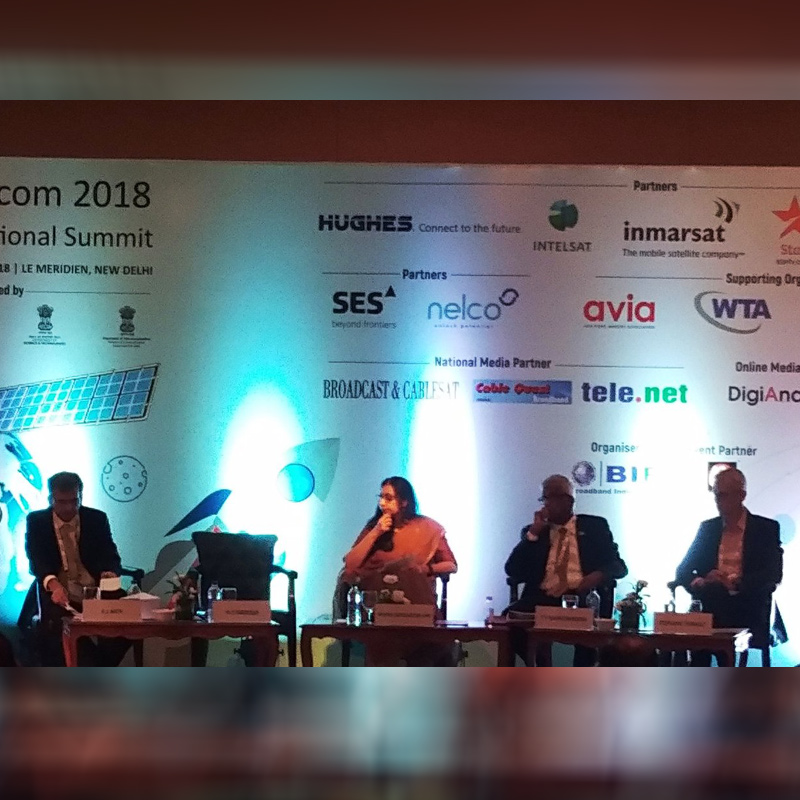
    "We must have digital communications infrastructure that facilitates all this…We really must have a fundamental rethink on India's satcom policy in light of what are the emerging requirements and India's aspirations," Sundararajan said addressing the annual satcom summit 'India SatCom-2018' organised by Broadband India Forum (BIF), a PTI report stated.

    She further said that the demand for communication network is also being propelled by financial service industry, digital payment companies, smartphone usage and social media.

    Sundararajan noted that the draft national digital communications policy aims to provide universal broadband connectivity at 50Mbps to every citizen by 2022, create four million additional jobs, and also talks of enhancing the contribution of digital communications sector to eight per cent of India’s GDP from approximately 6 per cent now.

    "If we are to achieve robust modern digital communications infrastructure that the country needs…it has estimated the need for investment at USD 100 billion. Often, we in government are asked if that is a high figure, but I don't think so…I think this is realistic investment number in sync with our infrastructure requirements," PTI quoted her as saying.

    Stating that the country must embark on comprehensive review of its satellite communications policy, she stressed on the need to strike a balance between autonomy, security and the country's communications demand. "…it is possible to find a sweet spot between these three aspects. Other countries have done so, and I don't think it is impossible for India to strike a calibrated position keeping these three imperatives in mind…Keeping our strategic capabilities and requirements in mind, we need to look at how we can bridge the deficit in term of communication requirements," she pointed out.

    The summit also delved on various aspects of communications, including broadband connectivity to the remote parts of the country, satellite mobility, inflight connectivity, new technologies and innovations.

    Echoing sentiments similar to Sudararajan, telecom and broadcast regulator TRAI secretary SK Gupta, while addressing the valedictory session of the event, opined that “mainstreaming of satcom” issues was heartening.

    Pointing out that satellite transponder allocation process in India “needs a review” and the mechanism an “overhaul”, Gupta said that no regulatory hurdle should be created against use of any technology as satellite communication is very important for various applications and services.

    The one and half day satcom conference saw the convergence of not only ideas and trends, but also of representatives from the industry and government, including those from India’s space agency ISRO, Ministry of Information and Broadcasting and BECIL.

  • MIB extends feedback deadline date on mandatory sports feed sharing norms

    MIB extends feedback deadline date on mandatory sports feed sharing norms

    MUMBAI: Ministry of Information and Broadcasting (MIB) has extended the deadline to give feedback on the draft sports broadcasting signals (Mandatory Sharing with Prasar Bharti) (Amendment) Bill, 2018 till 31 December 2018. In an earlier notification dated 17 October, it said that feedback must be given within a month to enable telecast of “Sporting events of national importance’ on mandatory channels of Doordarshan via cable/DTH/ IPTV operators.

    As per provisions of the Sports Act, the live feed received by Prasar Bharati from the content rights owners or holders is only for the purpose of re-transmission of the said signals on Doordarshan’s own terrestrial and DTH network (DD FreeDish) and not for
    cable operators or other distribution networks. The ad sales is also done by private companies after taking the pubcaster into confidence with the additional ad revenue shared between the rights holding TV channel and DD.

    Viewers, who do not have DD FreeDish [pubcaster Doordarshan’s FTA DTH platform] or Doordarshan’s terrestrial network, are either unable to watch these sporting events of national importance or are compelled to watch these sporting events on highly priced sports channels.

    Additonally, private DTH platforms and MSOs/LCOs were barred from showing DD's non-terrestrial channels that re-transmitted the shared feeds, after the August 2017 Supreme Court ruling, for the duration of that particular event and it was stressed upon also by Prasar Bharati fearing adverse reaction from the apex court.

    The extension notice reads: “Reference this Ministry's earlier notice dated 17.1 0.201 8 seeking feedback / comments on Draft Sports Broadcasting Signals (Mandatory Sharing with Prasar Bharati) (Amendment) Bill, 2018, it is informed that the deadline for receiving feedback/comments from General Public/Stakeholders on the said draft Bill, 2018 to enable telecast of 'Sporting events of National importance'on mandatory channels of Doordarshan via Cable /DTH /IPTV Operators has been extended by this Ministry till 31 .12.2018.”

  • MIB gives permission to two new channels – Khalsa and Nireekshana TV

    MIB gives permission to two new channels – Khalsa and Nireekshana TV

    MUMBAI: The Ministry of Information and Broadcasting (MIB) after being lenient for couple of months in awarding channel licenses, is back to being strict. In the month of October, two new channels received licenses while none saw their licenses cancelled as on 31 October 2018.

    The two channels are Khalsa channel and Nireekshana TV. Nexgen Telelinks got the permission for uplinking and downlinking Khalsa channel (non-news) in Hindi and all Indian scheduled languages on 9 October 2018. Shopping Zone India TV got the permission for uplinking and downlinking Nireekshana TV (non-news) in Tamil, Malayalam, Kannada, Telugu and scheduled Indian languages on 18 October 2018.  

    On the other hand, Jain TV, PBN (earlier Samachar 24X7) and Dheeran TV channels, which were present in the list of permitted private satellite TV channels in the list up to 30 September 2018, were not in the new list till 31 October 2018.

    The 14 licenses which were cancelled earlier by MIB due to security denial by Ministry of Home Affairs (MHA) are still now under stay order from the court.

    After cancelling permission to 252 channels, the number of private satellite TV channels having valid permission in India stands at 866 as on 31 October 2018. 483 channels are non-news channels and the remaining 383 are news channels.

    Of the 868 permitted private satellite channels, TV channels permitted for uplinking from India and also to downlink into India are 766 among which 362 are news channels and 404 are non-news channels. 11 non-news channels and five news channels are permitted for uplinking from India but not downlink into the country. 84 TV channels are uplinked from abroad which only have downlinking permission in India. This category includes 15 news and 69 non-news channels.

  • Ex-Videocon d2h CEO Anil Khera aims for kids’ channel

    Ex-Videocon d2h CEO Anil Khera aims for kids’ channel

    MUMBAI: He ran a successful DTH business in Videocon d2h up until it was merged with Dish TV. And now he’s off to establish an independent identity. Former Videocon d2h CEO Anil Khera has set up his own company One Take Media (OTM) that specialises in content production, global content acquisition and distribution, providing value added services (VAS) to global DTH/cable TV and OTT platforms.

    As per data published by the Ministry of Information and Broadcasting (MIB), the Indian DTH industry has around 8-10 million VAS subscribers availing the services in some form. DTH alone generates around $80 million as annual VAS revenue which is bound to touch $200 million by the year 2020. Speaking to Indiantelevision.com, Khera says that there are still gaps to be filled as far as content is concerned which is available on platforms such as OTT, DTH and cable. “We are identifying that gap and we are introducing that as the VAS services,” he says.

    The company sees kids’ genre as the fourth largest after movies, entertainment and others and plans to launch a channel in the near future. “I have a long term plan to start a kids’ channel as we have a very sufficient library for kids’ content,” he says.

    Khera said that he has kept one library separately for the channel and it will contain both original and acquired content. He denied disclosing the production houses that OTM has acquired the content from due to the NDA agreement with them. He said, “We have acquired the content from various Indian and foreign production houses. We have our own IP in animation rhymes which is called Nyra World and as far as languages are concerned, we will be looking at the largest sector which is the Hindi speaking market,” he explains.

    Premium content from foreign countries will be dubbed and shown in Hindi. The initial experiment will be to offer both acquired and original content to understand the audience. OTM has Kids1st TV, a channel targeting 2-6 years of kids, Cartoony TV–TV series in comedy, entertainment and adventure for the kids in the age group of 4-11 years old and Cartoony Movies for all age groups.

    Khera says the company is working with telecom clients based in Africa and MENA region besides OTT customers in Singapore and Malaysia. In India, it is working with Dish TV. “There are several telecom companies around the world. We have Indonesia Telecom where they have their app and MENA region telecom like Ooredoo. We are also in discussion with Etisalat and in Nigeria, we have the telecom company called Tingo for our kids and cooking content (The Great Indian Global Kitchen) that we own the IP for,” he reveals.

    Recently in India, the company signed a content deal with multi system operator (MSO) and headend in the sky (HITS) platform IndusInd Media and Communications Ltd (IMCL) to launch VAS. As part of the partnership, OTM will provide ad-free and unique content to IMCL subscribers. The subscription-based services are available to all InDigital subscribers. The unique services from OTM include animated cartoon series in Hindi for various age groups of kids across three services, nursery rhymes, TV series and animated Hindi movies. Other services are celebrity chef-based cooking shows, songs and Bhojpuri, Tamil and Telugu movies. Other unique services also include Hollywood and South Indian movies dubbed in Hindi.

    Khera said that as far as Hollywood cooking content is concerned, the company is in talks with Airtel DTH. Also being the first company to dub Turkish and Korean content in Hindi, he feels that there is a great pull for this content. “We want to provide the global content experience to the Indian customers. There is no demand as such but being in the media company for so many years, I believe it has a great pull,” he says.

  • MIB proposes to change mandatory sports feed sharing norms

    MIB proposes to change mandatory sports feed sharing norms

     NEW DELHI: In what could have far reaching effects on the financial viability of sports TV channels or streaming platforms, which acquire exlcusive rights for sporting events for the India region spending billions of dollars, the government proposes to amend rules relating to mandatory sharing of feeds of sports of national importance with not only the pubcaster, but with other distribution platforms. Reason for proposed changes: people with less purchasing power should not lose out on the sporting excitement.

    “…viewers, who do not have DD FreeDish [pubcaster Doordarshan’s FTA DTH platform] or Doordarshan’s terrestrial network, are either unable to watch these sporting events of national importance or are compelled to watch these sporting events on highly priced sports channels and, thus, the very objective with which the Parliament had enacted the Sports Act has been defeated,” Ministry of Information and Broadcasting (MIB) said in a notice issued on 17 October 2018, adding that public comments were invited within a month on the changes proposed in the relevant regulation relating to sharing by rights holding private TV channels of broadcasting feed with the pubcaster.

    As per provisions of the Sports Act, the live feed received by Prasar Bharati from the content rights owners or holders is only for the purpose of re-transmission of the said signals on Doordarshan’s own terrestrial and DTH network (DD FreeDish) and not for
    cable operators or other distribution networks. The ad sales is also done by private companies after taking the pubcaster into confidence with the additional ad revenue shared between the rights holding TV channel and DD.

    Though the sports rule was legislated in 2007, the shared signals on DD were sometimes donloaded by distribution platforms from satellite-delivered channels and re-transmitted not only in India but also in some neighbouring countries. Seeing this trend, Star India, which was investing heavily in sports, had moved the courts and in August 2017 got a favourable ruling from the Supreme Court that ruled the shared feed of sporting events of national importance, as mandated by the government, can only be re-transmitted on DD terrestrial network and DD FreeDish to avoid piracy and possible loss of revenue for the rights holder.

    Additonally, private DTH platforms and MSOs/LCOs were barred from showing DD's non-terrestrial channels that re-transmitted the shared feeds after the August 2017 Supreme Court ruling for the duration of the that particular event and it was stressed on also by Prasar Bharati fearing adverse reaction from the apex court.

    Within few  days of the SC ruling favouring the rights holding TV channel or broadcaster and few days before the lucrative IPL cricket rights bids were opened last year, Jawahar Goel, chairman and MD of Dish TV, India's first DTH platform started by the Zee group, raised an alarm on Star's emerging cricket monopoly.
    In a hard-hitting letter, addressed to various Indian government organisations, including MIB, regulator TRAI and the anti-monopoly authority, Goel had alleged that combined with the financial muscle and near-monpoly over cricket for India region, Star's acquistions will impact "every stakeholder in the broadcasting industry, starting from the distributors of  TV channels". Star India finally outplayed other bidders for the IPL rights for the next five years in 2017 by coughing up a whopping $2.4 billion.

    In the light of recent developments in the distribution segment of the Indian broadcast system, MIB's latest move gains importance. So, what's the proposed amendment being sought to be inserted in the 

    Sports Broadcasting Signals (Mandatory Sharing with Prasar Bharti) (Amendment) Bill, 2018?

    The relevant portion of the amendment being proposed for which stakeholders' comments have been invited reads: “No content rights owner or holder and no television or radio broadcasting service provider shall carry a live television broadcast on any cable and/or Direct-to-Home network and/or IPTV and/or terrestrial network or radio commentary broadcast in India of sporting events of national importance, unless it simultaneously shares the live broadcasting signal, without its advertisements, with the Prasar Bharati to enable them to re-transmit the same on its own terrestrial network and Direct-to-Home network and on other television distribution platforms/networks where is it mandatory to broadcast mandatory channels notified by the Union Government under Section 8 of the Cable Television Networks (Regulation) Act, 1995 in such manner and on such terms and conditions as may be specified.”

    At present, Star India and Sony Pictures Networks India — the latter has a partnership with ESPN that got a divorce from Star for sports channels in 2012 — are two networks that own and manage sports channels in India. However, in recent times digital players like Facebook, Reliance Jio, Amazon and Alibaba-controlled Indian digital wallet company PayTM have shown interest and bid for cricket properties in India. Facebook also won the India rights for La Liga football that was streamed free on the digital platform, while being sub-licensed to Sony for normal TV broadcast.

    However, an industry observor pointed out that apart from the fact that the pubcaster's DD FreeDish platform could get further hit financially if the proposed changes are legislated, it was also highlighted  that what could have further spurred the government into action is that after TRAI's new tariff regime kicked in last month, most broadcast companies and TV channel managers converted FTA TV channels into pay channels  depleting further the basic FTA bouquet aimed at people with low purchasing power.

    It would be interesting to watch how this proposed change plays out with stakeholders.

  • Zee Media gets permission for 4 regional news channels

    Zee Media gets permission for 4 regional news channels

    MUMBAI: After a long tenure of being strict in awarding channel licenses, the Ministry of Information and Broadcasting (MIB) has finally become lenient. In the month of September, eight new channels received licenses while none saw their licenses cancelled as on 30 September 2018.

    Out of the eight channels, four channels were of Zee Media Corporation Ltd (ZMCL). All the four permissions are for news channel named 1 Chennai (Tamil, English), 1 Mumbai (Marathi, English), 1 Kolkata (Bengali, English) and 1 Delhi (Hindi, English). The permission was given on 11 September 2018 for both uplinking and downlinking of the four channels.

    On the other hand, Disney Broadcasting India got the permissions for a non-news channel UTV HD (English) for both uplinking and downlinking on 14 September 2018.

    Vedic Broadcasting has got permission for launching three new channels named Aastha Tamil, Aastha Telugu and Aastha Kannada on 26 September 2018.

    The 14 licenses which were cancelled earlier by MIB due to security denial by Ministry of Home Affairs (MHA) are still now under stay order from the court.

    After cancelling permission to 247 channels, the number of private satellite TV channels having valid permission in India stands at 869 as on 30 September 2018. 483 channels are non-news channels and the remaining 386 are news channels.

    Of the 868 permitted private satellite channels, TV channels permitted for uplinking from India and also to downlink into India are 769 among which 365 are news channels and 404 are non-news channels. 11 non-news channels and five news channels are permitted for uplinking from India but not downlink into the country. 84 TV channels are uplinked from abroad which only have downlinking permission in India. This category includes 15 news and 69 non-news channels.