Tag: Mi Marathi

  • Bad news dogs Mi Marathi journos: work without pay

    Bad news dogs Mi Marathi journos: work without pay

    MUMBAI: There’s some amount of chaos reigning in the office of the 24 hour Marathi news channel Mi Marathi. With owner Mahesh Motewar – who acquired it from HDIL in 2012 – cooling his heels behind bars since December 2015, it’s bound to be.  A cash crunch has forced it to stop churning out original news programming and run archival content.

    Moreover, on 20 March 2016, Mi Marathi’s senior managers called a meeting at which reporters and editors were informed that they would have work without pay until further notice.

    A senior reporter present at the meeting told Indiantelevision.com, “We were shocked when the announcement was made. We were asked to raise our hands if we were okay to work without being paid. Only three hands went up.”

    Another senior official informed us on condition of anonymity, “The salaries have been delayed for a long time now. Three days back all the staff got their January pay, while their emoluments for February are still due. There is a crisis at our parent company, but the irony is revenue wise we are doing good. ABP and Zee are the only ones above us. I just hope the company can resolve its issues soon or it may be on course to shut down.”

    Another senior journo disclosed that he has been calling his friends in other news channels and newspapers to hire some of the mid and junior level reporters from Mi Marathi. He further clarified:  “A large chunk of the employees has already moved on. The way it is functioning; I don’t see the channel running for long. We senior guys get the salary last. We ensure that the younger reporters and editors get their wages first as they are the one’s most needing them.”

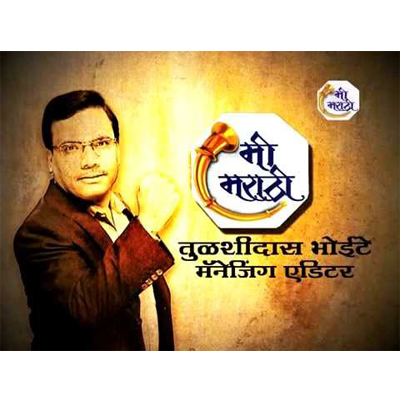
    However, Mi Marathi managing editor Tulsidas Bhoite was pretty emphatic that the channel would continue and there was no question of shuttering it. “Yes there are certain issues but there is no shutting down. Yes we have stopped our bulletins but that is because of some technical issues,” he said. “The reporters are there and we will  resume our original programming again in a week or two.”

    Observers say it will require a miracle of sorts to turn things around. Motewar is reportedly currently lodged in Yerwada jail after being found guilty of allegedly defrauding investors through a chit-fund scam under Prosperity Agro or Samruddha Jeevan. Motewar is allegedly politically well connected hence his broadcast venture could find a white knight.


  • Bad news dogs Mi Marathi journos: work without pay

    Bad news dogs Mi Marathi journos: work without pay

    MUMBAI: There’s some amount of chaos reigning in the office of the 24 hour Marathi news channel Mi Marathi. With owner Mahesh Motewar – who acquired it from HDIL in 2012 – cooling his heels behind bars since December 2015, it’s bound to be.  A cash crunch has forced it to stop churning out original news programming and run archival content.

    Moreover, on 20 March 2016, Mi Marathi’s senior managers called a meeting at which reporters and editors were informed that they would have work without pay until further notice.

    A senior reporter present at the meeting told Indiantelevision.com, “We were shocked when the announcement was made. We were asked to raise our hands if we were okay to work without being paid. Only three hands went up.”

    Another senior official informed us on condition of anonymity, “The salaries have been delayed for a long time now. Three days back all the staff got their January pay, while their emoluments for February are still due. There is a crisis at our parent company, but the irony is revenue wise we are doing good. ABP and Zee are the only ones above us. I just hope the company can resolve its issues soon or it may be on course to shut down.”

    Another senior journo disclosed that he has been calling his friends in other news channels and newspapers to hire some of the mid and junior level reporters from Mi Marathi. He further clarified:  “A large chunk of the employees has already moved on. The way it is functioning; I don’t see the channel running for long. We senior guys get the salary last. We ensure that the younger reporters and editors get their wages first as they are the one’s most needing them.”

    However, Mi Marathi managing editor Tulsidas Bhoite was pretty emphatic that the channel would continue and there was no question of shuttering it. “Yes there are certain issues but there is no shutting down. Yes we have stopped our bulletins but that is because of some technical issues,” he said. “The reporters are there and we will  resume our original programming again in a week or two.”

    Observers say it will require a miracle of sorts to turn things around. Motewar is reportedly currently lodged in Yerwada jail after being found guilty of allegedly defrauding investors through a chit-fund scam under Prosperity Agro or Samruddha Jeevan. Motewar is allegedly politically well connected hence his broadcast venture could find a white knight.


  • “There is no creativity or innovation in the Marathi news channels’ space:” Nikhil Wagle

    “There is no creativity or innovation in the Marathi news channels’ space:” Nikhil Wagle

    At the age of 19 he became the editor-in-chief of a regional daily and today has journalism experience of more than 35 years. Besides being on top of each and every beat, he was keenly focused on investigative journalism. 


    In August 2004, he became a victim of aggressive Shiv Sena supporters who were irked by his belligerence and brave journalism. He is the inspiration for many igniting minds who are keen to peruse a career in journalism; he is none other than veteran Marathi pressman Nikhil Wagle.


    Speaking exclusively to Indiantelevision.com’s Sagar Shere, Wagle shares his vision on the Marathi news space, where he feels there is huge room for creative experimentation.


    Excerpts:


    How has your stint with Mi Marathi been so far? What was the reason behind choosing the channel when you switched from IBN Lokmat?


    It’s just been nine months since I joined Mi Marathi and I am not working full time here. I only do one show for them which is Point Blank. The reason behind switching from IBN Lokmat was that the entire IBN network was taken over by Mukesh Ambani. We had conflicts on policies and ideology with them. We worked under Rajdeep Sardesai as a team and resigned because we thought Ambani will not give us the freedom to work as a journalist. 


    I liked the policies of Mi Marathi and their ideation behind news so I thought of coming to Mi Marathi. 


    There has been a drastic growth in the Marathi news channel space. What do you think is the pulling point for audiences and what does the Marathi news channel genre needs to work on to get in more viewers?


    Marathi news channel is growing and it was always better than Hindi news channel on the basis of content. When IBN Lokmat and ABP Mazha were newly born, they infused young blood and were ready to experiment. However now they seem to have faced a setback. These days Marathi news channels have started following a set pattern for everything, be it for news gathering, news visualizing, programming or debate. There is no innovation in Marathi news space. 


    From your perspective, what are the changes that you have seen over the years in the genre? In terms of approach for news, do you think there is a different strategy that Marathi channels are adopting now? 


    We need more creativity, more ideas and more experimentation in Marathi news channels. We should infuse young blood so that we can experiment and create good content. We need to concentrate on investigative journalism. These days all news channels thrive on byte journalism and feature programmes. However the need of the hour is investigative journalism. Over the past seven years, news channels have turned stale. We need fresh outlook. Moreover, new perceptions and innovation is always accepted by the audience. 


    Do you think there is scope for more news channels in the Marathi space?


    There is ample scope for Marathi news channels because IBM Lokmat has gone down in TRP and advertising. There was competition between IBN Lokmat, ABP Mazha and Zee 24tass. However, over the last one year there is no competition between these news channels. Also there is no quality news gathering, quality of format and quality programmes.


    If there is no competition you lose the passion and that is what has happened with Marathi news channels. At this point in time, if someone tries to break the format and comes up with something new, it will be great and viewers will definitely like it.


    What is the target group for regional news channels?


    Target audience for Marathi regional channels are all Marathi speaking audiences. They cater to middle class, higher middle class, rural and urban audience. Everyone has a different taste and a news channel should look after all its target audiences but sometimes you don’t need to look for a TG because some stories are important for the nation news wise and at that time you don’t look for TG. Stories like farmers’ suicide, terrorist attacks and natural calamities are serious issues and you can’t look at the TG before showcasing them.

  • “Media today is suffering from ideological corruption”: Tulsidas Bhoite

    “Media today is suffering from ideological corruption”: Tulsidas Bhoite

    Mi Marathi, a Marathi news channel has been working hard to gain cognizance since its revamp from an entertainment channel to a news channel in March 2014. The channel, after a year of constant endeavour to connect with the viewers, has become the chart topper in the Marathi news space.

    At the forefront of Mi Marathi is a team of veteran journalists and among them is the channel’s managing editor Tulsidas Bhoite.  

    Bhoite started his career in 1992 in print media. It was in 2000 that he moved to electronic media with his debut stint at ETV. He has worked with leading channels like Zee Marathi, IBN7, Star Majha, Zee 24 Taas, TV 9 and Jai Maharashtra.

    Indiantelevision.com’s Seema Singh spoke to Bhoite about the transition of Mi Marathi from an entertainment channel to a news channel, the challenges and much more.

    Excerpts:

    What was the reason behind converting the entertainment channel Mi Marathi to a news channel?

    I think it was a wise decision by the management. I travel a lot with all segments of people, be it with commoners or professionals from different field. As per my analysis, there is space for more than 10 news channels in Maharashtra. The market here is quite weak in terms of both revenue and TRP, and so far, not a single channel has tapped the market fully. Currently with seven players in the region, we have only just managed to tap 50 per cent of the market.

    How did the transition take place? What happened to the GEC employees?

    We haven’t removed a single employee from any department because we didn’t want to write-off any people. Everyone has their own talent, and it was our duty to cultivate that talent for the betterment of the channel. We decided to use GEC talent for news and fortunately the management allowed us to do that. As the pace of work in a news channel differs from that of a GEC, we do face the problem of speed but our employees are coping and trying to change their functioning style.

    When the management decided to relaunch the channel as a news channel, they started hiring best professionals from the industry. The hiring process is still on and we have on board the three best faces from the industry in Kumar Ketkar, Nikhil Wagle and Bharatkumar Raut.

    We are hiring more talent from the news industry now. Even today, we do not have any technical backup like the other news channels, because of the space crunch. Plans are also afoot to shift to a new office and buy more technical equipments. With no technical support and just 60 per cent workforce as compared to the other news channels, I think we have been doing a fairly good job.

    How is the management-employee relationship in the company? Are employees involved while taking decisions?

    We ask our employees to give ideas. We may or may not accept the ideas, but we always ask people to participate in the ideation process. In fact, Jhingroo, the icon created by the channel during elections, was the idea of our creative team, which is still being appreciated by many.

    Being the seventh player in the market, what was the strategy to attract viewers? 

    Yes, we entered the market as the seventh player in the regional news space in March 2014. In order to remain relevant in the space, we had to create a new market for ourselves. As I mentioned, there is a large part of Maharashtra, which is still uncovered by news channels. So our strategy was to create a new segment for ourselves in the news market and also grab existing viewers of other news channels.

    We decided to cover news differently. For example in Mumbai, channels generally cover Mantralaya when it comes to politics, stock market for financial and a select two or three theatres or multiplexes when it comes to entertainment news. We changed this. We sent our cameras to that part of the society, where others hesitated. The news industry generally works on a myth of the up market and down market. But if you see, only 10 per cent of the news channel viewer comes from the so called up market strata.

    Even in the rural parts of Maharashtra, channels focus on the sugar belt of Pune or Nasik. We completely changed that. We always cover every news right from rural to urban, from upper to middle to lower middle class. And I’m not saying this because I’m a journalist, but this is the most practical approach. Even advertisers want to cater to the rural markets these days.

    What were the challenges you faced when you entered the market?

    The first challenge that came our way was that no one wanted to accept us as we weren’t big faces, when we launched. Traditional leaders thought we could not carry on the channel. But when we applied our strategies to run the channel, after four months they started taking cognizance of the channel.

    What did you do right to get to the number one position?

    Firstly, the selection of issues and subjects to cover. Secondly, we consider the opinion of each person in the team as important. Thirdly, when others are trying to think on an issue, we have already acted on it. We connect our channel directly to viewers, from all segments. We are always trying to give them a say in each and every programme. To understand the pulse of the audience, we never forcefully apply our views on the audience. We give the audience a chance to express their opinion.

    What’s your Target Group?

    While we don’t focus on one TG, we look at targeting the 15-45 year olds. For example, our character Jhigroo, resonates not just with politicians, but also the younger generation, who while are not too interested in politics or the news, but like the animated character. We want to catch the young audiences.

    How did you ensure that you did not lose out on your viewers from the entertainment channel, while making new ones in the transition?

    Most channels apply the ‘Hot Cut’ policy. But during the relaunch, we did not make the mistake of ‘Hot Cut.’ So while a show was on air, we did not cut the programme to go on air on something that was happening now because that could have harmed us. So we used the phase out process. We kept 50 per cent programming and 50 per cent news from September 2013 to March 2014. And from March, we relaunched fully as a news channel and we continue treating news in a different way. A lot of emphasis is being given to the presentation of the news, despite lacking on the technical front.

    How do you plan to maintain the number one position?

    When we announced the relaunch in the newsroom, I had said ‘our struggle is man vs machine.’ While content is the king, distribution plays a crucial role and we are hoping to expand our reach.

    My aim is to not just get good numbers. My ultimate goal is that the channel should be cognizable, right from the top person to someone sitting in the rural area. People should know the channel and the content. Number one, two doesn’t really matter.

    We would like to capture 50 per cent of the market to be able to do more experiments with the content.

    What are the challenges in the Marathi news space?

    In Maharashtra, people are open to other languages, and so we have to compete with Hindi news channels as well. Our strategy is to go to people, pick up their issues and give them a voice.

    Do you think advertisers should put in more money in regional channels? Is there scope?

    There is an untapped market in Maharashtra. However, when it comes to news genre, I don’t think any sales team in any of the channels has the potential to tap that huge market, and this includes my channel. There is a need to set up that team. We need to look at people with good ideas, who can tap that market.

    The logo has remained the same even after the relaunch. Any plans to change that?

    We thought on that. The creative team has created a different logo as well, but for now we will stick to the current logo. Our communication from class to mass shows that they like our current logo.

    Are you looking at revamping the channel?

    My team is currently struggling with the limited resource. But we need to move to a new space and as soon as we find that space, we will have two studios and better equipment and lighting. The revamp will be in the next six months.

    We are also working towards bringing in more graphics in the next 15 days. We will not stick to a single rule of programming. Adding more content to the channel is an unending process. We are making rules, only to break them.

    How has Nikhil Wagle’s presence helped the channel?

    If you study our viewership pattern, we are equally distributed throughout the day, from 3 pm to 11 pm. We wanted to strengthen our 9 – 10 pm time band and so when Nikhil Wagle agreed to join our channel, we offered him that time band. He has his own followers in Maharashtra, and that cannot be denied. Our mood and his is the same and that helps the channel a lot.

    How many journalists and bureaus do you currently have?

    In all over Maharashtra, we have nine bureaus and we will increase that to 12 in the next three months.

    Of the nine, seven are connected by lease lines. We will also start our studios in the next three months. We want to give our correspondents in these studios an opportunity to handle their own small shows on regional basis.

    In Mumbai, we have a team of 12 reporters and 20 camerapersons and out of Mumbai we have 60 reporters and 30 camerapersons.

    What’s your take on prime time debate?

    When deciding the strategy for the channel, I think like a viewer and not like a journalist. People are fed up of debates and that’s a fact. Fortunately, we only have one debate showPoint Blank hosted by Wagle, who is a man of content.

    We take only four people on the panel in order to give proper time to each one to represent their point of view. Media is suffering from ideological corruption. We are media, we are supposed to give equal opportunity for people to give their opinion. There should be discussion and not debate.

    Vir Sanghvi had once said, “We don’t have news channels, we have low cost entertainment channels.” But I think people are fed up of such low cost entertainment and so we are trying to deliver hard core news.

    If you check our ratings, we aren’t getting good ratings for any of our entertainment shows.

    Have you subscribed to BARC? Will you be discontinuing your TAM subscription? 

    We haven’t yet subscribed to BARC, but we will. We haven’t taken a decision on whether we will continue with TAM or not. We may continue with both TAM and BARC.

  • Mi Marathi’s secret recipe for success in regional news space

    Mi Marathi’s secret recipe for success in regional news space

    MUMBAI: Marathi news channel Mi Marathi, which was eyeing the number one spot on the ratings chart after its late entry a year back, has finally hit bull’s eye.  


    In order to stay above the rest, Mi Marathi has designed a content strategy different than the other Marathi news channels. “We have never had a regional approach towards the channel. Mi Marathi has always been shaped as a global Marathi channel,” Mi Marathi editor in chief Ravindra Ambekar tells Indiantelevision.com in an exclusive chat.


    The differentiating factor for the channel when it launched, according to Ambekar, was that while other Marathi news channels were only catering to the Maharashtrains in Maharashtra, Mi Marathi took to representing the non-Marathis. “So while others were idolizing Raj Thackeray, we went against him. The programming of Mi Marathi has always revolved around people’s agenda,” says Ambekar.


    Ask Ambekar the recipe of reaching the top, and he proudly says, “We have never stuck to the studios. We believe in reporting from the ground and that’s how we connect to the viewers. People like to know the news from the ground and that is what has helped us reach the number one position.”


    The channel, which is working on a whole new look that it will soon be launching, is also concentrating on differentiated programming to attract more viewers and retain its number one position.


    Programming strategy


    Mi Marathi has roped in some big names… right from Kumar Ketkar to Nikhil Wagle, the channel has some of the top guns of journalism on its side.


    With its programming, the channel is also trying to bring a perceptional change that Marathi channels cannot cater to international news. It recently launched World News hosted by Kumar Ketkar, where he analyses major international news. “We must come out of the regional identity and boundaries,” opines Ambekar.


    That apart, it also has a show Local to Global hosted by newly appointed Nilesh Khare along with Shreerang Khare and Mayank Bhagwat. The show currently is the highest rated for the channel.


    Mi Marathi, through its content, is trying to connect to the new generation and that explains the English titles for most of its shows. “If we want to connect with the new generation, we will have to speak in their language,” says Ambekar, adding that the channel also does bulletins in languages spoken in the interior part of Maharashtra like a Malwani bulletin, all this to form a connect with the audience. 


    According to Ambekar, in Mumbai, Mi Marathi faces stiff competition from Hindi news channels. “The issue here is that when there is big news, people shift to Hindi news channels,” he says, adding that regional channels too need to come up with shows, which are at par with the quality of an English news channel.


    The channel is focusing on strengthening its morning primetime band, which currently airs half an hour recorded bulletins and shows. It will soon be launching a 7 am to 8:30 am non-stop super fast news bulletin catering to local and global news. “We have realised that people don’t have the luxury of sitting and watching news early in the morning and so we will be launching speed news in the morning band with the theme: ‘Don’t read newspapers, listen to them’,” informs Ambekar.


    Mi Marathi also has had a different approach for the afternoon band compared to the others in the space. While others prefer airing cooking shows in the afternoon band, this Marathi news channel chooses to air shows, which caters to social and health issues. “We understand that women would not want to watch a cooking show in their free time and so we air shows, which cater to issues relating to commuting, heath, government etc,” he says.  


    The evening band on the channel caters to remote areas of the state. Called the Zilla Parishad News, the programme covers issues at the zilla level. “We have total nine live bureaus and two – three  correspondents in every district of the state. This adds to the depth of stories we do,” informs Ambekar.


    Realising a void of business programmes in the Marathi news channel space, Mi Marathi has launched two business related shows: Khisa Pakit by Bharat Kumar Raut, which was a pre-budget show and will now continue featuring interviews of CEOs and Mi Marathi Bigg Boss by Nilesh Khare, which will go on floors next month. 


    The channel is also in discussion with Wagle for another show, after the successful Point Blank


    “We need to go above the competition and only then will we succeed,” opines Ambekar, who is hoping to financially stabilise the company in the next one year.


    “We are currently mostly dependent on corporate advertising currently. However, we are now moving towards retail marketing and events,” he informs.


    Events in the pipeline


    The channel is planning mega events like Agricultural Awards and educational seminars to boost its revenues. “We are focusing on revenue from events and retail client. There is limited space for advertising on television, since we need to concentrate on content and so we are focusing on events,” he says.


    While the Agricultural Awards will take place in October, the first educational seminar will be held in May at Kolhapur. 


  • Mi Marathi to strengthen digital presence; ropes in ABP Majha’s Nilesh Khare

    Mi Marathi to strengthen digital presence; ropes in ABP Majha’s Nilesh Khare

    MUMBAI: After attaining and retaining the number one spot in the genre for the past two weeks, Marathi news channel Mi Marathi is now looking at strengthening its digital presence.

    The channel has roped in former ABP Majha anchor Nilesh Khare, famous for his show Bigg Boss and given him the mandate for the same. In his new role as Mi Marathi editor – digital, Khare will be working with a new team to get the channel’s digital plan rolling.

    Khare, who joined the channel last week, will not just be heading the digital team but will also be hosting a show Marathi Bigg Boss on the channel.

    “We have a news channel and a newspaper, but now we want to strengthen our digital presence. We have recently launched an app but we will not be taking a regular digital route,” Mi Marathi editor in chief Ravindra Ambekar tells Indiantelevision.com.

    The plan, currently in its nascent stage, is to make the digital platform interactive. “We have done a lot of research and found out that one sided communication is not really helpful. While people have switched on notifications to keep themselves updated with news, this has now reached stagnation point. Hence we are looking at making our platform more interactive, where people can voice their opinions,” adds Ambekar.

    Mi Marathi will have a separate digital team, headed by Khare. “We should be launching the digital platform in the next six months,” informs Khare.

    Talking about his decision to join Mi Marathi, Khare says that it was the young and enthusiastic team that attracted him to associate with the channel.

    Mi Marathi will soon start shooting for Marathi Bigg Boss with Khare. “It was a popular show, which he worked on during his stint with ABP Majha. We will be bringing that on our channel now,” informs Ambekar.

    Mi Marathi plans to take the show international and plans are afoot to shoot the first episode in Dubai. The programme will feature Maharashtrian entrepreneurs across the globe. “This will be a yearlong show. While currently it is at conceptualization level, we have already shortlisted around 13 entrepreneurs and industrialists in Dubai and so we will start shooting there next month. Post that we will go to the US as well,” informs Ambekar.

  • Editors give thumbs up to branded content, if it doesn’t interfere with quality

    Editors give thumbs up to branded content, if it doesn’t interfere with quality

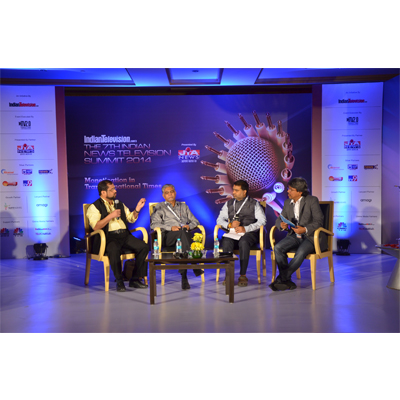
    MUMBAI: While the business heads and sales heads are worried about how to keep revenues growing, the editors are concerned about keeping them away from getting into their editorial decisions. Discussing exactly this was a panel at the 7th Indian News Television Summit that saw ITV Network editor in chief Deepak Chaurasia, senior columnist and veteran journalist QW Naqvi and Mi Marathi consultant and former IBN Lokmat chief editor Nikhil Wagle that was moderated by indiantelevision.com group founder, CEO and editor in chief Anil Wanvari.


    The discussion started off with Wanvari asking them how much would allow business heads to interfere with the editorial. Naqvi said that a business target should not influence editorial decision. Wagle said that he is aware that business is needed to run a channel but ‘without interference the channel can be profitable.’


    Chaurasiya was of the opinion that both need to be together for the business model to survive. “The company will go into loss if the model is wrong. The editorial should know the company’s profit and loss because it can’t be a loss  making business. However, sales and editorial should not have the authority to decide whether or not a story should be shown or the angle of the story be taken. If the marketing team will tell me that a particular party is giving money if we do this story and in this angle, then I would say I have surrendered myself to them,” he said.


    Wanvari said that political parties were different from brands, to which Wagle said that he isn’t against sponsored programmes, if they are disclosed. “If I was an editor, either I will stop such content or resign,” he said. Naqvi said that he is fine with integration where the quality, judgment and quantity isn’t compromised. “A programme shouldn’t be made just to make a brand happy despite not having any value,” he pointed out.


    Chaurasia however said that even a half an hour show with bad ratings will ruin his day’s average, so he hesitates while taking advertorial, despite the money. “Rather than think short term, I think its long term impact on my ad rates. 90 per cent advertisers want to make the show in their perspective,” he said. He was however worried about how with too many ads the time spent on the channel is decreasing.


    Times Now editor in chief Arnab Goswami is a brand in himself, which is being used by the channel, said Wanvari asking whether the three of them would allow that to happen to them. “TAM ratings only give numbers, not reactions. When that can be analysed, the real worth of a brand will be known,” he said.


    According to Chaurasia, with emergence of new channels and people shifting channels, it isn’t easy to keep brand loyalty. “Now-a-days people think that in four months, people will start asking for autographs while the first generation journalists have taken many years to prove their worth. They feel marketing will help them become this sooner,” he said.


    Moving on to the digital play in the future, Naqvi said that there is no doubt about digital being the priority for all. But when Wanvari asked if the editor would go with the marketing to an advertiser, Chaurasia said, “My work is to do content and make them understand the meaning. I have to get them ratings, revenue is a different department.”


    The regional space will see proliferation of digital in five years, according to Wagle, and long format journalism will be replaced by short form.


    Responding to Wanvari’s question about syndicating shows like how Al Jazeera or BBC does, Naqvi said that when the format will turn to digital, they could think of creating content that could sell because then the audience becomes global. “For this, we will need good internet connectivity till the remotest corner of the country,” he said. However, he also pointed out that not too many channels will survive digitally because people will not want to clutter their phones, but won’t mind seeing a long list of channels on TV.

  • Nikhil Wagle joins Mi Marathi as consultant

    Nikhil Wagle joins Mi Marathi as consultant

    MUMBAI: After a brief hiatus of a month, former IBN Lokmat editor in chief Nikhil Wagle has now assumed the role of a consultant with Mi Marathi. He will host a new show called Point Blank at 9pm from Monday to Friday.


    Wagle’s expertise in political news will be leveraged by the channel for the upcoming state elections in Maharashtra. He will also be anchoring an interview based show very soon. In his new capacity, Wagle is free to appear on other Hindi and English news channels but not on any competing Marathi channel.


    Recently, the Marathi news channel underwent a few changes. It got on board Ravindra Ambekar as chief editor, veteran journalist Kumar Ketkar as media consultant and Bharat Kumar Raut as consulting editor.


    Wagle has worked with Doordarshan as well as newspaper Aapla Mahanagar and has been with IBN Lokmat since its launch in 2008.

  • Live India, Mi Marathi post losses as revenue crawls

    Live India, Mi Marathi post losses as revenue crawls

    MUMBAI: Broadcast Initiatives, the company which operates Hindi news channel Live India and Marathi infotainment channel Mi Marathi, has widened its net loss for the full-fiscal as revenue has crawled while expenses have surged.

    Net loss stood at Rs 521.69 million, up from a loss of Rs 382.65 million posted in the earlier fiscal.  
         
      Revenue for the fiscal ended 31 March 2011 was at Rs 96.12 million compared to Rs 73.80 million in the previous year while expenses were at Rs 620.62 million, up from Rs 418.35 million.

    For the fourth-quarter ended 31 March, the company posted a standalone net loss of Rs 155.52 million.

    The net loss has widened as compared to Rs 109.20 million in the corresponding period of the previous fiscal as the company’s expenses on distribution and marketing increased three-fold.

    The company’s net sales, however, rose 130 per cent to Rs 36.97 million in the fourth quarter as against Rs 16.08 million a year ago.

    Expenses went up by 76.64 per cent to Rs 182.70 million, from Rs 103.43 million in the year-ago period.


  • Marathi GEC space: Zee Marathi winner in numbers game

    First the good news. The Marathi general entertainment space is expanding. The market is currently estimated to be above Rs 2 billion for 2007-2008. Now the bad news (for the current players). New entrants are eying a share of the pie.

    At present, there are just four players in the space – Zee Marathi, ETV Marathi, Sri Adhikari Brothers Mi Marathi and public broadcaster DD Sahyadri.

    A point of note is that apart from GEC, Marathi broadcast arena also includes three players in news – Star Majha, Zee 24 Taas and new entrant IBN-Lokmat. Additionally, there is Zee Talkies which enjoys a monopoly of being the only Marathi movie channel.

    Backgrounder:

    In the first phase of launches in this space there was DD Sahyadri, Zee Marathi, ETV Marathi, Tara Marathi and Prabhat.
    DD Sahyadri was launched in 1998 followed by Zee Marathi in 1999. Later ETV Marathi, Tara and Prabhat joined the arena between 2001-02.

    By 2003, Tara Marathi and Prabhat channels had gone off air.

    In 2007, Mi Marathi entered the fray.

    Position as of now:

    In the fiscal 2007-2008, If we check the Tam data for Maharashtra market in cable and satellite homes (4+ TG, 1st April 2007 to 29 March 2008), it has clearly been a two-horse race between Zee Marathi and ETV Marathi, as 1st and 2nd respectively. Though ETV Marathi got the better of the ratings in the period June-August 2007, it started losing ground after that and Zee Marathi emerges the clerar winner in the numbers game. (See the table).

    Channel share %
      Zee Marathi ETV Marathi DD10 Sahyadri (Marathi) MI Marathi
    Apr ‘07 51 28 13 8
    May ‘07 45 39 9 6
    Jun ‘07 41 41 12 6
    Jul ‘07 39 43 13 5
    Aug-07 41 43 12 5
    Sep-07 44 39 12 5
    Oct-07 52 36 8 4
    Nov ‘07 45 38 11 6
    Dec-07 48 35 11 6
    Jan ‘08 51 32 11 7
    Feb ‘08 51 32 12 6
    Mar-08 48 33 12 6
    Source TAM:- Market: Maharashtra Mkt TG: CS 4+ years Period: 1 April 2007 to 29 March 2008

    ETV chief producer Manvi admits, “We were on top from June till August in 2007. However, because of some connectivity and distribution issues we have fallen behind. Zee Marathi is doing well and it is not easy, but we are trying hard, to regain the lost position.”

    Among the other players, DD Sahyadri is maintaining its channel share of 12 in the market. However, also ran MI Marathi has not shown any growth and is stuck with an average channel share of 5. MI Marathi, despite having 3,000 hours of content and boasting of strong brand value among Marathi people, has not managed to get significant viewer eyeballs.

    All year performance:

    Zee Marathi is leading in this market with an average of almost 46 per cent channel share. At the beginning of April, it was holding 51 per cent market share, but slid after that to a low of 39 per cent in July, wherein ETV surged ahead. On the back of movies, reality and soaps, Zee Marathi had regained its lead position by September and has remained close to an average of 48 per cent ever since. ETV Marathi, meanwhile, has a channel share of 33 in March 2008. The average channel share of ETV Marathi is around 37 for the fiscal 07-08.

    DD Sahiyadri had average channel share of 11 for the whole year. While 6 per cent went to MI Marathi.

    Content:

    So what is it that clicks with the viewer? Is it a feature film, reality show, or fiction based daily soap?

    From Tam top 100 programmes for the period under review, Marathi feature film Subh Mangal Savadhan has got the highest TRP of 7.85 on Zee Marathi in April. Second and third were reality shows based on comedy (Hasyasamrat) and dance (Eka Pekshya Ek). Event show Swartarang was fourth while ETV Marathi serial Hya Gojirvaanya Gharat made it to fifth in the Top 5.

    Data from the month of march depicts that apart from dance reality show Eka Pekshya Ek, soaps from Zee Marathi like Avghachi Sansaar and Vahini Saheb are also getting an average rating of 5 and 4 respectively in the All Maharashtra Market.

    Zee Entertainment Enterprise Ltd (ZEEL) director (Zee regional channels) Nitin Vaidya told Indiantelevision.com, “Zee Marathi is offering viewers variety with quality and continuity. Viewers are very smart and demanding, so we are offering them a mix of reality and fiction. This explains why we are on top.”

    Talking about content, here it is interesting to note that Marathi soaps do not focus on so much on saas-bahu tussles and kitchen politics like Hindi GECs.

    “Maharashtra is a state of progressive minded people. They don‘t like the typical Hindi saas-bahu sagas. Viewers can see completely different programming on Zee Marathi,” explains Zee TV programming head (till recently Zee Marathi VP) Ajay Bhalwankar.

    That makes sense. But are daily soaps or reality shows the ticket to success? Bhalwankar says, “For Zee Marathi both the genres are working.

    For ETV Marathi however, it is the soaps that are working. Its soaps Char Diwas Sasuche, Hya Gojirvaanya Gharat and Kata Rute Kunala are getting decent TRPs of 4, 3.3 and 2.6 respectively.

    But to be on top, Manvi believes that his channel will have to ramp up its reality quotient. “Reality shows are in. Audiences like to watch dance and music shows rather than fiction. So we are putting emphasise in this genre.”

    Will reality help ETV turn the tide in its favour? Time will tell.