Tag: Messaging app

  • WhatsApp’s new campaign highlights interlocking layers of protection for user privacy

    WhatsApp’s new campaign highlights interlocking layers of protection for user privacy

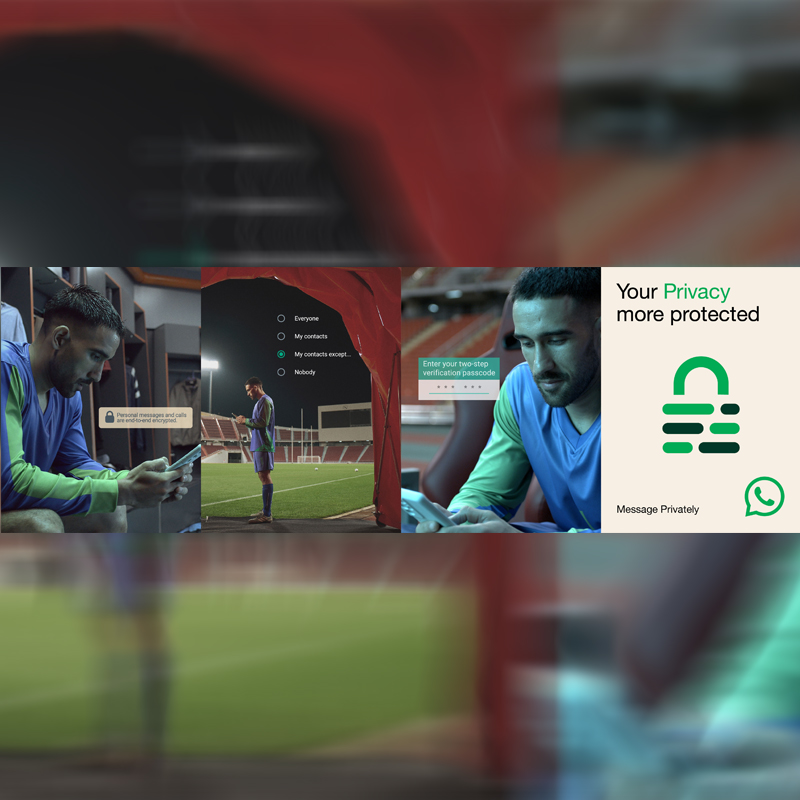
    Mumbai: WhatsApp has launched the India edition of its global brand campaign to create awareness about its interlocking layers of protection that offer people more privacy and control over their conversations while messaging.

    The campaign focuses on educating users on WhatsApp’s built-in layers of privacy protection that have been added over the years, including three new privacy features: leaving groups silently; controlling who can see when you’re online; and screenshot blocking for ‘view once’ messages.

    The new features were announced earlier this month as part of a global campaign, adding to a host of existing privacy features and demonstrating how WhatsApp’s multiple layers of privacy controls come together to provide users more protection when having a truly private conversation when messaging.

    Conceptualised by BBDO India and directed by Prakash Varma, the campaign film brings alive a heartwarming exchange between a father and son in an intensely personal moment, showing how WhatsApp’s built-in layers of protection allow them the privacy and security to have a meaningful conversation when it matters the most. 

    Embed Link: https://youtu.be/EcEZCWyfFCc

    The film depicts WhatsApp’s promise and strength of “privacy” through features like end-to-end encryption, two-step verification, and hidden online presence, enabling the duo to express themselves freely despite being surrounded by crowds in a restaurant or football stadium.

    Talking about the campaign, Meta India director-marketing Avinash Pant said, “At WhatsApp, privacy is in our DNA and over the years, we have consistently added layers of protection through product-features that empower people with more control over their messages. This is our way of extending awareness and assurance to our users on how the new and existing built-in layers of protection help you message freely without compromising on your privacy.” 

    He added, “We want users to know that they always have a safe and private space on WhatsApp, no matter where they are! We feel it’s a great privilege that two billion people around the world trust WhatsApp to deliver their personal messages every day, and this campaign is an affirmation of WhatsApp’s continued commitment to protecting their private conversations.”

    Commenting on the campaign and its creative treatment, BBDO India chair and chief creative officer Josy Paul said, “WhatsApp’s mission is to connect the world privately, and this campaign captures the essence of people feeling empowered to have private conversations even during vulnerable moments because their messages remain protected and secure.” 

    Speaking on the film, he said, “The film demonstrates WhatsApp being that ‘safe space’ for people like the father and son who have a very private and emotional conversation amidst hordes of people. You don’t know the exact exchange between the characters, you can’t see their messages because they’re private, but the simple shots of crowds disappearing, doors locking, CCTVs turning away, demonstrate how WhatsApp’s privacy features continue to provide the much-needed intimacy and protection throughout their most private moments.”

    Over the coming weeks, WhatsApp aims to educate users on each privacy feature through short films, which will highlight their benefits and the steps to activate them, so that users can take advantage of WhatsApp’s built-in layers of protection. 

  • WhatsApp onboards Manesh Mahatme as head of payments in India

    Mumbai: Facebook-owned WhatsApp messenger announced the appointment of Manesh Mahatme as the head of payments in India. Mahatme will focus on enhancing the payments experience for users, scaling the service offering, and work towards contributing to WhatsApp’s vision of digital and financial inclusion in India, it said in a statement.

    Mahatme previously served as a senior executive at Amazon India where he led the product and engineering teams for US online retailer’s payments business, Amazon Pay. His earlier professional stints also include Citigroup and Bharti Airtel.

    “We are excited to have Manesh join our WhatsApp India team,” WhatsApp India head Abhijit Bose said. “Manesh has been one of the key innovators driving the growth of digital payments in India over the last decade, and his experience will help us maximise the impact and scale of payments on WhatsApp.”

    WhatsApp, which has more than 500 million Indian users, in November last year received a much-delayed approval from the National Payments Corporation of India (NPCI) for the launch of its payments system in the country. However, its rollout so far has been capped by regulators at 20 million users. 

    The Facebook subsidiary is set to compete with fintech companies like Paytm, Google Pay, PhonePe, and Amazon Pay.

  • GUEST COLUMN: How Telegram is fuelling streaming piracy

    New Delhi: The popular messaging app, Telegram, is fast becoming the leading source of pirated content throughout Asia – and the cause of substantial revenue loss for content providers and operators.

    Users of the platform, which provides end-to-end encryption, can conceal their identity to share texts, videos, or other files relating to copyrighted content. Given that Telegram is popular with millions of active users, intuitive, and offers its users privacy, it is no surprise that streaming pirates exploit Telegram.

    The latest Telegram statistics reveal that in January 2021 it had over 500 million monthly active users – 38 per cent from Asia – and it was also the most downloaded app across both the App Store and Google Play globally with more than 63 million downloads. According to App Annie, it is the most popular social networking app in Malaysia and ranks third in India.

    Telegram appeals to pirates because it allows them to disseminate information easily and speedily to huge, encrypted private chat groups – as large as 200,000 people – and its channels can attract millions of subscribers. Video and movie channels are amongst the most popular with pirate sites like Hindi HD Movies attracting well over two million followers.

    From newly released movies and popular live sporting events to lesser-known, critically acclaimed documentaries with subtitles, pirates have circulated, exchanged, and sold illegal copies and video clips on Telegram. The scale of this for-profit piracy is siphoning off billions of dollars that rightfully belong to content and streaming providers and rights holders. Analyst firm Nera Consulting places the global TV industry’s revenue losses from digital piracy at between $39.3 to $95.4 billion per year while a recent global study conducted by Ampere Analysis for Synamedia found that sports streaming piracy alone is worth over $28 billion.

    Synamedia has been fighting TV and video piracy for decades, providing services and technology to protect $70 billion in operator revenue every year. By adopting an intelligence-first security model, marrying the very best human intelligence with

    cutting-edge cybersecurity and AI technologies, we have disrupted pirate services and brought many criminals to the attention of law enforcement officials.

    Gaming the system

    Tackling Telegram streaming pirates is a 24×7 battle, requiring continuous monitoring and intelligence gathering not just within Telegram but across all social media platforms to profile rogue players and detect connections and cross-platform relationships. Armed with these insights, Synamedia employs AI-based content recognition crawlers to infiltrate Telegram channels, tracking and identifying specific pirate streams by combining the metadata of a target video – and/or live feeds via platform APIs – with advanced deep machine learning models.

    Here, we can share some of our observations about how streaming pirates exploit Telegram:

    Prized Piracy Booty:

    Hotly anticipated Bollywood blockbusters, newly-released content, and live events – particularly sports fixtures stolen from legitimate streaming sites – are the main attractions. One live sports event can spawn several hundreds of pirated channels with links to watch the illegal streams. But older VOD content is still valuable, as we witnessed during lockdowns when live events were on hold.

    Masters of Disguise:

    With no embedded player inside the platform, pirates use Telegram channels and groups to distribute text and M3U links to consumers and to upload videos for free to Telegram’s hosted cloud services. To maximise appeal, pirates even include subtitles in different languages and use legitimate payment systems like PayPal and Bitcoin. Pirates hide keywords relating to the event they are stealing or use code words to weave a web of intrigue by embedding references to new private pirate channels inside their messages.

    Masters of Strategy:

    Pirates act fast, in real-time. Minutes ahead of a live sporting fixture, for example, they will proliferate new channels on Telegram with new links to illegitimate content. They have backup channels ready to switch up at a moment’s notice – sometimes pre-warning consumers which channel to use should the first pirated live stream be removed. They even have their own virtual crow’s nest or ‘lookouts’ for monitoring during an event. We saw a case where a streaming pirate changed the name of the video midstream due to a tip-off from others in the chat group.

    Jumping Ship:

    Pirates will flaunt that a Telegram channel has been disrupted due to copyright and distribute guidance on how to follow a new one. They also encourage consumers to jump ship to other platforms and pirate sites, providing links to the open web or links to other platforms with players.

    Stealing the stream:

    Not satisfied with stealing streams of live or on-demand content, pirates also offer OTT subscribers’ stolen credentials, pirated APKs, and hacked IPTV emulator channels which give consumers a link to live channels without the need for a set-top box.

    Anti-piracy game-changer

    Fighting streaming piracy requires solutions that demotivate pirates at every point along the video distribution chain. That’s why Synamedia’s anti-piracy monitoring solutions extend far beyond social media platforms to the outer reaches of the openw web– as well as closed subscription-based IPTV networks.

    Building an anti-piracy strategy requires a painstaking, forensic, intelligence-led approach to map out the increasingly intricate and sophisticated pirate ecosystem in multiple layers to cross-reference data, spot piracy behavioural patterns, unravel approaches, and understand trends. And to win against the pirates, the media and entertainment industry needs to collaborate not just with tech providers but also with governments, regulators, and law enforcement bodies. It requires governments across the globe to mandate the use of technologies such as watermarking and introduce tougher legal penalties.

    Streaming piracy is an existential threat. In light of the eye-watering amounts of money spent on producing content and purchasing sports rights, providers have a right to be confident that they are covering their costs and bringing in enough revenue to build sustainable business models because revenue leakage due to piracy is simply not viable in the long term.

    As well as deterring and disrupting piracy, using a model that offers incentives encouraging viewers of pirate streams to move back to legitimate services is often overlooked but equally important. With an appealing mix of access and payment models, content providers, and operators can turn the tables on the pirates and play the system to their advantage, encouraging consumers to pay for legitimate services instead.

    (Avigail Gutman is the vice-president of Intelligence & Security Operations at Synamedia. The views expressed in the column are personal and Indiantelevision.com may not subscribe to them.)

  • Snaps brings branded ads to messaging apps; gets $6.5 million funding

    Snaps brings branded ads to messaging apps; gets $6.5 million funding

    MUMBAI: Snaps, a new platform for connecting advertisers with consumers across messaging applications and devices, has made available ‘Branded Messages,’ a solution for creating and distributing native advertising, in the form of custom branded emoji keyboards and sticker campaigns to consumers.


    The company also closed a $6.5 million in a Series A investment round from a number of investors in the technology, media and entertainment industries. The investment will be used to build and launch a full suite of products and services to help brands better market themselves in messaging.


    Snaps is the first end-to-end mobile messaging platform for marketers to organically insert their brand into the 50 billion messages consumers send daily. During the first three months of operation, over 20 brands, including Burger King, Logo for its RuPaul’s Drag Race series, Trolli, Time Inc.’s Food & Wine, Comedy Central, The Houston Rockets, Nickelodeon, Victoria’s Secret, Sony Pictures Entertainment, VH1, to name several, are working with Snaps to develop emoji keyboard and sticker campaigns using the Snaps platform, which already reaches 400 million active monthly users.


    Also announced, jointly with Trolli, of Ferrara Candy Company, is the launch of a custom branded keyboard for its new Sour Brite Crawler Minis and Extreme Sour Bites. Trolli, in partnership with agency of record, Periscope, works to build a passionate millennial following by rolling out new and innovative products as part of their integrated marketing campaigns. The company’s latest campaign includes a TrolliMoji app in partnership with Snaps aiming to drive engagement among its core customers with fun, creative and sharable gummi-related emojis via a free, downloadable keyboard that can be used across messaging applications and connected devices.


    Food & Wine editor in chief Dana Cowin said, “Food & Wine is looking forward to working with Snaps on a series of entertaining food emojis. Since our avid fans actively communicate with standard emojis all the time – some going as far as writing entire restaurant reviews in emojis – we wanted to create a whole new world of possibilities for the super foodie connecting the images with the objects of their obsession. A picture of a slice of cake is made infinitely better if it’s identifiable as a birthday cake from a world-famous bakeshop, or if the dish is recognizable as one from their favorite celebrity chef. For celebrations, our users will be able to share a gif of sabering Champagne. We will be able to constantly update the keyboard with new chefs and restaurant dishes and make sharing even more fun!”


    “Our thesis has always been that the language of the future is a visually based language. People love to send and receive visual content, be it a branded emoji, sticker or gif, to their friends as a means of personal, authentic and immediate communication,” said Snaps founder Vivian Rosenthal.


    Through partnerships with Kik, Kanvas and other messaging apps, Snaps provides a complete turnkey solution for brands, from content creation and distribution to real-time content management and publishing tools, and deep engagement analytics.


    “The global messaging market is massive and growing – every brand should have a strategy for reaching consumers in this channel. From millennial and teen consumers through to enterprise employees, people are shifting from Facebook and email to smaller group interactions and real-time communication on messaging applications. Snaps’ is a socket that provides access to these audiences in creative, visual ways – with content people actually want to engage with and share,” said Snaps CEO Christian Brucculeri.


    “There is a huge opportunity for Snaps to build for messaging apps what Buddy Media built for social. As consumers shift into smaller groups in messaging, there is an opening for brands to create new experiences that will make them a part of these conversations. Snaps is the first platform built to do this,” said Ragovin Ventures founder and managing partner and Snaps investor and advisor Jeff Ragovin.


    Snaps investors include, Media Link chairman and CEO Michael Kassan, Ragovin, VEVO CRO Jonathon Carson, mParticle co-founder and CEO Mike Katz and Sourcepoint founder and CEO Ben Barokas.


    Over the next six to twelve months, Snaps will continue building and launching products to help brands better market themselves in messaging. The company will also look to expand its team in New York City and across the US.