Tag: Merger

  • Voltas Q2: Net profit sinks 26 per cent to Rs 80 crore

    Voltas Q2: Net profit sinks 26 per cent to Rs 80 crore

    MUMBAI: Consumer electronics firm Voltas has posted net profit of Rs 80 crore for the quarter ended 30 September 2020. This is a decline of 26 per cent from the same quarter last fiscal when the company reported net profit of Rs 107.3 crore.

    The consolidated total income for the period was higher by 10 per cent at Rs 1,651 crores as compared to Rs 1,495 crores in the corresponding quarter last year. Earnings per share (face value per share of Re 1) (not annualized) as on 30 September 2020 was Rs 2.37 as compared to Rs 3.22 last year. 

    The results take into account the effect of merger of a 100 per cent subsidiary-universal comfort products limited with effect from 1 April 2019, which has been approved by the National Company Law Tribunal on 11 September 2020.

    Consolidated segment results for the quarter ended 30 September 2020:

    Unitary cooling products for comfort and commercial use: The business achieved overall volume growth of 14 per cent contributed by growth of 11 per cent in room air conditioners, 20 per cent in commercial refrigeration products and 28 per cent in air coolers. Voltas continued to be the market leader and has sustained its no 1 position in the room air conditioner business and further improved its market share to 26.8 per cent in August 2020. Segment revenue increased by nine per cent and was Rs 572 crores as compared to Rs 526 crores in the corresponding quarter last year. Segment result was higher by 37 per cent at Rs 63 crores as compared to Rs 46 crores in the corresponding quarter last year.

    Electro-mechanical projects and services: Segment revenue for the quarter was higher at 15 per cent at Rs 928 crores as compared to Rs 809 crores in the corresponding quarter last year. Segment result was Rs 23 crores as compared to Rs 56 crores last year primarily due to conservative time based provisions, amidst liquidity constraints on some of the old legacy projects. Carry forward order book of the segment was higher at Rs 6,852 crores as compared to Rs 6,567 crores in the corresponding quarter last year.

    Engineering products and services: Segment revenue and result for the quarter were at Rs 93 crores and Rs 29 crores as compared to Rs 80 crores and Rs 25 crores, respectively in the corresponding quarter last year.

    Consolidated results for the six month period ended 30 September:  Impacted by the Covid2019 lockdown, the consolidated total income for the six months period ended 30 September 2020 was at Rs 3,015 crores as compared to Rs 4,192 crores in the corresponding period last year. Profit before tax was at Rs 223 crores as compared to Rs 408 crores last year. Profit after tax was Rs 161 crores as against Rs 274 crores in the corresponding period last year. Earnings per share (face value per share of Re 1) (not annualized) as on 30 September 2020 was Rs 4.82 as compared to Rs 8.21 last year.
  • Disney formally closes deal with Fox, massive layoffs expected

    Disney formally closes deal with Fox, massive layoffs expected

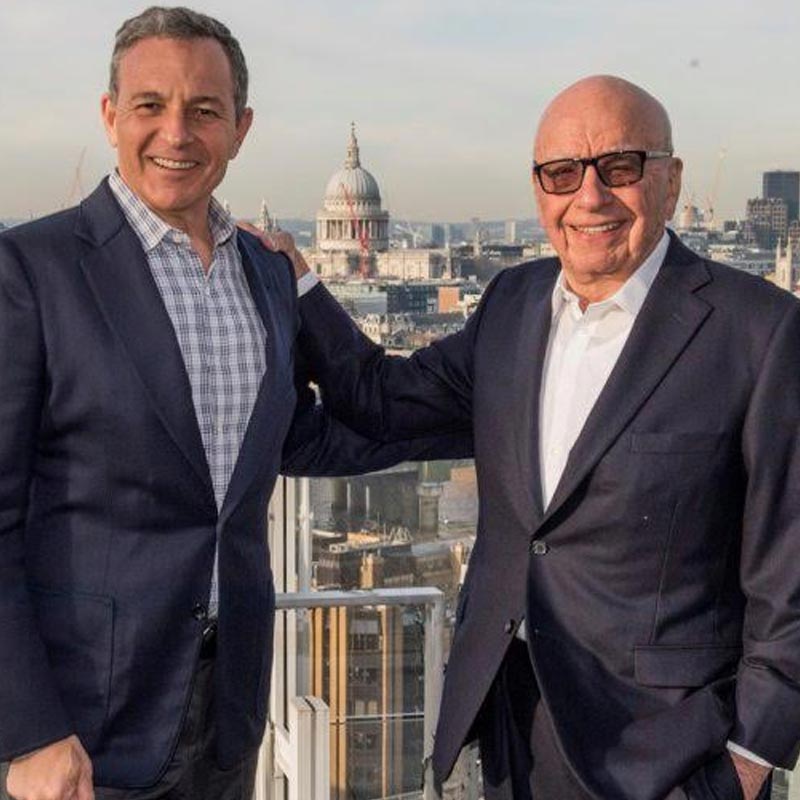
    MUMBAI: Walt Disney Co (Disney) has finally closed the deal with on its $71 billion acquisition of 21st Century Fox (Fox). In recent months, the acquisition received final approval from antitrust regulators across the globe. This merger will lead to thousands being fired, industry experts as well as several media reports speculate.

    With the deal, Disney is taking over majority of Fox’s assets including 20th Century Fox studio, the FX and National Geographic cable networks, and an additional 30 percent of Hulu. The giant media conglomerate thinks the deal will help it increase its international footprint along with expanding its direct-to-consumer offerings.

    “This is an extraordinary and historic moment for us — one that will create significant long-term value for our company and our shareholders,” Disney CEO Bob Iger said in a press release. “Combining Disney’s and 21st Century Fox’s wealth of creative content and proven talent creates the preeminent global entertainment company, well positioned to lead in an incredibly dynamic and transformative era,” he added.

    Bob Iger promised $2 billion in cost savings which clearly indicates to epic job cuts. While Disney is taking on 15,400 Fox employees, the smaller new Fox Corp will keep about 7,000. The layoffs are expected to come down heavily on domestic market first. “You can anticipate more domestic at the front end, just because of regulatory issues outside of the US,” Disney chief financial officer Christine McCarthy said earlier as quoted by Bloomberg.  The number of cuts could reach up to 4000, maybe even higher than that. Most of the jobs that are expected to be hit by the acquisition are duplicate ones.

    To take on this bet, Disney has to sell 22 regional sports networks in the US and its sports networks in Brazil and Mexico as part of regulatory approvals. The company also agreed to sell its stakes in such networks as Lifetime and History in Europe.

    Although the Fox deal will help Disney in its direct to consumer business, the cost of launching Disney+ is expected to impact the company’s financials next year.  A study from the research firm Ampere Analysis suggested that Comcast, after the acquisition of European pay TV giant Sky, and Walt Disney, after its Fox deal, will dominate global content spending.

  • Hathway back in black in Q3 2019

    Hathway back in black in Q3 2019

    BENGALURU: Broadband internet services provider Hathway Cable & Datacom Limited reported a standalone profit after tax and standalone net comprehensive income of Rs 6.44 crore and Rs 6.27 crore respectively for the quarter ended 31 December 2018 (Q3-2019, quarter or period under review). The company had reported a loss of Rs 5.90 crore in the previous quarter (Q2-2019) due to higher other expenses and foreign exchange loss. In Q3-2019, Hathway has reported a foreign exchange gain of Rs 3.07 crore as compared to a forex gain of Rs 4.32 crore in Q3 2018 and a forex loss of Rs 7.21 crore in Q2 2019.

    Hathway’s standalone operational revenue for the period under review declined 2.7 per cent y-o-y to Rs 134.85 crore from Rs 138.65 crore, but was 3.3 per cent higher q-o-q than the Rs 130.55 crore in Q2-2019. Standalone total income in Q3-2019 was slightly lower y-o-y (lower by 0.8 per cent) at Rs 143.41 crore as compared to Rs 144.57 crore in Q3 2018. Though the company’s standalone operating profit EBITDA) for Q3 2019 declined 14.6 per cent y-o-y  to Rs 51.30 crore (38 per cent of operating revenue) from Rs 60.06 crore (43.3 per cent of operating revenue), it increased 10.1 per cent q-o-q from Rs 46.58 crore (35.7 per cent of operating revenue).

    Let us look at the other numbers reported by Hathway

    Standalone total expenditure in Q3 2019 was Rs 139.67 crore or 101.6 per cent of operational revenue as compared to Rs 120.70 crore or 87.1 per cent of operational revenue in Q3 2018 and Rs 144.08 crore or 110.4 per cent of total income in Q2 2019. Standalone operating expenses in Q3 2019 was 0.6 per cent higher y-o-y at Rs 33.27 crore as compared to Rs 33.06 crore and was 7 per cent higher q-o-q than Rs 31.10 crore. 

    Standalone employee benefits expense for the quarter was 19.6 per cent higher y-o-y at Rs 13.55 crore as compared to Rs 11.33 crore and was 20.0 per cent higher q-0-q than Rs 11.29 crore. Standalone finance costs in Q3 2019 at Rs 20.57 crore were 17.3 per cent higher y-o-y than Rs 17.54 crore but were 36.2 per cent lower q-o-q than Rs 32.22 crore. Other expenses at in Q3 2019 at Rs 36.73 crore were 7.4 per cent higher y-o-y than Rs 34.20 crore, but were 11.7 per cent lower q-o-q than the Rs 41.48 crores.

    Takeover by Jio

    Two days ago, Hathway had informed the Stock Exchange – “Further to our intimations dated 17 October 2018 and 14 November 2018 with respect to boards' and shareholders' approval for raising of funds up to Rs 2940,00,03,500 (Rupees two thousand nine hundred and forty crores three thousand and five hundred only) through preferential allotment to Jio Content Distribution Holdings Pvt Ltd, Jio Internet Distribution Holdings Pvt Ltd and Jio Cable and Broadband Holdings Pvt Ltd (the "Proposed Investors"), please be informed that the proposed investors have received the approval from the Competition Commission of India on January 21 2019.”

    Hathway had also submitted a copy of the Letter of Offer dated 21 January 2019 to the Stock exchanges.

  • Dish TV-Videocon d2h to bank on economies of scale

    Dish TV-Videocon d2h to bank on economies of scale

    MUMBAI: The  long-awaited fusion of Dish TV and Videocon d2h  finally saw the light of day  on 22 March 2018. The pioneer in the direct-to-home (DTH) sector, Dish TV, and the fast-growing Mumbai-hqed and Dhoot family promoted service came together making Dish TV Videocon  d2h the largest pay TV operator in India and among  the top three in the world.

    The merged TV distirbution platform  will benefit from economies of scale while leveraging the individual strengths of the two services. One of the biggest attractions for the Jawahar Goel and Essel group promoted Dish TV as the acquirer was Videocon’s significantly higher average revenue per user (ARPU) as compared to Dish TV. While the former had an ARPU  of Rs 210, the latter’s ARPU stood at Rs 155-160. The combined ARPU is expected to be Rs 180. Owing to competition from Free Dish and other operational roadblocks, Dish TV had a lower ARPU but things are on the upswing, according to Dish TV CFO Rajeev Dalmia.

    Going forward, the acquirer, Dish TV, plans to keep the two brands independent in order to explore the regional opportunities as stated by Dish TV group CEO Anil Dua in an interaction with Indiantelevision.com.

    For any merger of this magnitude, integration is a big challenge and Dish TV is no exception. To ease matters, the company is concentrating on cultural integration in a bid to get the ship in order. The management undertook a cultural survey with 2000 participants so as to ease the pain of integration. Though still it has only been more than a month since the merger, the two operators’ office premises, logistics and warehouses have already been combined. Dua reiterated that the combined entity would draw synergies to the tune of Rs 510 crore through revenue aggregation and cost savings.

    In case of geographical capability, both brands bring different strengths to the table. The consolidated entity is expected to become a pan-India behemoth with its combined 29 million subscribers with Dish TV contributing with 16 million subscribers and Videocon d2h pitching in with  13 million users as on 31 March 2018.

    “Dish TV’s has always had benchmark content cost in the industry while Videocon’s content cost has been on the higher side,” said Dua acknowledging the disparity. Dish TV’s cost of content is 30-31 per cent of subscription revenue currently while the number for Videocon is higher at 36 per cent. He pointed out that the combined cost of content will be lower and hover around 30 per cent. “We want to maintain the cost of content as a percentage of total revenue—including advertising, carriage fees, value-added services along with other income—for the combined entity at 28 per cent,” added Dalmia.

    One of the key blocks of the merger is restructuring and assigning promising personnel to important positions. The management, which conspicuously does not feature anyone from Videocon, has appointed two marketing heads—one for each brand. Dish TV has put in place a common business head for North India and East India for the brands while also having a common business head for South India and West India.

    “We have one national service head for a common model of service across the country. Moreover, Ranjit Singh will continue to be the legal head for both brands,” Dua pointed out.

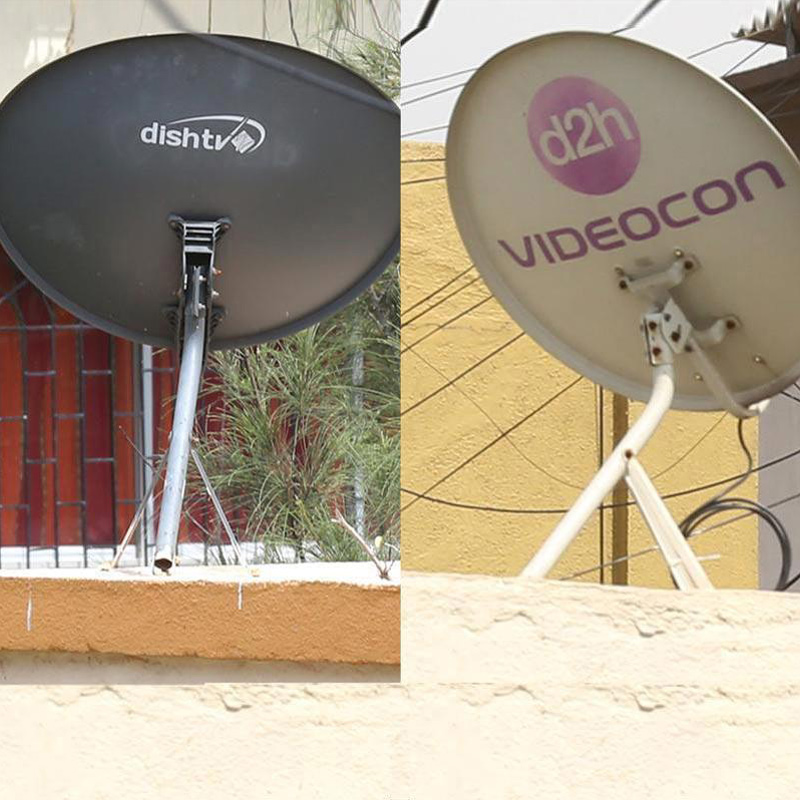
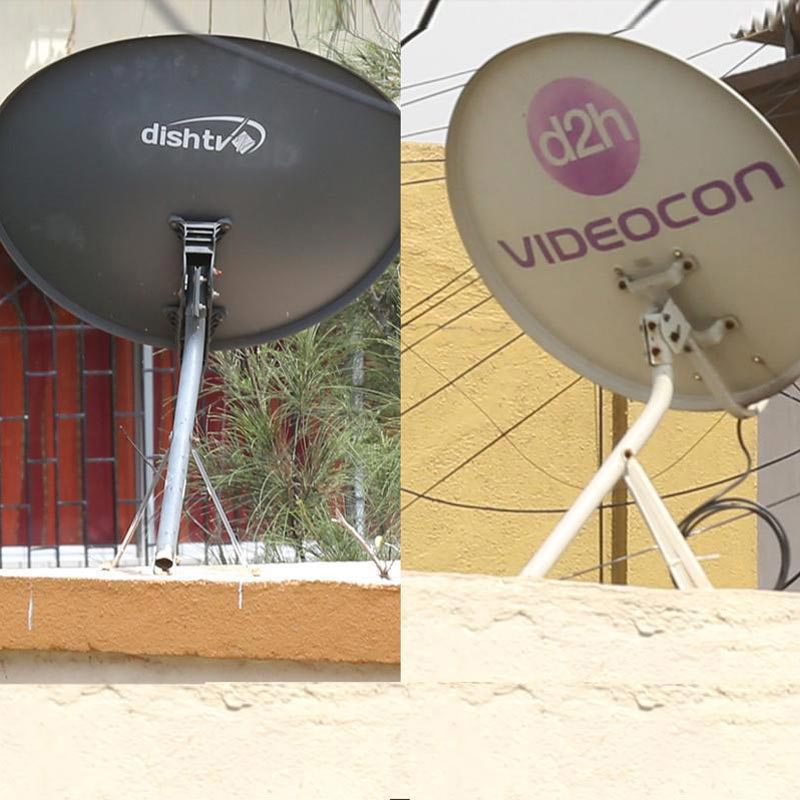
    Post merger, Dish TV wants to exploit the regional strengths without limiting the strength of the individual brands. The DTH operator has retained two independent brands as they have two marketing heads and two separate sales teams for each brand.

    Also Read:

    Videocon d2h, Dish TV merger comes to fruition

    Dish TV announces fresh Videocon d2h Nasdaq delisting date

  • India’s taxi war may be headed for a truce

    India’s taxi war may be headed for a truce

    MUMBAI: Gone are the days when we had to book a cab by calling a local can agency, and that’s because cab aggregators in India have completely changed the way we book a cab.

    Back in the day, while Mumbai had its distinguished kaali-peelis, Delhi had its metro whereas Bengaluru didn’t have a great public transport system. Cabs were never a mode of transport in India until a few years ago.

    India’s first official cab service began in Mumbai in 2007 with Meru cabs, who were extremely high priced but came in handy during airport and long-distance travels. It was in 2011, when cab service provider TaxiForSure eased the booking process by starting an online portal, aggregating multiple cab agencies. They grew in popularity by including an Android-based GPS system, which helped customers track their ride.

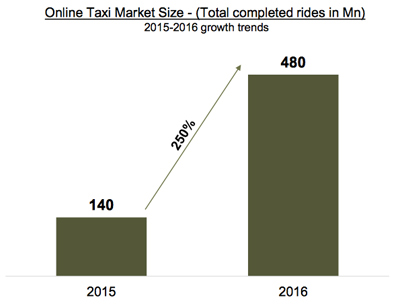
    ONLINE-TAXI-MARKET-INDIA_1.jpg

    Meanwhile, Ola, which started in 2010, was following a different model by associating directly with cab drivers, thereby eliminating the need for cab agencies. The company gained popularity only in 2013 as in the initial years, people couldn’t relate with the idea of talking to the driver directly on booking a cab and questioned the model’s authenticity. It was around the same time that global taxi market leader Uber entered the Indian market but failed to connect with the audience as it only allowed credit cards as a mode of payment.

    Over the years, a lot has changed in the Indian cab aggregator sector, where some had to shut shop or were bought over due to bankruptcy and increasing losses. In March 2015, OlaCabs acquired TaxiForSure for approximately US $200 million and Geotagg, a trip-planning applications company, for an undisclosed sum. The company also acquired Foodpanda’s business in India in 2017. 

    The segment has gained a lot of attention due to huge funding, highly competitive pricing (Ola-Uber on-going price war), security issues of women passengers and tussle with the government for license and permits.

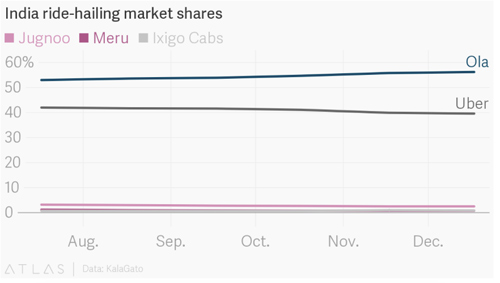
    Today, Ola clocks an average of more than 150,000 bookings per day and commands 60 per cent of the market share in India, while Uber’s shares have slipped from 42 per cent in July 2017 to 40 per cent in December 2017.  According to Japanese multinational conglomerate, SoftBank, the organised taxi sector in India may be worth $7 billion by 2020.

    In 2016, Uber made a deal with its Chinese rival Didi Chuxing to exit the Chinese market, after the duo fought hard for the country’s huge customer base Uber also exited Russia and Eastern European markets last year after reaching a similar deal with Yandex, giving Uber 36.6 percent of the entity formed by the two companies. 

    SoftBank has made major investment in Ola and Uber who has also invested in Grab, which is Uber’s rival in South East Asian countries. Ever since Uber inked the deal with SoftBank, there have been speculations that Uber would pull out of those markets and it turned into a reality earlier this year where Uber sold its business in SEA to Grab.

    Now, news is doing the rounds in market that a possible merger between Ola and Uber may be on its way in India. Since the Ola-TaxiForSure acquisition, the Indian market has essentially been a two-horse race and now, were the Uber-Ola deal to work out, we'd witness a monopoly situation like never before as Uber and Ola, together hold nearly 95 per cent of the market today. 

    public://INDIAN-CAB-MARKET-OVERALL.jpg

    If the merger does happen, we may see increase in advertising and marketing for the new merged entity as Ola and Uber are India’s two major cab aggregators with pockets filled. Ola has a robust advertising budget for television and print whereas Uber has an upper hand at digital and social media marketing. The combined entity would indicate 360-degree advertising including print, out of home, television and digital. 

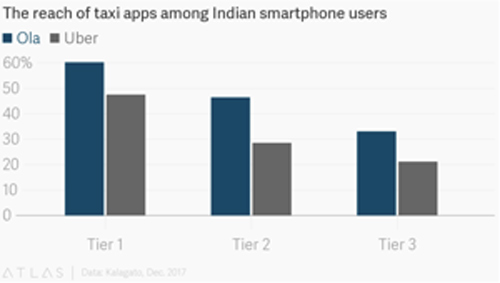
    While Uber has always had an elite and urban vibe to it, Ola has a stronger presence across smaller towns and segments. The Indian firm operates in 110 cities, far more than Uber’s 31. The merged entity would ensure a better penetration in rural as well as urban markets as the customer base for both the apps would be aligned together. 

    public://TIER-2,-TIER-3-MARKET-SHARE.jpg

    This would also mean the prices would be kept in check as currently, Ola is assumed to be comparatively cheaper and affordable than Uber. But this could also go the other way, as a monopoly could lead to price tampering and exorbitant charges.

    But the merger will also open the field for newer players to enter in the segment which will only help in competitive prices and all of them striving to serve better in order to acquire and retain customers. 

    All said and done, when and how the merger will unfold is a story for another day but if there’s one thing, it will definitely be an interesting tale to tell.

    Also Read :

    2018 will be a year of video campaigns: WATConsult's Rajiv Dhingra

    Going from clicks to bricks

    Kohli brand driving on the up

    Competing with consumer activities not brands: Kingfisher's Sheikhawat

    Cinema advertising begins to take centre stage

  • Videocon d2h, Dish TV merger comes to fruition

    Videocon d2h, Dish TV merger comes to fruition

    MUMBAI: The long drawn out merger of direct-to-home operators Dish TV India Ltd (Dish TV) and Videocon d2h Ltd (Videocon d2h) has finally come to pass.

    A release issued by Dish TV that taking further steps for effecting the scheme of arrangement for the amalgamation of Videocon d2h with Dish TV, the companies, earlier during the day, filed the copy of the order dated 27 July 2017 passed by the National Company Law Tribunal (NCLT) along with the approved scheme in Form INC-28 with the Registrar of Companies, Mumbai.

    “Accordingly, post completing all the steps pursuant to the scheme, Videocon d2h has merged into and with Dish TV on 22 March 2018, the effective date of the scheme,” the release added.

    The combined entity, to be named Dish TV Videocon, will have approximately 29 million subscribers, making it the second largest DTH company in the world. There was a halt in the merger scheme about two months ago when Dish TV wanted Videocon d2h to clarify some of the insolvency proceedings against it.

    Dish TV CMD Jawahar Goel said, “We are extremely pleased to announce that the D-Day is finally here. Today, Videocon d2h and Dish TV have become one entity. This amalgamation positions the new entity for exceptional future growth and profitability and puts on us the responsibility to lead the DTH industry in India to the next level.”

    “It has been a long journey and I would once again like to put on record, through these pages, our appreciation for the Ministry of Information and Broadcasting, the National Company Law Tribunal, the Competition Commission of India, the Securities and Exchange Board of India, the NSE, the BSE, NASDAQ and all other stakeholders for showing their trust in us. I would also like to express our gratitude to the shareholders of both companies for standing by us through the transaction and believing in the company,” he added.

    A meeting of the board of directors of the company is scheduled to be held on Monday, 26 March 2018, to inter alia consider and initiate necessary incidental actions in relation to the scheme of arrangement for amalgamation of Videocon d2h into and with Dish TV.

    The merger paves way for the creation of the largest listed media company in India taking into consideration the last reported full-year revenue and EBITDA numbers of the two DTH players on a pro-forma basis. Dish TV and Videocon D2h reported separate revenue and EBITDA numbers that, at a pro-forma level, added up to Rs 60,862 million and Rs 19,909 million for financial year 2016-17.

    The two companies had entered into definitive agreements in November 2016 for amalgamation of Videocon D2h into and with Dish TV through a scheme of arrangement amongst Dish TV, Videocon d2h and their respective shareholders and creditors.

    The proposed transaction had been notified to the Competition Commission of India (CCI) for its approval and CCI had given its approval for the proposed transaction vide its letter dated May 4, 2017.

    On May 12, 2017, in a meeting convened by the NCLT, the shareholders of the company had also approved the scheme for amalgamation of Videocon D2h into and with Dish TV.

    Subsequently, the Mumbai bench of the NCLT, at a hearing held on 27 July 2017, had approved the scheme under the provisions of Sections 230-232 and other applicable provisions of the Companies Act, 2013. The appointed date for the scheme was therein fixed as 1 October 2017.

    Dish TV Videocon is expected to provide better synergies and growth opportunities through enhanced after-sales, distribution and technology capabilities. Aon, Deloitte and PwC have been roped in to help it with project management for seamless integration of core functions, processes and technology infrastructure.

    It has been a long journey for Dish and Videocon d2h since they announced the intent to merge in November 2016. Last year, it received the nod from both the Ministry of Information and Broadcasting and the National Company Tribunal Law to go ahead to create the giant DTH player.

  • Videocon d2h delists from NASDAQ, merger with Dish TV likely on 22 March

    Videocon d2h delists from NASDAQ, merger with Dish TV likely on 22 March

    MUMBAI: Videocon d2h, which is looking at a merger with Indian direct-to-home (DTH) company Dish TV, has announced that it will be delisting from the US bourse NASDAQ.

    The amalgamation scheme between Dish TV and Videocon d2h is likely to take place on 22 March 2018 after due regulatory approvals from the Maharashtra registrar of companies and the high court. Videocon d2h shareholders will get Dish TV shares through global depositary receipts. Dish TV shares will not be registered in the US.

    Videocon d2h had made its intention to delist in mid-December 2017 but later postponed it because of a change in its plan to amalgamate with Dish TV. 4 April 2018 will be Videocon d2h’s last date of listing and it will be delisted from 5 April. After this, Dish TV will have to file the remaining requirements of US regulator Securities and Exchange Commission (SEC) to terminate Videocon d2h’s reporting obligations. The deregistration will be effective 90 days after Form 15F is filed.

    “Pursuant to the Scheme and following the effectiveness of the amalgamation, all outstanding equity shares of Videocon d2h, including equity shares underlying the ADSs, will be mandatorily exchanged for new equity shares of Dish TV. Dish TV is expected to be subsequently renamed Dish TV Videocon Limited. Videocon d2h ADS holders will receive new global depositary receipts (GDRs), each GDR representing one equity share of Dish TV, exchanged at a rate of approximately 8.07331699 new GDRs for every one Videocon d2h ADS (rounded off up to eight decimal places), unless such holders elect to receive equity shares of Dish TV in lieu of GDRs by cancelling their Videocon d2h ADSs,” a release to the NASDAQ stated.

    The combined company is to be named as Dish TV Videocon and will hold approximately 29 million subscribers, making it the second-largest DTH company in the world. There was a halt in the merger scheme when Dish TV wanted Videocon d2h to clarify some of the insolvency proceedings against it.

    Also Read :

    Dish TV-Videocon d2h merger date postponed

    Dish TV re-evaluating Videocon d2h merger

  • Merger talks on the anvil once again for CBS, Viacom

    Merger talks on the anvil once again for CBS, Viacom

    MUMBAI: Coming on the heels of the Fox-Disney merger, CBS Corporation and Viacom Inc are inching toward formally exploring a corporate reunion of the two halves of the Redstone media empire.

    According to a Variety.com report, there is less opposition within CBS this time around compared to the last attempt by CBS/Viacom vice chairman Shari Redstone to bring the two companies back together in the fall of 2016. The early rumblings are that CBS would acquire Viacom in an all-stock transaction.

    There are still big hurdles to clear in terms of valuation for Viacom, given the systemic concerns around its lower-profile U.S. cable networks, but there is also an understanding that the media landscape is changing fast and the potential for the two sides to work together on international growth initiatives provides rationale for a reunion. Viacom’s share price has also tumbled further during the past year, making a deal more attractive on a financial basis for CBS shareholders. As of Thursday, Viacom had a market cap of $13.8 billion, with shares closing at $33.61. CBS is valued at $22.7 billion, with shares closing at $59.27.

    Sources close to the situation emphasise that neither side has yet engaged bankers or advisers to hammer out an agreement. But CBS Corp. CEO Leslie Moonves and Viacom CEO Bob Bakish have had at least one discussion about the possibility of merging, according to a Reuters report Thursday.

    CBS and Viacom were first brought together in 2000 by Sumner Redstone, now chairman emeritus of both firms. The two were split up again in January 2006 out of Sumner Redstone’s frustration with a sagging stock price.

    Also Read :

    Disney to buy 21st Century Fox assets for $52.4 billion

    With Star India, Disney emerges as India’s largest M&E firm

    Sudhanshu Vats on Viacom18’s growth strategy and why data analytics is key

  • Dish TV re-evaluating Videocon d2h merger

    Dish TV re-evaluating Videocon d2h merger

    MUMBAI: The Dish TV-Videocon d2h merger had reached the final stage with the Ministry of Information and Broadcasting (MIB) giving it the green signal. Then, suddenly on 22 December, Dish TV announced that the union would be delayed beyond 27 December 2017 citing technical reasons. Now those reasons–it basically is revaluating the deal–are likely to hold up the fusing of the two DTH operators even further.

    Dish TV yesterday informed the BSE that it had told its advisors–which include financial advisor Morgan Stanley, E&Y, SR Batliboi & Co and Luthra & Luthra Law Offices-to re-examine the deal terms within 60 days.

    It said that it was taking this step as “it has come to our knowledge that certain entities belonging to the Videocon group, including the promoters of Videocon D2h Ltd, have become subject to insolvency and/or enforcement proceedings by lenders. The company is evaluating as to whether there is any impact of the same on its rights and obligations under the definitive agreements, and consequential effects on the transactions contemplated.”

    The companies had announced a merger in November 2016 tom-tomming the benefits that would accrue to the two if they went ahead. And both companies went about the process getting the various regulatory approvals required. In early March 2017, the merger got the NOC from the BSE and the NSE, Competition Commission of India clearance on 4 May 2017, shareholder approval through a meeting convened by the National Company Law Tribunal (NCLT) on 12 May 2017, and the NCLT green flag on 27 July 2017, and the MIB go ahead on 15 December 2017.

    As per the terms of the merger Dish TV Videocon d2h was to issue 857.79 million fresh shares. Shareholders of Videocon d2h were to get 2.02 shares of Dish TV Videocon for every share of Videocon d2h. D Dish TV shareholders would own 55.4 per cent shares of the merged entity while Videocon d2h would own the remaining 44.6 per cent.

    Dish TV is pressing the pause and review button at a time when at least two transactions in the direct-to-home segment have been completed.  Late last year, private equity firm Warburg Pincus picked up a 20 per cent piece of Airtel DTH for a handsome price of $350 million valuing the entire operation at $1.7 billion. Then Delhi-based Pantel Technologies and Veecon Media bought out all the losses, debt, and liabilities of Reliance Big DTH from the Anil Ambani group, bringing to a close a long struggle by the latter to exit the DTH business.

    Also Read :

    Dish TV-Videocon d2h merger date postponed

    DTH’s year of consolidation

    DTH subscriber growth down in second quarter


  • Dish TV-Videocon d2h merger date postponed

    Dish TV-Videocon d2h merger date postponed

    MUMBAI: The official date for the amalgamation of Videocon d2h into Dish TV has been moved ahead from the earlier decided 27 December 2017.

    In a release to the Bombay Stock Exchange, Dish TV said that the company would be unable to file the relevant intimation forms with the authorities, such as the Registrar of Companies and the Ministry of Corporate Affairs, by 27 December. The new date will be notified soon, the release added.

    A week ago, Dish TV and Videocon d2h were given the final nod by the Ministry of Information and Broadcasting to merge and create the world’s second-largest DTH company with 29 million customers. It was in November 2016 that the companies first announced their decision.

    The combined entity is expected to provide better after sales, distribution, and technology services.

    For the quarter ended 30 September 2017, Videocon d2h posted profit after tax (PAT) of Rs 168 million and an addition of 0.21 million subscribers. Dish TV’s PAT for the quarter was Rs 689 million and its subscriber base increased by 0.188 million.

    Also read:

    MIB clears path for Dish TV Videocon

    Dish TV reports improved operating profits for second quarter

    Recalibrating India’s DTH sector after Airtel DTH-Warburg Pincus deal