Tag: Merger

  • CCI approves Jio Cinema OTT and Viacom 18 Media merger

    CCI approves Jio Cinema OTT and Viacom 18 Media merger

    Mumbai: The Competition Commission of India (CCI) approved the proposed merger of Jio Cinema OTT and Viacom18 Media on Monday.

    Following an investment by BTS Investment and Reliance Projects & Property Management Services, the CCI announced in a tweet on Monday that it had approved the merger of the Jio Cinema OTT platform with Viacom18 Media.


    In April, Reliance Industries (RIL) and Viacom18 announced a strategic partnership with Bodhi Tree Systems. According to an agreement signed, Bodhi Tree was obliged to invest Rs 13,500 crore in Viacom18, and Reliance Projects & Property Management Services, a wholly-owned subsidiary of RIL, was informed to invest Rs 1,645 crore in the broadcaster, forming one of India’s largest TV and digital streaming firms. As a result, Reliance’s popular Jio Cinema OTT app was transferred to Viacom18.

    Bodhi Tree Systems (BTS) is a joint venture between James Murdoch’s Lupa Systems and the former chairman of Star India and Disney India Uday Shankar.

    IT support services are provided by Reliance Projects & Property Management Services. Through its portfolio of channels and streaming service Voot, Viacom18 Media engages in the business of offering media and entertainment services.

    Deals that exceed a specific threshold require regulator permission, which keeps an eye on unethical commercial practices in the market.

  • Sony-Zee to create $10 bn TV company; likely to hurt competition in the market: CCI

    Sony-Zee to create $10 bn TV company; likely to hurt competition in the market: CCI

    Mumbai: According to an official notice seen by Reuters, the country’s antitrust watchdog the Competition Commission of India (CCI) found in an initial review that a merger between the Indian unit of Japan’s Sony and Zee Entertainment to create a $10 billion TV company will potentially hurt competition because it will have “unparalleled bargaining power.”

    CCI notice to the two companies sent on 3 August stated the watchdog is of the view that a further investigation is merited. It gave the two companies 30 days from 3 August to respond.

    Sony and Zee in December decided to merge their television channels, film assets, and streaming platforms to create a powerhouse in a key media and entertainment growth market of 1.4 billion people, challenging rivals like Walt Disney Co.

    According to the three lawyers familiar with the process mentioned, the CCI’s conclusions will delay regulatory approval of the acquisition and might require the companies to propose changes to its structure.

    They also added that if that doesn’t satisfy the CCI, it can result in a drawn-out approval and inquiry procedure.

    Zee in a statement said it continues to take all the required legal steps to complete all the necessary approval processes for the proposed merger.

    According to the CCI’s 21-page notice, the proposed deal would place the combined entity in a “strong position” with around 92 channels in India, citing Sony’s global revenue of $86 billion and assets of $211 billion.

    “Such apparently humongous market position would enable the combined entity to enjoy an unparalleled bargaining power,” the CCI said in its notice, adding the combined entity could increase the price of channel packages.

    The initial review shows the deal is likely to cause an “appreciable adverse effect on competition,” the watchdog said. “Thus, it is considered appropriate to conduct further inquiry into the matter.”

    In a media interview held in December last year, Zee’s managing director Punit Goenka stated that the combined entity’s relative value is “potentially close to $10 billion” and that all necessary approvals are expected by October of this year.

    Classic Merger Case

    According to industry executives, the deal will allow the two companies to compete with Disney’s Star India network, which has dozens of popular entertainment and sports channels, by attracting more advertising revenue from streaming services and TV broadcasts.

    The combined company would have a share of almost 45 per cent of the Hindi language market, which attracts the greatest viewership in the nation, according to the preliminary CCI competition assessment, with Star coming in a “distant second.”

    This would further concentrate such segments at the cost of the competition, the CCI said in its notice.

    Sony and Zee had already responded in June and July to two so-called “defect” letters issued by the watchdog inquiring about the deal.

    After reviewing submissions about advertising revenue, the CCI concluded that the combined company would probably raise the price of some advertisements in order to take advantage of its dominant market position.

    “The combined strength of the parties is likely to be used to entrench their presence and earn higher profits,” the CCI said.

    “This merger is a classic case of the first or second largest player, integrating with the third largest competitors, to become the strong market leader.”

  • Nykaa gets board approval to buy digital lifestyle platform Little Black Book

    Nykaa gets board approval to buy digital lifestyle platform Little Black Book

    Mumbai: Nykaa has confirmed its board’s approval for the acquisition of Iluminar Media’s Little Black Book (LBB), a millennial-focused lifestyle discovery platform. This is in line with Nykaa’s fundamental, content-first strategy for connecting with its devoted customer base.

    LBB is a popular content hub thanks to its sizable, discerning user base, content creation ability, curation mindset, and connections to up-and-coming brands. Nykaa believes that LBB’s emphasis on the fashion, home, and beauty categories will complement Nykaa’s strong points.  

    Nykaa spokesperson Nihir Parikh said, “At Nykaa, we are committed to offering the best to our consumers and making their shopping experience delightful. We are excited about the strong synergies we share with LBB, much like Nykaa, they have sharply focused on driving discovery and spotlighting promising homegrown brands across their channels since day one.”

    “We welcome their like-minded leadership into the Nykaa family and look forward to helping them scale, as together we better serve our audience base,” added Parikh.  

    According to Nykaa, its market leadership in beauty and lifestyle is a result of its core strengths, which include a content-first approach, curated offerings, and a discovery-led shopping experience. LBB’s strengths in these areas will complement Nykaa and Nykaa Fashion’s vision of constantly enriching their customers’ shopping experiences.  

    LBB co-founder and CEO Suchita Salwan said, “Through this partnership with Nykaa, we’re excited to scale to even greater heights. Together, we want to drive value to Nykaa and LBB’s shared goals to build discovery for India’s emerging brands through content, community, and a discovery-first approach.”  

    She further added, “LBB’s robust content creation capabilities and creator network will be leveraged within Nykaa’s platforms to drive consumer engagement and retention, further scaling reach and engagement for our brand partners.”

    Suchita Salwan and Dhruv Mathur co-founded LBB (Little Black Book) in 2015, and it has grown from a Tumblr blog to a popular online marketplace.  LBB has established a brand and an audience among India’s urban millennials, reaching over 70 million users through various channels. Their emphasis on audience engagement through content and discovery has made them a brand beloved by both users and brand partners.

  • Twitter to address Elon Musk’s demands by providing crucial tweet data

    Twitter to address Elon Musk’s demands by providing crucial tweet data

    MUMBAI: In a bid to end the standoff between the company and Elon Musk, Twitter will grant Tesla’s CEO unprecedented access to its “firehose” of public tweet data, The Washington Post reported. With this, the tech giant seeks to assuage Musk’s concerns over fake or automated accounts by yielding access to the firehose API, which contains ‘every tweet as it is posted.’

    Twitter’s firehose API, in its entirety, shows what a user would see if they followed every account on Twitter — although the sheer volume of data is impossible to obtain or analyse without automation. Due to its value for ad-targeting and platform surveillance, it is also one of the company’s most closely held resources.

    Firehose data could be immensely valuable as raw material for a study on automated activity. However, conducting a full study of automated activity would require significant time and resources, given the sheer scale of the data.

    Providing valuable data could help Twitter score political points over Musk, as the micro networking platform seeks to fend off Musk’s qualms over the number of bots or automated accounts on the platform, and ensure that he honours his part of the buyout deal.

    The news comes just days after the maverick billionaire once again threatened to back out of his deal to purchase Twitter, accusing it of failing to provide data on fake accounts.

    In his filing with the US Securities Exchange on Monday, Musk accused Twitter of breaching its April agreement by not providing him sufficient data on automated accounts, rejecting the company’s offer to provide more detail on its internal studies of the issue.

    Musk legally committed to purchasing Twitter in April this year, but since then has been increasingly vocal about growing bot activity on the platform, in what is seen by many as an attempt to renegotiate the deal on more favourable terms or cancel it altogether.

    ALSO READ |The Twitter-Elon Musk tussle: To be ‘bot’ or not to be

    “Twitter’s latest offer to simply provide additional details regarding the company’s testing methodologies is tantamount to refusing Musk’s data requests,” Musk’s representatives said in the filing. “At this point, Musk believes Twitter is transparently refusing to comply with its obligations under the merger agreement.”

    Despite all this, Twitter Inc. remains confident the deal will proceed as planned. In an internal meeting, a senior company executive assured employees that the deal was proceeding normally and set for a shareholder vote in late July or early August.

    Meanwhile, the networking giant’s stock continues to trade well below the $54.20 price set by Musk, reflecting market skepticism that the deal will go through as agreed.

    In response to Musk’s SEC filing, Twitter issued a statement earlier this week. “Twitter has and will continue to cooperatively share information with Musk to consummate the transaction by the terms of the merger agreement,” the statement reads. “We intend to close the transaction and enforce the merger agreement at the agreed price and terms.”

  • GroupM merges Essence and Mediacom, integrates Mindshare with Neo

    GroupM merges Essence and Mediacom, integrates Mindshare with Neo

    Mumbai: WPP’s media investment group GroupM announced on Wednesday its plans to merge Essence with MediaCom and Mindshare with Neo in its latest steps to transform and further simplify its operations. The moves, which build on the April 2021 launch of Choreograph, WPP’s global data and technology company, will create a new 9,000-strong cross-channel performance platform built on AI technology, it said.

    Additionally, Finecast, Xaxis, and GroupM Services – GroupM’s global community of activation experts – will be brought together to form media performance organisation, GroupM Nexus. Xaxis Global CEO Nicolas Bidon will oversee GroupM Nexus as Global CEO.

    Essence and MediaCom will merge to form EssenceMediacom, a new agency offering fusing the digital and data-driven DNA of Essence with MediaCom’s scaled multichannel audience planning and strategic media expertise.

    MediaCom Global CEO Nick Lawson will lead newly formed EssenceMediacom as Global CEO. Kyoko Matsushita, after eight years at Essence, is promoted to a new role as WPP’s CEO in Japan as the company continues to invest in expanding, high-growth markets.

    Mindshare will complete the integration with global performance agency Neo, wherein both will operate under the Mindshare brand but will retain and scale Neo’s operating model, focused on pureplay performance solutions at its heart, integrating this into Mindshare’s full-funnel offering.

    Neo’s 1,200 digital-first, performance experts and consultants will be integrated with Mindshare’s 10,000 media specialists and Neo’s digital-first services will be fully embedded into Mindshare and GroupM’s offering, stated the agency.

    With this reorganisation, GroupM’s five agency brands will be streamlined into Mindshare, Wavemaker, EssenceMediacom, GroupM Nexus and Choreograph.

    “The future of marketing is outcomes-driven, supported by audience-first planning and continually improving, AI-enabled performance standards,” stated GroupM Global CEO Christian Juhl. “Through GroupM Nexus and our agency powerhouses Mindshare, Wavemaker, and EssenceMediacom we are building a tech-enabled future, side-by-side with our clients, that is accountable to advertisers’ growth goals and to our vision for an advertising ecosystem that works for everyone. I also want to congratulate Kyoko, who has grown and strengthened Essence in her time as Global CEO, on her exciting new role as WPP’s CEO in Japan. We will continue to work closely together to strengthen the position of our agencies across APAC.”

    The merger of Essence and MediaCom builds on a record of strong business growth for both agencies, according to the agency. Comvergence ranked MediaCom first in the industry for new business wins in 2021 with $2.87 billion in new billings attributed to wins, while Essence has continued to grow and expand its remit with Google and other key clients.

    “The formation of EssenceMediacom builds on the strong and proven relationship between the agencies to create the agency model our clients want for the future — one founded on brilliant strategy and brand-building capabilities, with pioneering digital expertise running throughout,” said EssenceMediacom CEO Nick Lawson. “EssenceMediacom will not only help our clients see the bigger picture and reimagine what’s possible; it will also provide opportunities for our people to upskill and train in new areas, further enriching and enhancing their careers.”

    “Today’s global marketers need both agility and scale from their agency partners to properly support their businesses across international markets. Bringing together Essence and MediaCom – each with their own celebrated histories of excellence – will create a truly unique combination of agile innovation and global scale in a single agency,” added Kyoko Matsushita.

    GroupM Nexus will comprise 9,000 practitioners around the world, collectively responsible for the activation of more than two million campaigns managed by GroupM each year. This global community represents the industry’s leading team of experts in digital channels and platforms, search, social, programmatic, AI, cross-channel optimization, and data-driven technologies and software.

    GroupM Nexus unites GroupM’s addressable content and TV, AI technology (Copilot), and omnichannel solutions from Finecast, Xaxis, and GroupM Services into a single unit. The global organisation will be underpinned by a new cross-channel performance platform and international delivery hubs to set new benchmarks for performance innovation and efficiency for GroupM’s agencies and clients.

    “GroupM Nexus unites leading media talent, digital services excellence, cutting-edge AI technology and unique scaled partnerships into a new cross-channel performance organisation with one purpose: power growth for our people, our agencies and the amazing brands they represent. We cannot wait to innovate together and unlock new opportunities for everyone,” said GroupM Nexus CEO Nicolas Bidon.

    “This is a journey we’ve been on for the past year with many clients who have been demanding more diverse media services to drive their growth,” commented Mindshare Global CEO Adam Gerhart. “The merger delivers seamless access to Neo’s digital-first capabilities and a relentless focus on performance models to accelerate Good Growth. For our teams it means more opportunity and the ability to create greater impact across the world. I’m delighted to partner with Neo CEO Nasreen Madhany as we complete the integration of the two businesses and move into a new future together.”

  • PVR-Inox deal: Consolidation to boost in-cinema advertising; steer advertiser segmentation for industry

    PVR-Inox deal: Consolidation to boost in-cinema advertising; steer advertiser segmentation for industry

    Mumbai: The all-stock merger between two of the country’s largest multiplex chains PVR and Inox Leisure announced earlier this week has been reckoned as positive for the industry on all counts. Led by PVR’s Ajay Bijli as MD, the combined entity PVR-Inox will have an invincible size advantage with its 1546 screens across 341 in 109 Indian cities, against Carnival and Cinepolis’ nearly 400 screens.

    Meanwhile, Kanakia Group-owned Cineline India has announced to re-enter the business after a decade in Q1FY23 with a total of 75 screens, of which 27 were acquired in February.

    Valued at 30-45 per cent higher than standalone entities Inox (~Rs 64 billion) and PVR (~Rs 110 billion), PVR-Inox will have a screen share of over 50 per cent within India multiplexes and 18 per cent within overall screens. Its combined box office share for Hindi and English content, which has a 65 per cent share in the overall box office, will be around 42 per cent, as per Elara Securities.

    Gaining from Premiumisation

    Weakening dynamics for the unorganised and single-screen film exhibition players, even before the pandemic hit, presented a tremendous opportunity for the organised ones to increase their foothold in the segment.

    Consolidation in the film exhibition sector started around 2014-15 with the buyout of Satyam Cineplex by Inox for Rs 240 crore, and Carnival’s mop-up of HDIL’s Broadway Cinemas for Rs 110 crore. In December 2014, Reliance Capital sold its multiplex business of Reliance MediaWorks (RMW) operating under the brand name ‘Big Cinemas’ to Carnival Cinemas for Rs 700 crore. The following year Mexican multiplex chain Cinepolis acquired Essel Group’s Fun Cinemas and PVR bought out DLF’s DT Cinemas for Rs 500 crore.

    Cineline India, which was present in the trade as Cinemax since 1997, sold its multiplex business along with Cinemax brand to PVR for Rs 395 crore under a non-compete clause in 2012. In light of the deal’s expiration on 31 March, the company is set to re-enter the business in the first quarter of FY’23.
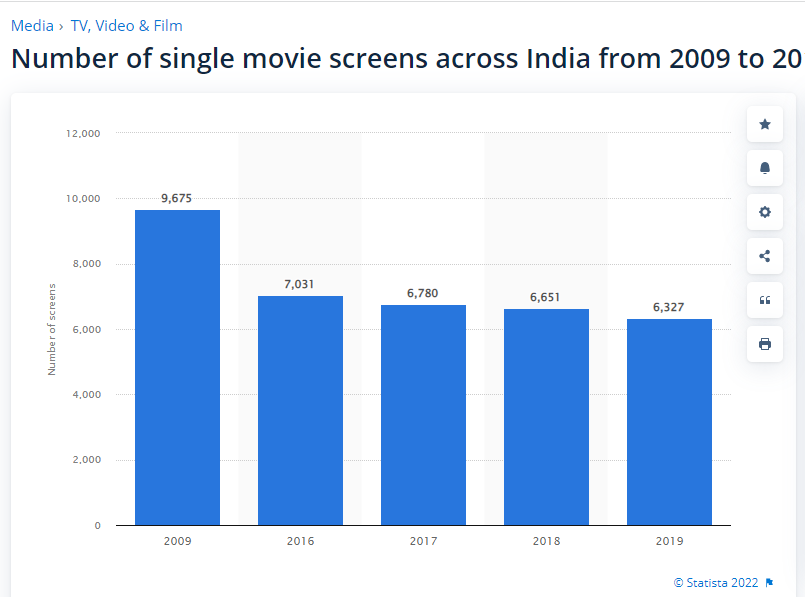
    From 9,600 screens in 2009, single cinema screens were reduced to just over 6,300 by 2019 in India. This decline is reflected in the country’s screen density which stood at 74 in 2019 (Statista). At an estimated overall screen count of 9,423 (FICCI-EY, March 2022), India is a largely underscreened country as compared to China which has around 70000 screens for comparable population size. Its ATP (Average Ticket Price) and SPH (Spends Per Head) are also among the lowest. Bridging the demand-supply gap in the Indian exhibition industry is expected to increase the box office collections by more than three times, as per Delloite’s 2018 report on screen density.

    Even as the economies of scale usher in revenue and cost benefits, rapid premiumisation in cinematic and customer experience led by technologies like 3D, 4DX, Imax, F&B, and other luxury offerings, as well as Covid-mandated hygiene standards, will drive ATP and SPH on one hand, and create more and better opportunities for advertisers on the other, thereby boosting advertising revenues for the new entity, and consequently for the industry at large.

    The merger will help in getting higher SPH (Rs 99 for PVR vs Rs 80 for Inox in FY20) on existing Inox screens. In FY ’20, Inox’s footfall of 6.6 crore gave additional F&B revenue of ~Rs 125 crore and net cost revenue of more than Rs 90 crore. The synergies may also result in substantial savings on manpower costs. On combined manpower costs of over Rs 600 crore, even a 20 per cent saving will result in savings of Rs 120 crore for the combined entity. Overall, the merger has the potential to add over Rs 300 crore to the bottom line of the combined entity, digital cinema distribution network and in-cinema advertising platform, UFO Moviez tells IndianTelevision.com.

    Boost to in-cinema advertising

    Last October as theatres began to reopen after 18 months of strict and partial lockdowns, in-cinema advertising which contributes 10-12 per cent to the overall revenue pie for cinemas, witnessed a slump of 25-30 per cent in rates. Studying the trend, Inox Leisure chief sales and revenue officer Anand Vishal had previously told IndianTelevision.com that “cinema is not going to be an easy sell” for quite some time hereafter.

    Cinema is not going to be an easy sell: Inox’s Anand Vishal

    This merger is expected to turn the tables in favour of the exhibitors sooner than previously estimated. According to UFO Moviez “the consolidation will be positive for overall in-cinema advertising in the country. In FY ’20, PVR was earning ad revenue of ~Rs 45 lacs per screen whereas Inox was at ~Rs 28.5 lakh, a difference of nearly Rs 17 lakh per screen. The combined entity should be able to get the same revenue as PVR for all screens. Thus, on around 650 screens of Inox, differential ad revenue of Rs 17 lakh per screen will translate into additional ad revenue of ~Rs 110 crore for the combined entity.”

    The segmentation of advertisers between big and smaller chains/single screens, which already existed by virtue of the players having differentiated TGs, will become more pronounced going forward.

    “PVR and Inox together have screens in around 110 cities whereas UFO has ad rights of over 3500 screens (smaller chains/single screens) spread across close to 1400 cities and towns. An advertiser/agency will now be required to deal with only two entities to advertise on a pan India network spread over 5000 screens. This will help in minimising admin work, which in turn will lead to faster closure of deals,” UFO Moviez observes.

    In spite of being among the hardest hit, the cinema exhibition industry is staging a phenomenal recovery with the success of films like “The Kashmir Files,” “RRR” and “Gangubai Kathiawadi.”

    dentsu Creative India CEO Amit Wadhwa points out that while “brands may have been circumspect regarding the above investments, in-cinema advertising will pick up henceforth, especially with the two big names coming together to form a much stronger brand. It has the possibility of creating better opportunities for brands to advertise and hence, in the bargain, the likelihood of charging a premium.”

    On the contrary

    Even though the “onslaught of OTT” has been ostensibly stated as the reason, the PVR-Inox merger was always on the cards. The surge in OTT consumption as a result of the pandemic may have only expedited it. As film producer Naveen Chandra opines, “We are in the initial stages of OTT growth in India so any responsive strategies based on the binging nature of consumers may be premature.”

    Commenting on its likely impact on distribution, he adds, “Any business that scales up to a near majority market share will have an advantage of charging a pricing premium for its products. The combined entity will hold nearly 60 per cent of the multiplex screens. That’s a great advantage whichever way you look at it. The programming muscle it provides is phenomenal as the entity negotiates its exhibition deals or exclusive release windows with platforms or theatrical shares with producers.”

    Irrespective of the assertions and speculations, OTT players have considered Cinemas an enabler rather than a competitor, even in the context of ‘windowing’ which became a ‘hot potato’ for the industry and media in the last couple of years.

    OTTs to benefit from the availability of price discovery platform as cinemas reopen

    Shemaroo Entertainment COO Kranti Gada asserts that “right from providing a barometer to assess a film’s worth, to unclogging the pandemic-paused film pipeline, and saving marketing costs for streaming platforms, the growth of cinemas will only be beneficial for OTT platforms.” Shemaroo Entertainment owns the video-on-demand service ShemarooMe.

    While OTTs are being projected as the eventual replacement of single screens, affordable cinema is here to stay, players and observers agree. The Southern anomaly where PVR and Inox hold six and three per cent share respectively stands testimony to it.  
  • Multiplex giants PVR, Inox announce merger to combat OTT onslaught

    Multiplex giants PVR, Inox announce merger to combat OTT onslaught

    Mumbai: Top multiplex chains PVR Ltd and Inox Leisure Ltd have announced a merger following a meeting of their board of directors on Sunday. The combined entity, called PVR Inox Ltd, will become the largest film exhibition company in India operating 1546 screens.

    “The merged entity would be able to strongly counter the advent of various OTT platforms and the after effects of the pandemic,” the two companies said in an exchange filing.

    The merger will be an all-stock amalgamation subject to approval of the shareholders of PVR and Inox respectively, stock exchanges, Sebi and such other regulatory as may be required.

    Post the merger, the promoters of Inox will become the co-promoters in the merged entity along with existing promoters of PVR. The board of directors of the merged company will be reconstituted with a total board strength of ten members and both the promoter families having equal representation on the board with two seats each. PVR promoters will have 10.62 per cent stake while Inox promoters will have 16.66 per cent stake in the combined entity.

    When the merger becomes effective, shareholders of Inox will receive shares of PVR in exchange of shares in Inox at the approved share swap ratio. Inox shareholders will receive three shares in PVR for ten shares of Inox.

    It was also decided that PVR chairman Ajay Bijli will lead the combined entity as managing director and Sanjeev Kumar will be the executive director.

    Inox Group chairman Pavan Kumar Jain will be named as non-executive chairman of the board, and Siddharth Jain will serve as non-executive non-independent director in the combined entity.

    “This is a momentous occasion that brings together two companies with significantly complementary strengths,” said PVR’s Ajay Bijli. “The partnership of these two brands will put consumers at the center of its vision and deliver an unparalleled movie going experience to them. The film exhibition sector has been one of the worst impacted sectors on account of the pandemic and creating scale to achieve efficiencies is critical for the long-term survival of the business and fight the onslaught of digital OTT platforms.”

    “Coming together of two iconic cinema brands, which are driven by passion, is certainly the most historic moment in the Indian cinema exhibition industry,” stated Inox Leisure director Siddharth Jain. “Both companies have set high service benchmarks in an endeavour to offer the best cinema experience in the world, to the most passionate moviegoers, and would continue to do so as a unified entity. As we head into the industry’s revival amidst headwinds, this decisive partnership would bring in enhanced productivity through scale, a deeper reach in newer markets and numerous cost optimisation opportunities, and continue to delight cinema fans with world-class experiences and landmark innovations.”

  • Discovery Plus, HBO Max to merge into one streaming service

    Discovery Plus, HBO Max to merge into one streaming service

    Mumbai: Discovery, which is expected to close its acquisition of WarnerMedia in the second quarter of 2022, confirmed its plans to combine its streaming service Discovery Plus and WarnerMedia’s HBO Max into one service rather than offer the two platforms as a bundle.

    Discovery chief financial officer Gunnar Weidenfels who addressed the Deutsche Bank 30th Annual Media, Internet and Telecom Conference said that Discovery is making preparations to combine the two streaming services. But before they are combined, the first step of integration will be some form of bundling as the company figures out the best way to merge the two platforms.

    On 11 March, Discovery Inc stockholders approved various matters relating to the acquisition of WarnerMedia from AT&T to create Warner Bros-Discovery Inc. The transaction will bring together WarnerMedia’s entertainment, sports and new assets with Discovery’s non-fiction, international entertainment, and sports business.

    Direct-to-consumer service Discovery Plus had 22 million subscribers, while HBO Max had 73.8 million subscribers at the end of 2021.

  • Discovery’s acquisition of AT&T’s WarnerMedia biz set to close in mid-2022

    Discovery’s acquisition of AT&T’s WarnerMedia biz set to close in mid-2022

    Mumbai: Discovery’s mega-deal to merge with AT&T’s WarnerMedia business is all set to close in mid-2022, subject to approval by Discovery stockholders and additional closing conditions.

    In the latest development, Discovery has won approval from the European Commission, the executive body of the European Union (EU) to take sole control of WarnerMedia from AT&T in the two companies’ megadeal announced last year. That move comes after Discovery chief David Zaslav said that Europe had granted unconditional anti-trust clearance to the deal.

    “The Commission concluded that the proposed acquisition would raise no competition concerns given that, following the transaction, the combined entity would continue to face sufficient competition from other players,” said the EC, the antitrust enforcer for the European Union. “In addition, the Commission found no competition concerns stemming from the vertical and conglomerate links between the activities of the companies, since the latter would not have the ability nor the incentive to engage in foreclosure practices.”

    Meanwhile, the deal’s “Reverse Morris Trust” structure has also received a favorable rating from the IRS, which means that it should come out tax-free for AT&T shareholders provided they retain the majority stake in the new company as planned.

    In May 2021, AT&T and Discovery had reached a definitive agreement to combine WarnerMedia’s premium entertainment, sports, and news assets with Discovery’s leading nonfiction and international entertainment and sports businesses to create a single company. David Zaslav, president and CEO of Discovery was announced as the future CEO of the proposed new entity, named WarnerBros.Discovery.

    AT&T houses brands like CNN, HBO, Cartoon Network, TBS, TNT, and the Warner Bros. studio. Discovery owns networks such as HGTV, Food Network, TLC, and Animal Planet. Warner Bros. Discovery will bring together leadership teams, content creators, and high-quality series and film libraries in the media business, while accelerating both companies’ plans for leading direct-to-consumer (DTC) streaming services for global consumers.

    The new company will unite complementary and diverse content strengths with broad appeal — WarnerMedia’s robust studios and portfolio of iconic scripted entertainment, animation, news, and sports with Discovery’s global leadership in unscripted and international entertainment and sports.
     

  • SPNI and Zeel sign definite agreements to merge

    SPNI and Zeel sign definite agreements to merge

    Mumbai: Sony Pictures Networks India Private Limited (SPNI) and Zee Entertainment Enterprises (Zeel) announced early on Wednesday that they have signed definitive agreements to merge Zeel with and into SPNI and combine their linear networks, digital assets, production operations, and program libraries.

    The agreements follow the conclusion of an exclusive negotiation period during which Zeel and SPNI conducted mutual due diligence. After closing, the new combined company will be publicly listed in India. The closing of the transaction is, however, subject to certain customary closing conditions, including regulatory, shareholder, and third-party approvals.

    Under the terms of the definitive agreements, SPNI will have cash balance of $1.5 billion closing, including through infusion by the current shareholders of SPNI and the promoters (founders) of Zeel, to enable the combined company to drive sharper content creation across platforms, strengthen its footprint in the rapidly evolving digital ecosystem, bid for media rights in the fast-growing sports landscape and pursue other growth opportunities.

    SPNI is an indirect subsidiary of Sony Pictures Entertainment Inc (SPE). Under the transactions contemplated by a non-compete agreement, SPE, through a subsidiary, will pay a non-compete fee to certain promoters (founders) of Zeel, which will be used by such promoters (founders) to infuse primary equity capital into SPNI, entitling the promoters (founders) of Zeel to acquire shares of SPNI, which would eventually equal approximately 2.11 per cent of the shares of the combined company on a post-closing basis. After the closing, SPE will indirectly hold a majority 50.86 per cent of the combined company, the promoters (founders) of Zeel will hold 3.99 per cent, and the other Zeel shareholders will hold a 45.15 per cent stake.

    Punit Goenka to lead the combined entity

    Punit Goenka will lead the combined company as its managing director & CEO. The majority of the board of directors of the combined company will be nominated by the Sony Group and will include the current SPNI managing director and CEO, N P Singh. On closing, Singh will assume a broader executive position at SPE as chairman, Sony Pictures India (a division of SPE) reporting to SPE’s chairman of Global Television Studios and SPE Corporate Development Ravi Ahuja.

    “It is a significant milestone for all of us, as two leading media & entertainment companies join hands to drive the next era of entertainment filled with immense opportunities. The combined company will create a comprehensive entertainment business, enabling us to serve our consumers with wider content choices across platforms,” said Zeel MD and CEO Punit Goenka. “This merger presents a significant opportunity to jointly take the businesses to the next level and drive substantial growth in the global arena.”

    Synergy in Scripted, factual, and sports programming

    The combination of Zeel and SPNI is expected to achieve business synergies and given their relative strengths in scripted, factual and sports programming, respective distribution footprints across India and iconic entertainment brands, the combined company try to meet the growing consumer demand for premium content across entertainment touchpoints and platforms.

    As part of the definitive agreements, the promoters (founders) of Zeel have agreed to limit the equity that they may own in the combined company to 20 per cent of its outstanding shares. “This construct does not provide the promoters (founders) of Zeel any pre-emptive or other rights to acquire equity of the combined company from the Sony Group, the combined company or any other party. Any shares purchased by the promoters (founders) of ZEEL, must be in compliance with all applicable laws including any pricing guidelines,” it said in a statement.

     “Today marks an important step in our efforts to bring together some of the strongest leadership teams, content creators, and film libraries in the media business to create extraordinary entertainment and value for Indian consumers,” said SPE’s chairman of Global Television Studios and SPE Corporate Development Ravi Ahuja. “I especially want to thank N P Singh, who presented us with the idea to explore this merger well over a year ago.”

    SPNI MD and CEO N P Singh said the merger will create a company that will redefine the contours of the media and entertainment industry. “As a representative of SPE on the Board of the new merged company, it will be my endeavour to provide strategic guidance and support to the company’s operating team in achieving our vision,” he added.