Tag: memorandum of understanding

  • Maruti Suzuki hits the gas on financing with SMFG India Credit tieup

    Maruti Suzuki hits the gas on financing with SMFG India Credit tieup

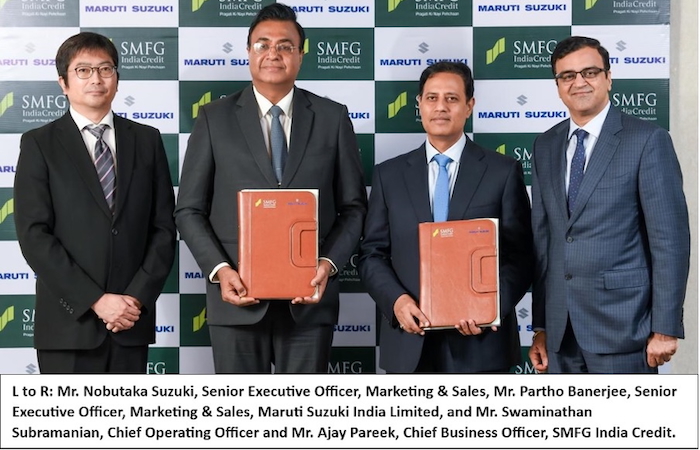
    MUMBAI: Maruti Suzuki India Ltd (MSIL) has inked a new deal that could supercharge its light commercial vehicle sales. The company has signed a memorandum of understanding (MoU) with SMFG India Credit (SMICC) to provide tailored auto retail finance options for buyers of its Super Carry and Eeco Cargo models.

    This new alliance is designed to give a leg-up to fleet owners and small businesses by offering flexible, tech-savvy financing solutions. With SMICC’s reach and Maruti’s dealer network firing on all cylinders, customers can now expect an end-to-end credit experience that’s fast, fuss-free and fully digital.

    Present at the signing were MSIL senior executive officers for marketing and sales, Partho Banerjee and Nobutaka Suzuki, along with vice-president Vishal Sharma. SMICC was represented by chief operating officer Swaminathan Subramanian, chief business officer Ajay Pareek, and Takamitsu Kajii, head of planning and alignment.

    “At Maruti Suzuki, customer delight remains to be our top priority. Our partnership with SMFG India Credit adds to our continuous efforts in aiding customers with easy, flexible, and personalised financing options for Super Carry and Eeco Cargo. The Super Carry has a special place in the hearts of fleet owners and drivers with its exceptional load carrying capacity & power, while the Eeco Cargo’s versatile combination of comfort and utility makes it a preferred choice. By leveraging SMFG India’s robust and wide network, customers can expect seamless, tech-driven, end-to-end financing experiences,” said Partho Banerjee. 

    Ajay Pareek added, “We are excited to offer top-class credit solutions to Maruti Suzuki customers as one of their retail vehicle financing partners. This collaboration aligns with our aim of becoming the preferred lending partner of choice for millions of Indians. Our tailor-made product offerings extend beyond auto retail financing and we are well poised to empower every Indian to achieve financial freedom, through easy and accessible loans. Keeping this as one of the cornerstones for progress, we are focused on partnering with top OEMs across key sectors. We are thrilled to ink this partnership with Maruti Suzuki and look forward to jointly serving their customers across the country.”

    With the commercial vehicle market picking up pace, this move could help Maruti Suzuki stay ahead of the curve and load up on volumes—one financed vehicle at a time.

  • Bisleri partners with ASI to restore water bodies at India’s heritage sites

    Bisleri partners with ASI to restore water bodies at India’s heritage sites

    MUMBAI : Bisleri International Pvt. Ltd. has embarked on a visionary collaboration with the Archaeological Survey of India (ASI) under the Adopt a Heritage 2.0 Programme, uniting heritage conservation with sustainable water stewardship. This landmark partnership, formalised through a Memorandum of Understanding (MoU), was signed by ASI director Zulfeqar Ali and Bisleri CEO Angelo George, with the agreement ceremoniously exchanged between ASI director general Yadubir Singh Rawat and George.

    As part of ‘Bisleri’s Nayi Umeed’ CSR initiative, the project will initially focus on revitalising four significant water bodies: Chand Baori in Abhaneri, the baori at Neemrana, Padma and Rani talabs at Ranthambore fort, and Budha Budhi pond at Kalinjar fort. Restoration efforts will include desilting, cleaning, ecological rejuvenation, and landscaping, ensuring minimal disruption to these historic sites. Informative signages will also be installed to enhance visitor experience and community engagement.

    George stated, “At Bisleri, we are committed to sustainability and cultural preservation. This collaboration with ASI reflects our dedication to protecting India’s rich heritage while ensuring the conservation of vital water resources for future generations.” 

  • FIVB and Bengaluru Torpedoes join hands to develop volleyball in the region

    FIVB and Bengaluru Torpedoes join hands to develop volleyball in the region

    Mumbai: The Bengaluru Torpedoes Volleyball Academy in India was officially recognised as a Volleyball Centre of Excellence in the country as the FIVB and Bengaluru Torpedoes signed a Memorandum of Understanding (MoU) last week.

    Situated within the esteemed Padukone Dravid Centre for Sports Excellence, the Bengaluru Torpedoes Volleyball Academy will serve as a hub for promoting volleyball, further amplifying its development and outreach endeavours.

    The MoU symbolises a shared dedication to cultivating talent, strengthening grassroots initiatives and enhancing the societal significance of volleyball regionally and globally. The partnership between the FIVB and Bengaluru Torpedoes will also facilitate a range of initiatives, including high-performance and grassroots activities, mass participation programmes, and knowledge exchange and collaborative projects geared towards enhancing athlete development. This will be achieved through quality sports science and medical services, alongside coaching and officiating.

    FIVB head of Technical and Development Steve Tutton expressed his excitement about the collaboration, stating: “We are thrilled to collaborate with Bengaluru Torpedoes Volleyball Academy in our mission to foster volleyball development. Together, we will leverage our expertise to implement innovative programmes and initiatives that will propel the sport to new heights.”

    Vishal Jaison, a spokesperson for Bengaluru Torpedoes, conveyed his enthusiasm for the partnership and commented: “This collaboration with the FIVB underscores our commitment to nurturing volleyball excellence from grassroots levels. By joining forces, we aim to expand opportunities for aspiring athletes and promote volleyball as an inclusive sport for all.”

  • Cabinet approves MoU cooperation between Prasar Bharati and Radio Television Malaysia

    Cabinet approves MoU cooperation between Prasar Bharati and Radio Television Malaysia

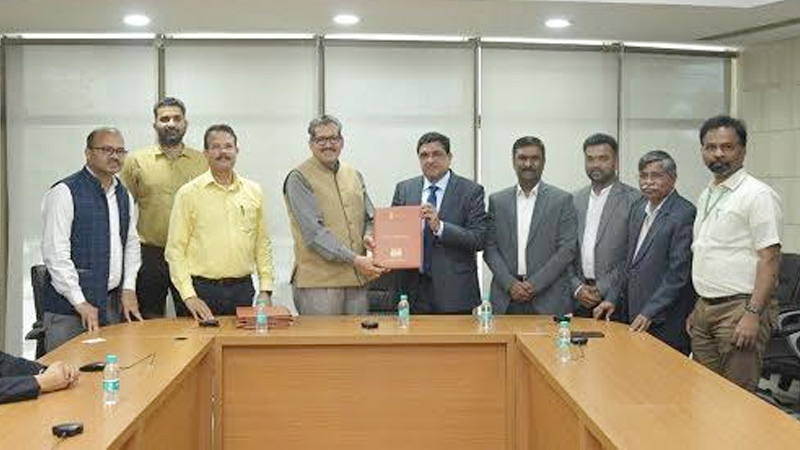
    Mumbai: The Union Cabinet chaired by the Prime Minister, Narendra Modi was apprised of the MoU/Agreement signed on 7 November, 2023 which has an immense potential to strengthen the cooperation in the field of broadcasting, exchange of news, and audio-visual programmes as well as significantly augment India’s friendly relations with the country. With this, the total number of MoUs signed by Prasar Bharati with different countries has increased to 46.

    Prasar Bharati plays a crucial role in nation building and lays continuous focus on providing meaningful and accurate content to one and all, both within the country and abroad. These MoUs are going to be crucial in distribution of content in other countries, in developing partnerships with international broadcasters and exploring new strategies to address the demands of new technologies.

    The major benefit arising out of signing of MoUs are exchange of programmes in the areas of Culture, Education, Science, Technology, Sports, News and other fields on gratis/non-gratis basis.

    India’s Public Service Broadcaster, Prasar Bharati has entered into a Memorandum of Understanding with Radio Televisyen Malaysia, the Public Service Broadcaster of Malaysia in order to promote cooperation in public broadcasting in the field of radio and television.

  • ABP Network & IIM Indore enter into MoU to combat fake news

    ABP Network & IIM Indore enter into MoU to combat fake news

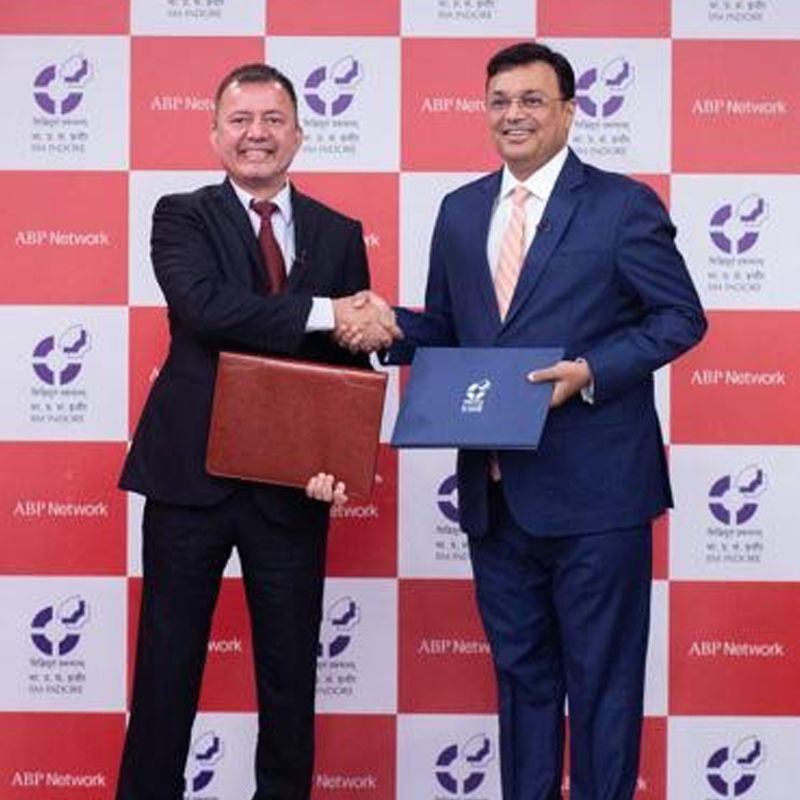
    Mumbai: ABP Network has entered into a memorandum of understanding (MoU) with the Indian Institute of Management (IIM) Indore to focus on analysing and recommending policy-level interventions combating fake news ecosystems.

    The agreement aims for both parties to collectively investigate the social-psychological underpinnings of fake news and design preventative mechanisms to address this issue.

    Both parties will work towards the development of an informed and open society through a mutual academic-practice collaboration framework.

    ABP Network and IIM Indore will cooperate and collaborate to carry out joint research for developing tools & processes needed for creating an informed society & open society. They will further develop awareness models on digital literacy for the citizens of India. There will also be a provision for short-term training/research opportunities for personnel of ABP Network and IIM Indore. Further, both the parties will also hold joint seminars of mutual interest.

    “With this collaboration, we look forward to a constructive professional relationship with IIM Indore in the years to come,” said ABP Network CEO Avinash Pandey. “ABP Network has always stayed true to its commitment to increasing the scope of an informed and open society. By entering into this agreement, we aim to develop preventive strategies to address the challenges of fake news, its genesis & impact, and develop awareness modules for the general public. We are confident that this partnership will play a pivotal role in the research and development of the dynamic media space and will allow an exchange of a plethora of ideas and strategies.”

    “We are delighted that IIM Indore and ABP Network are signing a MOU. Social consciousness is at the fore in the mission statement of IIM Indore,” said IIM Indore director professor Himanshu Rai. “Through this agreement, we can lay the foundation for building a conscious nation by combining the ground reach of the ABP Network and the intellectual excellence of IIM Indore. This will be done primarily by trying to solve the problem of fake news. According to us, the effect of fake news is not only on individual sensitivity but can also affect social unity and national security. Our journey starts here.”

  • Prasar Bharati and Qatar Media Corp join hands to exchange radio & TV programmes

    Prasar Bharati and Qatar Media Corp join hands to exchange radio & TV programmes

    NEW DELHI: Prasar Bharati and Qatar Media Corporation agreed to exchange of content that highlights the national characteristics, cultural and heritage, social events, festivals and competitions of both the countries.


    A memorandum of understanding (MoU) signed between the two also provides for exchange programmes for journalists, experts, technicians, specialists etc in the field of electronic media, radio and television.


    The MoU is aimed at enhancing the mutual bonds of friendship and to increase co-operation in the field of broadcasting between the two countries.


    The signing ceremony took place in Hyderabad House, New Delhi, in the presence of Prime Minister Narendra Modi, Qatar’s Emir Sheikh Tamim Bin Hamad Al-Thani, Indian and Qatari delegates.


    The Indian side was represented by Prasar Bharti CEO Jawhar Sircar and the Qatar side by its Ambassador to India Ahmed Ibrahim Abdulla Al Abdulla.


    There will be no commercial use of the content to be shared, according to the MoU. The aim is also to strengthen their co-operative relationship in the field of radio and television; and improve mutual understanding of political, economic, social and scientific aspects of the countries.


    Attempts will be made to explore opportunities for co-production between the two pubcasters.


    The aim will also be to encourage cooperation and coordination in efforts and attitudes in the regional and international forums, conferences, and meetings related to the radio and television field.


  • Throwing light on the TV Producers-Actors MoU

    Throwing light on the TV Producers-Actors MoU

    MUMBAI: A lot of dust has been raised in the media recently about the memorandum of understanding (MoU) inked between the Cine & TV Artistes Association (CINTAA), the Federation of Western India Cine Employees (FWICE), and the Indian Film and TV Producers’ Council (IIFTPC) on 1 May.


    While producers claim the MoU (indiantelevision.com is in possession of the original copy) aims at creating a more efficient and frictionless system with respect to parameters like employment and wages, shifts and work schedules and working conditions, actors are crying foul over perceived injustices meted out to them in it.


    Referring to the hue and cry over the “three-year contract” clause in the MoU, FWICE president and CINTAA Hon general secretary Dharmesh Tiwari cautioned that actors have misunderstood the clause. He pointed out that the MoU requires only five lead actors, as decided by the producer, to sign the three-year contract with him/her.


    “There has been a lot of confusion in the artistes’ minds regarding the clause. The real intention is: if a show runs for three years, the contract gets renewed every year but only for the main four to five lead actors. A producer has to let go of the other actors after a couple of months, so that they can work elsewhere,” explained Tiwari. “However, once a particular serial becomes a hit, the actor, especially the lead, wants more money to do it. So, we are just being cautious and want the person to sign beforehand so that even if the serial becomes a hit, he/she cannot leave or demand extra money. The clause further specifies that the actor can leave under ‘special circumstances’ and if it is genuine, the producer will let go of him/her anyhow. Mutual understanding is of importance here.”


    The clause implies that it is up to the producer to give a raise to whosoever is the face of the show.


    The three-year contract clause further states that all engagements of actors will be recorded in writing and it will be mandatory for producers to give a copy of the contract/agreement to such actors before commencement of the shoot or not later than 15 days after commencement of the shoot. In the event the artiste is not given a copy of the contract after expiry of the 15 days deadline, the terms and conditions will not be applicable to him/her till such time the signed agreement is handed over to him/her.


    Apparently, 10-15 actors and five to seven producers collectively formulated the MoU, after which, it was signed by hundreds of artistes and 40-50 producers before being sent for a final okay. A producer who was part of this core team on condition of anonymity went on to say, “Four or five actors are now saying in the newspapers that the three-year contract clause is not justified. I don’t think this is fair. It is an insult to CINTAA and the producers’ body.”


    Another producer on condition of anonymity defended the clause saying, “This is the first time in 20 years that some kind of documentation (read: MoU) has been done by CINTAA and the producers’ body together. Shouldn’t we be welcoming it rather than talking about pros and cons.”


    A third producer who also did not wish to be named said, “People are only talking about the three years, but they should know what the details are. Just don’t go by the headlines. People are reacting even without reading it. I can guarantee that most of the actors haven’t even read the clause. No one will benefit from this, but one will surely suffer losses if it isn’t implemented.”


    Sudhir Sharma of Sunshine Productions said, “I am not saying all producers are the same. This MoU puts a lot of  pressure on producers too. There are regulations on producers who do not pay on time or pay conveyance or stick to their contracts. So, it applies to producers as much as it does to actors. It is absolutely balanced and fair.”


    A fourth producer on condition of anonymity said the MoU would make actors think twice before acting pricey. “It is absolutely justified. An artist signs a contract with a show and after eight to 10 months once the show becomes popular, starts demanding extra money or threatens to leave it. Today, the economy is so tough that by the time a producer breaks even, it is already six months,” he said. “The artist starts behaving badly, coming late to the sets, disturbing the schedule, taking other assignments or generally making life hell for the producer. The three-year contract is for such artistes while disciplined artistes do not have anything to worry anyway.” 


    Apart from the three year clause, another clause of the MoU, which deals with actors who are engaged up to only five days per month and whose per day remuneration is only up to Rs 5,000, has been the subject of much debate. The clause states that such actors will be paid within five days of their last day of shooting. Morever, the production house will fix their per-day remuneration after negotiations with them, and Rs 300 will be paid in cash over and above the agreed per day remuneration after completion of the day’s shoot. In the event the actor is part of a mythological/historical/weekend show, the payment will be made within 21 days of his/her day of shooting.


    Lead actors get all the money and fame. Actors are paid purely on the basis of their popularity. It is learnt that a newcomer gets anywhere between five to 10 thousand rupees per day while an extremely popular actor may get paid up to 50-60 thousand rupees a day.


    “Think of the people who get less than Rs 5,000 per day. Out of the 5,000 to 10,000 actors today, there are only about a hundred who get paid above Rs 10,000-15,000 per day. The remaining get paid Rs 3,000-5,000. I am talking about a large chunk of actors here, not the stars,” said a fifth producer, who was also part of the core team that formulated the MoU. “A large number of actors would get paid after three months. Even if they had worked for only two days in the month for Rs 8,000, they would have to visit the office premises twice – once for billing and the second time, for payment. With this clause, 70 per cent of the community is going to get their payments within a week. It’s a beautiful system. Look at the bigger chunk.”


    A majority of producers feel that the MoU will help actors who are getting paid less so that they don’t have to wait for two to three weeks just for their payment to be released.  The MoU is a reflection of the fact that CINTAA is working for 95 per cent actors who work day and night and not just for the cr?me de la cr?me.

  • BBC, Microsoft in content alliance

    BBC, Microsoft in content alliance

    MUMBAI: UK pubcaster The BBC and software major Microsoft have signed a nonexclusive memorandum of understanding (MoU).

    This will define the framework within which the companies can explore opportunities for the delivery and consumption of BBC content and the evolution of next-generation broadcasting.

    BBC DG Mark Thompson and BBC director of new media and technology Ashley Highfield met Microsoft Chairman Bill Gates to officially sign the memorandum of understanding and discuss the BBC’s digital strategy. This includes plans for its online archive, for a radically re-invented Web site in the Web 2.0 world — a second generation of Internet-based services — and for ways to share its online content in the future.

    Thompson said, “We are currently witnessing unprecedented rates of change in technology and audience expectations. To ensure that the BBC is able to embrace the creative challenges of the digital future, we need to forge strategic partnerships with technology companies and distributors for the benefit of licence payers.”

    Gates says, “Microsoft’s strength is in driving digital innovation, and our vision is to open up rich, new consumer experiences that allow people to enjoy digital content anytime, anywhere and on any device.”

    “This vision fits squarely with the BBC’s charter to lead the industry in delivering content that is compelling and accessible. I’m delighted that we’re taking this important step, and I look forward to working together to develop new models for content delivery and consumption.”

    Highfield said, “Microsoft is not just a key supplier to the BBC, it is also a key gateway to audiences that the BBC needs to reach through Web services it runs like MSN and Windows Live(TM) Messenger, and hardware such as Xbox and the Windows Media Center. The BBC needs to work with all players in this space to make sure our programmes and content are enjoyed by the widest possible audience, without always having to come to bbc.co.uk to find it. The learnings from our US visit will very much inform our thinking on the BBC’s creative future.”

    The MoU aims to identify areas of common interest between the BBC and Microsoft on which a strategic alliance could be developed. Areas of potential investigation and collaboration include search and navigation, distribution, and content enablement. Any actual procurements of new technology, or launch of new services by the BBC, would be subject to appropriate regulatory approval.