Tag: MeitY

  • Comment: Self-regulation a positive step for OCC platforms, but…

    Comment: Self-regulation a positive step for OCC platforms, but…

    At a high profile event in Delhi last week, a section of the Indian digital industry, comprising some of the biggest global players and domestic thoroughbreds who now define themselves as online curated content (OCC) platforms, announced a self-regulatory code — distancing itself from user-generated content or UGC platforms.

    That the formal launch of the self-regulatory code, signed by nine platforms till now, was preceded by a bit of drama, backroom politics and media leaks involving the content and phrasing of the code — highlighting the proponents and critics of the self-regulatory mechanism — is another tale worthy of another time and place as the devil always lies in the fine print, though a Reuters report did bring out the divergent views. 

    The objectives of this OCC Code, drafted by an industry body Internet and Mobile Association of India (IAMAI) after consultations with the stakeholders are as follows: 

    • Empower consumers to make informed choices on age-appropriate content; 
    • Protect the interests of consumers in choosing and accessing the content they want to watch, at their own time and convenience; 
    • Safeguard and respect creative freedom of content creators and artists; 
    • Nurture creativity, create an ecosystem fostering innovation and abide by an individual’s freedom of speech and expression; and 
    • Provide a mechanism for complaints redressal in relation to content made available by respective OCC Providers. 

    Though highly laudable and praiseworthy a move, there’s no denying the fact that with curated content getting increasingly edgy in India in an hitherto unregulated environment, the government, nudged by the judiciary, has been actively toying with the idea of setting government-mandated guidelines, a fact that has been officially denied in and out of the parliament. The looming general elections in a few months time has made the government, probably, more circumspect.

    But it would be interesting to analyse the move of the fledgling OCC industry that boasts of several billions of investments in original Indian content by international and domestic players like Netflix, Amazon Prime Video, Hotstar, Zee5, Voot, Reliance Jio, etc. 

    Types of streaming services

    The online video industry primarily has two segments:

    # Curated video on demand (VoD) applications, which refer to digital applications that provision proprietary content for which application/platform concerned indulge in curating the content made available. 

    # UGC platforms/applications refer to those platforms/applications that allow users to upload content and make it available for other users to stream. In this case, the entity owning the application performs no role in curating/editorialising the content made available through its platform.

    # There’s a third category too of streaming services that are a hybrid of curated and UG content.

    As the professional video streaming applications exercise editorial control (curation) over the content made available through their platforms, they are liable for such content.

    On the other hand, UGC platforms enjoy certain protection within the Indian law framework as they can be classified as “intermediaries” under Section 79 of the IT Act, 2000. They shall not be held liable for the content distributed through their systems if they did not initiate the transmission; select the receiver of transmission and select or modify the information contained in the transmission.

    However this provision is not a blanket protection as the platform can in no situation escape the responsibility to act in conformity with law as the same section clearly states “the intermediary observes due diligence while discharging his duties under this act and also observes such other guidelines as the central government may prescribe in this behalf” and “the intermediary has [not] conspired or abetted or aided or induced, whether by threats or promise or otherwise in the commission of the unlawful act”.

    The said safe harbour continues to operate only for 36 hours, which means the intermediary has only 36 hours to acknowledge the receipt of complaints from the aggrieved user and a period of 30 days to respond to the same.

    While Section 79 of the IT Act was originally intended to provide time to intermediaries to act in alacrity with the law and get their act in order, however, in practice it has been abused by UGC and social media platforms that have used it as a protective wall to prevent any action against them.

    Existence of self-regulatory mechanisms for content industry

    Self-regulatory/co-regulatory mechanisms for content regulation have long held field for governance of editorialised or curated in content in India.

    The print media has Press Council of India (PCI); the news and current affairs broadcast has News Broadcast Standards Authority (NBSA); non-news broadcast has Broadcast Content Complaints Council (BCCC) under the Indian broadcasting Federation and advertisement sector has Advertising Standards Council of India (ASCI).

    TV content, generally, is regulated in multiple ways that range from statutory regulation to self-regulation. The content or programmes on these channels are regulated by the Cable Television Networks (Regulation) Act, 1995, which consists of a programme and the advertising codes that all content transmitted or retransmitted on television must adhere to. The programme and the advertising codes are collectively called “codes” and are mentioned in the Cable Television Networks (Rules), 1994.

    The programme code largely regulates the content that should be shown on TV. For example, the programme code prohibits airing any content that may not be suitable for public viewing that may be otherwise prohibited under the Cinematograph Act, 1952. This code also prevents the airing of content that may be in contravention of prevalent policies such as obscenity, communal disharmony, child pornography, etc.

    However, to ensure the independence of the media, a self-regulating provision has also been acknowledged by the state. To that end, IBF and NBA’s guidelines for regulating all content on TV across all forms of transmission — cable, terrestrial, DTH, IPTV, etc. — have helped, but have raised some questions too. The self regulatory codes will be applicable on NBA and IBF members who can be penalised by the self-regulatory bodies, but what about the non-members? Not all the 650-odd on-air TV channels out of the 800+ government permitted channels are members of IBF or NBA or both. 

    Still, the need and importance of self-regulatory mechanisms in India was observed by the Supreme Court of India in the case of Common Cause vs. Union of India where it affirmed and recognised the self-regulatory mechanism put in place for advertising content by ASCI. 

    Case for self-regulation by OCC platforms

    As envisioned by the Indian government’s Digital India initiative, access to digital services (government and entertainment services included) is now at the centre of India’s collective rise transcending urban/ rural, income and gender divides. 

    At present the OTT space is being regulated by the Ministry of Electronics and Information Technology (MeitY), which, as per government rules, is the ministry in charge of making policies in all matters relating to information technology, electronics and internet except licensing of Internet Service Providers. It is also in charge of matters relating to the Information Technology Act, 2000. 

    Information Technology Act, 2000 as India’s primary cyber law legislation provides for punishment for new offences such as publishing or transmitting obscene materials, materials containing sexually explicit acts and materials depicting children in sexually explicit acts.

    Moreover, intermediaries are subject to the Information Technology (Intermediary guidelines) Rules, 2011, which require intermediaries to publish rules and regulations as well as a privacy policy, and terms and conditions or user agreements that inform users not to use the platform to upload or transmit information that is grossly harmful, harassing, blasphemous, defamatory, obscene, pornographic, paedophilic, libellous, invasive of another's privacy, hateful, or racially, ethnically objectionable, disparaging, relating or encouraging money laundering or gambling.

    Well aware of any government’s leanings towards an Orwellian Big Brother-regime, Supreme Court has noted the value and importance of the internet as a medium, and has warned against excessive censorship underlining the importance of keeping the internet open and free. This is notably evidenced by the striking down of Section 66A of the Information Technology Act 2000 in a historic case few years back, which upheld the freedom of speech and expression. The court held that words like ‘offensive’, ‘annoying’, ‘menacing’, ‘insulting’ used in the section as grounds for restriction on speech on the internet were too vague and that this would have a chilling effect on speech on the internet. 

    Presently, there is no single regime regulating online content. This makes online content platforms soft targets and vulnerable in the whole scheme of things as they are subject to multiple existing criminal and civil laws. Some media reports some time back highlighted the self-censorship of content being undertaken by some OTT platforms – much before the self-regulatory code were announced and by those platforms that have not yet signed on for the last week’s announced codes. 

    Implementing a framework for self-regulation for curated VoD platforms could work as a guiding principle for OCC platforms and could ensure that the stakeholders regulate their content in a responsible and professional manner, protect users from illegal, infringing and discriminatory content (after all pirated content too cannot be allowed a free run as it results in loss of big time revenue), while being mindful of the need to nurture creativity, foster innovation and abide by the citizens’ freedom of speech and expression, and their right to receive information.

    To create an environment of responsibility in the online video space, it is necessary for the VoD industry to appreciate the genuine need of consumers for a safer viewing experience. In the Indian context, the needs of consumers get enhanced due to emphasis on family viewing as multiple-devise or solo viewing is still not a mass phenomenon.

    In the Indian scenario, the industry shall have to contend with the diverse socio-cultural and economic strata that exist within our society that bring along a complex set of different sensitivities. 
    With such a background, it is important, that the curated VoD industry agrees to a common set of principles, which reflect the following:

    # Empowering consumers to make informed choice regarding appropriate content for their families and themselves;

    # Protecting interests of consumers in making available content they want to view;

    # Safeguarding the freedom of creative community, while achieving the above two objectives. 

    The self-regulatory code for OCC platforms made public by IAMAI does address most of the aforementioned points, but also raises questions like:

    # Will the days of edgy domestic and international content for Indian consumers be soon over?

    # Will it lead the government to crack the whip via mandated guidelines if such self-regulation fails to rein in the errant ones?

    Questions that only the future can answer as we at Indiantelevision.com still haven’t laid our hands on a future-predicting crystal ball.

    However, enlisted below are some self-regulatory regimes from other parts of the globe that seem to be working? These global practices around regulations in curated VoD space indicate that many regulators and governments have refrained from imposing heavy regulatory control to avoid burdening the segment with legacy regulations and allowing it to grow optimally. Importantly, user choice and control have been prioritised over blocking of content to ensure protection of minors. Built in safe guards (like age filters and proper messaging about content type) have helped prevent access to objectionable content on an opt-in basis.
     
    Comparative Summary of OTT-Content Regulatory Frameworks

    Jurisdiction

    Regulatory Approach

    Description

    Canada

    Self-Regulation

    Canada has a strong system of self-regulatory practices which encourage industry partnerships with government as well as with each other to come up with codes of practice. The Canadian Association of Internet Providers (CAIP) became one of the first industry associations to come up with a code of conduct and this has been leveraged as a template for a number of online-industry designed codes to address various concerns like protection of personal information and protection of consumers of E-commerce.

    Japan

    Self-Regulation

    In the absence of an independent regulatory commission, Japan’s internet industry is another jurisdiction to have embraced self-regulation. Non-governmental, non-profit organisations have been formed, with the support of for profit organisations, to regulate the industry. This includes the Content Evaluation and Monitoring Association and the Internet Content Safety Association

    Australia

    Australian Communications and Media Authority (ACMA)

    Co-Regulation

    Legislative scheme requires ACMA, which is the converged regulator for broadcasting, telecom and the internet, to give the industry an opportunity to develop co-regulatory solutions before other forms of intervention are considered, with the regulator maintaining reserve powers to intervene when co-regulation has not adequately addressed issues of concern.


  • Indian M&E saw mix of regulations change the game in 2018

    Indian M&E saw mix of regulations change the game in 2018

    MUMBAI: If TRAI’s tariff regime for the Indian broadcast and cable sectors did not occupy top mind space of the industry in 2018, the year just gone by could also boast of some other major regulatory exploratory moves that could have deep impact on the sector in the near future; especially those relating to data protection, digital communication policy and online content that, according to some critics, is on a freeway with no checks and balances.

    Though many would say that the Indian media sector continues to be a challenging market (a polite euphuism for high level of regulation) offering tantalising opportunities because of sheer numbers on offer, Indian policy-makers have always had to counter such perceptions and, like their peers in many other parts of the globe, have at times found themselves outpaced by technology.

    Increasing protectionism aka economic nationalism around the world, led by the likes of US, the UK and China, resonates very well with Indian politicians and policy-makers too. And, such a trend is led more by regulations.

    Year 2018 has seen an interesting mix of regulations (some are still in the formative stages) for the Indian media and entertainment sector. Here we try to capture some of the annual highlights.

    Telecom Regulatory Authority of India

    Broadcast carriage regulator Telecom Regulatory Authority of India (TRAI)’s new tariff regime that had been embroiled in legal tangles hogged the limelight throughout 2018 with judicial directions clearing some hurdles. The last part relating to the 15 per cent discount cap was also dismissed as withdrawn in the Supreme Court.

    Issued early 2017, tariff regime aims to do away with bundling of TV channels and offering them on a la carte basis to consumers, apart from other directions like caps on discounts to consumers and distributors of content. The regulation’s main aim was to empower further a consumer who has primarily grown up on a diet comprising free meals. I-should-have-access-to-200-TV-channels-and-best-content-but-will-pay-a-nominal-monthly-fee attitude has over the years definitely spoilt the Indian consumer and part of the blame does lie with the industry that has been subsidising costs in a mad race for numbers.

    Now that TRAI wants to break those shackles of the consumer, industry stakeholders also have been pushing back against changes in the status quo. If content aggregators or broadcasters are to be blamed for subsidising costs, distributors, especially LCOs, too should be blamed for refusing to change with time and technology that have now brought them to the precipice where saying no to technological changes and upgradation could only hurl them towards closure. Lack of proper awareness and education of consumer too has created a vote bank of sorts that wants to consume global dishes at Indian rates.

    TRAI could be blamed for many things, but certainly not for lack of transparency. One of the most transparent regulators in the country, not only does it hold wide ranging discussions with stakeholders and industry, but has made some good recommendations too. For example, the regulator’s suggestions on ease of doing broadcast business, a new DTH policy and even use of foreign satellites or Open Sky Policy are not only radical but progressive and industry-friendly.

    However, many such nuggets are not implemented by nodal ministries like the Ministry of Information and Broadcasting, Department of Telecoms and Department of Space.

    In 2019 it is to be seen the stand TRAI takes on issues like proposed changes in audience measurement, OTT platforms (excluding video content) and the fast disappearing boundaries between telecom and traditional media companies as business interests converge.

    Ministry of Information and Broadcasting

    For MIB the year 2018 has been a roller-coaster ride with a former minister making more news than policies it has framed and rolled back. Whether it was a purported crackdown on social media and online journalists or handing out diktats to Indian TV channels to shift to Indian transponders or face the music or planning a social media hub within the ministry to track Indians’ digital footprints, TV-actress-turned-politician Smriti Irani has been in the limelight too often… till a Cabinet reshuffle saw her relinquish her MIB responsibilities to her junior minister Rajyavardhan Rathore in the first quarter of the year.  

    Irani waded into controversies because of her largely perceived unpopular move to create a panel in April 2018 to explore regulations for online media/news portals and online content. It did not help her or the government’s cause as this announcement, though being hinted at for several months, came close on the heels of a widely protested move to cancel accreditation of journalists if found peddling fake news, while the government did not define clearly what constituted fake news.

    Though the order was rescinded at the behest of the PM’s Office, the move had antagonised not just online journalists, but also social media players (many of whom are backed and funded by government’s sympathisers) and video-on- demand portals. That the responsibilities have been now passed on to Ministry of Electronics and Information Technology (Meity) tells how hot a potato it had been — and still continues to be with the latter being able to only partially address some of the issues.

    It would be an understatement to say that the past two years have been a difficult period for the Indian media and entertainment (M&E) sector what with after-effects of demonetisation of high value currency notes late 2016 and a new tax regime of GST rolled out last year. The story remains the same for ease of doing business in the sector as well.

    MIB is still to focus on the recommendations made by TRAI on 'Ease of Doing Business in Broadcasting Sector’ and implement them in letter and spirit. A unilateral decision by the previous leadership of MIB to impose a processing fee of Rs 100,000 per day/channel on temporary live uplinking of events (such as sports) and the same amount for seeking minor amendments (like change in name, logo, etc) is still causing heart burns.

    What was the rationale behind such moves to review processing fees? Allegedly non-revision for several years and that such a move could bring in some revenue for the government. But, should a government use licensing/permission fee as means of revenue maximisation? Probably, no.

    Towards the end of 2018, a proposal to amend the mandatory sports sharing rules to allow all distributing platforms to re-transmit sports programmes on Doordarshan’s terrestrial network where the rights lie with a private sector TV channel is unlikely to please those broadcasters who have invested billions of dollars in getting premium content for the Indian region. Giving up exclusivity would hurt the business, the sports broadcasters have chorused. It is to be seen how the MIB reacts to criticism of such a proposal.

    A revision of the DTH policy too is hanging fire as is an overhaul of the film certification processes as suggested by the Shyam Benegal committee. Interestingly, clearances for new TV channels too slowed down in 2018.

    Ministry of Electronics and Information Technology (Meity)

    For the Indian M&E sector, Meity gained importance in 2018 as proposals to regulate OTT platforms like WhatsApp, Facebook, YouTube, etc fell in its lap as has the proposal to frame content guidelines for the country’s burgeoning digital sector.

    If online video distribution is growing in India, so has the demand for content regulation. Even as Indian policy-makers struggle to understand the business model(s) for digital players, the cry for regulation to suit Indian sensibilities (or lack of it) too has increased. Netflix Indian original Sacred Games is still fighting out a legal case, while informal warnings have gone to other Indian OTT platforms too to tone down edgy programming being streamed.

    Bouncing amongst several government organisations (MIB, TRAI and Meity), the issue of online content regulation was a hotly debated topic in India with a large section of the industry pushing for self-regulation like those prevailing for TV content.

    If not in 2018, some sort of content regulation for online video will definitely come. With general elections round the corner in Q1 of 2019, Meity has preferred to sit over the issue of online content regulations.

    In response to a question asked by Congress Party’s Dr AM Singhvi few days back, the government informed Rajya Sabha or Upper House  that it has no proposal to introduce a legislation to codify web media and news portals or to introduce legislation for mandatory registration of web news portals. So, it’s truce for the time being.

    Department of Space

    Indian Space Research Organisation (ISRO) over the years has done some incredible work, including making the country an important player in the realm of global space industry. But in its zeal it has also ended up with several conflicts of interest — most importantly being a player and a gatekeeper or a regulator too.

    Thus, despite PM Modi’s government claiming it has eased norms for doing business in India, the foreign players in the space sector will always say otherwise. Year 2018 was no change from previous years as DoS and ISRO continued to push for increased reliance on Indian satellites for delivering broadcast and telecoms services while having inadequate capacities to match ballooning domestic demand.

    That satellites can play a critical role in deployment of broadband in remote places in India makes it imperative that a collaborative outlook on Indian and foreign satellites is taken. However, a new space policy, drafted in 2018 and likely to be brought in Parliament sometime in 2019, has left most foreign players and investors with an uneasy feeling as early readings suggest restrictive norms.  

    Department of Telecoms

    One of the biggest telecoms market in the world, India’s total subscriber numbers are a shade over 1191.40 million, while the wireless segment clocked a subs base of 1,169.29 million end of September 2018 as per data collated by TRAI. And, this humungous growth in mobile tele density has been fuelled by cheap feature phones and data packages at throwaway prices, though the internet infrastructure continues to be patchy.

    And, one of the biggest policy decisions of 2018 has been the formulation of the National Digital Communications Policy (NDCP), 2018 that seeks to unlock the transformative power of digital communications networks to achieve the goal of digital empowerment by attracting investments of about $ 100 million over the next few years.

    The NDCP 2018 aims to accomplish the strategic objectives by 2022 of broadband for all, creating four million additional jobs in the digital communications sector, enhancing the contribution of the digital communications sector to 8 per cent of India’s GDP from 6 per cent in 2017 apart from several other aims.

    The NDCP will aim to have more synergies amongst various government organisations, stopping just short of creating an over-arching communications regulatory body for broadcast, telecoms and digital realms.

    In some ways every new beginning comes with a mix of hope and fear, but India’s telecoms, broadcast, cable and digital sectors do have many upsides to look out for in 2019. That is, if policy-makers do uphold their part of the bargain of easing norms for doing businesses even while empowering the consumer and making the country an investor-friendly destination.

  • MIB mulls national b’cast policy to ease stakeholders’ woes

    MIB mulls national b’cast policy to ease stakeholders’ woes

    NEW DELHI: India’s Ministry of Information and Broadcasting is exploring formulating a national broadcast policy or NBP with an aim to ease lengthy and time consuming government processes that media and entertainment industry players have to go through while conducting their businesses.

    According to MIB secretary Amit Khare, his ministry is also formulating the internal FDI policy to align the overall framework with that of the Commerce Ministry. The government had liberalised investment norms for many sectors, including media and entertainment, in 2016, and later dismantled Foreign Investment Promotion Board too making sectoral nodal ministries responsible for greenlighting FDI proposals.   

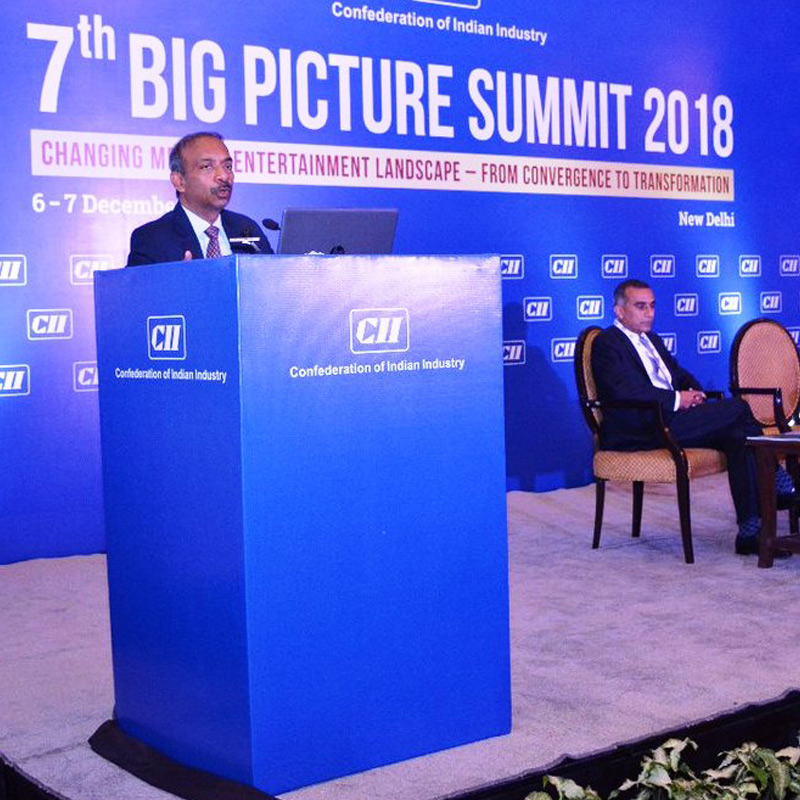
    “The media and entertainment sector should grow in a way that has less hurdle and more motivation,” Khare said here yesterday while addressing the concluding day audience at the CII Big Picture Summit 2018.

    Expanding on the NBP, Khare said government was exploring ways to ease processes, including a rethink on existing regulations for India’s M&E sector, which, not only has clocked impressive growth, but is also a big generator of employment for people. A new DTH policy, which is in the offing, is an indicator of the government's thought process.

    Admitting that regulation has failed to keep pace with changing technologies, the senior government official said, “Regulating everything is not desirable and even if desirable, it may not always be feasible.”

    However, he did not elaborate on the government’s thought process on content regulation for the digital space that’s fast becoming home to bold themes and bolder content if compared to traditional media of print and television.

    Pointing out that the government faced challenges while formulating policies or reviewing existing ones, Khare gave the example of expanding outlets for distribution of content that now, according to him, can be created practically by anyone with newer digital platforms offering creators enough number of outlets to showcase such creations.

    “In such a scenario, policy reforms [become] a little difficult,” Khare said, adding that the present government, however, was keen to review irksome government processes and clearances without being the “monitor” to mind a “grown-up” industry like media.

    Dwelling further on technology and the transformation it was bringing about in society, in general, Khare said MIB was in talks with regulator TRAI and BECIL to hold workshops to explore actively how broadband services could be delivered via existing cable TV networks to approximately 40 million households that presently don’t have internet facilities.

    Broadcast Engineering Consultants India Limited or BECIL, a government organisation under the ambit of MIB, provides project consultancy services and turnkey solutions encompassing the entire gamut of radio and television broadcast engineering.

    Later speaking to the media on the sidelines of the event, Khare said consultations will start with industry stakeholders on the formulation of NBP, but refused to give a time frame of it being legislated into some form of a policy document or guidelines.

    Info Tech Minister advocates robust digital measurement norms

    Facebook, Twitter, YouTube and WhatsApp have changed the manner in which users consume content and communicate with each other, but the social media platforms need to be mindful of "certain dos and don'ts" and guard against any misuse of their platforms, Information and Technology Minister Ravi Shankar Prasad said on Friday.

    Speaking at the CII Big Picture Summit, Prasad said that social media platforms' large focus on India underscored the sheer size and opportunities presented by the market here.

    "Facebook, Twitter, LinkedIn and WhatsApp are coming to India not only because they are giving some service. India offers a robust market, by its sheer size. I always say, come do business, but remember certain dos and don'ts…you must follow," Prasad said.

    The minister said that social media firms should also guard against any potential misuse of their platforms. In particular, these "public platforms" must not be misused by those with wrong intentions for the purpose of exploitation and denigration of others, he said.

    Outlining India's rising digital clout on the back of its large smartphone user base, strong IT outsourcing industry, electronic manufacturing capabilities and biometric programme Aadhaar, the minister asserted that the country will never barter its digital sovereignty and is, in fact, bringing a strong data protection law to safeguard its digital information.

    The right of accessing the internet is "not negotiable" and if the internet is designed for common good, it should be safe and secure, he added.

    He also called for a robust mechanism for measuring the ratings of digital platforms.

  • WhatsApp gets grievance officer under pressure from India

    WhatsApp gets grievance officer under pressure from India

    NEW DELHI: Under pressure to clamp down on sinister messages, WhatsApp has appointed a grievance officer for India and detailed out the process for users to flag concerns and complaints, including those around fake news.

    Meeting one of the key demands that India had put on WhatsApp to curb fake messages that triggered mob killings, the Facebook-owned company has updated its website to reflect the appointment of a 'Grievance Officer for India'. The update mentions that users can seek help through the mobile app, send an email or write in to 'Komal Lahiri', who is based out of the US, reports the Press Trust of India.

    According to Lahiri's LinkedIn profile, she is senior director, global customer operations and localisation at WhatsApp. When contacted, a WhatsApp spokesperson declined to comment on the matter but pointed to the public FAQ on the company's website that contains these details.

    According to sources, the appointment of the grievance officer was made at the end of August. They added that the officer for India being based in the US is in tune with similar practices by other American tech giants. Users can reach out to the company's support team directly from the app under 'settings' and in case they wish to escalate the complaint, they can contact the grievance officer directly.

    A section within FAQs read: "You (users) can contact the Grievance Officer with complaints or concerns, including the following: WhatsApp's Terms of Service; and Questions about your account". The updated FAQs also detailed out the mechanism for law enforcement officials to reach out to WhatsApp.

    The government has been pressing WhatsApp to develop tools to combat fake or false messages. One of the demands was to name a grievance officer to deal with issues in India.

    India is WhatsApp's biggest market with more than 200 million users. It, in July, limited message forwards to five chats at a time and had also removed the quick forward button placed next to media messages to discourage mass forwarding. It has also introduced a 'forward' label to help users identify such messages.

    The latest appointment is also significant as the Supreme Court, last month, had agreed to examine a petition alleging that WhatsApp does not comply with Indian laws, including the provision for appointing a grievance officer. The apex court had sought a reply on the matter within four weeks.

    With general elections slated for next year in India, the government is taking a tough stance on the use of social media platforms like Facebook, Twitter, and WhatsApp for the spread of misinformation.

    The government had warned WhatsApp that it will treat the messaging platform as an abettor of rumour propagation and legal consequences will follow if adequate checks are not put in place.

    In a meeting held with WhatsApp head Chris Daniels last month, IT Minister Ravi Shankar Prasad had asserted that the company will have to find a solution to track origin of messages on its platform, set up a local corporate entity that is subject to Indian laws within a defined time-frame as well as appoint a grievance officer.

    WhatsApp, which has been slapped with two notices and a third one under consideration, has said it is in the process of establishing a local corporate entity. It has, however, not accepted the government's demand for traceability of messages saying creating such a software will go against the idea of user privacy.

  • WhatsApp needs to have local entity answerable to Indian laws: Govt

    WhatsApp needs to have local entity answerable to Indian laws: Govt

    NEW DELHI: The Indian government’s unambiguous and non-encrypted message to WhatsApp: set up a local entity in the country that is answerable to local laws, and find a tech solution to trace the origin of fake messages and content on the platform.

    “I had a productive meeting with Chris Daniels, the CEO of WhatsApp. I complimented him for the awakening, which WhatsApp has led in the entire country… But there are also sinister developments like mob lynching and revenge porn, you must find solutions to these challenges, which are downright criminal and [in] violation of Indian laws,” Minister of Electronics and Information Technology (Meity) Ravi Shankar Prasad was quoted by PTI as having said after meeting WhatsApp head Chris Daniels yesterday.

    While admitting that the Facebook-owned messaging app has contributed significantly to India’s digital story, Prasad said he has asked WhatsApp to set up a corporate entity in India, appoint a grievance officer and find a technical solution to tracing the origin of fake messages on its platform.

    “I requested CEO WhatsApp Chris Daniels to set up a grievance officer in India; establish a corporate entity in India & comply with Indian laws. He assured me that #Whatsapp will soon take steps on all these counts,” Prasad said in a tweet.

    Later talking to reporters in the capital, the minister added: “I had said earlier also; it does not take rocket science to locate a message being circulated in hundreds and thousands…you must have a mechanism to find a solution.”

    According to Prasad, Whatsapp could face abetment charges if no action is taken by it. The messaging platform has taken some corrective steps in the recent past like limiting the number of forwards that an individual can make in India.

    In recent times, WhatsApp has been facing the heat as it had been accused of being the platform via which hateful messages and rumours were spread in India leading to violence and crimes. The issue, which some critics said was akin to shooting the messenger instead of upholding the law of the land, has also reverberated in the Indian parliament with lawmakers trying to put the government on the mat for WhatsApp-spread rumours-linked deaths and crimes.

    While Prasad is on record saying he’s in favour of gradually evolving a policy for regulating the likes of WhatsApp, Facebook and Twitter, his ministry’s nudge has made the Department of Telecoms circulate a missive to telecom players and industry bodies seeking suggestions on ways to block services that ride the telecom infrastructure. The proposal has been criticized by many, including a chamber of commerce, Assocham.

    Telecoms regulator TRAI is also exploring regulations for OTT services like WhatsApp.

  • Meity says no proposal presently to tap WhatsApp messages

    Meity says no proposal presently to tap WhatsApp messages

    NEW DELHI: Though the Indian government continues to explore avenues to track digital footprints of the citizens and regulations for online media, it said on Wednesday it did not plan at present to tap people’s WhatsApp messages.

    “No sir,” was the reply given by junior Minister SS Ahluwalia at the Ministry of Electronics and Information and Technology (Meity) when asked specifically whether the government planned to snoop into WhatsApp messages of individuals.

    However, Ahluwalia clarified that though the government respects an individual’s human rights, as enshrined in declarations of the United Nations, it has the powers to intercept or monitor digital information under various circumstances, including security reasons.

    “Section 69 of the Information Technology Act, 2000 empowers government to  issue direction for interception or monitoring or decryption of information generated, transmitted, received, stored or hosted in any computer resource in the interest of (i) sovereignty and integrity of India (ii) defence of India (iii) security of the State (iv) friendly relations with foreign States (v) public order (vi) for preventing incitement to the commission of any cognizable offence relating to above, or (vii) for investigation of any offence,” the Minister stated in Parliament to a query on whether any proposed move to tap WhatsApp messages would violate global conventions set by organisations such as the UN.

    To another query from a fellow parliamentarian, Ahluwalia said the Ministry doesn’t have any proposal at present to create a platform

    where a citizen can identify fake news or hoaxes, which are rampant these days in the country.

    The Minister, though, listed various government initiatives to make citizens aware of fake news on digital and social media. He said government agencies have been highlighting the importance of “following ethics” while using the internet and issuing general advisories against sharing rumours and fake news.

    “Government has also asked WhatsApp to convey various steps taken by them to deal with fake news and also to share learning material to

    educate the same,” the Minister stated.

    Still, his senior at Meity who also happens to be the Law Minister, Ravi Shankar Prasad is on record favouring evolving a policy to control the spread of fake news in India.

    Last month, Department of Telecoms, on a request from Meity, had written to all telecom and internet service providers , along with other industry organisations, requesting suggestions on ways that can help the government block under special circumstances social media content on platforms like the Facebook, WhatsApp and Instagram. The proposal has been criticised by many, including a chamber of commerce, Assocham.

  • DoT seeks views on blocking mobile apps like FB, WhatsApp

    DoT seeks views on blocking mobile apps like FB, WhatsApp

    NEW DELHI: India’s telecom department has sought views of the stakeholders on technical measures that can be adopted for blocking mobile apps like Instagram, Facebook, WhatsApp and Telegram. The proposal has been questioned and criticised by a large section of the industry and civil society, including chamber of commerce Assocham.

    The Department of Telecom (DoT) on 18 July, 2018 had written to all telecom operators, the Internet Service Providers Association of India (ISPAI), industry body Cellular Operators Association of India (COAI) and others and asked for their inputs to block applications under Section 69A of the Information technology Act. Stated aim: to uphold national security and public order.

    “DoT in the letter had said that the Ministry of Electronics and IT and law enforcement agencies have raised issue around blocking of certain mobile apps like Instagram, Facebook, WhatsApp, Telecom, etc. to meet requirement under Section 69A of IT Act,” PTI quoted an unnamed government source aware of the development.

    However, a source at DoT, on condition of anonymity, told the wire news service there was no such move to block any app and the telecom department had only started a consultation process based on a reference from the Ministry of Electronics and Information technology (Meity).

    Though PTI filed a news report on the development yesterday in the second half, the story was actually broken by online news portal medianama.com, which said it had reviewed the letter.

    The Section 69A of IT Act talks about power to issue directions for blocking for public access to any information through any computer resource. The law authorises the federal government or any officer authorised by it to issue direction to block the information on Internet in the interest of sovereignty and integrity of India, defence of India, security of the state, friendly relations with foreign states or public order or for preventing incitement to the commission of any cognisable offence relating to them.

    “Meity (Ministry of Electronics and IT) has informed DoT that blocking such apps during emergency situations are difficult as they work through multiple IP addresses and on different protocols, and, hence, there is a need for a reasonable good solution to protect national security. Being the licensing authority, DoT has initiated the discussion based on a letter received from the Group Coordinator, Cyber Law Division (Meity) during the second week of July,” a DoT official told PTI.

    In response to DoT consultation, industry body Assocham said that a proposed measure to evolve mechanisms to block applications as a whole at the telecom operator level is excessive, unnecessary, and would greatly harm India’s reputation as growing hub of innovation in technology as the country needed a “clear and predictable legal framework grounded on fairness, proportionality and the rule of law”.

    Assocham said that with the development in technology, there have emerged tools such as virtual private network, which enables users to access content that may have been blocked at telecom service provider (TSP) or internet service provider (ISP) level.

    “In this scenario, blocking of applications at the TSP/ISP level may not be an efficacious solution as users can get around the same with increasing ease. Therefore, the focus on developing mechanism to block content may be unwarranted,” Assocham said in a letter to the top-most government official at DoT, which was also sent to other senior civil servants.

    Assocham has buttressed its arguments against blocking of mobile apps by stating that online apps contribute substantially to India’s digital economy. Overall the Internet eco-system is expected to contribute up to $ 537.4 billion to overall India’s GDP of which a minimum of $ 270.9 billion could be attributed to apps, Assocham has pointed out quoting market research

    Recently, there have been widespread incidents of mob lynching in the country based on rumours spread through social media apps. The popular messaging app WhatsApp has been in the eye of storm over abuse of its platform for circulation of fake news that resulted in incitement of mob fury.

    An IT ministry official, who did not wish to be named, said WhatsApp has not committed itself on “traceability” and attribution of messages, which had been one of the key demands of the government. Hence, the ministry’s concerns have not been addressed and the potential for misuse still remains, the source was quoted by PTI.
    Last month, the government had expressed dissatisfaction over measures previously listed by WhatsApp for checking fake news that have, in several cases, triggered mob violence. WhatsApp told the government it was building a local team, including India head, as part of steps to check fake news circulation.

    Over the last one year, the Indian government has been exploring various avenues to regulate online media content, some of them botched at the initial stage, while some like the setting up of a social media hub to monitor Indians’ digital footprints was scrapped by Ministry of Information and Broadcasting after Supreme Court questioned the proposal stating whether it could lead to a surveillance state. However, a government body still exists that has the mandate to look into online media norms.

  • MIB’s Rathore admits to online media norms panel’s new avatar

    MIB’s Rathore admits to online media norms panel’s new avatar

    NEW DELHI: We had told you earlier, but now it’s official coming straight from the horse’s mouth. Ministry of Information and Broadcasting, led by an Olympics medal winning Rajyavardhan Rathore, has passed the baton to another government set-up to finish exploring regulations for the online media and content.

    “The Ministry of I&B had constituted a committee on 4 April 2018 for framing regulations for online media/news portals and online content, including digital broadcasting, which encompasses entertainment/infotainment and news/media aggregators,” MIB Minister Rathore said today in Parliament.

    He added: “However, since government had constituted an inter-ministerial committee on ‘Investment in Critical National Infrastructure, Digital Broadcasting and related issues’, which in its first meeting held on 10 May 2018 observed that some of the Terms of References (ToRs) and issues of the two committees are common, a decision was taken to dovetail the ToR of the committee constituted by this Ministry with that of the committee on ‘Investment in Critical National Infrastructure, Digital Broadcasting and related issues’.”

    The minister was replying to queries raised on proposed online media regulations by a fellow parliamentarian.

    The MIB panel, when constituted under the stewardship of Minister Smriti Irani, had drawn flak on many counts. One of many criticisms was that it was beyond MIB’s remit to deal with things that are internet-based as they fall within the purview of Ministry of Electronics and IT (Meity). Another drawback to the formation of this panel was that it had representatives from various government organisations, but no representation from India’s thriving and blooming online media that the committee was supposed to look into.

    The very fact that another government committee is supposed to look into matters relating to online media should continue keeping online players on their toes.

  • Online media regulations: action shifts to IT Ministry from MIB

    Online media regulations: action shifts to IT Ministry from MIB

    MUMBAI: If online media is readying the champagne to pop, then hold on to your exuberance. The government hasn’t given up its resolve to explore regulations for online media and content. It is only attempting to be on the right side of laid down rules and cut down on duplication of work.

    In short, the main action will be shifting from the Ministry of Information and Broadcasting (MIB) to the Ministry of Electronics and Information and Technology (Meity), while other things remain constant, which means the mandate will continue to be the same.

    A government official admitted, without saying so in so many words, that as a Meity committee, set up earlier, has the mandate to explore regulations for online media to facilitate its expansion, MIB will work along with its counterparts bringing in more synergy.

    The official insisted that the MIB committee, set up to explore regulations for online media in April 2018, is officially not being dissolved, but will work along with the Meity panel that comprises similar members.

    The 10-member panel, constituted by the MIB headed by Smriti Irani, was criticized by experts on the ground that it was outside the jurisdiction of MIB to explore regulations for online media, including OTT services, as the matter fell within the ambit of Meity — something that MIB Minister Rajyavardhan Rathore had reiterated in Parliament too. A big criticism was that a panel formed to look into matters relating to online media didn’t have a single online player as a member.

    When the MIB panel was announced it had as its members the following: MIB Secretary– Convener; Secretary, MeitY; Secretary, Ministry of Home Affairs; Secretary, Department of Legal Affairs; Secretary, DIPP; CEO of MyGov and representatives of Press Council of India, News Broadcasters Association, Indian Broadcasting Foundation, apart from representation from any other government organization or industry body deemed fit by the convener.

    The terms of reference of the committee were:

    i. To delineate the sphere of online information dissemination which needs to be brought under regulation, on the lines applicable to print and electronic media.

    ii. To recommend appropriate policy formulation for online media / news portals and online content platforms including digital broadcasting which encompasses entertainment / infotainment and news/media aggregators keeping in mind the extant FDI norms, Programme & Advertising Code for TV Channels, norms circulated by PCI, code of ethics framed by NBA and norms prescribed by IBF, and

    iii. To analyze the international scenario on such existing regulatory mechanisms with a view to incorporate the best practices.

    As criticisms mounted, the government has done what it is best at doing — located another government panel with similar or near-similar mandate in the relevant Ministry (Meity) and shifted the onus of exploration of regulations for online media to the rightful department, thereby blunting critics.

    Indiantelevision.com has always been of the opinion that rolling back of orders relating to fake news even if the Prime Minister’s Office intervened, and other such backtracking was akin to testing the waters for a bigger move to have norms for online media where content is continuously getting more edgy and experimental.

    Meity Minister Ravi Shankar Prasad, who also happens to be the Law Minister, yesterday said that it was time to talk to online stakeholders to explore formulation of policies that would govern the online media, especially social media and free messaging platforms like WhatsApp that are being blamed for incidents of lynching in the country.

  • Fake news on social media: Law & IT Minister favours evolving a policy

    Fake news on social media: Law & IT Minister favours evolving a policy

    NEW DELHI: The Indian government seems to be speaking in two voices over the menace of fake news. While law and IT Minister Ravi Shankar Prasad today said he would hold talks with stakeholders to evolve a policy, his junior SS Ahluwalia on Wednesday had told Parliament that the government doesn't propose to bring in regulations for social media.

    Law and IT Minister Ravi Shankar Prasad informed the Rajya Sabha (Upper House) yesterday that he will hold discussion with stakeholders, including political parties, to evolve a policy to deal with the misuse of social media, according to a PTI report, which also quoted a government statement saying it has been conveyed to WhatsApp in "unmistakable terms" that it was a very serious issue that "deserves a more sensitive response".

    The government yesterday also  shot off another notice to WhatsApp asking it to come out with effective solutions to curb the menace of fake news beyond just labelling forwards. It also warned the company that mediums used for propagation of rumours are liable to be treated as 'abettors' and can face legal consequences if they remain "mute spectators", the PTI report said.

    Facebook-owned WhatsApp has been under fire from the Indian government over fake news and false information being circulated on its messaging platform. The government had in the past too issued a stern warning to the company to clamp down on hoax messages designed to "provoke" and "instigate" people.

    "When rumours and fake news get propagated by mischief mongers, the medium used for such propagation cannot evade responsibility and accountability. If they remain mute spectators they are liable to be treated as abettors and thereafter face consequent legal action," a PTI report quoted an IT Ministry statement as saying. The ministry said it has approached WhatsApp to bring more effective solutions to the table, to ensure greater "accountability and facilitate enforcement of law" beyond the existing efforts towards labelling forwards and identifying fake news.

    The Supreme Court, earlier this week, asked Parliament to consider enacting a new law to effectively deal with incidents of mob lynching, saying "horrendous acts of mobocracy" cannot be allowed to become a new norm. 

    “Government doesn't regulate content on social media sites": IT Ministry's SS Ahluwalia,  

    On Wednesday, the Indian government admitted it doesn’t plan to regulate content on social media, as of now, despite the menace of fake news affecting the societal fabric. However, the government is quiet on the future of a committee set up under the Ministry of Information and Broadcasting (MIB) that has the mandate to explore regulation for online content, including those on OTT platforms.

    “Government does not regulate content appearing on social media sites, and law enforcement and security agencies may take action on specific case to case basis as per law in force,” junior Minister for Electronics & Information Technology (MEITY) SS Ahluwalia informed Parliament on Wednesday, emphasizing that the government was fully “committed to freedom of speech and expression” and “privacy” of its citizens as enshrined in the Indian Constitution.

    Ahluwalia was asked about the steps being taken by the federal government to address the problem of fake news and whether there were any plans to monitor and regulate social media content.

    According to the Minister, the Information Technology (IT) Act, 2000 has provisions for removal of objectionable online content that was “harmful, defamatory, hateful, libelous, objectionable” and affected minors, apart from the national security.

    However, as the Minister was not asked, he did not dwell on the future of  a committee —comprising representatives of various government organisations and few industry bodies too — set up under the MIB to explore online content regulations. The setting up of the panel was criticized as it was outside the remit of the MIB as the issue concerned came under the jurisdiction of MEITY.

    The said committee, helmed by MIB Secretary, is reported to have met a few times since its formation, but the details of those meetings are not public yet. Nor is the fact whether it would be disbanded or taken out MIB’s jurisdiction in favour of MEITY.

    MIB Stresses on Self-Regulation To Fight Fake News Menace On TV

    On Thursday, MIB Minister Rajyavardhan Rathore stressed on existing safeguards in laws and self-regulation to say that there was also no proposal to indulge in pre-censorship of TV channels to stop them from allegedly spreading fake news.

    “The [Cable Television Networks Regulation] Act [1995] does not provide for pre-censorship of any programmes and advertisements telecast on TV channels. However, it prescribes that all programmes and advertisements telecast on such TV channels should be in conformity with the prescribed Programme Code and Advertising Code enshrined in the aforesaid Act and the rules framed thereunder,” Rathore informed fellow parliamentarians who were concerned about some TV channels spreading fake news.

    Earlier, MIB, under minister Smriti Irani, had attempted to bring in regulations to control fake news, which had to be aborted as the Prime Minister's Office intervened in the aftermath of nation-wide criticism. Still, some critics feel that the botched attempt to bring in rules to rein in media critical of the government was testing of waters for future norms.