Tag: MediaKind

  • Internet to be disruptive force in video distribution to rural areas

    Internet to be disruptive force in video distribution to rural areas

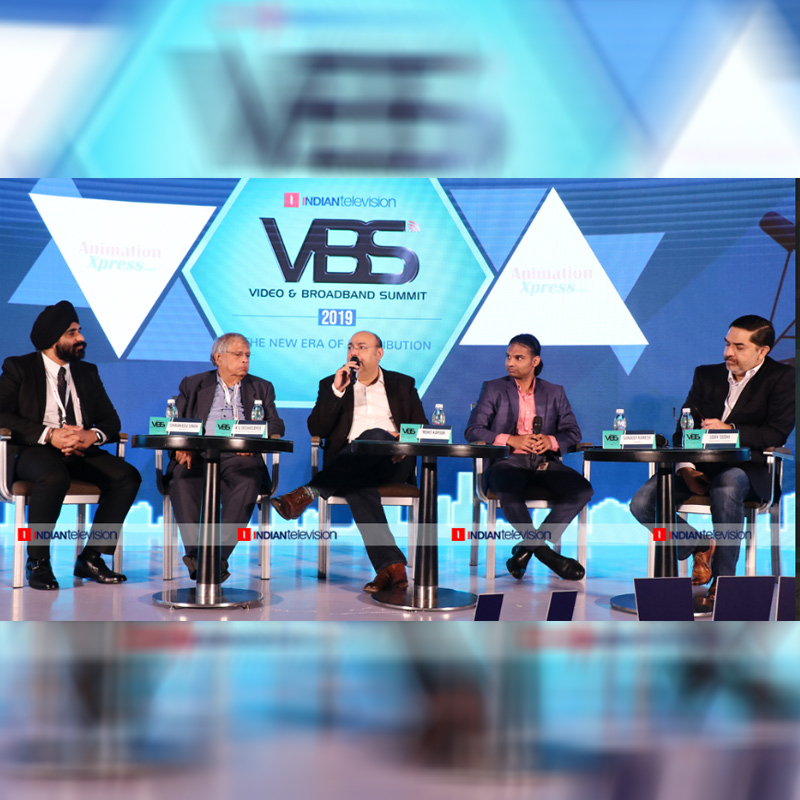
    MUMBAI: Internet has become a new medium for delivering video to consumers. It has been reaching around 400 million consumers with a free to watch option on their mobiles. VBS 2019 organised by Indiantelevision.com created a platform for industry doyens to discuss the changing role of the internet in video distribution.

    A panel discussion of Video and Broadband Summit 2019 focused on the Internet's role in video distribution. It was moderated by digital strategy consultant Uday Sodhi with MediaKind APAC marketing head Chiranjeev Singh, Win Broadband Services MD and CEO K V Seshasayee, Jio advertising & strategy VP Mohit Kapoor and Google media and entertainment industry head Sandeep Ramesh as the panellists.

    They shared their views on the internet being a new medium of delivering content. They agreed that while the internet will impact video entertainment distribution, there is enough space in the Indian media industry for all stakeholders, from internet providers, OTT players to media networks, to co-exist and complement each other. The panellists also believe the internet has emerged as another prominent distributor in the broadcast industry.

    Google’s Ramesh briefed the audiences on how internet disrupts the videos delivered to the consumers today and how things will be going forward. He said, "From the consumer’s point of view, video on demand is a habit. Once the consumers move to video on demand, they will not come back. This will happen as it is a secular change. All entertainment will be available online, sooner or later, and consumers will have a desire to watch the content wherever they want. This change will have implications on the content makers and distributors, but from the advertising stand point, digital advertising will be benefitted."

    Jio’s Kapoor highlighted an important fact, which is the innovation of smartphones. He said that Jio introduced Jio phones which have feature phone segments and are smart phones, sold for a price between Rs 700 and Rs 1,500. Around 100 million phones have been sold and consumers are using feature phones, but not using internet for viewing content or videos. About broadband, he informed out of 250 million homes in India, 50 million homes is Jio’s target, which will be achieved. Compared to the US or any other country, India is ahead in content consumption. Currently, average consumption of internet is around 8.5 – 9 GB. Jio is offering more than 11 – 12 GBs monthly.

    Win Broadband’s Seshasayee said, “All content providers and aggregators are focusing on tier 1 and 2 cities and few are trying to reach tier 3 cities. As per the statistics, out of more than 400 million Indian viewers who do not have internet access, the ones who have the access are using 2G, which will be obsolete within two months. As per mobile consumption statistics, 60 per cent consumers are consuming videos on mobile. So, if there are places with no internet access, there are opportunities for the country providers to enter that market, make use of the available resources and find an alternate solution to the problem.”

    Sodhi said that there is a huge opportunity created by the internet, daily in the dark areas. For around 700-800 million users who do not get cable to DTH in their homes, internet may become a way for them to deliver content.

    MediaKind’s Singh said that internet has actually enabled content creators and owners to reach consumers directly, which is happening with OTT platforms. This is a challenge for linear TV. Consumers watch linear TV for live updates like breaking news. The lag between the live TV and the OTT platform for the same content is narrowing down, which is now around maximum five seconds. So, consumers are moving to OTT platforms. We need to make sure that the consumers get enough value for the services they are paying for.

    The panelists also agreed that internet is a great opportunity for LCOs as well. They can provide OTT and video service to consumers in rural areas. LCOs can also build a library of YouTube videos, but monetisation or cost should be nominal because ultimately the content is free for the consumers.

    Kapoor said that in a few years, all countries will have OTT apps. Countries will spend a huge amount of money on programming. There will be a competition but that will happen when fibre will reach homes and the app or video will show up on the screens.

    He further said that the first thing which will happen is that India will get real broadband. The starting speed will be 100 mbps and will go higher in gbps. Once broadband will be available, consumers will realise that what they are paying for. He gave an example by saying that he has not viewed cable in a while, and his TV runs on broadband. As per the statistics, there were 20 – 25 million consumers who were consuming 1 GB internet in a month, but now the number has increased to 400 million consumers using 1 GB internet in a day.

  • TRAI assuages broadcaster fears of NTO review consultation paper at VBS 2019

    TRAI assuages broadcaster fears of NTO review consultation paper at VBS 2019

    MUMBAI: Assuaging fears of  media broadcasters, TRAI advisor (Broadcasting and Cable) Arvind Kumar today said at the Video and Broadband Summit (VBS) 2019 that the new consultation paper on broadcast tariffs is only seeking to address some infirmities in the earlier New Tariff Order (NTO) and will not bring any fundamental changes  to the regulatory framework.

    “Broadcasters should rest assured that the new consultation paper will not seek to decide their channel prices. The only objective of the new consultation paper is to open a debate on how the NTO is impacting the industry and to address some of the infirmities in the NTO,” Kumar said.

    Rejecting industry criticism of floating a consultation paper within months of February NTO, described by many as one of the most fundamental reform in Indian media broadcast industry, Kumar said that serving the interests of the consumers is at the heart of new consultation paper.

    “Consumer interest cannot be ignored in the name of regulatory certainties,” he said, adding as a regulatory body maximization of revenues is not the only objective of TRAI and serving the interests of consumers comes first to TRAI.

    Commending the fundamental changes brought forward by the NTO, Kumar said that the order has brough transparency to the media broadcast industry.

    “Main objective of the industry was transparency and to create a level-playing field for everyone. NTO has empowered the consumer by giving him choice,” he said at VBS 2019, being held today at Hyatt Regency.

    Further, the new system has harmonized the business processes, Kumar said as he commended the industry leaders for successfully transiting to post NTO environment.

    The much-anticipated VBS 2019 will is being held today in Mumbai with participation from prominent media networks, broadcast distributors, media and advertising agencies, consultancy services, OTT platforms, media monitoring firms, as well as government regulatory bodies.

    Among the prominent media networks who will be participating in the summit are Sony Pictures Network, Star India, 9x Media, Enterr10 TV, BBC Global News, IN10 Media, Shemaroo and Zee. From the distributors side DEN Network, Maharashtra Cable Operators Federation, Fastway Transmissions, GTPL Hathway, Tata Sky, SITI Networks, UCN Cable and Ashwini Cable will be participating in the one-day summit at Hyatt Regency, Mumbai.

    Representatives of India’s prominent media agencies like IndiaCast Media, MediaKind, The Remediation Company, IndusInd Media and Communication, One Take Media, Madison Media will be participating in the event held in the shadows of TRAI’s February 2019 New Tariff Order (NTO) and amidst expectations and fears of further changes to the months-old act, described by many as one of the most significant reform in Indian media broadcast industry.

    There will be representation from auditing firms like PwC and KPMG as well. Since broadband service providers are now key to video distribution, there will also be representation from Google, Reliance Jio Fiber, Reliance Jio and Win Broadband.

  • Dish TV partners MediaKind to upgrade infrastructure

    Dish TV partners MediaKind to upgrade infrastructure

    MUMBAI: DTH company Dish TV India, in partnership with MediaKind, has strengthened its infrastructure capabilities to enhance the customer TV viewing experience in India. Dish TV has upgraded and expanded its entire DTH platform to MediaKind’s AVP 4000 video processing platform to deliver enhanced, next-generation immersive experience to its 23.5 million subscribers in the country. The new platform will also assist in delivering cost efficiencies through better bandwidth utilisation.

    With this, DishTV will operate MediaKind’s award-winning compression headend technology, which will enable the company to evolve and adapt to both traditional broadcast and multiscreen service delivery from a single platform. The platform, which includes MediaKind’s AVP 4000 System Encoder, allows DishTV to serve satellite operations for both of its brands and caters to the evolving needs of its subscribers.

    Commenting on the announcement, DishTV India Ltd group CEO Anil Dua said, “As the leading DTH provider in India, we are always looking for new ways to deliver high quality viewing experience to our millions of customers. We are delighted to strengthen our longstanding partnership with MediaKind and leverage its compression technology heritage which extends more than 25 years. Through the deployment of MediaKind’s AVP technology, we can provide the highest video quality for our consumers alongside greater bandwidth efficiencies, thus enabling us to cost-effectively deliver the next-generation services to our subscribers.”

    Speaking on this, MediaKind CEO Angel Ruiz said, “The media landscape is constantly shifting and service providers need to continually adapt to deliver the highest quality media experiences for consumers. At the same time, the increased competition from pure-play online providers means it’s necessary to do this as cost-effectively as possible. We are delighted to extend our relationship with DishTV and to continue evolving its service offering in one of the world’s largest video markets. Through the deployment of our state-of-the-art AVP 4000 system, DishTV will benefit from significant cost efficiencies and have the opportunity to launch new and highly compelling viewing experiences.”

    This latest deployment will enhance DishTV’s operational efficiency by unifying the control and management of its two headends in an orchestrated manner. This will also allow DishTV to increase its satellite bandwidth efficiency and deliver superior picture quality to its subscribers, thus fulfilling the rising consumer demand for high quality media content choice.